Perfume Review – Monsieur de Givenchy by Givenchy: Vintage vs. Modern

I like to wear men’s colognes. I admit that quite proudly. In fact, the modern commercial trend towards generic sugar bombs and gourmands has made me resort more and more to men’s cologne of late. So, from time to time, I will post brief reviews or impressions of ones I enjoy. One of them, deeply ingrained in the memories of my childhood, is the 1959 classic, Monsieur de Givenchy (which I’ll just call “Vintage” or “MdG-V” from now on) by nd.1968Givenchy. My father used to wear it, along with a number of other classic, legendary men’s fragrances. (In fact, it’s thanks to my father that I ever developed a nose for men’s cologne to begin with!) Recently, a dear friend of mine recently sent me a very large decant of the vintage version, circa 1970s judging by his box. And it was as amazing as I remember.

Being inquisitive and also lucky to have a father with a nice selection of colognes, I decided to poke through his current collection. There, I saw a new-ish bottle of Monsieur de Givenchy (hereinafter “Modern” or “MdG-M” with the “M” standing for “Modern.”) My father dates it to about 2004 or 2005. So, I temporarily stole his bottle and decided to do a side-by-side comparison. Bottom line: I think there is clearly a huge, HUGE difference between the two fragrances. And one of them is terrible.

First, I need to make a point of clarification about the different versions. MdG may have been reformulated a few times over its 50 year history. The array of boxes shown on different Basenotes threads could be a hint of that.

Modern version of MdG on the Left, Vintage version on the Right. Source: Basenotes.

Modern version on the Left, Vintage version on the Right. Source: Basenotes.

(I’ve seen at least 3 different ones.) Making matters more complicated, Basenotes states that Givenchy issued a fragrance called “Monsieur de Givenchy II” in 1993 as an updated version of the classic, but then discontinued it, before finally just re-issuing it as Greenergy. It is a totally different scent. So too is Givenchy Gentleman (1974). Givenchy Gentleman and Monsieur de Givenchy are complete opposites. The Gentleman is heavier with patchouli and leather, while the MdG is a citrus chypre. If you’re still with me, I fear I may lose you when we get to 2007.

2007 was when Givenchy launched Les Parfums Mythiques – Monsieur de Givenchy Givenchy for men, a fragrance that has very different ingredients listed.
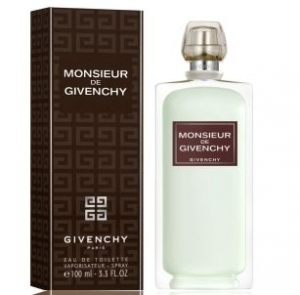
Mythique version.

Mythique version.

For example, the carnation, cinnamon, and pepper in the top notes are now gone. And, by all reports, the oakmoss heart has been so diluted that it has essentially vanished. Despite these huge changes, Les Mythiques appears to have completely replaced the MdG — whatever its prior formulations. Adding to this belief is the fact that Givenchy’s Mythiques line consists of a number of its classical colognes like Xeryus and Vetyver; it would seem to be a complete rebranding and modernisation of all its oldest fragrances. So, for the purposes of this review, when I refer to “MdG-M,” I’m referring to the final version of Monsieur (1990s to 2006) prior to its reformulation as Les Mythiques. And the Vintage version refers to the 1970s/80s formulation (or older) that is the true MdG, in my opinion.

One thing I can assure you: you can easily find the Vintage version on eBay. And, in this case (perhaps even more than usual), the vintage version is best. It is absolutely something you will want to seek out if you love aromatic citrus scents that are very discreet.  But onward and upwards, to the fragrances themselves.

MdG (in all its permutations) is commonly classified as “Citrus Aromatic.” Its notes are not so clear beyond the basics which are: lemon, lavender, bergamot and sandalwood. The details, however, vary from site to site. Fragrantica lists the notes for MdG-V as follows: “Top: carnation, cinnamon, pepper and lemon; middle notes are lavender and lemon verbena; base notes are sandalwood, musk and oakmoss.”

Basenotes has even less details, with no reference to the carnation and cinnamon, let alone the geranium and civet that I know is there. NST has a much more complete list, though it’s completely unclear to me which version of MdG they’re talking about. Nonetheless, this is how NST described the original scent:

A hesperides lover’s dream come true, Monsieur is composed of bergamot, lemon, lime, petitgrain, lavender, clary sage, orange, basil, musk, civet and cedar. Don’t worry — if it sounds herbal, it is, but only slightly.

That’s for the Vintage version. In contrast, the notes for the Modern version are a quarter of that. Fragrantica lists them as follows: “Top notes are bergamot and lemon; middle notes are lavender and lemon verbena; base notes are hinoki wood and oakmoss.” (I have absolutely no idea what “hinoki wood” is, but Google informs me that it’s Japanese cypress.) My father’s bottle of MdG-M essentially lists the same, only with the inclusion of “coumarin” (a classic Fougère element), oak moss “extract,” and “cinnamal.” (No sight  of anything resembling “hinoki,” by the way.) Observe how different the ingredient list for the Modern scent is from both Fragrantica and NST’s listings for the vintage. For the Vintage, I think we should go with NST’s fuller version of the ingredients because they seem much more accurate to my nose.

I put on a 3-4 average splashes of the Vintage (circa 1970s or early 1980s) on my right arm, and about 3-4 sprays of Modern (circa 2004) on the left. From the very opening splash of the Vintage, I got a sparkling, super bright explosion of green. Green, green and more green, but never in a linear, one-note manner. There was lemon, verbena and mossy greens with depth, complexity and a lovely herbal note. In contrast, my 3-4 squirts of the Modern led me to actually mutter out loud: “What the hell is this???!” It was watery and diluted beyond belief. The difference was mind-boggling.

There was such a wimp factor that I hurriedly sprayed 2 more bursts, then an additional 2 to 3 for good measure. So, now, I’ve got about 7 or 8 sprays of the Modern on my left arm and about 3-4 good splashes of the Vintage on the right. And I still smell the Vintage more! The Modern version was all watery lemon with absolutely no oakmoss from the onset. After 15 minutes, I suppose you can say that it had turned into lemon-lavender soap. I suppose. There is really so little to say about it.

In contrast, the Vintage version had started to open up. The lemon, verbena and oakmoss accords began to include geranium and lavender. They emerged quite prominently, along with the carnation and a faint touch of soap. I wonder if I can smell the sage and basil, or if I’m imagining it, but it doesn’t matter. Oh, lordie, is that geranium lovely! I can smell no cinnamon or orange, but I’m glad for it because I think it would detract from the lovely green, herbal woodiness. The petit-grain also helps in creating that impression. (Petit-grain is the result of distilling the twigs from citrus trees, creating a bitter, woody, masculine scent.) The result is an incredibly  balanced, harmonious and sophisticated composition that oozes elegance and class.

An hour in, the vintage version has turned to a lemon lavender musk with soap, some lingering geranium and wood (especially the cedar). There is also some warmth. The musk, civet and sandalwood start a quiet purr. Some have said that the vintage contains real santal oil, and I can believe it because there is a real depth and richness to the warmth.

I think these base notes are what separate MdG-V from another fragrance that it is often compared to: Chanel‘s classic, Pour Monsieur (1955). Pour Monsieur is much, much soapier. It’s also greener and has spice (ginger, cardamon, coriander, basil) at its base, while there is none in MdG. Instead, MdG-V has warmth (sandalwood) and musk (civet). MdG-V is actually closer to Dior‘s legendary Eau Sauvage (1966) in its vintage form.

However, it is all very discreet. Verrrrrrrrrrrrrrrrrrrrrry discreet. Everyone always says that MdG is fleeting (in all its formulations), and that is especially true on me. While most give the vintage about 4-5 hours in longevity, on me it starts to seriously fade 2 hours in. A little after the fourth hour, I can smell it faintly on the skin only if I touch my nose to my arm and inhale forcefully.

In contrast, the MdG-M version died about 2 hours in. Died completely, if I may add. Dead as a door nail. And I have little to say about the rest of its development prior to that point. I think it’s an utterly undistinguished, worthless, and watery scent that is easily superceded by most drugstore lemon-lavender soaps. Yes, there is a hint of civet that adds some muskiness later down the line but, really, this thing is a travesty to the name of Monsieur de Givenchy! Others think that there is no difference between vintage MdG and its later incarnations but… bah, humbug! Not in my opinion. (And one can only shudder to think of how bad the Mythiques version must be, given the reports of even further dilution.)

However, I firmly believe that the MdG-Vintage is worth a small effort to track down on eBay. I am usually someone who opts for orientals, spice and warmth, but I can’t help but really like MdG-V. Despite its limited sillage and fleeting longevity, it’s pure class and refinement. I see MdG as something Cary Grant would wear with a Saville Row bespoke grey suit, double-breasted and with a discreet ,white pochette.

And, yet, I hear that it was Freddie Mercury’s signature scent. Freddie Mercury! Queen! Tight, red leather pants, a bare, hairy chest, bouche à pipe lips, and hot, smoldering sexuality! Freddie Mercury, the original sexpot rebel that Adam Lambert only wishes he could be. Freddie Mercury and MdG!!! Honestly, there aren’t enough exclamation points to convey the incongruity of that pairing in my mind. One thing is for certain: it proves that MdG is not necessarily your grandfather’s cologne. So, if you like herbal citrus colognes and you’re in the market for a refined office scent that is both sophisticated and elegant, you may want to consider this one.

But I don’t promise that anyone will think you’re Freddie Mercury….
Perfume Review: Guerlain’s notorious Mahora (and Mayotte)

normal_guerlain_mahora3-300x225

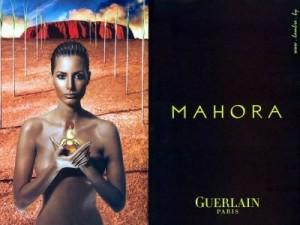
Elsa Benitez and Ayers Rock in Australia

I have a perpetual tendency to root for the under-dog. And I’m also naturally inquisitive, especially about things that are notorious. Which brings to me to Mahora, the beleaguered, endlessly trashed, and notorious last fragrance of Jean-Paul Guerlain for the House that bears his name.

images

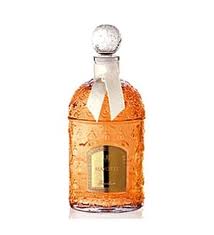
Mahora – the bottle for the Extrait version

Common reactions to Mahora range from “Worst. Perfume. EVER!” to comments about mosquito repellents or suntan lotions. Luca Turin — that endlessly acerbic perfume critic (with whom I often disagree, by the way) — apparently compared this to a $200 plug-in air freshner and called it Guerlain’s worst fragrance. It’s a fragrance sometimes nicknamed “My Whore,” due not only to its pronunciation in certain accents but also, undoubtedly, due to its over-ripe nature. And, yet, there are also numerous raves about its lushness and its heady, fearless, almost comfortingly exotic character. How could I possibly resist seeing what all the fuss was about?!

Mahora

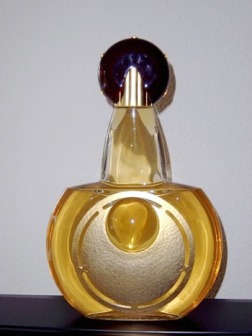
Mahora in the Eau de Parfum bottle

Mahora was released in 2000 in Eau de Parfum form as an homage to the island of Mahore (or Mayotte) where Guerlain has plantations of jasmine and ylang-ylang. It is a tropical, slightly fruity, super floral with an oriental dry-down. It is also the least Guerlain-like fragrance imaginable!

That difference probably explains, in part, why it was a complete and an utter bomb in the marketplace; Guerlain buyers used to things like Jicky, Shalimar or even, Jardins de Bagatelles, were undoubtedly bewildered by such a Hawaiian island fragrance.

Quietly discontinued just two years or so after its debut, Mahora was later re-released in 2006 with a name change. It was now called Mayotte and was included in Guerlain’s images (1)Les Parisiennes collection (supposedly with a significant price increase as a result). You can still find Mahora easily and relatively inexpensively on eBay (where I bought my bottle) for between $15 and $60, depending on size and seller. Mayotte, in contrast, is reportedly available only at the Guerlain store in Paris and at Bergdorf Goodman in New York where it retails for $270. We’ll get to the comparisons between the two fragrances shortly and whether either one is worth a shot.

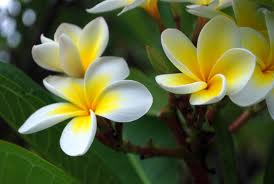
According to Aromascope and other sites, Mahora’s notes are as follows: orange, almond tree blossoms, ylang-ylang, neroli, tuberose, jasmine, sandalwood, vetiver, and vanilla. What almost none of these official notes include — but which almost everyone can detect — is frangipani. Frangipani is also known as plumeria, a flower common to Frangipanitropical climates like Mexico or South America but also to such exotic islands as Fiji, Tahiti and Hawaii. It has a very heavy, heady, lushly ripe, extremely sweet scent similar to magnolia, gardenia and tuberose. It can also bring to mind coconuts. (All of which make the Australian desert landscape of the Mahora commercial rather odd, in my mind.)

Frangipani is best described as an “indolic” scent, meaning over-ripe, almost to the point of decay. Tuberose is another very indolic flower which is why extremely creamy, ripe tuberose scents can — on some people — bring to mind feces or a cat’s litter box. (You have no idea how many people shy away from anything involving tuberose. If there is any scent that seems to strike fear in the heart of many women, it seems to be tuberose. I should confess that I adore tuberose and it’s my favorite flower in general.)  Indolic scents are not easy one, and combining frangipani with tuberose and jasmine was a brave, brave move. (One which apparently fell flat on its nose, judging by some of the extremely harsh reviews.) I have absolutely no idea why frangipani is not included on the official perfume notes, but there is zero doubt in my mind (and that of many others) that it’s included. In fact, I would go so far as to say that extremely indolic frangipani is the foundation to Mahora.

When I first sprayed Mahora, I did so carefully and gingerly. This is a perfume known to be a powerhouse. It’s been compared to such notoriously heady 80s blockbusters as Poison and Giorgio, or other infamously strong scents like Amarige and Opium. So I gently lowered the rather awkward blue top and gave a few squirts. And what I got was not  the expected orange notes I’d read about but, rather, green notes. Ripe, not crisply fresh, but most definitely green notes. A burst of the vetiver, perhaps? If so, this was like no vetiver I’d ever smelled because the overall result was like dirty water in a vase of rotting flowers that hadn’t been changed in a week. (Perhaps vetiver shouldn’t be mixed with tuberose by anyone but the Piguet perfumers who make Fracas. I love Fracas. This is no Fracas.)

The smell of filthy, murky, green, vase water was soon joined by coconut, sandalwood and what seemed to be almond tree. Not almond tree blossoms, but rather, the woody notes of a slightly moist, aged, possibly decaying tree bark. This too was…. unexpected and off-kilter. And it lasted a good 10 minutes or so, until it turned to a coconut sunscreen effect (mixed with the slightly brackish, rotten vegetal water scent) over a smell of buttered white flowers. Yes, buttered. As in buttered popcorn mixed with very heady tuberose and white flowers. I feel as though I’m wearing a dose of AMC Cinema’s popcorn butter mixed with white flowers and coconut. And, yet, it’s not Hawaiian Tropic suntan lotion, it’s not even Bain de Soleil (which I used to love) because of those blasted almond tree, wood, vetiver and green notes!

It’s perplexing. This is nothing like what I expected — which was a giant white floral with tropical elements. The initial scent is off-putting, unconventional and disorienting in the way of niche houses, like Serge Lutens. Just as his Tubéreuse Criminelle turns things upside down and on their head with a camphorous green note to the tuberose, the Mahora is very far from a mainstream, white tuberose scent in its initial opening bouts. It’s even further from most Guerlain fragrances, though I’ve seen some understandable comparisons to Guerlain’s Samsara. I think Jean-Paul Guerlain sought, perhaps, to make a tropical, exotic version of Samsara here. I simply don’t think he succeeded. (That said, I should confess that Samsara is not one of my favorite Guerlains either.)

An hour in, and Mahora is all big white flowers. It’s too exotic and tropical to be compared to Fracas or to some Estée Lauder variation. It’s got too much frangipani to really compare. It’s also starting to fade on me. I speak often of how my body consumes perfume but really, I expected this one to last! All the endless comments about migraines, monster sillage and longevity and I get maybe two hours of full scent before it starts to become closer to the skin. I think that, as the frangipani/coconut recedes and the other, softer white flowers come more to the foreground, Mahora starts to become less brash and heady. It’s calmer now, though I still smell the coconut.

Three hours in, the coconut has finally left the building and the Guerlain signature has entered. Mahora has unfurled into a creamy, vanilla with sandalwood and only a hint of the white flowers. It’s also started to develop of touch of that famous Guerlinade. “Guerlinade” refers to that Guerlain note which is a signature on most of their perfumes at the foundational element and which wafts through the dry-down with a very powdery (sometimes slightly vanilla-tinged) accord. I smell a wisp, possibly just in my imagination, of the jasmine but it’s faint. One thing is clear, however: Mahora has turned into a Guerlain oriental. All in all, Mahora lasted about 5 hours on me, which was considerably less than the enormous amount of time reported for the fragrance by most commentators.

While most commentators say that Mahora and its successor, Mayotte, are identical, there are some who disagree. The experts at CaFleureBon certainly see a difference in an article entitled “Sexy Sadie Thompson of M. Somerset Maugham’s Rain.” Another site, Aromascope (linked up above) compares the two fragrances as follows:

While Mayotte is an ode to ylang-ylang, Mahora dignifies tuberose. […]  I find Mayotte much more Guerlain-like: it possesses the same peachy heft of Mitsouko. Mahora, on the other hand, strikes me as rather aggressive and mutinous. Its sugared, almost oily tuberose seems to defy all things Guerlain, and perhaps that’s the reason the fragrance didn’t do so well. In spite of being much more refined and polished, Mayotte can hardly be called a tame and acquiescent version of Mahora – it bears but faint sibling resemblance and respectfully begs to differ. While Mahora is heady and persistent, Mayotte is soft and enveloping and has won my heart as the best ylang-ylang scent ever created.

Others sharply disagree and say that there is absolutely no difference between the two scents. Still others say that Mayotte is simply a weaker eau de toilette concentration of Mahora, though the fact that both are officially listed as “eau de parfum” seems to counter that theory.

So, is it worth trying? I’ve seen one reviewer argue that, if Mahora had been released now and under the Serge Lutens label, “as a hoity-toity luxury perfume, it would be resounding [sic] a success among sophisticated perfumistas.” I can see the point and rationale. I think I may even agree, particularly when remembering Mahora’s unexpected opening and when thinking about Serge Lutens Datura Noir. I found the latter significantly underwhelming, though it’s been long enough since I last tried it that I can’t recall all the details of why. It certainly shares a similar coconut and tuberose trait, though!

In the end, it’s a fragrance that only a white-flower lover may like and, even then, it’s not breath-taking or particularly special, outside of its history and notoriety. (For purposes of balance, my memories of the famous Serge Lutens Datura Noir, and indeed a number of his fragrances, also rank in the “not particularly special” category.) Do I regret buying a full bottle? No, not really. I rarely regret buying perfume, especially not one that is hard to find, discontinued, and controversial to boot. It’s worth it for me just to have it for my collection and for being able to know it. I also like being able to make up my own mind about super polarising scents. And, lastly, I can always find a use for some perfume or another. (With the exception of Montale’s Lime Aoud which is truly THE worst thing I have ever smelled!)

However, I would not feel that way if Mahora were not so cheap on eBay. There is absolutely NO way on God’s green earth that I would pay $270 (not including tax) for the Mayotte version. None. I bought my 1.7 oz bottle of eau de parfum for $23 or so! For that cost, Mahora is a fun, exotic, tropical white flowers oriental perfume that I can wear in winter before going to bed and when I want to mentally escape to Fiji. For $23, I get to see what all the fuss is about.

And that fuss is definitely not worth $270.

Scent Notes: Oud

A fantastic analysis of Oud and how much of it in contemporary perfumes is actually a synthetic molecule. Obviously, that impacts the nuances and smell. To quote one part of the fascinating post: “Nowadays, natural oud is rarely used in perfumery. Due to over-harvesting and the labourious process collecting the raw material, it is not feasible to use natural oud for mass market perfumery. Most fragrances on the market contain synthetic materials to replicate the natural oud scent. Vir Sanghvi (virsangvi.com) says that Firmenich’s Oud Synthetic 10760E is used in most oud fragrances on the mass market. Givaudan also has its own version of an oud synthetic. Elena Vosnaki (perfumeshrine.blogspot.ca) says that Oud Wood by Tom Ford is made with Givaudan’s Agarwood Arpur. Bond No. 9 New York Oud also contains the same synthetic.”

If you’re interested in Oud, make sure to read the whole thing. You can learn a lot, as I did. From Creed’s Royal Oud to others, there may be a market and commercial reason for why synthetic oud may be preferable for perfumers. Apart from the low(er) cost, naturally.

Perfume Review: Chanel Coromandel – Frankincense & Opium Dens

Were the Three Wise Men or Magi visiting Bethlehem today, Chanel’s Coromandel is a gift that they might have enjoyed wearing (even if it isn’t a suitable gift for a child in a manger).

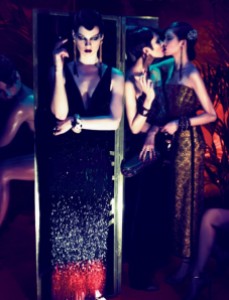
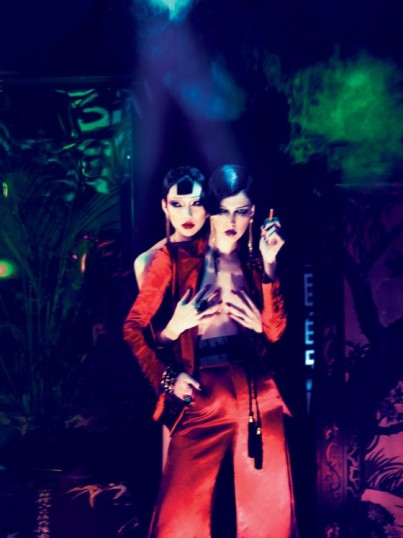
Photo series for Interview Magazine by Mert & Marcus.

Photo series for Interview Magazine by Mert & Marcus.

So, too, would those “Chasing the Dragon” in Imperial China’s opium dens, their limbs sinuous and contorted by their dark obsessions. It is, without question, a perfume of the mysterious, ancient East.

Coromandel is said to be an homage to Coco Chanel’s beloved lacquered, wooden Chinese folding screens and was introduced to the world in 2007 as part of Chanel’s six-line collection called “Les Exclusifs.” It was created by Chanel’s house perfumer, Jacques Polge, along with an equally famous “nose” in the industry, Christopher Sheldrake. According to Chanel’s own description on their website, “the elaborate scent unfolds in undulating detail, starting with an amber vibrato, followed by dry notes of Frankincense and Benzoin, then, soulful woody notes that add elegance and depth to the sensuous accord’s striking trail.”

The notes, according to a reviewer (“Zut”) on Basenotes, are as follows:

Top: citruses, bitter orange, neroli
Heart: jasmine, rose, patchouli, orris
Base: incense, olibanum [also known as Frankincense], benzoin, woodsy notes, musk, Tahitian vanilla

Coromandel is a perfume that reminds me that life would be much easier if I had significantly less expensive tastes. It’s not a perfume I adore with a searing passion, but it is a perfume that I definitely like a lot. A LOT. (Far too much for my wallet’s good health, actually. I suspect I will try to buy a full bottle of this.)

Coromandel opens with a burst of zesty citrus, powder and vanilla. Unlike one reviewer on Basenotes, I don’t smell bitter orange, only basic citrus. Two to four minutes in, the citrus is gone completely, leaving only vanilla musk, patchouli and a hint of almond. Exactly 10 minutes from the time I put in on, the vanilla musk turns darkly and intensely peppery. It is a sharp and dramatic change in such a brief period of time. As the frankincense and/or patchouli rise to the forefront, the perfume changes again. There are wisps of a milk chocolate smell that start to emerge.

I must be honest, and I need to say this from the onset, I truly cannot tell if it is the patchouli or frankincense that is more at play with Coromandel. Everyone talks about how this is such a patchouli monster, and it most definitely has patchouli at its heart. But I truly think that this is more of a frankincense monster than a patchouli one. While there are all kinds of dirty, dark patchouli out there, they all generally seem to have (on me) a warmer, softer edge than what I am picking up in Coromandel. Coromandel’s patchouli (if that is what I’m smelling for the most part) is different than the dirty patchouli that is in Hermès’ Elixir de Merveilles, to mention a patchouli perfume that I just recently reviewed. On me, Coromandel has a much more smoky, piercing, sharp, almost screeching (but in a good way), burning incense note, one that I associate with frankincense far more than with patchouli.

Regardless of whether it’s the frankincense or the patchouli that truly dominates here, the overall whole in the early stages is that of a very milky oriental. I have definite flashbacks to a milky Chai, with a touch of cinnamon, a good dollop of white cocoa, sugar, amber and lots of powdered vanilla. It’s an inescapable image for the first 40 minutes of the perfume’s development on my arm. It’s also a very comforting scent that brings to mind curling up under a thick, beige cashmere blanket, next to a roaring fire, as you sip that aforementioned Chai tea.

It is around this time that Coromandel’s milky vanilla spice has been joined by rose, violet and a faint hint of jasmine. It’s not the full-blown, blowsy, overly-sweet rose of YSL’s Paris, but a softer rose that is moderated by the violet note. The rose-violet-vanilla scent reminds me strongly of the old-fashioned, expensive lipsticks I used to buy in Paris, and of Chanel’s lipsticks themselves. The cause is the orris root mentioned amongst the ingredients. Orris root is the root of the iris flower ,and is often used in perfume or makeup as a fixative or base. It has a richly floral, heavy scent, often evocative of violets. And I can definitely smell it here.

There is supposed to be a strong thread of amber floating throughout Coromandel, but I find it overwhelmed by the frankincense. It’s amazingly strong, and I’m glad for it. I absolutely adore it, more than the increasingly common amber accord that is found in so many fragrances today.

Strangely enough, the perfume is getting more intense on my arm. Two and a half hours in, I wrote in my notes: “how is this just getting stronger???!?!?!!” It’s quite a feat, but it has put me in Coromandel’s thrall. As the peppery smoke increases along with the incense, I get flickering images of an old, quiet, dark Russian Orthodox church where black-robed, black-bearded priests walk through the hushed aisles, swinging those gleaming silver canisters back and forth as the smoke drifts all around them.

Photo series for Interview Magazine by Mert & Marcus.

Photo series for Interview Magazine by Mert & Marcus.

With every passing moment, however, the image which grows strongest in my mind is that of a lush, rich, red-silk lined opium den in Imperial China. (Or Johnny Depp “chasing the dragon” in a London opium den in the film, “From Hell.”) Coromandel is one of the very few things I’ve smelled that strongly calls to mind YSL’s Opium, in its true, vintage, 1970s, un-reformulated parfum glory. That almost sexually decadent smokiness is redolent of dark rooms reeking of vice and sinuous bodies, their limbs twisted and contorted in the pursuit of their madness.

True, unvarnished, untainted Opium is my absolute favorite perfume in the world. (We shall not speak of the travesty that it is in its current incarnation. We cannot. It is simply too painful.) True Opium was an ode to licentious abandon and unbridled passion.

Photo series for Interview Magazine by Mert & Marcus.

Photo series for Interview Magazine by Mert & Marcus.

It was pure, oozing sex, writhing under a full moon, baying in passion as your darkest side emerged and you lost all control. Opium captured my soul in the 1970s as a young child and it never let go. For true Opium, I would go to hell and back.

Coromandel is not Opium. It is too powdery, especially in its dry-down. It lacks Opium’s rawness, its power and its dark, unctuous slither. But it tries to be Opium’s soft, refined, sweet, baby sister in some ways. The incense and smoke that almost burns your nose is very evocative of Opium’s dark side. But it is incense and smoke wrapped up in powder, pearls, lace and cashmere, not in red-silk tuxedo held half-open and revealingly with one, long, taloned red-laquered finger nail.

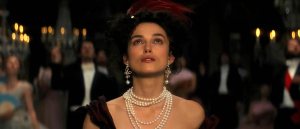
No, that is not Coromandel. In its middle and final stages, Coromandel may be better suited to Tolstoy’s tragic heroine, Anna Karenina, in the novel by the same name. Try to imagine Kiera Knightley’s “Anna Karenina” in an old, dark Russian Orthodox Church and you may get closer to the image that Coromandel evokes when I wear it. AK

A few final things: this is not necessarily a perfume that only a woman can wear. I think its smokiness and incense-y character makes it very accessible to men, as do the “woody” notes that so many seem to smell so strongly (but not me). I have read some female Anna-Karenina_05commentators say that it’s actually “too masculine.” I find that simply baffling. This is a scent everyone can wear if they should so choose. In fact, one of my closest male friends is bewitched by it. He is a man who adores YSL’s controversial, roaring, polarising, definitely masculine M7, too, so it’s not as though he leans towards “feminine” scents. If you’re a man and you’re intrigued by Coromandel, I think you should give it a shot. anna-karenina-posterEven if you’re someone who normally fears powdery or powdery vanilla scents, the degree of smokiness and spice may be enough to offset any “old lady” concerns that you might have.

If you simply can’t get passed the thought of powdered vanilla, then you may want to try Serge Lutens’ Borneo 1834, also created by Christopher Sheldrake. I’ve never tried it but, from reviews like the one I’ve linked to there, it seems that there are a number of similarities. Both share what appears to be Sheldrake’s signature: a bold, sweet, spicy oriental that almost seems like a gourmand perfume at times but which is built around a solid base of patchouli. Borneo, however, is said to have a greater darkness with more bitter dark chocolate (in lieu of the white cocoa) and much earthier, heavier patchouli. (By the way, there isn’t any chocolate actually in either perfume. They simply evoke the scent on occasion.) If Coromandel is not for you, then perhaps Borneo 1834 will be. I hope you will let me know what you think if you try either one.

______________________________

Details
Cost: $110 for a 2.5 oz bottle. It only comes in Eau de Toilette
Sillage: Strong for the first 3 hours, close to the skin after 4 hours. But, again, my body consumes perfume.
Longevity: 5-6 hours. On me. On others, it’s supposed to last a long, long time and the most out of all the six perfumes in the “Les Exclusifs” collection.