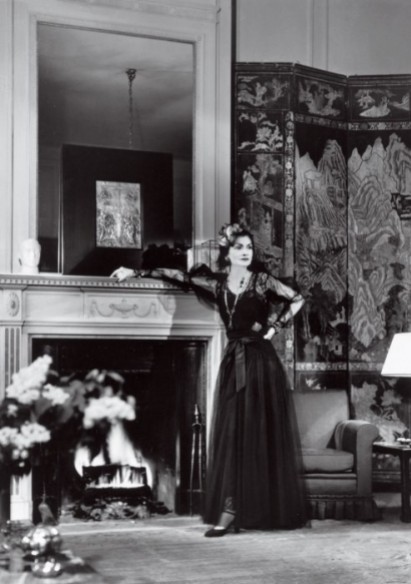
Perfume Review – Robert Piguet Bandit: “Beautiful but Brutal”

Robert Piguet was one of the most famous of the Paris haute couture designers, a man who trained Givenchy, Balmain and Christian Dior himself, and, in 1944, he made perfume history when he released Bandit. It was a year before the end of WWII, and he had just sent his models down the runway in villain masks, brandishing knives, toy revolvers and reeking a “bad boy” image that was shocking for the times.

Bandit, original ad. Source: Fragrantica.

Bandit, original ad. Source: Fragrantica.

According to the Perfume Shrine, “it was this occasion that prompted Germaine Cellier to grab the models’ knickers after they had walked the catwalk, reputedly studying their scent in an effort to ‘capture the best of their femininity’ for the couturier’s first foray into fragrance. Whether she did and how one defines femininity in the first place is food for thought.”

The result was Bandit, one of the most famous leather scents in history, up there in the pantheon with Chanel‘s Cuir de Russie (1924/1927) and Knize Ten (1924). It was given a five-star rating by Luca Turin, and is consistently on three different “best of” lists: best leathers, best chypres, and best feminines for men. The perfume is repeatedly described as a tough, brutal “B****” with references to dominatrixes and how its unbearable in the best way possible. Love and awe echo constantly through the words.

Germaine Cellier made not only Bandit, but Piguet’s most famous scent of all, Fracas, the legendary benchmark for all white florals and the white light to Bandit’s black one. That contrast seems to have been intentional and may have stemmed from the dichotomy that was Cellier herself. According to the Perfume Shrine:

Cellier herself was outwardly conforming to all the perceived ideas of [femininity]: beautiful, slim, blond and tall, she exuded an air of elegance. Yet her reputation was tinged with shades of unconventionality and homosexuality and her creations were aiming to reflect different perceptions of Yin and Yang. Fracas was made for the femmes, Bandit was for the [tough lesbians].

To Fracas’s torrid tuberose that makes you either fall madly in love with or shun forever, Bandit juxtaposes daring, bitter green leather which, according to a male admirer smelling it, exudes aloofness, rebellious intellectuality and absolutely requires an expanse of skin to show for its sensuality to bloom.

In fact, Elena Vosnaki says Cellier was quite explicit in making the distinction between her two fragrances:

Cellier infamously dedicated Fracas ~a voluptuous tuberose scent conceived for ‘femmes’~ to the beautiful Edwige Feuillère, while she promised the butcher Bandit to the ‘dykes’.

Marlene D

Marlene Dietrich

Things are obviously different these days, and we are less obviously shocked by both sexual identities or preferences, but, in its time, Bandit was revolutionary. It was a bitter green, leather chypre that was nothing like the usual leathers or chypres on the market. It was androgynous, hard, edgy, and “beautiful but brutal,” to quote the famous perfumer, Guy Robert, who wrote about Cellier and her Bandit extensively in his book, Les Sens du Parfum. The epitome of the kind of woman who would wear it was not only Cellier herself, but Marlene Dietrich. And, in fact, it was Dietrich’s signature scent.

"Les Fleurs du Mal," Charles Baudelaire.

“Les Fleurs du Mal,” Charles Baudelaire.

If the accounts are true, then Bandit was the essence of Baudelaire’s “Les Fleurs du Mal,” capturing his theories of rotting excess, unconventional or anti-social eroticism, and slightly twisted malevolence. (Serge Lutens only wishes his Tubereuse Criminelle was about returning the evil back to the flowers!) Bandit horrified and bewitched people in equal measure, creating polarizing waves until sometime in the 1970s when it seemed to have faded into the mists. It’s unclear what happened to it or when.

Then, sometime, in the early to mid-1990s, perhaps 1996, it seems to have been re-released in Eau de Toilette form by Andrian Arpel for his company, Alfin. (Are you confused yet? We still have a way to go in this saga.) Arpel may have bought control of Robert Piguet, Inc. and hence, obtained the right to release a new version of Bandit. It is said to be far from the original scent, though there seems to be no consistent explanation as to why. Some say it is a more floral version that minimizes the leather. Others claim that the eau de toilette was just leather and civet, nothing more, and that it had almost nonexistent longevity.

Bandit, intermediary 1990s version from Arpel/Alfin, in Eau de Toilette form. Note the gold top.

Bandit, intermediary 1990s version from Arpel/Alfin, in Eau de Toilette form. Note the gold top.

Whatever its scent, it’s not too hard to determine the Arpel intermediary version because its bottle tops are gold, instead of the tradional Piguet black. Furthermore, according to the Perfume Shrine,

the eau de toilette that circulated under Andrian Arpel (Alfin inc. being his previous company name) bears this label:

Parfums ROBERT PIGUET
Made in France
For Alfin.inc
New York NY 10019

In 1999, however, the Robert Piguet brand was bought by Fashion Fragrances and Cosmetics (FF&C). They made every attempt to release a version of Bandit that was close to the original in terms of notes and appearance. Bandit was released in eau de parfum or extrait de parfum concentrations, and, like the original, comes in a black bottle with a black lid.

It is extremely difficult to keep track of the timeline and the different versions of Bandit but, to summarize, there was:

  1. original, vintage Bandit eau de parfum in a black bottle with a black lid, along with original, vintage Bandit extrait de parfum that had a crystal top to a black bottle.I have even seen all crystal bottles on eBay for the extrait de parfum or pure parfum version that are obviously really ancient, 1960s or 1970s bottles. Reports on Basenotes would seem to indicate that this was, indeed, the form for the super old extrait version;
  2. 1990s intermediary Bandit in eau de toilette concentration and in a black bottle with a gold top (which is frequently sold on eBay);
  3. post-1999 version in eau de parfum and extrait versions with the original black bottle and black lid.
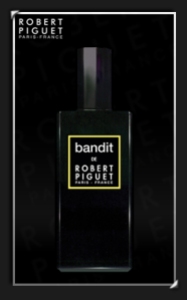
    Bandit eau de parfum in its current bottle which is exactly like the original bottle.

    Bandit eau de parfum in its current bottle which is exactly like the original bottle.

I have always longed to smell original Bandit, but I was happy to obtain a sample of the post-1999 eau de parfum version from Surrender to Chance. (Surrender to Chance also carries the intermediary eau de toilette version and the post-1999 version in extrait or pure parfum form. Links will be at the end of this post.) I’m glad I had the chance now, as Robert Piguet announced a few months ago, in October 2012, that a new formulation of Bandit was under way due to the increasingly severe IFRA restrictions regarding oakmoss as an ingredient in perfumes.

The notes in Bandit are:

galbanum, artemisia, neroli, orange, ylang ylang, jasmine, rose, tuberose, carnation, leather, vetiver, oakmoss, musk, patchouli.

You can read the Glossary for further details but, in a nutshell, artemisia is wormwood and galbanum is a type of plant resin. According to the site, I Smell, Therefore I Am, galbanum has “a penetrating, pine-like top note and a slightly bitter, woody base.” Artemisia is said to smell like tarragon, concentrated to the umpteenth degree. It is pungent, bitter, bitter green, sharp, and frequently used along side oakmoss, patchouli or civet to cut through the cloying heaviness of those notes. In fact, it is said to be akin to a filtering lens that lets you diffuse some of the stronger ingredients (like civet, for example) and to let you smell the more subtle notes.

The galbanum and artemisia are apparent from the opening blast of Bandit. It is GREEEEEEEEN, in all capital letters! People weren’t kidding when they said this was a bitter green scent, but I am disappointed that there is none of that “blood-curdling scream” which I had expected from the opening. It is sharp, yes, but hardly as sharp or as pungent as I had expected. There is actually a slight softness, which surprises me. The scent is definitely vegetal and, for a few fleeting seconds, I sniff brackish, slightly funky, left-over vase water after some flowers have died. It is a note of faint decay that instantly makes me think of Les Fleurs du Mal but, to my surprise, I quite like it. It is nothing as offensive as the fetid, cloyingly filthy, murky, dead plant water scent that I have encountered in some other fragrances and, again, it is quite fleeting.

There is a greenness to Bandit that ranges all across the middle to darker end of the spectrum. At times, I feel as though I smell bright green, almost like absinthe but really closer to raw, young tree bark. Most of the time, however, I smell dark olive green with grey-green, the latter from the oakmoss in particular. The mental image is of one endlessly shimmering green haze where there are occasionally peeks of bright, glowing absinthe green, amidst the darkness of vegetal weeds, decaying herbs and bitter blackened woods.

Speaking of oakmoss, this is one very unusual oakmoss scent! It doesn’t have that dusty pungency that I can find so difficult in some chypre perfumes. There is no impression of dusty litchen or grey minerals pulverised into grey dust. No, this is a weirdly fresh sort of oakmoss, as if taken just seconds before off a tree. It feels living, almost. I suddenly start to understand all the comments about artemisia working as a filter or highlighter to some scents. It must be the artemesia which is cutting through some of the more dominant head notes in oakmoss and concentrating the smell of its essence at its freshest state. The oakmoss is so much more aromatically woody than the more cloying, pungent, almost excessively dusty and “old” notes that I often smell in chypre perfumes.

For much of the opening 15 minutes, Bandit is dominated by the pungent oakmoss, galbanum and artemisia. I don’t smell any of the orange citrus flowers mentioned in the notes and which usually herald the start of a chypre perfume. Instead, I smell carnation. Dry, green, and with just the faintest floral note to counter the bitter green vegetal and wood scent. There is also a faint hint of soap but, again, I’m surprised to like it. Perhaps because it’s not the waxy, cloying soap that I smell in perfumes with aldehydes, nor is it the synthetic, laundry detergent soap scent of so many modern perfumes today. It’s just an odd hint of fresh cleanness to counter the vegetal impression of weeds growing out of control at the base of a tree with bitter bark rolling off it and covered by fresh grey-green moss. There is vetiver, balsam-like pine, and something astutely noted by one commentator on Basenotes, MontMorency, that seems to resemble a salty,  maritime note, like seaweed or kelp.

After an hour, the leather starts to make an appearance. It’s soft, softer than I had expected. That said, this is not soft leather that I’m smelling. It is not the soft, buttery, warm leather of a new jacket, nor the buttery leather of a car interior. This is all cold. It’s the cold, and most definitely black leather, of a whip. It’s a stony, severe, smell of leather. But, still, I’m disappointed. There is none of that “blood curdling” shriek, that almost horrified “dominatrix” or “bad ass biker chick” impression that I had read about repeatedly across different perfume sites like Fragrantica or Basenotes. There is no rubber, no harshness, none of what made Bandit so shocking. There is only one explanation: the current version is only a pale shadow of the original. (And the thought that this is going to be reformulated to an even weaker version is, quite frankly, rather horrific.)

Joining the leather are a few odd companions. I could swear that I smell camomile at one point, giving me an impression of softly herbal Alpine meadows and Heidi. There is also a faint animalistic muskiness but it’s not the harsh civet-type note of some animalic scents. The trio of Alpine Heidi, muskiness and the cold black leather of a whip has one final member: cigarettes. There is a fleeting, flickering whisper of an ashtray. Don’t get me wrong, I didn’t start smelling of a dirty ashtray. I still smelled mostly of dark green bitter woods, pungent moss and herbs, but the leather undertone had a faint whiff of ash at times, though it was extremely light.

It helps that Bandit’s leather tones were much closer to the skin than the more dominant green notes. The sillage on Bandit is huge, especially at first, but it surprised me by how quickly it became close to the skin for something that is consistently reported to be a powerhouse fragrance. The musky, leather undertones are all soft and close, almost intimate. It is incredibly sexy after such a fascinating start, and I resolve — for the umpteenth time — to try to get a hold of the vintage. Because, I have to be honest, I wanted so much more than what I got from this current version. More leather, more green, more pungency, more sillage, more of everything that I’m always reading about when it comes to Bandit. What I smell is so different and so intriguingly edgy that I dream about the vintage version.

Ultimately, the way Bandit smells on me is the way that the master perfumer, Guy Robert, describes the scent — only in a diluted, faint form. I cannot put it better than he did, so I shall use the Roberts quote provided on the Girvin blog:

[It is] “a beautiful but brutal perfume”, and that is as apt a description as any: Bandit is not a fragrance for the timid. It starts with heavy green notes, and moves slowly into a lovely floral blend with hints of spice, but the leather is apparent from the onset, and as it dries down, it is joined by an earthy-mossy accord that vaguely recalls a full ashtray. There is the slightest hint of powder, but it adds nothing of delicacy or girliness, and while Bandit stops short of being feral, the far dry down can only be described as decidedly animalic.

Like Fracas, Bandit is in-your-face sexy, but it is the dark, rebellious side of sexy — the bad girl, if you will. It is a sophisticated fragrance, mind you, but in spirit it is younger than Fracas, and it has more energy. Bandit is drinking and smoking and leather jackets, and running around at all hours getting into all sorts of mischief.  I’ve been trying to think of what would be the modern version of such a fragrance, and nothing comes to mind: perhaps there is no such thing?

I wish my version of Bandit were the fierce Bandit that Robert encountered. I see her form and her face, but it’s hazy and faint. The leather is tamed, the animalistic musk is soft, and I smell absolutely none of the florals that are part of it. No jasmine, no tuberose, no ylang-ylang and definitely no rose. (I truly don’t think many people do, from what I’ve read. At least, not for the current eau de parfum formulation.) That said, I definitely agree with Guy Robert that Bandit is an extremely original scent and for a very original woman.
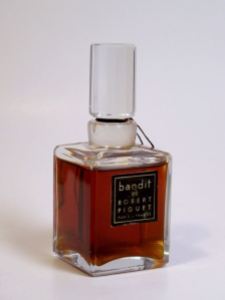
A 2 oz. bottle of vintage Extrait de Parfum, selling on eBay.

A 2 oz. bottle of vintage Extrait de Parfum, selling on eBay.

In my dreams, I buy the 2.0 oz/60 ml bottle of dark vintage pure parfum or extrait that is currently on eBay for $899. I splash it on, dress all in black in my leather jacket, leather pants and leather thigh-high boots, snap on some diamond earrings, put on my silver choker with spikes and baubles, along with the chunkiest of my men’s watches, then fly to Shanghai with nary a suitcase or companion. I would go to one of the dark, sophisticated bars in the old International District (I even know which one and they make a damn good cocktail!), and I would sip a bright green absinthe drink as I contemplated something infinitely risky, wild and dangerous. And I know I would get up to no good. No good at all! But that is the thing with Bandit, even in its diluted form. It seems oh so wrong, in such a good way.

DETAILS:
Sillage & Longevity: Great sillage for the first hour, then close to the skin. However, on others, it is reported to have enormous sillage for much, much longer. As for longevity, it is quite remarkable. On me, I could smell traces of it on my arm 8 hours after putting it on. It was soft, but it was there. On others, the longevity is reported to be even greater.
Cost & Availability: Bandit is available on the Robert Piguet website in all forms (except the rogue eau de toilette version), along with a body lotion version. The Eau de Parfum costs $95 for 1.7 oz/50ml and $135 for 3.4 oz/100 ml. The Parfum, pure parfum or extrait version costs $110 for 0.25 oz/7.5 ml and $235 for 1 oz/30 ml. In the US, you can also find Bandit available at Barneys, Bergdorf Goodman, Nordstrom, and various online retailers. In the UK, you can find Bandit at Harrods where it costs £75.00 for 1.7 oz/50 ml. In Australia, you can find Bandit on Libertine. You can also find Bandit on eBay, starting around $60 for the 1.7 oz size. But please, be careful as to which version you’re ordering and pay heed to the appearance of the bottles in the photos!
Samples: You can also order samples of Bandit from various sample sites. The one I use, Surrender to Chance, carries all versions of the scent except for the vintage. The mid-1990s Eau de Toilette version costs $3 for the smallest 1 ml sample vial, the Eau de Parfum costs the same, and the Pure Parfum costs $3.99 for 1/4 of the usual 1 ml vial, or $15.96 for the 1 ml vial. Surrender to Chance ships worldwide for about $5.95 (though it’s a little bit more for larger orders over $75), and for $2.95 for all orders within the U.S., regardless of the size of the order.

Perfume Review – Chanel Les Exclusifs Cuir de Russie: The Legend & The Myth

Some legends are perhaps better left untouched. Or unsniffed, as the case may be. Because, sometimes, the legend is closer to a myth. That was, unfortunately, my experience with Cuir de Russie, the legendary Chanel fragrance that is now part of its Les Exclusif line of perfumes. Cuir de R

Cuir de Russie (or “Russian leather”) is one of those scents that perfume junkies would talk about in hushed tones of reverence and awe. The vintage, original Cuir de Russie always seemed to me to be some sort of mythical animal, the perfume equivalent of a unicorn. Its name would shine in haloed light above distant snowy mountain tops and I almost expected a choir of angels to burst into rhapsodic song at its very mention.

Coco Chanel & her imperial Grand Duke.

Coco Chanel & her imperial Grand Duke.

Cuir de Russie was inspired by Coco Chanel’s passionate affair with a Russian Grand Duke, His Imperial Highness Dimitri Pavlovich Romanov, a cousin to the last Tsar. According to Wikipedia, Chanel’s biographer considered Cuir de Russie to be the “bottled … essence of her romance with the Grand Duke.” It was created by Ernst Beaux, Chanel’s then perfumer, sometime in the 1920s when Paris was flooded with Russian emigrés, both royal and common, who had escaped the Bolshevik revolution. (Chanel’s website gives the date of the perfume’s release as 1927, but I’ve always read it was in 1924.)

The Chanel website majestically declares Cuir de Russie to be an “imperial fragrance” and a “leather oriental” before adding:

The Grand Duke in his uniform.

The Grand Duke in his uniform.

The Russian influence at the heart of Mademoiselle’s creations was born from her encounter with the Grand Duke Dimitri, cousin of Tsar Nicholas II. Cuir de Russie, launched in 1927, is the fragrance of wild cavalcades, wafts of blond tobacco and the smell of boots tanned by birch bark, which the Russian soldiers would wear.
This sensual fragrance reveals the dark and musky scents of balms, Frankincense and Juniper Wood. Fruity zests of Mandarin Orange and Bergamot add a touch of insolence before giving way to the grace and fragility of eternal flowers: Rose, Jasmine and Ylang-Ylang. A ‘thoroughbred’ fragrance with a strong character, it holds within it the ambiguous secrets of femininity…

Somewhere in the decades following its release, Cuir de Russie seems to have faded into the mists of legend. I can’t determine when it was discontinued or why, but it just became that mythical perfume unicorn. Then, in 1983, Chanel brought it back. Trumpets blared, perfumistas fainted, and all wept with joy as the heavens burst forth in song. Chanel’s in-house perfumer, Jacques Polge, re-worked it slightly, toning down its legendary leather notes and increasing the iris for a more powdery note, but it was back and that is all anyone cared about.

The return of Cuir de Russie was hailed as a massive triumph by even that most ascerbic and disdainful of critics, Luca Turin. In his book, Perfumes The A-Z Guide, his five-star review states:

There have been many other fragrances called Cuir de Russie, every one either too sweet or too smoky. This one is the real deal, an undamaged monument of classical perfumery, and the purest emanation of luxury ever captured in a bottle.

[All] sumptuous leather, light and balsamic, forgoing any sugary compromise, Cuir de Russie regains its place at the top of this [Leather] category, right next to the rather more jovial Tabac Blond. […]Cuir de Russie is a striking hologram of luxury bygone: its scent like running the hand over the pearl grey banquette of an Isotta Frashini while forests of birch silently pass by”.

(First quote taken from Perfume Niche, and the second from the Perfume Shrine.)

Luca Turin is not alone in genuflecting before the shrine to the most holy of leather perfume holies. If I were to provide mere snippets of the adoring praise for Cuir de Russie — even a minute fraction of them! — I suspect I would writing this review until sometime in the year 2018. There are reviews on Fragrantica which expound for paragraph after paragraph about:

Coco at her Ritz apartment.

Coco at her Ritz apartment.

Cossacks on horseback on the steppes of Russia; semi-erotic imaginings involving the seduction of a languid Coco by her sweaty, horse-riding royal lover amidst the plush decadence of her Paris apartment at the Ritz; and about olfactory masterpieces involving the very scent of Coco Chanel’s sex and sweat-infused bedsheets. There was one from a fellow perfume blogger whom I deeply respect and admire which made me want to go take a cold shower, or find some ermine and jewels in which to roll around naked.

All of which makes me feel completely insane for not loving it. But I don’t. On me, it is none of the things described above, and I am crushingly disappointed by a scent that is, at best, average and occasionally pleasant. At worst, it is a barnyard filled with horse manure under a layer of soap. In short, I am one of the very few freaks in this world who   finds the legend of Cuir de Russie to be a mere myth.

The notes listed in Chanel’s description up above are the same ones listed on Fragrantica. Elsewhere, however, I’ve read a significantly larger and fuller list. I assume that the notes are essentially the same in both vintage and modern versions, with only the amount of certain ingredients differing. If so, then the full notes for Cuir de Russie are:

aldehydes, orange blossom, bergamot, mandarin, clary sage, iris, jasmine, rose, ylang-ylang, cedarwood, balsams, vetiver, styrax, incense, cade, leather, amber and vanilla.

Cuir de Russie opens on me with an explosion of aldehydes. (You can read more about aldehydes in the Glossary.) On me, it is a waxy, lemony, floral impression that is first and foremost soapy, and without any of the fizzy aspects that I often read about with aldehydes. As many of you know, I loathe soapy scents. And I suspect my dislike of the soap accord in aldehydes is why I dislike Chanel No. 5, and one of the reasons why I’m far from enraptured by Cuir de Russie. (Christ, I’m admitting that I don’t like the two most legendary Chanel perfumes ever. I may need to hide in witness protection. Mea Culpa.)

Initially, the burst of soap is like a thick lens, clouding and obscuring the citrus notes, but about five minutes later, I suddenly smell soapy leather. Specifically, I get a strong impression of a riding saddle and stirrups lathered with sweat. There is a strong smell of sour, sweaty horse. I shudder faintly, and wonder momentarily if the heinous soap smell was better. I should have enjoyed the sweaty saddle fragrance while it lasted because, suddenly, waves of horse manure (cow dung?) and soap are emanating off my arm.  I…. I… am stunned, and have no idea what to do. I quickly turn to Google and, there, on both Makeupalley and Basenotes, amidst the legions of gushing, cooing, almost delerious praise, I find a few rare nuggets of comfort. I am not completely alone or totally crazy.

Snippets of those rare (very rare!) criticisms of Cuir de Russie are as follows:

  • It was an overwhelming animalistic scent, like the smell of entering a barn and having the smells of animals and their droppings mixing with straw and leather.
  • This leather is more of the fecal farmhouse animal stench variety and is somewhat difficult to tolerate. […] Luckily, the barnyard aspects of the scent recede in the base notes. […] The opening of Cuir de Russie edt was difficult from the get-go and did not portend to good things to come. I tend to be quite sensitive to fecal aspects in scents (like my problem with Jicky, for example), and as such the heart notes with their fecal smelling leather and powdery iris were really not to my taste at all. If things stopped there this would be a definite thumbs down for me. What saves Cuir de Russie edt somewhat is it has a very nice dry-down that easily is the best part of the scent.

And, that’s basically it — because even those who can smell the fecal aspect of Cuir de Russie love it. As it is, that last quote came from someone who ended up giving Cuir de Russie a neutral rating due to the “nice” dry-down that she mentioned. Other than a few negative criticisms involving dirty ashtrays (not a frequent impression), almost no-one who smelled the barnyard scent or “cow patties” hated it. Seriously, they didn’t!

  • Cuir de Russie, however, was love at first sniff. It opens with a dirty animalic note that’s borderline fecal, but the soft, creamy, spicy florals seep in and smooth out this animal’s shaggy fur until Cuir de Russie becomes this heart-achingly beautiful blend with an undercurrent of barely-bridled danger; a lady in leather and lace, a sleek panther at repose in a meadow.
  • I really love the opening, when a true leather unfolds, bitter, dry, almost harsh, even a briefly passing “faecal” note, all in all, it smells like the inside of a fairly new, precious leather bag, that’s containing some scented cosmetics in its depths. But all too soon, this stage is fading away, moving over into a softer, creamier leather, which is still fine and very likeable.
  • All I can say is — poop. This stuff smells like poop. But in a really kind of good, fascinating way. Seriously, that’s the genius of Chanel. It’s like the poop of some delicate animal who’s only grazed upon a field of violets. I’m not sure I want to wear it, but I simply could not stop smelling the crook of my arm all day after my spritz! Pretty awesome.

There was even a review on MakeupAlley upbraiding Chanel’s perfumer, Jacques Polge, for toning down the original scent and demanding that they bring back more of the leather and barnyard!

Clearly, I am alone in disliking “the poop of some delicate animal who’s only grazed upon a field of violets.” (It is not a “delicate” animal, by the way, and I could only wish it had eaten bloody violets!) I certainly don’t want even more of this opening that so many adore and wish were as intense as it used to be.

As I try to figure out how I landed in a pile of horse manure, I come across a really interesting explanation on Perfume Niche. Apparently, it’s the birch wood that helps creates that leather tannery and barnyard scent:

Rectified birch tar is the smoky resinous note which makes Cuir de Russie, and most leather scents, smell like leather. It is, in fact, the dry-cooked resin from the bark of the birch tree and has been used for centuries to cure leather, and to “dress” it, as in polishes for military leather boots. […]  [Then] after the florals subside, Cuir de Russie conjures the uber-male, becoming a sexy masculine scent. That raw edge – the funky animalics, civet and castoreum – mix with the smoky leather, balsam and woods , giving Cuir de Russie an erotic, brutish quality.

I’m afraid I don’t see any “erotic, brutish” quality in Cuir de Russie. I would undoubtedly like it a lot more if it were half as interesting as all these descriptions would seem to convey. I keep wondering what the legendary vintage version must have been like if the current eau de toilette toned down the leather. Perhaps I should try to hunt down the concentrated extrait de parfum version which is supposed to be more intense, more “brutal,” heavier and thicker? I consider the downsides of a heavier version of soapy horse feces, and quickly change my mind.

About 30 minutes in, Cuir de Russie is already incredibly close to the skin. Apparently, it’s supposed to be. However, with the way my skin consumes perfume, it makes it difficult to assess its full range and development properly, so I start from scratch. I follow the advice of a Basenoter and put on triple the previous amount (on some clean skin). I have the same experience as the first time round, but this time, the perfume’s sillage is much better. (Apparently, I need to empty just over half the vial on me if I want to smell the dry-down properly.)

Unfortunately, I don’t get much of the lovely middle or bottom notes that others do. On me, it goes from: citric soap; to horse manure, sweaty saddles and soap; to a middle stage that is essentially a basic floral scent of strong jasmine, with bergamot, rose, powdery iris, and leather turned into soft suede. (The soap is still there too, though it’s a shadow of its former strength.) The jasmine part is lovely, and the rest of it is pleasant, but I shrug. Soon, the dry down begins: the suede impression is joined by a light touch of cedar, an even heavier dose of dusty powder from the iris, some definite musky notes, and a soft smoke and incense touch that is, I admit, lovely. There is also a note that strongly evokes hairspray. And, every CamillaPBnow and then, flitting back and forth, I smell something faintly horsey — though it is more leather saddles now than feces.

I feel like Camilla Parker-Bowles, Prince Charles’ horse-mad second wife, and recall the oft-repeated stories of her younger days. Rumour has it that, after a long day at the hunt, she would make a mad dash straight off her sweaty horse and into the house where she would tumble into a dress for a cocktail party, with nary a shower in-between.

I realise that my views are “sacrilegious,” to borrow the word of one fearful commentator on Basenotes who barely dared whisper the words “fecal” before rushing off to join in all the praise. If I could smell what Mick Jagger smells when he wears this (and he does); if I could see “The Ballet Russes, polished samovars and dangerous Cossacks with leather riding boots;” if I could conjure up Imperial Grand Dukes leaping off their black stallions to lasciviously and forcefully seduce me; if I could feel like a “virago” femme fatale or ultra-posh bombshell with hidden bondage tendencies– then I would probably genuflect at the alter of Cuir de Russie, too.

Until the time when all that magically occurs, I shall continue to think that Cuir de Russie is a perfectly pleasant, completely average floral musk with some suede notes under a strong head of horse manure. Literally.

DETAILS:
Target group: Unisex. Men love this as much as women.
Sillage & Longevity: As a rule, this is meant to be close to the skin, so the sillage is far from enormous. With regard to longevity, there seems to be a complete and total split in views, with some saying it lasts 10-12 hours, while others say it never surpasses the 4 hour mark. On me, it took 30 minutes or less before the perfume faded to the point where I had to forcefully inhale my arm to smell the notes. The whole thing lasted no more than 2.5 with my regular amount, but 4 hours with the triple dosage. Again, as always, my longevity issues are far from the norm as my skin rapidly consumes perfume.
Cost & Availability: Cuir de Russie is available exclusively in Chanel boutiques or on the Chanel website. The standard, basic Eau de Toilette in available in two sizes: the 2.5 oz./75 ml bottle is $110, while the 6.8 oz/200 ml. bottle is $220. It is also available in Extrait de Parfum form for $175 for 0.5 oz.