Perfume Review – Hermès Ambre Narguilé

I may have narrowed the search for my perfect amber. I need to say that at the onset because it’s quite an unexpected, unlikely thing. Certainly, I didn’t expect to like — let alone adore — a scent described as “cinnamon apple pie” by most commentators. I am not a fan of foody or gourmand perfumes. And I am most definitely not a fan of paying high prices to smell like cloying dessert. But there is something intoxicating, sensuous, comforting and unexpected about HermèsAmbre Narguilé. Of course, the incredibly intense ambre-narguil_fumes of rum that emanated from my arm for a few hours may have intoxicated my normal sensibilities, but this really is a boozy amber and tobacco scent par excellence.
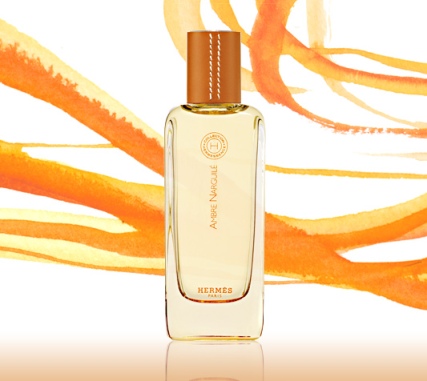
Ambre Narguilé was released in 2004 as part of Hermès’ exclusive, in-store Hermessence line of fragrances. It was created by Hermès’ in-house perfumer, Jean-Claude Ellena, a legendary perfumer who was recently called by Der Spiegel “the best ‘nose’ in the world.” Ellena is known for his minimalistic approach to ingredients, and for perfumes that always have depth and complexity, despite seeming sheer and transparent. That sheerness is rather a signature of his and, as I will explain later, a significant aspect of Ambre Narguilé.

Jean-Claude Ellena. Source:CaFleureBon

Jean-Claude Ellena. Source:CaFleureBon

On the Hermès website, Jean-Claude Ellena describes Ambre Narguilé as “[a]mber honey with swirls of smoke from the East. Savory, sensual, enveloping.” (Narguilé means a tobacco water pipe, or hookah, in French.) His goal in creating the perfume was as follows:

Amber, the Western expression of Eastern fragrances, has a warm, enveloping, almost carnal smell. I wanted to imbue this idea of amber with the memory of the East I love where tobacco – blended with the smells of fruit, honey and spices – is smoked in narguilés, or water pipes, and where swirls of smoke diffuse a sweet sense of intoxication.

The Fragrantica classifies Ambre Narguilé as a spicy oriental, but it doesn’t list the full notes. From what I’ve read in a few comments, the complete list seems to be:

benzoin, labdanum, musk, vanilla, caramel, honey, sugared tonka bean, grilled sesame seeds, cinnamon, rum, coumarin, and white orchid.

The opening burst of Ambre Narguilé was a huge surprise to me. From all the comments, I had expected a massive dose of cinnamon apple pie. I was fully intent on hating the perfume and, actually, I wondered why I was even bothering at all. After all, no good thing can come of a scent described as gourmand, right? Well, wrong. I clearly need to remind myself not to prejudge a whole category of perfumes. (Except soapy-clean laundry detergent scents. There, I plan to continue to prejudge as much as ever.)
Source: Fabio Visentin

Source: Fabio Visentin

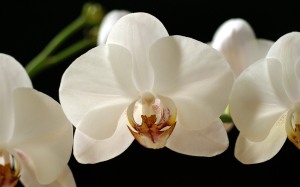
Instead of a cloying dessert, Ambre Narguile opened as a spicy, sweet white floral. I blinked. White orchid? I never expected to smell white orchid with that list of potent, warm ingredients. But I did now. The perfume was a rich, floral vanilla with toasted, warm tonka bean, white rum and a hint of tobacco. I didn’t get any of the heavy powder that often goes with tonka bean, especially in Guerlain fragrances where the tonka bean’s powdery notes are responsible in large part for the signature Guerlinade.  I wonder if perhaps toasting the bean made a difference and warmed up the notes instead of bringing out its more powdery side? Whatever the reason, the vanilla from the tonka bean was sheer, not cloying.
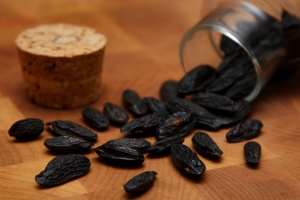
Tonka Beans.

Tonka Beans.

Two minutes in, suddenly, the cinnamon apple pie hits me. It’s incredibly concentrated, particularly for a scent that does not, in fact, have any apples in it! It’s odd; Ambre Narguilé is still a spicy floral scent, but now, it is also slightly gourmand. A few minutes later, the apple becomes a bit less predominant and I get a strong burst of rum, raisin, rum raisin, rum, rum and more rum. It’s not the light white rum of the start, but dark, black rum. The sort you see in pirate movies. There is so much rum, I feel a bit light-headed and drunk from it, but in the best way possible. I also suddenly feel as though I’ve had rum raisin pie that has a strong dash of saffron in it. Good lord, that’s good! I ponder whether to put on Johnny Depp in Pirates of the Caribbean.

About fifteen minutes in, I smell the faintly smoky aspects of the labdanum wrapping itself around the boozy resins. There is such a rich, nutty, smoky feel to the amber that it feels as though there is Siam Resin in there. And the apple suddenly seems a lot more like cooked plums than the apple of a strudel. I’m surprised that such a sweet, rich scent isn’t actually all that sweet. There is a dryness that I think comes from the labdanum which prevents this from being cloying or too dessert-y. The dryness makes me agree a lot more with Fragrantica’s description of this as a “spicy oriental” and not as a gourmand fragrance. It also adds to the impression that Jean-Claude Ellena had intended: shimmering, swirling whispers of smoke. He was right: the smoke helps to “diffuse” the sweetness, as does the hay-like aspects of coumarin.

After twenty more minutes of alternatively contemplating rum-drinking pirates and wanting to eat my arm, Ambre Narguilé starts to change. There is the lovely opening hints of tobacco but not just any tobacco. I smell my late uncle’s pipe: sweet, floral, almost rose-like, with fruity and apple overtones to its spiced tobacco. It’s such a strongly evocative scent that I suddenly miss him very much. The rose and apple
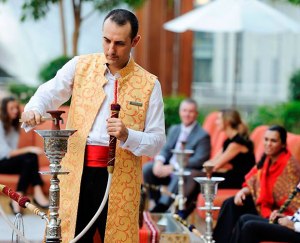
A Middle Eastern hookah water pipe or narguilé.

A Middle Eastern hookah water pipe or narguilé.

overtones also call to mind memories of using a hookah, or water pipe, a few years ago when that trend was very “in” and popular. The tobacco there — as in Ambre Narguilé — was never acrid, bitter, burning or strong like that of cigarettes, but lighter, softer, warmer, sweeter, and aromatically fruity. I’m amazed by just how well Ellena has nailed the hookah or narguilé aspect of things in this perfume. Clearly, it’s a result (in some part) of the labdanum, coumarin, and tonka bean, but that doesn’t really explain how he managed fruity, rosy, floral pipe tobacco in a perfume that has neither fruit nor any significant florals! I can’t understand it.

Another thing I can’t understand is just how sheer this scent is, while simultaneously being rich, narcotic and heady. So many of the reviews of Ambre Narguilé reference its “sheerness” and “transparency,” references which had made absolutely no sense toHookah me when I’d read them a few days ago. How could those two adjectives be used to describe a perfume as rich and sensuously deep as this one was supposed to be? I was baffled. Now, however, I can completely understand it. For such a seemingly gourmand scent, it is neither cloying nor diabetes in a bottle. It’s somehow light and airy, while simultaneously being almost narcotic-like in its headiness. It’s hard to explain, but imagine a light breeze. It gently wafts passed you, but it carries a maximum burst of concentrated smell.
I think only someone like Jean-Claude Ellena could manage such a seeming contradiction in spirit, and manage it quite so deftly. Perhaps he really is a “luminist” as he was recently described on Ca Fleure Bon, the haute perfume site of experts. They called him a “luminist” in terms of both his approach to ingredients and the final result. What I think they’re talking about is that he is a rare perfumer who manages to use a small range of ingredients in a way that illuminates them with both lightness and the most concentrated aspect of their essence. (At least, that’s how I interpreted their comments.)

Here, Ellena blends together a range of rich, ambery, spice ingredients in a way that amplifies their essence, while simultaneously creating an airy feel.  Ambre Narguilé has huge sillage, but you can also smell the concentrated nature of the ingredients. Yet, none of them are cloying or excessively sugary. More importantly, none of them are synthetic or artificial. There is no sharp screech of synthetic compounds, no clanging or burning in your nose, and no vaguely plastic-y tones.

Instead, it’s an incredibly well-blended, heady, cozy scent that has subtle transitions. The changes from stage to stage are not abrupt; the perfume moves seamlessly from that opening burst of white floral vanilla and white rum, to the cinnamon apple pie stage, to the rum raisin and rum, then to the tobacco, before ending in its final stage. Almost 6 hours later, Ambre Narguilé turns into a tobacco and wood scent with a leather undertone. The woody notes almost smell like cedar, but it is the leathery undertone to the pipe tobacco that suddenly explains why I like this scent so much: it reminds me of my beloved Karl Lagerfeld for Men (vintage) that is one of my favorite old fragrances to wear. Ambre Narguilé has the rich tobacco with the amberous, incense and leather feel of the Lagerfeld, but without the latter’s powder notes and with a hell of a lot more rum.

Which brings me to popular dessert smells from brands like Philosophy, Bath & Body Works, Britney Spears (for example, Fantasy which evokes floral supermarket cupcakes), Jessica Simpson (for example, Fancy, which evokes caramel and vanilla), and the like. I like Philosophy and BBW for what they are, and I have owned a number of things from each. (I have never owned Britney Spears or Jessica Simpson, and I never shall.) But, let’s admit it, the fragrances they create are completely artificial. To be as polite as I can possible be, they don’t smell particularly expensive, mature or natural. They are huge money-makers and extremely popular, but they are not expensive in scent or in cost. One reason for their profitability is the use of artificial, synthetic compounds which are significantly cheaper to use. The drawback to these artificial compounds is that they can be extremely sharp, cloying, excessively sugary and one-dimensional.

There is nothing artificial or cheap about the smell of Ambre Narguilé. It doesn’t smell of synthetics. It smells extremely expensive. And I don’t think you could get a comparable scent among the commercial, mass-produced, gourmand fragrances out there. According to a commentator on Basenotes, the famous NY Times perfume critic, Chandler Burr, said Ambre Narguilé:

is not merely the best; there is simply nothing like it on the market, period. And no one will ever do it as well again.

While I love the scent, I think Mr. Burr is pushing it and waxing a little too rhapsodic. But I do agree with him to an extent because I am convinced that there is no-one who could do it better amongst the plethora of dessert scents littering the aisles of Macy’s, Dillard’s, Sephora or the like.

But what about higher-end perfume houses? There, Ambre Narguilé would seem to have serious competition in terms of quality, as well as some overlap with existing amber scents. I’ve read a lot of comparisons on Basenotes to Frederic Malle‘s Musc Ravageur, though there seems to be no consistency in the comments as to how they differ or are alike. Some say that Ambre Narguilé is like Musc Ravageur’s dry-down, only sweeter and less musky. Others say the exact opposite. Interestingly, a Basenotes poll asking for people’s preference between the two resulted in a complete 50/50 tie. Other potentially similar scents that have been mentioned: L’Artisan Parfumeur‘s Ambre Extreme (said to be less spicy than the Hermès); Parfum d’Empire‘s Ambre Russe (said to be significantly richer, spicier and deeper than the Hermès); and Frapin 1270. I hear the last one mentioned a lot on MakeupAlley as an almost complete dupe for Ambre Narguilé (which has a 4.3 out of 5 score there). Unfortunately, I haven’t smelled any of those fragrances, so I cannot judge, but if you own one of them, you may not need Ambre Narguilé.

Do you, in fact, need Ambre Narguilé? That’s hard to say. For all its loveliness, I will be the first to say that it is really quite a simple, linear scent. Yes, it has transitions but, as a whole, it isn’t a complex, heavily nuanced, perfume that constantly transforms and morphs. The notes are essentially the same, though they vary as to degree or to the ingredient being emphasized, with more fruity notes at the beginning and strongly tobacco notes accompanying faintly leathery, woody accords at the end. But amber and tobacco are constant threads running from top to bottom in some form or another. As I frequently say, there is nothing wrong with linearity if you love the notes in question. And I think comfort scents are, in particular, more suited to being linear.

In terms of sillage and longevity, Ambre Narguile does well in both categories. The perfume projects for the first 2 hours quite forcefully before becoming slightly softer and more subtle. It became close to the skin about 4 hours in. And it lasted, all in all, about 7 hours on me. (Again, I have skin that ravages perfume.) On others, however, the average length of time seems to be between 12-15 hours! That is remarkable for a scent that is a mere eau de toilette. The famous perfume critic, Chandler Burr of the New York Times, told Oprah:

The rule is: Pretty is fleeting; heavy sticks around. Take the utterly genius Hermès Ambre Narguilé. Here’s a perfume of such luscious perfection, you want to melt into it as if it were an expert beurre caramel. Ambre Narguilé will not only dance all evening with the one that brung it, it’ll take you all the way home, too.

Perhaps the dispositive issue with Ambre Narguilé is its cost. It costs $235 and is sold only in the large 100ml/3.4 oz bottles directly from Hermès itself (whether online or via its boutiques). It doesn’t come in any other size and, again, it only comes in the eau de toilette concentration. However, and this part is key, Hermès sells a travel or gift set of
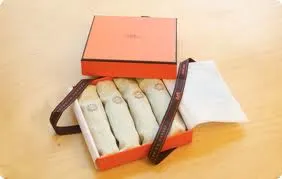
The Hermès travel or gift set.

The Hermès travel or gift set.

four 15 ml/0.5 oz bottles for $145. You can get 4 bottles of any perfumes in the Hermessence line, or all 4 can be the same perfume, such as Ambre Narguilé. In short, for $145, you would be getting 60 ml or about 2.0 oz of perfume, which is more than the standard 1.7 oz bottles for perfumes. As such, it is a much more manageable price. However, even then, it is still more expensive than Ambre Narguilé’s amber counterparts: Lucky Scents sells Frapin 1270 in a 100 ml bottle for $155, while Parfum d’Empire’s Ambre Russe is $75 for 50 ml and $110 for 100 ml. Despite their more affordable cost, however, more than enough people (including a number who seem to own one of the other amber scents) can’t seem to live without Ambre Narguilé and shell out $145 for the gift set. It all depends on how much you love boozy, smoky amber and if you consider Ambre Narguilé to be “utterly genius,” or just merely adequately cozy.

I started this review by saying that I had narrowed my search for my perfect amber. If Ambre Narguilé cost less, that search might be over. I really like it that much, and it makes me feel happy. (My German shepherd also adored it and jumped up to repeatedly lick my arm — which he doesn’t usually do when I’m wearing perfume.) I can’t get over how intoxicating that rum was, or how elegantly beautiful that swirling mist of tobacco. But it is simple. And should simple cost that much?

As in most things in life, price is a very subjective, personal thing, and what is worth it for one person may be too much for someone else. For me, the problem is that I’m extremely picky, am constantly inundated with scents I love or am tempted by, could not possibly buy all the things I’d like to buy in one calender year, and have definite cheapskate tendencies. So, I’m not sure that I would spend $145 for Ambre Narguilé. (I certainly wouldn’t spend $235!)

But I am considering it….
DETAILS:
Ambre Narguilé is available on Hermès’ website at the link provided above. Samples are available at a number of sample sites, as well as on eBay. The site I use, Surrender to Chance, sells it starting at $3.99 for the smallest size. As always, I think they have the best shipping prices, so I would start  there if you’re interested in testing out the perfume.

Perfume Review: Tom Ford Private Blend Amber Absolute

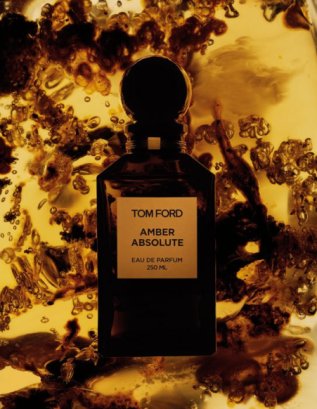
Some perfumes just announce their presence. Tom Ford’s Private Blend Amber tom-ford-amber-absoluteAbsolute is one of those perfumes. While his entire line of fragrances — Private Blend or not — seems to have a very brash, forceful attitude, I think Amber Absolute takes it to new levels. It is known to be the most concentrated and the strongest amber perfume on the market, but it’s far more than just that: it’s also a frankincense monster. To be honest, it reminds me of one of the aggressive, giant gorillas in Planet of the Apes — complete with chest-thumping machoism. I am not a fan.
Amber Absolute is categorized as a unisex oriental eau de parfum. On his website, Tom Ford describes it as follows:

AMBER ABSOLUTE is a honey-colored scent infused with the purest form of Amber, joined by a tenacious refrain of African Incense, Labdanum, Rich Woods and a touch of Vanilla Bean.

There are no further details about the ingredients and no further elaboration of what kind of “rich woods.” Amber Absolute is intended to be a simple scent; it is meant to be little more than pure, concentrated amber with a “tenacious” hint of those other things. To that extent, you could argue that Tom Ford succeeded in his goal. It really depends on how you interpret the “tenacious refrain” part, and the extent to which the amber was meant to dominate.

Bois de Jasmin has an extremely useful discussion of amber in perfume, and I think it would be helpful to share it here:

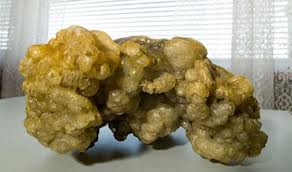
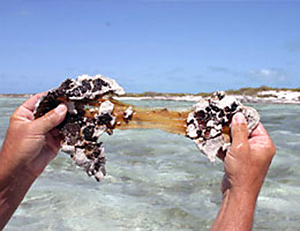
While amber commonly tends to refer to the semi-precious fossilized resin, in perfumery, the word refers to an abstraction of the complex odors of ambergris. Rich, animalic, warm and salty, this substance regurgitated by the sperm whale, has been sought after since antiquity for its unique scent. Given its scarcity and high price, amber

accords have been devised using materials like labdanum, which approximate the fragrance of ambergris, particularly since purified labdanum contains ambrein, one of the materials that gives ambergris its scent. The classical amber accord in perfumery tends to be sweet and vanillic. The best examples I can offer include Serge Lutens Ambre Sultan, L’Artisan Parfumeur L’Eau d’Ambre and Annick Goutal Ambre candle .

Ambergris

Ambergris

I find it unlikely that Tom Ford used pure ambergris in his perfume, so I’m guessing the infusion of “the purest form of Amber” must be synthetic ambergris (or ambroxan) with a healthy, if not enormous, chunk of labdanum. In my Glossary,

Pure, fresh ambergris found on the beach.

Pure, fresh ambergris found on the beach.

I elaborate on labdanum which is the distillation of the cistus plant and which imparts a dry, resinous, faintly woody smell. To me, labdanum is generally similar to ambergris (or to its synthetic form, Ambroxan) and to ambery resins. However, I think it has more of a masculine toughness as compared to amber’s sweetness, a touch more edge and a bit of a dirty, animalic spice.

Labdanum

Labdanum

Tom Ford doesn’t explain if his “African incense” is frankincense or what comprises his “Rich Woods.” The former must be Olbanum, and I’ve read some guesses that the latter consists of Guaiac Wood. I suspect that’s true. Descriptions of guaiac wood’s smell range from burning leaves and pepper, to rubbery rosy-sweet honey, to smoky, rubbery, tar-like asphalt. (See Glossary for more details.) All the descriptions apply here.

The reason why I’m spending perhaps a little more time than usual going over the notes is because I don’t find Amber Absolute to be a predominantly amber scent. To me, it’s smoky, peppery, almost asphalt-like frankincense fragrance first and foremost, and only then amber. Amber is merely the context and cocooning wrap, frankincense is the head and heart. And there is way too damn much frankincense!

Amber Absolute opens with a lovely note of spiced rum. It’s all Chinese Five Spice, headed by star anise. I cook with star anise, and was surprised by just how redolent the smell is here. The amber is rich and so boozy, I immediately thought of Captain Jack Sparrow in the “Pirates of the Caribbean” series and his love of rum. Here, the rum note is so concentrated, a mere whiff might make the mighty pirate drunk.

The frankincense is visible too and, initially, it isn’t quite the star player, though it is jostling for the center stage. It’s strong, smoky and has the sharp bite of black pepper. It’s faintly acrid; I can smell it at the back of my nose. There is also a definite burnt asphalt smell which can stem from either the possible Guaiac wood element or from the incense alone. Whatever the cause, the incense or frankincense notes become stronger and stronger. And stronger. It ends up becoming the olfactory equivalent to assault and battery, a most intentional tort.

It is such an aggressive assault that I should point out the need to be extremely careful in how much Amber Absolute you apply. Be careful for your own sake, never mind others. I thought I had been careful, but apparently, not enough. As I repeatedly state, my body consumes perfume. Consequently, for any sort of accurate test, I always use about 3-4 dabs from the small sample vial, smeared up and down each arm. That is the baseline. However, with Amber Absolute, I used far less. I know from prior experience the strength of Tom Ford scents — especially in their opening salvo — but I had also read enough about how Amber Absolute was the strongest amber on the market to know I had to be careful. So, I only put on 1-2 dabs on each arm. Oh boy!

It was absolutely tolerable — nay, lovely — in the opening 15 minutes or so. There, it was a mix of boozy amber (verging on seriously concentrated rum), star anise and spices with an element of frankincense. But the frankincense muscled the supporting players off the stage, took over, and then set up a chest-thumping rhythm of increasing shrillness. What happened to a mere “refrain of African incense”? Oh, right. “Tenacious.” Mr. Ford, I think you’ve confused “tenacious” with obnoxious.

As my prior reviews show, I’m a huge fan of frankincense, so it should tell you something that I found it really too much here. Isn’t this supposed to be an amber scent first and foremost? Frankincense and amber are a lovely combination but, here, there is nothing to really dilute, soften and tame the hard, extremely smoky, almost acrid (and verging on painfully sharp) edges.

Which brings me to my real problem with Amber Absolute: it is not well-rounded for a large portion of its lifespan. It’s too top-heavy on one key note. It’s unbalanced and, unbalanced to such an extent, it clearly must be intentional. I can’t fault Amber Absolute for being a simple, even linear scent; that was what they wanted it to be. But I can absolutely fault it for being painfully unbalanced.

Speaking of linearity, it’s not always a bad thing. I certainly don’t use “linear” as a constant negative. Nor do I need for my scents to always morph and transform like Cinderella. In fact, comfort scents like rich, warm, cozy ambers are one category where I can very much enjoy linearity. It’s akin to having the lovely basenotes (sometimes, the best part of a perfume!) there from the onset but just in different degrees of concentration. But I don’t like this linear perfume.

After three hours of being assaulted and beaten up by frankincense, the charging gorilla decides he’s got better things to do and goes to sit in the corner. The dry-down starts, and it’s a relief. There is salty caramel, vanilla and more of what I consider to be real amber. Soft, nutty, sweet and delicious. The salt of the caramel is balanced by the sweetness, and the whole thing has a lovely touch of smoke. The frankincense is still there, but it’s glowering from the corner and shackled. It’s been tamed enough to almost smell a bit like dirty patchouli, but not quite. The combination is lovely but it’s faint. Like most Tom Ford scents on me, the opening salvo is loud and intense, but when it fades into softness, it’s almost too soft.

Which brings me to something that I often wonder about when it comes to Tom Ford fragrances: olfactory fatigue. I don’t think I experience it with other lines, but I often suspect it is a factor with Tom Ford scents. Most of them open with such an enormous (if not overwhelming) blast that I wouldn’t be shocked if my nose tuned things out after a few hours. I’ve read mentions of olfactory fatigue when it comes to Amber Absolute in particular, so I suspect my assessment of the length or power of the dry-down phase may be strongly influenced by fatigue. Don’t get me wrong, it’s a linear scent even then, and there really isn’t a hell of a lot to write about how it unfurls at this stage. I simply am not sure of how strong it is at this point because my nose has been barraged in the preceeding hours.

All in all, Amber Absolute lasted about 8 hours on me with the projection being very good for the first 3 hours, then closer to the skin for the remainder of the time. Given how quickly my body consumes perfume, 8 hours is a long time. On others, however, I have read reports of Tom Ford scents lasting 12-18 hours, and I suspect that Amber Absolute would push things to the higher or highest end of that range.

All in all, I didn’t hate Amber Absolute, but I certainly didn’t love it. I had really expected that I would. In fact, from all that I had read about it and from a friend’s experience with it, I had expected it might be “The One” as far as amber scents go. I have thought long and hard about whether disappointment and very high expectations have contributed to my negative impressions of the scent. I don’t think they have. I’m not judging this as an amber perfume because, on me, it wasn’t one. At least, not a real amber. I’m judging this as a predominantly frankincense perfume in the cocoon of amber. And, even as a frankincense monster, it is not a thing of beauty. For a large portion of its run, it’s not even a thing of comfort. It feels slightly insolent in its extremely aggressive, chest-thumping swagger as it announces: “I’m here! I’m the strongest amber around. And I am absolute!”

So, my hunt for the perfect amber goes on. Maybe it will be Hermès’ Ambre Narguilé from its Hermessence collection, or maybe you can suggest something that I should try. Have you found your perfect amber? If so, what is it? I’d love to hear your thoughts on either Amber Absolute or the best amber that you’ve encountered thus far.


DETAILS:
Cost & Availability: $205 for a 50 ml/1.7 oz bottle or $495 for a 200 ml/8.45 oz bottle. In doing a search today for all sites selling Amber Absolute, I came across a claim that it was just discontinued two months ago, in October 2012. I can’t seem to ascertain the accuracy of that comment. Certainly, Tom Ford’s website has the perfume listed as part of his Private Blend collection. However, I can no longer find it listed on the Nordstrom, Bergdorf Goodman or Neiman Marcus websites. Neiman Marcus has it listed, but the category is empty and without a picture of the bottle. Barney’s does not appear to carry any of the Private Blend line, so that’s no help. I’m extremely surprised given the enormous popularity of Amber Absolute, but I’m starting to suspect that chap was right and maybe the scent has been discontinued. If you’re eager to try it, though, there is always eBay where Amber Absolute is plentiful. And, of course, Tom Ford’s website, for now at least. If you like amber, I suggest trying out a sample which can be found for $3 on Surrender to Chance, or on other decant/sample sites like The Perfumed Court.

Perfume Review: Amouage Jubilation XXV: An Oud Fit For A Sultan

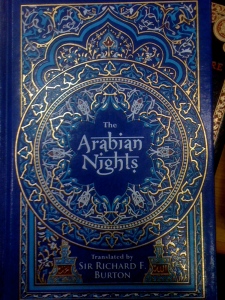
The royal perfume house of Amouage would be perfect for a fairy tale or Greek myth. It would be the story of King Midas, and all he touched would be perfume gold. It would The Arabian Nightshave Ali Baba and a cave filled with treasures of scent and spice, incense and frankincense — not stolen by thieves but given freely by the Sultan with the order to create the most luxurious scent in all the land. Or, it would be the story of “Perfume” without serial killers and death, and with a happy ending.
As the renowned perfume critic, Luca Turin, said in a 2007 German magazine article:

The story of Amouage is remarkable. Twenty five years ago an Omani prince decided that his country, renowned since Egyptian times for the quality of its frankincense, home to the unique Green Mountain rose and on whose beaches half the world’s ambergris lands at random, needed a perfume firm that would take on the world’s greatest.

So, in 1983, His Highness Sayyid Hamad bin Hamoud al bu Said was ordered to do just that by His Majesty Sultan Qaboos bin Said, the ruler of the Sultanate of Oman. As the perfume store Aedes explains, they wanted “to tell the world about the ingredients particularly found in Oman – the rarest frankincense from Dhofar in the south of the country and the rarest rose of all, the rock rose harvested high up in the mountains of the Jebel Akhdar range towering over the Sultanate’s beautiful capital, Muscat.”

A Thousand and One Nights.

A Thousand and One Nights.

Consequently, Amouage tends to use very Middle Eastern ingredients such as oud or agarwood, rose, incense, resins like labdanum, and spices. It also hires some of the most famous “noses” in the perfume world to create its fragrances, supposedly with an unlimited budget. No expense spared. And the result is some of the most expensive perfumes in the world, even if no longer the most expensive. (It amuses me that the Amouage website describes its offerings as “The Gift of Kings” because it truly means that – both literally and figuratively.)

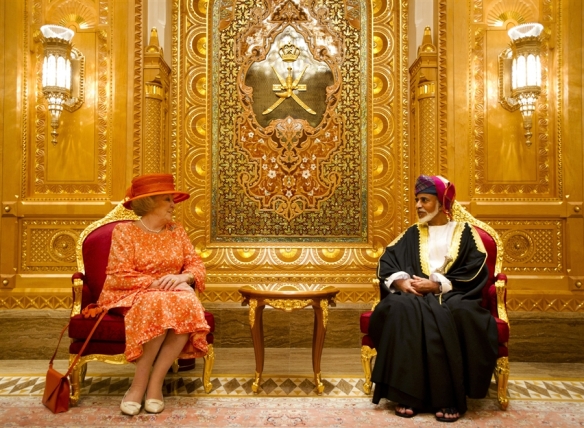
The Sultan of Oman with Queen Beatrix of the Netherlands in Oman.

The Sultan of Oman with Queen Beatrix of the Netherlands in Oman.

On its 25th anniversary in 2007, Amouage launched two celebratory eau de parfums Amouage 2 Jubiliationsunder the guidance of its artistic director, Christopher Chong, and created by the famous orientalist nose, Bertrand Duchaufour. (“Orientalist” is Luca Turin’s description, not mine.) The men’s version was called Jubilation XXV and the women’s version was Jubilation 25. Both versions are eau de parfum concentration and both are essentially considered to be unisex fragrances. Certainly both genders seem to wear the different versions. I have both and plan to review Jubilation 25 tomorrow. For now, let’s focus on the men’s version.
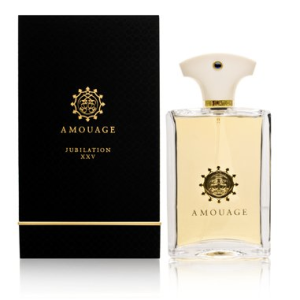
Jubilation XXV is classified as an “Oriental Fougère” fragrance for men, which essentially means its a woody, aromatic oriental. (See the Glossary for a full explanation of the Fougère family of fragrances.) Fragrantica lists the notes as follows:

Top notes are orange, coriander, labdanum, tarragon, olibanum and blackberry;

middle notes are guaiac wood, cinnamon, bay leaf, honey, orchid, rose, clove and celery seeds;

base notes are opoponax, patchouli, myrrh, cedar, musk, oakmoss, ambergris, agarwood (oud) and immortelle.

Amouage describes the perfume’s evolution as follows:

With the grandeur of a great epic, Jubilation XXV opens majestically with notes of the finest frankincense from Oman.

At its heart are elegant notes of rose, orchid and smoky gaiac wood, evoking the philosophy of the enigmatic man carrying the essence of his sophistication across all eras and cultures.

Like the magic of a spellbinding epiphany, notes of musk, myrrh, cedarwood, ambegris, patchouli and immortelle resonate in the depth of the fragrance expressing his longing to travel far, across all continents, to find the ethereal unknown.

Jubilation XXV.

Jubilation XXV.

I don’t see it. Jubilation XXV opens with a massive bear hug of oud, concentrated honey, sweet myrrh, a  touch of saffron, an almost imperceptible whisper of blackberry, and a strongly boozy amber accord — all under the strong auspices of balsam-heavy orange amber. It is incredibly reminiscent of Hermès’ Elixir de Merveilles, a fragrance I truly adore and which I reviewed here. It is all bitter Seville oranges which, just like in the Elixir, are wrapped in bitter black chocolate (compliments of the patchouli), salt, amber and woody balsam. I find barely any of the supposedly massive blackberry accord that a vast majority of the people have noted. There is a miniscule hint of it seconds into Jubilation’s opening, but it is mere seconds for me. The real fruit that I smell is, as noted, orange.

I was so astonished by the similarities that I tested it out a second time, late in the evening, with a different perfume on each arm. The only difference between the two openings is the touch of oud but — bar that — they were essentially identical. I’m extremely surprised that no-one else has noticed, but I suspect that most men don’t realise the Elixir is really unisex, and perhaps the average Elixir woman isn’t likely to try a seemingly “men’s” oud fragrance.

The oud note is extremely interesting in Jubilation’s opening hour. It is a fleeting, flickering thing; a darting ghost that pops up unexpectedly for a little while before vanishing from sight. Numerous commentators have said that Jubilation is a ghost as a whole: one minute it’s here, the next it’s gone, then it’s back again. They say the scent keeps disappearing, before reappearing. I haven’t had that experience with Jubilation as a whole, but I have had it with the oud element. Sometimes, it feels as though there is absolutely no oud in Jubilation and that I somehow accidentally sprayed on my Elixir. At other times, it appears with an almost mentholated note that cools down and cuts through the narcotic headiness of the warm, boozy resins, the rich heavy balsam-infused orange, and the peppery, smoky frankincense.

The oud in Jubilation is not the sharply screechy, metallic clang of the very synthetic-smelling Montale Aouds that I’ve tried. Nor is it the more medicinal oud of YSL‘s M7. It is slightly closer to the softer ouds in the By Killian Arabian Nights collection (though, at this early stage, not to Kilian’s Pure Oud). No, the oud in Jubilation is too tamed and softened by the smoky resins and the balsam-infused orange. That’s not necessarily a bad thing; it merely means that Jubilation’s first stage is not oud-dominant. (That comes later.)

Nonetheless, as a whole, Jubilation lacks the edge and hardness of some oud perfumes. It certainly lacks the more extreme aspect of oud scents like M7 (in its original formulation) which have resulted in descriptions like “dangerous.” Jubilation is a complex, nuanced, layered, very high quality and extremely expensive, rich scent. But it’s not dangerous, if that is what you’re looking for. And, dammit, it smells a lot like an oud version of Hermès Elixir for the first hour! It even has the latter’s unusual salty quality; a hint of the sea air mixed with saltwater taffy.

I checked to see how many of the same ingredients they share; both perfumes have cedar, orange, patchouli, resins, ambergris and incense. Jubilation has a ton more notes than the Elixir, but many of those separate notes come very close to replicating the accords in the Elixir. The myrrh, opoponax (sweet myrrh), labdanum (resin), olbanum (frankincense) and immortelle all have sweet, smoky, incense-y notes that parallel the Elixir’s patchouli, Siam resin, caramel, sandalwood, tonka bean and incense. Immortelle, in particular, has a maple-syrup, honey, caramel aspect that is definitely echoed in the Elixir. (See the Glossary for more details and definitions of these various notes and perfume ingredients.)

The real differences between the two scents begin after the first hour. Jubilation start to lose that sweet head, and the full roar of the woods start to appear. The lingering and final traces of orange are mentholated now, not caramelized. There is also far greater smoke. I smell hints of the Guaiac wood whose scent is described by Fragrantica as “smoky, tarmac notes” and which one Basenotes commentator finds to have a “rosy, honeyed-sweet and slightly smoky and waxy-oily slightly rubbery aroma. The Guaiac wood is subtle, especially under the much more overpowering oud notes, but it’s there. I don’t smell the coriander, orchid, bay leaf, tarragon or celery seeds listed in the notes. I cook extensively, and I know what all those herbs smell like. And they’re not appearing on me.

After a few hours, Jubilation turns into an intimate frankincense and oud party. The oud is much, much stronger now. It’s as though the top notes had muzzled it but now, it’s free to soar. The smell evokes a wintery outdoors, a large stone campfire among the dark, dry woods, with a brisk, chill in the air and the smell of burning leaves. There is stone-like coldness, with sharp black pepper and a definitely leather undercurrent to this oud. As such, it is very reminiscent of By Kilian’s Pure Oud. There is also that rubbery, almost plastic-y but medicinal aspect to the oud that calls to mind the pink plastic sides of a bandaid. That part evokes YSL’s M7. I wonder at times how much of this is the oud and how much is the Guaiac wood with its tarmac, rubber, pepper and smoke notes that others have found. Perhaps it really is just the oud itself combined with the incense, smoke, and biting pepper of the frankincense.

It doesn’t matter. The final result is that the two overarching smells alternate between a gentle waltz, an intimately fiery tango, and a loud cha-cha-cha. They weave in and out of the room. Sometimes, they are snuggling in the dark shadows of the alcoves – just out of sight. At other times, they tango back into the room and the rat-a-tat-tat of their heels stomp up my arm and to my nose. Then they vanish again. It’s bewildering. If I hadn’t read all those comments about the perfume’s on-again, off-again vanishing act, I would think I was hallucinating or that my nose had gone wonky.

The ghost act makes it hard for me to assess the sillage of Jubilation. Its projection for the first hour is as big as everyone says, but then it becomes much more difficult to ascertain. More than one person has wondered if Jubilation was just so strong at the start that their nose “got used to it” for large stretches of time. I will say that, on me, Jubilation does not have the massive longevity that most report — but that is hardly anything new. All in all, Jubilation lasted about 5.5 hours on me, with the last 3 being close to the skin.

All in all, I liked Jubilation XXV, but I’m hardly tempted to share in the mass genuflection and obeisance for the fragrance. Much of the adoring, worshipful praise seems — to me — to stem from those lovely opening notes that some have compared to spices and dates (the fruit) in a Turkish bazaar. Believe me, I know how utterly divine those notes can be; I raved about them extensively for Hermès’ Elixir de Merveilles. I suspect the Elixir is precisely why I’m not more overwhelmed and passionate about Jubilation; I’ve already had the experience. But, for one who hasn’t and who is seeking an oud fragrance on top of it, then I suspect Jubilation XXV will make you rather weak at the knees. It is not an overwhelming, crushing oud fragrance but a very luxurious one that feels expensive. Which is just as well, given that it is expensive.

Bloody expensive, in fact! The usual bottle is 3.4 fl.oz/100 ml and costs $290, £170.00 or around €210. There is a smaller 1.7 oz/50 ml version that costs £140.00, but a cursory review of a few US websites shows it is not available on any of the usual or big perfume sites. I found the smaller size only at Beauty Encounter where it retails for $245. It’s not a particularly good deal, given that double the quantity (or 3.4 oz) costs only $50 more. (As a side note, the women’s version of Jubilation is slightly more expensive in general: $300 for 3.4 oz, instead of $290.)

Amouage Gold in actual gold.

Amouage Gold in actual gold.

So, is Jubilation XXV worth getting? As always, that is a subjective and personal decision, but the cost of Jubilation makes it a bit more complicated than that equation usually is. Amouage may no longer make the most expensive perfume in the world — that was Gold in 1983 — but it’s still not a walk in the park. Yet, for a large number of people, Jubilation XXV is a scent without compare, one of their all-time favorites, and completely worth every golden penny. I would suggest testing it out via a sample. If it steals your heart, wonderful. If not, then perhaps you can always layer one of your existing ouds (particularly if you already own one from By Kilian) with the significantly cheaper, but always marvelous, Elixir de Merveilles.

DETAILS:
Availability & Stores: In the US, Jubilation XXV can be purchased online at AedesFour SeasonsLuckyscent or Parfums Raffy. (Google and Parfums Raffy state that it is the authorized retailer for Amouage and that it provides free shipping.) If you want the smaller 1.7 oz version, you can go to Beauty Encounter. Samples of Jubilation can be purchased from all those places, as well as from Surrender to Chance (the decant site I always use) where the smallest vial costs $3.99. In London, I’ve read that Jubilation XXV is available at Harrods, Fortnum & Mason, Les Senteurs or the Amouage boutique. In Canada, I’ve read that it’s available at The Perfume Shoppe. In Germany, at First in Fragrance. And, of course, it is available world-wide on Amouage’s own website. The website also has a “Store Locator” for about 20 countries which should, hopefully, help you find Jubilation somewhere close to you.

Perfume Review – Les Néréides Imperial Oppoponax: Evoking the Guerlain Classics

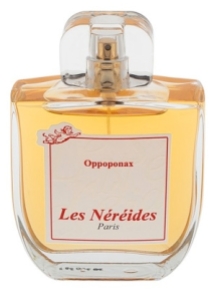
Imagine a pool of molten amber, covered with the sheen of fresh citrus oil. It’s like a thin film covering the thick, unctuous depths below. At the very bottom of the pool is a thin layer of white. Not sand, but powdered vanilla. That is the image evoked by Les Néréides Les NImperial Oppoponax, a unisex fragrance that is all sweet myrrh, amber, sandalwood and powdered vanilla.

Les Néréides is a French perfume house that initially started in the world of expensive, high-end costume jewelry before branding out into perfume. Their fragrances represent their overall ethos of the most basic, pure and simple ingredients but at the most luxurious level. They eschew expensive or fancy bottling, preferring to opt for a minimalistic aesthetic, both to appearance and, to some degree, the perfume itself.

Imperial Oppoponax embodies that aesthetic very well. It also embodies something else: vintage Shalimar by Guerlain. It’s incredibly similar, to the point that I’m in a Shalimarslight state of disbelief. (And joy.) Those who mourned the loss of their beloved legend to the horrors of IFRA restrictions and reformulations should rejoice. Because I could swear I’m wearing Shalimar, particularly in its dry-down stage! Imperial Opoponax (which has now been renamed simply “Opoponax”) is a mere eau de toilette, but it truly conjures up the glories of Shalimar at its best — both in the stronger parfum concentration and in its vintage state, before Shalimar was destroyed in a haze of synthetics and IFRA-mandated changes. (“IFRA” is the international perfume federation whose 2010 rules on the amount, type and concentration of certain key ingredients has forever altered the nature of the perfume world for the worse.)
Imperial Oppoponax is classified as a “Oriental Woody” on Fragrantica and its notes are not complicated:

citrus, opoponax (sweet myrrh), amber, vanilla, sandalwood, and benzoin (resin).

For point of comparison, Shalimar has a few more: citrus; lemon and bergamot, jasmine, may rose, opoponax, Tonka bean, vanilla, iris, Peru balsam and gray amber. (And, yet, on me, Imperial Oppoponax has a slightly similar citrus opening and an identical dry-down.)

Imperial Oppoponax opens with a sharp, almost masculine burst of citrus. There is a definite feeling of classic men’s colognes in its sharpness; impressions of Guerlain‘s Habit Rouge cologne for men float through my mind along with Guerlain’s Shalimar. It’s definitely the opening of a very intense citrus-y, woody, aromatic oriental. I put on some vintage Shalimar parfum on my other arm and compared the scents. Shalimar is richer in its citrus start, more nuanced and complex, with florals and greater warmth. Imperial Opoponax is much closer to Habit Rouge with its crisp, fresh, faintly herbal twist on a citrus start.

Ten minutes into the opening, hints of the sweet myrrh and resins begin to tiptoe into the picture. You can find more details on benzoin and sweet myrrh in my Glossary, but,

Benzoin

Benzoin

in a nutshell, benzoin is a type of resin that has a light, sweet, often powdery vanilla scent, while sweet myrrh can range from slightly nutty and amberous, to faintly herbal and balsam-like.

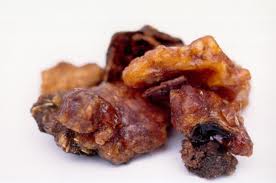
According to NST, opoponax “has a sweet,

Opoponax

Opoponax

balsam-like, lavender-like fragrance when used as incense. King Solomon supposedly regarded opoponax as one of the ‘noblest’ of all incense gums.” Here, the balsam element to opoponax adds a woody, almost smoky note to the perfume, while the lavender is an aromatic.

The two notes together, along with that citric start, solidify my impressions of old Habit Rouge. I happen to adore Habit Rouge with a passion, so I can’t stop sniffing my arm. Some find the opening of Imperial Opoponax too masculine and too strongly evocative of an old time barber shop. To me, Imperial Oppoponax is a happy trip down memory lane! Lemon and lime! Subtle lavender (but in a good way) with traces of powdered vanilla! Wood that almost smells faintly cedar-ish! God, this is lovely!

It may sound odd to think of balsam trees and lavender mixed with a very boozy, sweet,  almost nutty, ambery scent and vanilla powder, but it works. Like Habit Rouge, the sharp, almost excessively zesty citric start is balanced by an immediate impression of greater depth and warmth. There is a strong hint of smokiness and incense that are emerging, but the real star is a definitely boozy amber with its undertones of powder.

The citric notes fade about 30 minutes in, leaving the rest of the perfume as one very well-blended resin booze fest. There is real intensity to the sweet myrrh and benzoin, and it’s almost narcotically heady. There is a faint sharpness or accridness to the smell, though I don’t know if it’s from the smoke — which makes me think of a weak form of frankincense –or if it’s the combination of the ingredients together.

Imperial Oppoponax is a very well-blended perfume but it might easily be called linear. From reading comments about Les Néréides style, I get the definite impression that they seek to essentially bottle the essence of an ingredient in its most concentrated, pure form. Here, it’s oppoponax and while there are other players on the stage, they are all supporting cast members to support the star and to make it shine even more brightly. I also get the crazy feeling that Les Néréides’s goal with Imperial Oppoponax was essentially to bottle the basenotes of the classics. Did you ever smell something whose basenotes or dry-down was so enchanting that you thought to yourself, “why can’t they just bottle THAT?! I would buy a full bottle of that!”

Well, I think that’s what Les Néréides tried to do here. If they didn’t seek to do so intentionally, it is the final result nonetheless. Imperial Oppoponax evokes the Guerlain classics extremely well but what it really epitomises is the dry-down on Shalimar. It starts off as Habit Rouge, and then develops into Shalimar. With every passing hour, as the Imperial Oppoponax opens further, softens and unfurls its warm heart, it evokes the sweet myrrh, ambergris, tonka bean, and vanilla base notes of Shalimar. The tonka bean and vanilla that form the Guerlinade or signature to almost all Guerlain scents is evident here, even though the sweet vanilla and powder comes from benzoin instead. And the peru balsam in Shalimar is paralleled by the balsam notes to the opoponax that both perfumes share.

Tea fireplace

A cat who clearly shares my appreciation for fireplaces and cozy atmospheres.

The middle to final stages of Imperial Oppoponax are all cozy, snuggly and warm. I felt imperious, slightly haughty and very Parisienne when I went out earlier this afternoon with Imperial Oppoponax enveloping me. But tonight, once home, the warmth and coziness made me reach for my flannel pajamas and a soft pashmina wrap, as I suddenly wished I lived someplace where a real fireplace wouldn’t be laughable. It’s a scent of great femininity but also great softness; it makes you want to cuddle and snuggle, even if it’s just with a soft blanket and your German shepherd.

Imperial Oppoponax has impressive sillage for the first two to three hours. If you spray too much, you may smell the sweet myrrh almost at the back of your nose. It has definite forcefulness, this perfume. And it does “not go gently into that good night” either, to quote the poet Dylan Thomas. No, Imperial Oppoponax stays and stays — even on me. It projected its scent solidly for the first three hours but only became close to the skin about five hours in! However, I could still smell it on my wrist for hours after that. All told, Imperial Oppoponax lasted just over 8 hours on me. Eight. Me! It’s positively shocking, especially when you consider that this is a mere eau de toilette!

It’s also an incredibly affordable eau de toilette, if not a flat out steal. Imperial Oppoponax — or just plain “Oppoponax” as it is now called — costs $70 for a large bottle (100 ml or 3.3/3.4 fl. oz.). In contrast, a 1.7 oz bottle of Shalimar eau de toilette costs $73 at Sephora. And, if I may point out once again, that would be for a reformulated version of Shalimar which smells nothing like the real, original scent, and which is full of synthetics that smell artificial and sharp. If you ever loved the middle to final notes of (original) Shalimar, then Imperial Oppoponax is a scent you may want to strongly consider. It’s almost a bargain in some ways. If, however, you never were all that fond of the powdered vanilla Guerlinade base to begin with, or if you don’t like a powdery accord to your boozy resins, then Imperial Oppoponax may not be for you.

Personally, I’m thrilled to finally have a way to smell both my beloved Habit Rouge and Shalimar, all in original vintage form and all in one bottle. I consider Imperial Oppoponax to be some sort of karmic finger in the face of the IFRA olfactory atrocities. It’s almost as though Les Néréides said, “You think you’re going to change the face of perfume history? Well, we’ll see about that!”

I don’t know how they did it, but bravo!

DETAILS:
Cost & Availability: Imperial Oppoponax is sold (under the fragrance’s new name, “Oppoponax”) on Luckyscent for $70 for 100 ml/3.4 fl oz. You can also find it on the company’s website, Les Néréides, for 50,00 € tax incl. It only comes in Eau de Toilette version.