Review En Bref: Guerlain Spiritueuse Double Vanille

As always with my Reviews En Bref, I’ll give you a summary of my impressions of a perfume that — for whatever reason — didn’t seem to warrant a full, exhaustive review.

Guerlain SDVSpiritueuse Double Vanille (“SDV”) from Guerlain is a lovely, cozy fragrance. Created by Jean-Paul Guerlain and released in 2007, it was once part of Guerlain’s “Exclusive” range but is now available outside of Guerlain stores. It is an extremely unisex fragrance, despite being labeled as a perfume “for women.”  

On its website, Guerlain describes the scent through a quote from Jean-Paul Guerlain:

If a colour or fragrance were to be associated with each day, like the planets were in ancient times, sandalwood would be the Sun, saffron would be Jupiter, and without doubt vanilla would be Venus.

Guerlain SDV 2The notes in the perfume are:

  • Head: Pink Peppercorn, Bergamot, Incense

  • Heart: Cedar, Bulgarian Rose, Ylang-Ylang

  • Base: Vanilla Bean, Benzoin

Spiritueuse Double Vanille opens on me in a way that is really true to its notes. There is an immediate burst of rose, bergamot and incense, followed quickly by pink peppercorn. The bergamot isn’t like Earl Grey tea but, rather, more like petitgrain: the woody-citric distillation of twigs from a citrus tree. The rose is heady, sweet, rich and dark. A definite damask rose.

There is obvious vanilla throughout, strongly evoking long, freshly sliced Madagascar beans or concentrated vanilla extract. It leads to a very boozy smell, tinged with florals and some incense notes. The latter is particularly lovely, as the smoke is not bitter or smoky. Rather, it’s sweet and rounded. It’s a perfect counterbalance to the rose.

Ten minutes in, the rose fades just a little, leaving a definite impression of an apple pie soaked in vanilla ice-cream with rum sauce. Twenty minutes in, a subtle, quiet cedar note emerges. It’s not camphorous, but fresh and dry, like a new cedar chest of drawers. Despite the subtle wood note, the overwhelming impression is of apple pie and hookahs (or water pipes).

And that is why this is such a short review. I feel as though I’ve been down this road before: Spiritueuse Double Vanille reminds me almost exactly of Hermès‘ 2004 Ambre Narguilé. There are a few, very small, extremely minor differences but, all in all, I feel as though I could essentially just repeat large chunks of my review of Ambre Narguilé here, and be done with it. They are both incredibly boozy, rich scents with fruity tobacco and swirling incense, smoke notes that evoke a hookah. I’m hardly the only one who has noted the incredibly strong similarity. Birgit from Olfactoria’s Travels said the same thing, and there are numerous Basenotes threads comparing the two (along with Tom Ford’s Tobacco Vanille).

There are some differences, though they are subtle. The Guerlain is slightly denser and richer, and a tiny bit less airy than the Jean-Claude Ellena concoction for Hermès. The latter has faintly more fruity undertones, especially to the tobacco, while the Guerlain is more fruity-floral. Also, the tobacco in the Guerlain fragrance turns from that of sweet pipe tobacco into something a bit dryer, earthier, in its dry-down, more akin to actual tobacco leaves. The Hermès perfume screams out “rum, rum raisin, rum, more rum, and amber,” while the Guerlain’s chant might be “rum, vanilla, rum raisin, vanilla, rum and vanilla, and vanilla.” Honestly, though, those nuances are not strong enough to warrant buying bottles of both. If you have one, you don’t really need the other. (That said, when has actual “need” ever figured into perfume purchases?)

As noted up above, Spiritueuse Double Vanille is often compared to Tom Ford‘s Tobacco Vanille. I have not yet tried the latter (though it is becoming increasingly apparent that I need to move my sample up on my list of things to review), but, again, there are supposed to be differences. This time, however, the differences are said to be quite stark. From what I’ve read on Basenotes and elsewhere, Tom Ford’s perfume is supposed to be brash and assertive — Spiritueuse Double Vanille on steroids, if you will. Guerlain’s perfume is said to be perfect for those who find the Tom Ford to be too much. As a side note, I’ve also read of a third perfume to which the Guerlain can be compared: Bond No. 9‘s New Haarlem. I have no familiarity with that one, either, but, if you’re interested, you can read a discussion comparing all four scents on Basenotes.

Luca Turin gave Spiritueuse Double Vanille a less than stellar review in Perfumes: The A-Z Guide. Calling it “bad vanilla,” his snarling two-star review is as follows:

Anyone who has bought vanilla in pods knows that they do not smell very good up close, with dissonant fruity, rum-like notes that make you feel like skipping lunch. Guerlain obligingly magnifies all the negative traits of vanilla in this pointless, loud, and misconceived confection.

(As a point of comparison, Luca Turin gives Ambre Narguilé a three-star review that is slightly more flattering and positive.)

On Fragrantica, the criticisms of Spiritueuse Double Vanille seem to fall into two, related camps. First, that it is a linear scent of simple, boozy, vanilla extract. Second, that it is too expensive for what it is. Spiritueuse Double Vanille comes in only one size (2.5 oz/75 ml) and costs $250. I think price is, ultimately, a very subjective, personal thing, so I won’t comment on that. With regard to the other criticism, I don’t think SDV is a one-note scent and, on me, it’s certainly more than just plain vanilla extract. But, even if it were, I believe linearity is only a bad thing if you absolutely hate the note(s) in question.

The sillage and longevity of Spiritueuse Double Vanille is impressive. There was a scent bubble for about four hours, after which it became closer to the skin. All in all, it lasted about 8.5 hours on me. On others, it is said to last all day, though it is not the “beast” that is Tobacco Vanille.

If you like comforting, warm, sweet and boozy scents, I think you should give Spiritueuse Double Vanille a try. It’s not earth-shattering, but it is very cozy and I suspect some may find it wholly addictive.

DETAILS:
Cost & Availability: Spiritueuse Double Vanille costs $250 for 2.5 fl. oz/75 ml. It is available at Guerlain boutiques, and on its websiteIt is also available on the Nordstrom website and, apparently, in the store. It is shown on the Neiman Marcus website (where it is priced at $225), but there is a note saying that it is not available; the same story applies to Bergdorf Goodman. (I don’t know if it is available within the stores themselves.) For all other countries, you can use Guerlain’s Store Locator on its website. If you’d like to give SDV a test sniff, you can get a sample from Surrender to Chance where prices start at $4.99 for half of a 1 ml vial.

Perfume Review – Ormonde Woman by Ormonde Jayne: The Dream Landscape

Thomas Gainsborough. "Open Landscape with Shepherd, Sheep and Pool." The Victoria and Albert Museum

Thomas Gainsborough. “Open Landscape with Shepherd, Sheep and Pool.” The Victoria and Albert Museum

If a perfume were a painting, I think Ormonde Woman would be one of Thomas Gainsborough’s famous landscapes. The perfume by the niche luxury house of Ormonde Jayne is reminiscent of the famed 18th century painter’s portrayal of nature, all bright light contrasted by dark intensity, hidden mystery, and hints of rich warmth. Gainsborough created a dream-like, hazy impression through soft brush strokes and, yet, there is the dark verisimilitude of the Dutch painters, like Rubens, who inspired him. Light and dark, depth and surfaces, reality and a dream — it is all simultaneously evoked by the brilliance that is Ormonde Woman.

The unisex perfume was the very first fragrance put out by Ormonde Jayne upon its debut in 2002, and it is the luxury perfume house’s signature scent. It is a scent of some renown, has received a five-star rating and was named as one of the 100 great classics by the perfume expert, Luca Turin, in The Little Black Book of Perfume: 100 Great Classics.

I’d heard vague, breathy mentions from people of this “amazing” scent, but never really paid much heed until some months ago when one of my oldest friends — who knows almost nothing about perfume — asked me about it. I was so taken aback by her interest (and in a niche perfume, no less!) that I ordered a sample. In all honesty, it took me months to get around to testing Ormonde Woman because I tend to be put off by things with a lot of hype. (I still haven’t seen the movie, Titantic. And I never will.) So my first foray into the Ormonde Jayne brand was with Tolu. It captivated me and rendered me weak with joyous admiration. It also made me determined to explore the brand’s signature perfume. And, you know what? The hype over Ormonde Jayne is fully warranted! Ormonde Woman

Ormonde Jayne is described on Fragrantica as a chypre, but I think Tania Sanchez has a better description in her book with Luca Turin entitled Perfumes: the A-Z Guide. There, she categorizes it as a “forest chypre.” (In a nutshell, a chypre perfume is a scent that begins with citrus notes and ends with either oakmoss, patchouli, musk, or some combination thereof. You can read a more detailed explanation of the important chypre category of fragrances in the Glossary.) Ms. Sanchez’ five-star review of Ormonde Woman helps explain, in part, why the perfume is so special:

Of the many feminine perfumes since [Chanel’s] Bois des Iles that have been composed around woody notes, the others that I can recall have been cozy, powdery-rosy, touched with mulling spices, with the warm furred feeling of a napping cat by the fire, or, more recently, hippie-inspired simple concoctions meant to evoke mostly the gorgeous smell of hard-to-get sandalwood oil. Ormonde Woman is the only abstract woody perfume I know that triggers the basic involuntary reflex, of stepping into a forest, to fill one’s lungs to bursting with the air. This is a full-fledged perfume with all of the sophistication of Bois des Iles and its ilk, but none of the sleepy comfort. Instead, it has the haunting, outdoors witchiness of tall pines leaning into the night — a bitter oakmoss inkiness, a dry cedar crackle, and a low, delicious, pleading sweet amber, like the call of a faraway candy house. Lulling and unsettling in equal measure, and truly great.

Gainsborough. "Moonlight Landscape with Pool."

Gainsborough. “Moonlight Landscape with Pool.”

I agree in large part with Ms. Sanchez’s review. I certainly agree that Ormonde Woman can be lulling and unsettling in equal measure, but I would also add some other adjectives to the mix: “mesmerizing,” “hypnotic,” and “unisex” for starters. However, I think it’s almost regrettable that she used the word “witchiness” in her paean to the perfume. It has led to a plethora of reviews talking about Ormonde Woman’s witchy aspect with a few unsettled posters even writing that they feel it is a scent best suited for Halloween. I think the adjective minimizes the perfume to something that is only a tiny part of its essence, and hardly the sum total.

The Tsuga tree or, "Black Hemlock."

The Tsuga tree or, “Black Hemlock.”

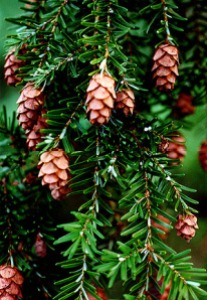
The source of all this magical business stems from one simple cause: Black Hemlock. It is the key to the Ormonde Woman and, though it may conjure up images of warlocks and witches, it is actually just a type of spruce tree. To be more specific, it is the name for a pine tree of the Tsuga genus. Ormonde Jayne was the very first perfume house to use the ingredient — a sign of its innovative, creative approach to perfumery — and, according to Wikipedia, others have followed suit.

Linda Pilkington, the founder, nose and soul behind the Ormonde Jayne brand, talked about the Black Hemlock note and the persona of the Ormonde Woman with the blog Riktig Parfym (formerly Fragrant Fanatic). I highly recommend reading the interview; there, as in all the other interviews that I’ve read with Ms. Pilkington, she comes across as charming, down-to-earth, self-deprecating, open, direct, and full of warmth. (I realise that I’m starting to sound like a crazed “fan girl,” as Americans put it, about Ms. Pilkington. I plead guilty.)  Her explanation of the ingredient is as follows:

Ormonde Woman is based on hemlock and there are 3 types of hemlock. There is the tree, the bush and the plant. The plant (which is not the hemlock used in OW) is poisonous and if you boil it and then drink the water you’ll first get a sensation that you’re feet are numbing and as the poison spreads through your body, you get paralyzed and die. This was used in 15th-16th centuries as a womans way to murder a man. As a woman usually is physically weaker she cannot strangle a man, but to boil a plant and put into his food isn’t usually a problem. And it’s still done today. So, the persona of Ormonde Woman is a woman who knows what she wants. She has long raven colored hair, wears a long black cape and rides through the woods at night, maybe to meet a lover?

Ormonde Woman and its notes are described on the company’s website as follows:

Beginning and ending with the unique scent of Black Hemlock absolute – rarely used in such luscious quality and quantity – this utterly hypnotic, unconventional and mysterious woody essence is combined with jasmine and violet absolute to create a dusky, seductive perfume.

Top NotesCardamom, coriander and grass oil
Heart Notes: Black hemlock, violet and jasmine absolute
Base Notes: Vetiver, cedar wood, amber and sandalwood.

Source: Miriadna.com.

Source: Miriadna.com.

Ormonde Woman opens on me with fresh, zesty citrus, bitter resin, a massive dollop of spice, and bright greens. At first, I thought it was like spicy grass but, after some contemplation, I think it’s more like fresh moss. Not oakmoss, per se, or, at least, not the usual oakmoss. There is none of the pungent, almost dusty, grey-mineralised aspects of the note. Instead, this is like the brightest moss were it jade green, wet from

Image: Moody. Source: Canadian Govt. Website.

Image: Moody. Source: Canadian Govt. Website.

dew, and covered with amberous spices. People are right when they say that it evokes the green, mossy floor of a forest. It is almost tinged with dark shadows; there is none of the sweet mildness of freshly cut grass on a summer’s day. That comes later. For now, the moss is wet and tinged by the cedar and sandalwood trees around it.

Yet, the real focus in the opening hour is the Black Hemlock. It is fascinating. Resinous evergreen with burnt notes and black licorice. The strength and prominence of the note seems to vary widely with the amount of the perfume used. In fact, I think the quantity you use may dramatically change your impression of the opening. The first time I tested Ormonde Jayne, I didn’t dab on a lot; only 2-3 tiny blots from the vial on each arm. With that amount, the Black Hemlock note was prominent, but not the sole focus. The second time, I dabbed on quite a bit (4-5 smears, approximating 2 big sprays per arm). The Black Licorice Wheelsresult was as if a black cloud had suddenly descended upon the forest. There was a massive, monumental dose of black licorice, much more of a burnt aroma, and a contrasting cool, chilled, mentholated impression. For some reason, it calls to mind the image of something like tar. Not the tar that they use to pave roads but, rather, the treacly, thick, blackish paste found in Marmite. Actually, there is more than just a visual similarity to Marmite. There is a quiet saltiness underpinning the sweet spice. It’s faint, flickering in the background like a ghost, but it’s there.

Antique Spice Drawer on Etsy. Source: Prairie Antiques.

Antique Spice Drawer on Etsy. Source: Prairie Antiques.

In greater doses, the spice accords in the perfume also gain heft, and my impression of bright green grass or dewy moss become much less. The faintly lemony note of coriander and the lightly spice earthy-sweet notes of the cardamom were much more noticeable. But something else was apparent. Star anise. I could swear that I smelled the Chinese Five Spice mix, dominated by its star anise element. There was also a strong impression of spiced wood, almost like a faintly dusty spice drawer in an old cabinet where the wood has absorbed decades of strong spices.

Tsuga Needles

Western Hemlock. Source: Puget Sound University.

The licorice was not only more prominent in greater doses the second time round, but so too were the mentholated, chilled camphor notes and the evergreen. Having never smelled Black Hemlock prior to now, I have no idea if the minty-mentholated notes come from the cedar or from the spruce/pine tree. Regardless, they become stronger and stronger until — 30 minutes in — the predominant note emanating from my arm is pine needles. They’re so fresh and concentrated, it’s as though you scraped them right off the tree and crushed them between your fingers.

An hour in, the pine needles fade and have their place taken by sandalwood. Ormonde Woman is actually the first time in a long time that I’ve smelled real, actual, genuine sandalwood in a truly prominent way. A large portion of the perfumes which claim to have that rare, exorbitantly expensive ingredient and which I’ve tested lately seem, to me, to have absolutely no visible, noticeable traces of it at all. In truth, after the recent test of one perfume which claimed to have sandalwood in its notes, I was starting to wonder if I even knew what it smelled like anymore.

Well, it’s here. And, it’s not synthetic! It is sweet, lightly smoky, like creamed honey and molten resin mixed with wood. I’m rather awed by its strength and character, given the scarcity of true sandalwood and its cost. In fact, the strength of the note here makes Ormonde Woman a modern call-back to  those rich sandalwood orientals of the 1970s and 1980s, before the Mysore wood was over-harvested and had to be placed under government protection. The sandalwood mixes with a faintly aromatic, woody, cedar-y scent; with the slightly green-sweet-earthy aspect of cardamom; with the bright, dewy, wet moss; and with a vague breath of something floral. It is a play on bitter and sweet, woody and green, wet and dry.

That vague floral note soon turns into pure, sweet jasmine. Ms. Pilkington has said she likes to work with hedione, a compound often used in conjunction with Jasmine Absolute (which is a part of Ormonde Woman). Hedione lends a vaguely green, fresh tone to the jasmine here. When combined with the lemony fresh notes of the coriander, they cut through any possible indolic heaviness that the flower may have, leaving only sweetness and brightness. I’m afraid that jasmine is the only real floral note that I can smell; in neither of my two tests could I really smell the violets that others have noted. Frankly, violet seems like such a dainty flower that I don’t know how it could possibly compete with the heavy woods, the faintly smoke elements, the resins and the spices.

In the middle stage and the final dry-down, those latter accords still remain. On me, it’s all creamy, delicious, intoxicating sandalwood, resinous amber, and faintly lemony wood. There is still a faintly tarry, smoky note, though the mentholated, almost camphorous notes of the cedar (and Black Hemlock?) have mostly dissipated. There is also the mild sweetness of summer’s grass and the earthy greenness of vetiver dancing in the shadows, faint but there nonetheless.

I have the oddest visual image in my mind: a large, chewy, sort of brownie square. It’s tarry, black, smoky, and moist with bits of light-brown cedar chips sticking out of it and chunks of chilly black licorice. It’s speckled with little glowing orbs of sweet, honeyed amber that dot its surface and the whole thing is wrapped in a box filled with jade-green, dewy moss, sweet emerald-green grass, and delicate white jasmine.

Gainsborough. "Landscape with Cows and Human Figure."

Gainsborough. “Landscape with Cows and Human Figure.”

But, most of all, I feel as though I have entered a Gainsborough landscape through a dream. To me, Ormonde Woman is a perfume of great contrasts where the woods are dark and mysterious, drawn in realistic detail, but there are contrasts of shining bright light and parts where everything is soft, hazed, romantic and dreamy. One is jolted at first, then enveloped in softness. Based on my experience with Tolu, I think such contrasts are something that Ms. Pilkington does very well. They are also one reason why there is such depth and complexity to her scents.

It is utterly mesmerizing, and most definitely unisex. Not feminine, but unisex! I’ve read that the men’s counterpart, Ormonde Man, has oudh and pink peppers in it, and that it’s supposed to be much less sweet. I haven’t tried it to know but, frankly, I think a man would smell divine in Ormonde Woman. In fact, it seems to be a big hit with men due to the strongly woody notes and the Black Hemlock.

That said, I don’t think Ormonde Woman is for everyone. It will be too masculine for women who prefer lighter, sweeter or floral scents. My friend who initially asked me about it months ago enjoys light, airy, fresh green scents; for someone like her, Ormonde Woman would be far too much: too tarry, too spicy, too woody. In addition, the bitter aspect of Black Hemlock seems to have been a problem for a number of people, leading them to react quite strongly. Interestingly, a few perfume bloggers who recoiled upon first essay ended up falling in love with the fragrance some time later after trying it again. So much so that they bought a full bottle!

On Fragrantica, one male poster, “smcandsmc,” wrote something that I think sums up the fragrance perfectly:

Stunning. Wow. Grassy top lifted me off the ground, gorgeous rich middle keeps me suspended in mid air. […]  Seriously having an out of body experience over this. Plotzing. When I read rhapsodic descriptions of the vintage classics in their vintage formulations that I will never experience, this is the depth, richness and quality I imagine.

The superb richness and quality that “smcandsmc” noted is a key characteristic of Ormonde Jayne scents. The perfumes consistently scream high-quality luxury in a way that has utterly transfixed me. I’m sure there will be some in the line that won’t suit my personal style, but the quality of those I’ve tried thus far cannot be denied. They have been outstanding across the board. You can tell that the highest quality ingredients were used in order to create the most luxurious, wonderfully indulgent, seductive experience possible. And the fragrances repeatedly meet the brand’s overall philosophy:

quality and true luxury, the pursuit of beauty and elegance. […]

[The return] to the golden age of perfumery, an elegant era when fragrance creation was a fine art.

Perhaps more importantly, Ormonde Jayne fragrances are approachable and wearable. They are not edgy, sometimes discordant, intellectual art that you would admire but rarely (or, in some cases, never) wear. I can see women and men alike wearing Ormonde Woman frequently, whether on special occasions, for a casual dinner, or just simply to the office (though I would advise caution with regard to the quantity used if you plan on wearing it there). Ormonde Woman has a high degree of concentration: 25% in its most basic form (which seems more akin to extrait de parfum for some other lines), so the sillage can be very strong depending on the amount sprayed. On me, Ormonde Woman wasn’t as strong or potent as Tolu, but it had good sillage for the first two hours, becoming close to the skin around 3 to 3.5 hours in. As a whole, it lasted around 6.5 hours on my perfume-consuming skin. On others, it generally seems to last a long time (8-10), though I’ve read some conflicting reports of its tenacity.

I could go on and on about both Ormonde Woman and the Ormonde Jayne line itself. Truth be told, my initial draft was well over 4,000 words! I have struggled to give you the essence without sounding like a crazed loon but, if space and my readers’ valuable time (not to mention patience) were not an issue, I would wax rhapsodic for several more hours about the astounding quality of the brand. The depth, the richness, the luxuriousness, the ease with which the perfumes transport you elsewhere upon first whiff, their almost lyrical nature….. it is a return to the “golden age of perfumery” indeed.

DETAILS:
Cost & AvailabilityOrmonde Woman is available in perfume extract (30%) and eau de parfum (25%) in 50 ml bottle, as well as in accompanying bath, lotion, cream and candle forms. It is available at the Ormonde Jayne boutique in London or on the company’s website. It is not sold in any department stores in the U.S. The website offers purchases in USD currency and, there, the cost of Ormonde Woman is as follows: a 1.7 oz/50 ml bottle of eau de parfum costs $126 (£80), while the pure parfum comes in a 1.7 oz/50 ml “premium French flacon with a gold OJ motif stopper and Japanese ribbons” and costs $300. There is a set of travel sized purse sprays (4 x 10ml) that costs $100 and a Discovery set of all 12 fragrances in 2 ml mini-sprays for $75. The perfume is also available at Harrods in London and, I’ve read, at Fortum & Mason. Please note that Harrods only sells Ormonde Woman in the expensive bottle for £184.00, not in the £80 bottle available on the brand’s own website. Ormonde Jayne fragrances are also sold in Brussels, Belgium at Senteurs d’Ailleurs (whose website is under construction, so I can’t link you to anything) and at Osswald in Zurich, Switzerland.
OJ Discovery SetI highly recommend the Discovery Set which the Ormonde Jayne website describes as follows: “Ormonde Jayne’s Discovery Set is comprised of 12 x 2ml mini sprays of eau de parfum, together with a brochure explaining each perfume, all housed in a black and gold box… and whats more, the shipping is complimentary worldwide.”
Samples: You can also order samples of Ormonde Woman from various sample sites. I obtained my sample from Surrender to Chance which sells samples starting at $3.99 for half of the standard 1 ml vial. It is also offers Ormonde Woman in parfum concentration for the same starting price. Surrender to Chance ships worldwide for about $5.95 (though it’s a little bit more for larger orders over $75), and for $2.95 for all orders within the U.S., regardless of the size of the order.

“The People v. Amarige” – Prosecution & Defense

The People v. Amarige – Case # 13-92745B

The Bailiff: “Oyez, Oyez, the Court is now in session. The Honorable Judge Charles Highblossom presiding. On the docket, The People v. Amarige, Case # 13-92745B. The charge is olfactory assault and battery. State your name and business before the Court.”

[A small, balding man rises]: “I am the District Attorney, Luke Sneering.”

[A tiny, dark woman rises]: “I am the Public Defender, Grace Hopeless-Causes, representing the Defendant, Amarige de Givenchy.” [She points to the table where Amarige sits. She is enveloped in the most luxurious white furs, drips gleaming diamonds, and wears the largest, frothiest hat this side of a royal wedding. The defendant’s chin is raised defiantly, her eyes staring straight ahead, but she nervously fingers her diamond choker.]

[The white-wigged judge bangs his gavel]: “The Prosecution may proceed.”

THE PROSECUTION:

[The D.A., Mr. Sneering]: “Ladies and gentlemen of the jury. We are here to convict Amarige, from the house of Givenchy, with being the most heinous perfume in the world. Countless have fallen prey to her horrors. You will hear testimony from asthmatics whom we will wheel in from the Intensive Care Unit where they landed after a mere whiff of her olfactory napalm. You will hear of her ubiquity in the 1990s, Amarige 1990sassaulting you from every magazine perfume strip, invading your home through your mailbox, until there was no escape. You will hear from Luca Turin, the perfume expert, on how she is “truly loathsome,” a perfume he rated one-star, and which he hates the most in all the world. And, in the end, you will do the right thing: you will convict her of assault and battery, even though what we really should be charging her with are crimes against humanity!
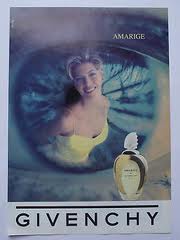
Let us start at the beginning. Amarige was let loose upon the unsuspecting public in 1991, a fruity-floral Frankenstein created by the legendary nose, Dominique Ropion, who really should have known better! Her parts, according to Fragrantica, consist of:

top notes are composed of fresh fruit: peach, plum, orange, mandarin, with the sweetness of rose wood and neroli. The floral bouquet, very intense and luscious, is created of mimosa, neroli, tuberose, gardenia and acacia with a gourmand hint of black currant. The warm woody base is composed of musk, sandalwood, vanilla, amber, Tonka bean and cedar.

In those long-ago days, as the perfume blogger The Non-Blonde states so well, there was no escape from her fumed tentacles. You didn’t have to buy it to wear it.

[You] didn’t have to: you could go into a public building, a friend’s home or get on a bus and emerge with your hair and clothes smelling of it. Amarige was so recognizable and obvious that even I, lover of assertive perfumes, couldn’t deal with it. Not to mention the fact that it’s so very peachy you could feel the juice dribble on your chin.

The Non-Blonde may have had a baffling change of heart on Amarige, but she was right when she said that “women who maintain the old habit of marinating themselves in Amarige should have their noses and sanity examined.” (Frankly, I think the Non-Blonde should have her sanity examined for her sudden appreciation of Amarige. No, time does not heal all olfactory wounds!)

I said at the start that what we should be charging Amarige with are crimes against humanity. The world agrees with me. I present as witnesses, some posters from Basenotes.

[The court security guards wheel in the witnesses that they have ferried over from the Intensive Care Unit. From their gurneys, they feebly lift their heads to take the vow to ‘tell the truth, the whole truth and nothing but the truth,’ so help them God. And then they testify.]

  • Tuberose’s reputation has been damaged almost irrepairably by this most horrid affair. If I were her I would sue.
  • Truly, truly awful. Radiates out to the orbit of Neptune. Causes asthma, retching and a stampede for the exit. Frightens children and pets, ruins dinner-parties, restaurant meals and plane journeys. Could be used to eradicate vermin from silos and warehouses. [..] Please people, stop buying this hideous juice so Givenchy will stop making it. It’s an abomination, a crime against humanity. I can’t understand why any woman would want to smell like this, or why her significant other would want to smell it on her. A chemical disaster of Chernobyl proportions.
  • this Perfume is a migraine in a bottle. […] The absolute worst fragrance I’ve ever smelled.
  • I own a bottle of it due to my initial attraction to its smell in small quantities. Wearing it, I feel nauseous and completely unable to eat anything. I tried to scrub it off in the shower but it won’t die. I haven’t eaten anything all day. I think this toxic odor could be useful as a diet aid.
  • Horrible, HORRIBLE soapy smell broadcasting out to the planet at gigawatt levels. I made the mistake of spraying this onto my wrist and I thought I’d never be able to remove it. This smell made me feel nauseous and headachey.

The final witness comes from Fragrantica:

If I had to describe this perfume in one word it would be ‘haunting’ because it’s unpleasant and, like the eerie warnings written in blood on the walls, impossible to scrub off.

‘Blood on the walls.’ Blood on the walls, people! The eerie warnings come, in part, from tuberose, one of the most indolic flowers around. What is an idole, you ask? I draw your attention to Exhibit 3, the Glossary of perfume terms. It is something found naturally in many heady, white flowers — like tuberose. In excessive amounts, it can lead to a feel of extreme full-blown, over-ripeness. In cases of fragrances like Amarige, it can turn to an aroma of sourness, even cat litter feces, plastic flowers, urine,  garbage heaps of rotting fruit, or all of the above. At best, Amarige is a fetid, rotting stinker that will turn from over-blown flowers to pure sourness and cat urine. At worst, it will choke up your airways, prevent all breathing and render you utterly unconscious. All in just 2 small whiffs.

You don’t believe me, I can see it in your eyes. Well, we shall prove it to you. Guards! Bring in the testers!”

[The guards set up two, tiny canisters at each end of the room. The jury shifts in their chairs nervously. A cordon of security blocks the doors. The District Attorney dramatically puts on a giant gas mask, akin to those used by soldiers in the first Persian Gulf War when there were fears of Saddam Hussein using chemical warfare — or Amarige — against American troops. Mr. Sneering points to the guards and nods.

Pfft. Pfft. Pfft.  

Three small whiffs of scent are released from each of the two canisters. White flower after white flower suddenly fills the room. They flit here, they flit there. They are omnipresent. There is a smell of orange, orange blossom, more orange blossom, and still more. It spreads its powerful molecules around the room like a carpet unfurling a wave. Little spectres of happy yellow mimosa flowers dance along the orange carpet. There is a shadow of some silken amber rising up, peeking its eyes above the wave of orange. Peach makes an appearance, adding to the orange haze filling the room and cocooning the white ghosts of tuberose and gardenia. The powerful ghosts dance merrily up to the District Attorney and punch him in his gas-masked nose. He falls back, but rises with a glare.

There is an audible gasp. A woman in the far back of the visitor’s gallery clutches her throat and gasps for air. Juror #4 faints completely. Jurors #6 and #9 have a look of rapt enchantment and glazed joy on their faces, much to the disgust of the District Attorney who sneers at them. In her seat, Amarige smiles faintly. With an almost imperceptible flick of her dainty chin, she tells the ever-growing, large white ghosts of tuberose and gardenia to move near Juror #5 who told of her upcoming wedding in Voir Dire. They move and the Juror suddenly sits up straighter in her chair, dreams of her wedding day and of Amarige trailing behind her in a billowing cloud of white.

The Jury Foreman has been watching these proceedings with unease. When Juror # 2 keels over beside him, begging for medical help and saying she is dying, he starts to back away. Quietly, he inches towards the door and then flees outright, only to head straight into a wall of security. The gas-masked police officers grimly shake their heads. He looks at them pleading. “I can’t take it any more. Get me out of here,” he whispers. “It’s in my nose, it’s burning my skin. There is so much fruit all of a sudden. I’m surrounded by peaches and a whiff of plum. It’s cloying, synthetic and artificial. And it’s covering every inch of me, like fruited animals devouring my skin. I need a shower. Please, have mercy.” They sympathetically shake their heads again and drag him, kicking and screaming, back to his chair.

The Judge has had enough of these theatrics. He orders medical attention for the gasping or collapsed bodies, lying crumpled like rag dolls throughout the room. He orders all the windows opened and the room to be fumigated before the court will reconvene the next day. He contemplates also ordering psychiatric evaluations for those jurors who had beatific, hypnotized, enraptured smiles on their faces, but decides he cannot seem biased.

The next day, the court reconvenes and the District Attorney resumes his case.]

“Ladies and gentlemen, I apologise for subjecting you yesterday to the horrors of Amarige. But, I had to give you the chance to decide for yourself. The People’s case will conclude with our expert, Mr. Luca Turin, the most famous perfume critic in the world. Before you is Exhibit 4, an excerpt from his book with Tania Sanchez, Perfumes: the A-Z Guide. Note the categorization of Amarige as ‘Killer tuberose.’ Killer. Not extreme but ‘killer.’ The one-star review reads as follows:

We nearly gave it four stars: the soapy-green tobacco-tuberose accord Dominique Ropion designed for Amarige is unmissable, unmistakeable, and unforgettable. However, it is also truly loathsome, perceptible even at parts-per-billion levels, and at all times incompatible with others’ enjoyment of food, music, sex, and travel. If you are reading this because it is your darling fragrance, please wear it at home exclusively, and tape the windows shut.

Ladies and gentlemen, the People rest their case.”

THE DEFENSE:

[The Public Defender, Grace Hopeless-Causes, rises and speaks]: “Ladies and gentlemen of the jury, I am here for one reason and one reason only. To represent the shamed, silent, closeted minority of women who adore Amarige and feel she has been most unjustly accused of crimes against perfumery! She has been vilified for far too long and it’s time for the Amarige lovers to defend her!

The weight and power of Luca Turin’s reputation has added the final, unjust nail in Amarige’s coffin. It is not tuberose who should sue Amarige, but Amarige who should sue Luca Turin for defamatory libel!

Don’t believe the District Attorney. He has presented only one, very slanted, side to the story. Did you note how he had only one witness from Fragrantica? Why is that, do you think? I’ll tell you why: because that was the sole, truly harsh review of Amarige. He didn’t tell you of all the others which spoke of the joy, the happy, dancing aura of Amarige, the image of beautiful wedding days, or posts writing of “sumptuous” finishes, of “sophistication” and “class.” There is no mention of how it is addictive, of how you can’t stop sniffing your wrists, of how intensely feminine it can make you feel.

And there is not a word about how it can drive men wild.

No, the District Attorney has presented a very lopsided, distorted picture of Amarige. Even when he quotes Luca Turin, he leaves out the words of his co-author, Tania Sanchez, who wrote in that same book:

Amarige is a genius work of perfumery, utterly recognizable, memorable, technically polished and spectacularly loud.

The D.A. quickly brushed over how they wanted to give it four stars. FOUR. And there is not a peep out of him over the fact that the very book he quotes as expert opinion actually lists Amarige in their top 10 BEST list at the back! It is in their 10 Best Loud Perfumes list, next to the 5-star Fracas, 5-star Angel, and the 5-star Lolita Lempicka perfumes. Strange for a perfume that Mr. Sneering and Luca Turin would have you believe is a crime against perfume humanity, no?

amarige1998Yes, Amarige is loud and a diva. Yes, one big squirt can blow your head off. But no-one ever said you should bathe in it, for heaven’s sake! Plus, don’t let the opening blast fool you. Amarige has average sillage and longevity. After the first ten minutes, it can fade to a much tamer level. If you don’t believe me, read Fragrantica, Basenotes or MakeupAlley, and see similar comments for yourself.

To all those who have had asthmatic attacks as a result of encounters with Amarige, I apologise. She apologises. Truly. But the same thing could happen from Lolita Lempicka, Angel or a whole host of perfumes. Why have they not been brought up on charges? Why does Luca Turin adore and worship the brilliance of Angel — a scent which many have compared to toxic nerve gas — but not the admittedly “genius,” “technically polished” masterpiece of Amarige? And, in all cases, isn’t it the fault of the wearers who spray on too much? Blaming Amarige for medical injuries triggered by over-use is akin to blaming a car manufacturer for accidents that may arise from someone texting while driving.

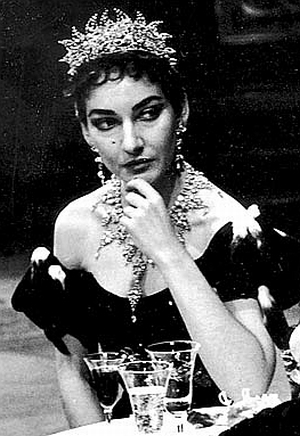
Where we concede and confess fully is the charge that Amarige is a diva. Yes. Yes, she is.Maria Callas Amarige is Maria Callas, the legendary opera singer, taking center stage under the bright white lights, and showered with diamonds by billionaires like Aristotle Onassis who loved her more than he ever did Jackie O. Amarige is not meant to be a simpering, quiet wallflower, sitting in the corner, awaiting a man to ask her to dance. She will push her way to the center of the floor and dance by herself, mesmerizing a room — public opinion be damned!
As for the charge that she is a cloying monster with some potentially synthetic undertones, we plead the Fifth. Even if true, and we are not saying that it is, many other perfumes are too. And, yet, do you see them in this courtroom? Speaking only for myself, I do not find Amarige to be synthetic. I think she is exactly what Givenchy and Dominique Ropion meant for her to be. As Fragrantica explains:

The name of the perfume ‘Amarige‘ is an anagram of the French word ‘Mariage.’ That is why this fragrance is as intensive as a strong feeling, merry, juicy and unforgettable as a moment of happy mariage. It is so opulent and floral that it seems like its composition includes all the beautiful flowers that exist in the world.

The Amarige woman is graceful, playful and charming, a real French woman in love. She radiates joy and gives a happy smile.
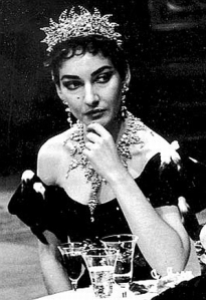
Maria Callas Tosca

Maria Callas in “Tosca.”

Despite her opulence and diva status, Amarige can be a cheap date. You can find a 1 oz bottle on Kohl‘s for $50 or on Sephora for $49. A 1.6 oz bottle costs $67 on Sephora, and much less on eBay. Compare those prices to more reputable white floral or tuberose scents: Robert Piguet‘s Fracas starts at $95; while Frederic Malle‘s Carnal Flower starts at $230 at Barneys.

Whatever she is, I realise this is the most hopeless of all lost causes. Amarige’s reputation has been destroyed beyond all measure. I can sit here and talk to you about her lovely white femininity, her peach exuberance, that dry-down of spice and amber, and it will make no difference at all. There is simply no hope of restoring her good name.

But I make this plea to you, ladies and gentlement of the jury: do not let the perfume world’s easy, facile dismissal of Amarige influence you. They are not objective and they have followed Luca Turin like sheep. After all, they proudly admit their love for Fracas, another white flowers explosion that make people gasp for air.

Admittedly, Fracas is a much more elegant creature than the brazen hussy, Amarige. And, yes, hard as it is to believe, Fracas almost seems like almost a quiet, shy child in comparison. But are they really so different as to warrant Fracas’s triumphant twirl in the spotlight as a cult favorite and legend, while Amarige wilts in the wilds of guilty obscurity? Again, Fracas may be of slightly better quality and there is not a hint of anything synthetic about it. But it too is an over-blown indolic scent that can turn sour or lead to thoughts of rotting fruit. Amarige is more fruity than Fracas, true, but there is luscious peach, orange and amber in Hermès‘ sophisticated 24 Faubourg, after all.

Unlike 24 Faubourg’s sophisticated woman, however, Amarige is like a happy child, all yellow, orange and white dancing flowers, full of exuberance and femininity. It is not a scent for those who like discreet, quiet, unobtrusive fragrances. It’s not for those who can’t stand heady, narcotically powerful ones, either. And it is most definitely not for those who can’t bear white flowers.

But if you love Amarige, I beg of you: do not go quietly into that good night, hiding your face in shame and covering your scarlet letter, that “A” which marks you as an A-marige lover. Rise up and defend her name. Admit your folly and sins. Admit she is glorious. Don’t wear her only in the privacy of your own room with the windows duct-taped shut. And find her not guilty of crimes against perfumery!”

[The Public Defender sits down and the jury leaves for its deliberations. There is no word from them for three days. Then, finally, they return.]

THE VERDICT:

Hung jury.

[Nine jurors wanted to convict.

Three held out, utterly in love, and on their way to buy a bottle for themselves.]
Preliminary Review – Chanel Les Exclusifs 1932: Sparkling Jasmine

In 1932, in the midst of the Great Depression, Chanel launched her first collection of haute jewelry. It consisted of diamonds set in platinum and was shown in an exhibit entitled “Bijoux de Diamants.” In 2012, on the 80th Anniversary of that exhibit, Chanel debuted a new fine jewelry collection and, in homage, called it The 1932 Collection.

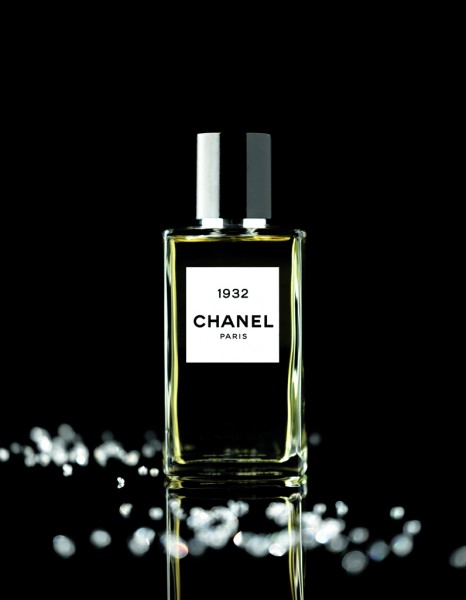
Le-parfum-1932-de-ChanelSometime in early 2013, Chanel will release the perfume that goes along with that collection. It too is called, quite simply, 1932 and it is part of Chanel’s Les Exclusifs line of fragrances. The date for its release seems to be February 1, 2013, though I have read one report of March 1, 2013.

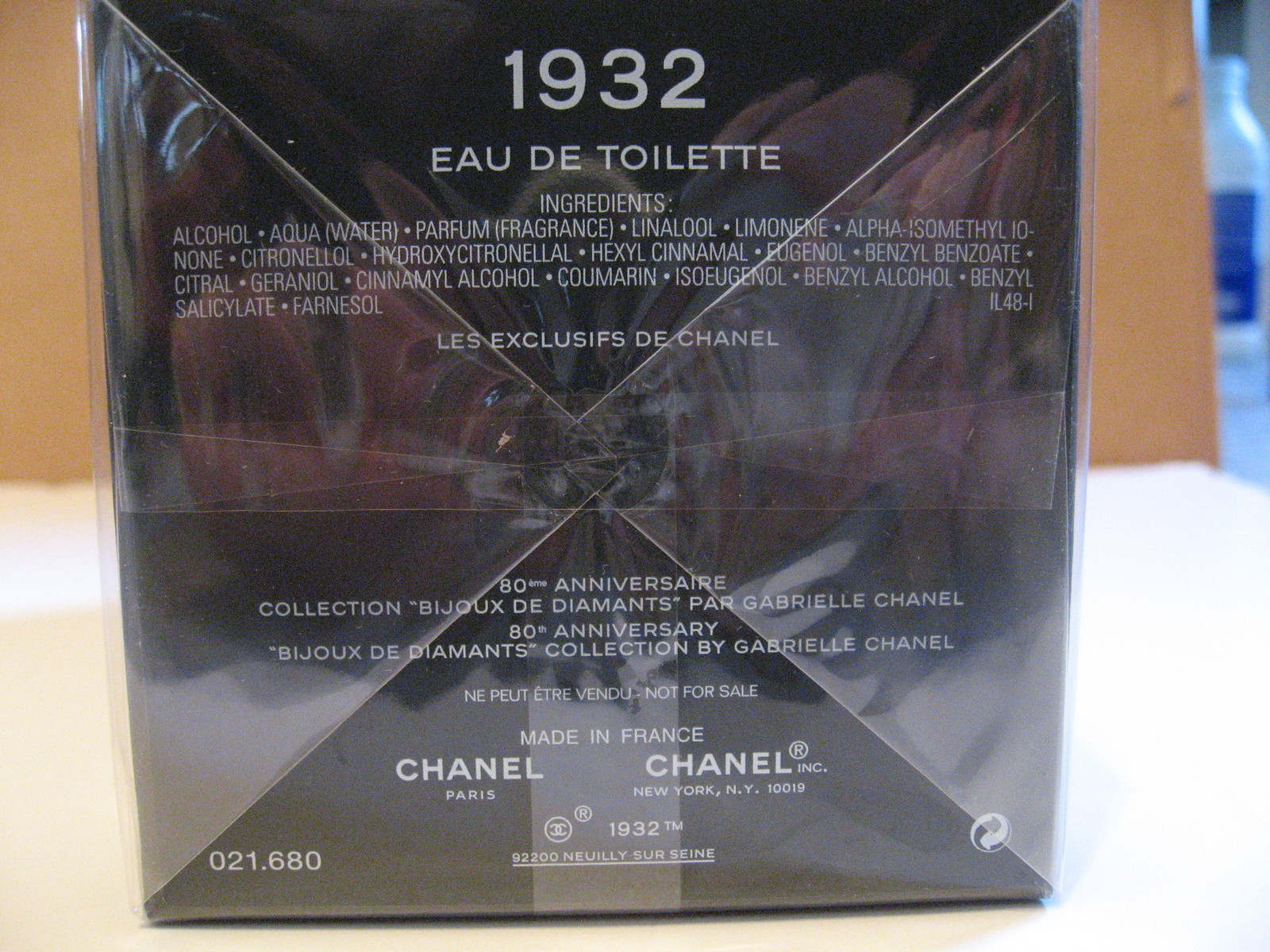
I have a large sample of 1932 already, but there is no official information on the perfume, no press release, no listing on Chanel’s website, and only a few unconfirmed details. So, I set out to discover more about the perfume prior to reviewing it. Two attempts to ascertain notes or details from Chanel were unsuccessful. The only thing that seemed certain beyond all doubt is that 1932 is a jasmine scent that comes in Eau de Toilette concentration. So, I played amateur detective, relying on a photo of a 1932 perfume box, its listed ingredients, and Google. You can read about my efforts in full detail here, but the bottom line is that the only definite notes in 1932 thus far seem to be:

jasmine, iris and musk.

Relying on the perfume box’s list of ingredients and all the sources available to me thusChanel 1932 far, I hazarded a vague guess that the notes may include some or all of the following:

Jasmine, rose or some possible rose enhancers (farnesol), bergamot (or lavender or coriander), cinnamon, cloves, violet or orris/iris, coumarin (hay), musk and possibly vetiver.

Again, you can read all the reasons why I came to that conclusion in the Sneak Peek post.

I am the very first to say that I am no perfume expert, and even less so when it comes to chemical terms and the technical aspect of perfume ingredients. I have tried to do the best that I can, with the limited information and resources available to me, but I’m sure my attempts to translate terms like “hexyl cinnamal,” “linalool,” or “farnesol” may have gone array somewhere.

Nonetheless, I think I have a mildly competent nose (I hope), so I can give you preliminary idea of what 1932 is like. Later, when Chanel releases press information, details of 1932’s notes, pricing and availability, I will do a proper review and include other people’s perceptions or reviews of the scent so that you can get a better, fuller idea as to what it is like.

For the meantime, however, I’m working totally blind on this — much like someone standing before a Mexican piñata while blind-folded, and attempting to hit something accurately. Let’s take a leap into the deep-end together.

1932 opens on me with a strong burst of bright lemon. It’s so fresh and zesty, I feel as though someone just cut into a lemon in front of me and squirted some drops of its juices on my skin. That immediate burst of freshness is followed almost seconds later by a massive dose of aldehydes. (You can read more about aldehydes in the Glossary.) Here, they smell soapy, waxy and candle-like. The lemon quickly melts into the aldehydes, creating the impression of soapy lemon wax. There is also the impression of something floral, akin to rose, but it is almost imperceptible under that thick veil of aldehydes. Along side, there is faintly powdery iris, but, again, the whole thing is subsumed under the sheer force of the aldehydes.

For full clarity, I should note that I tested out 1932 twice to ensure I had as accurate a sense about the perfume as possible. And, with one exception, 1932 was consistently the same throughout. The difference was a slight variation in the opening. The second time I tested 1932, there was a hefty dose of coumarin with its strong notes of sweet hay that appeared almost immediately after the lemon note. (In fact, if I sniff the vial to my decant, the predominant impression is of lemon followed by hay.) Unfortunately, the hay note is a bit of a ghost throughout this perfume. As you will read later, it pops up, vanishes, comes back, flits away, and so on. It is both maddening and quite enchanting, but then I love coumarin. With the exception of coumarin’s appearance in the opening the second time around, the rest of the perfume’s development continued on the same trajectory in both tests.

Two minutes in, the jasmine makes an appearance. It is timid, as if raising its bonneted head above the field of waxy soap and dappled lemon. The jasmine is sweet, light and demure, verging on the insubstantial. How could it possibly compete with those forceful aldehydes? This is probably the time to confess that I am not a particular fan of aldehydic fragrances and that this opening makes me sigh a little, though it is never as extreme or as unbearable as some perfumes. Even for someone like myself who dislikes the note, this is very manageable.

Fifteen minutes in, the jasmine becomes a much stronger player on 1932’s stage. It is heady, but there is a surprising sheerness and airiness to the scent. It is not an indolic or over-ripe scent — and jasmine can be one of the most indolic flowers around! (You can read more about Indoles and Indolic scents at the Glossary.) Indolic flowers can often have a rubbery element to the narcotic richness at their heart; over-blown ripeness that, sometimes, can verge almost on the side of decay. These indoles are the reason why some people get the impression of “rotting fruit,” sourness, urine, plastic, or Hawaiian flowers. Here, I don’t smell anything verging on over-ripe or full-blown; there is no rubberiness, no rotting fruit and, certainly, no decay. However, I do occasionally get faint whiffs of something slightly sour emanating from my arm. It’s extremely mild, never constant, and quite fleeting.

Thirty minutes in, 1932’s aldehydes have faded and jasmine takes full center stage. It is significantly stronger, though still airy, and is now accompanied by musk. There are also faint banana undertones to the scent. I have no idea if they are yet another manifestation of the aldehydes (which can take on a banana accord in addition to the lemon, waxy, soapy one) or if they are the result of something else. Such as, for example, ylang-ylang.

One person who has already tried 1932 says that there is ylang-ylang and sandalwood in the scent. On Perfume Shrine (a blog which first broke the story of 1932 over a year ago in early 2012), a poster by the name of Henrique/Rick wrote the following description this week on the site’s latest entry about the perfume:

Well, in the case of this fragrance, i’m pretty sure that it’s not hedione, since the jasmine used on it has a slightly fruity, yellow aspect on the aroma, while the hedione is more green to my nose. This is a lovely Chanel, very true to the classics. Altough the jasmine is highlighted, this is not a heavy jasmine fragrance. It starts with a exquisite blend of aldehydes, iris and ylang-ylang, then leaving space for the jasmine to shine, and at the base revisiting the jasmine and combining it with a gorgeous woody base of sandalwood supported by some musks. It’s really well done, there was a long time that i didn’t smell a Chanel that i wanted to glue my nose on my arm from the first moment until the last on skin.

Henrique/Rick’s comment is the sole description or impression of 1932 that I can find anywhere on the internet at this point. I agree with him on much of his description, especially the aldehydes. (How could one miss them?!) I also agree on the iris, but I’m not absolutely convinced on the ylang-ylang or the sandalwood. Yes, they could be there. But then again, the banana smell could easily come from the aldehydes; and jasmine by itself can be as heady, ripe and creamy as ylang-ylang.

Henrique/Rick is probably correct that “hedione” (a jasmine molecule first discovered in 1962) is not included here. For one thing, hedione is not listed on the box, though obviously that’s not dispositive. Perfume boxes don’t always list all the ingredients, after all! But the real thing is, one doesn’t have to use hedione to create a jasmine scent. According to a detailed explanation of how to create jasmine scents by Pierre Benard, a Grasse perfumer interviewed on Fragrantica, there are other ways to replicate the flower’s note. One way is to combine “Indol plus Benzyl Benzoate” with some eugenol for a green note. I see the eugenol and Benzyl Benzoate on 1932’s box, so maybe that is the route Chanel decided to take here. I certainly don’t smell the green note that Henrique/Rick attributes to hedione but, like him, a much more yellow, fruity aspect.

We part ways on the issue of sandalwood. If it’s included in 1932, it was almost nonexistent on my skin the first time round. The second time round, I could smell something vaguely approximating it, I suppose, but it was extremely faint. The impression may well have come from another ingredient entirely. I think back to Luca Turin and Tania Sanchez’s repeated comments in “Perfumes: the A-Z Guide” on just how few sandalwood fragrances actually have sandalwood in them at all these days. According to them, true sandalwood from Mysore, India is so scarce and so prohibitively expensive that most perfumers use Australian sandalwood which is an entirely different species of plant and with an entirely different scent. To the extent that 1932 may have sandalwood in it (of any kind), I think it is completely overshadowed and overpowered by the musk.

In that first hour, there was an unexpected element to 1932 in my first test. For some inexplicable reason, there was a slight earthiness to the scent on one arm accompanied by definite notes of mildew. It was faint but, there is no doubt, I smelled mildew! It’s not musty, so much as faintly moldy and a bit damp, if that makes sense. I can only attribute it to iris note which I’m guessing is from orris root; distillations from the roots of a flower or plant can have a faintly earthy smell, and that is much more the case than when the flower above earth is used. But I’m still not quite sure what causes the mildew note unless it is the combination of the orris root with the musk. The second time around, I didn’t smell mildew precisely, but there was a similarly damp and slightly earthy note. This time, it was faintly musty. Nonetheless, it was extremely subtle and subsumed by the stronger musk note.

1932 remains a predominantly musky jasmine smell for about two hours and then two new players arrive on the stage. The first is bergamot. It isn’t overwhelming but neither is it so faint as to be imperceptible. It’s a bit of a surprise, to be honest, especially for it to show up at this point instead of in the opening. But I definitely smell traces of Earl Grey Tea! It adds a note of freshness and depth to a scent that was essentially quite simple thus far.

The second player is coumarin. As noted earlier, the coumarin note is almost like a playful ghost: it appears with such freshness and sweetness, then it suddenly vanishes entirely, only to reappear and pop back up 10 minutes later, before flitting away again. Its coy disappearing act continues throughout the development of 1932. Each time, however, the coumarin smells exactly like freshly mowed hay! It never has the vanilla undertones that the ingredient may sometimes have. It adds a bit of dryness and a subtle woodsy element to the sweet jasmine; it also tends to make 1932 a scent that some jasmine-loving men could wear as well.

The final hours of 1932 are very simple. It is really just jasmine and musk with an almost imperceptible touch of something woody. It’s soft, light, and silky on the skin like a fine negligée. And that’s about it.

At no time did I smell the cinnamon or cloves which I had guessed might be in the perfume due to the ingredient list on the perfume box. Nor did I perceive any obvious or strong vetiver notes, even though the French Marie-Claire site had stated vetiver was in the perfume. To the extent that vetiver roots can contribute to an earthy element in perfumes, then perhaps that was the cause of the faintly musty, earthy impression that I had at one point. But I highly doubt it; I really don’t smell vetiver! (And I just reviewed Chanel’s vetiver scent, Sycomore, yesterday, so I am familiar with both the note and how Chanel may handle it.) No,1932 is not a green or green-brown scent in any way; it is all yellow and white, with perhaps a little beige from the musk.

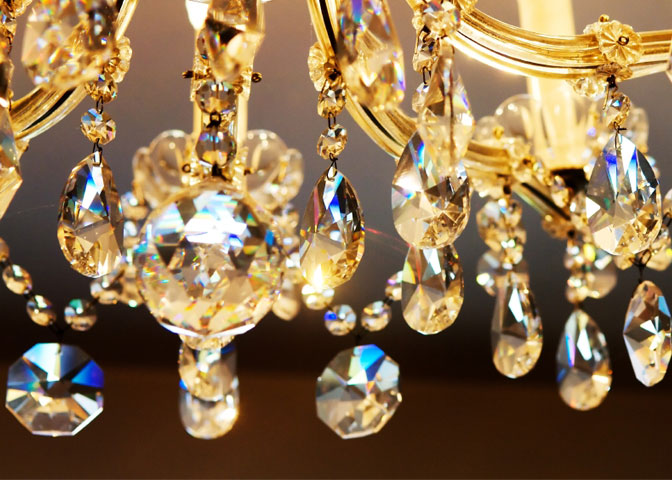
ChandelierI have the oddest perception of 1932 as a crystal chandelier. Not all of its prism drops have been properly cleaned, and some have a thin film on them, as if from the remnants of soap. Others prisms, in contrast, are clear and reflect the light, shooting off coloured rays of lemon, jasmine and musk when the sun catches them. It’s overall shimmer is so subtle as to be imperceptible at times. Sometimes, it’s a bit dull and dusty. Sometimes, bright and shiny. But whenever the light hits it, there is a sparkle in Chandelier reflectionsthe reflection, even if it only hits the walls around it. In those cases, the jasmine sparkles with a sort of evanescent glow.

That said, I wasn’t overwhelmed by 1932. It is most definitely not love at first sniff, or even third. It is a perfectly nice, even lovely, scent that oozes very discreet, very expensive, elegant trails behind it. It is simultaneously somewhat heady but, yet, also sheer and light. But it is far too demure, nondescript and soft for me. I don’t find it particularly complex, transformative, or unique. At the same time, however, I think it is undeniably well-blended with ingredients that are obviously of extremely high-quality. It is hugely approachable, and will undoubtedly be a massive hit with those who like soft florals, jasmine fragrances and/or unobtrusive feminine scents.

All in all, it really and truly embodies the classique Chanel woman — though not a very modern one. To me, it calls to mind one of those 1950s aristocratic, wealthy leaders of high-society, or one of Alfred Hitchcock’s icy blondes. Impeccably dressed with pearls and gloves, hair frozen in a perfect coif, and extremely feminine, but also controlled, reserved, haughty, aloof and not-so-faintly superior. It is a fragrance that I can imagine a lot of women wearing every day. It is discreet, while being highly feminine, lady-like, and expensive-smelling. On the other hand, one might argue, it is also simple, boring, predictable, and faintly generic. There is nothing particularly electrifying or charismatic about it.

But you know what? I highly doubt it’s meant to be! This is a scent for the woman (or jasmine-loving man) who does not want to stand out in an ostensible manner. This is not for Maria Callas, Grace Kelly, or any famous person for that matter. This is for the quiet movers-and-shakers behind the scene who abhor the spotlight and who clutch their pearls (or cufflinks) at anything as remotely vulgar as obviousness. Quelle horreur! I think this is absolutely and intentionally meant to be a scent for the aristocratically discreet who want something safe and timeless that screams high-class, restraint and quiet wealth.

1932 accomplishes all that superbly.

Details:
Sillage & Longevity: The sillage and longevity of 1932 is adequate, in line with some others in the Exclusifs line which are said to be thin, sheer, and of short duration. (For example, 31 Rue Cambon or 28 La Pausa.) On me, 1932 had good projection for the first one and a half hours, thereafter becoming close to the skin. As for longevity, it was below-average even for my perfume-consuming skin. It only lasted a little bit above 4 hours, all in all. But, as always, remember that my body consumes perfume. Perhaps others will have more luck. At this time, it’s hard to know for certain what it would be like for the average, normal person.
Cost & Availability: There are limited details on either of these points. Thus far, I know that 1932 comes in Eau de Toilette concentration, but I don’t know if Chanel will release a parfum version as it has for three of its Exclusifs line (Bois des Iles, Gardénia & Cuir de Russie). As for cost, it will undoubtedly be the same as all the other Exclusifs eau de toilette fragrances which currently retail for $130 for a 2.5 oz/75 ml bottle or $230 for a 6.8 oz/200 ml bottle. In general, the Exclusifs line is only available in Chanel boutiques or on their website. At this time, however, I have no information as to when 1932 will be available outside of Chanel’s Paris store, or when it will be available on its website (either the U.S. one or the French one). As noted earlier, I will do a full, proper review with all the necessary information once the perfume officially launches and Chanel releases further details.