Perfume Review: Tom Ford Black Orchid Voile de Fleur

Tom Ford Black Orchid Voile de Fleur For Women (VdF) appears to be nothing like Black Orchid. The original Black Orchid was apparently one of those “love it or hate it” scent that was intended to evoke carnal sensuality. Tom Ford actually said explicitly that Black Orchid was intended to evoke a “man’s crotch,” though it’s unclear whether it was washed or unwashed. I have not smelled it, but I am constantly seeing references to sweaty or unwashed testicles (a more polite word than that which is usually used) in comments TFabout Black Orchid. Its fans — and they are many — seem to adore it, though a large number confess they wear it only to bed for romantic purposes and would never dare wear it outside the house. In contrast, VdF is a light, safe, very floral fragrance. It is also boring as hell, but more on that later.

Tom Ford’s press release describes VdF as follows: “[t]he alluring potion of Black Orchid is given a warm effervescent modernity with this new entry.” Both fragrances are classified as floral orientals and both include black truffle, though to different degrees. (Honestly, I wonder if there is any in VdF! But I’m getting ahead of myself.) VdF seems to be a softer, more floral take on the dark, dense original, and not only because it is an eau de toilette while the original is eau de parfum. Fragrantica summed it up as: Black Orchid is “fatal and sexy, while Black Orchid Voile de Fleur is romantic, light and bubbly.”

The Perfumed Court has the fullest list of the notes that I have seen thus far:

black truffle, ylang ylang, bergamot, blackcurrant, honeysuckle, gardenia, spicy lily, black orchid, black plum, black pepper, lotus wood, succulent fruit, warm milk, cinnamon, vanilla tears, patchouli, balsam and sandalwood.

I should state at the outset that VdF was quietly discontinued around 2010 but I’m reviewing, in part, because it is easily available on Amazon and other e-retailers. On eBay, it ranges in price from around $30 to $90, depending on size and seller. It’s a scent that may be worth a shot for those of you who fear Black Orchid (original) may be too much, especially for places like the office. However, those of you who have issues with indolent white flower scents, especially gardenia, should stay far, far away.

VdF opens with a burst of bergamot, a scent that falls between orange and lemon, and gardenia. There is hint of honeysuckle and ylang-ylang, though it’s most definitely not the ylang-ylang in Téo Cabanel’s Alahine. This ylang-ylang is softer, creamier and lighter but, to be honest, it’s hard to detect at times under the onslaught of gardenia. Gardenia is a flower that often imparts an indolic nature to scents. It’s a frequent cohort of tuberose or jasmine, and has a very narcotic, heady scent that some people find similar to cat urine, a litter box, or moth balls. Not everyone, but some people definitely have a bad reaction to more indolic scents. (For more on the precise meaning and nature of “indolic,” please see the Glossary.)

The top notes for VdF also include black currant and, unfortunately, it creates a very sour, unpleasant note on me. The Perfume Shrine has a good explanation of the scent as well as the occasional tendency for some people to smell sour, almost urine-like ammoniac notes: “[c]ompared to the artificial berry bases defined as ‘cassis,’ the natural black currant bud absolute comes off as greener and lighter with a characteristic touch of cat. Specifically the ammoniac feel of a feline’s urinary tract, controversial though that may seem.” I’m really surprised that I actually smell that here. There are numerous scents which people occasionally feel resembles a “cat’s litter box” (usually feces, more than urine) and which makes them queasy. Fracas – that famous indolic tuberose powerhouse – is perhaps the best and most frequent example. I’ve never had that problem; in fact, Fracas is one of my old favorites and a scent that I truly think deserves its legendary status.

With VdF, for the first time in my life, I smell something sour that verges almost on cat urine. It must be the black currant. It doesn’t last and it does recede after about 20 minutes, but 20 minutes is too long given the huge sillage of the scent in its opening hour. The sour, almost ammonia-like, scent surprises me and I scour my brain to see if I saw any other comments to that effect. If I did, I don’t remember them now. So, perhaps, we should just chalk this one up to skin chemistry. Nonetheless, I must confess, the sourness leaves me unfortunately biased against the perfume. In fact, I’m not sure I can get past it.

But we must soldier on, so onward and upwards. Once that incredibly unfortunate note recedes, VdF is all soft ylang-ylang and gardenia, with jasmine following closely behind.  And, that’s about it. On me, there are no hints of leather that I’ve read about elsewhere, absolutely no earthiness (even in mild form) from the black truffle, no… nothing. One perfume blog, Perfume-Smellin’ Things, described VdF as a “femme fatale” scent:

[O]nly a tiny bit less robust than the sinfully opulent original Black Orchid, Voile de Fleur replaces the pungently earthy accord of black truffles with a leathery undertone, thus transforming from some (most probably evil) mythical creature of the night into somebody slightly less outlandish and more “urban”…a femme fatale.

Good lord. Really? I wish it smelled that way on me. I might have liked it if it did. Alas, on me, VdF is just a linear blast of gardenia and ylang-ylang. One big flat-line. And the patient dies shortly thereafter….

I wish I had more to say, but I don’t. I’m too underwhelmed and bored to even be verbose. (And you know how verbose I usually am!) This is not a scent I can recommend. White flower lovers may have issues with the linearity or the longevity of the scent. Non-white flower lovers who are sensitive to gardenia may recede gagging from the indoles or the sourness of the black currant notes. Everyone else will just be bored beyond belief. Spare yourself the money; take a nap instead.

Details:
-The sillage or projection is — like most Tom Ford scents — big in its opening before receding about an hour in to a softer, calmer level. VdF starts becoming close to the skin about 2.5 hours in and fades away completely after 3.5 hours in total. Once again, I need to emphasize that my body consumes perfume, but this is one of the shorter Tom Ford scents that I’ve tried.
– Availability: eBay and Amazon, as well as other e-retail sellers. Cost varies but I’ve seen bottles go for $29.95 on eBay. I don’t recommend that you waste your money.

Perfume Releases: Ouds, Flankers & More

After seeing an extremely beautiful bottle in a Fragrantica posting for the new Lancome Oud scent, I thought it might be fun to post about some of the new perfume releases. At the very least, you’ll see some gorgeous bottles. All posts are taken via Fragrantica. (If I could figure out how to properly re-blog a non-WordPress article, I would but, alas, my technical knowledge does not go that far. I have tried to give credit via full quotes and source citation.)

Lancome jumps on the increasingly mainstream, extremely popular oud bandwagon with Lancome L’Autre Oud:

Lancome launched L’Autre Oud in October 2012 as a part of the luxurious and exclusive collection. The scent is inspired by traveling the Orient. Opulent, rare and mysterious, this new fragrance provides the Lancome vision of popular oud. L’Autre Oud is an allegory of the mythical tree located between shadow and light, strength and tenderness, freshness and sensuality.

The formula is simple: seventeen ingredients were carefully selected to convey the point and the theme as best as they can. It starts off with spicy notes of saffron, cypriol from India, labdanum absolute and aromatic clary sage. The heart consists of Turkish rose and Bulgarian rose absolute. The rich, powerful and woody base is made of guaiac wood, green and wet patchouli, vetiver, amyris wood, moss, gurjun balm and myrrh absolute. The perfumer is Christophe Raynaud. The fragrance is available in bottles of 75 ml at the price of 120 Euros.

Chopard, that famous old jewelry house, doesn’t want to be left behind either. It has teamed up with the legendary Dominque Ropion, the “nose” behind such scents as Malle’s Carnal Flower and Portrait of a Lady, Dior’s Pure Poison, Armani’s Acqua di Gioia, Givenchy’s Amarige and Ysatis, Lady Million, Krazy Krizia and many more. Together, they have created an oud perfume for men:

Chopard is launching a new fragrance for men which will first be launched in the Middle East. It is inspired by the Orient and contains dark and seductive spices, leather and dark wood. The composition signed by perfumer  Dominique Ropion, highlights oud, completing the oriental character of the edition.

The composition of the new fragrance CHOPARD OUD MALAKI offers luminous accords of grapefruit in the very top of the composition, along with an aromatic blend of artemisia and lavender. The heart accentuates masculinity with leather accords combined with tobacco and spices, while the base notes highlight oriental notes with a combination of oud, ambergris and mysterious, dark, woody notes.

CHOPARD OUD MALAKI
grapefruit, artemisia, lavanderleather, tobacco, spicesoud, ambergris, dark wood

Fragrance Chopard Oud Malaki can be obtained as 50 and 80 ml Eau de Parfum, available since 2012.


I know I keep writing about the popularity of oud, along with other bloggers like Scent Bound, but it’s really popular! So, here’s a third oud fragrance release: Reminiscence Oud by the french house, Reminiscence. Fragrantica states as follows:

After wonderful vanilla (Reminiscence Vanille) launched in 2012, the French house of Reminiscence is launching Reminiscence Oud which joins the collection “Les Classiques.” Its oriental character is accentuated with spices and surrounded with the main ingredient of the composition—oud.

Reminiscence Oud is beautifully composed. Harmonious and perfect for both sexes, Reminiscence Oud offers hot and comfortable aromas supporting the oriental rhythm. The fragrance balances between pink pepper, saffron and cardamom, providing dynamics to warm and pleasant notes of amber and chocolate patchouli. The new composition is enriched with the charm of rose enhanced by intense oud and castoreum.

Reminiscence Oud
pink pepper, cardamon, saffron, rose, patchouli, amber, castoreum, oud

Fragrance REMINISCENCE OUD arrives in a dark brown color and has the same form as its antecedent with one difference. The body of the new bottle bends in the opposite direction from the bottles of the entire collection. The cap is gold in color as well as the stars on the front side of the bottle. The perfume aims at men and women and is available as 100 ml Eau de Parfum.

Two other trends are also popular, though they’re more of a marketing ploy, in my opinion. They are: releasing flanker versions of existing perfumes, or selling special limited-edition versions of existing perfumes in more luxe (and therefore, more expensive) bottles. It’s an increasingly popular way for perfume companies to make money without expending the capital, effort or resources required to produce a new perfume completely from scratch. Which probably explains YSL‘s decision with regard to M7 Oud Absolu and In Love Again. Fragrantica provides the relevant information, along with photos of the embellished bottles:

On the eve of the holidays Yves Saint Laurent is launching limited editions In Love Again Crystal Edition and M7 Oud Absolu Crystal Edition. The fragrances are available in the same form as last year’s collection of classics which includes eight fragrances by Yves Saint Laurent, with stoppers covered with gold and black crystals.

In Love Again is one of the classics of the Yves Saint Laurent collection, composed of floral-fruity notes. Its composition encompasses accentuated accords of mandarin, currant, grapes, rose, peony, musk and blackberry. The new edition In Love Again Crystal Edition can be obtained in a bottle with golden crystals 80 ml eau de toilette priced at 200 pounds.

IN LOVE AGAIN
mandarin, currant
grapes, rose, peony
blakcberry [sic], musk


M7 Oud Absolu is a sophisticated and luxurious fragrance based on notes of the popular M7 edition combined with precious oud accords. The composition highlights intense oud surrounded by patchouli, labdanum and myrrh refreshed with luminous mandarin zest. New edition M7 Oud Absolu Crystal Edition is available in a flacon with black crystals 80 ml eau de toilette priced at 185 pounds.

M7 OUD ABSOLU
mandarin
patchouli
oud, myrrh, labdanum


There are also numerous, new, flanker versions for other best-selling scents such as: Armani Code, Coach Signature, Dolce & Gabbana The One, Dior’s Hypnotic Poison, Narcisco Rodriguez‘s best-selling For Her (just released in L’Eau for Her version), Issey Miyake‘s L’Eau d’Issey, Valentino‘s Valentina Acqua, Cartier‘s L’Heure Verteuse, and YSL Parisienne. If you’re interested, you can find more information on these (and the numerous other) releases at Fragrantica.

Perfume Review – The Enchanted Forest by The Vagabond Prince & Bertrand Duchaufour

EF light

Source: J. Chanders at DeviantArt

Imagine a sea of pine and evergreens. There is a small hole in the thick blanket of trees through which the sun hits a golden light tunneling down to the dark, damp, forest floor. The ray of light hits turns some plants bright, incandescent green. Peeking out from behind the leaves are lush, ripe black currants. A few lie crushed — spilling out a crimson hue that contrasts brightly again the pine cones and the dark, grey-green mosses. All around, hidden outside the beacon of light, are the woods. Looming dark and majestic, they are silent, mysterious, unknown, and beckoning. That is The Enchanted Forest, Enchanted F bottlea newly released perfume for men and women created by Bertrand Duchaufour for the new niche perfume house, The Vagabond Prince.

nd.17172

Source: Fragrantica

Bertrand Duchaufour has been called “the new pope of niche fragrances.” The legendary nose behind many L’Artisan Parfumeur scents — including Timbuktu and Dzongha — he has also created perfumes for Penhaligon, Créations Aromatiques, Comme de Garçon Kyoto, Acqua di Parma, Eau d’Italie, and, now, The Different Company.

BDuchaufour

Source: Fragrantica

Recently, however, he collaborated with The Vagabond Prince (a new niche perfume house out of California and owned by the founders of Fragrantica) on their first perfume, The Enchanted Forrest.

His thoughts and intentions behind the scent are quite instructive. In an article he wrote for Fragrantica, he states:

Enchanted Forest is a unique fragrance for several reasons. It is the only perfume I know of that is built around blackcurrant as the sole raw material, to such an extent that one can say it is a CASSIS. Another reason why we can speak of its uniqueness is the topic, this pagan festival that is the Kupala—a Slavic tradition that continues, more festive than other things at present, as a kind of homage to nature and the mysteries of the forest.

o.18238

Source: Fragrantica

At the same time, he wanted to evoke the dark, mysterious nature of a forest. So, he “chose the balsam fir, because it symbolizes the quintessential Russian forest,” seeking to link the “earthy notes” in the fragrance with “pine and the dried pine needles covering the floor of an endless pine and fir land.” (Id.)

But his goal was far more than just black currant, earth notes and slavic forests. Duchaufour explicitly sought to bring in a pagan element: joyful abandon, but with softness and femininity.

[N]either have I forgotten the joyful pagan side of the festival, by giving—mainly in the top notes—sparkling effects of citrus and alcohol (wine, coriander seed, pink pepper and just a trace of orange) that mingle with discrete floral notes but feminize the heart of the fragrance, such as hawthorn, rose, a touch of jasmine, carnation … just to offset everything else that could have made it a little too masculine. The whole composition oscillates between the dark masculine strength of the forest, the smooth, juicy and delicious blackcurrant and some soft flowers. The seduction which emanates from the bottom of the fragrance develops power with amber notes and very sophisticated musk.

Enchanted Forest is classified as a “woody aromatic” and its notes on the sample I received are as follows:

Top notes: pink pepper, aldehydes, sweet orange (traces), flower cassis, blackcurrant leaf, hawthorn, effects of rum and wine, rosemary, davana.
Heart notes: blackcurrant buds absolute (by LMR from Grasse), CO2 blackcurrant (by Floral Concept from Grasse), Russian coriander seed, honeysuckle, rose, carnation, vetiver
Base notes: opoponax resinoid, Siam benzoin, amber, oakmoss, fir balsam absolute, Patchouli Purecoeur®, castoreum absolute, cedar notes, vanilla, musk.

Source: Fragrantica.

Source: Fragrantica.

I was quite pleasantly shocked and pleased to receive a sample from the company, but I vowed I would always give you my blunt opinion regardless of how I obtained the perfume. And the bottom line is: I don’t think I’m the target audience for this very evocative, very well-made scent, but I’m sure it will be a hit.

prairie fruit

Source: Kayben Farms

The Enchanted Forest opens with a burst of cassis (which is the French name for black currants and what I’m used to using) and citrus. It’s the bright, zesty zing of a freshly grated lemon rind, and it’s a lovely pairing with the tart, sweet, fresh burst of cassis. Cassis doesn’t have the slightly over-ripe opulence of a purple (let alone a purple patchouli) fruit as used in perfume; it’s all tangy tartness with a touch of sweetness that is more aromatic and fragrant than actual, cloying sugariness. Cassis is often a note tasted in red wine, so it should be no surprise that the added “wine” notes simply underscore that aspect here. There are definite impressions of hot, mulled, spiced wine. In his Fragrantica article, Duchaufour attributed his “alcohol” smell to “wine, coriander seed, pink pepper and just a trace of orange.” I have to say, I don’t get any of those individual components, but I definitely get the sum total.

Seconds after opening, the heady scent of crushed pine needles and pine cones joins the party. Fir balsam absolute (natural pine fragrance in a concentrated form) is listed in the base notes of the fragrance, but it feels as though it starts at the top and runs all the way through the scent. Cassis and fir balsam are the heart and driving force behind The Enchanted Forest, and there is no way to ever forget that. In contrast, the oakmoss — a foundational element for chypre fragrances — stays at the base, as do some of the other notes like the cedar, the resins and the castoreum, to arise only later during the dry-down stage.

blackcurrant buds fruits with leaves

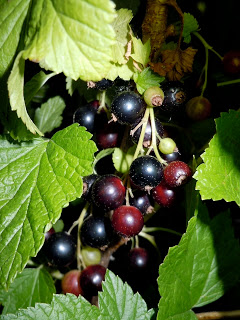
The black currant plant with buds, fruits and leaves. Photo Source: The Perfume Shrine

For the first 60 to 90 minutes, it’s predominantly cassis and fir that lead the show but, at the 30 minute mark, other guests start to appear. I smell the black currant leaf and some geranium, though they are fleeting. So, too, is the black currant bud absolute. The latter is an interesting ingredient and, given its greater role later on, I thought I would link to the explanation provided by the Perfume Shrine:

Black currant bud absolute is known as bourgeons de cassis in French …[and is different] from the synthetic “cassis” bases that can be cloying and which were so very popular in the 1980s and early 1990s perfumery, notably in Tiffany for Tiffany (by Jacques Polge) in 1987 and Poeme for Lancome (by Jacques Cavallier) in 1995. Compared to the artificial berry bases defined as “cassis,” the natural black currant bud absolute comes off as greener and lighter with a characteristic touch of cat. Specifically the ammoniac feel of a feline’s urinary tract, controversial though that may seem.

Black currant absolute comes from the bud… but also from the distilled leaves of the plant … and is extracted into a yellowish green to dark green paste that projects as a spicy-fruity-woody note retaining a fresh, yet tangy nuance, slightly phenolic.

I want to say up front that I do NOT smell ammoniac cat pee! Nor has anyone who has tried the scent thus far. However, in general, enough people seem to smell “cat piss” from black currant or black currant buds to warrant a surprising number of bewildered questions, articles or threads on the subject on the internet. Despite that, black currant buds are featured in a number of extremely popular, famous fragrances. A few examples are: Black Orchid by Tom Ford, Chamade and Champs Elysees by Guerlain, Gucci Rush II by Gucci, Escape by Clavin Klein, First by Van Cleef & Arpel, Beautiful by E.Lauder, In Love Again by YSL, Fan di Fendi by Fendi, and
Rock & Rose by Valentino. (Source: Fragrantica.)

o.18240

Source: Fragrantica

An hour and half in, Enchanted Forest has become a very forest green scent. The cassis is still there but this is a dappled mix of greens, from the pine and evergreen, to the fresh, almost herbal leaf of the cassis plant, to more cedar-y pine cones. I don’t smell the rosemary, vetiver, honeysuckle or a few other of the notes listed, but I get a definite hint of some sweet, nutty, amber-y resin and smoke. However, the perfume is so well blended, I can’t tell which of the resins may be the cause. It could be the Siam resin, the opoponax (sweet myrrh) resin, the amber, or, even, the patchouli.

All of this brings me to the issue of linearity. Some perfumes are called “linear” because they are essentially one flat trajectory. Others, however, don’t really deserve that slightly disparaging term because they are so well-blended that they are a harmonious whole. The Perfume Shrine has a very thorough explanation of and defense for the “deceptive simplicity” of what some may dismiss as a “linear” scent. As she explains, some scents are really not akin to a flat-line on a medical device but, rather, have prisms and shifting weights amongst several key components.

A variation on the linear scent is the “prism”/prismatic fragrance, whereupon you smell a humongous consistent effect all right, but when you squint this or that way, throughout the long duration, you seem to pick up some random note coming to the fore or regressing, then repeating again and again; a sort of “lather, rinse, repeat” to infinity. A good example of this sort of meticulously engineered effect is Chanel’s Allure Eau de Toilette (and not the thicker and less nuanced Eau de Parfum) where the evolution of fragrance notes defies any classical pyramidal structure scheme. There are six facets shimmering and overlapping with no one note predominating.
In short, the engineering of a perfume is sometimes much more technically and intelligently labored than appears at first sniff. Linear scents are never “simple”, so to speak. Preferring a perfume that takes you into a wave of highs peaks & low valleys of differing “notes” is not in itself the mark of connoisseurship that it is touted to be.

I can’t decide if I think the Enchanted Forest is a “prismatic” scent or not. At times, especially during the first two hours, it seems flat-out linear. All cassis and fir trees. But at other times, especially at differing times from hours two to four, it definitely seems to be a shifting prism, highlighting some aspects, then others — sometimes in as little as a few minutes time!

Which brings me to an odd thing I noticed. Two hours in, the perfume’s notes changed depending on where I had put it on my arm and when I smelled it. You see, I often place perfumes that I’m testing in various places up my arm (or arms). Usually, the scent remains the same no matter where it’s placed — pulse points or not. That was not the case here. On one wrist, I smelled ambery resin: warm, nutty, sweet. ambery and with what seemed to be the opoponax resin (a relation to myrrh) leading the way. On the inner crook of my elbow on my other arm, I smelled all pine cones, green cassis leaf, smoky incense and a dash of oakmoss. On my other wrist and the outside of my hand, it was pine, cassis and what seemed to be a dash of the rose! And, every few moments, the scents seemed to shift or alter in small degree. One minute, my wrist smelled of amber resin, a few minutes later, it smelled of pine cones, then it shifted back moments later to honey and amber. I honestly can’t understand it. I put them all on at the same time!

I think the flickering nature of the scents underscores that this is an extremely well-blended prismatic perfume, and not a purely linear one. There really is deceptive simplicity; you merely have to wait for the opening notes to subside before you realise it.

The development of Enchanted Forest went roughly as follows: the opening of cassis and pine balsam lasted a bit over an hour; the middle notes really began at hour 1.5 and lasted for about another two hours; and about four hours from when I first dabbed on the perfume, the dry-down began. It’s a resin party! All amber, smoke, incense and honeyed sweetness. It’s warm and it’s cozy.

The whole progression of the scent is extremely evocative. It’s as though you were outside in a dark forest at night, sipping mulled wine by the light of the fire. You are surrounded by crushed pine needles and cones and there is a touch of damp greenness in the air. Then, you stomp out the fire and come in from the cold, inside to the cozy warmth of a cottage with trails of smoke and cedar still lingering on your clothes. You sip some vanilla tea with honey; the fire crackles; amber is in the air. The perfume truly does evoke such a feeling.

Unfortunately, lovely as parts of this fragrance are, I fear it’s not for me. I wanted to like this smell, but I would never wear it. And it truly is me, and not the perfume. I simply am not a fruit girl. Granted, it’s not a sugary, cloying fruit by any means! It’s tart and fresh, and there are a plethora of green notes — the zing of a citrus rind; the bright, effervescent green of leaves; the dark black of a forest floor littered with pine cones and crushed needles; and the grey-green of mossy oakmoss. But, to my surprise, it’s still not for me. Despite the warm honeyed amber from the resins (I love Siam resin!), despite my love for myrrh and musk, cassis is at the heart of this fragrance. Its opening is a bit overwhelming for one who isn’t into fruit and, on me, its threads linger faintly even in the dry-down. And the thing which initially drew me to ask for a sample — the resins, myrrh and patchouli — have too subtle a character for my tastes. I have also suddenly realised that not a huge devotee of pine and fir. At least, not enough to warrant a scent with so much of it.

I know I am in a definite minority, especially judging by the comments on Fragrantica. There, the perfume was greeted with great praise by all those who received a sample. (And most actually wanted the cassis top note to last much, much longer!) I should note, however, that the perfume is made by the founders of Fragrantica itself. The Vagabond Prince is their company. I am not implying that the comments are biased, but I thought it was something I should note. That said, there is no doubt that this scent will be a crowd-pleaser, and not solely because of how well it brings to mind Christmas. It’s a charming, evocative, well-blended perfume with obviously high-quality, rich ingredients, no cloyingly over-sweet fruit, and clearly made with love. But it seems that I prefer my cassis in champagne, not on my skin.

DETAILS:
-Sillage: Very good for the first 2 hours, then there was less projection. It became close to the skin around 3.5 hours and very close to the skin from 4.5 hours onwards.
-Longevity: Very good. It lasted well over 6 hours and, as I say repeatedly, my skin consumes perfume. I think that this would last quite a while on others and initial reports on Fragrantica would seem to support that impression. However, the perfume is too new to have more detailed assessments of longevity. I will update this post when more information becomes available.
– Cost, Availability and Location: [UPDATE: This perfume has now been released in the US. You can find it on Min NewYork where it costs $180 for a 3.4 oz/100 ml bottle. ]
The perfume is now available in Paris. It’s release date was today, December 22, 2012. It costs 140 Euros for 100ml/3.4 oz. and is available at the luxe fragrance store, Jovoy Paris. The link to the Jovoy company website is: http://www.jovoyparis.com/. Full contact information is:
Parfums Rares Jovoy
4 Rue de Castiglione,
+33(0)140200619
contact@jovoyparis.com
In the US, the fragrance will be available to buy online on The Vagabond Prince website, as well as on Lucky Scent and in its retail boutique called Scent Bar (in Beverly Hills, CA). I will update this post as I get further information.

Perfume Review – Serge Lutens Serge Noire: Janus & The Cloven Beast

Serge Lutens describes Serge Noire as a phoenix rising from the ashes. Phoenix Rising 2Perhaps. I see it more as a cloven beast, with “cloven” referring not only to the cloves that make up such a large part of its character but also to the traditional definition of the word: split in two. To me, Serge Noire is Janus, that ancient Roman god with two faces and the god of beginnings and ends. In common, modern parlance, you might say that Serge Noire is slightly bi-polar.

A good starting point in discussing Serge Noire is the Lutens’ press release. As provided by BoisdeJasmin, it states:

The ether of ashes… A phoenix, the mythical bird of legend burns at the height of its splendour before emerging triumphant, reborn from the ashes in a choreography of flame, conjuring the shapes of yesterday in a dance of ashes. The swirls of oriental grey enrich the twilight with depth and intensity while windswept memories hint at the beauty of transformation. An ode to everlasting beauty under cover of night’s rich plumage.

The Lutens website omits the poetry, and simply says:

nothing can capture this scent’s spirit better than subtle “snapshots” from the past, like a forgotten glove lying on an antique chair.

Incense stirred by the smell of burnt wood.

The full, complete notes for Serge Noire are hard to pinpoint with any uniform, agreed-upon accuracy. The consensus on the basic elements seems to be: cloves, cinnamon, patchouli, incense and “dark woods.” However, Perfume Shrine also referenced “elemi,” a spicy, peppery and citrusy resin. Fragrantica gives the notes as: “patchouli, cinnamon, amber, woody notes, incense, clove, spices and ebony wood.” And, yet, most think that there must be some cumin in there too. I also see repeated references to grey ash, labdanum/cistus, benzoin and castoreum. (Castoreum essentially comes a beaver’s anal sacs and has been used in such famous fragrances as Shalimar, Jicky, Cuir de Russie, Antaeus, Amouage Epic and more. See, the Glossary for a full definition and more details.) I’ve even read a few comments that mention gunpowder too!

I was a bit terrified to try out Serge Noire because of the sheer forcefulness of the negative reviews. This is a fragrance that seems to engender extremely intense reviews, but the positive ones on places like Basenotes are nowhere as vehemently extreme as the negative ones. (If you’re ever bored, I suggest reading some of the comments. At the very least, they’re really amusing.) To give you an idea of some of the Basenotes comments:

  • “Sacré bleu, Serge! Why did you market this horror?”
  • “[W]hy did I buy this? just like chewing tin foil”
  • “It starts out like a punch in the face and a savage cauterizing of the ol’factory with several murderous spices. Then ATTACK OF THE CLOVES and suddenly your feet are raised high above your head as you are hoisted in the dental chair preparing for root canal treatment. This surely must be somebody’s idea of a practical joke.”
  • “Absolutely, incredibly and horribly foul. One of the most disgusting things I have ever smelled in my life.”
  • “Pure evil!”

An even more alarming review came from NST where the perfume was compared to a potpourri of ingredients whose recipe included, just in small part, the following:

  • 50 pieces of charred cassia bark (the bark should be blackened and retain only the most rancid traces of oil and odor);
  • Ten 1/8-inch slices of Swiss cheese;
  • Chain-gang T-shirt bits (with scissors, cut out and save the stained, armpit areas (bits) of 25 sweaty T-shirts that have been worn at least 10 hours on a 90-100 degree day;
  • One large box of moth balls, roasted (roast on a grill in the open air while wearing a HEPA-filter mask); and
  • 10 handfuls of singed hair (… for pre-singed locks, visit the worstsalon in your area and obtain fall-out from recently botched dye jobs, hair-straightening sessions, permanents, etc.).

Finally, pour the contents of three bottles of Angostura bitters and two bottles of grenadine into the bucket, top off with more salt, and let the mixture ‘rest’ in the (covered) bucket — in a dark and dank place — under lock and key — for at least two weeks.

To be fair, there are a lot of extremely passionate, gushing, postive reviews for Serge Noire, with its fans calling it the best Lutens fragance “in years” and with others applauding the genius of the “nose” behind its creation, the very famous Christopher Sheldrake. Some of those — like Perfume Shrine‘s review — wax so poetically, they are almost other-worldly. In fact, the latter review seemed much more like existentialist tract on philosophy and poetry than an assessment of mere perfume.

Nonetheless, I’ve found the horror outweights the poetry when it comes to reactions. There are also constant references to “BO” (body odor) and sweat which I found alarminng. But when Smelly Thoughts — a blogger who adores niche fragrances that are somewhat avant-garde or extreme — called it “hideous” just a few days ago, I really paled a little. So, it’s not surprising that I put it on with great trepidation. And I must say, I hardly find it to be “pure evil.”

I loved the opening spray of Serge Noire, but I wonder how much of my reaction stemmed from enormous relief rather than actual love. My initial notes actually read like this: “CLOVES! No sweat, thank god! Ooops… sweat.” As someone who cooks extensively, I have issues with cumin and, to me, it often evokes an impression of dirty, sweaty socks with the rancid, fetid body odor of someone who has never understood the joys of soap and water. Serge Noire definitely evoked “BO.” But, to my surprise, there was just a fleeting note of sweat in the opening salvo. Instead, I was strongly reminded of the smell of a leather saddle, slightly damp and with a touch of the horse or rider’s sweat. There was also a fascinating mix of camphor to counter the sweetness of the clove and what almost seemed like star anise. There is a faint touch of something medicinal that vaguely brings to mind Tiger’s Balm muscle rub, but it’s a sweet note as compared to the sharply metallic, cold, screechy medicinal accord in some oud fragrances. The camphor is not a surprise;Sheldrake has used it before in fragrances for Serge Lutens. Tubereuse Criminelle is perhaps the most well-known for that accord but there, the camphor mixes with a green floral scent, not with something as sweet as cloves and cinnamon.

I was so enchanted by the warmth of the cloves that I actually added another two sprays (though small in size) to my other arm. The cloves are a bit surprising in their expression on my skin; they’re not sharp but deeper, warmer and more well-rounded than I had expected. Some of the Lutens fragrances can be a bit cacophonous in their opening but Serge Lutens surprises me by being much tamer than the ferocious, hideous beast of the reviews.

I was really enjoying the fragrance thus far and it made me feel rather Christmas-y in some ways. Yet, the strongest and most constant memory that it evoked was Estée Lauder’s legendary Cinnabar, that famous 70s cousin to YSL’s Opium. The cloves in Serge Noire are, on my skin, much sharper than the more cinnamon-predominant Cinnabar, but they definitely share similarities to my mind and not solely because they are powerhouse scents centered around cinnamon and cloves. No, there is definitely a slightly retro feel to Serge Noire, though it’s a modern take on retro with the cinnamon.

On MakeupAlley, one commentator said they smelled “deadly hot pepper” but I don’t see it. Another said that she had a very strong impressed of ketchup mixed with a spicy BO scent. I definitely agree on the ketchup, but it’s a very vague, tenuous and fleeting impression, and it’s really due to the cloves and patchouli. Others reference the frankincense but to me, in the first two hours, it’s more patchouli. If it is frankincense that creates that peppery, smoky, dirty black scent, then it’s a very different type of frankincense than the one in Chanel’s Coromandel. (Reviewed here.) No, I think it’s more patchouli than frankincense, though Perfume Shrine (linked up above) seems to ascribe the peppery, spicy notes to a resin called “elemi.”

Either way, the linear nature of the fragrance in the early hours is a slight disappointment. The heart of cloves, cinnamon and camphor is just too strong of a constant thread. Yes, there is incense and patchouli, but it’s hard to separate them at times. Serge Noire is an extremely well-blended fragrance — so much so that the patchouli, cloves, cinnamon, and incense blend together in an extremely harmonious whole. I would have preferred something that morphed much more. And it does, later, change a little but not by much.

I thought Serge Noire was a very warm fragrance which is why reviews referencing its cold, “austere” nature were a little confusing at first glance. Austere? Is it the incense? Perfume Shrine’s review noted a definite and almost overwhelming impression of old, slightly dusky, byzantine Orthodox churches. That was my feeling for Chanel’s Coromandel, but not for Serge Noire. Others have said it’s the holiest of all holy incense fragrances, but I don’t agree with that either because it would seem to imply that Serge Noire is primarily an incense fragrance. I think it’s primarily a clove one. Which brings me to another point: cinnamon. There is definitely cinnamon here but it’s true presence comes later. To me, cinnamon is a much milder, softer, gentler and more feminine scent than cloves which is hot, not merely warm. It’s sharper, dirtier, sometimes slightly more acrid or astringent, but always more forceful.

Starting on the second hour, another note starts to rear its head. It’s the smell I had dreaded upon initially reading reviews for the perfume. It’s the smell of sweat and body odor. If this were a horse race, the clove chestnut that had led the pack, followed closely by the cinnamon sorrel, have now faded from the leader spot. They’re being edged out by a faint nose by the black patchouli stallion and its incense twin. However, coming up from the rear, is the sweaty horse whose saddle is slick with its earthy nature. And the dark woods all around the racetrack are starting to gently sway in the breeze, as if to participate in the events before it.

The award-winning, incredibly brilliant expert, Elena Vosnaki, at Perfume Shrine has a polar opposite impression:

Initially dry and spartan with the flinty, camphoreous aspect of gun powder comparable to Essence of John Galliano for Diptyque, ashes to ashes and snuffed out candles, Serge Noire by Lutens assaults the senses with the intense austerity of real frankincense and elemi. The impression is beautifully ascetic, hermetic, like an anchorite who has dwelled in a cave up in the rough mountains with only the stars as his companion in the darkest pitch of the night: the “noire” part is meditatively devoid of any ornamentation, eclipsing any pretence of frivolous prettification. The surprising transparency is evocative of the Japanese Kodo ritual rather than the denser cloud of Avignon. Those who are unitiated to the wonders of Lutens might coil away with trepidation and apprehension at this point, but much like the alarming mentholated overture of Tubéreuse Criminelle, this subsides eventually, although never quiting the scene completely.

And yet behind the caustic and mineral masculinity, a hopeful ascent of a feminine trail of lightly vanillic, ambery benzoin and sweet spice is slowly, imperceptibly rising after half an hour; like a subtly heaving bosom draped with Japanese garments or the curvaceous calligraphy of thick black ink on gaufre paper of ivory or creamy skin. It is then when cistus labdanum provides an erotic hint of sophisticated elegance in Serge Noire while the emergence of sweet spice, a touch of cinnamon, gives a burnished quality of black that is slowly bleeding into grey.

The ashen ballet in the flames, the swirls of oriental grey sing an ode to everlasting beauty, beauty under the cover of night’s rich plumage.

Perfume may be subjective, but there are few more respected experts in the perfume world than Elena Vosnaki, so her impressions of Serge Noire make me wonder why I’m getting such a different vibe. To my huge relief, Perfume Posse resolved my dilemma and made me realise that we’re BOTH right: “it just has a lot of facets that go in and out – dust, warmth, cool incense, woods.” It is coldly austere, but also red hot. (Actually, “red hots,” the cinnamon candies, are a big note in the perfume’s dry down.) It’s all incense (or, for Grain de musc, “a sizzling succession of resins”), or it’s dental chairs of camphor and stale body sweat.

In short, Serge Noire is a bit schizophrenic. It is simultaneously exactly like my review, and like that of the Perfume Shrine. Hot and dusty, or austere, cold and full of the greyJanus ashes of a dying fire — it is both things at once. Or, to go back to Janus, it wears two faces. Remember all that Lutens PR and the seemingly over-the-top, marketing flights of fancy? Well, I actually get it now. The phoenix rises from the dusty, cold ashes of death, reborn as a fiery, powerful, red-hot swirl of light and warmth, before Phoenix Risingflying off above the woods and into the cold night. It not only true, but it’s actually is pretty genius how the marketing so captured what seems to be a very intentional and deliberate ethos behind this perfume. So intentional that it reportedly took ten long years to create this scent’s contradictory nature, a scent that is Serge Lutens’ own personal favorite.

For all of Serge Noir’s vociferous opening, it definitely quietens down after about two hours. And four hours in, it’s very close to the skin and almost…. well, I wouldn’t say “subtle” but it’s definitely been tamed. It’s quiet amber and spice with the frankincense or patchouli just barely shimmering in the light. It’s cinnamon and resin. And sweat.

I did mention the rise of the sweat factor, didn’t I? Well, it becomes quite prominent in the dry-down, though I should emphasize again that the perfume is extremely close to the skin at this point. Still, after about five or six hours, I would catch a faint but definite smell of body odor. I’d been doing other things, forgotten about the perfume (yes, that actually is possible at this point) and, for a fleeting moment, thought to myself, “God, is that me?”

I like Serge Noire a lot more than I had expected to and, indeed, found the opening quite enchanting. But, after some reflection, that body odor element combines with a few other things to make this a bottle I wouldn’t buy. (If given to me, however, I’d certainly wear it on occasion. I think….)  It’s a fascinating fragrance and, on me, certainly wasn’t as “hideous,” “evil,” “horrific” and venomous as the critical reviews had led me to expect. If you’re a perfume junkie with a curious streak, I would definitely recommend buying a small vial for $3.99 at Surrender to Chance just to see what all the fuss is about. If you’re a fan of cinnamon and clove, I’d advise the same. And, honestly, you may really like it; there are certainly plenty of people who do. For everyone else, however — particularly those of a less inquisitive, bold or fool-hardy nature, or those who like the “fresh, clean” scents — I would recommend staying far, far away.

Details:
Cost: The perfume comes only in one formula, Parfum Haute Concentration, and can be purchased on the Serge Lutens website for $140 for a 50 ml/1.7 oz bottle. It’s also available at other retailers, like Barney’s or Luckyscent.
Sillage: Enormous at first, before fading in the second hour and then becoming close to the skin around the fourth. But, as always, this is on me and my body consumes perfume.
Longevity: Very long lasting for a Serge Lutens fragrance, in my opinion. My prior experiences have been extremely short in duration. On me, all in all, this lasted about 5.5 hours. On others, the reports are for much longer.