Viktoria Minya & The World of A “Nose”

A grey afternoon in Paris unexpectedly turned into one of the most fascinating, educational perfume experiences I’ve had in a long, long time. It’s all thanks to Viktoria Minya. She gave me the chance to peek behind the curtain, and to glimpse a small portion of the life of a “nose.” We talked about everything from IFRA/EU restrictions on perfumes, how she studied to become a “nose,” some of the surprising things she deals with in perfume creation, and the very elementary basics of the raw materials that noses use to create fragrances. I hope you enjoy the glimpse behind the perfumed curtain.

Viktoria Minya. Source: Fragrantica.

Viktoria Minya. Source: Fragrantica.

Hedonist. Source: Parfums Viktoria Minya on Facebook.

Hedonist. Source: Parfums Viktoria Minya on Facebook.

Viktoria Minya is a perfume creator who founded Parfums Viktoria Minya, but also an actual, genuine, trained “nose.” Her debut perfume, Hedonist, is a gorgeous, luxurious, elegant, airy, honeyed-floral affair that I really loved. But I also enjoyed the little bit that I got to know of Ms. Minya herself in our email correspondence at the time. Then, a few weeks ago, close to the time of my departure to Paris, and by a complete fluke involving something else, we had a few email exchanges where I happened to mention that I would be in her city. Unfortunately, both our schedules seemed extremely complicated, and it seemed unlikely that we’d be able to meet.

Then, while roaming the streets of Paris one afternoon, and with some incredibly lucky timing that happened out of the blue, everything seemed to fall into place. I somehow found myself in her perfume studio, sitting across from an absolutely beautiful woman with the most unbelievably stunning eyes, and the warmest smile. (Not a single photo that I’ve seen of Ms. Minya actually does her — and her eyes — justice.) Ms. Minya had prepared a lovely selection of things for me to nibble on while we talked and before we went into her actual work area where she has her perfume “organ.” (See photo below.) As I ate some French cheese (yes, I said cheese! And she didn’t even know of my obsession with it!), I tried to focus on the conversation but those absolutely mesmerizing eyes made it a little hard at times. Plus, as usual for this entire trip, I was somewhat in a daze from sleep-deprivation.

As a result, I fear I don’t remember all the details of the technical stuff I learnt, but I thought I would share some aspects that I found really fascinating, from the issue of IFRA (the “International Fragrance Association”), to her studies as a nose, the black market for ingredients, and more. Then, later, I’ll share what it was like in her perfume studio with all the raw materials and the perfume oils. The photos I took suffered from the problem that I mentioned earlier in another post: my camera is dying, so some of the images are blurred and the writing on the bottles isn’t always completely clear. Hopefully, though, it will give you an idea of the sorts of things a “nose” may have in her arsenal, and the feel of that day.

Photo: my own.

Ms. Minya’s perfume “organ.” Photo: my own.

In terms of general discussion, one of the things that came up a few times was the impact of the IFRA and EU restrictions. You and I — consumers and buyers of perfume products — usually think about the impact in terms of its effect on us. We moan about chypres and oakmoss, we talk about reformulations, and we gripe about the sorts of perfumes available to us or the massive changes to perfumery in just the last five years alone. We almost never think of what it must be like for a “nose.” It’s not surprising, after all, because their world is so far away from ours. But it’s not for Ms. Minya.

As an actual, working nose, the IFRA/EU restrictions create a whole different set of problems for Ms. Minya than they do for us. For one thing, I get the impression that she finds that they stifle creativity. (She was too polite to say so, but that was my impression.) For another, the restrictions have an impact on a nose’s actual business dealings with clients. Ms. Minya may have her own brand and perfume line, but she also works as a nose for clients to create scents in accordance with their particular wishes. She gave me one example of a situation where a client requested that she make a perfume with certain ingredients at a certain level. Again and again, she had to say something to the effect of: “No, it’s not possible to that extent,” or “No, that is illegal in the EU.”

Chris Bartlett of Pell Wall Perfumes Blog is a perfumer and consultant who has an absolutely wonderful, useful, eye-opening and completely depressing listing of all the IFRA/EU ingredient limits for Category 4 (fine perfumes in an alcohol-based solution). Though his list is not yet updated to include all the changes from the 47th Amendment of June 2013 (yes, I realise how ludicrous and Kafkaesque that sounds), I still look at it from time to time, usually resulting in complete irritation and annoyance at the EU. I looked again at the listing upon my return from Paris and in light of my meeting with Viktoria Minya — and I saw it in a whole new light from the perspective of a “nose.”

Let me give you some examples from Mr. Bartlett’s list of IFRA’s standards and limitations as of June and before the 47th Amendment took place. Some of the terms may seem like gobbledygook to you, but just pay attention to the percentage numbers at the end of each line (or whether the ingredient is permitted at all in perfume creation), and things will eventually become clearer:

Cumin oil 0.4%

Eugenol* [clove oil] 0.5%

Farnesol* 1.2%
Fig leaf absolute Prohibited
Galbanum ketone (various trade names; 1-(5,5-Dimethyl-1-cyclohexen-1-yl)pent-4-en-1-one) 1.13%
Geraniol* 5.3%  […]

Iso E Super 21.4%  [ME: GOOD GOD!!!!!!!!!!!!!]

Jasmine Absolute 0.7%

Jasmine Sambac Absolute 4%
Lemon (expressed) 2%
Lime (expressed) 0.7%

Musk ambrette Prohibited

Oakmoss Absolute 0.1%

Opoponax 0.4%

Peru balsam (crude) Prohibited

Quinoline Prohibited
Rose Ketones 0.02%
Santolina oil Prohibited
Safranal (2,6,6-Trimethylcyclohexa-1,3-dienyl methanal) 0.005%
Safrole, Isosafrole, Dihydrosafrole~ Prohibited (EOs containing these permitted if total below 0.01%)
Savin oil from Juniperus sabina Prohibited
Styrax (from Liquidambar styraciflua macrophyla or Liquidambar orientalis only) 0.6%
Styrax (all other species) Prohibited

Ylang ylang extracts 0.8%

* – the main sources of these chemicals is in natural materials and you need to work out how much is in all the oils that contain them and keep the total in your product below the levels quoted here. These are some of the most complex standards to ensure compliance with.

NB- The limits for Oakmoss and Tree Moss are cumulative (so the combination of both must be below 0.1%)

I tried to include in that list a good number of things with which we common lay-people are familiar, but, also, a portion of the many things marked with a red “Prohibited” notice (even if I have no idea what some of them are). The fact that things like ylang-ylang is limited to 0.8%, lime to 0.7%, and oakmoss at 0.1%, while that bloody, godawful “ISO E Supercrappy” (™ Sultan Pasha) can be as high as 21.4% suddenly clarifies things a bit more to me. It’s not just that some perfumers love that ghastly, cheap, synthetic crap; it’s that they are running out of ingredients to use at any substantial, rich or useful levels! I mean, seriously, some poor flower is at less than 1%, while the laboratory-created, aromatic equivalent of a hospital morgue’s antiseptic is at 21.4%??! Plus, a portion of the ingredients on the list are completely illegal to use?! To me, and from my layman perspective, that doesn’t seem to leave perfume noses with a huge amount of original options or alternatives.

Source: CaFleureBon

Source: CaFleureBon

Which brings us back to Viktoria Minya and her world. She went to school in Grasse, perhaps the heart and soul of the perfume creating world, and attended the Grasse Institute of Perfumery. I asked her about the program which is one-year long, and followed by internships within the perfume world. Within the program, the students take a variety of courses on such subjects as: natural and synthetic raw materials; fine fragrance formulation; legislation courses; evaluation courses; and even functional perfumery courses (how to create fragrances for soaps, shampoos, candles, shower gels, etc).

There was much more, too, but, again, the haze of a particularly grueling travelling schedule means I’ve forgotten some of the details. So, I did some research, and stumbled across a 2009 article called “Smelling like roses… or not” which actually quotes Ms. Minya as a student and which also talks about the way “noses” are trained:

In class, the students flared their nostrils against white tester strips dipped in scented, mostly clear liquid. The exercise tested their olfactory memories as they built on the more than 300 natural and synthetic odors they had memorized since the course began in late January. The task included identifying the scents’ compounds and family. […]

By the end of the yearlong course, which includes a mandatory internship at a fragrance company lasting several months, students will have acquired a lexicon of at least 500 raw materials; the rest of their creative arsenal, which eventually could include thousands of ingredients, will be developed in the field.

As for Viktoria, as that old article makes clear, lessons in building an olfactory memory bank sensitize the nose:

On a recent visit to a horse stable, Viktoria Minya had to hold her breath until she could step outside. And at home recently, the 27-year-old perfumery student has found she needs to take out the trash as often as three times per day. It’s a side effect of her developing olfactory organs: “I smell too much.”

The article also mentioned a few other interesting things:

“A perfume hides a story,” said Laurence Fauvel, a perfumer and one of the teachers at the school, which opened in February 2002. “To create something really new is very difficult.”  […][¶]

An official at the school estimated that about [only] 20 star “noses” exist worldwide.

Mr. Fauvel’s comment reminds me of the common line in many writing classes about how every plot or novel has essentially been written before. It’s true, and I’m sure the same theme applies, broadly speaking, to perfumery as well. But, to bring things full circle to perfume notes, it certainly can’t help when IFRA and the bloody EU restrict your options even further in terms of quantity and type of ingredients. As Ms. Minya told me, there are no longer quite as many avenues for self-expression and artistic creativity.

Vincent Van Gogh, "Irises" (1889). Source: hdwallshub.com

Vincent Van Gogh, “Irises” (1889). Source: hdwallshub.com

She compared the situation to a painter being told that he cannot use certain paint colours on his canvas, while other colours are limited in amount. So, perhaps it’s more apt to talk about “vibrancy” instead of the broader terms of “originality” and “creativity.” If a painter is forbidden from using brown paint, if he can only use blue if it’s 0.7% of his overall creation, and if green is limited to no more than 0.1%, then how do you end up with Van Gogh’s Irises? You can’t. You get a watered down, diluted, much less vibrant composition that may be good — perhaps even very good, in some cases — but it won’t be the masterpiece that is the Irises.

Stephen Weller, IFRA photo, via The Scented Salamander.

Stephen Weller, IFRA photo, via The Scented Salamander.

In the faintest fig leaf to appearing fair, I suppose I should mention IFRA’s side of things. Stephen Weller, IFRA’s Director of Communication, has given a few interviews in France defending his organisation as the supposed savior of certain key ingredients. The blog, The Scented Salamander, states that Mr. Weller:

makes the particularly salient point in this exchange that without IFRA, a number of perfumery ingredients would have altogether disappeared from the palette of the perfumer as they have come under attack from the European Union and before that pressure groups voicing their concerns…

Weller explains in this new interview with Premium Beauty News how his organism permits a more nuanced approach to the dermatological and allergic risks presented by aromatic materials.

You can read more about his claims at the Scented Salamander, but they essentially include the argument that you should thank IFRA for saving oakmoss and other ingredients from complete eradication in perfumery. I can see his point in theory, but I have great difficulties with his attempts to portray IFRA as the purely protective, angelic and benevolent savior of perfumedom! And don’t get me started on the oakmoss. Yes, the EU is driving most of this, now, but, correct me if I’m wrong, I believe early IFRA regulations started all this.

More to the point, and to use a parallel, I don’t see manufacturing associations putting restrictions on factories who produce food items or on chefs in restaurants simply because there are some pressure groups who complain about nut allergies. Some of the EU proposals (like the ludicrous idea of possibly banning Chanel No. 5 that I’ve talked about in another IFRA/EU post) are akin to shutting down the Eiffel Tower simply because 1%-3% of the EU’s 503.5 million population may have vertigo. (It’s been estimated that “1 to 3 percent of the EU population… are allergic or potentially allergic to natural ingredients contained in fine perfumes, according to a report published in July by the Scientific Committee on Consumer Safety (SCCS), an advisory body for the European Commission.” [Emphasis added.])

And IFRA’s substantive actions don’t seem like true championship or defense of the perfume industry to me. For example, why aren’t warning labels enough? They put such warnings on cigarettes, and on pre-packaged food items that may have been prepared in a factory that had some nuts in it. Are perfumes actually more dangerous to people’s health than cigarettes??! Also, why are perfumes to be regulated with such ingredients as the amount of lavender or citrus oils, but massage oils are left alone? Presumably, that minuscule percentage of EU citizens who have allergic reactions — or just the mere potential thereof — might possibly decide to have a massage one day. Why are those oils fine, but the ones in perfumery — which allergic people can simply avoid using — subject to increasingly Orwellian, draconian measures?

I’m sorry, I got sidetracked and derailed in rather irrational rage, so let’s leave the issue of IFRA and get back to the realities of creating a perfume. There, even apart from ingredient limitations, there are other hurdles to originality, too. This time, however, they pertain more to the business tail-end of things for one who is a brand’s creator or founder. Take, for example, the simple, seemingly prosaic issue of a perfume’s name. Now, obviously, you don’t want to use another brand’s exact name for your new creation, but I wasn’t aware of just how tricky the issue might be for French perfumers. According to Ms. Minya, back in the 1980s, many French companies bought up the legal rights to a whole host of names — lots of them being common adjectives or phrases — for future use. Now, when you try to launch your new perfume, there is a good chance that they might sue you for using one of their vast stable of trademarked names.
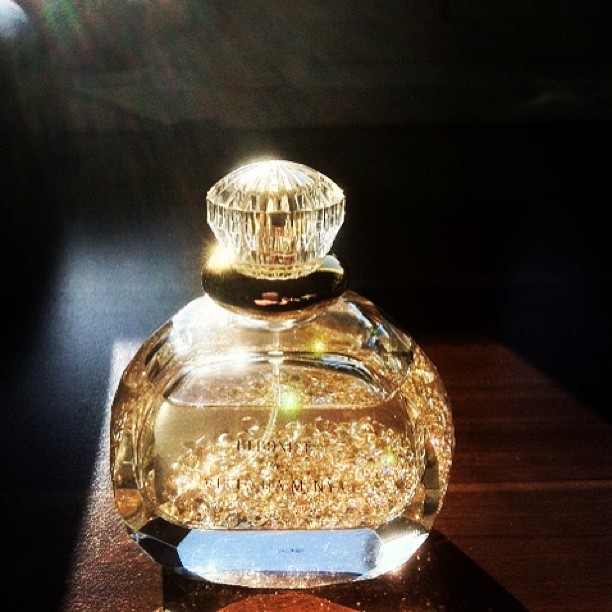
Hedonist. Source: Parfums Viktoria Minya on Facebook.

Hedonist. Source: Parfums Viktoria Minya on Facebook.

I remember hearing this, blinking and having a light bulb moment when she explained that this old 1980s situation is the reason why so many French perfumes have some generic variation of “Rose de ___” or “Vanille de ____”  as their name. To quote Ms. Minya: “This is why we have more and more names with numbers, botanical or common names of ingredients ( like “orange” ) and geographical names – because these cannot be trademarked by anybody.” I suspect this may be the reason why Neela Vermeire might have had to recently change the name of her upcoming Mohur “Esprit” to just plain “Mohur Extrait,” though I am just guessing. (I have not asked Ms. Vermeire, and I certainly don’t know for sure.)

While trademark concerns are hardly unique to France, the situation there seems a little more complicated for perfumers than for artisans or artists in other fields. Even if you can get the money to make a perfume, even if you survive the draconian IFRA/EU’s restrictions to make something good, even if you spend all the money for the further compliance minutiae, you still aren’t home scot-free. Now, you can’t even choose your perfume name without the risk of a lawsuit.

Yet, the real issue that I see is something much broader in reach: you need very big pockets to engage in the perfume game, and to survive. I’d like one day to explore the issue of perfume creation primarily from a perfume creator’s perspective, but it’s clear even now that the real bottom line is money and how hard it is for truly “niche” perfumers to flourish in light of so many minefields. Someone like Tom Ford — who is backed and owned by the Estée Lauder multi-national conglomerate — or Kilian Hennessey is obviously going to have a very different time of things than someone like Viktoria Minya, Andy Tauer, or Neela Vermeire.

To me, as a layman and outsider, each of the things discussed here seems to represent a noose tightening around the neck of a truly vibrant, creative, non-homogenous, flourishing perfume world where small voices have as much chance in the marketplace as the big behemoths. It’s a sad parallel to the overall conglomeratization of the world in general, from the media and entertainment industries to banking and the airlines. But the last time I checked, neither the banking nor airline worlds depended on creativity and the freedom of imagination, so it’s substantially worse when artistry is stifled in an industry like perfumery.

IMG_0034_4b

Size makes itself an issue for noses like Ms. Minya in some ways that surprised me. As promised, I’m going to spend a bit of time talking about the raw materials used in the perfume process. When I went into Ms. Minya’s actual perfume studio with its vast, impressive “organ,” I gasped. As far as the eye could see, there were bottles of ingredients. Everywhere! Not just the organ, but filling whole bookcases and even in a fridge. As I was exclaiming about the endless varieties of orange blossom, iris, or rose accords, Ms. Minya mentioned how obtaining some of the ingredients wasn’t easy. Apparently, some companies are extremely unwilling to sell in the sort of small order sizes appropriate to a small, individual perfumer or nose. I didn’t ask if the companies countered things by charging much more for orders that aren’t in bulk, because I never like to talk about money or intrude into someone’s financial matters, but I assume that it’s a frustrating hassle and obstacle at the very least.

So, let’s drop money, and move onto the actual ingredients in question. First, we should probably begin with the basic difference between a perfume oil and an essential oil. Now Smell This has an easy explanation that puts it much more succinctly than I could ever manage:

Essential oils are volatile, fragrant liquids extracted from plant leaves, bark, wood, stems, flowers, seeds, buds, roots, resins and petals, usually through steam distillation. In other words, they are raw materials that can be used to create perfumes. They are highly concentrated […].

Perfume oils are fragrance components, natural or synthetic, in an oily base rather than an alcohol base, and can be used directly on the skin.

Now, here’s a glimpse of some of the things in Ms. Minya’s arsenal:

Perfume oils distilled in 10% alcohol. You can see various types of orange-related oils on the top shelf, rose on the middle, and things like vetiver on the bottom. Remember, this curves all the way around.

Perfume oils distilled in 10% alcohol. You can see various types of orange-related oils on the top shelf, rose on the middle, and things like vetiver on the bottom. Remember, this curves all the way around.

A fridge filled with fragile perfume oils, or oils of the weakest strength and diluted in 1% alcohol.

A fridge filled with fragile perfume oils, or oils of the weakest strength and diluted in 1% alcohol.

As you can see from these photos (which you can click to expand even more), there are two separate categories of ingredients. One are the oils on her curving, circular “organ” which are ingredients diluted in a 10% alcohol base. The other photo shows bottles in a fridge, and that’s where my memory failed me. All I could really remember is that the latter are very expensive and have a very fragile shelf-life, so they are usually kept in a fridge to ensure that they last longer. So I wrote to Ms. Minya to ask for help in clarifying the differences between the various bottles, and this was her response:

what perfumers are working with are what we call “raw materials”, some of them are liquid ( like most essential oils ), some are powders ( like vanillin – molecule present in vanilla, I am using the very expensive Natural version of it), some are resins ( like peru balsam or mimosa absolute). Every perfumer has their different habits, but I like to work with them in a 10% solution form, they are called 10% solution or 10% solution of … ( any given raw materials ). This helps me to directly smell the “end product” after formulation.

Perfume oils like grapefruit or guaiac wood.

Oils like grapefruit and guaiac wood on the top row; magnolia and mandarin on the bottom.

Perfume oils distilled in 10% alcohol. Here, you can see different sorts of orange oils like bigarade to other sorts.

Oils distilled in 10% alcohol. Here, orange bigarade and what Ms. Minya tells me is a “different origins orange oil.”

The raw materials in the fridge are simply weaker, more diluted solutions of some raw materials ( so like 1% or 0.1% solutions ) OR fragile raw materials, like rose oil, the citrus oils like bergamot, mandarine, orange, lemon and lime, or spices like nutmeg and safran, etc. [Emphasis added.]

More of the almost diluted 1% oils in the fridge such as Ylang-Ylang and Osmanthus.

More of the almost diluted 1% oils in the fridge such as Ylang-Ylang, Osmanthus and some sort of Sandalwood.

More of some of the delicate but weakest "finishing" ingredients. You can see Narcissus Absolute is one of the ones in the first row to the left.

More of some of the delicate but weakest “finishing” ingredients. You can see Narcissus Absolute is one of the ones in the first row to the left.

[As a whole and generally,] the raw materials comes from the producers in “pure”. Then we dilute it with alcohol. 10% solution means 1 GR of rose oil -let’s say- and 9 GR of alcohol in a 10 ml bottle ( the ones you saw on my perfume organ ). 1% solution means 0,1GR of rose oil and 9,9GR of alcohol in a 10 ml bottle. The 1% solutions are for “fine-tuning”, sometimes it is to give a small aspect of a certain material, other times the given raw materials are very strong and we like to give just a tiny amount into the creation.

Just like the perfume you get from a boutique is a concentrate of pure mixture of raw materials which then is diluted with alcohol.

So, to simplify things if you’re a dodo like me, a 10% solution in Ms. Minya’s case has really just 1 gram of actual perfume oil, while a 1% solution has a mere 0.1 gram of the raw material.

Speaking of materials, Ms. Minya mentioned something just in passing that made me almost fall off my chair: there is apparently a whole, lurking black market for some ingredients! Guess in what context this issue arose? The thing about which I’m the greatest snob: sandalwood. It seems that my beloved Mysore sandalwood is so rare that some people — not all, but a tiny, unethical few, and primarily in the Far East or the Middle East — resort to the black market to obtain it. I imagine that this is an issue which applies more to some small-time or experimental perfumers who may not have the access to the very few places which still hoard have small quantities of Mysore sandalwood to sell at outrageous prices. It certainly seems related to the issue of how some companies selling raw ingredients are unwilling to fulfill small orders. Again, however, I do not like to discuss money, so I did not ask follow-up questions, but it is certainly something that gives one pause. A black market? Seriously? Who knew that perfumery could involve secret cloak-and-dagger skullduggery of the highest order?!

While I was absorbing this tidbit, Ms. Minya quietly assembled a little surprise for me: a blind testing of some of the concentrated perfume oils. She had actually just returned from Hungary where she’d given a lecture on the issue of perfumery, and had a lot of bottles previously prepared for a similar sort of demonstration. I can’t recall the precise percentage of what she made me sniff on strip after strip of the paper mouiellettes, but I believe it was the 10% stuff.

And it was quite an experience…. A number of notes that I’m very familiar with in actual perfume were wholly unrecognizable to me in essential form. Granted, I’ve never been particularly good at detecting the nuances of things from a mere paper strip and it’s a whole other matter on skin, but still! In a number of cases, I could detect the notes after the paper strips had time to breathe and develop, or, perhaps, to decrease from their concentrated opening moments. In other cases, however, the usually familiar notes smelled quite alien to my nose. Aldehydes? I wouldn’t or couldn’t have guessed correctly if you’d put a gun to my head. (In fact, I’m still finding it hard to believe that that odor was aldehydes!) Incense, one of my favorite notes? Forget it. I was absolutely convinced it was some type of wood, if my hazy memory serves me correctly. (Ms. Minya now tells me it was myrrh, but all it smelled like to me was dry wood.)

To my relief, and to avoid the complete destruction of my ego, some of my guesses at least hit upon the adjacent characteristics of a note. One of the first ingredients that Ms. Minya made me try smelled to me of smoke, amber, leather and wood. Well, all those things are either used with the ingredient, or are subset nuances of the note — which turned out to be….. patchouli. After she told me, it seemed somewhat obvious, but I have to emphasize the “somewhat” part of that statement. In reality, for me, the essence of one of my favorite ingredients really did NOT have the exact same smell as it did when mixed in with other stuff in an actual perfume. And this was the case quite often. (The one exception was the synthetic, Safranal, which smelled precisely as it did in some saffron-oud perfumes, was so strong that a mere drop on a mouiellette completely overwhelmed all the other paper strips, and thereby explained a whole host of overly intense, hotly buttered saffron perfumes that I’ve wondered about….)

On another test, Ms. Minya let me smell a concentrated perfume oil that I thought was a spicy geranium. It turned out a type of rose oil. Well, geranium in essential oil concentration has an odor that is rose-like, so… I was close?? Still, I can’t get over the aldehydes and incense myrrh being completely unrecognizable. (Have I mentioned that none of this was particularly great for the ego?!)

Joking aside, I truly loved every minute of it, and it was pretty hard to drag me away from the lure of those bottles. Each one seemed to contain a whole new world of smells that was different from what I had previously experienced. I’ve had a few cheap oils that I’ve used to add to scented heaters, candles and the like, but nothing quite like the hardcore oils I smelled in her studio! If I lived in Paris, I would definitely avail myself of the opportunity to take one of the classes or workshops that Ms. Minya offers.

Actually, at the time of my visit, I didn’t know that Ms. Minya actually teaches this stuff to dolts like myself! The other day, while doing my research preparation for this post, I noticed a section of the Parfums Minya website listing the services she offers as a nose. For example:

courses range from beginner level to levels tailored to the talents of more advanced candidates. The most popular themes are as follows:

• Main Olfactory Families
• Exclusive Natural Raw Materials
• Basic Formulation / Accords
• Perfume Creation

All course can be easily adapted according to clients’ specific needs. [¶] Price: Starting at 220 EUR ( five session course )

She also offers a cheaper workshop that let’s you create your own perfumed product, be it a fragrance, a candle, or a body product:

For those clients who would like to experience the joyful moment of perfume creation without going through the advanced studies of raw materials and ingredient classification, we propose a facilitated perfume creation workshop where clients will be manipulating fine essential oils and fragrance accords to go home with their own crafts.

The most popular themes are as follows:

• Perfume Creation Workshop
• Scented Candle Creation
• Scented Personal Care Creation (lotions, bath balls, etc. )

Price: 90 EUR for individuals. Starting price for groups: 50 EUR / person.

Hedonist in its handmade wooden box that is "fashioned to capture the sleek look and feel of snakeskin leather."

Hedonist in its handmade wooden box that is “fashioned to capture the sleek look and feel of snakeskin leather.”

Despite some of the issues mentioned up above, things are hardly doom and gloom for Ms. Minya. Her debut perfume creation, Hedonist, sold out in just a few months, and there is already a long list of pre-orders. Apparently, that does not happen very often, especially for one’s first fragrance. In the meantime, Ms. Minya is being kept busy as a nose for clients, but also in travelling to give lectures on perfumery-related issue.

The future looks bright too, with two new perfumes being slated for release in 2014. While they are works in progress and the details were kept secret, they are apparently going to be in the style as Hedonist with the same sort of philosophy of using “the most noble raw materials and giving them an indulging edge.” When pressed for a little hint or two, Ms. Minya merely smiled and said that the perfumes are centered around “the two most expensive flower essences existing in perfumery.”  Aha! Iris! One of them has to be an iris scent! 

Photo: my own.

Photo: my own. It does her beauty absolutely no justice at all!

I have to thank Ms. Minya for many things. One is for being a lovely hostess, but, more importantly for really taking the time to explain the technical and basic details of what is involved in perfume creation. More importantly, however, I want to thank her for pulling aside the curtain and giving us all a peek into a world that is often shrouded in some mystery. You and I, we buy perfumes; few of us know anything about the process of actually making them. Things like the building block steps, the basic procedural tasks of how to dilute the pure oils and in what amounts — those are a foreign world for the vast majority of us. Ms. Minya took the time to explain it to me not only in her studio where she welcomed me with warmth, but also in subsequent follow-up emails where she patiently answered my bewildered questions on what must be the equivalent of the “A, B, C” for her.

Just as importantly, she was open and candid throughout. As she wrote to me, “I think some brands are totally mystifying perfumers on purpose for the public. They say the magic goes away if people find out about the small details of our work, I disagree, I think the magic starts whenever they are let to have a look behind the curtains!!!”

I really hope you saw some magic today. I certainly did when I was in her studio. And, it turns out that the Wizard of Oz actually and truly is a bit of a magician. A very beautiful, incredibly sweet magician with gorgeous eyes and the warmest smile.

Note: Photos of Ms. Minya’s studio are all my own. Other photo credits or sources are as noted within the individual captions.

FURTHER DETAILS:
For additional information on Ms. Minya or Hedonist, you can check out her website, Parfums Viktoria Minya. If you’re curious about Hedonist and how it smells, you can read my extremely positive review here. Hedonist retails for $195 or €130 for 45 ml of eau de parfum. Hedonist can be pre-ordered directly from Viktoria Minya with shipment going out in November. (I assume that means that the new stock will arrive then, and so pre-orders will not be necessary for anyone who reads this post much later in time.) In the U.S., however, the perfume is currently stocked and available for purchase at Luckyscent. Samples are available from Luckyscent or from Surrender to Chance, which sells vials starting at $6.49 for a 1/2 ml vial. I think Ms. Minya has always offered a much better deal on samples, in terms of a cost per size basis: it’s €5 for what is almost 2 ml, if memory serves me correctly and I think there is free shipping.

Naomi Goodsir Bois d’Ascese: Monks & Georgia O’Keeffe

Source: Bonfirehealth.com

Source: Bonfirehealth.com

It’s twilight, a few stars shimmer in the horizon, and the skies’ purple hues are tinged by the slowly seeping, oncoming wave of darkness. The forest already feels blackened, and the tall trees stand guard like sentinels at Nature’s chapel. They surround the campsite where a large bonfire crackles and hisses. There is the driest of black smoke, and the scent of charred trees with an almost tarry, leathered edge. From the ground to the trees, the drought has struck; everything is so dry, there is fear that an errant spark would set the whole forest ablaze. And, in fact, the smell of the cade tree logs burning in the bonfire would probably alarm Smokey the Bear. Yet, amidst the scent of a forest burnt to a cinder, there is a subtle ambered sweetness underlying the dry smoke. It’s subtle, but it’s there — a tiny, golden ember at the heart of the forest’s smokiest bonfire.

That’s the aromatic, nutshell essence of Bois d’Ascese, a woody-incense perfume from the Australian milliner, Naomi Goodsir. Bois d’Ascese was one of two fragrances released in 2012 by the house in its first foray into the aromatic arts, and both are eau de parfums created by Julien Rasquinet. Like its sibling, Bois d’Ascese (or Ascetic‘s Wood) was received with great appreciation and praise, but I’m afraid I’m a little underwhelmed. Bois d’Ascese is a well-crafted fragrance with intentional starkness and almost sculptural minimalism, but it never really moved me. I tried it twice because I really wanted to love it, but I’m afraid it was far too severe. I tend to be a sybarite in my perfume tastes, not a monk who seeks extreme austerity.

Source: Enquire.it

Source: Enquire.it

Naomi Goodsir’s description of Bois d’Ascese is beautifully evocative:

a secluded CHAPEL,
BLAZING dusk,
moment
of GRACE,
DIVINE smoke,
silent CANTIQUE.

by Julien RASQUINET

Incense woody (2012)
A captivating & reassuring smoke. Notes of tobacco & whisky, are supported by cinnamon, amber & cistus labdanum. Oakmoss, smoked cade wood, almost burnt, prolong the incense of Somalia with power & elegance.

Photo: Narinder Nanu via washingtonpost.com

Photo: Narinder Nanu via washingtonpost.com

Bois d’Ascese opens on my skin with smoked cade and charred wood, infused with dry incense. It’s the scent of campfires taken to the extreme, with singed trees about to go up in flames or that have already burnt to the ground. Cade is an interesting note which is sometimes used in leather fragrances. It comes from prickly juniper shrubs, and the essential oil is often called Juniper Tar as a result. It has an intensely dark, smoky, and tarry aroma, due to something called phenols and creosol. On occasion, cade oil even has a turpentine-like undertone. Here, with Bois d’Ascese, the cade — in all its various manifestations — is the fragrance’s dominant note from start to finish. It’s austere, intense, blackened, tarry, stark, and with a smoky nature that is underscored even more by the dry incense.

However, Bois d’Ascese also has other touches, subtle though they may be. Underneath the burning cade, there is a tinge of dry sweetness, but it’s infinitesimal in the opening minutes. Also lurking in the base are light flickers of tobacco, though they feel charred like everything else. After about five minutes, there is a subtle touch of burnt wax which I assume stems from the labdanum, infused by the burning campfire smoke, but it quickly fades away. Eventually, after about forty minutes, the fragrance turns a little less severe. The tobacco grows a tiny bit stronger, the ambered warmth starts to rise to the surface, and Bois d’Ascese feels a little richer. It’s all relative, however, and a question of degree.

Georgia O' Keeffe, "Deers Skull with Pedernal" Source: wikipaintings.org

Georgia O’ Keeffe, “Deers Skull with Pedernal” Source: wikipaintings.org

All these changes are but mere blips in the overall landscape which, by and large, is that of a forest set on fire. Yet, despite the scent of burnt wood, the overall dryness of the scent is such that I keep visualising a parched, dry desert. In specific, I see Georgia O’Keeffe paintings with their bleak, stark, barren, desiccated beauty. There is a dryness to Bois d’Ascese that feels like the subject of her paintings, as well as the way that certain notes are presented in sharp, unrelieved focus. Unlike the paintings, however, there is no light to offset the dark smokiness at the perfume’s core, though the Bois d’Ascese is very airy in weight. In fact, in its dark severity, the fragrance takes on an aesthete’s harshness that is almost medieval in nature and quite evocative of a monk. I realise that I’m mixing metaphors and genres, but the fragrance conjures up both things for me. The bottom line is an austere dryness that is both artistic and, for me, off-putting.

Source: layoutsparks.com

Source: layoutsparks.com

At the end of the second hour, the incense shifts a little, taking on a subtle, soapy aspect in the undertone, much like myrrh, but not quite as High Church as that note can sometimes be. That tiny, brief hint of myrrh’s soapiness fades in and out, however, never dominating the main type of smoke from the incense and campfire wood. There is a slight increase in the amber sweetness, but on a scale of 1 to 10 with “10” representing bone-stark woody dryness, Bois d’Ascese has merely dropped down to a 8.95. Eventually, around the end of the sixth hour, it drops down further to about a 7.5 on the numeric scale, as the incense grows slightly warmer and a touch sweeter. I smell no whisky, oakmoss or cinnamon, and the tobacco was a minor touch that largely faded after the first hour.

Source: Theatlantic.com

Source: Theatlantic.com

Bois d’Ascese lasts for hours and hours on my skin. Its core nature of burnt wood with campfire smoke never, ever changes, not even after 11 hours. All that really happens is that the incense gets a microscopic hint of amber, and that the smokiness eventually overtakes the tarry, slightly turpentine-like, slightly leathery cade as the primary note around the end of the seventh hour. All in all, Bois d’Ascese lasted 11.5 hours on me with a small dose, and well over 13.75 hours with a larger quantity. It is generally somewhat thin and gauzy in feel, without an opaque heaviness or richness, and its projection is moderate.

Anthony van Dyke, "Portrait of a Monk" via Wikipaintings.org.

Anthony van Dyke, “Portrait of a Monk” via Wikipaintings.org.

Bois d’Ascese is perfectly nice, and absolutely elegant in its minimalism, but it’s not for me. Judging by Naomi Goodsir’s description, it seems as though Bois d’Ascese was intentionally meant to be austere, severe and sternly smoky, so I certainly can’t blame it for that. I can only blame my own tastes for needing something more nuanced, complex, rich, deep, and warm. I love incense fragrances, but nothing quite so severe and puritanical. Apart from visions of a burning forest, Smokey the Bear having a fit, and campfires, Bois d’Ascese also conjures up dark, Flemish 17th-century art and Georgia O’Keeffe desert paintings. The actual smell of the perfume may belong in the first group, but the spartan, monastic, completely desiccated feel of the fragrance visually evokes the second category for me. In fact, I suspect that Anthony van Dyke’s medieval monk (along with many of the Spanish Inquisitors) would have greatly appreciated Bois d’Ascese. That said, the fragrance is well-done, and I think those who love hardcore smoke or incense fragrances should absolutely check it out.

Bois d’Ascese is generally appreciated by men and women alike. The reviews on Luckyscent, on Fragrantica (even the opening one referencing mesquite smoke), or on various Basenotes threads are largely very positive in nature. Bloggers seem to feel the same way. Take, for example, Kevin from Now Smell This whose review I stumbled upon after writing my comparison to Georgia O’Keeffe’s paintings, and who, I was delighted to see, also thought of New Mexico. (Georgia O’Keeffe’s paintings are set in New Mexico). His review reads, in part, as follows:

Bois d’Ascèse conjures one of my favorite places — northern New Mexico; the fragrance creates a dry, austere, pungent scene. Willa Cather was on my mind as I wore this fragrance (I’m reading her letters) and […] Santa Fe, Ranchos de Taos, and Acoma, Isleta and Laguna pueblos.

… As Bois d’Ascèse develops, quickly, it begins to smell like an outdoor scene: a dry valley full of baking stones and adobe houses, junipers oozing sap. The aroma of incense (or a piñon-fueled campfire) is on the wind. Up close Bois d’Ascèse is intense (and long lasting); but its sillage is sweeter and gentler. In the extreme dry-down, a malty note emerges with some amber.

Within ten minutes of application, Bois d’Ascèse settles into a linear, smoky wood/incense perfume…where it remains for hours. I enjoy the fragrance, but I would have liked more layers of development and some unexpected “pops” from that campfire. Bois d’Ascèse’s main ingredient is either one helluva tenacious accord or a super-powerful single ingredient. A flower, strong, assertive, would have been welcomed somewhere in Bois d’Ascèse: a lily blooming in the adobe’s court yard, perhaps? Marigold would be heavenly. A fistful of pungent desert herbs/leaves? I layered Bois d’Ascèse with a mimosa fragrance oil I own and love the result. Bois d’Ascèse reminds me of Boadicea the Victorious Explorer, but it’s even more “bleak.” (That is not a put-down by the way!)

I agree with almost every part of his assessment, though I don’t like Bois d’Ascese the way he does. But, yes, for me, the fragrance absolutely needs something a little more to alleviate its severe linearity and its arid, New Mexico desert feel.

Despite the general praise for Bois d’Ascese, a tiny minority find the scent is too much like a smoking campfire or charred woods, and really dislike it. For example, on Fragrantica, some of the extremely rare, critical reviews read, in part, as follows:

  • I’ve tried both fragrances from this house and I am impressed with the creativity and the longevity/projection. However I also found them to be disturbing. As in please get this off me now. [¶] This One: Industrial smelling. Like freshly greased tools picked from a tool box. Cold with no sweetness and nothing to comfort you. [¶] This is unique but not elegant in anyway. I can’t believe someone would even try to dress this up.
  • I have a neighbor who burns crappy wood (like pallets), often wet, and garbage in his damned outdoor fire pit. That’s what this stuff smells like. The few spices and other notes are overwhelmed by wet smokiness that’s astonishingly persistent. I’ve washed my hands repeatedly and still can’t get rid of the scent. If you want to smell like you spent the night sweating next to a bonfire you’ve found your perfume. If you don’t, there are a million really good incense perfumes out there–keep looking. A suggestion to the brand: perhaps change the name from Ascetic’s Wood to Flagellant’s Wood? Seems more like the experience.

I had to laugh at the description of “Flagellant’s Wood,” because I think there is great truth in it, as my repeated monk references demonstrate. (Some of Opus Dei’s numeries might want to give Bois d’Ascese a go….) Though there are a handful of other comments similar to those quoted above — and all involving a struggle with the charred cade smoke — the bottom line is that they’re outweighed at least 3:1 by those who absolutely adore the fragrance. One person even calls it “meditative” in its smoky beauty, and, on some levels, he’s right.

In short, Bois d’Ascese is a very particular kind of fragrance, and it may not be for everyone. However, if you enjoy woody scents that skew somewhat masculine and that are completely dominated by a very elegantly severe, austere, dark, tarry smokiness, you definitely should give it a sniff. If you love campfire scents, Bois d’Ascese may even be true love for you. I shall stick to something a little more sybaritic and luxurious in nature.

DETAILS:
Cost & Availability: Bois d’Ascese is an eau de parfum that is available only in a 50 ml/1.7 oz size, and which retails for $150 or €110. The Naomi Goodsir website doesn’t have an e-boutique from which you can purchase the perfume directly. In the U.S.: You can purchase Bois d’Ascese from Luckyscent and MinNewYork. Both sites sell samples. Outside the U.S.: In Europe, you can purchase Bois d’Ascese for €110 from France’s Premiere Avenue, or from Germany’s First in Fragrance. In Paris, you can find it at the Nose boutique; in Denmark, at Nagpeople; in the Netherlands at ParfuMaria; and in Russia, at Ry7. In Italy, you can turn to Alla Violetta which also offers samples for sale. In Australia, Peony Melbourne carries the Naomi Goodsir line, and sells Bois d’Ascese for AUD$179. For all other countries, you can use the Naomi Goodsir Retailers list to find a vendor near you. Samples: I obtained my vial from Luckyscent, which sells samples for $4 for a 0.7 ml vial. You can also order Bois d’Ascese from Surrender to Chance where prices start at $8.99 for a 1 ml vial.

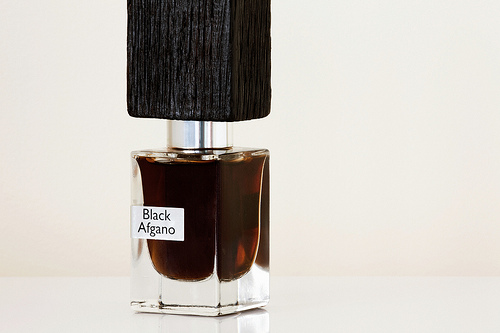
Nasomatto Black Afgano

Source: Nathan Branch.

Source: Nathan Branch.

I never thought I’d spend time researching hashish for a perfume blog, but it seems to be an unavoidable aspect of Black Afgano, the famous, slightly notorious fragrance from the Dutch niche house, Nasomatto. It’s a pure parfum that supposedly seeks to replicate the effects of hashish and, perhaps, even its actual smell. The whole thing is done in a very wink-wink, coy manner, right down to the perfume’s ingredients which are kept secret and which some jokingly claim include a little bit of the drug.

Some people aren’t joking about it, though, and they genuinely believe Black Afgano contains hashish or cannabis. (Technically, there is a difference between hashish and cannabis.) I find the possibility extremely amusing and hard to swallow, but they may have a reason for their conviction. According to the Nathan Branch blog, at the time of Black Afgano’s release, there was much “talk about how perfumer Alessandro Gualtieri spent several years experimenting with actual Afghanistan hashish (even “smuggling” it to his lab) in order to make a perfume that either features the essence of hashish or smells somewhat like the stuff[.]” Like me, he also dismisses the likelihood of hashish as a note, saying “that strikes me as more a fantasy story that’s good for generating hipster buzz.” Still, the bottom line is that hashish and Black Afgano seem intertwined, whether in terms of the perfume’s description or in terms of people’s expectations. A number of people truly expect to smell cannabis, and, for some, those expectations led to disappointment and harsh criticism.

Hashish via fadedfools.com

Hashish via fadedfools.com

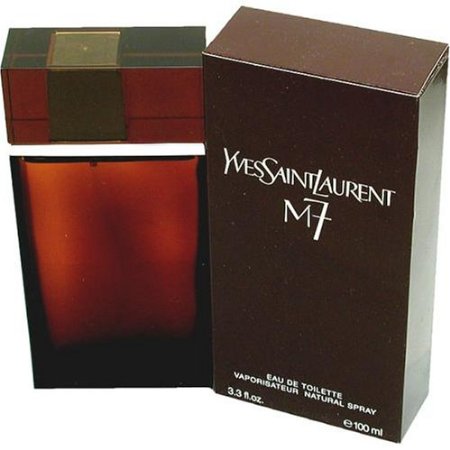
I’ve never done drugs of any kind, and have no familiarity with hashish or its related, supposedly weaker counterpart, cannabis. In Europe, however, everyone knows about Amsterdam’s open stance on drugs, and I had quite a few high-school classmates who’d tried the city’s famous hash brownies (or who… er… exported… other souvenirs of their trip). I knew full well the visuals, even if I didn’t experience the product, and I have to say, the visuals are dead-on for Black Afgano. The scent, though, was a surprise, and nothing like what I had expected. In a nutshell, Black Afgano is a very nice amber oriental dominated by medicinal oud, incense, nutty labdanum, chewy tobacco, patchouli, and vanilla. A wholly conventional, if potent and super-rich, oriental — and hardly the dangerous, completely daring, hardcore fragrance that I had expected. In fact, it strongly reminded me of another, earlier, much more pioneering, and genuinely innovative oud scent: YSL‘s famous M7 in vintage form.

Source: Nathan Branch at website linked up above.

Source: Nathan Branch at website linked up above.

Black Afgano was created by Nasomatto’s founder, Alessandro Gualtieri, and was released in 2009. The Perfume Shoppe has a description of the scent, and its notes:

One of his boldest creation invokes the best quality of hashish. It is the result of a quest to arouse the effects of temporary bliss. The fragrance’s description (“smuggled” ingredients, harsh herbs, marijuana-as-incense) conjures wild thoughts yet Black Afgano’s dark brown juice is syrupy and the fragrance opens with strong aromas of oud and musk. There is also a hint of wood-scented cigarette smoke in the opening minutes of the fragrance. Black Afgano’s mid-notes develop into smelling like marijuana with a dry, herbal-leafy accord (cured tobacco) tinged with a sweet sweaty note. In the dry down Black Afgano becomes vanillic ambery with a touch of patchouli. The lasting power of Black Afgano is sensational.  Bold and masculine which says “Dare to wear me”.

The specific, official elements in Black Afgano are unknown. Nasomatto doesn’t release notes for its perfumes, and lists nothing on its website. Fragrantica has nothing, either, but Luckyscent vaguely references “coffee, oud, tobacco and hash.” It seems far too minimal a list. While different blogs mention different elements, Scent Intoxique has one of the better ingredient lists, with “cannabis, herbal notes, resins, woods, coffee, tobacco, frankincense, oud.” Nonetheless, I don’t think that’s complete either, and since everyone has their own version of what is included, here is mine:

Coffee, oud, frankincense, tobacco, labdanum, herbal notes, dried fruit, wood, vetiver, vanilla, patchouli, amber resins and/or benzoin.

YSL M7.

YSL M7.

Black Afgano opens on my skin with a blast of coffee and oud, followed quickly by tobacco, fruited raspberry and cherry notes, labdanum, and incense. There are strong undertones of both leather, and something that is aromatic but floral. In truth, it is extremely close to YSL’s fabulous, vintage M7, only more concentrated and potent (which is a plus, as M7 was incredibly sheer and short in duration on my skin). Black Afgano has the exact same cola note from the labdanum amber resin, though it’s more raspberry in nature here than in M7 where it was almost wholly cherry-like. The medicinal nature of the oud, and the manner with which it combines with the amber, incense, and slightly honeyed undertones of the labdanum, feel very close as well. There are differences, however: M7 opens with herbal lavender, juicy bergamot, and a powerful element of cardamom; it lacks even a drop of coffee, something which is quite robust in Black Afgano’s start. Yet, ultimately, M7 is hardly about the lavender or citruses, and the two fragrances have enough similarities that my jaw was a little agape.

Source: science.howstuffworks.com

Source: science.howstuffworks.com

Putting M7 aside, Black Afgano’s opening is quite lovely. The rich coffee feels like freshly roasted beans, as well as the somewhat wet, black grinds. The labdanum is beautiful here, showing all the reasons why it is my favorite type of amber resin. It’s dark, very nutty, just barely animalic and musky, with a tinge of dark leatheriness underlying its glowing, golden heart. 

Source: colourbox.com

Source: colourbox.com

The other notes are lovely too. The tobacco element is similar to the sun-dried, sweet leaves in Serge LutensChergui with their sweetly honeyed touch, but there is also a thick, almost wet feel to the note in Black Afgano. I never detect cigarette smoke or ashtrays, though. At the same time, there is a subtle suggestion of patchouli at play in Black Afgano, and it’s the dark, dirty kind which adds some rich, textured depth and chewiness to the tobacco. Flickers of dark, rooty, slightly earthy vetiver lurk in the base, while, up top, there is a surprising fruited note. It smells strongly of raspberries, with a touch of plum, and it adds another source of sweetness to counter the darker elements. The whole thing is very much like the middle and drydown stages to M7 that I’d hoped to experience in full potency, but which my wonky skin turned instead to a thin, sheer gauze. And absolutely none of it smells of hashish or cannabis….

Norlimbanol. Source: leffingwell.com

Norlimbanol. Source: leffingwell.com

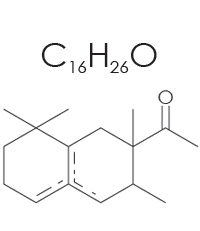
The swirl of dark, smoky, chewy, wood, incense, labdanum, and tobacco notes have something else underlying them. It almost feels like ISO E Super, but it’s not. I can’t pinpoint which precise synthetic is at play, but I know it’s there and it adds to the slightly medicinal feel of the oud. I was very relieved to have some help from the blog, Scent Intoxique, whose review of Black Afgano noted two synthetic elements:

Straight out of the bong you’re greeted with a dense aroma chemical sucker punch made up of synthetic Givaudan oud, coupled with an underpinned cedar effect in the form of Kephalis (which is an Iso-E-Super substitute, only with a more woodier/smokier feel).

Finally I can make out some quite prominent vetiver/tobacco notes, adding to the “greenness” which the general nose picks up. I may be off, but I definitely feel like I’m picking up one of the main players here and that’s Norlimbanol™, which is described as an “extremely powerful woody/animal amber note. That has a dry woody note in the patchouli direction”.

As described by Chandler Burr, “Norlimbanol is one of the most amazing scents around, a genius molecule that should be worth its weight in gold; Norlimbanol gives you, quite simply, the smell of extreme dryness, absolute desiccation, and if when you smell it, you’ll understand that instantly—the molecule is, by itself, a multi-sensory Disney ride.”

It’s this same compound which I believe gives the scent its subtle leathery undertones along with the amber.

I don’t share his enormous familiarity with either aroma-chemical, but I’d bet he’s right. That said, I would say the labdanum is also responsible for the leather nuances in Black Afgano, though they aren’t very profound or dominant on my skin. And I’m pretty sure there is actual patchouli at play as well.

Forty minutes into Black Afgano’s development, the fragrance begins to shift. The notes turn hazy, overlapping each other and creating a soft bouquet. The coffee, medicinal oud, sweet raspberry, cola, slightly honeyed tobacco, and nutty, leathered labdanum are all still there, but they’ve lost some of their edge and distinctiveness. A quiet hint of powderiness lurks underneath, and the whole thing has started to lose projection.

Painting by Holly Anderson. "Spherical Romance Art Set" via Artbarrage.com. https://www.artbarrage.com/item.php?id=656

Painting by Holly Anderson. “Spherical Romance Art Set” via Artbarrage.com. https://www.artbarrage.com/item.php?id=656

With every hour, Black Afgano becomes quieter and quieter, though its primary overall bouquet remains on a singular, linear trajectory for many more hours to come. At the end of the second hour, the fragrance hovers just barely above the skin scent, and thirty minutes later, sits right on it. Around the same time, both the coffee and vetiver fade away entirely, the patchouli becomes much more noticeable, and a chocolate note creeps into the mix. Some aspect of the labdanum’s dark, nutty, slightly leathery characteristic has combined with the patchouli to create a definite but subtle chocolate undertone to Black Afgano. Around the 3.5 hour mark, a quiet hint of vanilla pops up in the base, and it eventually becomes much more prominent.

By the start of the fifth hour, Black Afgano is a blur of sweet woodiness with smoke. The fragrance is a well-blended hazy bouquet of medicinal oud, cola labdanum with its faintly raspberry-like undertone, patchouli, amber, incense, and vanilla, but they are really hard to tease apart. Flickers of tobacco and leather lurk at the edges, but they never feel distinct either. Soon, Black Afgano turns even more nebulous and abstract, wafting only patchouli, vanilla, and labdanum amber with faint tendrils of black incense. In its final moments, the fragrance is nothing more than the merest suggestion of patchouli with ambered sweetness.

All in all, Black Afgano lasted just short of 10.75 hours on my skin. It was nothing like the purported legend of longevity that I’d read about with its rumours of a single drop lasting for 24 or 36 hours. I know my skin is wonky and consumes perfume, but this was really a surprise, especially for a fragrance that is pure parfum extrait! A few people on a Basenotes thread reported a similarly moderate or average lifespan, but the majority find Black Afgano to have monumental longevity. My experience with the sillage, however, was wholly consistent with all the reports; everyone agrees that it is a scent that doesn’t project much and which remains very close to the skin.

part of "The Blooming Tree," Painting by Osnat Tzadok, via osnatfineart.com http://www.osnatfineart.com/art/landscape-paintings/6088-The-Blooming-Tree.jsp

part of “The Blooming Tree,” Painting by Osnat Tzadok, via osnatfineart.com
http://www.osnatfineart.com/art/landscape-paintings/6088-The-Blooming-Tree.jsp

I have very mixed feelings about Black Afgano. It wasn’t at all what I expected. In fact, I’m a bit perplexed by how Black Afgano — that supposedly hardcore, brutish, super macho, edgy, dangerous scent — makes me envision curling up in winter before a fire in a sweet, smoky, woody amber cloud, but it does. It’s a totally safe, easy, approachable, comfort fragrance for me, without any edge whatsoever. I absolutely enjoyed wearing it, and I’m pleased I have an alternative to the rare, discontinued, vintage M7 which actually lasts on my skin. Vintage M7 lasted a whopping 3.5 hours on me, and the equally discontinued, reformulated M7 was even worse! Both fragrances only felt noticeable for a mere, solitary, wholly abysmal hour, so even the soft, minimally projecting Black Afgano is a step up in that regard. And, again, it was a very pretty, even occasionally beautiful, warm, rich amber on my skin. As Now Smell This put it: “Black Afgano is a handsome oriental fragrance for men; it’s a “well-rounded” perfume with no ragged/jagged edges. Black Afgano smells more like the incense people use to cover up their pot use than it does the drug itself.”

Source: lolzparade.com

Source: lolzparade.com

Yet, despite my enjoyment of the scent, there is the issue of hype. When I wore Black Afgano, I wondered to myself, “Is this IT??!” Even if one puts aside its similarity to other fragrances, it doesn’t feel revolutionary or edgy at all. Black Afgano has such a reputation for ferocity, and I don’t understand that given the largely soft, sweet cloud I experienced. In fact, I have to wonder if there is some sort of hipster cool or bravado swagger associated with the scent that makes people — young men, in particular — like to hype it up? Is this part of a certain subculture in the perfume world that likes to brag about “panty dropper” fragrances? Is Black Afgano the perfume equivalent of a Porsche’s penis extension symbolism for guys who thinks it makes them seem super cool, macho, and virile? Or is it all the fault of my skin which has muted the fragrance’s supposedly “beastly” roar?

Whatever the reason, I simply don’t get the fuss. Black Afgano is a perfectly lovely fragrance — one I enjoyed, in fact — but what I smelled didn’t rock my world, make me feel like a dangerous rebel, or make me lust for a bottle right away. Don’t kill me, but I could see a grandfather wearing Black Afgano in a sweater and slippers by the fire as he sips a glass of scotch, just as much as I can see a hot young guy or woman wearing it. In my opinion, Amouage‘s Tribute is the beastly, smoky, dangerous Darth Vader or Hell’s Angels of fragrances. Black Afgano could work in a NASA library.

The reactions to the scent are very interesting. There is that one small sub-group that I mentioned earlier (who are almost invariably young males) which adores to brag about the dangerous toughness of the scent. Then, there is a much larger group which simply enjoys Black Afgano’s dark, chewy, sweet-smoky, ambered nature, without regard to the perfume’s reputation. Finally, there is a massive group who seems to loathe the fragrance, either on its own merits or in conjunction with the extreme hype.

On Basenotes, the views seem very split. For example, in one thread, most of the Basenoters are extremely negative about the scent, despising it as rather unwearable or genuinely unpleasant, or else regretting having bought it. Apparently, a month earlier, there was another Basenotes discussion which was wholly positive in nature. In the official Basenotes entry for Black Afghano, the fragrance has an 82% score out of 33 reviews: 66% (or 20 people) gave it Five Stars and 21% (or 7 people) gave it three.

On Fragrantica, early reviews seem to be wholly gushing in nature, while the vast majority of subsequent assessments are sharply negative. I can’t tell you the number of people who find the scent to be over-hyped. For some, it’s because they are genuinely upset that there is no actual smell of weed. If you think I’m exaggerating, I’m not. For example:

  • Cant believe the price for this rotten flanker of M7 , i would call it a suffocating oxygen sucker. Where is the marijuana and coffee btw?
  • Nothing like the hashish or cannabis, and those notes were exactly what I was looking for. And I know too well what I`m talking about.

Apparently, some people were hoping to get a legal form of hashish in perfume form. I’ll spare you my thoughts on that quixotic dream. More interesting (and sane) to me, are the repeated references to M7 amongst Fragrantica posters. I’m glad to know it’s not just me, but I’m a little surprised by some of the anger over the similarities. Yes, actual anger about Black Afgano, and it’s not just the quoted commentator up above, but some others as well. M7 has a worshipped, protected, cult status amongst many perfumistas, but still! Again, I think the issue of hype is partially responsible, with many finding the fragrance to be much ado about nothing (particularly in light of M7), or being disappointed by their expectations when they experienced a perfectly nice, conventional, sweet, smoky, woody, amber fragrance.

Perhaps the more useful part of the reviews is the discussion of similar fragrances other than M7. On Basenotes, a few people shared my thought that Black Afgano has a similar tobacco note to that in Serge LutensChergui. On Fragrantica, 20 people voted for a similarity to Carner Barcelona‘s Cuirs. I haven’t tried it, so I don’t know how true that may be. On both Basenotes and Fragrantica, a number of people bring up Montale‘s Dark Aoud. I haven’t tried the latter, either, so I can’t compare, but it may be something to keep in mind if you can’t get Black Afgano. Apparently, Nasomatto only makes the fragrance once a year in somewhat limited quantities, so I’ve read a few people claim that it’s not always easy to obtain. (However, I had absolutely no problems finding sites from the U.S. to Russia and South Africa that sell Black Afgano, so take that claim with a grain of salt.) However, the Montale is significantly cheaper at $110 for 50 ml than Black Afgano, which costs $185 or €108 for a 30 ml bottle. Also, as a slight warning, Black Afgano supposedly stains clothing, so if you get it, be careful where you spray it.

Treating Black Afgano in a vacuum, and without reference to the larger context, the fragrance doesn’t work on everyone’s skin. One problem is the tobacco note. A friend of mine wanted to like Black Afgano, but said it smelled like “a sour and stale ashtray” on his skin, and he’s not alone; I’ve seen a few references to an “ashtray,” along with chewing tobacco, and pot smoke. A tiny handful struggle with something completely different: cumin. I have never seen any site or blog list cumin as one of the notes in Black Afgano, but clearly, something in the scent replicates a stale or sweaty aroma to some noses. Finally, some people have problems with the synthetics, detecting either a rubbing alcohol note (which would be the ISO E Super-like element mentioned up above), Ambroxan, or various unpleasant, abrasive chemical aromas. One person even compared the scent and feel of Black Afgano to latex paint!

The bottom line — and the reason for this extended discussion– is this: Black Afgano is complicated scent on a variety of different levels, some of which have absolutely nothing to do with the fragrance’s actual aroma. It’s a perfume that comes laden with expectations, whether it’s about the notes, its effects, or its reputation. Block it all out. If you do, and if your skin plays nicely, then you may experience a very rich, deep, oriental, amber scent. Not a revolutionary one that will knock your socks off, but quite a nice one. If your skin doesn’t comply, then it will be a dark, unpleasant tobacco or synthetic oud experience for you. And if you’ve smelled or own vintage M7, your primary reaction may be déjà vu.

Either way, Black Afgano won’t be the dark, brooding, difficult, revolutionary “beast” of legend. It’s not radically daring, it’s not a high, it’s not like cannabis, and I highly doubt you’ll be transported away in state of euphoric, drugged-out bliss. My advice is to approach Black Afgano with low expectations, and not to expect the Lost smoke monster or some sort of hashish drug replacement. If you’re lucky, then you may be surprised at the loveliness of the chewy, dark, incense-y, tobacco-y, nutty labdanum and cola, oud opening. You may really enjoy the soft patchouli, vanilla, and ambered sweetness of the drydown, and you might even think Black Afgano is a cozy, comfort scent at the end of the day. Whatever you do, however, don’t buy Black Afgano blind, and don’t believe the hype.

DETAILS:
Cost & Availability: Nasomatto is a concentrated parfum extrait (or pure parfum), and is generally sold only in a 30 ml/1 oz bottle. However, a mini 4 ml version is available directly from Nasomatto, who sells the 30 ml bottle for €108 and the 4 ml mini for €38. Nasomatto ships world-wide. In the U.S.: Black Afgano retails for $185 for 30 ml. It is available at Bergdorf Goodman, BarneysLuckyscent,  , BeautyBar, C.O. Bigelow (where it is currently sold out). Outside the U.S.: In Canada, you can find Black Afgano at The Perfume Shoppe which sells the 30 ml bottle for US$185. In the UK, Black Afghano costs £108, and is available at Roullier WhiteBloom Parfumery, and The Conran Shop. Liberty London sells the Nasomatto line, but I don’t see Black Afgano listed on the website. In France, you can find Black Afgano at Premiere Avenue for €108. In Spain, it’s sold at Parfumerias Regia, in Italy at Sacra Cuore, in Russia at what seems to be Nasomatto’s own Russian site, along with Orental.ru. In Germany, Black Afgano is sold at First in Fragrance (where it’s priced higher than retail at €120). In the Netherlands, you can obviously find it at Nasomatto’s own shop in Amsterdam. In Australia, you can find Black Afgano at Libertine which sells the 30 ml bottle for AUD$220. In Hong Kong, I found Konzepp carries the fragrance, in South Africa at Rio Perfumes, and in the UAE, I found it on Souq.com but it seems to be sold out or currently unavailable. Samples: I obtained my sample from Surrender to Chance where prices start at $4.99 for a 1/4 ml vial. Samples are also available for purchase at many of the sites linked up above.

Perfume Review: Penhaligon Vaara

Source: mariyatourtravels.com -

Jodhpur, India. Source: mariyatourtravels.com –

There once was a Maharaja who loved his granddaughter very much. So much so, that her mere birth felt like the occasion to celebrate with something special. He commissioned a famous perfumer to create a scent in her name, honouring both his granddaughter and the land that he loved so much. It is the story of Vaara, the new creation of Bertrand Duchaufour for the old, famous British perfume house, Penhaligon.

Source: telegraphindia.com.

Source: telegraphindia.com.

The perfume site, CaFleureBon, explains the tale:

Vaara,  was inspired by the Royal House of Marwar-Jodphur in Rajasthan when  His Highness Maharaja Gaj Singh II desired a scent to commemorate the birth of his granddaughter, Vaara and to reflect his family’s deep love and connection with Jodhpur. Vaara offers a unique glimpse into this aromatic world of the Maharaja.

Bertrand travelled to Jodhpur to explore the life of a Maharaja; visiting historic forts, family palaces, exotic gardens and bustling city markets. His journey provided him with an abundance of inspiration for the fragrance and the end result, Vaara, cleverly captures the spirit of this fascinating part of India.

Mehrangarh Fort, Jodhpur. Source: aboutrajasthan.in

Mehrangarh Fort, Jodhpur. Source: aboutrajasthan.in

I absolutely adore Jodhpur, which I found to be one of the most magical places in India, so I couldn’t wait to try Vaara. Penhaligon‘s description merely added to my excitement:

The fragrance begins with a delicious blend of coriander and carrot seeds, creamy saffron and juicy quince: ingredients discovered during his trips to local markets in Jodhpur. The heart of Vaara belongs to the gardens of Balsamand, the Maharaja’s summer palace, with two glorious roses blended elegantly with a billowing white note of Indian magnolia, a touch of freesia and a whisper of iris. The fragrance settles into a luscious combination of honey, white musks and resins dripping over an aromatic base of tonka, cedarwood and sandalwood.

According to Penhaligon and Luckyscent, the notes in Vaara include:

Quince, Rosewater, Carrot Seed, Coriander Seed, Saffron, Moroccan Rose Absolute, Bulgarian Rose, Freesia, Indian Magnolia, Peony, Iris, Honey, White Musk, Cedarwood, Sandalwood, Benzoin Resin, Tonka Bean.

Source: imgshowcase.blogspot.com

Source: imgshowcase.blogspot.com

Vaara opens on my skin with quince and a watery rose. For those who may be unfamiliar with the smell of quince, it has an aroma between pear and apple with a honeyed undertone. For some, the smell feels fresh but exotically spicy, while, for others, quince has an aroma that slightly resembles pineapples, citruses, or lemon blossoms. In Vaara, the quince does indeed smell like something between an apple or a pear, though it’s closer to the latter for me and has a faint tinge of lemon blossoms. The rose note in the fragrance is delicate, sweet, very pink in feel, and extremely watery in characteristic. It’s syrupy and strong in a way that feels a lot like a tea-rose. Its watery aspect doesn’t feel dewy or metallic, but the end result is something that feels like a waterlogged pastel.

Source: Dennis 7 Dees Gardening center. dennis7dees.com

Source: Dennis 7 Dees Gardening center. dennis7dees.com

Dancing all around the fragrance are strong whiffs of the accompanying players. First and foremost is a carroty smell of iris, followed by violets. The latter doesn’t last for more than a few minutes because it is bulldozed over by the onslaught of a clean, white musk that smells cheap, chemical, and synthetic. It has a sharp tone to it and strongly evokes hairspray. Quickly, it infuses all the other notes from the quince to the rose and iris. It does the same to the peony which arrives on the scene, smelling very fresh, syrupy, and quite similar to the roses. There is a small whiff of freesia, too. The floral notes all feel very young, feminine, and flirty — too much so for me. I’m having visions of teenage girls in the ’80s wearing big, chintzy, cabbage rose dresses from Laura Ashley.

Making a valiant attempt to prevent Vaara from dissolving completely and thoroughly into floral hairspray are a few whispers of other notes. There is the merest tinge of something lemony from the magnolia. That said, I never smell the flower in its full, creamy, velvety, floral richness, so perhaps the note really is a subset of the quince. I have no idea. About ten minutes in, the saffron appears, adding a subtle touch of spiciness. Five minutes later, the hairspray stops acting like an advance scouting team for a Panzer unit, loses a little of its forcefulness, and lets a few of the other notes shine through. The pear-lemon blossomy quince regains its place as the star of the show, followed by the chorus of pink roses, sweetly carroted iris, purple violets, and syrupy white peonies. Despite the minor, momentary pop of saffron, Vaara doesn’t feel remotely oriental to me. Not once was I transported to Jodhpur or felt the warm breath of India. Instead, Vaara conjures up a large, full-blossomed, bridal bouquet of quince and florals all wrapped up with clean, white, musk hairspray like a bow. While the musk may make Vaara feel fresh and bright, it also makes it smell quite cheap to my nose.

Source: oncewedd.com

Source: oncewedd.com

Twenty minutes into Vaara’s development, the perfume shifts a little. The carroty undertones rise in prominence, strengthening the iris note. Yet, the latter feels as floral as it does carroty. It’s probably the impact of all the other notes which seem to grow in sweetness, as well as in strength. The potency of the pastel florals makes Vaara a scent that is primarily floral in nature, then perhaps fruity-floral, but never one that seems even remotely “oriental” to me.

Linda Evans as "Krystle Carrington" in Dynasty. Source: Kootation.com

Linda Evans as “Krystle Carrington” in Dynasty. Source: Kootation.com

What it really does is conjure up the past. Vaara has such a British, Sloane Ranger, 1980s feel. A young, shy, Lady Diana, circa 1981, might have worn Vaara in her youth — except the fragrance is probably too potent and forceful in strength. A better choice might be the very blonde, sweet Krystle Carrington from the old television show, Dynasty — except Vaara smells too commercial for the wife of a corporate magnate. Then again, Vaara’s increasingly strong undertones of floral hairspray might suit the bouffant-loving Crystal quite well.

The sad thing is that Vaara might have been quite decent without the cheapness and the low-quality, girly, super-feminine ingredients. At its heart, there is a kernel of a truly lovely scent. Unfortunately, Bertrand Duchaufour already built on that kernel, and already made that fragrance. It’s Mohur from Neela Vermeire Créations. Mohur has an extremely similar opening to Vaara, so similar, in fact, that I was initially taken aback. Ignoring Vaara’s brief spasm of quince, and considering only the opening forty minutes, the two fragrances overlap to a sharp extent. Mohur has the exact same sweet, syrupy, watery, pink tea-rose, followed by carroty notes, iris, and purple violets. The similarities largely end there, however, as Mohur’s violet undertone feels deep, haunting and rich, and evokes old, classic Guerlain scents. Mohur has a flicker of oud, a hint of almonds, and a more successful, substantial spice note, instead of the minuscule pop of saffron given by Vaara. Those are the very minor differences, however.

The substantial and main ones are the fact that Mohur never feels even remotely synthetic, chemical, or cheap. The fragrance sits atop bucketfuls of the most precious, rare, almost extinct, genuine Mysore sandalwood — not a whisper of which is to be found in Vaara, no matter what its note list may claim. Mohur is luxe, sophisticated, endlessly elegant, very expensive in feel, and layered with complexity. Vaara lacks all of that. It feels like a shrill pre-teen jumping up and down at the skirts of its big, elegant sister, clamouring at a high pitch to be allowed to join in the fun. Oh, and did I mention the ’80s? The pre-teen is a big-haired, twelve-year old with lots of hairspray, and a hell of a sharp voice.

ISO E Super. Source: Fragrantica

ISO E Super. Source: Fragrantica

One reason for that sharpness is the use of ISO E Super, an aromachemical synthetic that some perfumers use as a “super-floralizer” and to add longevity to weak floral notes. To my chagrin, ISO E Super is present in Vaara to quite a significant degree. It not only amplifies the loudness of the white musk, but it adds to the forcefulness of floral notes (like iris or freesia) that, by themselves, are quite weak, dainty, little things. Given that I only dabbed on about 2.5 large smears of Vaara, I can’t get over its seriously intense potency during the first hour. Unfortunately, the loud buzziness of the synthetic combines with the equally synthetic white musk to give me one very intense headache. I don’t always get headaches from ISO E Super, but I do when a lot is used. Or, when a perfume is very cheap….

At the end of the first hour, Vaara starts its final transformation. All traces of a fruited element vanish from the top, as the quince becomes a muted blip in the horizon. Now, the scent is a quartet of rose, rose-like peony, carroty-floral iris, and violets — all infused with white hairspray musk. Vaara’s edges have started to blur, and the notes begin to overlap. Just after the 90-minute mark, the rose takes over as the main and dominant element, followed by white musk and ISO E Super, with only subtle whiffs of the other florals. With every passing half hour, the scent devolves further into a simple tea-rose scent that is simultaneously extremely syrupy sweet, somewhat watery, and, also, quite fresh and clean. I’m singularly unimpressed with any of it. What’s odd is that Vaara is muted in feel, while still very strong in power. No doubt, it’s thanks to the chemical Panzer unit that is stomping its way up my nose to the back of my throbbing skull.

Source: wallpaperswide.com

Source: wallpaperswide.com

And that’s really the end of the story. Not a whiff of sandalwood, nary a hint of benzoin sweetness and vanilla, no tonka bean, no discernible magnolia, and no cedarwood. Vaara merely becomes more nebulous: a shapeless, very commercial-smelling, very amorphous blur of sweet roses, and white musk. It stays that way in one linear, simple line until the 8.5 hour mark, when dripping, sweet honey makes an appearance. The base feels rounder and warmer, too, but it’s never anything specific. At most, one can say that ISO E Super’s “woody hum” (as Luca Turin describes the note) vibrates a little in the base along with some warmth. In its final hours, Vaara turns powdery with a slightly sour undertone and mixed with an abstract hint of rose. All in all, the fragrance lasted just short of 11.75 hours, a length of time which is quite rare for a pure floral on my perfume-consuming skin but which is further testament to all the synthetics underlying it. The sillage was generally high and good for most of Vaara’s life, though it had a 1980s powerhouse forcefulness for its initial hour.

You may think some of my critical harshness for Vaara stems from my issues with ISO E Super, or perhaps from my disdain for cheap synthetics as a whole. You’d be mistaken. It’s not just me. Bois de Jasmin gave Vaara a rare 3 stars, something I haven’t seen in a while. She, too, noted both the cheapness of the scent and its early similarities to Mohur:

…[W]hy is Vaara such a wallflower? Etro has already tried to take us to Rajasthan with its recent fragrance, but the violet and rose combination never got past the South of France. Despite its promises, Vaara doesn’t even cross the Channel. It’s soft spoken and mild, a perfume for someone who really doesn’t like orientals or anything richer than frozen yogurt. […][¶]

… [I]f the drydown either had more curves (or to put it bluntly, if Penhaligon’s had spared more pennies for the juice), Vaara would have been terrific. But instead of taking me for a ride, Vaara meanders around rose and settles for a well-behaved drydown of raspy woods and laundry musk.  It’s surprisingly clean, considering that we’re talking about an India inspired perfume. There is not even a hint of the bonfire smoke that pervades most Indian cities, nor the opulent incense hanging around the temples. At best, it’s a neatly packaged idea of India, without any messy bits.

These messy bits, however, make other Duchaufour fragrances much more compelling, whether it’s the sultry Eau d’Italie Paestum Rose, playful L’Artisan Traversée du Bosphore, or even Vaara’s older sister, Neela Vermeire Mohur.  By contrast, Penhaligon’s is a more commercial and approachable brand than the others I’ve mentioned, so Vaara’s garden party exoticism is not accidental. That Vaara is the low-budget version of Mohur is also not surprising.

Source: BrownThomas.com

Source: BrownThomas.com

I think she’s being far, far too kind, and extremely diplomatic. But, if you parse that review, you’ll find the blunt truth hiding behind the extreme tactfulness. Vaara is a “low-budget,” “commercial,” “wallflower” with “laundry musk” that is the result of Penhaligon not sparing enough pennies. In my opinion, it’s definitely commercial, belongs in a mall, and is far over-priced at $125 and $160. The extremely cheap-looking gold bow on the bottle (metal? plastic?) doesn’t help.

The early assessments from those who have tried Vaara are much more enthusiastic. On Fragrantica, all three of the reviews thus far are positive and two of the three come from men. One chap happily compared Vaara to that 1980s monster Poison, writing: “Here the honeyed plum has been replaced by quince but I would not be surprised to learn Duchaufour has made use of the same lush alpha- and beta-damascone combination of the Dior masterpiece.” Well, I certainly agree with his choice of decades….

The other two praise Vaara as well, with one gushing about how Vaara was not “a heavy, cloying oriental monster. No, [Duchaufour] mastered a truly delightful, fruity, wet and juicy, interesting and compelling new age world scent” with fruits, florals, and woods. His subsequent rave about the quince element makes me think that he experienced substantially more of it than I did. I’m not very surprised; my skin tends to emphasize and amplify basenotes, which may be one explanation for why the white musk was so dominant for me. If your skin brings out the top notes, perhaps Vaara will be more of fruity scent for you as well. If it doesn’t, then welcome to my world of laundry-clean musk and floral hairspray. As a side note about those three positive Fragrantica reviews, one of the commentators does admit that Vaara doesn’t end well: “The dry down, however, is less magical, with the blurry trace of roses and the prominence of powdery and balmy notes.” 

On Luckyscent, the only comment thus far sums up a little of what I feel:

This is mostly rose on my skin. A sweet tea rose type fragrance. Not what I was expecting. Seems pretty linear with not much scent development. Disappointing!

To me, smelling cheap is worse than being linear or being simple. Smelling of floral hairspray and rose “laundry musk” (to use Bois de Jasmin’s phrase) is just as bad. I plan on getting over the whole ghastly ordeal by putting on some Mohur instead.

DETAILS:
Cost & Availability: Vaara is an eau de parfum that comes in two sizes. There is a 1.7 oz/50 ml bottle that retails for $125 or £85; and a 3.4 oz/100 ml bottle that costs $160 or £120. I believe the fragrance will fully launch in mid-August 2013, though it is already available from Penhaligon and from some retailers.  Penhaligon: You can buy Vaara directly from Penhaligon which sells the fragrance in both sizes. They also have a U.S. Penhaligon site which offers free shipping on all orders over $100. Penhaligon also provides a Store Locator Guide which lists shops from Canada and Korea to Indonesia, Singapore, the Cayman Islands, Australia, Turkey, Hong Kong, and all of Europe which carry its products. In the U.S.: Vaara is already available at Luckyscent which sells both sizes, along with a sample. Vaara will launch at some select Saks Fifth Avenue stores on August 19th, and a little later at Gumps. In New York, the Penhaligon line is available at Aedes, Saks, Chocheng, Eisler Chemist, and some other shops. I don’t believe they have Vaara yet. In Washington D.C or Baltimore, Penhaligon is sold at Sterling & Burke, and Loafers & Lace, respectively. Vaara is also already available in the large $160 size at ShopLondons. Outside the U.S.: In Canada, the Penhaligon line is carried at The Perfume Shoppe and Beauty Bar Cosmetics (which doesn’t have an online retail website), but the Perfume Shoppe has no listing Vaara yet. In Europe, Vaara is already available at London’s Harvey Nichols in the small 50 ml size, and from Ireland’s Brown Thomas in the large size for €140. In France, the Penhaligon line is sold at Paris’ niche boutique store, Nose, as well as at Les Galleries Lafayette, Le Bon Marché, Printemps, and other stores listed in Penhaligon’s vendor page. A number of those stores’ online page show no listings for Vaara yet, as it is too new. For all other locations throughout Europe and beyond, you can check Penhaligon’s Stockist listings for a location near you. Samples: You can obtain samples from a number of the links listed up above. I obtained my sample from Surrender to Chance which sells Vaara starting at $4.99 for a 1 ml vial.