Perfume Review- Serge Lutens Datura Noir: Hells Bells

The Devil’s Weed. Hell’s Bells. It sounds like something from a gothic novel, a Regency romance, or a horror movie. Perhaps, even the street name for a drug. The latter might actually be quite an appropriate context for the “Devil’s Weed,” a toxic, poisonous, hallucinogenic plant which (Wikipedia says) once drove the soldiers of Jamestown mad, back in 1676.

Datura Seed Pod. Source: Flick, KurtQ/KurtQvist.http://www.flickr.com/photos/kurtq/3971036475/

Datura Seed Pod. Source: Flick, KurtQ/KurtQvist. http://www.flickr.com/photos/kurtq/3971036475/

The Devil’s Weed (aka, Hell’s Bells, Devil’s Trumpet, Angel’s Trumpet, Brugmansia, and many other names) is scientifically known as the Datura Stramonium plant and is a type of deadly nightshade with truly revolting looking pod seeds that resemble something out of a Tim Burton movie. Yet, its delicate, summer-blooming flowers are often used in perfumery because they are said to smell of sweet apricots or plums. In perfume, the Devil’s Weed goes by the much more innocuous sounding name of the Datura flower.

That flower is the ostensible inspiration behind Datura Noir, a perfume created by Christopher Sheldrake for Serge Lutens. It was released in 2001 and it seems that it may soon be discontinued. Though there has been no official announcement (there rarely is), I’ve read numerous comments claiming that the perfume will be discontinued in as soon as a few months. It is currently on the Serge Lutens website which describes the perfume as follows:

Like a diabolic trail of smoke left by Satan in Paradise.

Some say this fragrance will enthrall you; others that it will make you crazy. Others still that excessive exposure will kill you dead.
To be precise, one night I took brugmansia, also known as Angel’s Trumpet, and distilled the notes of its lingering memory.

What a description! My word! If only the perfume lived up to it….

Datura Noir BottleLet me be as blunt as possible: Datura Noir is about as satanic, dark, “Noir” and diabolical as raindrops on roses and whiskers on kittens. It is a perplexing perfume that has left me completely unable to make up my mind about anything but the fact that it is most definitely NOT diabolically dark. You see, Datura Noir is all creamy white coconut, creamy white tuberose, and bitter white almonds. I like two of the three things very much. Unfortunately, creamy coconut… not so much. And, on my skin, this is a very coconut-y perfume.

Fragrantica classified Datura Noir as an Oriental Vanilla (I’d call it a Floral Vanilla, myself), and provides the following notes:

coconut, tuberose, tonka bean, almond, lemon blossom, mandarin orange, musk, chinese osmanthus, heliotrope, myrrh, vanilla and apricot.

The first time I tried Datura Noir, it opened on my skin with an explosion of buttery vanilla and almond, followed a few minutes later by fruity floral notes that were hard to isolate. For a second, I also thought I smelled green plums and, possibly, apricots — but it soon disappeared. Underlying them all was coconut which resembled just slightly Hawaiian tropical oils. I’m not usually crazy about the note and, yet, it worked in some odd way — perhaps because it was extremely mild and fleeting, and because it was alleviated by the almond note.
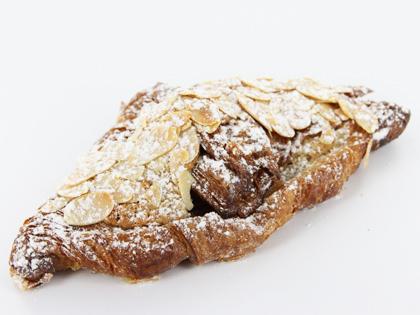
Croissant au amandesThe almond was absolutely heavenly. At times, it was bitter; at others, sweet and warmed by the vanilla. I detected the heliotrope which not only resembles almonds but which also has a slightly sweet powdery element with a touch of light violets. While heliotrope can sometimes lead to a “Play-Doh” impression, it doesn’t here. This is all almonds and vanilla, and it strongly brings to mind the almond paste with vanilla (pate d’amande) that French patisseries love to use in some croissants. I’m rather in love with it, especially as it isn’t cloying or insanely sweet. The reason is that the sweetness has a definite bitter edge, like the kernels of fruit were freshly crushed. In addition, the vanilla isn’t like highly sugared cupcake frosting. At times, it was rather like French patisserie dusting powder; strong but simultaneously light. At other times, it was rich vanilla, as if from pure Madagascar beans, and had a definitely custardy, creamy aspect to it.

That lovely, slightly gourmand opening happened the first time I tried Datura Noir. The second time, however, it was almost entirely thick coconut and tuberose. It was an astonishing — and extremely stark — difference. I actually couldn’t quite believe it. Yes, there was some bitter almond vanilla, but it skulked in the background as if it were a red-headed stepchild about to be beaten by its abusive parents. This opening was overwhelmingly hotly buttered, heavy, gooey coconut with indolic tuberose trailing just a step behind. The almond-vanilla notes came later — as if the order had been reversed — but even then, it was still mild and submissive.

Datura's flower. Source: Indee on Flick: http://www.flickr.com/photos/indee/3741757903/

Datura’s flower. Source: Indee on Flick: http://www.flickr.com/photos/indee/3741757903/

The sharp contrast certainly substantiates the review at Now Smell This which noted how the perfume can change on your skin from day-to-day:

At times it seems to perfectly conjure up the mystical connotations of the Datura flower, and so I tend to think of it as a sexy, secret rendezvous kind of perfume, not something to be worn by the light of day. Other times, the almond in particular seems to strike a jarring note, as though you had shown up for an assignation with a tall, dark stranger and found only a dainty plate of Amaretti cookies. Then there is nothing to do but scrub it off and try again another day.

I’m not sure that Datura Noir ever became “a sexy, secret rendezvous kind of perfume” on my skin. Irrespective of the opening, the perfume consistently developed in its middle and final stages into a buttery coconut and creamy tuberose scent. There were always traces of almond and vanilla, but they never trumped the other two, more dominant notes. There were also varying degrees of soft apricot from both the osmanthus and the datura, but the aroma was more like the almond-y kernel than that of the sweet fruit. Lastly, there was an extremely light musk note that consistently developed on both occasions during the final hour but it was extremely subtle; powdered vanilla was a much greater undertone. None of this screams sexy, clandestine rendezvous to me. And I’m afraid the perfume never morphed beyond what I described. Unlike a few reviewers, I never once smelled myrrh (which I think might have helped) or mandarin orange peel.

In short, I never found anything remotely evoking seductive danger. Had I not read up on the history and nature of the Devil’s Weed, I would have been utterly baffled by the references in reviews such as the enormously positive one at Perfume-Smellin’ Things. There, she found Datura Noir to be the scent of a sweet woman driven to dark things:

In my imagination, the delicate, passive Farnesiana [by Caron] has an alter ego…because there is only so much a sweet-natured girl can take… push her to the limit and we’ll be looking at your necrologue in The NY Times. If you make her really, really angry, Farnesiana turns into Datura Noir, which is anything but delicate or passive. What unites the two for me is the bitter almond quality presented on a creamy floral background. And it is that quality that also makes them oh so different.

In Farnesiana, the almond-heliotrope accord is a soft, if melancholy embrace. In Datura Noir, it is a soupçon of cyanide in your champagne. […] The tuberose, the presence of which lends the composition a languid, tropical feel, is wonderfully creamy, and makes a perfect seductive accomplice to the evil almond. “Very few of us are what we seem,” warns Agatha Christie. That certainly describes Datura Noir. Delicious but poisonous, beautiful but lethal, creamy-white but with the heart of darkness, it will kill you, but softly…if that’s any consolation.

My position is much closer to that The Perfume Shrine which found Datura Noir to be “schizophrenic,” changing perceptibly each time, and not necessarily for the better:

It has the almond nuance of cyanide we read about in novels, yet dressed in edible apricot and tropical fruit and floral notes (candied tuberose clearly present) as if trying to belie its purpose, while at the same time it gives the impression of coconut-laced suntan lotion smelled from afar; as if set at a posh resort in a 1950s film noir where women are promiscuous and men armed to the teeth beneath their grey suits and there’s a swamp nearby for dumbing [sic] bodies in the night…

Initially, I didn’t agree one whit with the scene described but, on my second test of Datura Noir, I could definitely understand why it came to mind. The second version of Datura Noir actually does have a very 1950s Miami gangster/moll vibe to that tropical tuberose accord; one can definitely imagine an overly sexual, over-blown blonde bombshell in a bathing suit, hanging by the side of a Mafia henchman. And, in fact, the Starz premium-cable network has a series called Magic City set in the 1950s that is about the exact scenario invoked by the Perfume Shrine. (Really. A Miami hotel, the Mafia, beautiful women, and dead bodies dumped repeatedly in an ocean grave.)

A scene from "Magic City."

A scene from “Magic City.”

A similar — but significantly harsher — impression came from “Feysparrow” on Makeupalley who wrote:

Usually a perfume that says ‘bad girl’ this shamelessly is found in drugstores…[b]ut Datura Noir, expensive it might be, was designed to smell this cheap. It’s quite clever in a way, right up there with selling ‘antiqued’ furniture and ripped jeans.

It’s tropical and cloying. It’s brazen. It tells passersby, ‘I have done things with many people and I will do those things with you, if you like’. I’m not extrovert enough to even begin to imagine I could carry this off, the thought alone makes me feel headachy and dissolute. I like the scent of datura flowers in real life but here their scent is duplicated with an accord of white flowers, one of which is tuberose which smothers the others to death before I can tell what they were. The tuberose is in turn slaughtered by the coconut, my least favorite note of all time – but of course it has to have coconut, it just wouldn’t be cheap-smelling enough without a heavy hit of coconut. Finally, a flood of almond, apricot, and sweet vanilla adds a gourmand quality to the indigestible heap and in a last gesture of vulgarity, the bad girl says, “Eat me.”

Ouch! I don’t think Datura Noir smells cheap (in the sense of low-cost, poor quality ingredients), but I can understand the comparison to a cheap, brazen woman. It’s all due to that bloody coconut which is simply too over the top here. Too unctuous, too heavy, too dominant, too much of a bad partner for something as rich as tuberose.

As you can tell, I much preferred my first version of Datura Noir, though the coconut element was still a bit too much for me even then. But, as should be equally clear from some of these comments, one doesn’t seem to have a guarantee as to which version of the perfume will show up. To be fair, there are a few really positive reviews for it on Makeupalley and even more on Fragrantica (where it is occasionally compared to Dior’s Hypnotic Poison). However, as a whole, this is a scent which seems to trigger a strong “love/hate” reaction — sometimes within the same person. I felt a bit like the MakeupAlley poster, “myolderbrother,” who wrote: “Unfortunately, the awesomeness isn’t consistent. I’m quite confused with this scent and seem to have a love/dislike affair with it.”

Equally inconsistent are the reports on the perfume’s sillage and longevity. On me, the perfume had good-to-great projection for the first hour on my first try when I put on a fair bit; it had good-to-low projection on my second test when I put on less. In both cases, however, the perfume became much less powerful in the second hour and almost close to the skin. It became fully close to the skin in the third hour. On Fragrantica, the majority of people found the sillage to be merely “moderate.” In terms of longevity, on my first test, there were lingering traces of the scent in the seventh hour; on the second attempt, it didn’t last past five hours. Elsewhere, the reports range from “it barely lasted” to comments about great longevity.

One thing should be noted about Datura Noir. Its name seems to come up often in discussions of Guerlain‘s Mayotte or, as it is more frequently called, Mahora (the perfume’s original name). I’ve reviewed the notorious Mahora and I have to say, the two perfumes are nothing alike. For one thing, there is no edible, gourmand component to Mahora. For another, Mahora had some seriously green aspects to it at first, before turning into a predominantly tuberose perfume with some coconut in it. Datura Noir, in contrast, is a primarily coconut-tuberose (and almond) perfume and the difference in degree is quite large. While both are very, very buttery, Datura Noir seemed much lighter and airer (relatively speaking) the first time around, but significantly heavier the second. I think I prefer Mahora — not only because of the way that the tuberose manifested itself, but also because it wasn’t such a bi-polar, bewildering perfume.

If all of this leaves you confused, well, join the club. I simply don’t know what to think of Datura Noir. Normally, I have an opinion one way or another — but Datura Noir is a bit too much of a drastic chameleon for me to know its true nature. The Perfume Shrine called it a schizophrenic kaleidoscope, and said so with a shiver. But those who love it, seem to do so passionately. If the rumours about it being discontinued soon are true (and I’m hearing them repeatedly), then you may want to give it a sniff soon to decide for yourself. It will either be your “Angel’s Trumpet,” or you’ll find yourself swearing, “Hells Bells, this is the Devil’s Weed!”


DETAILS:
Cost & Availability: Datura Noir is an eau de parfum which comes in a 1.7 oz/50 ml bottle that is usually priced at $120. It is currently being discounted on a number of different sites. Right now, it is on sale as the “Deal of the Week” at Beauty Encounter for $96.95 with free shipping. I don’t know how long that special will last. It is also available on: Fragrancenet for $98.19, Amazon for $98.87, Parfum1 for $108 and StrawberryNET for $111. The extent and number of these discounted offerings tend to add to the perception that it may be discontinued soon. At the moment, it is still listed on the Serge Lutens website where it costs $120. Datura Noir is also available at Barney’s. In the UK, you can find Datura Noir at Harrods where it costs £69.00 for a 1.7 oz/50 ml bottle. For other countries, you can use the Store Locator on the Lutens website. Sample vials to test it out can be bought at Surrender to Chance starting at $3.99. 

Perfume Review: Serge Lutens La Fille de Berlin

In time for Valentine’s Day, Serge Lutens is releasing the first of two new fragrances for 2013. It is La Fille de Berlin (“The Girl from Berlin”), a unisex rose perfume that tries to pay homage to a woman’s strength, resilience and beauty in the face of destruction.

Lutens is a very intellectual perfumer who seeks to render concrete the most abstract of theories and images. That is never more evident than in his press materials for La Fille de Berlin — such as his explanatory video which you can watch below and which has been translated in full on YouTube.

A shorter, barely less oblique explanation of the scent is available in the press release posted on Fragrantica where Mr. Lutens describes the perfume as follows:

A flower grown under our ruins, cut off from the world, appears before your eyes to all of us to open our eyes. I took courage in both hands in her flowing Rheingold hair. On the lips, I tasted blood. My girl from Berlin showed combative, more beautiful than ever–and so I broke my contempt and yet my shame, hiding under the guise of my pride. Through the power of criticism, of love and hate, God and the devil, death and life, I drew a furrow in which she disappeared. And while the maelstrom together beats on me, I pay homage to her beauty enraged.

A scene from "A Woman in Berlin" ("Anonyma: Eine Frau in Berlin".)    REUTERS/Constantin Film/Handout  Source: Reuters article 2008

A scene from “A Woman in Berlin” (“Anonyma: Eine Frau in Berlin”.) REUTERS/Constantin Film/Handout. Source: Reuters article 2008

If all this esoterica leaves you sighing, you’re not alone. Long story short, La Fille de Berlin is meant to pay homage to the strength of German women who survived the Soviet occupation after the war — though there seems to be something much darker, more ominous, and much more violent being referenced in both his video comments and in the press release references above to shame and blood. If you read the complete YouTube quote from Mr. Lutens, you will get a full sense of the incredible bleakness, anger, betrayal and misery which seems to be at the start of his dark, almost existentialist mythology for La Fille de Berlin. (One almost wonders if he’s talking about rape, in addition to some sort of actual or symbolic “murder.” No matter how much resilience may be his ultimate theme, the whole thing is very unsettling.)

Since none of these things are a happy way to sell perfume (especially on Valentine’s Day), Mr. Lutens tries to be slightly more positive in his quotes to The New York Times where he states, “Beauty is the moment in which you rise up […] It is the moment when you pick up your head, stride through your own ruins and climb up the mountain.” Okay, it’s still not particularly happy and cheerful, what with “your own ruins” — but, at least he tried.

La Fille de BerlinThere are no perfume notes for La Fille de Berlin. Lutens is a perfume house which often omits a large part of the ingredients in its perfume description but, here, it does so completely. The rumour mill says that La Fille is a rose and pepper scent, while Luckyscent feels some of the notes are “Rose, violet, pink and black pepper, musk” — but Lutens himself has stayed silent. On his website, the fragrance is only described with still further (and, by now, rather exasperating) lyricism:

She’s a rose with thorns, don’t mess with her. She’s a girl who goes to extremes.
When she can, she soothes; and when she wants … !
Her fragrance lifts you higher, she rocks and shocks. 

That’s all well and good, but I’m afraid I find nothing shocking or extreme about La Fille de Berlin. It’s a lovely rose scent which starts with peony-like roses before taking a fruity (and almost fruity-patchouli) turn, then becoming rather austere and, by the end, quite nondescript. I found it pretty average as a whole, and far preferred LutensSa Majesté La Rose for a rose scent — and any number of other Lutens fragrances in general. If truth be told, La Fille de Berlin was actually a bit of a disappointment. I’m not alone in feeling that way. One of the handful of reviews already out is from Cosmetopica (who also couldn’t make head nor tails out of Lutens’ lyricism). She, too, found the perfume far less distinctive and exciting than many of Lutens’ other creations.

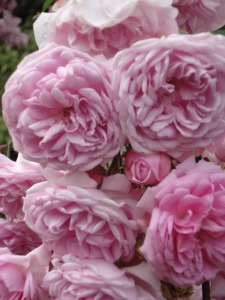
Peony roses at Warwick Castle, UK. Photo used by permission from CC at "Slightly Out of Sync."

Peony roses at Warwick Castle, UK. Photo used by permission from CC at “Slightly Out of Sync.”

La Fille de Berlin opens on me with a wet, dewy rose note that is faintly similar to the sweetness in a tea rose, but slightly richer and redder. That said, it’s not as rich as a hearty, beefy Bourbon or Damask rose, but something in-between. Perhaps, large peony roses? Soft violet notes flicker and dance at the edges. Sometimes, the scent seems soft and slightly powdered. At other times, heartier and deeper. The violet notes vaguely evoke YSL‘s Paris in its original formulation but Paris is a much warmer, headier, more intense, and spicier take on roses.

As some others have noted, there is a subtle green note which is present. It’s as if Christopher Sheldrake (Lutens’ favorite perfumer and traditional cohort in olfactory adventures) sought to bring in the scent of the green, leafy sepals which protect a rose bud. The green notes are hard to describe. They’re not like those at the start of Sa Majesté La Rose which is a much more lavish, baroque and dramatic scent after its green, slightly soapy start. In La Fille de Berlin, the green elements are fresher and slightly dewy, and underscored by what seems to be geranium leaf.

Source: ElementalLife.org

Source: ElementalLife.org

There is also an unexpectedly woody element, like that of a rose’s own stem, and elements of rich, wet soil. It’s an odd mix — greenness with earthy, loamy soil and the faintly woody aspect of a rose stem — and it makes me wonder if Christopher Sheldrake sought to disassemble every part of a rose before putting them back together again. He’s done that deconstruction trick for Lutens before; it was handled brilliantly with the tuberose flower in Tubereuse Criminelle.

Ten minutes in, La Fille de Berlin begins to take on a fruity aspect. At first, it’s the unexpected scent of cherries. Then, it’s just a general fruity smell under the veneer of sweetness and it strongly resembles some purple patchouli fragrances I smelled last year. Specifically, it calls to mind Marc JacobsLola and, to a much lesser extent, Chanel‘s Coco Noir. Both are scents with rose, a fruity patchouli element, notes of pear, pink peppercorn, and geranium, over a base of musk. As the Fragrantica notes demonstrate, Lola, in particular, is a primarily rose and peppercorn perfume with fruity-patchouli overtones. I own Lola and Coco Noir, so I sprayed on a little bit of each on my legs to see if I was just imagining things.

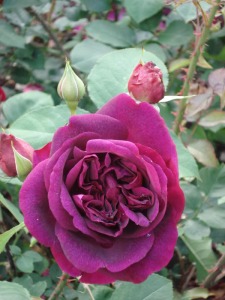
Purple rose at Warwick Castle, England. Photo provided with permission by CC from "Slightly Out of Sync" blog.

Purple rose at Warwick Castle, England. Photo provided with permission by CC from “Slightly Out of Sync” blog.

I was not imagining things. Though Lola opens with heavy fruit notes, it soon develops into something extremely similar to the jammy, peppercorn rose in La Fille de Berlin. Coco Noir is completely different in its opening, but it too has that jammy, purple, fruity patchouli element in its middle stages. (I reviewed it here, if you’re interested.) It should be noted that Christopher Sheldrake (who undoubtedly created La Fille de Berlin) was also responsible for Coco Noir, along with Chanel’s in-house perfumer, Jacques Polge. But it is really to Lola that La Fille de Berlin seems most similar at the start. The main differences is that the latter is slightly less fruity, much more subtle and fresh, and of infinitely better quality. There is nary a screeching synthetic in sight — which is much more than I can say for Mr. Jacobs’ creation.

Two hours in, La Fille de Berlin changes. The sillage drops even further, and the perfume takes on a cold, austere, almost metallic bent. It loses what warmth it had and becomes a linear progression that is predominantly rose with white musk and light sandalwood. It is far from exciting. Victoria from Bois de Jasmin had a far sexier time with the scent, experiencing amber, musk and faintly “naughty” bits:

A couple of hours later, my skin smells of amber and musk. La Fille de Berlin has an intriguing animalic note that would be untoward and raunchy if the rest of the composition were not so refined and polished. The reference here seems to be Serge Lutens’s own Muscs Koublaï Khan […] a rose wrapped into so much musk and civet that it becomes something else altogether. La Fille de Berlin, on the other hand, is much less musk and more rose, and it’s well-behaved enough to be worn to the office without raising anyone’s alarm. But when you press your wrist to your nose, you notice the naughty and smoldering bits. The impressive tenacity will ensure that you will be aware of La Fille de Berlin for the entire day.

I only wish I had her experience; it sounds infinitely more interesting! Having just tested extreme animalic musk and naughtiness in Parfum d’Empire’s Musc Tonkin, I’d be quite alert to the presence of any skanky notes or civet in La Fille de Berlin, no matter how minute and refined. But, alas, I simply don’t smell it here. No amber, either. There is some earthiness which was there from the start, though faint, but I attribute it to the undertones of what seemed more like patchouli than animalic elements. And, even so, on a scale of 1 to 10 (with 10 being extreme earthiness), I’d place the note at a 3.5 at the start and at a mere 1 towards the end. Instead, something else is much more evident. I swear, even in the dry-down, there is a fruity note! It is much, much more subtle than it was at the start, but it is still there. I find it excessively sweet, and I blame it on the pepper which has to be closer to the fruitier type of pink peppercorn berries than to anything black and biting.

As a whole, my experience with the final hours was much closer, again, to that of Cosmetopica. She owns and loves Muscs Koublai Khan, so she would have noticed any animalic similarities had she encountered them. Instead, she detected milky sandalwood in the dry-down. I agree; I found a definite creamy, soft, milky aspect to things, though to my nose it didn’t smell like strong or, even, genuine sandalwood. More like an ersatz cousin, if you will. For the most part, it was mild and quite overwhelmed by the white musk and by that endless fruity element.

La Fille de Berlin had average sillage and very good longevity. The perfume projected for the first twenty minutes before settling in to become much more discreet. It became close to the skin about three hours in, though it was still strongly noticeable if you brought your wrist to your nose. The overall duration of the scent was a little under nine hours on me. On Cosmetopica, it was eight; on Victoria from Bois de Jasmin, “the whole day.”

All in all, La Fille de Berlin is well-behaved, refined, unisex perfume that is perfectly pleasant — with all the implications that accompany that last adjective. As Cosmetopica’s review noted, one buys niche perfumes with their higher price tag for something that is slightly more distinctive and interesting. Serge Lutens has perfumes that run the gamut from being intellectually brilliant masterpieces that are not versatile scents for everyday use, to things that are simply lovely and constantly wearable, to scents that are occasionally just perfectly “nice.”

This is the latter. Though the bright pink colour of the liquid is absolutely gorgeous and though I wanted to love it, at the end of the day, I found La Fille de Berlin to be quite boring. And, for reasons I can’t quite pinpoint, it wasn’t a particularly happy scent in my mind either, unlike Sa Majesté La Rose. (That conclusion doesn’t even consider Mr. Lutens’ incredibly dark and depressing backstory for the perfume which, ideally, I shall forget about as soon as possible.) However, as with every review, perfume is a wholly subjective thing — so what may not be my cup of tea may be a ravishingly sophisticated, discreet rose scent for others. As always, it’s best to try it and see for yourself.

DETAILS:
Cost & Availability: La Fille de Berlin eau de parfum is available right now on the Serge Lutens website where it costs $120 for a 50 ml/1.7 oz bottle. In other currency units, I’ve read that it will cost €78. There does not seem to be a bell-jar for the scent on the website. It is also available right now for $120 on Luckyscent — which ships internationally. Luckyscent is not showing any samples for sale at this time. I will update this post when the perfume becomes available at other retailers, such as Barney’s or Harrods — both of which traditionally carry a handful of Lutens perfumes. La Fille de Berlin has just debuted, but is supposed to be fully launched in March 2013, so I suspect it may be a few weeks before it is available outside of the company’s website or in its Palais Royal headquarters in Paris. The perfume is part of Lutens’ “export” line of fragrances, so it definitely will be offered at other selected retail outlets. For other countries, once mid-March comes around, I suggest using the Lutens Store Indicator guide on its website to help you find a location that sells Fille de Berlin near you. Samples should also be available soon on decant sites, and I will update this post once I see them listed on places like Surrender to Chance.

Perfume Review – Chanel Les Exclusifs Sycomore: Mighty Vetiver

Close your eyes and imagine you are in the heart of a forest at Yosemite National Park.

Source: Deby Dixon Photography

Source: Deby Dixon Photography

Cypress trees and evergreens intermingle and stretch far before you. The dark, dry earth is sprinkled with pine needles, and a wild boar is rooting at the tall grasses at the base of a tree, his endeavors lifting the smell of the earthy, chocolate-y roots into the air. Icicles hang from the branches where, nestled deep within, are purple juniper berries. In the heart of the forest, campfires burn thick logs of pine and cypress, and there is a smell of peppery smoke intermingling with the burning woods. Someone is cooking caramel, and burning it. You huddle deeper into your coat as the hint of frost brings a chill, but you can’t help but take a deeper breath of the vetiver surrounding you.

SycomoreGreen and brown, smoky and earthy, with a heart of cypress and wood — that is Chanel‘s Sycomore. It is an incredibly elegant smell, luxurious and leaving a smooth, trail of pure class oozing in its green-brown trail. It is richly masculine, with not a hint of florals, but this is silken masculinity in the most sophisticated, elegant of packages.

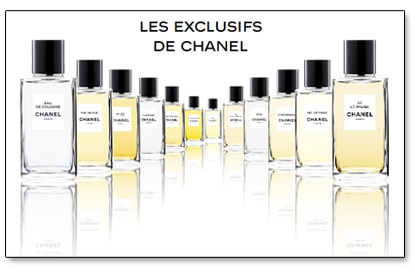
Sycomore was first introduced to the world in 1930, the creation of Chanel’s very famous, original perfumer, Ernst Beaux. From what I’ve read, it was all violet and tobacco with some support from soft aldehydes and balsamic wood. The original Sycomore vanished in the perfume mists, but it was re-envisioned and re-introduced in 2008 as an eau de toilette and as part of Chanel’s prestige collection called “Les Exclusifs.” It lesExclusifswas created by Chanel’s house perfumer, Jacques Polge, along with an equally famous “nose” in the industry, Christopher Sheldrake.

On its website, Chanel describes the new Sycomore as follows:

A rich-wood fragrance with a noble character — like the Sycomore tree that inspired it — created by CHANEL Master Perfumer Jacques Polge in 2008. At the heart of the scent: Vetiver, with an elegant Sandalwood note and dashes of Cypress, Juniper and Pink Pepper, for an earthy, warm and enveloping, yet subtle presence.

I think Chanel’s description nails it, unlike the Fragrantica‘s entry for Sycomore which seems completely incorrect in my opinion. Fragrantica puts Sycomore in the “Woody Floral Musk” category, and lists its notes as “vetiver, sandalwood, aldehydes, tobacco and violet.” I suspect both the categorization and the notes apply only to the 1930s version of Sycomore.

No, Chanel’s notes for Sycomore are the ones to follow and they are clearly listed by the Perfume Shrine as follows:

Vetiver, cypress, juniper, pink pepper, smoke, burning woods.

To get a true understanding of Sycomore, I think it’s important to elaborate a bit on the notes. For example, vetiver which not everyone is familiar with as an ingredient or as a smell, and which is the main part of Sycomore.  Chandler Burr, the former New York Times perfume critic, gave this extremely useful explanation to GQ:

vetiver-roots

Vetiver Roots.
Source: Herbariasoap.com

In the most basic sense, [vetiver is] a grass native to India that grows in bushes up to 4’x4′. It’s also related to lemon grass, as you can tell when you smell it. The stuff—it’s the grass’s long, thin roots that they distill—is infinitely more interesting though: deep, shadowed, astringent, earthy like newly tilled soil, and balsam-woody. It can be warm like tobacco leaves, it can have a crushed-green leaves freshness, or it can be cool like lemon verbena.

Haiti produces about 80% of the vetiver oil in the world, although sometimes you’ll be putting a bit of Indonesia or Brazil on your arm as well (Haiti’s is more floral, Java’s is smokier). There are folks producing it responsibly, too. When you buy a bottle of Terre d’Hermès, which is loaded with the stuff, you’re supporting around 2,000 Haitian farmers and distillers. […]

Like wine, the scent of vetiver oil improves as it ages: the best of it is made with roots that have been aged somewhere between 18-24 months; the oil costs around $200/kg when it hits the market. American scent maker IFF makes it three ways: with steam (resulting in vetiver essence, which is dryer and lighter), solvent (which produces an absolute and is darker, with the scent of rich dirt), and a new technology called “Molecular Distillation” that uses carbon dioxide to yield a scent that’s extraordinary—strongly grapefruit, fresher, zestier.

The Perfume Shrine says that the vetiver in Sycomore is said to be of the Haitian variety so, under Mr. Burr’s explanation, the more floral kind. I’m not an expert on any of the varieties, so I will take their word for it. All I know is that this vetiver smells exactly as Mr. Burr described: “deep, shadowed, astringent, earthy like newly tilled soil, and balsam-woody.”

Do you know how perfume can sometimes take on a colour aura before your eyes? WeaveSycomore opens on me all brown and green. Not khaki but some interwoven panel of dark green and green-brown. It calls to mind green roots and brown earth. Sycomore starts exactly like that, alongside pink peppercorns and an unexpected but definite note of chocolate. It’s almost like chocolate patchouli with vetiver. It’s so confusing that I go over the notes again and, still, I’m at a loss. So, I look up cypress wood which I’m not very familiar with, and that must be the explanation.

From my reading, it seems that cypress wood has a pungent, woody, spicy aroma that can also be sometimes resinous, coniferous, or cedar-like. Here, the combination of the cypress wood with the earthiness of the vetiver seems to have transformed the sum total into chocolate patchouli. You can smell each individual note, but you also have that strong overall impression.

It’s so striking that I looked to see if others had felt the same way. On Basenotes, one commentator also thought there was patchouli in Sycomore, though she concludes the cause was the combination of juniper and cypress. The Scent Critic blog and some on MakeupAlley also picked up on the chocolate edge. And finally, Victoria from Bois de Jasmin summed it up in her usual elegant succinctness: “The chocolate richness of the root is accented by the peppery and smoky notes. The composition possesses an alluring dark character, which in sensation alternates between the tannic dryness of red wine and the softly worn polish of aged woods.”

The chocolate and patchouli impression in Sycomore is so strong for the first hour that it evokes Serge LutensBorneo 1834 in its opening stages. So much so that I’m utterly bewildered by why people compare Chanel’s Coromandel (also from Les Exclusifs) with Borneo 1834, instead of Sycomore. Adding to the similarities between Borneo 1834 and Sycomore is the latter’s strong opening notes of tobacco and smoke. The tobacco note here is faintly bitter, and it is accompanied by a peppery, biting smoky note that is definitely woody.

I wonder about the “burning woods” note listed on many perfume reviews as an element (though not on Chanel’s website), and I keep thinking of guaiac wood. You can read the Glossary for more details but, in a nutshell, guaiac wood has an aroma that is earthy, smoky, tarry, peppery and similar to burning leaves. Tom Ford’s Amber Absolute is also said to have guaiac wood in it, though its official notes are equally vague and merely reference “rich woods” instead of “burning woods.” Both perfumes share a similarly woody, peppery, smoke note, so I have to wonder.

I do smell some sandalwood in Sycomore but, on me, it’s not strong at any point in the perfume’s development. Others have found it, but it’s just a whisper on me. I have to say, I doubt it is real Mysore sandalwood anyway. Anyone who has read Luca Turin and Tania Sanchez’s book, Perfumes: The A-Z Guide, will be struck by their repeated, insistent comments on just how few sandalwood fragrances actually have sandalwood in them at all these days. According to them, true sandalwood from Mysore, India is so scarce and so prohibitively expensive that most perfumers use Australian sandalwood which is an entirely different species of plant and with an entirely different scent. To the extent that Sycomore has sandalwood in it (of any kind), I think it is completely overshadowed and overpowered in the initial stages by the patchouli impression from the cypress and vetiver.

As Sycomore continues to unfurl, there is an impression of burnt caramel, black cocoa powder, incense and dry earth. This is like the black version of Coromandel, without the latter’s vanilla, benzoin and powder heart. The increasingly peppery and smoky nature of the perfume makes me wonder again if they used guaiac wood to fortify any “smoke” accord, not to mention the weak sandalwood. There are also flickering hints of evergreen from the juniper which add a coolness or chill that counters the smoky earthiness. It’s an incredibly sexy, darkly mysterious perfume.

There is a dryness to the rich, earthy smell that really calls to mind dirt — not rich, dank or loamy, but sweetly dry. I realise that non-perfumistas will recoil at the thought of smelling faintly like dirt, but there is really no other way to truly describe the undertones to the very smoked, rich, woody notes. The comparison to dirt also explains Luca Turin’s comments in his five-star review of Sycomore in Perfumes: The A-Z Guide. There, he wrote:

The dream team at Chanel seem to delight in applying superior skills to existing ideas they deem worthy of perfecting: Coromandel was a reorchestration of Lutens’s Borneo 1834…. Sycomore is, in my view, a magisterial gloss on Bertrand Duchaufour’s Timbuktu [for L’Artisan Parfumeur]. The later introduced an Altoids-like idea to perfumery, consisting of a minty-licorice coolness combined with a radiant crackling-wood-fire note. […] Vetiver has both an anisic aspect and a smoky one. Cleverly flank it with Timbuktu’s two companions, add a big slug of sandalwood, and vetiver finds itself in worthy company at last. […] Sycomore [is] … the freshest, most salubrious, yet most satisfyingly rich masculine in years. If putting it on does not make you shiver with pleasure, see a doctor.

I’m surprised that Mr. Turin deems Sycomore one of the few sandalwood fragrance reviews not to warrant his usual comments about how perfumes don’t have real sandalwood in them any more, and I certainly don’t find the same “big slug” as he does, but I agree with the rest of his review. (Minus, his choice of which Chanel perfume to compare to Borneo 1834). I particularly understand his reference to Timbuktu which has often been described as having a dry dirt foundation. Sycomore has both the dirt aspects of Timbuktu and that slightly chilled licorice note underlying the earthiness of the dark patchouli…. er.. vetiver and cypress.

Mogambo 2

Mogambo

Perhaps it’s all that dry dirt and rich green which make me constantly imagine those old movies that explored the heart of an African forest — everything is slightly dark and smoky, mysterious and Tshadowy, all amidst lush greenness and dry red-brown dirt. I keep thinking of Clark Gable with Grace Kelly and Ava Gardner in Mogambo, or Humphrey Bogart and Katherine Hepburn in African Queen. I could see either man wearing Sycomore, and Katherine Hepburn too (though never ever Grace Kelly or Ava Gardner).

As time passes, there is even greater depth to the impressions of burnt umber, burnt caramel, resins, saltiness, and earthiness — all under the forest’s canopy of green-brown vetiver and wood. The patchouli impression ceased being dominant a while ago; now it is the turn of the juniper. In general, juniper has an aroma that is fresh, sweet, and like pine trees, with a slightly balsam-like, resinous undertone. Here, they make I feel as though I’m walking through an icy forest at wintertime, my feet crunching on evergreen needles, the chilled smoke of winter in the air, as I walk towards campfires of burning pine logs where someone is cooking with dark chocolate and another person is accidentally burning the caramel. There is still the chocolate note, you see, though it is overshadowed by a more resinous, caramel element. There is also an undertone of anise and licorice.

In its drydown and final hours, all those things vanish, leaving mostly sweet, faintly lemony, grass. It is vaguely reminiscent of the lemongrass that Chandler Burr referenced. The sweetness of the grass may be one reason why a number of people smell marijuana or cannabis a few hours into Sycomore. I do not, but the occasional “ganja” comment is something worth noting if you’re tempted to try Sycomore. What I do smell, in addition to the sweet grass, is a sort of creaminess that I think comes from the sandalwood. As always, however, it is faint; even more of a shadow now than before.

There are two things which confused me about Sycomore. One, which I’ve already mentioned, is that it is Coromandel which is compared to Borneo 1834, when I think it should be this Polge and Sheldrake collaboration instead. (At least, for the opening hour. I don’t think Coromandel is remotely like Borneo 1834.) The second is a far more important issue: Chanel’s gender classification for this scent. Chanel has labeled Sycomore as a woman’s perfume and, to me, that is akin to saying M&Ms are only for women. It makes absolutely no sense at all.

Not only is Sycomore unisex, not only is it the furthest thing possible from “girly,” and not only do men adore this, but it is — I would argue — actually a masculine scent first and foremost. It may be a somewhat feminine masculine fragrance, but it is a masculine fragrance at its heart. In fact, women who have not explored niche scents and who are used to the more traditional, conventional or mass-market feminine fragrances — whether of the floral, “girly,” clean, sugary or gourmand variety — may find Sycomore to be overwhelmingly masculine and an utter shock if purchased blind. This is no Marc Jacob Lola, Guerlain Shalimar or Dior J’adore.

No, Sycomore has consistently been compared to men’s colognes. In fact, commentators on both Basenotes and Fragrantica find it to be an exact duplicate of Lalique‘s L’Encre Noire for Men (2006). A few people even bring up Hermès‘ men’s cologne, Terre d’Hermès — though most people on Basenotes find that much more citrus based and without anything close to the same degree of vetiver in it (no matter what Chandler Burr may think). I agree with that. I’ve got Terre d’Hermès and like it. But, like many on Basenotes, I find them to be very different perfumes and don’t think Terre d’Hermès is a predominantly vetiver scent. As a point of interest, in a Basenotes thread asking for people’s preference as between Sycomore and Terre d’Hermes, a monumental majority chose Sycomore as the better, more elegant, and truer vetiver fragrance.

All in all, Sycomore is an incredibly lovely fragrance and as smooth as silk. It is magnificently blended, such that everything folds into one rich layer upon another. There is a paradoxical coolness to its warmth, but it is never a chilly or aloof scent. It has too much earthiness in its beating heart, radiating its fire with every thump, thump, thump. It is never cloying, and there is not a single, synthetic, cheap note anywhere to be seen. It is truly as masterful and brilliant as so many thing. It is also a very approachable fragrance; it is not one of those edgy, discordant scents that can be worn only infrequently and are to be admired mostly on an intellectual basis as works of olfactory art. I can see men wearing this almost daily and some women frequently.

And, yet, it is not a fragrance for me. For the longest time, I could not pinpoint why. I like vetiver, I wear men’s cologne, and I like smoke and resinous scents. I find it an extremely elegant perfume and, really, it should push all my buttons. In fact, its opening led me to say “Wow” and I couldn’t stop sniffing my wrists for the first ten minutes. But, at the end of the day, it was simply too much vetiver and its dryness could well be described as bone-dry. Sahara dry. For my personal tastes, Sycomore simply veers too much into the masculine without any real sweetness to accompany it.

Nonetheless, if you are a fan of vetiver, woody and/or dry scents, I highly encourage you to test out Sycomore. If you’re not a fan of either of those three categories, then you may like the sweeter, softer Coromandel. (It is my favorite of the 3 Exclusifs that I’ve tried thus far). But if you’re not a fan of patchouli, benzoin or frankincense, then I fear you should skip that one too.

Have you tried Sycomore? If so, was it love at first sniff or simply not your cup of tea?

Details:
Sillage & Longevity: The sillage and longevity of Sycomore is impressive, particularly given that most of the Exclusifs line (with the exception of Coromandel) are said to be thin, sheer, and of short duration. On me, Sycomore had good projection for the first 3 hours, and only became close to the skin after 5 hours. As for longevity, it was above-average for my perfume-consuming skin. I could still smell faint traces of it after 9 hours. On others, I’ve read reports of it lasting almost an entire day.
Cost & Availability: Sycomore only comes in Eau de Toilette concentration and costs $130 for a 2.5 oz/75 ml bottle or $230 for a 6.8 oz/200 ml bottle.  The Exclusifs line is available only in Chanel stores or on their website. I have read numerous comments from people who have tried it at Selfridges in the UK, but did I not see a single Les Exclusifs fragrance on the Selfridges website. Nor have I found it on any U.S. department store websites. It’s not on Lucky Scent either. It is, however, available on Surrender to Chance which is where I obtained my sample. Prices for the smallest vial (1 ml) start at $3.

Perfume Review- Serge Lutens Chergui: The Desert Wind

africanduststorm

A fire fanned by the wind, a desert in flames.

As if bursting from the earth, Chergui, a desert wind, creates an effect that involves suction more than blowing, carrying plants, insects and twigs along in an inescapable ascent. Its full, persistent gusts crystallize shrubs, bushes and berries, which proceed to scorch, shrivel up and pay a final ransom in saps, resins and juices. Night falls on a still-smoldering memory, making way for the fragrant, ambery and candied aromas by the alchemist that is Chergui.

That is how Serge Lutens describes Chergui, a perfume for men and women created Cherguiwith Lutens’ favorite perfumer, Christopher Sheldrake. It was released in 2001 as a fragrance exclusive to Lutens’ Paris Palais Royal salon and was not available for export. In 2005, however, it was made available worldwide and became a monster hit.

In fact, in 2007, MakeupAlley apparently voted Chergui its #1 favorite perfume. It took that place above: Frederic Malle’s Musc Ravageur (#2), Hermès’ Ambre Narguilé (#3), Guerlain‘s Mitsouko (#8), Andy Tauer‘s L’Air du Desert Marocain (#10), Chanel No. 19 (#11), Chanel Bois de Iles (#12), Guerlain‘s Shalimar (#14), Chanel‘s Coco (#15), Guerlain‘s L’Heure Bleue (#19) and many other, much-loved fragrances. I don’t think I would vote Chergui my favorite scent, let alone of all time (vintage Opium will always have that spot), but I adore Chergui. It is absolutely lovely, and my favorite out of the seven Lutens perfumes that I’ve tried thus far. Until Chergui, I found myself admiring a Lutens fragrance more on an intellectual or theoretical basis, rather than an emotional one. I couldn’t find one that I would actually want to wear. Until now.

Fragrantica classifies Chergui as an “oriental spicy” and lists its notes as:

tobacco leaf, honey, iris, sandalwood, amber, musk, incense, rose and hay.

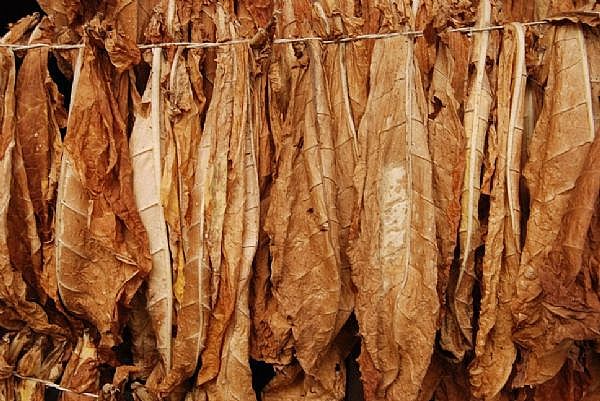
Dried tobacco leaves

Tobacco leaves drying in Virginia.

Chergui opens on me slightly differently than on others. There is an initial citric and lemon note that I haven’t read of others experiencing. The citrus accompanies a strong rose note along with smoky tobacco leaves over a leather base. The combination of notes reminds me a tiny bit of my much-loved vintage Montana by Claude Montana (now renamed Montana Parfum de Peau) as well as the opening of some chypre fragrances — so much so that, for a minute or two, I wonder if perhaps I received a different sample as part of my Lutens set. But, no, this is definitely Chergui. The tobacco leaves are unmistakable. This is not the tobacco of a cigarette or dirty ashtray, nor is it the fruity tobacco of a pipe. These leaves recall images I’ve seen of tobacco drying under the hot sun of the American South. They have a rich amberous, almost nutty element to them with smoke that goes far beyond the sort in mere incense; it verges into the more extreme, black, tarry aspects of frankincense.

Source: etshoneysupliers.

Source: etshoneysupliers.

At the same time, the opening exudes honey. It is not as strong on me, at this time, as it seems to be on others. In fact, I seem to have the reverse experience of a number of commentators who start out with honey, hay and tobacco, only to find a heart of spicy rose later on. On me, the pyramid triangle is reversed. The rose is upfront and on top, with smoke and woody notes following on its heels.

There is also a note of camphor which intertwines itself with the smoke. It’s almost a medicinal note which leads me to wonder if camphor is Christopher Sheldrake’s favorite ingredient for perfumes. The slightly chilled, cold, cool note it provides is interesting, particularly when combined with the rose notes, because it creates a strong similarity to the many rose oud fragrances currently on the market. In fact, I can definitely smell a woody, medicinal, floral oud note in Chergui, though no oud or agarwood is listed. (Then again, I continuously read that Serge Lutens doesn’t list all the ingredients in his perfumes, so who knows.) The note is subtle and not very strong, but it dances around the rose and honey opening, adding dryness and wood to the perfume’s richness.

The camphorous smoke accords strongly call to mind campfires, except you’re not in a forest as you are with oud perfumes. Here, the campfire is in a field of roses sandwiched between a Turkish tobacco bazaar and an ancient Greek Orthodox churchGreek Orthodox Censer that is billowing out incense and frankincense. Unlike so many others, I don’t get impressions of Morocco or the desert from Chergui. I definitely did from Andy Tauer’s L’Air du Desert Marocain, but not from this. On me, it was not spiced enough for Morocco. Instead, for some strange reason, I get persistent images of Istanbul. But all that is mere quibbling because, frankly, I cannot stop sniffing my arm!

As time passes in the opening hour, the leather starts to bloom, alongside subtle hints of sandalwood. This is not the cold, black leather of scents like Robert Piguet’s Bandit or Montale’s Aoud Cuir d’Arabie; nor is it the pale suede of Chanel’s Cuir de Russie or Etat Libre d’Orange’s Tom of Finland. This is warm, soft leather that is caramel, nutty and smooth. The accompanying sandalwood is faint, but never synthetic. And the whole thing is cocooned in a backdrop of rich honey. There is great sweetness, but it is never cloying or like the sugar bomb perfumes that are currently saturating the commercial market. This is not diabetes in a bottle; there are no cupcake or dessert similarities here.

Thirty minutes in, the camphorous notes have receded a little, as have the woody oud-like notes. The sandalwood increases its presence, as does the element of sweet hay from what is said to be a healthy dollop of coumarin. (See the Glossary for further details on coumarin and its notes.) To be honest, I really don’t get a hell of a lot of sweet hay at this point but, then again, my perfume triangle seems to be reversed. The strong coumarin accord comes later, about four hours into the fragrance, and its straw-like sweetness is a perfect counterbalance to the different, richer kind of sweetness coming from the honey.

The smoke, sandalwood and florals call to mind several different perfumes. Again, L’Air du Desert Marocain is not one of them. There is, however, a surprising and peculiar impression of YSL‘s Opium made light — a comparison also noted by the blog, That Smell. To some extent, that’s not surprising as Opium is the ultimate benchmark for all spicy orientals with incense and frankincense. But Chergui is much lighter and sweeter than (vintage) Opium with its powerful eugenol cloves, its opening blast of citrus and orange, and its muscular sandalwood, opoponax and balsams. I haven’t tried (yet) Tom Ford’s Tobacco Vanille which some say is similar to Chergui, but what I think it sometimes resembles is Molinard‘s Habanitaamazing Habanita, one of the original sweet tobacco and leather fragrances which dates back to 1921. Chergui lacks its very strong citric opening and its constant, very powdered vanilla character, but there are similarities especially with the rose, leather and sweet tobacco accords of the opening hours. Chergui is more honeyed tobacco leaves, while Habanita is more powdered tobacco paper, but there are similarities.

As time passes, Chergui continues to develop. At the two hour note, the tobacco has become softer, the incense milder, the sandalwood smoother and the whole thing takes on a creamy aura. I have a definite impression of creamy tea due to a milky note that is lovely and cozy. And the honey accord is getting stronger now that the powerful incense and wood accords have retreated. The leather is very faint, if it’s there at all. Interestingly, I’ve read a surprisingly large number of comments that say the leather seems stronger on men than on women, with these reports coming from women whose husbands or boyfriends also wear Chergui.

Source: Visual Photos

Source: Visual Photos

After 4.5 hours, Chergui is all honey with some soft tobacco and loads of sweet, dry coumarin. It really smells like bales of hay in a barn, only coated with honey! Those notes constitute the essence of the dry-down phase for me and they remained for several more hours to come.

In terms of sillage and longevity, Chergui became close to the skin after about four hours, but its longevity is impressive. I could smell faint, minute traces of it on my skin after 8 hours and, again, my body consumes perfume voraciously. On others, I’ve read it lasts forever and ever. Also, as a side note, I’ve read a lot of people say that this is a perfume that can actually improve in the heat and in summer, so it should not be considered solely as a winter perfume.

Chergui has many admirers, but some detractors as well. On Basenotes, it has 102 positive reviews, 13 negative ones and 28 neutrals. The 13 negative comments focus on how it is either cloyingly sweet or uninteresting. On Fragrantica, the negative reviews are greater in number with the primary complaints being: 1) it smells too powdery; 2) it’s too sweet or too “old man”-ish; and 3) it opens like “bug spray.” I don’t smell any powder in Chergui and, given how I’m not a huge fan of the note, I would mention it if I did. I can see, however, why some may get the impression of “bug spray.” I think it’s the camphorous element in the opening. According to Luca Turin, in the old days, camphor notes (like that in patchouli) were used as bug repellent. The more common criticism of Chergui — that of its sweetness — is something I don’t personally agree with given the extent of the very dry smoke, incense and coumarin, but I can see how this would be far too much for someone who isn’t into honey perfumes or who generally prefers light, floral, or less heady scents. This is definitely not the scent for them!

Among the many rave reviews for Chergui, a few stood out to me. One was the absolutely beautiful review by Victoria from Bois de Jasmin who wrote:

it is an Arabian Nights vignette in a liquid form.

The candied quality melts in the smoke whispers that fill the arrangement, like incense smoke seeping through the carved screens. The floral accord folded into the smoky layers of Chergui lightens density and sweetness, lending a voluptuous silky quality. The fine cured Virginia tobacco notes overlaid on the smoky leathery base give the composition a slightly masculine character, counterbalancing the sweet notes….

If Chergui is an oasis, it encompasses not only the romantic elements of such a vision—dark black tea served with sugar cubes on the side, narghileh smoked inside leather tents, heavy silks carried by the caravans. The camels resting in the shade are suggested by the animalic sweetness underpinning the honeyed base. Like in an intricate Persian miniature, Chergui is a tale that spills from one story into another.

It maintains the suspense despite the fact that the development of the composition from the top accord to the bottom is not particularly dramatic. Instead, the hints of what is to come—whiff of tobacco, curl of rose petal, creaminess of sandalwood—are suggested in the preceding stages, resulting in the harmony of the narrative. At the same time, the intrinsic romanticism of Chergui fits with the philosophy of Serge Lutens’s work. Like Delacroix, a French painter, was fascinated with the Moroccan scenes, Serge Lutens’s fragrances allow a glimpse into another world through the eyes of an outsider.

I think that may be one of the most beautiful reviews I’ve read for any fragrance! But an equally noteworthy one — albeit less romantic and much more amusing — came from a commentator on MakeupAlley. There, “ThreeJane” gave a wonderful, very down-to-earth review of how Chergui can make one average, harried, stressed-out woman feel:

Chergui is a WOMAN’S scent. You’d better be a mature woman…all curves, breasts, buttocks, and satiny toffee-colored skin to wear this. You can pin a man from across the room with your smoky eyes, beckon him with a narcotic-laced toss of your hair, bend his will to your whim, and break his heart with an indifferent glance. Your clothes meld to your curves, and men can’t say why you are so intoxicating… […]. Women want to be you, men want to possess you.

That’s how this scent makes me feel, anyway. Not like a harried housewife with four homechooled kids and a messy (not dirty! Just cluttered!) house that has dogs bouncing off the walls and a perennial dish or three in the sink. Some days I just drag around in yoga pants and a t-shirt (it’s really a pajama tee from Target, don’t tell) with my hair haphazardly twisted up in a bun. I’m 41, with some wrinkles and sagging skin, standard mom issue.

But when I wear Chergui, I magically transform into Catherine Zeta-Jones in “The Legend of Zorro”, Angelina Jolie in “Original Sin”. Lush, luscious, sensual, unforgettable. After you get past the first almost acrid, medicinal blast of herby incense (about 10 minutes)…almost eyewatering, really…the scent melds into a spicy, honeyed, slightly sugary amber that’s saved from cloying-ness by a fresh bite of tobacco, iris, and I guess it’s hay. There’s supposed to be rose notes in this, which unfortunately, rose never shows up on me. But it’s not needed or missed.

Hours, and I mean HOURS, later, the drydown maintains the amber and slowly includes a woody edge…I guess that’s the sandalwood. I can see the guy from “The Most Interesting Man in the World” beer commercials wearing this. But it’s not manly, oh no. If my florid, overblown prose didn’t spell it out above, it’s verrrry feminine (all dependent on chemistry…always).

[…] There aren’t a lot of things that can elevate me from my rather humdrum hausfrau existence, so when I find something that lifts me up, I’ll take it and exploit it every chance I get. Just lovely.

The two reviews could not be more different and, yet, I think they both manage to capture the gist of Chergui. Try it for yourself, and see where the red desert wind takes you….

Details:
Cost & Availability: Chergui is currently on sale as the “Deal of the Week” at Beauty Encounter where the 1.7 oz/50 ml bottle is priced at $85.65 and free shipping is available. I don’t know how long that special will last. At all other times, you can find Chergui on the Serge Lutens Chergui Bell Jarwebsite. In the famous bell-jar shape, it costs $280 for 2.5 fl oz/75 ml. However, in the smaller size and regular bottle, it costs $120 for 1.7 fl oz/50 ml. Serge Lutens is sometimes available at fine retailers like Barney’s, but I don’t see Chergui listed on a number of department store sites. Chergui is also available on Penny Lane and Lucky Scent for $140 for the 1.7 oz/50 ml bottle — which is $20 more than it costs on the Lutens website. In the UK, you can find Chergui at Harrods where it costs £69.00 for a 1.7 oz/50 ml bottle. You can also find it at Les Senteurs (or perhaps just at their Elizabeth Street shop) where that same bottle costs £79.00. The site sells samples of Chergui for £3.50. In Australia, I found it on the Grays website where the 1.7 oz/50 ml bottle retails for AUD $124.50. For other countries, you can use the Store Locator on the Lutens website. Sample vials to test it out can be bought at Surrender to Chance (but not Lucky Scent) starting at $3.99. Surrender to Chance also has a special Lutens sample pack of 3 non-export perfumes which includes Chergui (and Borneo 1834) and which starts at $11.50 for the smallest sized vials. Surrender to Chance has the best shipping rates, in my opinion: $2.95 for orders of any size within the U.S., and $5.95 for all international orders under $75 (otherwise, it’s just a tiny bit more).