Perfume Review: Chanel 31 Rue Cambon (Les Exclusifs)

Chanel headquarters

31 Rue Cambon is named after Coco Chanel’s apartment above Chanel’s long-time headquarters at the same address, and was introduced to the world in 2007 as part of Chanel’s six-line prestige collection called “Les Exclusifs.”

Chanel's apartment at 31 Rue Cambon. Source: GirlsGuidetoParis.com

Chanel’s apartment at 31 Rue Cambon. Source: GirlsGuidetoParis.com

The fragrance was created by Chanel’s house perfumer, Jacques Polge, and is supposed to reflect Chanel’s personal taste for the classically simple but, also, the baroque. According to Chanel’s own description, 31 Rue Cambon was

[t]he epicenter of the world of Gabrielle Chanel, a place that harmoniously combined her need for simplicity with her taste for the baroque. It took the complex form of a beautiful Chypre fragrance to capture these contrasting passions, also present in Haute Couture, in a scent. This exceptional fragrance combines the mysteries of both sensuality and elegance.

The categorization of the perfume as a “chypre” raised a lot of debate and discussion when this perfume was first released back in 2007. A chypre is almost invariably something that has oakmoss as its core foundational element; and there is absolutely none here. In fact, the century-plus era of the famous “chypre” family of perfumes being one of the most significant and influential is now over, thanks to the EU and IFRA. (I will spare you one of my rants on that subject but, if you want to read more about what a chypre is supposed to be, feel free to use the Glossary linked at the very top of the page.)

Though Chanel’s description references chypres, Now Smell This states that Jacques Polge himself describes the perfume as an “oakmoss-free chypre.” Whatever the oakmoss issue, in an interesting turn of events, Chanel itself does not classify the scent as a “chypre” at all. Instead, on its page listing all the Exclusifs, it categorizes 31 Rue Cambon as a “Smooth Woody Floral.” That’s just as well, because the description sums up 31 Rue Cambon perfectly, in my opinion.

31-rue-cambonChanel offers no notes for the fragrance on its website but, Now Smell This says that the notes are said to include “bergamot, iris, jasmine, patchouli and labdanum.” Personally, I am tempted to agree with  the commentator, cylob“, on Fragrantica, who believes that the full list of notes are as follows:

pepper, bergamot, orris, narcissus, jasmine, patchouli, ambrette, vetiver, labdanum.

31 Rue Cambon opens on my skin with bergamot and aldehydes. The bergamot reads here as a citrusy lemon and not like Earl Grey tea (as it sometimes does). The aldehydes, to my huge relief, are not waxy and extremely soapy but, rather, light and incredibly fizzy. Moments later, there is the subtle breath of jasmine, light and airy, never indolic, heady or narcotic. When combined with the aldehydes, they really fizz in a way that reminds me, with a smile, of YSL‘s Champane/Yvresse. Here, there is a definite feeling of sparkling champagne, only it’s lemon and jasmine in an effervescent accord. There is a subtly powdery note of iris from the orris and, then, vetiver.

The vetiver is very interesting in this opening stage. It’s fresh, green and more akin to lemon grass than to anything dark, earthy or rooty. Its freshness undercuts any chance that the jasmine could be indolic and adds to that overall impression of bright, green Spring colours, flecked with dollops of bright yellow and white.

Field of NarcissusThe colour image of yellow is enhanced by a sense of narcissus hiding behind the other notes, combined with something that very much feels like the bright cheeriness of daffodil (which is often another name for daffodils). The whole thing is very light and sheer, a gauzy veil of floral notes dominated primarily by lemon and fizzy aldehydes, but the feeling of both the yellow colour and of narcissus is there.

Chandelier reflectionsThirty minutes in, the perfume has subtly changed, almost like light shining on a different part of a crystal chandelier and reflecting different facets. The aldehydes and lemony bergamot are joined by a much stronger note of iris, a touch of a pepper, and a suddenly earthier, woodier vetiver whose rootier characteristic has started to emerge. The iris adds some soft powder, but it’s light and far from the sort of powder you find in Guerlain’s signature Guerlainade. Any fear of powderiness is undercut by the dryness of the quiet pepper note. Like the iris, the jasmine is also much stronger now, though still light in texture and still far from indolic. Also emerging for the first time is the ambrette; it’s a flowering shrub that is sometimes called Musk Mallow and whose parts are often used to replicate the scent of (animal) musk. Here, like the rest of the perfume, its musky touch is light, soft and gauzy.

An hour in, the oddest thing happens. The perfume seems to vanish entirely. I was in disbelief, sniffing my arm like a hyena attacking the first food he’s seen in days. Nothing. Gone. 31 Rue Cambon is often bemoaned for its longevity issues, and it’s certainly not the most enduring in the line, but this seemed to be taking things a step too far. Then, suddenly, there was a hint of fragrance: musky, faintly woody floral notes that were too soft and mild to be more than just a vague hint of something. Then, it vanished again.

At the second hour mark, lo’ and behold, like a Jack in the Box, it popped back up! And not only did it suddenly re-appear but it seemed stronger than it had been before. Strong jasmine and sweetness, accompanied by light powder, green notes and vetiver. I can’t account for it. There are ghostly notes, but an entirely ghostly perfume?! It was the strangest thing, but there is no denying that 31 Rue Cambon decided to leave, return, leave and then reappear to stay quite a few times during the time I tested it. I have to wonder if its mercurial nature is why so many people think the perfume has incredibly short longevity. Maybe they’re not sniffing their arm at the right time when it decides to join the party, so they missed its prima donna return?

Whatever the reason, I have to say that I liked 31 Rue Cambon a lot more than I had expected to. All the oft-told stories about how it barely shows up, the low sillage, and the extremely brief longevity issues — not to mention the whole muddy mess involving chypres/non-chypres/modern-take-on-chypres — had left me frowning a little and anticipating a scent that would be problematic. To my surprise, 31 Rue Cambon was very good. And I attribute most of that to the dry-down because it’s absolutely lovely.

In its middle to final stages, the perfume becomes a soft veil of sweetness and green notes. At first, about four hours in, it is soft patchouli, musk, earthy (but light) vetiver, and an amorphous, generalized “floral” accord. The patchouli note is far from the 1970s dark, dirty, hippie patchouli (which I actually quite adore); it’s just a faint whisper that adds a touch of sweetness to the vetiver. The latter is also just the merest breath of depth and earthiness. Actually, sometimes, the perfume just evokes some sort of “green” note without even seeming like vetiver.

Later, about eight hours in, the perfume simply becomes light amber with just a dab of labdanum. It’s a sweet, almost honeyed scent that is not opaque, thick or resinous. I adore labdanum and the depth it adds to ambery elements. Here, it’s too light to have serious body of its own, but it adds a perfect amount of depth to the amber to stop it from being totally translucent and faint. The whole thing feels a little like being in candlelight or in the soft warmth of afternoon sunlight.

Those final hours are quite a sharp juxtaposition to the fizzy, bright opening notes filled with citrus, aldehydes, iris and jasmine. I wouldn’t say the perfume has turned “baroque” — to use one of the descriptive adjectives applied by Chanel to 31 Rue Cambon — because it’s far too gauzy in texture. No, I think 31 Rue Cambon is best described as a mercurial woman who is lightheartedly playful and teasing in the sharp brightness of the morning, and slightly more weighty, sensuous and serious in the warmer, golden light of the late afternoon.

31 Rue Cambon is not to my personal taste and style, and I would never wear it, but it surprised me. In a good way. I think that, if people go into it without any expectation of a “chypre” and just approach it with an open mind, they too may be surprised. It’s a very Chanel scent and oozes that house’s classique, elegant signature. It’s neither revolutionary nor earth-shatteringly unique — but it wasn’t trying to be. That’s simply not Chanel. But it’s very, very good. 

The only significant problem with 31 Rue Cambon seems to be its longevity issues. On average, it seems to last most people around four hours. Some have said significantly less, with one commentator on Fragrantica saying it lasted a mere 30 minutes! If I hadn’t persisted and kept on smelling my arm, I would have given it an hour. Yet, to my disbelief, I could smell lingering traces of the labdanum at the 9 hour mark! And you know how my body consumes perfume! So, I have to wonder if a miniscule fraction of those people simply didn’t realise that the perfume was still on them, except it was like a teasing ghost that completely vanishes only to flit back on the scene, then to repeat  that annoying act a few more times? Not all, but perhaps for a handful?

Either way, longevity is a definite issue, even if you’re not continually sniffing your arm to detect all of 31 Rue Cambon. The problem might be solved if the fragrance came in the stronger eau de parfum concentration; alas, it is available only in the significantly lighter eau de toilette formulation.

Nonetheless, it’s still a scent worth trying. At the very least, it will let you know what all the swooning is about, because this is one very hyped, much adored fragrance. In Perfumes: The A-Z Guide by the perfume critics, Luca Turin and Tania Sanchez, Ms. Sanchez writes a veritable ode to 31 Rue Cambon, awarding it 5 stars and raving orgasmically that “I cannot remember the last time, if ever, a perfume gave me such an instantaneous impression of ravishing beauty at first sniff.” In fact, she states, point-blank, that it is “one of the ten greats of all time, and precious proof that perfumery is not dead.”

I think all that goes too, too far. 31 Rue Cambon is good, but it’s not that good! It’s a beautiful scent which floral, aldehydes lovers will love in the opening, and which Orientalists will love in the closing, but it’s really not a particularly breath-taking perfume of ravishing beauty. It’s just a very typical Chanel that exudes elegance.

By the same token, I also don’t agree with Robin at Now Smell This who thinks this is “the best” of the Exclusifs. Out of those that I’ve smelled thus far, I would grant that title to Coromandel. (My review for that is here.) Perhaps that’s because I’m more of an Orientalist than she seems to be. If I weren’t, then maybe I would prefer 31 Rue Cambon.

Since I’m being contrary, I’ll go to the opposite side of things and add that I absolutely disagree with those few Fragrantica commentators who think that 31 Rue Cambon is a scent suited only to a very old, rich woman. To quote one assessment, written by “shabbus”:

This smells of wealth, but also of age. If you were sitting in the lobby of the Breakers Hotel in Palm Beach and a wealthy dowager entered and sat down next to you while her driver checked her in and made sure her bags were handled by the bellman, her Hermes scarf would smell of 31 Rue Cambon. And so would the Pomeranian on her lap.

No. Absolutely not, in my opinion. For some reason, the 31 Rue Cambon woman reminds me of Holly Golightly in Breakfast at Tiffany’s. Insouciant, breezy, mercurial, unreliable, fizzy, ditzy, but always elegant and feminine, and with the capacity to be slightly more warm, stable and serious at the end. Or perhaps it would be more like this playful side of a retro-looking Jennifer Garner in Chanel in a photo shoot taken in 2009:

Photo: W Magazine, 2009. Via The Daily Mail.

If I were to agree with anyone, it would be with the assessment at I Smell Therefore I Am whose review really encapsulated the overall feel and visuals of the scent:

For me, 31 Rue Cambon sits somewhere between the floral vanilla of Allure and the deep golden hues of Mitsouko.  It’s a bright fragrance, so shimmering at first, and really for a while, that it was hard for me to classify in any useful way.  Where Mitsouko is somewhat like sunshine through a pane of amber glass, 31 Rue Cambon is like sunlight hitting the beige upholstery of a sublimely cosy couch.  It’s well blended, and more than anything it simply smells like “Chanel” to me.

I think 31 Rue Cambon is the perfect scent for a woman wanting an elegant, discreet, soft woody floral with a slightly opulent edge of sensuality. Its soft elegance makes it never out-of-place — whether you’re at the office or on a date. In fact, its low sillage also makes it an ideal perfume for the office.

In a way, the development of 31 Rue Cambon actually feels a bit like a day at the office. Its restrained elegance and fizzy, bright opening evoke the feel of a bright Spring morning, as you go to work wearing a feminine but perfectly tailored and structured Chanel suit with a crisp white shirt underneath. Its surprising ambered warmth and softly seductive edge during its lovely final period is really akin to what happens, hours later, when a woman prepares to leave the office to join friends for drinks by letting down her hair and opening a few buttons of her shirt to reveal just the faintest suggestion of cleavage.

It’s very elegant, it’s very discreet, it’s very Chanel and, for some women, it may be “ravishing beauty at first sniff.”

Details
Cost & Availability: 31 Rue Cambon comes in two different sizes: $130 for a 2.5/75 ml oz bottle or $230 for a massive 6.8 oz/200 ml. You can find it exclusively at Chanel boutiques or on the Chanel website. You won’t find it at Nordstrom, Barney’s, Saks Fifth Avenue or the like, though I believe it used to be available in-store at Bergdorf Goodman. However, t’s not listed on their site, so your best bet is to go through Chanel itself. As for samples, you can find them at Surrender to Chance where prices start at $3.00 for the smallest vial (1 full ml).

Let’s Play “Questions”….

I’ve been thinking a lot lately about the various notes with which we each struggle. Our personal bête noire, if you will. How many of us really pinpoint all the notes that really turn us off perfumes? A discussion in comments to the recent Serge Lutens’ Cuir Mauresque review and how it smelled “dirty” to some brought the issue of about animalic civet and musk to the forefront of my mind. So did a comment on another blog about lily-of-the-valley and muguet. But, while we know our greatest and most horrifying notes, the greater issue concerns the grey zones: what about those which straddle the line and where it’s all a question of their treatment in a perfume?

So, I thought it would be fun to play Questions. It’s one of my favorite games and, as a former litigator, I have my own extremely elaborate version with a complicated set of rules, but I’ll spare you what has been compared to the Spanish Inquisition and just stick to the basics. Well, as “basic” as someone massively detailed like myself can be….

This is the scenario: you’re going to a famous perfumer to order a bespoke fragrance. In preparation, he asks you to write down all the notes that you can think of and put them into six different categories. These are the categories:

  1. Notes you absolutely adore with a passion and which make you sit up just a little bit straighter when you see them on a perfume list.
  2. Notes you like.
  3. Notes you neither like or dislike. True and genuine indifference as to their appearance in a perfume.
  4. Notes that are very iffy for you unless done right, are in conjunction with other things, or are handled in a certain way. In other words, problematic notes that straddle the line between ambivalence and dislike unless something amazing happens to them.
  5. Notes that you don’t like. 
  6. Notes that you hate with the searing passion of a thousand burning suns!

Now, you might be surprised when you really think about ALL the possible notes out there and which one of the categories they would really fall under. I certainly was for a few of them. Categories #3, 4 and 5 are the ones I’m most curious about. What straddles the line and what gets pushed over into some dislike? Are there things to which that you are truly indifferent, or that you like but are hardly going to get excited over?

For those of you who post here regularly, I know some of your hardcore buttons for Category #5: patchouli for one of you; civet or musk for another; Tide and soap for a few; and, yes, lily-of-the-valley or muguet for one poor person whose dislike almost verges on trauma. (You know who you are…) And, obviously, we all hate synthetics. (Or so I hope.) I’ll also take for granted that you’ll have problems with any note that is taken to a huge, abnormal extreme.

But I’m curious about how clear-cut things are for you. When thinking of your list, consider the following general categories in order to find ingredients frequently used in perfumery: Fruit; Food; Citruses; Things in your Spice Cabinet; Gourmand; Chypre; Fougère; Oriental; Leather; Abstract scents; Alcohol. Feel free to put an asterix next to any note where you’re still not sure where it lies and explain which other category it may fall into.

So, this is my personal list, though I’m sure I’ve forgotten a few things:

1. Notes you absolutely love and adore with a passion. Essentially, notes which make you sit up just a little bit straighter when you see them on a perfume list: 

Orange blossom; orange notes in general; saffron; sandalwood; labdanum; patchouli; incense; frankincense/opoponax; resins/Siam resin/Peru Balsam/amber; and ambergris.

2. Notes you like:

Tuberose* (may be in the Love category); jasmine; gardenia* (may be in the Love category); bergamot; honey; myrrh; cloves; cardamom; nutmeg; ginger; almond; boozy rum or rum raisin; hyacinth; and grapefruit.

3. Notes you neither like nor dislike:

Tobacco leaves; tea; tarragon; vetiver; lemon; verbena; fennel/anise; ylang-ylang; osmanthus; star anise; violets; frangipani/plumeria; peppercorns (pink or black pepper); lily-of-the-valley; muguet; salt; peaches; plums* (may be iffy if too purple patchouli synthetic); apricots; earth; chocolate; vanilla; caramel; coffee; and oakmoss.

4. Notes that are questionable and iffy for you unless done right, are in conjunction with other things, or are handled in a certain way. In other words, problematic notes that straddle the line between ambivalence and actual dislike unless done well.

Geranium; rose; green galbanum; powder; orris root/iris (due to the powder issue); skanky civet; leather* (needs to be done REALLY well or it will go the Dislike category); agarwood/oud; musk; white musk* (borders on the Dislike category since it’s often so synthetic in smell); powder; black licorice; cumin; coconut; aquatic notes (this is different than salty notes); cherries; rhubarb; dust; plastic; gasoline; asphalt; medicinal camphor; curry; celery; oleander (see “powder” issues); purple (purple grape-y patchouli); and “metallic” notes.

5. Notes that you don’t like

Aldehydes; lavender; cedar; excessively peppery cypress; melon; angelica; coca-cola/root beer; sweat; butter; popcorn; horse feces (see, “leather”); urine; blood (not that I’ve smelled it yet in perfume, but I know it’s out there); and suntan oil.

6. Notes that you hate with the searing passion of a thousand burning suns!

“Clean, fresh” scents (soap; laundry detergent; fabric softener; Acqua di Gio); calone; baby powder; shampoo; hairspray; and rubbing alcohol/disinfectant.

So, what about you? Knowing what you love and hate is easy, but the shades of grey… that is much harder. As a side note, if you think it would be fun to have more of these sort of chat or discussion posts, please let me know.

Perfume Review: I Love New York For All by Bond No. 9

Bond No. 9 is a New York perfume house founded in 2003 whose fragrances celebrate the city itself. As the company explains on its website,

The Bond No. 9 collection of women’s, men’s, and unisex eaux de parfum — has a dual mission: To restore artistry to perfumery, and to mark every New York neighborhood with a scent of its own. Each fragrance represents a specific downtown, midtown, or uptown locale or a city-wide sensibility.

ILNY_LOGO_BANNER_RED

Bond No. 9 has a variety of different collection lines, but the “I Love New York” (sometimes spelled elsewhere as “I Love NY”) line is intended to be a special post-9/11 homage to the whole state of New York. Released in September 2011, ten years after the horrors of that day, “I Love New York” began with three perfumes (For Him, For Her, and For All) and will soon expand to number many others fragrances. I think there may be nine in the line by now (For Marriage Equality, For Mothers, For Father’s, For Earth Day, etc.), but I’m not certain of the final total.

Sephora began to carry a few Bond No. 9 fragrances as of March 2013, so I thought this would be a good time to start exploring the line. There is enormous adoration for the big fan favorite, Chinatown, as well as for New Haarlem, but I thought I would start with the “I Love New York” collection since that is what Sephora carries. I chose “I Love New York For All” because it’s essentially a coffee scent and… well, I have a slight problem with caffeine over-consumption.

I_Love_NY_For_AllThe company describes I Love New York for All as:

velvety smooth yet sense-awakening—like a really good and fresh cup of java laden with cream. In fact, at the heart of this warmth-inducing gourmand’s delight is an infusion of coffee beans with soothing but slightly spicy cacao natural and tantalizing creamy chestnut. But those aren’t the first flavors you smell. At the outset, a gentle wake-up call: a citrus-floral-spice blend of bergamot, lily of the valley, and pepper. Top-notes usually aren’t as softspoken as these, but for sure your attention is riveted, and remains so as the coffee aroma begins percolating. The mellowness is sustained at the end with base notes of exotic, always-entrancing patchouli, animal leatherwood, hypnotic sandalwood, and, adding a rum-like kicker, vanilla.

The exact notes in the perfume (which I’ll sometimes refer to simply as, “For All“) are:

bergamot, muguet, lily of the valley, pepper, coffee beans, cacao, creamy chestnut, patchouli, vanilla, leatherwood and sandalwood.

Oddly enough, the carded manufacturer’s sample that I have also lists “full-bodied geranium,” which is not on the notes on either Bond No. 9’s website nor on Fragrantica. It is, however, most definitely part of the perfume and a big part of its opening.

I Love New York For All has a crazy, crazy start! Utterly schizophrenic and unusual — not in a good way, either. It begins all green, black and brown: heavy green geranium leaves; spicy, biting, sharp, pungent black pepper and acrid smoke; and brown woods. There is an occasional note of chestnuts, like marron glacé, which pops up somewhere in the mix, as well as vague hints of patchouli. And yes, there is a vague, fleeting impression of coffee, but it’s nothing like actual coffee. Not even remotely.

I had to look up “leatherwood” to see if it was responsible for the extremely unpleasant, medicinal note of smoke and woods. After doing some digging around, I still don’t know what it is. Wikipedia states, rather unhelpfully, that it might be one of several different kinds of plants or shrubs, possibly a tree. Whatever it is, I’m sure it’s something with a definite smoky, peppery wood aroma that, here, is similar to either cedar or cypress. Perhaps, even agarwood oud, as it’s got a heavily medicinal aspect to go along with the dark wood note.

And, yet, despite that very acrid, bitter, sharp note, there is an incredible sweetness to I Love New York For All. It’s sickly sweet, revoltingly cloying, synthetic and chemical — and it churns my stomach. The combination of it with the geranium — so green that you can almost smell the fuzz on the leaves — and with that acrid pepper and dry wood made me want to dry-heave at my desk.

The nauseating mélange softens after fifteen minutes, but only just barely. Chestnut, cardamom, vanilla and ersatz coffee impression become much more noticeable, with a definite chocolate edge to the whole green-brown mess. As time passes, the brown notes overtake the green and black ones, though the synthetic trumps all. I think it’s meant to be vanilla, and it does eventually turn into something less chemical, but for the first hour, it’s beyond painful. It’s hard to explain what that note is really and truly like, but it feels like medicine. Almost antiseptically sharp and unnatural.

I tried to find some explanation for it in reviews, someone who could tell me what the hell this painful cocktail of medicine was really all about. I didn’t have any luck. I found one review by The Scentrist who seems to have changed his mind about “ILNYFA,” now loves it, and says he is was wrong about the scent. His initial review merely states that he found it the most interesting of the original “I Love NY” trio and damns it with faint praise; his later review finds the scent much more “likable” and something he really enjoys. Obviously, his experience was very different from mine, but he does pinpoint the vanilla as being too sweet, writing:

it does a fairly masterful job of straddling the fine line between being overly feminine and butchy-masculine. Can I find fault with the vanilla? A bit, as it makes the concoction sweet, perhaps overly so in some respects. It could likely do without it, but it wouldn’t be quite the same and probably lack a broader appeal.

Having read that, I think it might be the vanilla note which is causing me so much misery, along with its manifestation in conjunction with some other, extremely discordant elements. Or, maybe, it’s the cedary woods having turned the vanilla? Whatever it is, the result is something too harshly synthetic and chemical, with medicinal undertones.

My experience was close to that of the commentator, “sebjar,” on Fragrantica who wrote:

geez all I get is medicine, bitter medicinal notes almost annoying like the medicine has gone bad kind of smell. Or almost like opening a wooden medicine cabinet where the medicine fragrance has taken over the wooden cabinet with just a hint of the wood like cedar or some other fragrant wood. Not recommended. […] I usually love cacao, chocolate notes but it’s just not working for me here. And I was really hoping it would because I’m a huge fan of gourmands but I wouldn’t call this a gourmand! Sorry!

Or to “bigjakeriz” who said:

Based on the notes I thought I would love this since I love sweet gourmand fragrances. But when I got to test this , what a shocker. Like a combination of all the notes but gone stale. Just a sickly sweet stale scent. Smells like chocolate when it turns bright and flakey with some medicine poured over it. I could not tolerate this at all.

In all fairness, however, the perfume has a number of rave reviews on Fragrantica.  A large number of people seem to have had a very, very different experience with the smell. Some called it a chocolate scent, others a coffee one. A few changed their minds completely on it, going from dislike over the peppery notes to a much greater appreciation. A handful compared it to “popcorn” (which I don’t agree with) or to cinnamon waffle cones. I did notice that the vanilla tamed after two hours and, yes, turned to something vaguely reminiscent of waffle cones, albeit very chemically artificial ones. 

I couldn’t tolerate I Love New York For All to see how it further developed. I lasted 2.5 hours before I waved the white flag and had to scrub it off. By the end of that period, the nausea was just too great. I don’t mind gourmand fragrances is done properly, but there is nothing rich, luxurious and natural about the Bond No. 9 take on things. It’s not like a Guerlain gourmand fragrance, for example. No, I Love New York For All takes sweet to a whole new and very sickly level with synthetic notes. Then, it tosses sweetness into a mix that involves acrid woods, over-done biting black pepper, cocoa and geranium (!) for a combination that is simply unbalanced in every possible way. I can’t even begin to imagine what it would be like if I actually smelled lily-of-the-valley, bergamot and muguet in that unholy mélange.

Unbearable. Simply unbearable.

DETAILS:
I Love NY For All is available on the Bond No. 9 website where it costs $105 for a 1.7 oz/50 ml bottle and $175 for a 3.5 oz/100 ml bottle. Bond also offers a limited-edition eau de parfum version of the scent with a charm necklace for $255 for 3.3 oz. There is free ground shipping within the US for all purchases, but international shipping seems crazily high at $150!! (Surely that must be a typo!) You can also find the perfume at Sephora which seems to offer accompanying products such as body lotions and a body wash. Nordstrom also carries it for the same prices, along with the limited-edition $255 eau de parfum version. Saks Fifth Avenue has it as well and seems to be the retailer with which Bond No. 9 works most closely. In Canada, you can find Bond No. 9 at The Bay where it costs CAD $120 for a small and CAD$200 for a large bottle. In the UK, Harrods seems to carry all of Bond No. 9’s “I Love NY” line except for I Love NY For All. In Russia, Bond No. 9 is carried at TSUM. In Dubai, the line is available at Paris Gallery.

Perfume Reviews – Jo Malone “Sugar & Spice” Collection: Ginger Biscuit and Bitter Orange & Chocolate

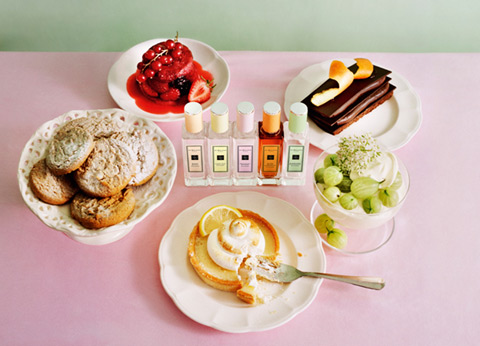
Jo Malone just launched her limited-edition Spring collection of perfumes inspired by British cakes and desserts. The collection is called “Sugar & Spice” and numbers five fragrances in all, each in the super light cologne concentration.

Jo Malone Sugar and Spice Collection

Source: Fragrantica

According to Basenotes, the perfumer is Christine Nagel of Mane who “spent time with the Jo Malone Creative Studio eating cake in Fortnum and Masons, Claridges and various other fine cake establishments to familiarise herself with the local sweet treats.” The line includes: Redcurrant & Cream, Ginger Biscuit, Lemon Tart, Bitter Orange & Chocolate and Elderflower & Gooseberry.

Source: Fragrantica

Source: Fragrantica

The company has really outdone itself with the campaign for this collection. There is a really fun, bubbly, happy video (see midway down below) featuring Adam Ant’s famous 80s hit, Goody Two Shoes, and also, just in case you missed the food aspects to the collection, the company also released four dessert recipes to accompany the fragrances. (I couldn’t find one for Bitter Orange & Chocolate.) You can find the compiled list of all of them at The Daily Mail, though I will provide the direct link to the appropriate recipe in each fragrance’s discussion section.

I have samples of all five colognes, and I’ll review two of them — Ginger Biscuit and Bitter Orange & Chocolate — in this post. You can find my reviews for the other three perfumes in the collection — Elderflower & Gooseberry, Lemon Tart, and Redcurrant & Cream — here.

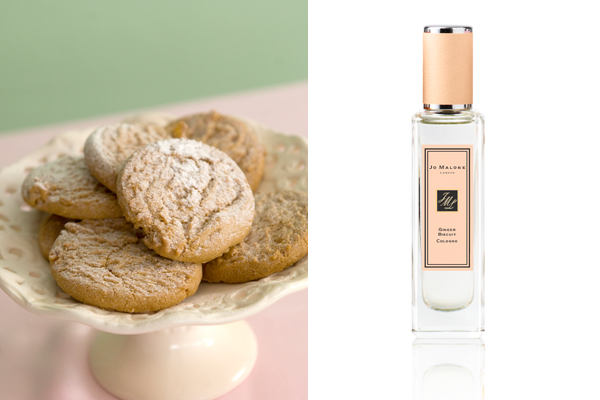
GINGER BISCUIT:

The Jo Malone website describes Ginger Biscuit as follows:

Just-baked biscuit. Spiced with ginger, nutmeg and cinnamon, melting into caramel. Butter-crumbly with roasted hazelnuts. Warmed by tonka bean and vanilla. Irresistible.

Source: The Style Insider.com.

Source: The Style Insider.com.

According to Basenotes, the perfumer, Christine Nagel, had the following vision in mind for the fragrance:

‘I wanted to recreate the equivalent deliciousness of a just baked biscuit enlivened with grated ginger.’ says Nagel, ‘Texture was important in this fragrance; the sharp natural note of ginger is set against the sensation of a baked, crumbly biscuit.’

Notes include ginger, nutmeg and cinnamon, caramel, roasted hazelnuts, tonka bean and vanilla.

Ginger Biscuit opens on my skin with a strong note of aldehydes. You can read more about aldehydes and the role they play in perfumery in the Glossary linked at the very top of the page, but, in a nutshell and the simplest terms, aldehydes smell soapy and/or waxy. Here, both aspects are present, though the soap eventually fades after about ten minutes. In those opening minutes, there is also the smell of warm cookies. There are definite and strong notes of vanilla, followed soon thereafter by a light touch hazelnut. Ginger Biscuit smells essentially just like a cookie or biscuit candle, only about a thousand times milder and lighter. 

Unfortunately, soon thereafter, something else becomes much more dominant than hazelnut or sweet cookies. There is now a strong note of alcohol — as in rubbing alcohol. Its sharpness makes me think that the “ginger” component is extremely artificial and synthetic. While you can smell ginger, fleetingly, underneath or around it, the note is much more like disinfectant mixed in with vanilla.

I’m rather horrified. It feels exactly like you’ve gone to the doctor’s office and the nurse has swabbed your arm before taking blood with some antiseptic, except, here, it happens to be cloaked in cheap vanilla. If this is “ginger,” then you can get much more genuine and natural-smelling ginger in some of the pre-packaged jars in your supermarket.

On the barely more positive side, the whole damn perfume is so bloody light and ephemeral, you have to practically douse yourself and wolf at your arm to have much hope of smelling anything detailed. And I’m talking about the very first few minutes here! From a distance of about a foot away, you can smell some extremely generic wafts of vanilla and rubbing alcohol. Further than that, and I wouldn’t count on it for the average spray or two.

After the first twenty minutes, the perfume’s low sillage becomes even less. Then, thankfully, shortly before the second hour, the whole thing dies away entirely. It never changed much beyond the main vanilla and alcohol scent I described above, adding a whole new twist on simple, minimalistic and linear.

Lest it was not clear from this review, I think this is a horribly cheap-smelling, synthetic fragrance. I find it revolting, and I think even Bath & Body Works has better cookie or vanilla “fragrance sprays.” They cost about $14 for 8 oz which is about 7 more ounces than this stuff. For example, one of their vanilla fragrance sprays is Warm Vanilla Sugar. It doesn’t have “ginger” in it but, if we’re using Ms. Nagel’s definition of “ginger,” that’s just as well. I’ve smelled a lot of ginger in a lot of perfumes, and what’s in Ginger Biscuit does not seem at all like real, genuine-smelling, good ginger but, rather, like something concocted in a lab. Warm Vanilla Sugar is hardly the best vanilla cookie scent I’ve tried but it’s extremely affordable, lacks the screechingly sharp disinfectant note, and is a damn sight better than Ginger Biscuit, in my opinion. Plus, the Bath & Body Works fragrances don’t have a soapy undertone in the opening minutes.

I cannot believe Jo Malone is asking $60 for this. And for a miniscule bottle, to boot! Outrageous.

To wipe away the bad taste of cheap chemicals, I suggest watching the wonderful, incredibly fun, bubbly video launched as part of the Jo Malone ad campaign for the “Sugar and Spice” collection. It shows all the makeup and food they used in a “behind the scenes” look. Plus, the classic Adam Ant song is always an incredibly peppy and cheerful way to brighten your day:

Finally, if the perfume isn’t your cup of tea (and I really hope it isn’t), you can always try making the recipe for Stem Ginger Biscuits which can be found at this Daily Mail page.

BITTER ORANGE & CHOCOLATE:

Jo Malone’s website describes Bitter Orange & Chocolate as follows:

The bite of bitter orange, layered with dark chocolate.  Orange peel counterpoised with warm, powdery cocoa, milky coconut and coumarin.  Sumptuous and addictive.

Basenotes quotes Nagel as saying,  

[this fragrance is] very special and unexpected. Orange is a classic raw material for a perfumer so we chose to shake things up with a mix of bitter and sweet orange notes. When combined with the chocolate many interesting qualities began to develop. The chocolate is dark, powdery and creamy but the orange adds energy and bite.

Source: Jo Malone.

Source: Jo Malone.

Bitter Orange & Chocolate opens with an absolutely gorgeous note of rich orange peel and the darkest of bitter chocolate. The orange is sweet, heady and reminiscent of the Seville oranges used in marmalade, only more slightly sugared. It is mouth-watering, delicious, and a simply lovely, lovely note! The chocolate is simultaneously like the dark slabs used in baking but, after ten minutes, it’s also like hot chocolate.

As time passes, the chocolate note starts to dominate, adding an occasionally dusty cocoa powder appearance to its other two faces. The orange recedes (alas) to the background, popping up in visibility for brief moments here or there, but generally content to let the chocolate take the lead in this dance. I don’t smell any coconut, milky or otherwise. After thirty minutes, there is the vaguest hint of coumarin that starts to pop up. This version of it is sweet and faintly hay-like, but also with vanilla undertones. The coumarin is very subtle, yet it adds an interesting subtext of dryness to counter the sweet overtones. In its final stage, the perfume turns into a sheer veil of powdered chocolate with some coumarin.  

The whole thing is very light, sheer and subtle, with minimal projection. You can detect definite whiffs of it in the opening minutes from about half a foot away. Perhaps less. Soon thereafter, you can still smell it if you bring your arm a few inches away from your nose. At the thirty minute mark, you have to put your wrist right under your nose to detect it, and it becomes even more minimal after that. Its duration was much shorter than some of the fragrances in the line: the fragrance died away entirely after about 1.5 hours.

All in all, Bitter Orange & Chocolate was my favorite out of the collection. I say that not only because I have an oft-repeated love for orange notes but, also, because this fragrance lacked some of the serious deficiencies of the others in the line. It was neither too, too sweet, nor too artificial and chemical-smelling. There were no notes of sharp disinfectant, soap, or synthetics. It was lovely and well-balanced. It’s not a particularly complicated scent — but, then, it wasn’t trying to be.   

The problem is that $60 is a lot for a fragrance that is both very simple and of very short duration. Bitter Orange & Chocolate lasted around 1.5 hours on me, and was barely detectable for much of that time unless I jammed my arm under my nose. Some people don’t mind re-application of their scents, but a 90-minute benchmark requires a lot of re-spraying! Even if someone has skin that doesn’t go through perfume as quickly as mine, Jo Malone fragrances are NOT known for their longevity as a whole. So, when your $60 bottle is a tiny 1 oz., those constant re-applications will finish things off quickly and makes the perfume a bit more costly than it might otherwise appear.

I read somewhere that Jo Malone representatives suggest layering some of these scents with others from her Tea Fragrance Blends collection. That’s fine, and should help in adding some minor modicum of complexity or depth to some of the scents. The problem is, that Tea collection was from 2011 and is no longer available. But even if it were, or even if you used the current Earl Grey & Cucumber fragrance (which is all that remains available from that collection), perfumes can and should be judged on their own merits. They should not be assessed based on how they smell by buying another $60 bottle to help things along. Besides, I highly doubt that layering would significantly change the duration problem.

Like all the fragrances in the collection, Bitter Orange & Chocolate doesn’t suit my personal style or taste, but it is definitely the one I would recommend the most out of the five. You can find my reviews for the other three fragrances in the collection here.

DETAILS:
Cost & Availability: Each of the colognes in the range costs $60. There is only one size: a very tiny 30 ml/1 fl. oz. As noted earlier, the set is a limited-edition release, but I have no idea how long “limited-edition” means in the Malone world and when they will be removed. Each fragrance can be purchased directly from the Jo Malone website which also offers free shipping “and the fragrance samples of your choice at checkout.” I don’t know how many samples you can get. You can also find the Sugar & Spice Collection at various stores. For example, here is Bitter Orange & Chocolate at Neiman Marcus (with the other perfumes in the series being listed and linked at the bottom of the page). Bergdorf Goodman also carries the full line. Unfortunately, according to a note on their page, neither Bergdorf nor Neiman Marcus ships to Canada. You can also find the collection at Nordstrom. Bloomingdales carries the whole line, along with some sort of Bonus Offer as well.
If you want to try out samples, you can find them at Surrender to Chance which is where I purchased my set. That set is currently sold out, but you can purchase samples of each individual fragrance starting at $2.99 for the smallest size (1/2 a ml vial). I highly recommend that you sign up for Surrender to Chance’s email and newsletter as they send out their monthly discount codes. If you’re interested in trying out the Malone fragrances (or any perfumes from StC, for that matter), here are the codes for March: 5% off orders with the code: nomoresnow. However, orders over $75 can get 8% off with the code: wewantspring.  Shipping for all orders of any size within the US is $2.95. Due to the massive increase in international shipping rates by the US Postal Service, international shipping has gone up everywhere. At Surrender to Chance, it is — alas — now $12.95 for all orders under $150.