History: Nagako, Japan’s Ferocious Dowager Empress [2004]

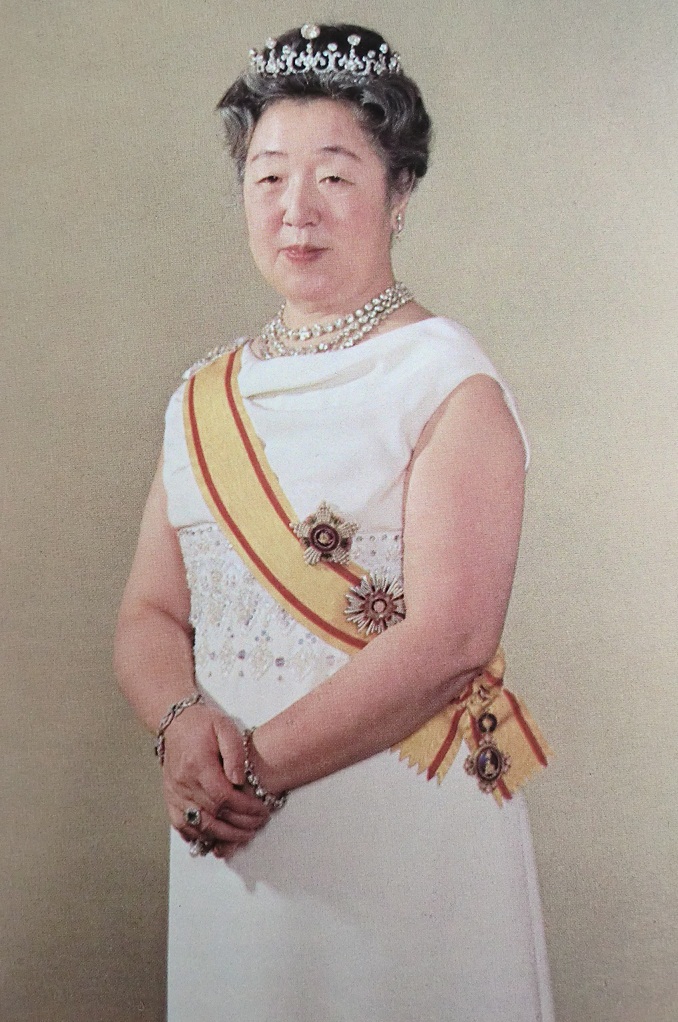
I thought some of you might be interested in a 2004 piece I wrote on Japan’s powerful, fierce Empress, then later Dowager Empress, Nagako. It is, among other things, the tragic story of a victim turned abuser and of a woman who rose to become a real force and power behind Emperor Hirohito.

The Early Years

empress nagako kojun japan diamond tiara

Empress Nagako, posthumously known as Empress Kojun.

Dowager Empress Nagako was the wife of Emperor Hirohito and the mother of Japan’s current Emperor, Akihito. When she died, only four years ago at the age of 97, she was also the longest living empress consort in Japanese history. She was Crown Princess from 1924 to 1926, Empress from 1925 to 1989, and Empress Dowager from 1989 to 2000. In short, she was close to the throne for 76 years!

She was born on March 6, 1903, Tokyo, the eldest daughter of Prince Kuni who headed one of the eleven cadet branches of the Imperial Family. Her father, a descendent of a 13th century emperor, was the last of his line. And she, in turn, was the last imperial princess to marry into the Japanese Imperial Family.

Continue reading

History: What if….? The Chaos Theory & Royal History. [2005]

ED. NOTE: Regular and perfume readers, please feel to skip this post entirely. You see, once upon a time, I wrote mainly about history under the name “Pandora’s Box” for one of the main, unofficial royalty sites. A few are already posted and hidden in the archives, but I’m in the process of transferring over some more articles that were published back in 2004 and 2005 (and leaving them largely as is), so that everything in one place. In this case, it’s an article that examines alternative history and how easily things would have been different if one tiny, small event had not occurred.

For example, the Tsarevitch’s hemophilia leading the way for Rasputin, the miscarriages of Catherine of Aragon & Charles II’s Catherine de Braganza, the assassination of Archduke Franz Ferdinand that triggered the start of WWI, or if a royal heir had not died, paving the way for Queen Victoria’s unexpected rise to the throne. Consider it an examination of the “Chaos Theory” as applied to royal history, if you will, and a light-hearted, extremely speculative game. As with all the articles, I certainly don’t expect anyone to read it; most of them are quite academic, very long, for a totally different audience, and have some extremely wonky formatting after the transfer from the old website. So, if your main interest is perfume, please feel free to skip them.

What if…. ?

Written by Pandora’s Box – Tuesday, 04 January 2005

The “Chaos Theory” posits that the tiniest event half a world away can have enormous consequences, in the most unexpected of ways. History is not immune from causality or the strange twists of fate. A crazy monk, a face on a coin, an assassination, a baby’s death… these things can have unexpected, long-lasting consequences. In fact, they can change the course of history. But what if some of these seemingly minor, inconsequential events had never occurred? Today, we’ll explore that subject and some of the hypothetical situations which could have arisen if events had turned out differently. The potential outcome is obviously speculative and up for conjecture, but there is usually evidence to support one side or another. In this light-hearted parlour game, I’ll tell you a few of the things I sometimes wonder about, and how I think history was impacted. Perhaps you will see a different outcome. If so, let me know, along with some of your own favorite “what ifs.” At the end of my column, I’ll give you some information on submitting your choices.

* * *

What if…
What if Catherine of Aragon had given Henry VIII a male heir? Much of Henry’s obsession with securing the succession stemmed from the lessons he had learned from his father, Henry VII, and the bloody conflict of the War of the Roses. Henry knew full well that a male heir would secure the Tudor line, prevent rival claimants and preclude another devastating political conflict.

Had Catherine of Aragon given Henry a son (or two), it’s quite likely that Henry would have remained married to her. If he had not sought to remarry, he would never have split from Romeor created the Church of England to justify his actions. He certainly would not have married Anne Boleyn. Yes, he probably would have continued his affairs, but it’s unlikely he’d have had six wives. Even more significantly, there would not have been a legitimate daughter calledElizabeth, who would later become one of England’s greatest monarchs.

* * *

What if…
What if Arch-duke Franz Ferdinand had not been assassinated in Sarajevo in 1914? One might argue that, but for the assassination, the tenuous balance of power which had existed between various rival empires would not have been upset. If World War I had not occurred, then neither would have the political, economic and social conditions of the interwar years, which led to World War II. And that, in turn, led to the rise of Hitler, Nazism, the Holocaust, the spread of Stalinism after Hitler’s defeat and much more.

Even if we don’t string out causality so far down the line, the assassination of Franz Ferdinand had other big consequences. The war which ensued decimated much of the aristocratic class inEngland, triggered economic ruin in Russia, led to the downfall of the Austro-Hungarian Empire, the Ottoman Empire, and the Russian Empire. Some historians might argue that the economic and social conditions in Russia would have made Revolution inevitable, but there is little doubt that the Great War exacerbated existing conditions and speeded up the eventual outcome.

The Great War also created much of the conditions and problems existing today in the Middle East. In the Balfour Declaration, and some other contradictory documents such as the Sykes-Picot treaty, the British promised all things to all people in the Middle East in return for their support against the Ottoman Empire. Present-day Israel, the area being fought over as Palestine, Iraq, Saudi Arabia, Jordan (formerly Transjordan)… all these areas were impacted by British promises, both during and after the War.

In short, the assassination of Franz-Ferdinand is perhaps the best example of the Chaos Theory. Franz-Ferdinand was not the ruler of an Empire, and he was merely the Emperor’s nephew, albeit very close in the line of succession. Nonetheless, his death triggered events which led to cataclysmic changes at every level of society, and in almost every country on earth.

* * *

What if…
What if George III had agreed to taxation with representation for the American colonies? One of the key causes of the American Revolution was the question of taxation. The English government felt that the colonists should pay taxes as compensation for the services and benefits which they received. The colonists believed that they shouldn’t be taxed if they were not given political representation.

Conflicts between the colonists and the Crown grew worse after the French and Indian war, which severely depleted the Treasury. King George III wanted the colonists to pay for the war through higher taxes and issued something called the Stamp Act. The angry colonists, led by Samuel Adams and James Otis, came up with the slogan “No taxation without representation” and petitioned the King to revoke the Act. He didn’t. A few years later, another statute – the Townshend Act – was enacted which taxed tea, among other daily necessities. Although the Townshend Duties were subsequently revoked, the tea tax remained in place. A few years of relative calm ensued, but trouble lurked under the surface:

[T]he crises of the past decade had created incompatible mindsets on opposite sides of the Atlantic. King George III and Parliament still faced money problems and were determined to assert their powers to tax the colonies and regulate trade for the benefit of the entire British empire. On the other hand, the colonists’ ideas about taxation without representation, about actual versus virtual representation, about tyranny and corruption in the British government, and indeed about the nature of government, sovereignty, and constitutions had crystalized during this period.

The Library of Congress, The American Revolution 1763-1783, at http://memory.loc.gov/ammem/ndlpedu/features/timeline/amrev/rebelln/rebelln.html

The wheels of change were moving inexorably towards rebellion and, eventually, towards revolution. But what if the King had agreed to provide the colonists with a voice in Parliament when they had asked back in 1765 or at later points in time? The decision might have diffused the seeds of resentment and prevented them from being fanned into the flames of actual conflict.

Or perhaps not. One cannot discount the impact of ideas, and the Age of Enlightenment had sown the seeds of intellectual questioning against the established political order. From Russia to Europe to the Americas, revolutionary ideas about the nature of government and its relationship to the people were being debated. The feelings held true regardless of whether it was France or America, Voltaire or John Hancock, a feudal regime or the New World, a question of daily bread or taxes on tea. In both cases, the result was the same: the Old World political model was seen as unfair, undemocratic and inherently corrupt.

Then again, ideas are one thing, but economic reality is another. History has shown time and time again that the masses are rarely moved to radical revolutionary change unless their economic livelihood is on the line. Karl Marx published Das Kapital in 1867 but few Russians actively sought revolution until famine, huge wartime losses and an influenza pandemic turned their daily existence upside down. That was almost fifty years later. Clearly, ideas only go so far; but people don’t necessarily act on them until there is no food on the table.

In short, the taxation issue probably had a greater impact on the daily life of the American colonists than any intellectual discourse on the nature of government. Had there been some change in the laws – even if it was only indirect change, through political representation and the hope of softening future tax duties – the American Revolution might not have occurred. At the very least, the parties might have arrived at an arrangement similar to that of the British government and the present-day Commonwealth.

If either of these two scenarios had come to pass, history might have been very different. All it would have taken was one tiny law regarding representation, representation in a Parliament already dominated by British aristocrats who would have voted for their own vested interests and along party lines. They certainly would not have supported measures benefiting far-flung colonists against the Crown, so where was the harm? Yet that’s the very reason why, realistically speaking, the colonists would have remained dissatisfied. Representation might have been nothing more than a temporary band-aid on an already infected wound. We will never know one way or another but, oh, the possibilities….

* * *

What if…
What if Charles II’s wife, Catherine de Braganza, had been able to have an heir? The Queen’s inability to conceive and carry a child to term led Charles II to designate his younger brother, James, as his heir. James, the Duke of York, was a Roman Catholic and extremely unpopular.

He ascended the throne as James II in England (and James VII in Scotland), and was England’s last Catholic monarch. His subjects distrusted him due to his religion and “Popish” policies which they felt made him a pawn of Rome. James II was eventually deposed in “the Glorious Revolution” of 1688, and fled to France where he lived out the rest of his life. He was replaced on the throne first by his daughter Mary (Queen Mary II), and then by his daughter Anne. Both daughters were Protestants.

Charles II’s failure to have a legitimate heir and his choice of a Catholic as successor triggered a chain of consequences whose impact lingers to this day. The two interconnected events led to political statutes which changed not only the line of succession, but also the qualifications for succession. In 1701, Parliament passed the Act of Settlement which ensured that no Catholic would ever rule England again. It stated that, if Queen Anne had no heirs, only descendents of Sophia, the Protestant Electress of Hanover, were eligible to ascend the throne. It also stated that any member of the royal family who married a Catholic would be excluded from the line of succession.

The Act changed the political landscape. Queen Anne had no surviving heirs. Since she outlived the Electress Sophia, the terms of the Act of Settlement kicked in. Sophia’s son ascended the British throne as George I, the first of the Hanoverian kings. And, obviously, the line remains unbroken to this day, since the current monarch is also one of Sophia’s descendents.

The Act’s proscriptions regarding marriage to a Catholic also remain in effect. When Prince Michael of Kent married a Catholic, Baroness Marie-Christine Von Reibnitz, in 1978, he immediately and automatically lost his place in the line of succession. At the time, he was eighth in line to the throne.

Would things have been different if Charles II had had a legitimate heir? Possibly. Although Protestantism had a strong hold in England by the 1600s, James II was not the wisest or the best of kings. One can argue that his religion was the straw which broke the camel’s back. Had there been a different ruler on the throne, Parliament might not have felt the need to pass a formal rule prohibiting Catholic monarchs or marriages. At the very least, the succession would not have passed to the descendants of the Electress of Hanover.

* * *

What if…
What if Marie-Antoinette and Louis XVI had been successful in their attempt to escape France?The initial stages of the French Revolution took place in 1789. The King and his family were imprisoned in the Tuileries palace but life was not (yet) the horrific misery which it would eventually become. Although the palace was a dark, dank, gloomy (and allegedly cursed) place, the Queen was permitted a few ladies-in-waiting, her possessions, and some minimal comforts. The King received the same treatment.

Part of the reason was a political fiction which was thrust on the King. Although the King tried to pretend the Revolution had occurred with his consent, few were fooled by this pretense. The simple reality was that the King was a prisoner who had little choice but to accede to the decrees of the National Assembly.

The royal couple remained imprisoned for two years. But in 1791, the Queen’s alleged lover, a Swede by the name of Axel Ferson, helped plan an escape. His plan had initially called for the King and Queen to leave Paris in a small, fast coach; their children would travel separately to avoid suspicion. But Marie-Antoinette refused to leave her children. While her maternal instincts are understandable, her position on another issue was not. The Queen stupidly insisted on bringing almost every possession, article of clothing, and knickknack she owned. Between her insistence that the entire family travel together and her wish to bring everything but the kitchen sink, there was no choice but to travel in a large, slow coach.

The decision proved catastrophic. Not only did it slow down the escape but it also made the royal family stand out. The overburdened coach made it as far as Varennes, almost to the German border, when they were caught. A peasant recognized Louis from his face on French coins! He sounded the alarm and the royal family was captured. They were brought back to Paris under armed guard and their fate hung in the balance. The National Assembly suspended the rights and “powers” of the King, and began to discuss abdication. More significantly, for the first time, they began to discuss the possibility of a Republic. And execution.

One might argue that abdication, assassination and a republic were inevitable outcomes of the Revolution, but there is another school of thought which disputes that conclusion. Before the royal family’s flight, regicide was generally considered an unthinkable option which was advocated only by the most violent of extremists. While kings had been killed in the past, it was usually by foreign enemies, or during periods of political upheaval, warfare or invasion. More to the point, it was usually something which only an equal was permitted to do. As Alexander the Great reportedly said, “only a King may kill a King.” With a few exceptions, such as Oliver Cromwell, it was almost unheard of for a king’s subjects to kill him. One reason was the theory of the Divine Right of Kings which argued that kings were God’s appointed, annointed representative on Earth. To kill God’s representative…. Well, you know how the story goes.

Here, there is no doubt that the French Royal Family’s failed escape cemented their fate. After the flight, it was no longer possible to continue with the illusion that the King supported the Revolution or its reforms. The moderates in the National Assembly were pushed aside by extremists who argued that the royal family’s attempted escape proved they were enemies of the French people. And from that point, it was only a tiny hop, skip and a jump to demanding their heads. Literally.

How would things have ended if the royal family had succeeded in their escape? There is little doubt that the extremists like Robespierre would have used a successful escape to hijack the Revolution, as he did with the unsuccessful attempt. But once the sound and fury of the Reign of Terror ended, then what? It’s quite probable that the course of events would have continued as they did until Napoleon’s defeat at Waterloo. At that point, however, the “what if” scenario becomes interesting. If the French royal family had survived, they would probably have sought the protection and shelter of England. After Waterloo, it wouldn’t have been Louis XVIII, the King’s brother, who would have been placed on the throne but his son, the young Dauphin and future Louis XVII. What would have happened then? I don’t have the faintest clue but it’s certainly an intriguing hypothetical to contemplate.

* * *

What if…
What if Tsarevitch Alexei, Tsar Nicholas II’s heir, had not been a hemophiliac? Nicholas and Alexandra had tried desperately for a son, only to have four daughters until, at long last, Alexei was born. His hemophilia was the only reason why Empress Alix turned to the mad monk, Rasputin, who seemed able to stop Alexei’s bleeding. In Alix’s eyes, Rasputin was the only one capable of helping and curing her young son. As a result, he gained enormous influence and control over the Empress who treated him as her closest confidant after the Tsar himself. No matter how debauched or depraved his actions, she looked the other way. By 1911, many of the top positions in the government were filled with his appointees and followers.

Rasputin’s unpopularity and her refusal to curb his increasingly degenerate behavior led to enormous scandal and vicious rumours. Gossip ensued about Alix’s relationship with Rasputin, as well as that of her young daughters. By 1916, things had reached a fevered pitch. The war was going badly, Russia was suffering enormous casualties, and food was scarce. The people were beginning to mutter about the Empress’ German origins. It was well known that the Tsar’s policies and decisions were shaped by “that German woman,” as Alix was labeled. It was equally well known that “the German woman” was controlled by Rasputin. People were beginning to think that Rasputin had become the true lord of Russia, and rebellion was in the air. Yet Alix still would not hear a word against him.

In 1916, Rasputin was murdered by a group of aristocratic princes. But it was too late. Only a few months later, the Tsar was forced to abdicate and the Romanovs were imprisoned. The wheels of revolution had slowly begun to turn, leading to the tragic events of 1918.

Would things have turned out differently if Alexei had not been a hemophiliac? I don’t believe so, given the impact of the war and Russia’s underlying economic and social problems. However, it’s quite likely that Rasputin would not have gained power over the Imperial couple, thereby obviating the need to assassinate him. And his assassination was, arguably, almost as damaging as his life had been. As the Tsar’s sister, Grand Duchess Maria Pavlova, wrote in her memoirs: “His death came too late to change the course of events. His dreadful name had become too thoroughly a symbol of disaster. The daring of those who killed him to save their country was miscalculated. All of the participants in the plot, with the exception of Prince Youssoupov later understood that in raising their hands to preserve the old regime they struck it, in reality, its final blow.”

* * *

What if…
What if Prince Charles had been permitted to marry the woman he loved from the onset? I’ve phrased this question carefully because I’d really prefer to stay out of the endless Charles, Camilla and Diana debates. My question is not about Charles and Diana’s marriage but, rather, how things might have been if the marriage had never taken place.

Obviously, one thing to take into consideration is the fact that Camilla Shand was unavailable from 1973 onwards. Camilla married Andrew Parker Bowles while Prince Charles was away on a naval mission. By some accounts, she was mad about Andrew Parker Bowles from the onset. Other reports, however, claim that she only married him because she thought Charles would never propose since she didn’t fit the bill as a suitable consort. Whatever the truth, let’s pretend that Camilla was available and single.

What if the future King of England had married the woman he loved from the onset? Perhaps the better question is, what if the rules about suitable consorts had been different back then, such that Charles could have married the one woman whom he obviously can’t be without? Charles is in his mid 50s now, but he got married when he was 32. Although people’s characters are rather well-formed by that age, how would he have been if he’d been in a happy marriage? How would it have impacted his eventual reign as monarch? We’ll never know the answers to these questions but, again, it’s something to consider.

* * *

What if…
Speaking of marriages, what if the relationship between David, The Prince of Wales and subsequent Duke of Windsor, and Wallis Simpson had ended in a different manner? There are numerous reports which indicate the British Establishment was more concerned about Edward as a monarch than it was about his relationship with an American divorcée. For example, the Prime Minister, Stanley Baldwin, was contemptuous of the Prince’s overall character. And it didn’t help that Edward/David seemed to be ratifying, if only in appearance, the Hitler regime. Quite simply, the Establishment was alarmed of what would happen when the Prince ascended the throne.

Be that as it may, if Parliament and the Commonwealth had agreed to a morganatic marriage or if Edward VIII had not abdicated but given up Wallis instead, how would history be today? Would the future King have seen Hitler as he truly was, and not just as the man who saved Germanyfrom the brinks of an unbearable Depression and economic collapse? Or would he have continued in his support, unaware or disbelieving of Hitler’s plans for the Jews? Would he have continued despite inevitable opposition from his close friend and supporter, Winston Churchill, one of the lone voices in the desert warning against the German threat? Or would he have approved of Chamberlain’s appeasement strategy, as did so many in positions of power at the time? More to the point, what would have happened when war broke out, something which Hitler’s long-term plans made inevitable?

It’s impossible to know the answers to these questions but one thing is likely: so long as there was an independent Britain, there would still be a Queen Elizabeth II. In the early 1930s, there was a popular saying that Edward VIII, then Prince of Wales, was not “heir conditioned.” It meant that he was sterile. The reason was that the Prince of Wales had the mumps when he was young. Some reports even allege that he suffered the rare occurrence of a viral outbreak on his testicles.

Regardless of location, the mumps made one thing very clear: whether or not he abdicated, whether or not he married Wallis Simpson, it’s quite unlikely that he would have been able to have children. Thus, his brother and his heirs would have been next in line. And Princess Elizabeth would have eventually ascended the throne.

* * *

What if…
What if Princess Charlotte, the daughter of the Prince Regent (later George IV) had not died in childbirth with her baby? The Prince Regent had only one child with his wife, Caroline of Brunswick, whom he detested. His beloved daughter, Princess Charlotte, married Prince Leopold of Belgian in a love match. Her death in 1917 came as a huge blow to the Prince Regent. More importantly, it changed the line of succession to the throne. After the death of George IV, his younger brother ascended the throne as William IV. The new King had no legitimate heirs, so his niece, Victoria, became his heir. In short, if Princess Charlotte had not died, there would not have been a Queen Victoria.

Without Queen Victoria, and her wise consort Albert, many of the incredible achievements of Victorian era might not have occurred. Under her reign, there was incredible overseas expansion; Prince Albert’s brilliant handling of the “Trent Incident” which kept England out of the American civil war; there was a long period of domestic stability, free of the internal political upheavals or profligacy which had marked the reigns of earlier rulers; and Britainexperienced an unprecedented economic boom. True, the Industrial Revolution would have occurred regardless of the person occupying the throne, but the impact of Prince Albert’s contributions in this area cannot be discounted.

Similarly, one cannot ignore the beneficial impact of royal continuity. By having the same monarch on the throne for decades – especially one who had numerous legitimate heirs– Victoria provided political stability in a way which England had not experienced since the George III.

More importantly, “[t]o the Empire, she brought a dignity, style, and most important, a validation of the monarchy that had not been witnessed since, perhaps, Elizabeth I.” Ilana Miller, Queen Victoriahttp://www.victoriaspast.com/FrontPorch/queenvictoria.htm. She wisely used her powerless position to unite the country, particularly in the political realm where she sought to avoid the political strife which had plagued her predecessors. She accomplished this through her style of working with her prime ministers, especially Disraeli and Melbourne.

Victoria also united the country in the example she set in her personal life. By emphasizing the family unit and simple values, she seemed a more approachable monarch than the profligate, extravagant Prince Regent or the very Germanic, early Hanover kings. The people were able to feel as though she – and her family – were just like them, although obviously nothing could be further from the truth. But, if Princess Charlotte had lived and given birth to a child, none of that would have happened and England might be a very different place today.

* * * * *

To My Readers: These are just a few of the many “what ifs” that intrigue me. If you have any other royal scenarios which capture your imagination, please submit them. Ideally, I’d like my column next week to be devoted to your ideas or comments on this subject. Almost every country has a rich royal history, so the more wide-ranging, the better.

When you write, please let me know if I have your consent to publish your comments (with possible editing for space or clarity) and the name/email/description which you’d like me to use in quoting you. If you can write a brief explanation on why a certain event is important in your eyes, all the better, but please don’t think that a long discourse is necessary. All that’s needed is a few sentences to explain your thinking or the background of events to other readers who might not know as much as you on a subject.

– Pandora’s Box
pandorasbox -etoile.co.uk

History: Urban Legends, of the Royal Kind… [2004]

ED. NOTE: I don’t always write about perfume. In fact, once upon a time, I wrote mainly about history under the name “Pandora’s Box” for one of the main, unofficial royalty sites. A few are already posted and hidden in the archives, but I’m in the process of transferring over some more articles that were published back in 2004 and 2005 (and leaving them largely as is), so that everything in one place. I certainly don’t expect anyone to read them, especially as most of them are quite academic, very long, for a totally different audience, and have some extremely wonky formatting after the transfer from the old website. So, if your main interest is perfume, please feel free to skip them.

Urban Legends, of the Royal Kind…

Written by Pandora’s Box – Tuesday, 16 November 2004

There are hundreds of urban legends about royals – in history, on the internet, in common parlance, they abound everywhere. You must have come across them, I know you have. Whether you’ve been talking to a friend, reading the paper or just using extravagant analogies, we’ve all come across comments comparing people to the sadistic Caligula, the evil Lucrezia Borgia, or the gluttonous Henry VIII.

Sometimes, we assume the legend is true. It’s usually not out of ignorance but, rather, because a story becomes part of popular culture or modern folklore. As the old saying goes, where there’s smoke, there’s fire and, in some instances of royal history, that’s quite accurate. In a few instances, however, the politics of an era, its social mores, and the power of folklore create an image which subsequent scholarly research shows to be quite untrue. Sometimes, all that’s needed is time to bring hidden documents to light. And sometimes, it was all a lot of rubbish to begin with, but the rumour caught fire anyway. Modern research has shown some of these rumours to be the result of some political, cultural, or social need; but it’s still too late, the legend has caught hold of the popular mind.Human nature is such that we revel – almost guiltily – in the titillating and salacious. How many of you have sometimes given a quick peek at a particularly juicy tabloid story? How many of you have occasionally grinned at the embarrassment of some popular actor whom you’ve thought was an over-rated, arrogant buffoon? I know I have.

Take that barely sublimated feel of vicarious superiority, combine it with an elemental appreciation of seeing the mighty fall, and perhaps you’ll see why certain myths take hold in the popular imagination. Go one step further and combine that natural, human response with today’s increasingly short attention span – and what do you get? A stewing pot of half-formed beliefs that have just enough truth to withstand a cursory, gossipy conversation but little else.

It’s the perfect laboratory for an urban legend, where a controversial fact becomes “true” simply by virtue of being repeated long enough. In short, people have just enough knowledge to get the wrong idea, and then they repeat that misconceptions to others who, in turn …..

Well, I think it’s time to discuss some of those commonly repeatedly rumours. Just because something has been repeated over the centuries as the gospel truth doesn’t mean that it is, in fact, true. By the same token, just because something has been repeated ad nauseaum doesn’t mean it’s false.

This week’s column will focus on a few of those popular myths from Lucrezia Borgia and Napoleon, to  the “Prince Albert” piercing, Anne Boleyn, Jack the Ripper and the royal prince, Richard III, and Hungary’s Blood Countess, Elizabeth Bathory. I’ll avoid some of the truly obvious ones, so that I may discuss some of the more controversial or popularly misunderstood urban legends. A few of the royals discussed below will be analysed in greater detail in subsequent columns but they still warrant inclusion on this list. If you have a special curiosity about someone on this list and would like to see their life explored in depth, please let me know. In the meantime, let’s get down to details.

In each of the following instances, I’ve tried to give a simple one line summation about the urban legend in question. Sometimes, the reference will be immediately obvious to one reader but it won’t be to another. So, I’ll be as basic as possible. Following the summation, I’ll explain the “Status” of the legend; in other words, if it’s true, false, in controversy or some variant in between. Then, I’ll give a brief historical explanation about the context surrounding the story and why it should be treated as true, false or up for debate.

 * * *

Legend: Prince Eddy, Queen Victoria’s grandson and second in line to the British throne, was “Jack the Ripper.

Status: False.

Explanation: Prince Albert Victor, the son of The Prince of Wales, was popularly known as “Prince Eddy.” He was named Duke of Clarence in 1891 and would probably have succeeded his father as King had he not died of the flu during the epidemic of 1891-1892. There were unconfirmed rumours that the Prince was slightly retarded but it’s safest to say that he was simply rather slow and not particularly bright.

Rumours concerning the Prince and “Jack the Ripper” had existed at the time of the investigation into the Whitechapel murders, but they really took off after 1970. That was when Dr. Thomas Stowell published an article in a criminal journal claiming to have solved the mystery. Stowell relied on papers left by Sir William Gull who was Queen Victoria’s physician. Sir William had apparently treated Prince Eddy for syphilis, a condition that slowly eats away at the brain. Dr. Stowell’s article never explicitly names the killer as Prince Eddy but, rather, calls him “S.” The person is easily recognizable as the Prince. Stowell’s theory is that the killer had syphilis, went mad and committed the murders. Stowell’s argument has been disproved on a number of different levels but so have all subsequent attempts to link Prince Eddy to “Jack the Ripper.”

Quite simply, the Prince had unbreakable alibis for many of the key dates. In fact, Eddy was not even in England on the day of two murders. Court circulars and royal records show that he was in Scotland, at a large house party where he was seen by hundreds of witnesses, shooting grouse with Prince Henry of Battenberg. He also had strong alibis on the dates of several other murders. Seehttp://www.casebook.org/suspects/eddy.html.

For those interested in the subject of Prince Eddy, the late, great historian and royal biographer, Theo Aronson, wrote an excellent discussion of his life and the “Jack the Ripper” legend in “Prince Eddy and the Homosexual Underworld” (1995)(out-of-print but available used).

 * * *

Legend: The Queen Mother, consort to King George VI and mother to Queen Elizabeth II, used artificial insemination to conceive her children.

Status: Controversial, unresolved, but most probably false and highly unlikely.

Explanation:This legend has its roots in Kitty Kelley’s 1997 book, The Royals. Kelley quotes an “unnamed royal family friend” as her source for the claim that the Queen Mother resorted to “manual fertilization.” Since then, stories of “turkey basters” have become urban legend. It’s one which, in my opinion, is highly unlikely.

Although artificial insemination has existed, in some form or another, since the 1700s, it’s highly unlikely that a man as shy, reserved and private as King George VI would have agreed to the sorts of intrusions required for success. One may argue that kings have done a lot less for an heir, but this King truly lacked the sort of ruthless, brash personality for such actions.

Another strike against the book is that royal insiders were quite unwilling to assist Ms. Kelley with her research. And, arguably, it shows: a large numbers of reviews that found her allegations to be “unsubstantiated.” Ms. Kelley has repeatedly claimed she leaves no rock unturned in her research, but the shrill, extraordinarily nasty tone of the allegations in this book really leave one to wonder if she just had an axe to grind. The book is a compendium of every possible royal urban legend in existence, and the evidence for the claims flimsy beyond belief.

 * * *

Legend: Kitty Kelley’s book on the British Royal Family was banned in the UK

Status: False.

Explanation: Kitty Kelley’s book has never been published in the UK, leading many conspiracy theorists to allege that it was banned. The story has now risen to the level of urban legend but it is completely untrue. Britain’s tough libel laws differ greatly from those in the US and would certainly have led to a large verdict against Ms. Kelley and the publisher. As a result, neither was willing to take the risk of releasing the book in Britain. At no time did the Royal Family ban the book.

 * * *

Legend: Napoleon was poisoned to death

Status: Unresolved.

Explanation: The exiled Emperor died on the island of St. Helena in 1821 after a lingering decline and a final period of intense stomach pains. Rumours spread that the British had killed Napoleon to get rid of a thorn in their side and to end any political influence which he might still have. To counter these allegations, British military doctors on St. Helena performed an autopsy and found evidence of stomach cancer, which was given as the cause of his death.

In the 1960s, new tests found abnormally high levels of arsenic in his hair and suspicions were raised anew that the Emperor had been murdered. For the longest time, the two main suspects were the British or a close aide of Napoleon’s, the Comte de Montholon. According to some, the Comte murdered Napoleon under directions from the British. This theory was recently disproved by new tests on Napoleon’s hairs which suggested that he had been exposed to arsenic over a long period of time, as opposed to simply his brief exile on St. Helena. The results were interpreted as “clearing” the British. “British ‘cleared’ of Napoleon’s murder,” (October 29, 2002) at http://news.bbc.co.uk/1/hi/sci/tech/2371187.stm

Be that as it may, questions still remain over the arsenic and why Napoleon’s hair showed such high levels. Some possibilities involve arsenic being used in 19th century hair restorer, to create certain colours for wallpaper, or in other innocuous products. Others continue to insist that Napoleon was murdered. One of these is the President of the International Napoleonic Society, Ben Weider, who strongly rejects the claim that Napoleon died of cancer. (For his analysis of the situation, see http://perso.club-internet.fr/ameliefr/E-Conference2.html)

Personally, I think there are plenty of innocuous reasons for the arsenic findings and do not believe Napoleon was murdered. Nonetheless, the matter is unresolved and open to debate.

 * * *

Legend: Anne Boleyn, Henry VIII’s second wife, had 6 fingers on one hand

Status: Unproven and almost certainly false.

Explanation:Folklore has always given Anne six fingers but there is no real evidence to support the claim. The rumour can be attributed to Henry VIII himself who repeatedly charged his wife with witchcraft when he’d tired of her and wanted to end the marriage. George Wyatt, grandson of Thomas Wyatt and one of Anne’s very few friendly biographers, stated she had a “double nail” on one of her fingers. http://tinyurl.com/5hm3n A misshapen nail is much more likely than a separate sixth finger, particularly as any deformation was seen in the Tudor era as a mark of disease or even God’s disfavor. It’s unlikely that Henry VIII would have wanted the mother of his children to be thus marred. http://fine-eyes.net/anneboleyn/myths.html In short, the myth should be discounted as false.

 * * *

Legend: Champagne glasses were created after being modeled on Marie-Antoinette’s breasts.

Status: False.

Explanation: There are various different versions of this story but the most familiar involves Marie-Antoinette who was said to have champagne glasses made out of molds of her breasts so courtiers could drink to her health from them. The second most prevalent story involves Madame du Pompadour. The mistress of King Louis XV supposedly had the saucer-shaped coupe glasses commissioned for her lover who supposedly greatly admired her breasts. In all cases, however, the story is false since the coupe was invented far before any of these ladies were born.http://www.snopes.com/business/origins/champagne.asp

* * *

Legend: Prince George, the Prince Regent and future King George IV, was a bigamist.

Status: True.

Explanation: Prince George, the eldest son of King George III, and known as “Prinny” was already married when he was forced into his ill-fated, unhappy marriage to Caroline of Brunswick. Legend has it that he fell in love at first sight with Maria Fitzherbert, a Catholic widow, whom he saw standing on the stairs of the Opera House in 1784. Whether it was love at first sight or not, one thing became clear: the Prince was deeply enamoured. He pursued her for quite a while but Mrs. Fitzherbert was an extremely religious woman and refused to become someone’s mistress, even if that “someone” was the future King of England.

The Prince was not used to being rejected or not getting his own way. To show Maria how serious he was, he attempted “suicide,” but he made sure he had a doctor on hand just in case. Prinny wanted to make a grand gesture and get his way, not to actually end his life, which he enjoyed far too much. Maria was terrified but she agreed to marry the Prince.

On December 15, 1785, the two were secretly married. The marriage was valid under canonical and ecclesiastical laws. However, it was illegal under the Royal Marriages Act of 1772 which required the monarch’s consent before any member of the royal family could get married. Here, the King had never agreed and it would have been out of the question to ask him since he did not approve of Mrs. Fitzherbert.

There was another, equally important, reason why the Prince’s marriage was kept secret. Under the Act of Settlement of 1689, the Prince automatically forfeited his right of the succession by marrying a Roman Catholic.

The marriage was one of the worst kept secrets in society but the couple were so discreet that most people looked the other way, with the exception of older segments of high society and Beau Brummell, the Prince’s close friend and society’s arbiter. The couple spent most of their time in Brighton where Prinny was building and furnishing Brighton Pavilion. Mrs. Fitzherbert had a home in the Old Steine with a secret passageway into the Pavilion; she also had a home in London, close to the Prince. Both homes were purchased and furnished by the Prince. Never good with money in the first place, the Prince was racking up huge debts in this period, close to £1,000,000. It was a huge sum in those days, the equivalent to something like £80,000,000 today. http://www.eh.net/ehresources/howmuch/poundq.php

The Prince was running out of money and neither his father nor anyone else was willing to help him. The King, who was increasingly tired of his extravagant, scandalous son, finally agreed to pay the Prince’s debts if he got married. The King’s choice: his niece, Caroline of Brunswick. The King knew full well about the Prince’s secret marriage to Mrs. Fitzherbert; who didn’t? However, as noted above, it was illegal under the terms of the Royal Marriages Act.

Prinny and Mrs. Fitzherbert separated briefly when he married Caroline in 1795. Since the Prince had never been officially married to Maria, he didn’t need to obtain a divorce. After his daughter was born, the Prince renewed his pursuit of Mrs. Fitzherbert. She, always the good Catholic, asked for the Pope’s guidance. In 1800, Pope Pius VII reaffirmed the validity of their marriage. Even Princess Caroline agreed; she considered Mrs. Fitzherbert “the Prince’s true wife.”

The couple got back together and stayed together for almost a decade. They separated permanently when the Regency was declared in 1811, and they remained apart even when Prinny became King in 1820. However, Maria was well-taken care of: she received a yearly stipend from the royal family until her death in 1837 at the age of 81, long after Prinny’s death in 1830. She was considered by many to be the King’s widow and his one real love. In fact, his dying wish was to be buried with a miniature of her face, a wish that was granted.

For a fun, richly anecdotal, but also well-balanced, biography of Prinny, you might want to try Saul David’s “Prince of Pleasure: The Prince of Wales and the Making of the Regency,” (1999). For a complex discussion of Maria and her marriage to the Prince, you can try James Munson, “Maria Fitzherbert: The Secret Wife of George IV” (2002).

 * * *

Legend: Lucrezia Borgia was murderess who engaged in incestuous affairs with her father and brother.

Status: False.

Explanation: Few woman have a reputation like Lucrezia Borgia. Over the centuries, she’s become a symbol of sexually depraved evil, a Mata Hari capable of murder and incest, who discarded husbands and lovers alike, or a cold blooded killer who doled out a fatal dose of poison from a cunning ring or necklace. Her very name is associated with poisonings and sex, but the truth is very far from the legend. Modern scholarship has shown Lucrezia to be a rather unfortunate young woman who was the victim of her mad brother’s sociopathy and her father’s ruthless ambition.

Lucrezia was born in 1480 into the mighty Borgia family. It had its roots in Spain but it really dominated the Italian political landscape. The family was headed by her father Rodrigo, the future Pope Alexander VI. Her mother was not married to Rodrigo but was merely one of his mistresses. She bore him four children, including Lucrezia’s infamous older brother, Cesare, and another brother, Juan. In 1492, Cardinal Rodrigo became Pope. The first whiff of scandal around the Borgias arose when the new Pope installed a young mistress in the palace next to St. Peters and visited her openly. It wouldn’t be the last scandal associated with the Borgias.

As for Lucrezia, she’d already been engaged to two Spanish nobles before the age of eleven. Her father had broken each engagement because he had higher aspirations, aspirations that were fulfilled when he got Lucrezia betrothed in 1493, at the age of thirteen. The candidate was Giovanni Sforza, an aristocrat whose family ruled Milan. It was not a happy marriage, even though the marital contract explicitly said that no consummation could take place for a year. Sforza was a weak man who tried to play political games against the Borgias, and lost. Rodrigo Borgia was not someone you wanted as an enemy, so Sforza fled Rome fearing for his life.

In 1497, the Pope filed divorce papers on Lucrezia’s behalf, and that’s when the problems began. Sforza was pressed to sign the divorce papers, specifically one attesting to non-consummation of the marriage by reason of his impotence. Sforza was well-known to have fathered several illegitimate children and the allegation about his virility infuriated him. He retaliated with the claim that the Pope wanted the divorce because he wanted his lovely daughter all to himself.

The accusation stuck, then and throughout history. The Borgias were feared and hated in Rome, and more than one powerful noble was eager to believe that the Pope was having incestuous relations with his daughter who was 18 by then. Eventually, the charge came to encompass not only the Pope but also Lucrezia’s brothers, Cesare and Juan.

One of the reasons was the political atmosphere of the times. The Borgias were seen as a corrupt family, but people were unwilling to target them openly due to Cesare’s hotheaded, murderous nature or her father’s vindictiveness and might. Lucrezia was an easier target for rumours. She was also a young, beautiful, blonde woman, so people took delicious glee at the thought that she might be having sex with her father. Over time, the rumours were taken as the gospel truth.

Another reason for the rumours is that the Borgias were an unusually close family, something which wasn’t easily understood at the time. It certainly bewildered Sforza who found the Borgias’ ostentatious display of closeness to be incomprehensible. Michael Mallet, The Borgias: The Rise and Fall of a Renaissance Family (1987). Lucrezia’s brothers may have been divided by rivalry and jealousy, but they both loved her very deeply. So did her father, although not in an incestuous way. Lucrezia, in turn, seems to have been driven by a deep compulsion to please her family in all matters, no matter what she felt inside or how questionable their activities. Thus, when Cesare insisted on including Lucrezia in some of his vicious “sports” — such as shooting unarmed criminals from the balcony of the Vatican with a cross-bow — Lucrezia sighed and followed his “request.”

Cesare hurt her reputation in other ways too. When her lover, a young Spaniard, was found murdered, it was universally assumed that Cesare had done it a fit of incestuous jealousy. When Lucrezia’s other brother, Juan Borgia, was murdered and his body fished out of the river, no-one suspected Cesare (although he was indeed the killer) but people whispered that Lucrezia was inhumanly cold and unaffected.

In reality, she’d been devastated by the news and it ended her one attempt at extricating herself from her family’s web. Lucrezia had fled to a convent soon after her father had filed the Sforza divorce papers. She allegedly wanted to take the cloth and become a nun. She was so determined that she refused to leave no matter how much her father blustered. Her beloved brother’s death ended all that. Lucrezia quietly returned to the Borgia fold and resigned herself to her fate. Before the ink on the divorce papers was dry, she’d been married off again. This time, her husband was the Duke of Biseglie, a member of the Neapolitan ruling family. Their marriage was a happy one until the Duke’s family fell from power. Then, Cesare murdered him too.

Cesare died at the age of 30, far before his sister, but the damage to her reputation had already been done. He, more than any one else, was the cause of her legend as a vicious murderess. The reality is that Lucrezia was neither a monster, nor a vacuous blonde but a woman with limited options in her time. She tried her best to resist her family’s machinations but she simply lacked the power to do so.

As one commentator put it, a “study of Lucrezia’s life in view of her popular image makes the peril of taking ‘popular knowledge’ as fact extraordinarily clear. Lucrezia Borgia was a woman who has been shamefully and undeservedly maligned for centuries and whose few champions have been only very moderately successful in setting the record straight. It is, indeed, a cruel irony that this woman, who was the least awful of her clan, has received a reputation as being among its worst.” Marguerite Wolf, http://www.dragonrest.net/histories/lucrezia.html

For a truly stellar analysis of Lucrezia, her fascinating life and family, and her very different later years, I suggest Sarah Bradford’s “Lucrezia Borgia: Life, Love and Death in Renaissance Italy” (2004)

 * * *

Legend: “The Blood Countess,” Erzsébet (or Elizabeth) Bathory, took baths in the blood of virgins in order to keep her youth and beauty.

Status: False, although many of the Countess’ other infamous deeds are true.

Explanation: Erzsébet (or Elizabeth) Bathory was a Hungarian countess, who was born around 1561 into one of the richest, most powerful Protestant noble families in Mittel Europa or Middle Europe. Her maternal uncle was the King of Poland, Stephan Bathory (1533-1585). Some of her cousins were Princes of Transylvania and one of them even made a grand marriage into the Habsburg Imperial family. Her other relatives included a cardinal and the Prime Minister of Hungary.

Madness supposedly passed through the Bathory veins. Many of her relatives had a dark side: one uncle was supposedly addicted to rituals and worship in honor of Satan; her aunt Klara was a well-known bi-sexual and lesbian who enjoyed witchcraft and torturing servants; and Elizabeth’s brother, Stephan, was an infamous lecher and drunkard around whom no female woman or child was safe. Elizabeth’s uncle, King Stephen, was no exception to the list because his savagery in battle has often been cited as evidence of the family’s derangement.

Elizabeth was reportedly stunning beyond belief, one of the most beautiful women of the era, with legendary paleness, jet black hair and rather “mad eyes.” She was married to a Hungarian noble, Count Ferencz Nasdasdy, at the age of 15. The Count was frequently away on military campaigns against the Turks, leaving Elizabeth alone in castle on a lonely mountaintop in the Carpathians. She soon got bored and tried to devise ways in which to keep herself entertained.

She found it in torture. Numerous historic reports showed that Elizabeth had a veritable passion for torture, which was directed at both her servants and at peasants within her fiefdom. Elizabeth began with the servants, punishing them mercilessly for the slightest infraction, actual or imagined. It was historically common for aristocrats to brutally beat their servants, even to the point of death but Elizabeth took it much further than an occasional disciplinary matter. On some occasions, she whipped the servants until they bled to death; on others, she would put a naked servant girl outside, covered in honey, for the animals and insects to devour. She sewed up the mouth of a girl that talked too much, while burning the genitalia of others. By some accounts, she even invented the horrific torture device, the Iron Maiden. She also developed the “art” of freezing a girl to death during the winter by pouring water over her naked body until it hardened and she was unable to move. And when Elizabeth was merely in a bad mood, she used branding irons, razors, pincers and torches.

When the Count died in 1604, Elizabeth got even worse. It is at this point that the legend takes on overtones of the vampire stories. According to legend, one day, a servant girl accidentally pulled too hard when brushing the Countess’ hair and Elizabeth slapped her so hard that she drew blood. The blood fell on her own hand, instantly transforming it into the freshness of youth. Elizabeth, vain and proud about her legendary beauty, was convinced she’d found the secret of youth. She ordered her servants to cut up the young maid and drain her blood into a big vat. Elizabeth bathed in it to keep her entire body young and continued to kill young peasants for years thereafter in order to keep her beauty.

That’s the legend but is it true? There is little evidence for the claims, some of which may have arisen out of political conflicts of the time pitting various powerful families against each other, as well as Protestant versus Catholic.

A more likely explanation of the legend is that Elizabeth was covered in blood from her love of torturing victims. Her personal log put the number of her victims as high as 650 but there are questions about that document. A few recent historians have argued that Elizabeth’s victims probably numbered two or three hundred but nothing as high as 650. Whatever the case, reports of Elizabeth being virtually covered in blood probably stemmed from the viciousness of her torture methods, not from any wish to bathe in blood itself.

Since her death, her legend has grown. In fact, it’s often hard to separate fact from fiction. A review of modern scholarship leads me to believe that Elizabeth never drank blood or bathed in it. Some extremely well-respected historians have argued that the allegations against her must be seen in the political landscape of the time and that her “legend” was embellished for political reasons. One theory which has been brought forward stems from her status as a rich widow who was a prey for powerful men. The theory alleges that Elizabeth’s political machinations could have resulted in the confiscation of her properties by the Emperor. Her relatives, which included Count Thorzo who eventually brought her to justice, preferred to keep her rich inheritance for themselves.

I’m a firm believer that events must be read in the political context of the times, so I find the latter theory not wholly implausible. The “political context” theory has gone a long way towards explaining away some of the things in the Dracula legend. Vlad the Impaler, the Prince upon whom the legend is based, has been the subject of more than a few historical embellishments. If any thing, it was Elizabeth Bathory who was the real inspiration for Bram Stoker’s novel, not Vlad.

Still, there is only so far one can go with the “political context” theory, at least when it comes to the Countess who truly was a monster beyond belief. She may not have taken “baths in the blood of virgins” or drank their blood, but her other actions gave ample credence to the subsequent legends. For one thing, it is undisputed that Elizabeth killed hundred of people, making her one of the biggest serial killers in all of history. For another, Elizabeth did, indeed, rip out pieces of her victim’s flesh with her teeth. Not to eat it, necessarily, but simply as part of her peculiar sociopathy and madness. Equally true is the fact that she tortured people to such a point that she was frequently covered in blood, hence the legend that she “bathed in blood.” Lastly, there is no doubt whatsoever that Elizabeth took the brutal disciplinary tactics of the age to new, sadomasochistic levels and thoroughly reveled in each new, heinous method of inflicting pain.

Sources: Valentine Penrose’s “Erzsébet Báthory, La Comtesse Sanglante,” translated in English as The Bloody Countess: The Crimes of Elizabeth Bathory (1996)(my note: very detailed, researched account but not recommended, because of a genuinely peculiar style of writing which overwhelms the facts and is far from the professional approach by most normal historians. The author’s style seems to be an attempt to recreate a surrealist, artistic text. Only the very patient can get passed the style to the historical fact underneath); Tony Thorne, Countess Dracula: The Life and Times of Elisabeth Bathory, the Blood Countess (1998)(my note: an excellent account of the Countess’s life which attempts to place it in a historical context and which does not quickly accept some of the myths surrounding her); Raymond T. McNally, Dracula Was a Woman: In Search of the Blood Countess of Transylvania(1987)(my note: although Mr. McNally is the foremost expert in this area, his book should not be considered for anything other than the most basic facts about Elizabeth Bathory’s life. Some of his allegations have been proven to be dubious because he simply goes too far. On the other hand, the book he co-authored with Radu R. Florescu on Vlad the Impaler, Dracula, Prince of Many Faces: His Life and his Times (1990) is truly excellent. It places the Prince in a historical context and debunks many of the legends, which have arisen around him.) Also consulted: The True Crime Library, at www.crimelibrary.com; The Mad Monarchs site, at http://tinyurl.com/62jud.

* * *

Legend: The “Prince Albert” genital piercing and ring was named after Queen Victoria’s husband.

Status: Unproven.

Explanation: The “Prince Albert” is a form of male, genital piercing in which a metal ring is placed through the foreskin and into the urethra. The practice has become associated with Queen Victoria’s consort, Prince Albert, who allegedly wore a ring attached to his penis which was then strapped to his thigh. The reason usually given is the clothing styles of the day. The strapping prevented any unseemly bulges, while keeping the smooth line of the tight trousers that were fashionable at the time.

There are no contemporary accounts of the Prince having such a “dressing ring” but that is not surprising. The Victorians – particularly the royal couple – were famed for their prudishness. In public, at least. After all, this was a society that insisted on table legs being covered up lest people get improperly aroused. Furthermore, after Victoria’s death, her daughter ripped out and destroyed large portions of Victoria’s diaries out of fear that something “untoward” and improper would be revealed. The same mindset would definitely have applied to such intimate practices as genital piercing. In short, it’s not utterly impossible that Prince Albert had a “dressing ring” but it hasn’t been proven either.

 * * *

Legend: Richard III killed the two princes in the tower

Status: Controversial, unproven and still the subject of much debate.

Explanation: Richard III had been vilified by historians and Shakespeare alike. One of the “crimes” for which he has received the greatest infamy was the death of his two, young nephews. The young princes were Edward V and his brother, Richard, Duke of York, sons of King Edward IV and his Queen, Elizabeth Woodville.

Their uncle, Richard of Gloucester, later Richard III, came after them in the line of succession. Richard III dealt with that problem through an act of parliament which declared the two princes illegitimate. Although the parliamentary decree might seem unjustified, there were a few questions about their parents’ marriage and, specifically, whether a precontract to another woman would have rendered it invalid. Nonetheless, “bastardy” was not an automatic bar to succession; it could be remedied by law, and bastards had a history of inheriting lands and titles. In short, the young princes arguably had an unqualified right of succession to the British throne, a right that was much stronger than their uncle.

Richard was undeterred. The parliamentary decree had “officially” resolved the princes’ role in the succession and paved the way for his own rule. In 1483, he placed the young princes in the Tower of London, which was, at the time, a palace as well as a prison. Eventually, the princes just disappeared from sight.

Their fate is unknown. It’s been speculated that they died at a young age, that they escaped and lived their lives abroad, or that Richard simply had them killed. The English author, Sir Thomas More, wrote that they’d been murdered and buried at the foot of a staircase in the White Tower. In 1674, the skeletal remains of two small bodies were found at the bottom of a staircase in the Tower of London. The bones seemed to date to the late 15th century. They are the best evidence for the claim that the princes were murdered, as opposed to the other possibilities put forward to explain their disappearance.

History has placed the blame for the young princes’ death on Richard III but is it justified? Some historians (and Shakespeare himself) have argued that Richard killed the young princes. The theory is that Richard III had an insecure grasp on the monarchy and that the Princes were a threat to Richard so long as they were alive.

However, there is another equally plausible candidate for the role of villain. Henry Tudor, the Earl of Richmond, who became King Henry VII and the father of Henry VIII. Henry Tudor succeeded to the throne in 1485, after defeating Richard in the Battle of Bosworth. Henry’s right to the throne was arguably shakier than Richard’s because it derived from right of conquest on the battlefield. Furthermore, he was a ruthless man who hadn’t hesitated to kill other potential rivals for the throne. Why not two little boys who had been hidden away over the preceding two years and who had the strongest claim of all?

Finally, Henry VII did not hesitate to use the young princes’ family to legitimize his claim. He married their sister, Elizabeth of York, to add the patina of a blood right. However, Elizabeth’s right to inherit the throne depending on both her brothers being dead. As a result, Henry ordered one of his nobles act on his behalf and kill the young princes soon after he ascended the throne.

Or so the theory goes. In reality, there is no proof of Henry’s guilt; any more than there is of Richard’s. We probably will never know what happened to the young princes, or who killed them.

Nonetheless, people should be cautioned at accepting the popular historical image of Richard III. Shakespeare’s play went out of its way to demonize the late King and the mud has stuck to this day. Yet, both the play and some contemporary accounts need to be placed in the context of the times. Shakespeare wrote the play around 1591, less than a decade after the Tudors had come to power, when the wounds of the longstanding “War of the Roses” were still fresh. Furthermore, Shakespeare depended on royal patronage for his livelihood; it would not have been politically wise to write something showing Richard III in a positive or well-balanced light. In short, both his play and the commentary of other contemporary writers need to be taken with a grain of salt.

That’s not to say that Richard was a saint. Far from it. However, history is rarely black or white, particularly at the highest levels of power. Richard III did many terrible things but killing the two princes in the tower may not be one of them.

Sources: Michael Hicks, Richard III (2003)(an excellent, balanced portrait that strips away the propaganda by both Richard III’s apologists and his detractors); Alison Weir, The Princes in the Tower (1995)(makes a strong case that Richard III was guilty of the young princes’ death but isn’t very willing to consider other theories or suspects.)

-pandorasbox- etoile.co.uk

Perfume Review – Santa Maria Novella: History & Ambra Eau de Cologne

As some of you know by now, one of my greatest passions in life is history. And perhaps few perfume houses have a greater history than Officina Profumo-Farmaceutica di Santa Maria Novella (or “Santa Maria Novella” for short). It is not very well-known, alas, so this review will be as much about the Santa Maria Novella’s impressive past as it will be about one of their colognes.

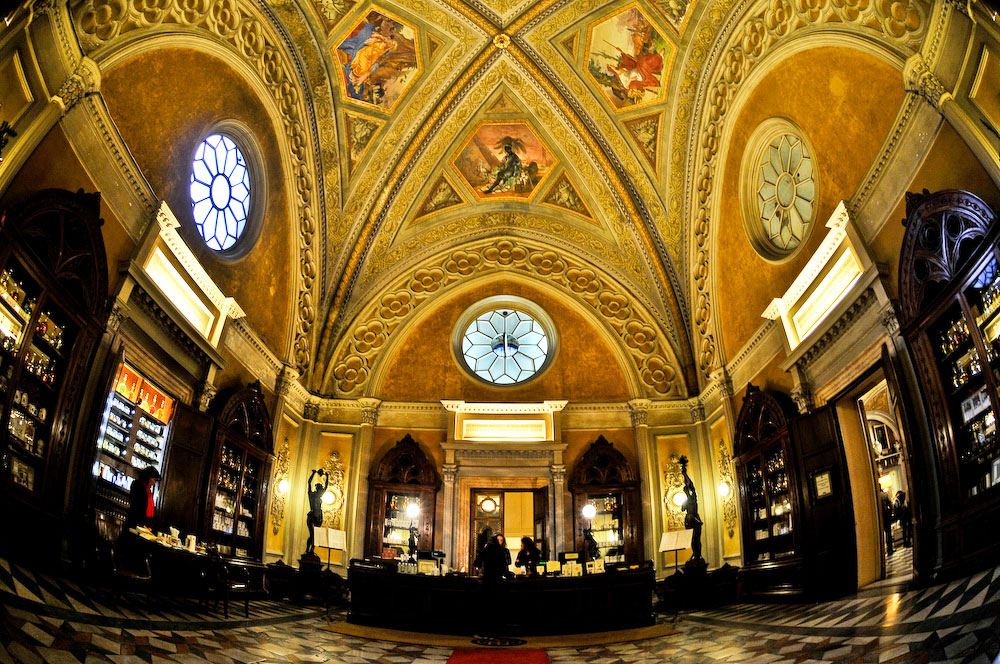
Santa Maria Novella. Pharmacy salesroom today. Source: MuseumsinFlorence.com

Santa Maria Novella. Pharmacy salesroom today. Source: MuseumsinFlorence.com

Frescoes on the wall of Santa Maria Novella Pharmacia. Source: Milay Mail newspaper at MMail.com.

Frescoes on the wall of Santa Maria Novella Pharmacia. Source: Milay Mail newspaper at MMail.com.

Santa Maria Novella is one of the oldest pharmacies in the world and, according to many accounts, the real, true source for the birth of cologne. A fully functioning pharmacy in Florence, it was founded in 1221 by Dominican friars. As the fame of their potions grew, the pharmacy was opened to the public in the 1400s and the Grand Duke of Tuscany conferred his patronage upon them, along with a gift of the Medici coat of arms.

In 1533, Santa Maria Novella’s fame exploded when they were commissioned to create a signature fragrance for the young, fourteen-year old Catherine de Medici upon her marriage to Henry II of France. As one magazine article explains:

Catherine de Medici, niece of Lorenzo the Magnificent (of Medici). Painting: Unknown artist in the Uffizi Gallery via Wikicommons.

Catherine de Medici, niece of Lorenzo the Magnificent (of Medici), in middle age. Artist: Unknown. Painting in the Uffizi Gallery, via Wikicommons.

Known as ‘Acqua della Regina’ or ‘Water of the Queen’, the resulting citrus-based cologne water of Calabrian bergamot could be interpreted as being the world’s first celebrity fragrance. It served to popularise the concept of perfume to the French royal court… The royal essence soon became a sweet smell of success wafting across the most fashionable courts – including England’s under Elizabeth I. The Officina’s original scent sensation helped lay the foundations for both the French and English perfume industry. In the West, the trend for scent was then maintained by other Italian perfume lovers, including Cosimo de’ Medici, Isabella and Alfonso d’Este, to Lucrezia Borgia.

The impact of “Water of the Queen” did not stop there. When a young perfumer, Giovanni Paolo Feminis, moved to Cologne, Germany in 1725, he took the scent with him and re-produced it to great acclaim. It was named Eau de Cologne in honour of the city, thus heralding the birth of the perfume concentration known today. The original Acqua della Regina scent is still made today by Santa Maria Novella and really deserves the true credit for creating “eau de cologne.”

The pharmacy is still in operation and still creating their perfumes based on formulae that are hundreds of years old, including their world-famous potpourri. The original workspaces and sales rooms are now part of a museum (which you can see in stunning photos here), and the perfumes are sold world-wide.

There is history in every fiber of Santa Maria Novella. An admiring article in the New York Times (written in 1986) talks about how little has changed at Santa Maria Novella since the 1400s:

In the pharmacy, one of several in Florence that dispense herbal potions, light filters through stained-glass windows onto the rows of essences: lime-colored heliotrope, myrtle like liquid sunshine and the nut-colored Marescialla. This last was named after the Marquise d’Aumont, wife of a French marshall, one of the last women ever to be burned at the stake as a witch. She used the essence to perfume her gloves.

Since the 1400’s, the Pharmacy of Santa Maria Novella has been making all kinds of perfumes, potions, powders and pomades, and nothing much seems to have changed in the intervening centuries except for the installation of a modern cash register; ”It’s hideous, isn’t it?” says Fiametta Stefani-Bernardini, one of the family of two sisters and a brother who run the pharmacy. ”But we have to have it, by law.”

Source: Italymag.co.uk

Source: Italymag.co.uk

The original monastery infirmary and pharmacy used to be in the rooms adjoining today’s shop, and you can ask to visit them, preferably when there are not too many customers in the pharmacy.

Santa Maria Novella bottlesHere in the Sala Verde, or Green Room, and in the blue-and-gilt pharmacy, the clock stopped 400 years ago and the glass retorts, pestles, scales and measures once used by the monks are still in their cabinets, as well as bottles designed by Leonardo da Vinci. The pharmacy opens onto what used to be the cloister, now the parade ground of the local carabinieri detachment.

Some of the products are as old as the pharmacy itself, such as the Aceto dei Sette Ladri, or Seven Thieves’ Vinegar, named for a band of seven looters who would strip the bodies of the dead during the plague and who protected themselves from infection by rubbing this so-called vinegar over themselves. Today the aceto is sold as smelling salts, for which there seems to be a thriving market.

Between the scent of a Maréchal’s aristocrat wife who was one of the last women burned at the stake (in Paris in 1617), and the Seven Thieves’ Vineger intended to protect against the Black Death, my jaw dropped. May I emphasize once more that all these products are still available and made in the exact same formulation?

Equally impressive to me is the fact that supposedly “none of its products are tested on animals.” In fact, not only are the products “never tested on animals” but Santa Maria Novella even has a large Cat and Dog Grooming line. Lastly, whether it’s soaps, candles, bath products, lotions, or cologne, each batch is still made by hand and primarily from natural products. As one article points out, the “vast majority of the medicinal herbs used in its products are grown locally on the hills around Florence” and the products consist mainly of natural oils or essence.

Ambra.

Ambra.

With all this history (I really should have gotten my PhD in the subject, instead of being shipped off to law school), I naturally had to try one of the fragrances. I opted for Ambra which was first made in 1828 and which is categorized as an Oriental. Fragrantica describes it as follows:

a slightly dry composition of amber and with birch wood accents. Top notes: bergamot, lemon, bitter orange [bigarade] and neroli. Heart: jasmine, lavender and rosemary. Base: amber, birch, sandalwood and benzoin.

Birch is really the key to Ambra, a most unexpected, unusual, and, frankly, perplexing fragrance which was absolutely nothing like what I expected. Usually, I can get at least a vague sense of a perfume by looking at its notes. Not here. Ambra is primarily a herbal, woody birch fragrance, and only tangentially anything ambery or oriental. And it’s largely due to the birch note which runs through the life of Ambra’s development. According to Fragrantica, the odor of birch

comes from the literally “cooked” wood, as in birch tar, a phenolic, tarry smelling ingredient mostly used in the production of leather scents, some chypres and some masculine fragrances.

Silver birch tree. My own photo. Fjällnäs, Sweden.

Silver birch tree. My own photo. Fjällnäs, Sweden.

On my skin, Ambra’s opening is birch, more birch, a little more birch, and then some neroli. Bitter orange with bitter birch. It’s a fascinating combination, and a little bit odd, because the tree note smells simultaneously woody, smoky, minty, and a little bit mentholated like eucalyptus. At times, it almost feels a little bit like shoe polish cream. At other times, there are fleeting hints of something like diesel gasoline.

Minutes later, the strong pungent combination of bitter orange bigarade with that unusual woody element is joined by bergamot, lemon and lavender. The latter is a very strong and herbaceous, feeling a little like a lavender absolute or oil. Now, I’m not a fan of lavender but, here, the birch injects it with smoke and a tarry element, transforming it to something quite different. In fact, the twist on neroli and lavender brought by that powerful birch tree accord is quite inventive. Christopher Sheldrake has mentholated, camphorous eucalyptus as his signature for Serge Lutens fragrances, infusing it in everything from tuberose to patchouli, but you have to remember that Ambra’s formula is almost 200-years old and far preceded Mr. Sheldrake!

The smoky, woody, tarry, mentholated lavender-bigarade (neroli) combination is… disconcerting to me. I’m honestly not completely sure what to make of it. Something about it fascinates me and keeps drawing me in, despite my general loathing of lavender. It’s that incredibly smoky, woody feel which transforms the pestilential purple plant, my nemesis, into something oddly mesmerizing.

Just when I think I’ve decided that the cologne is almost verging on the soothing, it suddenly morphs into something else. Ninety minutes into Ambra’s development, sandalwood shows up! It happened both times that I tested the perfume, almost on the dot. The sandalwood is light and subtle, but it’s there. More importantly, the pungent, smoky, mentholated birch drops in volume by a significant degree, as if someone has flipped a switch. The perfume is now primarily neroli orange, infused with lavender, on a base of light sandalwood, smoke, and mentholated birch. I never smelled any jasmine or rosemary. There is the start of a light musky, almost powdery, note, but it is extremely faint. Ambra remains that way for another 90 minutes, slowly becoming lighter and more faded, turning mostly into a quiet, sheer amber. It dies completely just after the start of the 5th hour.

As noted above, Ambra is an eau de cologne, but it was surprisingly rugged for such a minimal concentration. I ascribe it all to the birch and the very potent orange neroli. Yet, despite that, Ambra has low projection. It hovers only a few inches above the skin for the first hour, before becoming a skin scent around the second hour. It is always incredibly light and airy in feel, but it was much stronger than I had expected.

There are few reviews in the blogosphere for Ambra. One admirer is The Perfume Critic who described Ambra as “[a] surprisingly long-lasting amber eau de cologne with noticable birch notes.” He wrote:

Pros: I love the addition of the birch note which adds an almost leathery tone to the composition; beautiful packaging and bottle.

Cons: Make sure you also purchase the spray adapter for your bottle so that you don’t have to use it as a splash! This adapter does not come with the bottle. [… ¶]

Reminds me of: Andy Tauer’s Lonestar Memories; Kolnisch Juchten. [¶]

… Although SMN considers Ambra an eau de cologne, I felt that there might actually be a stronger concentration of perfume oils – perhaps it’s really an Eau de Parfum? Maybe it was because I sprayed myself 6 times, or maybe it was because of the heat in the room where I was sitting, but this morning I found myself wondering what that amazing smell was…only to realize that it was me!

Wearing Ambra, I felt as if I should be stepping down from a stallion, riding crop in hand, having just returned from the hunt. I’m on my way to the library where my fellow hunters are milling around smoking their sweet pipe tobacco while sipping Scotch in crystal goblets: Ambra definitely has a vintage, old world feel about it. What most sets it apart from other amber aromas is the lack of the sweet vanilla note so often added to amber scents. Additionally, the birch tar note lends the feeling that both leather and smoke notes are part of the composition. […]

You know, I can completely see his scenario of the horseman returning from the hunt, before retreating to a smoky room to sip scotch. Ambra really does have an outdoorsy character, along with an old world feel. Now, it didn’t last quite so long on my perfume-consuming skin as it did on his, but then I didn’t use anywhere close to 6 sprays! I suspect that Ambra might easily have lasted longer had I used a greater quantity.

I think those who love neroli, lavender, and woodsy notes should try Ambra. Don’t expect a true amber fragrance, because you’ll be disappointed; the birch and aromatics are too dominant in the perfume’s development. On the other hand, if you’re looking for an unusual neroli or lavender — something that is quite soothing and relaxing at times, but with a twist — and a very airy, lightweight perfume that is ideal for hot temperatures, you may be very pleased. Ultimately, Ambra wasn’t for me because I struggle too much with lavender (which makes Santa Maria Novella’s Imperial Lavender completely out of the question), but I definitely would like to try their Patchouli, Opoponax (frankincense), and Orange Blossom colognes.

Even if Ambra doesn’t sound like your kind of thing, I would urge you to at least check out Santa Maria Novella’s enormous range of cruelty-free products, from personal care items to bath and body products, candles, children’s shampoos, room accessories, potpourri, and, even, olive oil! Because, seriously, how cool is it to have products once made by Dominican friars almost 800 years ago and associated with everything from Catherine de Medici to marauding thieves who fought off the Black Plague?!


DETAILS
Cost & Availability: Ambra is an Eau de Cologne that comes in a 100 ml/ 3.3 oz splash bottle and which costs $125. In the U.S., it is available directly from Santa Maria Novella’s US website which offers free shipping for orders over $150. Remember, you may need to buy an atomizer spray to go with the bottle. Santa Maria Novella also has numerous other sections worth checking out. All items are cruelty-free and have not been tested on animals. The Pet Section includes everything from Lemongrass Anti-Mosquito repellant in lotion form to No Rinse Cleansing Foams, and more. Santa Maria Novella also has stores in 5 U.S. cities from L.A., to New York, Chevy Chase, Dallas and Bal Harbour, Fl, and you can find those addresses on the website. Also, Lafco, on Hudson St. in NYC, supposedly carries the entire line. I checked the LAFCO website, and I don’t see any Santa Maria Novella’s products on it, but I think they may carry them in-store. In terms of other retailers: Aedes seems to carry a good selection of some Santa Maria Novella products, from candles to soaps, along with Ambra for $125.  Luckyscent carries a very small selection of the company’s colognes, soaps, bath gels and shaving creams, but Ambra EDC is not part of them.
Outside, the U.S., you can turn to the Italian Santa Maria Novella website but I’m having a little trouble navigating it and somehow the photo of the perfume doesn’t look like the one I’m used to. There is also no pricing that I can find. The Farmacia  has a number of European off-shoots: stores in London and in Paris. I can’t find an address for the Paris store, but the official distributor for the company’s products is Amin Kader Paris which has two stores in the city. Again, I can’t find Euro pricing information for the fragrance. On a side note, on a Fodor’s site, I read that Santa Maria Novella has shops in the following cities: Roma, Venice, Lucca, Forte dei Marmi, Bologna, Castiglione della Pescaia, London, Paris, and Livorno.
As for samples, I obtained mine from Surrender to Chance which carries Ambra starting at $3.99 for a 1 ml vial.