Perfume Review: Tauer Perfumes L’Air du Desert Marocain

Desert Night SkyThe desert is vast and still. Silence reigns under the thousand stars. Dawn is around the corner, and the Bedouins have just started to awake. Soon, they will feed the camels and put out their wares for trading. Soon, the sun will shine intensely upon the sandy dunes and the dry desert wind will pick up traces of the spices, mixing it with the dust and the scent of Morocco, filling the air with the riches of the ancient spice route and the mysteries of the desert.

That is the promise of L’Air du Desert Morocain Eau de Toilette Intense, a unisex fragrance by Tauer Perfumes. And it is a promise that it delivers upon, lock, stock and ten roaring barrels. It is an incredibly impressive perfume, created by a Swiss scientist who has absolutely zero formal training in perfume making, and it explains why both L’Air du Desert Marocain and the Tauer line of perfumes itself have become such a massive hit.

Tauer Perfumes was founded by Andy Tauer, a molecular biologist with a PhD who left the world of science in 2005 to become a perfumer. L’Air du Desert Marocain was his second creation, made to be a lighter version of his hit, Le Maroc pour Elle. And it has become not only adored, but, also, critically acclaimed. L’Air du Desert Marocain received a 5-star rating as a masterpiece from Luca Turin’s co-critic, Tania Sanchez, in Perfumes: The A-Z Guide.

Moroccan archwayIt is the smell of Morocco and is immensely evocative, but, for all that I think this is one absolutely marvelous scent and for all that I couldn’t stop sniffing my wrists in the beginning, I don’t think this is a scent for me. It is too dry, and one of those rare perfumes that I think actually leans a little too masculine (despite being unisex) and it is also something that would be hard to wear every day. But, on the right man, though, I think that it would be rhapsody and heaven — the sort of scent that would make another woman or man want to sniff him for days on end and to dream of his scent. On a man, this is a fragrance that could make his spouse or significant other find it impossible to keep his or her hands to themselves.

L'Air du Desert Marocain via Luckyscent.

L’Air du Desert Marocain via Luckyscent.

Fragrantica classifies L’Air du Desert Marocain as an “Oriental Spicy.” The Tauer website provides the following notes:

Head: Coriander and cumin, carefully blended with petitgrain.

Heart: A warm heart note with rock rose and a hint of jasmine.

Body:Dry cedar woods and vetiver, brilliantly joined on a fine ambergris background.

However, I have seen a fuller listing of notes elsewhere. For example, Bois de Jasmin gives what seems a much more comprehensive account, and that is what I’m going to work with:

coriander, petitgrain, bitter orange, lemon, bergamot, jasmine, labdanum, geranium, cedarwood, vetiver, vanilla, patchouli and ambergris.

L’Air du Desert Marocain opens with such forcefulness that my head spins. It is a good forcefulness, and I absolutely love it, but I recall Fragrantica‘s statement that this was made as a “lighter” version of Le Maroc Pour Elle and blink. Quite frankly, it is almost a little overwhelming in its spiciness, and I rarely say that. Yet, it explodes with such a marvelous opening that I find myself testing it out three different times on different places. And each opening was different.

Spice Market MoroccoThe very first time, I got a very strong scent of orange petitgrain with spices. You can read more about petitgrain and all the various notes in the Glossary, but, in a nutshell, petitgrain is the distillation of the bitter twigs of a citrus tree, usually orange blossom. It is a woody, bitter, but highly aromatic scent. Here, the strongly woody, faintly bitter notes recall a wooded version of orange blossom. To my nose, there are also lovely saffron notes, mixed with spices. They are not easily identifiable, individually, but create an overall impression of a Middle Eastern spice market. The notes are sweet, but dry and far from cloying. There is, in fact, almost a smell of dust or dusty sand which suddenly explains one commentator on Fragrantica who disdainfully asked: “tell me, is one willing to smell like the baked, parched sediment that is sand?”

Tribal nomad smoking a hookah in the desert.

Tribal nomad smoking a hookah in the desert.

I happen to think that dry note is essential to cut through the extremely heady, powerful spice notes that are apparent from the very start. There are notes of woody, sweet incense and amber from the labdanum (also known as rockrose or cistus, and similar to ambergris). The incense in L’Air du Desert Marocain is some of the sweetest incense I’ve smelled in a while, perhaps because it is laden with the patchouli which is very rich, black, dirty, 70s kind of patchouli. The whole thing is very strong, and it never goes away, though it does fade to an underlying sweetness after about five hours. (Yes, this thing is a sillage and longevity monster!)

Source: 1stdibs.com

Source: 1stdibs.com

With the dust and wood undertones, I keep remembering an artsy, funky antique shop here which sells hundred-year old wooden Chinese apothecary cabinets; they smell faintly dusty, woody, and carry the lingering traces of old spices. I go to my own spice cabinet and drawers, hoping to pinpoint exactly what spices I’m smelling here. I find nothing. My coriander does not smell exactly like the coriander in L’Air du Desert Marocain, and neither does my cumin. But those are mere powders and, from interviews that I’ve read with Andy Tauer, he seems to use the most expensive oils and distillations. It certainly smells like it. You can smell the incredible quality of the perfume.

My second try with L’Air du Desert Marocain yielded a totally different, but equally fascinating, opening burst. This time, I smell lemoned coriander and tea. Amazing Earl Grey tea with notes of bergamot, an ingredient which falls between orange and lemon in scent. There is Earl Grey but there is also something else, something smokier, darker and almost tarred. It evokes Lapsang Souchang, a black tea which Wikipedia says “is distinct from all other types of tea because lapsang leaves are traditionally smoke-dried over pinewood fires, taking on a distinctive smoky flavour.” The black, bitter, smoky tea is tinged with pine notes but also the lightness of the bergamot and the piney aspect of cedar. I feel triumphant at finally pinning down one of the more elusive notes in the perfume, but I’m astounded at how different this opening is from my first go-round.

My third try yielded a mix of my prior two attempts. This time, the opening was of cedar, lemon, vetiver and pine needles with a strong element of dust. Actual dust! The wood and dust notes are complimented by the earthy sweetness and amber notes of the vetiver, but cedar is the predominant star here.

This undulating wave of shifting notes is, in my opinion, a characteristic of a “prismatic” scent. The Perfume Shrine has a very thorough explanation of scents which may appear linear but which, in reality, have prisms and shifting weights amongst several key components.

A variation on the linear scent is the “prism”/prismatic fragrance, whereupon you smell a humongous consistent effect all right, but when you squint this or that way, throughout the long duration, you seem to pick up some random note coming to the fore or regressing, then repeating again and again; a sort of “lather, rinse, repeat” to infinity. A good example of this sort of meticulously engineered effect is Chanel’s Allure Eau de Toilette (and not the thicker and less nuanced Eau de Parfum) where the evolution of fragrance notes defies any classical pyramidal structure scheme. There are six facets shimmering and overlapping with no one note predominating.

Here, with L’Air du Desert Marocain, sometimes the opening gave me notes like the petitgrain, orange and labdanum, sometimes bergamot, coriander and cedar, and sometimes a combination of all three, including the base or bottom notes (the heavier molecular compounds which last longer on the skin).

Regardless of which version I start out with, two hours in, the heart of L’Air du Desert Marocain starts to unfurl. It is labdanum, patchouli, and sweet incense with cedar and faint touches of cumin that, at this point, in no way smells like body odor or sweat. The overall impression is of spiced amber and perfumed wood. The sillage is slightly less overwhelming at this point, but there is still significant projection.

Three hours later, the cumin starts to turn and shift a little. There is a faint, tiny element of sweat that creeps in. If you’ve read any of my reviews for perfumes with cumin, you will know that I’m highly sensitive to the scent of cumin and its inevitable turn to a sweat note. It happens on me each and every time, whether it’s Serge Lutens’ Serge Noire or Amouage’s Jubiliation 25. And, each time, I struggle with it. Here, it is fainter than it was in Serge Noire but, still, 6.5 hours, I have to give a faintly worried sniff under my arms. It’s my own issue and my own neurosis because, again, my nose is extremely sensitive to cumin (it’s why I can rarely cook with it). Here, it’s very subtle, but the faint trace of body odor is definitely apparent at this point.

The cumin note doesn’t impede my enjoyment of the perfume’s dry-down which is rich and almost narcotically boozy in its smoky amber and patchouli. It’s not a cozy, “let’s snuggle under the blanket” sort of amber. This is far too incense-heavy for that. It’s more masculine and rugged — and much sexier. On a man, I can imagine his partner or spouse thinking, “let me nuzzle you, sniff you and run my hands over you.”

fehr4I can’t think of the person whom I think embodies the L’Air du Desert Marocain man. This is not for Brad Pitt or Tom Cruise, nor for the Marlboro Man or John Wayne. The character which consistently comes to mind is the Bedouin chief, Ardeth Bay, played by Oded Fehr in The Mummy (1999). Or Omar Sharif’s character in Lawrence of Arabia.

Women can certainly wear L’Air du Desert Marocain and, again, it is officially a unisex scent “for women and men,” but I don’t think it’s the most versatile scent or the sort of thing that one could wear daily. In fact, some men on a Basenotes thread I read found that it was perhaps a little too much for them, too. That said, I think it’s a fantastic scent and well worth a sample for those who like their scents spicy and heady. It will take you to the deserts of Morocco and, if you’re lucky, make you feel like a Bedouin king.

DETAILS:

Sillage & Longevity: This thing lasts and lasts! My skin consumes perfume voraciously and, yet, L’Air du Desert Marocain had serious projection or sillage for the first 2.5 hours, then slightly less for the next hour, and only becoming close to the skin a little under 5 hours in. Nonetheless, it was still easily detectable at that point any time I brought my nose to my wrist. In terms of longevity, it lasted just under 10 hours on me, which is pretty remarkable. On others, the fragrance is reported to last eons with only a few sprays, so I wouldn’t be surprised if it lasted a good 16 hours on someone, if not far more if you used a lot.

Cost & Availability in General: In the US, you can buy a 1.7 oz/50 ml bottle for $125 from Luckyscent and The Perfume Shoppe, as well as directly from Tauer Perfumes from February 2013 onwards. (See further details below in the Tauer section.) If you want to order now from Lucky Scent, please be aware that they are backlogged until the end of January 2013 on all orders for the perfume. They also sell a sample vial for $4. Samples are available from Surrender to Chance as well, starting at $5.99. In Europe, First in Fragrance sells the perfume for €95.00 for a 1.7 oz/50 ml, or for €190.00 for a 3.4/100 ml bottle from. It too carries samples. In the UK, Les Senteurs carries the Tauer line but the online website only seems to carry samples, not the full bottles. It may be different in the actual stores, but you will have to check. I don’t know about the shipping rates for any of those sites. The Tauer website’s store locator also provides locations in over 10 countries — ranging from France and the Netherlands to Russia, Singapore, the UK, Poland, Romania, Spain and more — where its products are available. You can find that list of stores here.

Cost & Availability from the Tauer Website: The Tauer Perfumes website lists the cost of the 50 ml/1.7 oz bottle as as: Fr. 96.00 / USD 103.70 / EUR 79.70. Tauer Perfumes also sells a sample 1.5 ml/ 0.05 oz glass vial of L’Air du Desert Marocain for: Fr. 6.00 / USD 6.50 / EUR 5.00. Though they used to ship to most places in the world, you need to know that they can’t ship to a number of places in Europe right now and that they will only be able to ship to the U.S. from February 2013 onwards. For various reasons due to a sudden problem with their shipping supplier, as of this post in January 2013, they say that they can only ship to customers in Switzerland, France, Germany and Austria. They also state they they hope to remedy this situation soon.

As a side note, the Tauer website also sells a sample Discovery Set of 5 different Tauer perfumes (for free shipping to most places in the world) which you can choose at will for: Fr. 31.00 / USD 33.50 / EUR 25.70. The website provides the following information:

Free selection: It is your choice to pick a set of 5 DISCOVERY SIZE perfume samples in glass spray vials. 1.5 ml each (0.75 ml of 0.75 ml of UNE ROSE CHYPRÉE or UNE ROSE VERMEILLE or CARILLON POUR UN ANGE) are at your disposal. Pick any scents from the Tauer perfumes range. The amounts of 1.5 (0.75 ml) are minimal amounts. Usually , we will ship around 2 ml (1ml). The DISCOVERY size vials are spray vials and will allow you to enjoy our fragrances for several days.

Packaging: The DISCOVERY SET comes in a glide-cover metal box for optimal protection.

Shipment: This product ships for free within 24 hours after we received your order world wide. Exceptions: Italy, United Kingdom, Russia, Belgium, Czech Republic.

Review En Bref: L’Artisan Parfumeur Nuit de Tubereuse

As always with my mini-reviews, this post will be a brief summary of my impressions of a perfume that, for whatever reason, didn’t merit one of my full, extensively detailed reviews.

With Sephora now carrying seven L’Artisan Parfumeur fragrances, I thought it might Artisan NdTbe time to review one of those: Nuit de Tubereuse. As some of you know, I love tuberose, but I’m significantly underwhelmed by this 2010 creation from the legendary nose, Bertrand Duchaufour. Actually, to be completely frank, I’m not a fan.

Nuit de Tubereuse is an eau de parfum, and Fragrantica states that its notes are as follows:

cardamom, clove, pink pepper, black pepper, citrus, green mango, angelica, tuberose, orange blossom, ylang-ylang, rose, broom, musks, vanilla, sandalwood, palisander, benzoin, styrax.

Nuit de Tubereuse opens green. It’s green tuberose and it’s unpleasantly medicinal. This is not the mentholated, camphor and eucalyptus green of Serge Lutens Tubereuse Criminelle, but something much more unpleasant, like sulphur. I also have a distinct impression of aspirin, along with an astringent note that strongly calls to mind rubbing alcohol, cheap vodka or cleaning products. Some comments on Fragrantica describe a very similar experience.

For fairness sake, however, I should add that a number of people on Fragrantica seem to like this perfume, in part because it is nothing like traditional tuberose scents like Fracas. There is none of that warm, buttery smell that one finds in the more traditional tuberose scents like Fracas. They find it much lighter and more manageable, though some think that it can be quite masculine. I don’t think it is masculine, but I do find it surprisingly strong for a L’Artisan perfume which — in my experiences thus far — have been rather light, sheer, gauzy and without great projection.

As moments pass, the astringent green tuberose and aspirin is joined by a lot of pink peppercorns, some clove, soapy musk, and a faintly sour, green edge that most reviewers attribute to the mango. If so, it’s definitely green mango. The whole combination sounds a lot more unpleasant than it actually is — but it’s still not a particular joy. The tuberose is cold. Stone cold. About 30 minutes, I smell something that calls to mind fruity bubble gum. In slight disbelief, I look up some other reviews and, yes, reviewers like Now Smell This and a few others commentators have noted “Juicy Fruit.” I sigh, and start to wonder if I actually like Bertrand Duchafour fragrances.

After an hour, Nuit de Tubereuse turns into a jasmine and ylang-ylang fragrance on me. Mostly, it is just plain jasmine, even though that is not actually listed as a note. Yes, there is a faintly earthy edge to the jasmine, but it is nothing like the earthiness mentioned in a number of comments, both on Fragrantica and Basenotes. I had expected quite a bit of it due to the inclusion of angelica. I have a bag of angelica powder for cooking, and its earthy pungency always makes me reel and re-evaluate making that recipe. (Angelica is in Serge Lutens Ambre Sultan and it is, I am convinced, why some find that scent so unpalatable.) In any event, I expected a lot more earthiness in Nuit de Tubereuse due to the angelica and the various online comments. But, no. It’s just plain jasmine with ylang-ylang. It’s nice, but I’m utterly bored to tears. So much so that I’m relieved its sillage is moderate to low (about 30-40 minutes at strength, then close to the skin), and that the longevity is about 4 hours on me, though most report far greater length. I can’t wait to get this off and try something that is actually faintly exciting or enjoyable.

A lot of reviewers have stated that this is not really a tuberose scent as much as it is a floral and spiced fruit scent that just happens to have tuberose in it. I agree. And some perfume bloggers, like The Candy Perfume Boy, have done “a big 180” on this scent and have ended up really liking it. That will never be me, I fear. I’m far too turned off and bored to want to give this umpteen chances until it finally sways or bullies me into submission. In fact, I’m starting to think that I simply do not like green tuberose, or modern twists on tuberose. (Perhaps I was too imprinted in my childhood with Fracas, and can’t move on?)

I can’t decide if I would recommend Nuit de Tubereuse as a starter tuberose to those terrified of the more traditional indolic, buttery, overpowering tuberose scents on the market. Some commentators on Fragrantica think it would be a great way to tiptoe into this floral sub-category. But, after some thought, I don’t think it would be a good idea. That opening is simply too unpleasant; and the rest of the time, Nuit de Tubereuse is merely a linear fragrance that is quite boring. If I had experienced some of the earthly, woody base notes, perhaps I would feel differently.

That said, body chemistry is a funny thing and enough people have liked Nuit de Tubereuse or noted the earthy, woody dry-down for me to suggest that you may want to give this a potential sniff if you happen to pass by a bottle at Sephora. After all, it’s not completely hideous or revolting. But I would certainly never recommend that you blindly spend $120 on a 1.7 oz/50 ml or $165 on a 3.4 oz/100 ml on an impulse purchase just because you think you like tuberose. Please, don’t do it.


Perfume Review – Ormonde Jayne Tolu: A Perfect, Lovely Paradox

Paradox: (noun) A seemingly absurb or self-contradictory statement that, when investigated, may well prove to be true. Tolu, from the luxe niche London house of OJ ToluOrmonde Jayne, is a paradox in the most mesmerizing way possible. It is an airy, breezy, narcotically heady, heavy, dewy green, freshly orange floral… no, I mean, lushly spicy amberous oriental, no, I mean, a woody, balsam and pine smoky floriental…  It is a contradiction that delights, that keeps your nose plastered to your arm, that awes you with its heady, airy opulence, and that recalls the happiest moments of carefree youth while making you feel every inch a sophisticated adult. It is intoxicating. And I cannot recommend it enough.

Linda Pilkington, founder of Ormande Jayne.

Linda Pilkington, founder of Ormonde Jayne.

Ormonde Jayne is a high-end, niche London perfume house founded by Linda Pilkington in 2002. She sounds like a fascinating woman. According to her biography on the website, her passion for perfumery began early, as a teenager, and this “led Linda to her first career, growing and selling flowers by the roadside outside her Cheshire family home. She also learnt to make scented candles and bathing oils from craft sets and courses, and created beautiful scented cushions for birthday and Christmas presents.” After years spent travelling and exploring the world, working in places from South America, Africa and the Far East, soy bean farms to ice cream parlours, she returned to London where she began making her own perfumes. She showed her creations at a London trade show where she won repeatedly. And then she was asked to make “the perfect, scented candle” for Chanel itself. After that, in 2002, she opened her own boutique and her perfumes have received praise ever since, including a number of 5- and 4-star reviews from Luca Turin.

Ormonde Jayne’s philosophy is simple:

one of quality and true luxury, the pursuit of beauty and elegance. Our perfume library reposes on an exquisitely simple principle – extraordinarily beautiful scents using speciality oils not widely used in the perfume industry today.

Her goal is to return

to the golden age of perfumery, an elegant era when fragrance creation was a fine art, when essential oils and absolutes were allowed to infuse for a period of months before filtration and then allowed to mature again before bottling, resulting in a deeper, more complex perfume.

Honestly, I cannot recall the last time I was so impressed with a niche house upon my very first sniff, and I plan to investigate her whole line, sample by sample. My first exposure to Frederic Malle, Serge Lutens, Amouage, L’Artisan, Tom Ford, By Kilian, Caron, Montale, and a whole host of other lines never resulted in anything like this. My reactions to those houses varied from indifference to ambivalence, from liking to loving (but not feeling utterly compelled to buy), to truly not understanding what all the fuss was about. Ormonde Jayne is different. It’s not simply that Tolu was bewitching, but that the perfume smells unbelievably luxurious and rich in that genuinely old-school, classique manner of the haute French perfume houses of yesteryear. THIS is what perfumes used to be, almost across the board, and what they are so rarely today.

This is class. It is class, purity, and luxury made simple but, yet, also made fresh and modern at the same time. It’s like smelling the vintage version of some great classic, but made even better. No wonder Luca Turin seems to think that Ormonde Jayne is beating Caron and Guerlain at their own game. I hadn’t believed him when I read that statement a while back and, in truth, I don’t always agree with Mr. Turin, but dammit, he’s absolutely correct in this instance. “Tolu is the kind of fragrance Guerlain or Caron would be turning out regularly if all was right in the world[.]”

If I ever met Ms. Pilkington, I would hug her for returning some of my wide-eyed innocence and belief, after feeling far too long jaded, cynical and oh so depressed at the current state of perfumes in this IFRA-infected world. I would also hug her for her blunt statement in a 2010 interview with the Perfume Shrine that she will never reformulate her perfumes, allergies be damned! “No, we haven’t reformulated anything. I never will. Nor discontinue any in our fragrance rotation. We have 12 fragrances now and I absolutely love each and every one of them. I don’t want to make any changes!” When asked what she would say to a customer asking about allergic reactions, her response was:

I say “If you think madame that it might be give you any risk of an allergic reaction, it would be best if you didn’t buy this perfume”. We talk over some of the ingredients (if the customer knows about any specific trigger or if we think there might be some) and I say “just don’t buy it”. In the end, I don’t give a f*ck if they buy or not, as long as we’re stand our ground and do not mislead. *laughing*

Fascinating as Ms. Pilkington is, nothing is more so than Tolu. I’m hard-pressed not to summarize my entire review in one word: heaven! But, in an attempt to make you understand why I am so thrilled (and why I had to keep stopping writing to sniff my arms), let me tell you more about the scent itself. According to Fragrantica (where it has nary a single bad review), Tolu is classified as a Woody Oriental. (I think there should be a new category entitled “Perfect Paradox.”) It is technically a woman’s eau de parfum, though I think a man could pull this off, especially during the dry-down.

Ormonde Jayne’s website states:

Perfume treasure, this opulent velvety formulation with pure Tolu resin [a Peruvian tree resin] takes you on a sensual Oriental journey. Laced with golden frankincense and amber, the scent’s core is enveloped with a heady mix of orange blossom and clary sage, while intense citrus notes consolidate the harmony.

Top Notes: Juniper berry, orange blossom and clary sage
Heart Notes: Orchid, Moroccan rose and muguet [lily-of-the-valley]
Base Notes: Tolu, tonka bean, golden frankincense and amber.

You know those word association games? I put on Tolu and the very first word that shoots across my brain is “Enchanting!” In fact, that is the first thing I jotted down. There is warm, billowing blanket of orange blossom which immediately rolls onto thenerolifruitandflowersb skin. It’s not screechy, sharp and overpoweringly cloying like Tom Ford‘s Neroli Portofino, nor is it overly sweet like many synthetic orange scents. It’s also not light and imperceptible like the orange in a few niche perfumes. It’s heady in a soft way, and is one of the brightest, freshest orange blossom scents I’ve smelled in a long time. The sillage is also powerful, which makes me ecstatic as, far too often for my liking, orange blossom is merely a faint hint amongst many supporting notes. Not here. It is the star, stage center, with the brightest lights shining on it.

mimosa-flower-200x300

Mimosa in the South of France.

I must confess at the outset that I have a monumental weakness for orange blossom that supercedes many other ingredients or notes that I love. And the orange blossom here reminds me strongly of the oils or essences used in my favorite body cream, Couvent de Minimes Orange Blossom. Here, as there, there is a purity to the scent that makes it clear that real oils were used in the product. It calls to mind my childhood in Cannes with visits to Provence; I am immediately transported back to my old home at the end of Spring. Summer is around the corner, and there is a vast sea of orange trees in bloom along side golden mimosas bushes swaying in the wind under blue skies that are neither hazy with heat nor pale eggshell blue from the winter. The orange is intoxicating, narcotic and, yet, so airy at the same time that it feels like fizzy champagne in an odd way. It’s been only 15 minutes and, yet, I ponder currency exchanges in my head and whether my bank account can afford an immediate purchase, while the sane part of my brain pleads to wait out the full development of the perfume before acting rashly.

ijunipe001p4

Juniper berries.

Thirty minutes in, a faintly smoky warmth starts to creep in. Amber that is rich, almost nutty, and with a faint hint of smoke from incense. Oddly, the scent on one arm is very different from that on the other where I smell no amber at all but, rather, crisp pine needles and balsam. It must come from the juniper berries listed in the top notes, and it is fresh, bright and rich — as if plucked just moments before from living trees growing on the high reaches of the snowy Alps. Clearly, some extremely expensive oils must have been used because at no time does it smell sharp, synthetic, or like the common air-freshener sort of pine in some perfumes. On both arms, the orange blossoms seem to have receded momentarily, as if to make way for the fresh, woody pines and amber, but it is just for a moment. The orange blossom is not only the quietly solid foundation upon which other notes rest, but a permanent part of this opening stage.

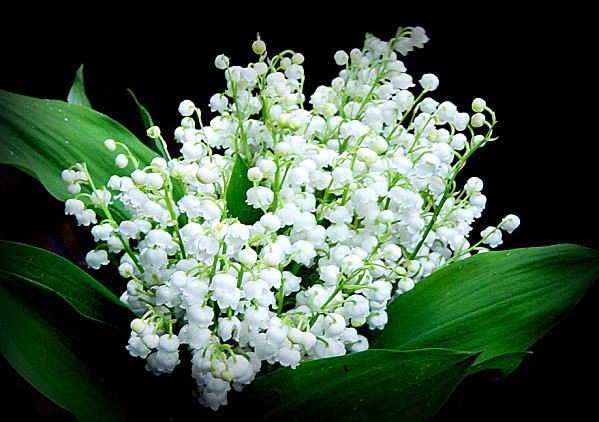
Soon, the juniper recedes and the flowers return. As always, there is the rich top head of orange blossom but there are other accompanying notes, too, even if they are but supporting players on the stage. There is also orchid and lily-of-the-valley. Orchid is a hard scent to describe, or even to classify, as it can smell of a variety of different things, depending on type. To me, white orchids can sometimes evoke the light purple impression of lilac and hyacinth, but in an oddly earthy way. That is the way the orchid seems to smell here. Lily-of-the-valley (or muguet) smells somewhat similar to my nose, bouquet-de-muguetwithout the earthy richness. The Perfume Shrine describes lily-of-the-valley as follows:

Lily of the valley is technically a green floral with rosy-lemony nuance [which] … has been adequately used in classical fragrances as a catalyst to “open up” and freshen the bouquet of the other floral essences in the heart, much like we allow fresh air to come in contact with an uncorked red wine to let it “breathe” and bring out its best.

To me, however, lily-of-the-valley is a light, fresh floral note that smells almost like a green, lilac-hyacinth hybrid. Here, it counters the headiness of the orange blossom with freshness that is dewy and ethereally light. It is almost sheer, and yet, it has depth and richness. The note makes Tolu, in these very early stages, call to mind the delicacy of Dior‘s Diorissimo, a very lily-of-the-valley scent.

Thus far, Tolu has leaned far more towards a floral scent than an oriental, let alone a spicy woody one. There are amber notes which flicker back and forth, but, for the first two hours, I have the reverse experience of what some people report. I don’t get spice right off the bat at all. There is the Diorissimo resemblance from the lily-of-the-valley, along with some rose and the hyacinth-like notes of orchid. And all of this is within the warm haze of orange blossom. The latter is something which projects outwards, while the other scents are closer to the skin, almost as if they were inside a big, airy, orange coccoon.

I can now smell the clary sage, but never think that it is the same sort of sage that you use in cooking. According to a helpful discussion on Basenotes, clary sage is nothing like regular (Dalmatian) sage that you have in your herb rack. It is sweeter, fresher and with a hint of peppermint, while Dalmatian sage is more bitter, biting and aromatic. Clary sage is also said to have elements of lavender in its odor profile and, sometimes, even of green tea. Here, it adds to the impression of freshness and lightness in Tolu, while also adding a faintly minty, sweet note that cuts through some of the richness of the orange blossom. It’s almost as if a faintly minty lavender note has joined those orange blossoms and dewy, green flowers, but it’s so light that I wonder if I imagine it at times.

That lightness, along with much of the airiness in Tolu, brings me to one of the perfume’s several lovely contradictions. It is airy and light, while narcotically heady and heavy. I realise that I’m not making much sense. It is the ultimate example of a paradox and really requires that you test out this scent yourself to understand it. The best way I can explain it is that there are two polar opposite groups of scents here. The first is the dewy, fresh, green, spring-like notes: lily-of-the-valley; white orchid; lavender-y and minty clary sage; and then, lilac and hyacinth (though they are not listed as ingredients, their smell is there to me). It flashes colours of white, lavender, soft lilac and bright green, all in a soft, airy light of the dawn’s first dew. The second competing group is the scent of just one thing: orange blossoms. Narcotically heavy, almost inducing an obsessive inability to resist sniffing my arm, triggering an utter delirium of joy amidst the flashing colours of bright orange at the heart of noon. It is a paradox, yes, but it is also a sign of a masterful hand. I contemplate why I only smelled Tolu after Christmas, and not before when it would have been at the very top of my wish list.

An hour in, rich vanilla starts to appear. It’s creamy, not powdery, and smells faintly like a rich, banana custard. It almost makes me think of ylang-ylang but there is no such ingredient in Tolu. Some people on Fragrantica have referenced an oriental milky rice note, but I think the accord is far richer and heavier than the light sort of milky rice note I associate with scents like Kenzo‘s Amour line. I think the issue here is the combination of tonka bean and tolu balsam. Tonka bean smells of vanilla, while tolu balsam is a tree resin. Unlike benzoin, another resin, tolu balsam has a nutty, sometimes almond-like accord to accompany its vanilla and cinnamon heart. (You can read more about tolu balsam and other resins in the Glossary.) It has a greater richness and depth than the often powdery benzoin accord.

Soon, tolu balsam’s soft, lush, warm vanilla notes are joined by spice and smoke. I smell rich frankincense, but it is not peppery or dirty. The vanilla from the tonka bean and its accompanying powder notes soften the blunt edges of the frankincense, turning the latter into a light swirl of black smoke, rather than a heavy darkness. The rich resins and the myrrh create an impression of caramel and amber, but touched with a woody pine accord.

Three hours in, and all the way to the end of its dry-down at hour seven, Tolu is all incense, vanilla, honeyed amber and caramel, with a hint of pine. The subtle smoke and incense are gorgeous, as is the surprising earthiness that contradicts the velvety softness underlying the sweet scent. That said, for me, the dry-down never really progresses much beyond the panoply of resinous notes. It’s lovely, rich and soft, but I preferred those hypnotic opening and middle notes. (It’s hardly surprising given my passion for orange blossom.)

All in all, this is an utterly luxurious, captivating scent. It doesn’t perform twists of complexity, doesn’t have suddenly crazy notes popping in at a random stage, doesn’t try to shock you with something edgily disturbing, and doesn’t do anything other than the promise Ormonde Jayne made at the outset: “one of quality and true luxury, the pursuit of beauty and elegance.” It is a perfume that I have to have. It is a scent that will make me join the legion of admirers on Fragrantica who repeat “gorgeous,” “sophisticated,” and “classy” like a broken record. It smells of wealth and luxury; the sunny South of France interposed with the pine-covered snowy Alps of Gstaad, and the smoke of the Orient. It is a paradox wrapped in opulence, but it enchants you from the very first whiff. And it is utterly perfect.

DETAILS:
Sillage & Longevity: Enormous sillage for the first three hours, then closer to the skin. However, on others, the projection is reported to last even longer. As for longevity, it was quite good, though as always you have to keep in mind that my body consumes perfume. On me, I could smell traces of it on my arm seven hours after putting it on. It was soft, but it was there. On others, the longevity is reported to be enormous.
Cost & Availability: The fragrance is available in perfume extract (30%) and eau de parfum (25%) in 50 ml flacon. Tolu is available at the Ormonde Jayne store in London, at Harrods in London, Fortum & Mason, or on Ormonde Jayne’s website. It is not sold in any department stores in the U.S. The website offers purchases in USD currency and, until January 14th, 2013, all shipping is complimentary with a hand-poured candle is offered as a free gift. The website’s page for purchases in US dollar lists the costs of Tolu as follows: a 1.7 oz/50 ml bottle of eau de parfum costs $126, while the pure parfum comes in a 1.7 oz/50 ml “premium French flacon with a gold OJ motif stopper and Japanese ribbons” and costs $300. There is a set of travel sized purse sprays (4 x 10ml) that costs $100 and a Discovery set of all 12 fragrances in 2 ml mini-sprays for $75. The latter is described as follows: “Ormonde Jayne’s Discovery Set is comprised of 12 x 2ml mini sprays of eau de parfum, together with a brochure explaining each perfume, all housed in a black and gold box… and whats more, the shipping is complimentary worldwide.” Tolu is also available in different bath, lotion, cream and candle forms. Harrods sells a 50 ml/1.7 oz bottle of Tolu for £80.00. Ormonde Jayne fragrances are also sold in Brussels, Belgium at Senteurs d’Ailleurs and at Osswald in Zurich, Switzerland.
Samples: You can also order samples of Tolu from various sample sites. The one I use, Surrender to Chance, sells samples starting at $3.99 for half of the standard 1 ml vial. Surrender to Chance ships worldwide for about $5.95 (though it’s a little bit more for larger orders over $75), and for $2.95 for all orders within the U.S., regardless of the size of the order.

Perfume Review – Amouage Jubilation 25: Scheherazade & Seduction

In The Thousand and One Nights (also known as The Arabian Nights), Scheherazade Scheherazadetricks her new husband into saving her life by enchanting him with a different tale each night. The powerful Persian king had become bitter and enraged by the infidelity of his former wife, so each day he would marry a virgin, only to behead them the next morning before they could betray him. Eventually, the kingdom ran out of virgins and the Vizier (or Prime Minister) was at a loss to know how to placate his bloodthirsty, vengeful king. The Vizier’s daughter, Scheherazade, offered herself as a volunteer; she had a plan to tame the king and stop the bloodshed destroying the land.
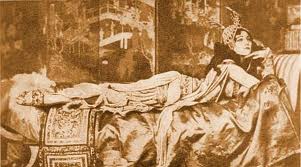
Scheherazade spent her wedding night by telling the king a story but, cleverly, she Sch2never finished it and stopped at the most exciting part right before dawn, the time of her impending execution. The king, determined to know how the story ended, was forced to delay her sentence. That next night, she finished the tale but began an even more exciting story. Once again, she stopped exactly midway shortly before dawn, and the curious king spared her life so that he might hear the conclusion. This continued for a thousand and one nights, as Scheherazade weaved her magic through stories of Aladdin and the Genie, Ali Baba, Sinbad and many more. By the end, the king had fallen in love with the clever Scheherazade and made her his queen.
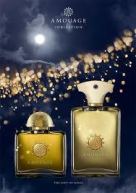
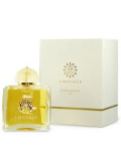
If the bewitching, enigmatic, intensely feminine, aristocratic Scheherazade were alive today, she might very well make Amouage’s Jubilation 25 her signature scent. As I wrote in my review for the sibling fragrance, Jubilation XXV for Men, the royal perfume house of Amouage would be perfect for a fairy tale or Greek myth. (Or for The Arabian Nights itself.) Amouage is the official royal perfume house for the Sultanate of Oman, and created at the order of the Sultan himself. It seeks to evoke the magic of the Middle East at the hands of master perfumers, who are given all the riches in the land — nay, the richest ingredients in all the world — with a no-expense spared budget.

Amouage 2 Jubiliations

Amouage Jubilation 25 (left) and Jubilation XXV (right).

On its 25th anniversary, in 2007, Amouage launched two celebratory eau de parfums under the guidance of its artistic director, Christopher Chong. The men’s version was called Jubilation XXV and was created by Bernard Duchaufour; the women’s version was named Jubilation 25, and was made by Lucas Sieuzac. Both versions are eau de parfum concentration.

Amouage J25

Jubilation 25

On its website, Amouage describes Jubilation 25 as follows:

Jubilation 25 captures the magic of timeless eternity with rich top notes of rose and ylang-ylang in which myth and reality are expressed using the finest frankincense from Oman.

This fragrance will appeal to the elegant, enigmatic and sophisticated woman who lives her life as an art form – evoking the time, place and cultures she inhabits with the mystical allure of amber, musk, vetiver, myrrh, frankincense and patchouli.

Jubilation XXV is classified on Fragrantica as an “oriental floral,” but it would be much more accurate to call it a fruity chypre. “Chypre” is one of the main perfume families. As a basic rule of thumb, a chypre perfume starts out with citrus-y top notes, has labdanum as part of its middle notes, and has a base that includes oakmoss. The oakmoss is traditionally the main key, but the base also often includes patchouli, musk or some sort of animalic note. (See the Glossary for a full explanation of the chypre family of fragrances, its general composition, and the range of its sub-families.)

Jubilation 25’s notes are listed as follows:

Top notes are ylang-ylang, rose, tarragon and lemon;

middle notes are labdanum, rose, artemisia and incense;

base notes are amber, patchouli, musk, vetiver and myrrh.

The perfume opens and I think to myself, “So Parisienne!” It’s a definite fruity chypre and a very heavy, mature scent. The opening notes are citrus and oakmoss, with a strong touch of tarragon and cumin. Unlike others, I don’t smell any significant amount of ylang-ylang from the start. Instead, what I get is a cumin-infested rose and peach note that is uncomfortably intimate. The peach comes from the davana flower which helps create the slightly fruity nature of the opening. It also evokes Guerlain’s Mitsouko, the standard bearer for fruity chypres, and a perfume which similarly calls to mind female intimacy and cumin. There is also a definite element of sweat which adds yet another type of intimacy to the scent. I can’t help but think of a woman in a slight state of arousal. There is a soft kind of blossoming and earthy fecundity which bring to mind a woman’s panties and… well, “intimate” is the only way I can describe it politely.

The cumin note is subtle at first. It’s not like the cumin in Serge Lutens Serge Noire but the earthiness is such that I have to wonder how the perfume would smell on me if worn at noon during the height of summer. The thought worries me a little. (Okay, a lot!) I can’t begin to imagine how this would smell in 110 degree heat!

A few more minutes in, the tarragon fades away as does a portion of the citrus-y note, leaving a very dry but pungent oakmoss scent. Officially, there is no oakmoss in Jubilation 25. None of the notes listed on the Amouage website (or, indeed, anywhere) list it. But it is there. Read any review of Jubilation 25, and you’ll see a plethora of references to oakmoss and chypres. The ingredients may not list it — just as they don’t list cumin — but dammit, it’s there!

Oakmoss is a tricky scent to describe or convey. It looks and smells similar to the lump of dried litchen that is often stuck at the top of flower pots or in floral arrangements. And, calling it “mossy, herbal and woody” doesn’t really seem adequate. To me, oakmoss has a dry, musty, dark green-grey smell that is dusty and almost mineral-y as well. It is often astringently pungent and a lot like a very damp, earthy forest. But a damp forest that is definitely musty and a bit dusty as well.

Twenty minutes in, the cumin (or whatever skank-ladened note is replicating cumin’s smell) is flitting in and out, making me feel, at times, that it’s actually quite delightful in its uncommon juxtaposition with rose and lemon. At other times, however, I have to resist the urge to sniff under my arms in alarm. It’s a bit of intellectual genius to combine the natural earthiness of cumin with the inherent earthiness of oakmoss, but it’s also rather disturbing.

There is a funky ripeness that makes me fear I am not brave enough for this scent. And, suddenly, I understand Luca Turin’s comparison of Jubilation 25 (which he very much liked, by the way) to Dior’s outré Diorella.  Diorella was created by the legendary nose, Edmond Roudnitska, who also created the other monster of funk that Jubilation 25 is often compared to: Rochas’ Femme. (Jubilation 25 is compared to the reformulated, post-1989 version of Femme that had actual cumin added in.)

Femme

Femme

Femme is repeatedly described as far more than just merely animalic but, rather, flat out “intimate.” And a good chunk of the ingredients in Femme are also in Jubilation 25, even if the latter doesn’t officially list cumin. (It really should!) The same story applies to Guerlain’s equally “intimate” or “skanky” Mitsouko, which is the third fragrance to which Jubilation 25 is often compared. Mitsouko’s peach, rose, ylang-ylang, oakmoss, vetiver, amber and musky notes are the same ones in Jubilation.

In slight contrast to those “intimate” female scents, Diorella has been described as “fruit on the  verge of going bad” by Luca Turin. The perfume blog Yesterday’s Perfume, elaborates on that Turin metaphor saying that Diorella “at its heart, … smells like garbage on the verge of going bad that someone has thrown a pile of flowers onto” but swears that it “shows you how to find beauty in the intersection of garbage and flowers. I know this doesn’t sound like an endorsement, but it is!”

Jubilation 25 combines aspects of all the aforementioned perfumes into one. I think that the last part of Yesterday’s Perfume’s quote about Diorella could really apply to Jubilation 25 if slightly altered: it “shows you to how find beauty in the intersection of [bodily funk] and flowers.” It just takes a little time to become enchanting (or, perhaps, a little less alarming).

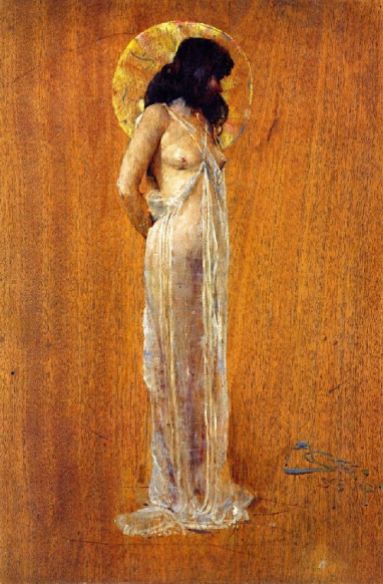
But it is, unquestionably, a fascinating scent. It gets in your head with its juxtaposition of soft, feminine florals, earthy dampness and mossiness, and bodily funk. It’s got a little bit danger, and a whole lot of enigma. I can’t decide if I like it, or if I am repelled by it. As time goes on, I am less repelled than I was at the onset, but I’m still completely at a loss on how to assess this scent. It’s that bodily funk aspect that is all woman; it is both the fascination and lure, and the source of my continuing alarm. True, it’s less blunt, forceful, and sexually ripe as compared to Femme where, if memory serves me correctly, it clobbered you on the head. Here, there is just a sheer hint of it. Sheer, like Salomé’s seventh and final veil which was closest to her damp, slightly sweaty, naked

Sir Arthur Streeton's "Scheherazade."

Sir Arthur Streeton’s “Scheherazade.”

body as she danced before the king she wanted to seduce and manipulate into committing murder.

I feel a little trapped and paralyzed by my polarized reactions to Jubilation 25. In fact, I feel just like a fly quivering on a spider’s web, as competing thoughts run through my head. From utter revulsion at the scent, I slowly feel some grudging fascination, then back to alarm as a particularly strong whiff of armpits flashes by before receding again. I scrawl, “Oh no. This is too much!” in my notes, followed a few minutes later by, “I think I like this???” Jubilation 25 is like Scheherazade luring into her mystery, her web, her tales, before trapping you with her enigma, and making you want more.

The soft dry-down doesn’t help free me. It’s all musky rose with a touch of sweetness from the myrrh and amber. For some odd reason, the ylang-ylang is stronger now on me, as is the peach from the davana and the patchouli. Perhaps they were just hidden by that huge burst of overwhelmingly skanky funk? The latter is still there but it is just a faint shimmer now, almost imperceptible. (Well, most of the time. It tends to come and go at this point, almost like a ghost.) I really like the dry-down, though it’s nowhere as fascinating as that opening which lasted a good two hours on me.

Unlike the king in A Thousand and One Nights, however, I do finally manage to break free of the enchantment. I don’t think I would buy Jubilation 25, even if I could afford it (which we will get to shortly). It’s just too mature, heavy and intimate a scent for me. I don’t mind heaviness if it’s resinous ambers or spice, but heavy oakmoss is a bit harder for me to handle as a frequent choice of scents. But it’s the intimacy issue which is more dispositive. I have faint images of slightly ripe panties and earthy underarms that continue to plague me a little. Yes, I don’t think I would wear it. No, on further thought, I think I would. Yes, I would. I can’t get it out of my head and I’m utterly fascinated by its dangerous, alarming elements. I don’t think it is just intellectual fascination, either. There are a lot of scents that fascinate me intellectually and theoretically — such as Serge Lutens Tubereuse Criminelle — but which I’m not interested enough at the end of the day to actually want to wear them.

Jubilation 25 is different because it really has gotten inside my head. I can’t stop sniffing my arms, though I always do so with a healthy dose of trepidation. I could see this as the scent of a dangerous woman, a black widow, or a diva. I think of Angelina Jolie’s character in any number of her films but, especially, in Gia (one of my all-time favorite movies). I also think of Angelina Jolie herself in Alexander, where she met and bewitched Brad Pitt. I think of such diverse people as: the legendary icon, Ava Gardner; the racy, imperious, very sexual but haughty Princess Margaret of England; or the steely, hard, but manipulatively charming Margaret Thatcher, Britain’s former Iron Lady.

What finally breaks me free of the spell and the madness is the price of Jubilation 25. I am simply too much of a cheapskate to spend $300 (or approximately $330 with tax) on one single perfume. I just can’t do it, even if I could afford it. The most commonly available size of Jubiliation 25 is 3.4 fl.oz/100 ml and costs $300, £190.00 or around €220. There is a smaller 1.7 oz/50 ml version that costs $265 or £160.00, but a cursory review of a few US websites shows it is not available on any of the usual or big perfume sites. I found the smaller size only at Beauty Encounter, but it’s really not a good deal given that double the quantity (or 3.4 oz) costs only $35 more.

No, Jubilation 25 is just too expensive for me but, oh, how it tempts me. This is not an ordinary, cheap or generic scent. It smells haughty, regal, luxurious, feminine, and infinitely intimate. It’s dangerous and enigmatic. It’s Mata Hari, Salome and Scheherazade all wrapped into one. And it probably would have brought Scheherazade’s king to his knees far sooner than a thousand and one nights…..

DETAILS:
Sillage & Longevity: Heavy sillage for the first 2 hours before becoming slightly closer to the skin. It becomes fully close to the skin about 3 hours in. All in all, it lasted about 5 hours on me. On others, it is reported to have great or, even, huge longevity.
Availability & Stores: In the US, Jubilation 25 can be purchased online at AedesFour SeasonsLuckyscent or Parfums Raffy. (Google and Parfums Raffy state that it is the authorized retailer for Amouage and that it provides free shipping.) If you want the smaller 1.7 oz version, you can go to Beauty Encounter. Samples of Jubilation can be purchased from all those places, as well as from Surrender to Chance (the decant site I always use) where the smallest vial costs $3.99. In London, I’ve read that Jubilation 25 is available at Harrods, Fortnum & Mason, Les Senteurs or the Amouage boutique. In Canada, I’ve read that it’s available at The Perfume Shoppe. In Germany, at First in Fragrance. And, of course, it is available world-wide on Amouage’s own website. The website also has a “Store Locator” for about 20 countries which should, hopefully, help you find Jubilation somewhere close to you.