Viktoria Minya & The World of A “Nose”

A grey afternoon in Paris unexpectedly turned into one of the most fascinating, educational perfume experiences I’ve had in a long, long time. It’s all thanks to Viktoria Minya. She gave me the chance to peek behind the curtain, and to glimpse a small portion of the life of a “nose.” We talked about everything from IFRA/EU restrictions on perfumes, how she studied to become a “nose,” some of the surprising things she deals with in perfume creation, and the very elementary basics of the raw materials that noses use to create fragrances. I hope you enjoy the glimpse behind the perfumed curtain.

Viktoria Minya. Source: Fragrantica.

Viktoria Minya. Source: Fragrantica.

Hedonist. Source: Parfums Viktoria Minya on Facebook.

Hedonist. Source: Parfums Viktoria Minya on Facebook.

Viktoria Minya is a perfume creator who founded Parfums Viktoria Minya, but also an actual, genuine, trained “nose.” Her debut perfume, Hedonist, is a gorgeous, luxurious, elegant, airy, honeyed-floral affair that I really loved. But I also enjoyed the little bit that I got to know of Ms. Minya herself in our email correspondence at the time. Then, a few weeks ago, close to the time of my departure to Paris, and by a complete fluke involving something else, we had a few email exchanges where I happened to mention that I would be in her city. Unfortunately, both our schedules seemed extremely complicated, and it seemed unlikely that we’d be able to meet.

Then, while roaming the streets of Paris one afternoon, and with some incredibly lucky timing that happened out of the blue, everything seemed to fall into place. I somehow found myself in her perfume studio, sitting across from an absolutely beautiful woman with the most unbelievably stunning eyes, and the warmest smile. (Not a single photo that I’ve seen of Ms. Minya actually does her — and her eyes — justice.) Ms. Minya had prepared a lovely selection of things for me to nibble on while we talked and before we went into her actual work area where she has her perfume “organ.” (See photo below.) As I ate some French cheese (yes, I said cheese! And she didn’t even know of my obsession with it!), I tried to focus on the conversation but those absolutely mesmerizing eyes made it a little hard at times. Plus, as usual for this entire trip, I was somewhat in a daze from sleep-deprivation.

As a result, I fear I don’t remember all the details of the technical stuff I learnt, but I thought I would share some aspects that I found really fascinating, from the issue of IFRA (the “International Fragrance Association”), to her studies as a nose, the black market for ingredients, and more. Then, later, I’ll share what it was like in her perfume studio with all the raw materials and the perfume oils. The photos I took suffered from the problem that I mentioned earlier in another post: my camera is dying, so some of the images are blurred and the writing on the bottles isn’t always completely clear. Hopefully, though, it will give you an idea of the sorts of things a “nose” may have in her arsenal, and the feel of that day.

Photo: my own.

Ms. Minya’s perfume “organ.” Photo: my own.

In terms of general discussion, one of the things that came up a few times was the impact of the IFRA and EU restrictions. You and I — consumers and buyers of perfume products — usually think about the impact in terms of its effect on us. We moan about chypres and oakmoss, we talk about reformulations, and we gripe about the sorts of perfumes available to us or the massive changes to perfumery in just the last five years alone. We almost never think of what it must be like for a “nose.” It’s not surprising, after all, because their world is so far away from ours. But it’s not for Ms. Minya.

As an actual, working nose, the IFRA/EU restrictions create a whole different set of problems for Ms. Minya than they do for us. For one thing, I get the impression that she finds that they stifle creativity. (She was too polite to say so, but that was my impression.) For another, the restrictions have an impact on a nose’s actual business dealings with clients. Ms. Minya may have her own brand and perfume line, but she also works as a nose for clients to create scents in accordance with their particular wishes. She gave me one example of a situation where a client requested that she make a perfume with certain ingredients at a certain level. Again and again, she had to say something to the effect of: “No, it’s not possible to that extent,” or “No, that is illegal in the EU.”

Chris Bartlett of Pell Wall Perfumes Blog is a perfumer and consultant who has an absolutely wonderful, useful, eye-opening and completely depressing listing of all the IFRA/EU ingredient limits for Category 4 (fine perfumes in an alcohol-based solution). Though his list is not yet updated to include all the changes from the 47th Amendment of June 2013 (yes, I realise how ludicrous and Kafkaesque that sounds), I still look at it from time to time, usually resulting in complete irritation and annoyance at the EU. I looked again at the listing upon my return from Paris and in light of my meeting with Viktoria Minya — and I saw it in a whole new light from the perspective of a “nose.”

Let me give you some examples from Mr. Bartlett’s list of IFRA’s standards and limitations as of June and before the 47th Amendment took place. Some of the terms may seem like gobbledygook to you, but just pay attention to the percentage numbers at the end of each line (or whether the ingredient is permitted at all in perfume creation), and things will eventually become clearer:

Cumin oil 0.4%

Eugenol* [clove oil] 0.5%

Farnesol* 1.2%
Fig leaf absolute Prohibited
Galbanum ketone (various trade names; 1-(5,5-Dimethyl-1-cyclohexen-1-yl)pent-4-en-1-one) 1.13%
Geraniol* 5.3%  […]

Iso E Super 21.4%  [ME: GOOD GOD!!!!!!!!!!!!!]

Jasmine Absolute 0.7%

Jasmine Sambac Absolute 4%
Lemon (expressed) 2%
Lime (expressed) 0.7%

Musk ambrette Prohibited

Oakmoss Absolute 0.1%

Opoponax 0.4%

Peru balsam (crude) Prohibited

Quinoline Prohibited
Rose Ketones 0.02%
Santolina oil Prohibited
Safranal (2,6,6-Trimethylcyclohexa-1,3-dienyl methanal) 0.005%
Safrole, Isosafrole, Dihydrosafrole~ Prohibited (EOs containing these permitted if total below 0.01%)
Savin oil from Juniperus sabina Prohibited
Styrax (from Liquidambar styraciflua macrophyla or Liquidambar orientalis only) 0.6%
Styrax (all other species) Prohibited

Ylang ylang extracts 0.8%

* – the main sources of these chemicals is in natural materials and you need to work out how much is in all the oils that contain them and keep the total in your product below the levels quoted here. These are some of the most complex standards to ensure compliance with.

NB- The limits for Oakmoss and Tree Moss are cumulative (so the combination of both must be below 0.1%)

I tried to include in that list a good number of things with which we common lay-people are familiar, but, also, a portion of the many things marked with a red “Prohibited” notice (even if I have no idea what some of them are). The fact that things like ylang-ylang is limited to 0.8%, lime to 0.7%, and oakmoss at 0.1%, while that bloody, godawful “ISO E Supercrappy” (™ Sultan Pasha) can be as high as 21.4% suddenly clarifies things a bit more to me. It’s not just that some perfumers love that ghastly, cheap, synthetic crap; it’s that they are running out of ingredients to use at any substantial, rich or useful levels! I mean, seriously, some poor flower is at less than 1%, while the laboratory-created, aromatic equivalent of a hospital morgue’s antiseptic is at 21.4%??! Plus, a portion of the ingredients on the list are completely illegal to use?! To me, and from my layman perspective, that doesn’t seem to leave perfume noses with a huge amount of original options or alternatives.

Source: CaFleureBon

Source: CaFleureBon

Which brings us back to Viktoria Minya and her world. She went to school in Grasse, perhaps the heart and soul of the perfume creating world, and attended the Grasse Institute of Perfumery. I asked her about the program which is one-year long, and followed by internships within the perfume world. Within the program, the students take a variety of courses on such subjects as: natural and synthetic raw materials; fine fragrance formulation; legislation courses; evaluation courses; and even functional perfumery courses (how to create fragrances for soaps, shampoos, candles, shower gels, etc).

There was much more, too, but, again, the haze of a particularly grueling travelling schedule means I’ve forgotten some of the details. So, I did some research, and stumbled across a 2009 article called “Smelling like roses… or not” which actually quotes Ms. Minya as a student and which also talks about the way “noses” are trained:

In class, the students flared their nostrils against white tester strips dipped in scented, mostly clear liquid. The exercise tested their olfactory memories as they built on the more than 300 natural and synthetic odors they had memorized since the course began in late January. The task included identifying the scents’ compounds and family. […]

By the end of the yearlong course, which includes a mandatory internship at a fragrance company lasting several months, students will have acquired a lexicon of at least 500 raw materials; the rest of their creative arsenal, which eventually could include thousands of ingredients, will be developed in the field.

As for Viktoria, as that old article makes clear, lessons in building an olfactory memory bank sensitize the nose:

On a recent visit to a horse stable, Viktoria Minya had to hold her breath until she could step outside. And at home recently, the 27-year-old perfumery student has found she needs to take out the trash as often as three times per day. It’s a side effect of her developing olfactory organs: “I smell too much.”

The article also mentioned a few other interesting things:

“A perfume hides a story,” said Laurence Fauvel, a perfumer and one of the teachers at the school, which opened in February 2002. “To create something really new is very difficult.”  […][¶]

An official at the school estimated that about [only] 20 star “noses” exist worldwide.

Mr. Fauvel’s comment reminds me of the common line in many writing classes about how every plot or novel has essentially been written before. It’s true, and I’m sure the same theme applies, broadly speaking, to perfumery as well. But, to bring things full circle to perfume notes, it certainly can’t help when IFRA and the bloody EU restrict your options even further in terms of quantity and type of ingredients. As Ms. Minya told me, there are no longer quite as many avenues for self-expression and artistic creativity.

Vincent Van Gogh, "Irises" (1889). Source: hdwallshub.com

Vincent Van Gogh, “Irises” (1889). Source: hdwallshub.com

She compared the situation to a painter being told that he cannot use certain paint colours on his canvas, while other colours are limited in amount. So, perhaps it’s more apt to talk about “vibrancy” instead of the broader terms of “originality” and “creativity.” If a painter is forbidden from using brown paint, if he can only use blue if it’s 0.7% of his overall creation, and if green is limited to no more than 0.1%, then how do you end up with Van Gogh’s Irises? You can’t. You get a watered down, diluted, much less vibrant composition that may be good — perhaps even very good, in some cases — but it won’t be the masterpiece that is the Irises.

Stephen Weller, IFRA photo, via The Scented Salamander.

Stephen Weller, IFRA photo, via The Scented Salamander.

In the faintest fig leaf to appearing fair, I suppose I should mention IFRA’s side of things. Stephen Weller, IFRA’s Director of Communication, has given a few interviews in France defending his organisation as the supposed savior of certain key ingredients. The blog, The Scented Salamander, states that Mr. Weller:

makes the particularly salient point in this exchange that without IFRA, a number of perfumery ingredients would have altogether disappeared from the palette of the perfumer as they have come under attack from the European Union and before that pressure groups voicing their concerns…

Weller explains in this new interview with Premium Beauty News how his organism permits a more nuanced approach to the dermatological and allergic risks presented by aromatic materials.

You can read more about his claims at the Scented Salamander, but they essentially include the argument that you should thank IFRA for saving oakmoss and other ingredients from complete eradication in perfumery. I can see his point in theory, but I have great difficulties with his attempts to portray IFRA as the purely protective, angelic and benevolent savior of perfumedom! And don’t get me started on the oakmoss. Yes, the EU is driving most of this, now, but, correct me if I’m wrong, I believe early IFRA regulations started all this.

More to the point, and to use a parallel, I don’t see manufacturing associations putting restrictions on factories who produce food items or on chefs in restaurants simply because there are some pressure groups who complain about nut allergies. Some of the EU proposals (like the ludicrous idea of possibly banning Chanel No. 5 that I’ve talked about in another IFRA/EU post) are akin to shutting down the Eiffel Tower simply because 1%-3% of the EU’s 503.5 million population may have vertigo. (It’s been estimated that “1 to 3 percent of the EU population… are allergic or potentially allergic to natural ingredients contained in fine perfumes, according to a report published in July by the Scientific Committee on Consumer Safety (SCCS), an advisory body for the European Commission.” [Emphasis added.])

And IFRA’s substantive actions don’t seem like true championship or defense of the perfume industry to me. For example, why aren’t warning labels enough? They put such warnings on cigarettes, and on pre-packaged food items that may have been prepared in a factory that had some nuts in it. Are perfumes actually more dangerous to people’s health than cigarettes??! Also, why are perfumes to be regulated with such ingredients as the amount of lavender or citrus oils, but massage oils are left alone? Presumably, that minuscule percentage of EU citizens who have allergic reactions — or just the mere potential thereof — might possibly decide to have a massage one day. Why are those oils fine, but the ones in perfumery — which allergic people can simply avoid using — subject to increasingly Orwellian, draconian measures?

I’m sorry, I got sidetracked and derailed in rather irrational rage, so let’s leave the issue of IFRA and get back to the realities of creating a perfume. There, even apart from ingredient limitations, there are other hurdles to originality, too. This time, however, they pertain more to the business tail-end of things for one who is a brand’s creator or founder. Take, for example, the simple, seemingly prosaic issue of a perfume’s name. Now, obviously, you don’t want to use another brand’s exact name for your new creation, but I wasn’t aware of just how tricky the issue might be for French perfumers. According to Ms. Minya, back in the 1980s, many French companies bought up the legal rights to a whole host of names — lots of them being common adjectives or phrases — for future use. Now, when you try to launch your new perfume, there is a good chance that they might sue you for using one of their vast stable of trademarked names.
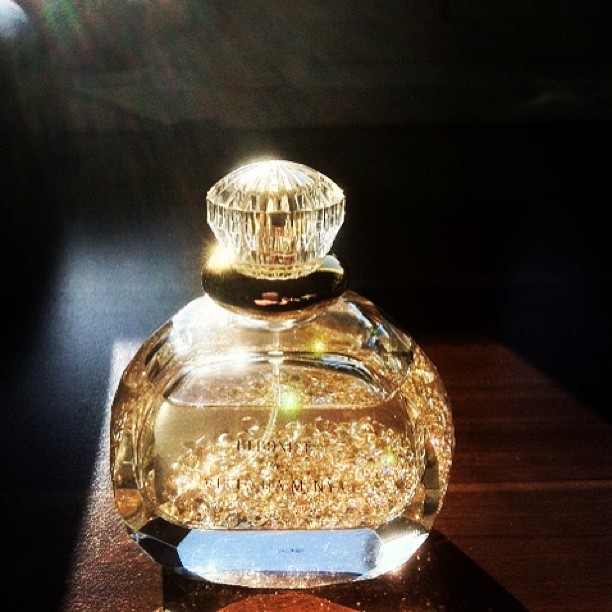
Hedonist. Source: Parfums Viktoria Minya on Facebook.

Hedonist. Source: Parfums Viktoria Minya on Facebook.

I remember hearing this, blinking and having a light bulb moment when she explained that this old 1980s situation is the reason why so many French perfumes have some generic variation of “Rose de ___” or “Vanille de ____”  as their name. To quote Ms. Minya: “This is why we have more and more names with numbers, botanical or common names of ingredients ( like “orange” ) and geographical names – because these cannot be trademarked by anybody.” I suspect this may be the reason why Neela Vermeire might have had to recently change the name of her upcoming Mohur “Esprit” to just plain “Mohur Extrait,” though I am just guessing. (I have not asked Ms. Vermeire, and I certainly don’t know for sure.)

While trademark concerns are hardly unique to France, the situation there seems a little more complicated for perfumers than for artisans or artists in other fields. Even if you can get the money to make a perfume, even if you survive the draconian IFRA/EU’s restrictions to make something good, even if you spend all the money for the further compliance minutiae, you still aren’t home scot-free. Now, you can’t even choose your perfume name without the risk of a lawsuit.

Yet, the real issue that I see is something much broader in reach: you need very big pockets to engage in the perfume game, and to survive. I’d like one day to explore the issue of perfume creation primarily from a perfume creator’s perspective, but it’s clear even now that the real bottom line is money and how hard it is for truly “niche” perfumers to flourish in light of so many minefields. Someone like Tom Ford — who is backed and owned by the Estée Lauder multi-national conglomerate — or Kilian Hennessey is obviously going to have a very different time of things than someone like Viktoria Minya, Andy Tauer, or Neela Vermeire.

To me, as a layman and outsider, each of the things discussed here seems to represent a noose tightening around the neck of a truly vibrant, creative, non-homogenous, flourishing perfume world where small voices have as much chance in the marketplace as the big behemoths. It’s a sad parallel to the overall conglomeratization of the world in general, from the media and entertainment industries to banking and the airlines. But the last time I checked, neither the banking nor airline worlds depended on creativity and the freedom of imagination, so it’s substantially worse when artistry is stifled in an industry like perfumery.

IMG_0034_4b

Size makes itself an issue for noses like Ms. Minya in some ways that surprised me. As promised, I’m going to spend a bit of time talking about the raw materials used in the perfume process. When I went into Ms. Minya’s actual perfume studio with its vast, impressive “organ,” I gasped. As far as the eye could see, there were bottles of ingredients. Everywhere! Not just the organ, but filling whole bookcases and even in a fridge. As I was exclaiming about the endless varieties of orange blossom, iris, or rose accords, Ms. Minya mentioned how obtaining some of the ingredients wasn’t easy. Apparently, some companies are extremely unwilling to sell in the sort of small order sizes appropriate to a small, individual perfumer or nose. I didn’t ask if the companies countered things by charging much more for orders that aren’t in bulk, because I never like to talk about money or intrude into someone’s financial matters, but I assume that it’s a frustrating hassle and obstacle at the very least.

So, let’s drop money, and move onto the actual ingredients in question. First, we should probably begin with the basic difference between a perfume oil and an essential oil. Now Smell This has an easy explanation that puts it much more succinctly than I could ever manage:

Essential oils are volatile, fragrant liquids extracted from plant leaves, bark, wood, stems, flowers, seeds, buds, roots, resins and petals, usually through steam distillation. In other words, they are raw materials that can be used to create perfumes. They are highly concentrated […].

Perfume oils are fragrance components, natural or synthetic, in an oily base rather than an alcohol base, and can be used directly on the skin.

Now, here’s a glimpse of some of the things in Ms. Minya’s arsenal:

Perfume oils distilled in 10% alcohol. You can see various types of orange-related oils on the top shelf, rose on the middle, and things like vetiver on the bottom. Remember, this curves all the way around.

Perfume oils distilled in 10% alcohol. You can see various types of orange-related oils on the top shelf, rose on the middle, and things like vetiver on the bottom. Remember, this curves all the way around.

A fridge filled with fragile perfume oils, or oils of the weakest strength and diluted in 1% alcohol.

A fridge filled with fragile perfume oils, or oils of the weakest strength and diluted in 1% alcohol.

As you can see from these photos (which you can click to expand even more), there are two separate categories of ingredients. One are the oils on her curving, circular “organ” which are ingredients diluted in a 10% alcohol base. The other photo shows bottles in a fridge, and that’s where my memory failed me. All I could really remember is that the latter are very expensive and have a very fragile shelf-life, so they are usually kept in a fridge to ensure that they last longer. So I wrote to Ms. Minya to ask for help in clarifying the differences between the various bottles, and this was her response:

what perfumers are working with are what we call “raw materials”, some of them are liquid ( like most essential oils ), some are powders ( like vanillin – molecule present in vanilla, I am using the very expensive Natural version of it), some are resins ( like peru balsam or mimosa absolute). Every perfumer has their different habits, but I like to work with them in a 10% solution form, they are called 10% solution or 10% solution of … ( any given raw materials ). This helps me to directly smell the “end product” after formulation.

Perfume oils like grapefruit or guaiac wood.

Oils like grapefruit and guaiac wood on the top row; magnolia and mandarin on the bottom.

Perfume oils distilled in 10% alcohol. Here, you can see different sorts of orange oils like bigarade to other sorts.

Oils distilled in 10% alcohol. Here, orange bigarade and what Ms. Minya tells me is a “different origins orange oil.”

The raw materials in the fridge are simply weaker, more diluted solutions of some raw materials ( so like 1% or 0.1% solutions ) OR fragile raw materials, like rose oil, the citrus oils like bergamot, mandarine, orange, lemon and lime, or spices like nutmeg and safran, etc. [Emphasis added.]

More of the almost diluted 1% oils in the fridge such as Ylang-Ylang and Osmanthus.

More of the almost diluted 1% oils in the fridge such as Ylang-Ylang, Osmanthus and some sort of Sandalwood.

More of some of the delicate but weakest "finishing" ingredients. You can see Narcissus Absolute is one of the ones in the first row to the left.

More of some of the delicate but weakest “finishing” ingredients. You can see Narcissus Absolute is one of the ones in the first row to the left.

[As a whole and generally,] the raw materials comes from the producers in “pure”. Then we dilute it with alcohol. 10% solution means 1 GR of rose oil -let’s say- and 9 GR of alcohol in a 10 ml bottle ( the ones you saw on my perfume organ ). 1% solution means 0,1GR of rose oil and 9,9GR of alcohol in a 10 ml bottle. The 1% solutions are for “fine-tuning”, sometimes it is to give a small aspect of a certain material, other times the given raw materials are very strong and we like to give just a tiny amount into the creation.

Just like the perfume you get from a boutique is a concentrate of pure mixture of raw materials which then is diluted with alcohol.

So, to simplify things if you’re a dodo like me, a 10% solution in Ms. Minya’s case has really just 1 gram of actual perfume oil, while a 1% solution has a mere 0.1 gram of the raw material.

Speaking of materials, Ms. Minya mentioned something just in passing that made me almost fall off my chair: there is apparently a whole, lurking black market for some ingredients! Guess in what context this issue arose? The thing about which I’m the greatest snob: sandalwood. It seems that my beloved Mysore sandalwood is so rare that some people — not all, but a tiny, unethical few, and primarily in the Far East or the Middle East — resort to the black market to obtain it. I imagine that this is an issue which applies more to some small-time or experimental perfumers who may not have the access to the very few places which still hoard have small quantities of Mysore sandalwood to sell at outrageous prices. It certainly seems related to the issue of how some companies selling raw ingredients are unwilling to fulfill small orders. Again, however, I do not like to discuss money, so I did not ask follow-up questions, but it is certainly something that gives one pause. A black market? Seriously? Who knew that perfumery could involve secret cloak-and-dagger skullduggery of the highest order?!

While I was absorbing this tidbit, Ms. Minya quietly assembled a little surprise for me: a blind testing of some of the concentrated perfume oils. She had actually just returned from Hungary where she’d given a lecture on the issue of perfumery, and had a lot of bottles previously prepared for a similar sort of demonstration. I can’t recall the precise percentage of what she made me sniff on strip after strip of the paper mouiellettes, but I believe it was the 10% stuff.

And it was quite an experience…. A number of notes that I’m very familiar with in actual perfume were wholly unrecognizable to me in essential form. Granted, I’ve never been particularly good at detecting the nuances of things from a mere paper strip and it’s a whole other matter on skin, but still! In a number of cases, I could detect the notes after the paper strips had time to breathe and develop, or, perhaps, to decrease from their concentrated opening moments. In other cases, however, the usually familiar notes smelled quite alien to my nose. Aldehydes? I wouldn’t or couldn’t have guessed correctly if you’d put a gun to my head. (In fact, I’m still finding it hard to believe that that odor was aldehydes!) Incense, one of my favorite notes? Forget it. I was absolutely convinced it was some type of wood, if my hazy memory serves me correctly. (Ms. Minya now tells me it was myrrh, but all it smelled like to me was dry wood.)

To my relief, and to avoid the complete destruction of my ego, some of my guesses at least hit upon the adjacent characteristics of a note. One of the first ingredients that Ms. Minya made me try smelled to me of smoke, amber, leather and wood. Well, all those things are either used with the ingredient, or are subset nuances of the note — which turned out to be….. patchouli. After she told me, it seemed somewhat obvious, but I have to emphasize the “somewhat” part of that statement. In reality, for me, the essence of one of my favorite ingredients really did NOT have the exact same smell as it did when mixed in with other stuff in an actual perfume. And this was the case quite often. (The one exception was the synthetic, Safranal, which smelled precisely as it did in some saffron-oud perfumes, was so strong that a mere drop on a mouiellette completely overwhelmed all the other paper strips, and thereby explained a whole host of overly intense, hotly buttered saffron perfumes that I’ve wondered about….)

On another test, Ms. Minya let me smell a concentrated perfume oil that I thought was a spicy geranium. It turned out a type of rose oil. Well, geranium in essential oil concentration has an odor that is rose-like, so… I was close?? Still, I can’t get over the aldehydes and incense myrrh being completely unrecognizable. (Have I mentioned that none of this was particularly great for the ego?!)

Joking aside, I truly loved every minute of it, and it was pretty hard to drag me away from the lure of those bottles. Each one seemed to contain a whole new world of smells that was different from what I had previously experienced. I’ve had a few cheap oils that I’ve used to add to scented heaters, candles and the like, but nothing quite like the hardcore oils I smelled in her studio! If I lived in Paris, I would definitely avail myself of the opportunity to take one of the classes or workshops that Ms. Minya offers.

Actually, at the time of my visit, I didn’t know that Ms. Minya actually teaches this stuff to dolts like myself! The other day, while doing my research preparation for this post, I noticed a section of the Parfums Minya website listing the services she offers as a nose. For example:

courses range from beginner level to levels tailored to the talents of more advanced candidates. The most popular themes are as follows:

• Main Olfactory Families
• Exclusive Natural Raw Materials
• Basic Formulation / Accords
• Perfume Creation

All course can be easily adapted according to clients’ specific needs. [¶] Price: Starting at 220 EUR ( five session course )

She also offers a cheaper workshop that let’s you create your own perfumed product, be it a fragrance, a candle, or a body product:

For those clients who would like to experience the joyful moment of perfume creation without going through the advanced studies of raw materials and ingredient classification, we propose a facilitated perfume creation workshop where clients will be manipulating fine essential oils and fragrance accords to go home with their own crafts.

The most popular themes are as follows:

• Perfume Creation Workshop
• Scented Candle Creation
• Scented Personal Care Creation (lotions, bath balls, etc. )

Price: 90 EUR for individuals. Starting price for groups: 50 EUR / person.

Hedonist in its handmade wooden box that is "fashioned to capture the sleek look and feel of snakeskin leather."

Hedonist in its handmade wooden box that is “fashioned to capture the sleek look and feel of snakeskin leather.”

Despite some of the issues mentioned up above, things are hardly doom and gloom for Ms. Minya. Her debut perfume creation, Hedonist, sold out in just a few months, and there is already a long list of pre-orders. Apparently, that does not happen very often, especially for one’s first fragrance. In the meantime, Ms. Minya is being kept busy as a nose for clients, but also in travelling to give lectures on perfumery-related issue.

The future looks bright too, with two new perfumes being slated for release in 2014. While they are works in progress and the details were kept secret, they are apparently going to be in the style as Hedonist with the same sort of philosophy of using “the most noble raw materials and giving them an indulging edge.” When pressed for a little hint or two, Ms. Minya merely smiled and said that the perfumes are centered around “the two most expensive flower essences existing in perfumery.”  Aha! Iris! One of them has to be an iris scent! 

Photo: my own.

Photo: my own. It does her beauty absolutely no justice at all!

I have to thank Ms. Minya for many things. One is for being a lovely hostess, but, more importantly for really taking the time to explain the technical and basic details of what is involved in perfume creation. More importantly, however, I want to thank her for pulling aside the curtain and giving us all a peek into a world that is often shrouded in some mystery. You and I, we buy perfumes; few of us know anything about the process of actually making them. Things like the building block steps, the basic procedural tasks of how to dilute the pure oils and in what amounts — those are a foreign world for the vast majority of us. Ms. Minya took the time to explain it to me not only in her studio where she welcomed me with warmth, but also in subsequent follow-up emails where she patiently answered my bewildered questions on what must be the equivalent of the “A, B, C” for her.

Just as importantly, she was open and candid throughout. As she wrote to me, “I think some brands are totally mystifying perfumers on purpose for the public. They say the magic goes away if people find out about the small details of our work, I disagree, I think the magic starts whenever they are let to have a look behind the curtains!!!”

I really hope you saw some magic today. I certainly did when I was in her studio. And, it turns out that the Wizard of Oz actually and truly is a bit of a magician. A very beautiful, incredibly sweet magician with gorgeous eyes and the warmest smile.

Note: Photos of Ms. Minya’s studio are all my own. Other photo credits or sources are as noted within the individual captions.

FURTHER DETAILS:
For additional information on Ms. Minya or Hedonist, you can check out her website, Parfums Viktoria Minya. If you’re curious about Hedonist and how it smells, you can read my extremely positive review here. Hedonist retails for $195 or €130 for 45 ml of eau de parfum. Hedonist can be pre-ordered directly from Viktoria Minya with shipment going out in November. (I assume that means that the new stock will arrive then, and so pre-orders will not be necessary for anyone who reads this post much later in time.) In the U.S., however, the perfume is currently stocked and available for purchase at Luckyscent. Samples are available from Luckyscent or from Surrender to Chance, which sells vials starting at $6.49 for a 1/2 ml vial. I think Ms. Minya has always offered a much better deal on samples, in terms of a cost per size basis: it’s €5 for what is almost 2 ml, if memory serves me correctly and I think there is free shipping.

New Perfume Release: LM Parfums Hard Leather

As fate would have it, this morning I received the press release for LM Parfums‘ new fragrance, Hard Leather. Just yesterday, I talked about my overall impressions of the perfume which I got to test in Paris a few weeks ago, and absolutely loved. Hard Leather is set to launch in a few weeks, in November 2013. While I don’t have an exact date yet, I do have the notes and concentration of the perfume. [Update: The perfume has released and I have a full review of it. I have also placed it on my Best of 2013 list.]

I thought I’d post the full photographic press release instead of just writing out the text. I think the visuals are sexy and very sleekly cool, and I’m not just saying that because black is my favorite colour.

LM Parfums Hard Leather

LM Parfums Hard Leather 2

LM Parfums Hard Leather 3

LM Parfums HL 4

So, in short, the notes in Hard Leather are:

Rum, Leather, Iris, Honey, Sandalwood, Cedarwood, Oud, Frankincense, Styrax and Vanilla.

Hard Leather is an extrait (or pure parfum) in concentration and comes in a 100 ml/3.4 oz bottle. LM Parfums’ extrait line usually costs $225 or €195, with the company offering 5 ml decants for €19. I don’t have pricing for Hard Leather, but I assume it will be in the same range. The line is available in the U.S. at OsswaldNY, and Hard Leather should be no exception. In Europe and elsewhere, you can buy LM Parfums directly from Laurent Mazzone’s website, as well as from numerous retailers. Links to online vendors who generally carry the line are below.

DETAILS:
In the U.S.: Laurent Mazzone’s fragrances used to be European exclusives, but the range just came to America two months ago. It’s sold exclusively at OsswaldNYC, with samples available for purchase by telephone order. Outside the U.S.: In Europe, you can buy the perfumes directly from LM Parfums. (There is also this other LM Parfums site.) Samples are available for €14 or €19, depending on the perfume in question and its concentration, and they come in a good 5 ml size. In the UK, the LM Parfums line is carried exclusively at Harvey Nichols. In France, you can find the perfumes, and 5 ml samples of each at Laurent Mazzone’s own Premiere Avenue. In Paris, LM Parfums are sold at Jovoy. Germany’s First in Fragrance carries the full line and sells samples as well. You can also find LM Parfums at Essenza Nobile, Italy’s Vittoria Profumi, or Alla Violetta. In the Netherlands, you can find LM Parfums at Silks Cosmeticsor Parfumaria. In the Middle East, I found most of the LM Parfums line at the UAE’s Souq perfume retailer. For all other countries, you can find a vendor near you from Switzerland to Belgium, Lithuania, Russia, Romania, Croatia, Azerbaijan, and more, by using the LM Parfums Partner listing. Laurent Mazzone or LM Parfums fragrances are widely available throughout Europe, and many of those sites sell samples as well.

Paris Perfumers: Laurent Mazzone & LM Parfums

Fate, planning, and a little bit of serendipity gave me the chance to meet with three, very different, Paris perfumers during my trip. Actually, to be completely precise, one is primarily based in Grenoble, and one is an actual nose/creator, while the other two are more technically considered as perfume creators with their own houses. Semantics aside, I had a marvelous time with each one, and thought I’d share a little bit of the experience, each of which was very different but utterly memorable. Today, the focus will be Laurent Mazzone and some of the LM Parfums that I tried, including some gorgeous upcoming, new releases slated for November 2013 and early 2014.

LAURENT MAZZONE & LM PARFUMS:

Hotel Costes. Source: hotel-costes.semuz.com

Hotel Costes. Source: hotel-costes.semuz.com

The Hotel Costes on the Rue St. Honoré in Paris is perhaps the pinnacle of stylish, ne plus ultra, sophisticated cool. Velvet, opulence and excess are the bywords for the decor inside, but one of the main attractions is the indoor courtyard. And what a scene it is! Imagine a large, covered, indoor courtyard surrounded on high by Roman statues and greenery. At its pristine, white tables covered with crystal glasses, an array of pencil-thin, black-clad, social x-rays — draped in ennui as much as in Hermès — pose stylishly on thin, black chairs. Their fragile bones seem likely to be crushed by the great effort of lifting their cigarettes. And they’ve clearly followed the mantra and example of Anna Wintour, Vogue’s “Nuclear Winter” editor-in-chief, when it comes to haughtiness. Their male counterparts are all tanned, in dark suits with crisp white shirts that are opened a few buttons, and fixated on their cellphones as they sip a glass of chilled white wine with one well-shod limb elegantly crossed over the other. All around are a phalanx of haughty waiters, many of whom seem to be aspiring models, who look down their noses at your from their great height and seem almost offended that you’ve bothered them with a request. (Or perhaps they’ve simply got issues with people who ask for ice, or for directions to the loo? At the very least, they’ve got issues with a variety of things, and need a serious attitude adjustment.)

Hotel Costes courtyard. Source: lefigaro.fr. photo : DR.

Hotel Costes courtyard. Source: lefigaro.fr. photo : DR.

Outside the Hotel Costes. Photo: my own.

Outside the Hotel Costes. Photo: my own.

As I walked up to the hotel from the aristocratic, luxurious Place Vendome just around the corner, a large chauffeur-driven Rolls-Royce was idling, and a bodyguard talking into his microphone. The chauffeur stood in the middle of the road with the famous Chopard jewellers behind him. Hovering like a gaggle of geese, outside and in, were extremely tall, elegantly clad women whose clothing, looks, and attitude marked them as somehow being involved in Paris Fashion Week which was ending the next day (October 2nd).

It was into this overly hip, excessively cool, “in” scene that I arrived — sleep-deprived, with my voice half-gone from the early part of my trip, and feeling rather bedraggled, if truth be told. I was scheduled to meet Laurent Mazzone and Fabienne, the international business agent for LM Parfums, whose incredibly warm, sweet, and friendly emails had resulted in this meeting. We had begun communicating just a few days before my departure and after my enthusiastic, extremely positive review for LM Parfums‘ gorgeous Sensual Orchid.

As luck would have it, Laurent Mazzone was going to be in Paris for the fashion shows. He had greatly enjoyed the thoroughness of my review (happily, my verboseness seems to a positive thing for some people!), and invited me for drinks. When I warned Fabienne that my French was rusty and that I hadn’t spoken it consistently in almost 20 years, she offered to come along as well. (It was just as well because, despite her opinion that I wasn’t at all rusty, I most definitely am! Plus, in the fog of my exhaustion, I often blanked out on words or phrases. Merci, Fabienne, for saving my linguistic hide.)

Laurent Mazzone.

Laurent Mazzone.

I found Laurent and Fabienne easily, sitting at a couple of tables in the corner along with Laurent’s partner, and was greeted with kisses and even a hug. Laurent Mazzone is a very dapper, youngish man in his early ’30s (I think), with a cherubic face, a naughty gleam in his mischievous, warm, brown eyes, and a big grin. He has an enormously exuberant personality, which I loved, and endless passion. Yet, he is also extremely serious when it comes to the subject of perfumery, and has a true commitment to the idea of making luxurious, sensuous perfumes in the grand tradition, but with a modern feel. There was enormous sensitivity in those brown eyes when listening to my comments about some of his line, sometimes followed by a huge, infectious smile from ear to ear when he saw that I understood and appreciated their nature.

Source: uae.souq.com

Patchouli Boheme. Source: uae.souq.com

He had brought a chic, black, and black-ribboned, LM Parfums bag of what I thought would be perfume samples. They turned out to be actual, full, 100 ml bottles of 3 of his fragrances: Ambre Muscadin, Patchouli Boheme, and the new, limited-edition, Chemise Blanche. Yet, despite my patchouli and amber obsession, I never tested any of those perfumes that day and, instead, ended up trying his forthcoming, new perfume, Hard Leather.

Hard Leather will be released in November, and I can’t wait because I absolutely loved it! In fact, I think I may have yelped or cried out rather loudly upon sniffing it because, suddenly, some tables of black-clad, haughty Parisians were turning around with raised eyebrows. I didn’t care, and I think I may have hugged Mr. Mazzone at one point over Hard Leather because it was (and is) absolutely fantastic. Mr. Mazzone describes it as an “animalic leather” that, to my opinion at least, isn’t particularly animalic or aggressive after the opening 10 minutes, but, instead, much more beautifully well-rounded and warm. It might be “animalic” by French standards, but I don’t think it is generally or as a whole, and especially not by Middle Eastern or Amouage standards.

Hard Leather has its musky side to be sure, but it’s primarily woody, sweet, rich, spicy, ambered, and incredibly sensual. From the first sniff, I could instantly tell that there was oud from Laos in it, with its own very unique, aged character, but what I liked about this version of it is that it didn’t smell fecal like so many fragrances that use that particular Laotian wood. Even better, there is none of that revolting Gorgonzola or cheese undertone that very aged Laotian oud can sometimes have. Soon after the agarwood announces itself, there is a burst of pungent civet which quickly calms down (in less than ten minutes), and melts into the rich, well-blended, richly burnished whole.

In essence, Hard Leather smells like your boyfriend’s leather jacket, lightly mixed with his musky scent, along with deep, almost honeyed, slightly smoky oud, and a vague tinge of floral sweetness, atop a base of ambered warmth. At times, it seemed to share some kinship with Serge Lutens Cuir Mauresque, which is one of my absolute favorite Lutens fragrances, but there are clear differences in smell. Even apart from the oud, Hard Leather has a little more edge at first, and is significantly more woody. It also seems to have a different (and much smaller) floral vein running through it. I can’t remember the rest of the notes that Laurent later told me about, but, if memory serves me correctly, there is iris absolute in Hard Leather as well. [UPDATE 10/17/13 – I have the official press release for Hard Leather with its sleek graphics and the full list of notes in the perfume.]

I also can’t recall the name of the perfumer with whom Laurent worked, but I laughed at his description of the process whereby he kept telling the nose to put in “more. More, more, more!” Not only is such a comment completely in keeping with Mr. Mazzone’s character, intensity and passion, but the perfume really has deep richness. I was so crazy about Hard Leather that Mr. Mazzone sent his friend up to their rooms to get his own small decant to give me as a gift, which resulted in a further exuberant outburst that undoubtedly horrified the Hotel Costes’ snobs, but too bad. This is such a fantastic perfume! I will do a review closer to the perfume’s launch date, but I’m telling guys, in particular, and women who like masculine, woody or leather scents: you need to check this one out.

Source: Silkcosmetics.nl

Some, but not all, of the LM Parfums line. Source: Silkcosmetics.nl

What I love about LM Parfums is that they are luxurious, sensuous, full-bodied, and rich. Hard Leather, unlike most of the perfumes from the line, is an extrait de parfum (only three of the current LM Parfums have that concentration), and clocks in at 20% perfume oil. All the perfumes, however, have an opulence that really harkens back to the golden age of perfumery. They’re not fuddy-duddy, old or dated in smell, but Laurent is clearly driven by his love for the classic perfume greats. These fragrances all feel like actual, serious perfumes — they proclaim their richness and luxurious nature without hesitation, announce their presence, and feel no shame over the fact that they are both perfume and French in nature.

Yet, the thing I found with Sensual Orchid and Hard Leather is that their richness contrasts with a surprising airiness in feel. These are not opaque, thick perfumes by any means! Based on what I’ve tested thus far from the line, even the sillage drops after about 2-3 hours to hover somewhat discretely just an inch or so above the skin. The perfumes are potent when smelled up close and linger, but they aren’t battleships of heaviness with nuclear projection that trails you for hours. (In all honestly, I wish they were like that, but I realise that my personal tastes are not the modern style, and that ’80s-style powerhouses are rarely made today.) Still, LM Parfums are all very French in feel or spirit. Mr. Mazzone mentioned a number of the perfume legends, like Guerlain’s Mitsouko, for example, and how he wants his perfumes to reflect the same sort of sophisticated complexity with layers of nuance.

His philosophy certainly shows in Hard Leather, but also in another upcoming fragrance called Army of Lovers. It is a chypre and, honestly, this is a true chypre! None of that neo-chypre or wanna-be, pretend, quasi-chypre business. (Le Labo’s Ylang 49, I’m looking straight at you with your revolting purple patchouli!) No, this is an actual, genuine chypre with an amount of oakmoss absolute that you have to smell to believe. It’s beautiful, very elegant, and reeks of class. It was created by Mr. Mazzone with a Robertet nose (I think) whose name I have now forgotten, and the perfume name references a Swedish group that Mr. Mazzone loves. I have to wonder if there will be any trademark issues in using the same name, but the perfume won’t be released until 2014, so I’m sure he has time to work out any problems that may arise.

I wish I could recall the notes in Army of Lovers, but all I remember now is how impressed I was with its elegance. At one point, I had Hard Leather on one shoulder or bicep, and Army of Lovers on the other — and I may have uttered a rather strangled, guttural moan. I certainly did something very loudly that seemed to have (further) shocked the constipated denizens of the Hotel Costes, and I saw a very disapproving gleam in our server’s eyes when he stopped by next. At this point, I most definitely did not care. Laurent Mazzone was spraying me with glee, and then himself, and we were standing up to sniff each other publicly without the slightest bit of thought to those around. I might have entered a slight fugue state at one point as the potent chypre of Army of Lovers, and the spicy, oriental, animalic leather-oud warmth of Hard Leather billowed out around me. I may have this incorrectly, but if I recall, I think Laurent Mazzone stated that Ambre Muscadin and Patchouli Boheme are two of the main corner stones or representational fragrances from his line. I suspect that either Hard Leather, Army of Lovers, or both will be soon joining them.

In telling you all this, I’m being completely honest. Just as I am when I say that there were some things I smelled that day that were not my cup of tea at all. Very well-made, and beautifully blended, yes, but most definitely not my personal style. Mr. Mazzone sprayed me with something and — blame my usual bluntness or, perhaps, massive sleep-deprivation — I instinctively recoiled, my whole body jerked back, and I grimaced. It was some floral fragrance with purple, fruity patchouli and a synthetic element. So much purple, sweetness, and fruitiness! I had blocked out the name entirely due to my sheer horror, but, in looking over the list of names in the LM line now, I suspect it was O de Soupirs.** If I recall correctly, Mr. Mazzone described its feeling or inspiration as something a woman would wear before going to a rendezvous with her lover. Before I could stop myself, I blurted out something along the lines of “Absolutely not! This is for a 14-year old girl!” (Oh God, now that I’m remembering more of the day, I think I even tried to rub it off my arm with a napkin!)  ** [UPDATE: it turns out the fragrance I didn’t like was a new, upcoming, not-yet-released perfume called Lost Paradise. It will be launched in 2014. — Further Update 1/29/14: the name has been changed to Ultimate Seduction. ]

I usually try to be more tactful and polite, so I’m quite chagrined at my rudeness, but I really couldn’t help the outburst or my instinctive, gut-level reaction. There was a pause in the conversation, and Mr. Mazzone blinked, but he was extremely gracious about it, though there was a hurt look in his sensitive eyes. I tried to explain that I was always very honest in my opinions, and that my candour should let him know that I was quite sincere in my raves for the other two perfumes. He actually seemed to like that a lot, but he’s also incredibly polite, so perhaps I’m just hoping that he put it all into context.

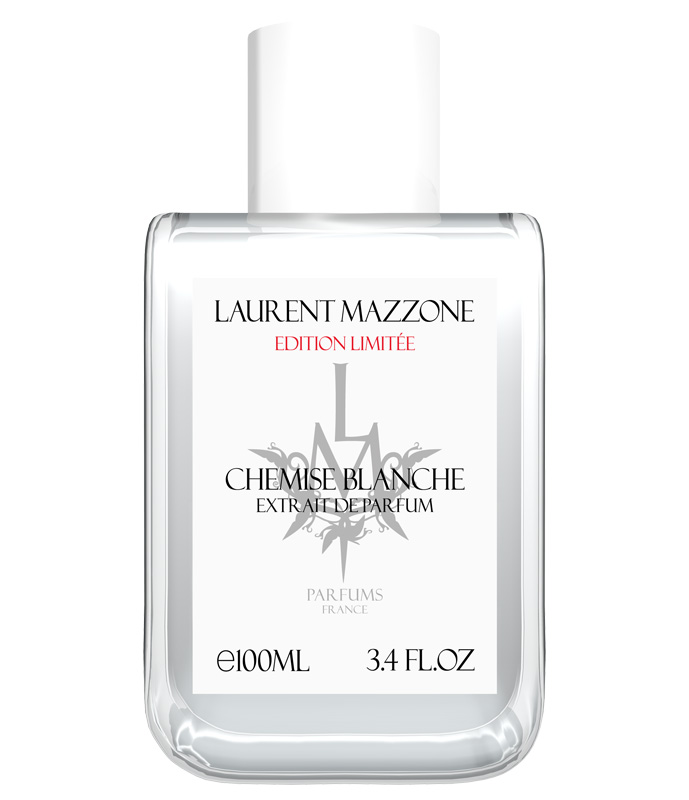
Even before this incident, Mr. Mazzone had quickly caught onto my personal tastes, which strongly mirror his own, so it wasn’t a surprise when he immediately noted that I would very much dislike another perfume that he had included in the very generous “samples.” It was the new, recently released but limited-edition Chemise Blanche which — unlike its siblings — is not done in a black, velvet box imprinted with the LM Parfums logo. It’s also not in one of the black bottles that Mr. Mazzone has intentionally made almost just barely opaque, but not quite. He was concerned that perfume owners would not be able to see how much was left in their bottle if it was a solid black, so he specifically had the glass done in a way which would show how much liquid was left if the bottle was held up to the light. I loved the thoughtfulness and attention to detail involved in that, especially as the issue of remaining quantity is a problem that I always have with my old, jet-black bottle of Fracas.

Chemise BlancheInstead, Chemise Blanche is in a clear, glass bottle and in a white velvet box. The reason Mr. Mazzone was sure I would dislike it is because it is very much the opposite of my favorites from his line: it’s a perfume centered around aldehydes and citruses. To me, it very much evokes something crystalline in visuals, almost Alpine, if you will: white, pure, clear, airy, and very light in feel, despite being an extrait in concentration. According to Fragrantica, the notes include:

aldehydes, bergamot, mandarin, iris, lily of the valley, rose, benzoin, tonka, amber and musk.

To my surprise, given my loathing for aldehydes, the note was much tamer than I had expected but, alas, even Mr. Mazzone admitted that Chemise Blanche smelled of soap and dishwashing liquid on my skin. (By now, sniffing yet my another portion of my shoulder, we were really receiving some strange looks!) Chemise Blanche is not my style at all, and my skin is always a huge problem when it comes to aldehydes, but I freely admit that the perfume is very well-done. Actually, with a few wearings, I occasionally persuaded myself that Chemise Blanche might almost be something I would opt for if I were looking for a crisp, light, gauzy perfume with a citric edge. Almost. I’m wearing Hard Leather as I write this, and I doubt I would ever go for crystal white when I could have shades of richly burnished brown, red, black and amber instead!

Nonetheless, Chemise Blanche turned out to be quite a hit with my friend with whom I was staying and who has very difficult perfume tastes. It’s not only that she is someone whose tastes are the polar opposite of mine; it’s also that she finds almost everything to be “too sweet” or “too strong.” She recoils in horror at even the slightest bit of Orientalism or spice, isn’t a huge fan of most pure florals, and adores airy, light, clean and citrusy fragrances. Even in that last category, however, she thinks the vast majority are “too sweet.” (It was quite interesting going perfume-shopping with her one day! No matter what citrus fragrance I found for her, almost all were rejected and, in a few cases, deemed to be “too masculine” as well.) Chemise Blanche, however, smelled lovely on her skin, and she seemed almost convinced that it wasn’t the dreaded, verboten “sweet.” (It is not. Not even remotely!) So, I left her a large decant for her to test out while she decides if it is full-bottle worthy. 

Laurent Mazzone. Source: unique.ru.com

Laurent Mazzone. Source: unique.ru.com

All in all, I had an absolutely wonderful time meeting Laurent Mazzone, his partner, and Fabienne. They were incredibly warm, friendly, effusive, generous, and filled with life. It was truly fun, whether we were laughing over Mr. Mazzone’s astringent views on some of the Paris Fashion Week collections, sniffing each other publicly, or having passionately robust discussions about the state of perfumery in the past versus today.

You know, all perfumers talk or claim that they put a little bit of themselves or their personalities within each fragrance, but it’s not always true. Commercial perfumery certainly doesn’t have that, and neither do some purportedly “niche” lines. Yet, in sniffing the various LM Parfums, I can actually and genuinely see a little bit of Mr. Mazzone in most of them. There is a quietly refined, passionate lustiness or sensuality in the ones that I’ve tried — whether it’s the overtly sexy Sensual Orchid, the smooth, sweetened, goldenness of Ambre Muscadin, the hugely smoky Patchouli Boheme with its almost mesquite-like opening, or the more masculine Hard Leather — that really seems to epitomize different parts of the gregarious, outgoing, exuberantly passionate man I met. Chemise Blanche seems to be an anomaly, at least to me personally, in terms of that character assessment theory, but the line certainly carries something for everyone and its clean crispness should definitely appeal to some modern tastes.

I may end up doing a proper review for Chemise Blanche down the line, but I definitely plan to cover Patchouli Boheme and Ambre Muscadin. Hard Leather as well, when it is released next month. In the meantime, if you have the chance to try any LM Parfums, do give them a sniff. The line is now in the U.S., and is no longer exclusive to Europe. Plus, Osswald in New York has a very affordable deal on samples which should make testing quite easy. For readers in Europe, the line is not hard to find, and LM Parfums sells 5 ml decants at a very reasonable price (€14 or €19). As for me, I suddenly fell upon the genius idea of layering Sensual Orchid with Hard Leather on occasion, and now, I really have to get my hands on a proper decant of both. The people at the Hotel Costes are lucky they’re not around to witness my reaction….

[UPDATE: I have now reviewed Ambre Muscadin and Hard Leather, with shopping information and pricing information provided in the appropriate reviews.]

Disclosure: Some of the perfumes covered in this post were, as noted, provided by LM Parfums. There was no financial compensation for any of this. I don’t do paid reviews or posts, and my views are my own. 

DETAILS:
Cost & Availability: LM Parfums always come in a 100 ml/3.4 oz bottle. The European price is generally either €120 (€125 at some online vendors), or €195 (or £195). The American retail price is either $175 or $225. In the U.S.: Laurent Mazzone’s fragrances used to be European exclusives, but the range just came to America two months ago. It’s sold exclusively at OsswaldNYC. For some strange reason, the website seems to show only two fragrances now, and not all the ones it had earlier when I reviewed Sensual Orchid. In terms of samples, none of the U.S. perfume sample sites currently carry the LM Parfums line, but Osswald has a special deal for all its perfumes for U.S. customers who telephone the store: 10 samples for $10, with free shipping in the U.S., and it’s for any perfumes that they stock! That means the full, existing, current LM Parfums line (or whatever parts they may now carry of it), and some other goodies only found at OsswaldNY, for less than a $1 a vial! The deal is only available for telephone orders, however, so you have to call (212) 625-3111. Outside the U.S.: In Europe, you can buy the perfumes directly from LM Parfums for €125 or €195. (At this other LM Parfums site, some of the bottles are priced at €120.) Samples are also available for €14 or €19, depending on the perfume in question and its concentration, and they come in a good 5 ml size. In the UK, the LM Parfums line is carried exclusively at Harvey Nichols. In France, you can find the perfumes, and 5 ml samples of each (usually about €14) at Laurent Mazzone’s own Premiere Avenue. In Paris, LM Parfums are sold at Jovoy. Germany’s First in Fragrance carries the full line and sells samples as well. You can also find LM Parfums at Essenza Nobile, Italy’s Vittoria Profumi, or Alla Violetta. In the Netherlands, you can find LM Parfums at Silks Cosmetics or Parfumaria. In the Middle East, I found most of the LM Parfums line at the UAE’s Souq perfume retailer. For all other countries, you can find a vendor near you from Switzerland to Belgium, Lithuania, Russia, Romania, Croatia, Azerbaijan, and more, by using the LM Parfums Partner listing. Laurent Mazzone or LM Parfums fragrances are widely available throughout Europe, and many of those sites sell samples as well. 

Histoires de Parfums Ambre 114: The Golden Touch

"Goldfinger" movie still. Source: businessinsider.com

The woman in gold from “Goldfinger.” Source: businessinsider.com

Imagine diving into a pool. You fall head long into rich, heady, salty, sweet, slightly smoky, dense but smooth, creamy, caramel waters. Fifteen minutes later, when you get out, your skin is coated with an almost translucent, airy haze of gold. That shimmering touch made me think of James Bond’s villain, Goldfinger, who would undoubtedly approve of the golden Ambre 114, a fragrance from the extremely talented (and sadly under-appreciated) French niche perfume house, Histoires de Parfums.

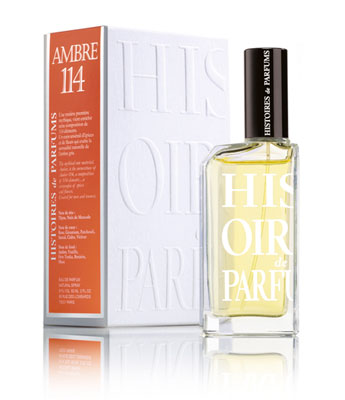
Ambre 114 in the large 4 oz size.

Ambre 114 in the large 4 oz size.

In fact, if Goldfinger had been an actual person, he would have been the perfect inspiration for a perfume house that seeks to capture the essence of famous characters and mythical years in a bottle. Histoires de Parfums was founded in 2000 by Gérald Ghislain who seems to be on a mission to create lyrical perfumed tributes to history. As the Histoires de Parfums website explains, each of the early fragrances was entitled just with a date in history, the year in which a legendary figure was born, with attention being paid to everyone from the Marquis de Sade and Casanova, to Mata Hari and Ernest Hemingway. One of the few exceptions to the rule, however, is Histoires de Parfums’ Cult Books Collection which is intended to be a timeless interpretation of the issue of sensuality from the East to the West. In the case of Ambre 114, it is the East who is speaking, giving “an oriental vision of voluptuousness” that is centered around sweetened amber done in the airiest of manners.

The "half" bottle of Ambre 114 in the 2 oz/60 ml size.

The “half” bottle of Ambre 114 in the 2 oz/60 ml size.

The company’s description for Ambre 114, along with its notes, is as follows:

This mythical raw material improves a 114-element composition. A caravanserai of scents for this hot oriental intensifying the natural sensuality of grey amber, sweet perfume and tinted with exoticism.

In the Orient, women used to burn incenses, myrrh and amber. It is an oriental vision of voluptuousness.

Top Note: Thyme, Nutmeg
Heart Note: Rose, Geranium, Patchouli, Sandalwood, Cedar, Vetiver
Base Note: Amber, Vanilla, Tonka Bean, Benzoin, Musk.

Source: e-boolean.org

Source: e-boolean.org

Ambre 114 opens on my skin with a powerful burst of ambergris. For those who haven’t experienced it, ambergris is a very different kettle of fish from the usual “amber” found in most fragrances. Extremely rare and unbelievably expensive, genuine ambergris has a salty, sweet, musky quality that is almost (just barely) sweaty and marshy in feel. It’s hard to explain, but the aroma is intensely rich, smooth, buttery and deep. On my skin, it almost invariably smells of salted caramel, and Ambre 114 is no exception. The fragrance shows off all of ambergris’ beautiful features in a bouquet that is strongly infused with patchouli. The latter is dark, dense, almost dirty, with a chewiness like the thickest brownie. The patchouli is just lightly smoky and spicy, creating a visual swirl of black with red and gold. When mixed with the ambergris, the result is Ambre 114’s primary bouquet on my skin: salty-sweet, musky, caramelized amber with chewy, smoky, spicy, black patchouli.

Ambre 114’s main duo is lightly sprinkled with green notes in the opening 20 minutes. There is a definite herbal component to the scent, though it never smells of thyme to me. Instead, it feels more generalized, abstract, and indistinct in nature. For a brief moment, though, there was something almost minty lurking about the golden ambered bouquet. Whatever the herbs may be, they occasionally have a slightly medicinal undertone, though it’s extremely light and muted. It’s almost like you’ve entered an old Chinese holistic shop filled with dried herbs, instead of a medical one, if that makes any sense.

Source: footage.shutterstock.com

Source: footage.shutterstock.com

The herbs aren’t the only green elements in Ambre 114. There is vetiver as well, though there is something odd about it in the opening moments. I can only describe the aroma as an earthy “meatiness.” I think the earthy, rooty vetiver must have combined with the salty, slightly mushy, musky aspects of the ambergris to create an aroma that is almost truffle-like in its undertones. Whatever its source, the aroma is just a brief flicker that dies away after about five minutes. A much stronger note is the geranium, though it’s not the flower so much as the fuzzy green leaves. They add a wonderfully peppered, slightly spicy piquancy to the scent, ensuring that the scent’s sweetness never turns cloying or excessive.

In the background, there are flickers of other things, too. There is nutmeg, adding a slightly bitter edge that, again, helps counter the sweetness from the ambergris. Faint touches of vanilla lurk in the base, while far, far below is the merest suggestion of a floral note. It’s peppered, but it’s not geranium, and it definitely doesn’t smell like a rose, either.

Source: wallsave.com

Source: wallsave.com

All these elements are really just supporting players on a stage dominated by the waltzing ambergris and patchouli. Ambre 114’s primary and dominant bouquet on my skin is salty-caramel sweetness mixed with smoky patchouli. It’s rich, plush, warm and sweet, but never truly gourmand or dessert-like in nature. Ambre 114’s core essence remains largely unchanged on my skin, though the degree and strength of some of its notes — especially the secondary notes — vary in significance. After about 20 minutes, the vanillic resin (benzoin) slowly starts to rise to the surface. It dilutes some of the ambergris’ musky, salty qualities, and adds further sweetness. There is a touch of light powder underlying it, too, but it’s never like makeup powder and certainly not very heavy.

In fact, nothing about the scent is heavy at all. Though the fragrance is very potent for the first forty minutes, it’s astonishingly light in feel. Ambre 114 is effortlessly refined, smooth, creamy, heady, cozy, comforting and sexy — all in a billowing, soft cloud that coats your skin like a gold sheath. It’s not an easy trick to take such heavy ingredients and turn them into air, while still keeping the scent very strong. I’ll be honest, it’s actually too airy for my personal tastes; yet, there is also something quite appealing about how effortlessly Ambre 114 surrounds you like the thinnest but softest cashmere sweater. You can only admire the talented touch who created it.

Source: de.123rf.com

Source: de.123rf.com

Ambre 114 slowly changes. Forty minutes in, many of the notes have melted into the amber. The geranium, herbs, nutmeg, and earthy, green vetiver have vanished. The ghostly impression of something floral faded away long ago. Even the patchouli seems to have taken a back seat to the ambergris. Much more noticeable, however, is the vanilla resin, along with its light touch of sweetened powder. The whole thing becomes a beautifully blended swirl of notes, dominated by the ambergris. By the middle of the third hour, however, Ambre 114 has lost its caramel aroma, and is now primarily a sweet, slightly musky amber with vanilla. There are bursts of patchouli that pop up every now and then, if you sniff really hard, along with a sprinkling of sandalwood. The fragrance remains that way for a number of hours until the end of the fifth hour when it turns into an abstract, vague, generalized blur of sweet amber with some vanilla powder and perhaps the faintest suggestion of sandalwood.

All in all, Ambre 114 lasted 7.5 hours on my perfume-consuming skin. The sillage was never enormous to begin with, but it drops even further after 90-minutes. At the end of the third hour, Ambre 114 hovers right above the skin, though you can easily smell its golden notes if you bring your nose to your arm. By the start of the fifth hour, Ambre 114 intimately coats the skin like the sheerest, thinnest gauze, and is increasingly hard to detect. This is not a powerful projection monster, by any means.

Ambre 114 shares a few similarities to some other amber fragrances. Parts of the opening evoked Serge Lutens‘ pioneering Ambre Sultan, but Ambre 114 is a faint, ghostly whisper of that fragrance’s famously potent, intense herbal blast. Plus, Ambre Sultan is really an ode to labdanum, not ambergris, and there is a substantial difference in the two resins’ amber smell. Ambre 114 also reminded me of my favorite amber of them all: Profumum Roma‘s Ambra Aurea. The primary reason is that salty-sweet, marshy, musky, caramel aroma from the ambergris which dominates both scents. That’s where the similarities end, however, as Ambra Aurea lacks Ambre 114’s vanilla and powdery elements, and also has a significantly different weight. Ambra Aurea is like the richest, heaviest fur coat you can buy, while Ambre 114 is the softest, thin cashmere sweater.

Another perfume repeatedly comes up as a point of comparison: Maître Parfumeur et Gantier’s Ambre Precieux. It’s an extremely well-known, much beloved amber that reportedly has a strong vanilla (and vanilla powder) component. I haven’t tried it, but thankfully, a friend has. The Scented Hound‘s review for Histoires de Parfums’ Ambre 114 amusingly states: “If Serge Luten’s Ambre Sultan and Maître Parfumeur et Gantier’s Ambre Precieux had a baby, this is what it would smell like.” He had a different experience with Ambre 114 than I did, so his description may be useful:

WHAT I SMELL:  Almost icy/hot to the touch, Ambre 114 goes on medicinal; the thyme is very evident.  Then as quickly as that leaves you, out comes the geranium note.  I can tell that there’s a bit of amber in there, but I am getting more vetiver at the beginning than amber.  Slowly, the spiciness then wafts up through the other notes.  It starts to warm and then begins to open to that lovely rounded amber that any amber lover craves.  What you are left with is a lovely vanilla’d creamed amber that wraps you in a wonderfully warmed blanket perfect for the long winter nights.

He really enjoyed Ambre 114, concluding that it was “lovely and if I didn’t own so many ambers at present, I probably would be buying a bottle. This is easily a comfort scent.” The Scented Hound is not alone in his opinion; almost every other blogger who has covered Ambre 114 either likes it or raves about it.

Even really picky perfume critics give it a thumbs up. Ambre 114 gets a Four Star mention in the famous perfume bible, Perfumes: The A-Z Guide, by Luca Turin and Tania Sanchez. The latter had a third type of experience with Ambre 114, one in which the rose note was quite prominent, judging by the perfume’s description as “benzoin rose.” The very brief review states:

A beautiful, durable amber accord built of benzoin, patchouli, vetiver and rose. Its transparent smoky sweetness feels weightless, as if hollowed out in the middle to make it float.

On Basenotes, Ambre 114 has a 100% positive rating. Out of 18 reviews, 78% give it Five Stars, 11% give it Four, and 11% give it Three. The main issues leading to some hesitation were that the fragrance was “too simple,” and “weak on longevity.” One positive review, from “alfarom,” reads:

Amber is a dangerous territory where sweetness can easily become overwhelming turning a fragrance into an unbrearable heaviness. The big point of strength of Amber 114 is its extremely balanced blend of spices/herbs and resionus notes (mainly benzoin) joined by woods and rose that make of this composition quite an easy wear in which sweetness is carefully tamed and dosed to become a side aspect. Overall I’d say that while Ambre 114 can be considered as one of the most complex and deep ambers around, at the same time it is outstanding for its incredible wearability and “lightness”. These things don’t happen by accident. Amazing Stuff!

I think he’s right about the lightness, but I experienced a much simpler, more linear scent that he did. It certainly wasn’t “complex” by any means.

What’s interesting to me about reading other people’s accounts of the scent is how extreme the different experiences or perspectives can be. Some think Ambre 114 is a deliciously gourmand, sweet scent. Others — including one chap who explicitly states that he “abhor[s] super-sweet amber scents” — don’t think the fragrance is sweet at all. Some commentators detect the rose, while others join the Scented Hound and me in not smelling any, or in experiencing a lot of nutmeg instead. Half the commentators, including those who give the fragrance five stars, think Ambre 114 has below average projection and so-so longevity, while others have the opposite opinion. One commentator says “You can get a clear 15+ hours out of this” — which really makes me wonder just how much he sprayed!

On one of the many, many Basenotes threads discussing Ambre 114, I came across something else I found interesting. People who don’t generally like amber fragrances like Ambre 114. I’m guessing the cozy vanilla is partially responsible, because Ambre 114 isn’t really a hardcore, spicy oriental fragrance in my opinion. It’s definitely more of a comfort scent that straddles the line between Oriental and Gourmand. The other factors in swaying amber-haters may be just how light, airy, and discreet the scent is. People who don’t like amber fragrances generally seem to struggle with the weight, or find the note to be too much. It’s either too sweet, too spicy, too rich, or some combination of the above. Ambre 114 avoids all that, as it is a very uncomplicated, safe, gauzy, approachable scent. Plus, its extremely soft sillage makes it a scent that a number of people have said they feel comfortable wearing to the office.

Another positive is that Ambre 114 is quite affordable for such a high-quality scent, at least relative to most niche fragrances. The smallest size is 2 oz/60 ml and retails for $125, whereas most niche perfumes start with 1.7 oz /50 ml and often cost quite a bit more. Plus, it’s not hard to find retailers who carry a practical, travel-size 14 ml decant of the perfume that you can buy for $36. (See below in the Details section.) The decant is an affordable way to enjoy the perfume a good number of times while you decide if it’s worth buying a full bottle.

All in all, I like Ambre 114 quite a bit, though it will never be my favorite amber. For me, personally, it’s too translucent and light, the sillage is too low, the longevity on my wonky skin isn’t great, and I don’t think it is distinctive enough. The extremely long-lasting Ambra Aurea suits my style and tastes much more, especially as it’s centered almost completely around salty-sweet, musky caramel and the ambergris isn’t diluted by vanilla. However, I think if I’d experienced some of the rose or woods that people talk about, my views on Ambre 411 might well be different. It might have the edge that would make it stand out and feel a little more interesting. Regardless, I think Ambre 114 is a beautifully blended, well-balanced, extremely cozy fragrance that feels very effortless and is very easy to wear. As ambers go, it’s a refined, elegant take on the note, and I thoroughly enjoyed wearing it.

In short, I definitely recommend Ambre 114 for those of you who are looking for a light amber fragrance that doesn’t overwhelm you, is soft spoken, appropriate for the office, and very cozy in nature. Its warm sweetness and feathery softness feel very much like that favorite sweater that you wear when you want to curl up, relax, and be absolutely comfortable.

On that note, I will leave you with the song that has been in my head since the start of this review: Dame Shirley Bassey singing “Goldfinger.” It’s not the best audio version, but you’ll see the famous woman in gold, along with a young Sean Connery as 007. Ambre 114 has the golden touch, as well.

DETAILS:
Cost, Availability, Decant Sets & Samples: Ambre 114 is an Eau de Parfum that comes in two sizes: 2.0 oz/60 ml for $125 or €145; or 4 oz/120 ml for $205. (Further decant or mini-sized options are below). Both full bottle sizes are available on the Histoires de Parfums website, which also has a fantastic sample program (6 samples of your choice) whose $20 price goes towards the purchase of a large 4 oz. bottle. Further details are available here as to how the process works. Shipping is free for all orders anywhere in the world for purchases over $130; below that, there is a $10 shipping fee. In the U.S.: Ambre 114 is available from Luckyscent in both sizes, along with samples. BeautyHabit has not only the 2 bottles, but also a 14 ml decant for $36. Parfum1 sells the 2 oz size bottle, along with samples and the 14 ml decant. They ship world-wide. Ambre 114 is also found at MinNewYork in the smaller $125 size. The Perfume Shoppe (which has a Canadian division) sells 14 ml decants of Ambre 114 for $36. Outside the U.S.: In the UK, you can find Ambre 114 at the Grooming Clinic for £74 for the smaller 2 oz/60 ml bottle. Roullier White carries some Histoires de Parfums fragrances, but Ambre 114 is not listed on their website. In Paris, the boutique, Nose, carries Ambre 114, as does Jovoy. For the rest of Europe, you can find it at Italy’s Alla Violetta or Germany’s First in Fragrance for €145 for the 2 oz bottle. In Russia, Ambre 114 is sold at Orental. In Australia, you can find it on sale at City Perfume for AUD$180 for 2.0/60 ml oz or at the full AUD$190 price at Peony Melbourne. For all other countries, Histoires de Parfums vast Store Locator lists retailers from South Africa to the Netherlands, Sweden and Kuwait. Samples: You can find samples at a number of the retailers linked to above. I got my test vial from Surrender to Chance has a variety of different options and sizes for Ambre 114, from samples to decants. Samples begin at $4.99 for a 1 ml vial.