Arabian Oud Sehr El Kalemat

Source: Gamma Parfums, Russia.

Source: Gamma Parfums, Russia.

Some perfumes are an immediate love affair, some are immediate hate, a few can result in total apathy or boredom, but many take a few tries for you to make up your mind. Personally, I tend to know what I like or don’t like pretty much right off the bat, but, occasionally, I’ll come across a perfume where I’m ambivalent and truly undecided, no matter how many times I test it. Sehr el Kalemat from Arabian Oud is one of those fragrances.

Sehr el Kalemat is a flanker to the popular Kalemat (sometimes written as Kalamet, with an “e,” and a few other linguistic variations). I love the original Kalemat, and it is only fragrance where I’ve urged people with a specific sort of perfume taste to buy a scent blindly. One of my readers, Feral Jasmine, purchased both Kalemat and its flanker, Sehr el Kalemat, and kindly offered me a sample. The caveat: I had to write honestly what I thought about it, without worrying about her feelings. I never have a problem being blunt or candid, but, in this case, I’m truly at a bit of a loss as to what I think. I’m at the end of my fourth test of Sehr el Kalemat, and I think the most accurate description of my reaction is that I’m underwhelmed. Torn, conflicted, but generally underwhelmed.
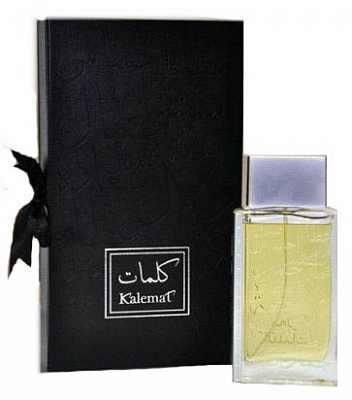
Seher KalematBefore I get to the scent itself, I have to go through the confusing issue of its name. Like many Middle Eastern fragrances, the perfume has a few alternative spellings, such as Sehr Al Kalemat (on the official, Arabian Oud website), Seher Kalemat (on eBay), or Seher Al Kalemat (on some online retailers). Some perfumistas call it Kalemat Black, perhaps because of the black box, while a few on Basenotes get confused over how Kalemat Black is actually perhaps Kalemat White because of the silver-white plates on the side. I’m going to go with Sehr el Kalemat as it is easier to type, and that is how the fragrance is spelled on Arabian Oud’s Amazon listing.

As always with anything involving Arabian Oud, it’s an utter nightmare trying to get concrete, definitive, set details on the fragrance. Arabian Oud has no description for it on its official, Middle Eastern website. Its UK one doesn’t even list the perfume! The few other retailers that do offer Sehr el Kalemat have substantial differences in the notes that they include, and completely disagree with Arabian Oud about the bottle size.
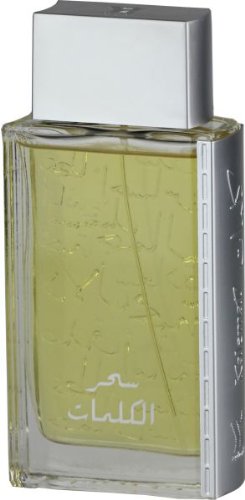
The bottle as shown on Arabian Oud's Amazon page.

The bottle as shown on Arabian Oud’s Amazon page.

According to Arabian Oud‘s Amazon listing, Sehr el Kalemat is either a 75 ml or a 100 bottle of eau de parfum with:

Top Note: Cardamom, bergamot, pink pepper Middle Note: Saffron, coriander, Bulgarian rose Base Note: Amber, vetiver and sandal 75 ml. [Emphasis added.]

However, a different page on Amazon from the same company states:

Between Patchouli flower, violet and bottom Albergmot wonderful mixed layer through a mixture of vanilla and touches of Oud eventually subside on the bottom of musk and amber luxury.

Meanwhile, a vendor site in South Africa, Fragrances Unlimited, writes what seems to be a slightly (slightly!) closer description of the fragrance that I experienced:

Following the success of the legendary perfume, Kalemat,comes Seher Al Kalemat, the name literally mean Magic of the Words, another designer outfit pairing black and silver. This new hit from Arabian Oud is an elegant fragrance recomposed around fruity aromatic facet & delicately oriental trail. Of the 3 original facets of Seher Al Kalemat (Fruity,Woody & Oreintal) the oriental one wins thanks to the Amber, musk and vanilla base note.

Top Note: Bergamot, Rose and Saffron

Heart Note: Patchouli, Sandalwood, Violets and Guaiac Wood

Base Note: Vanilla, Amber and Musk

Size: 100 ml

Type: Eau de Parfum

Between Arabian Oud’s hot mess of a website, the sizing differences, and the big variation in notes depending on site, I’m a bit frustrated, but I would say the notes that I personally detected are something more like this:

Spices, Berries, Patchouli, Rose, Saffron, Guaiac Wood, Incense-y tonalities, something almost oud-y, Vanilla, Amber,  and Musk.

As mentioned above, I’ve tested Sehr el Kalemat a few times, using different quantities and amounts. For the most part, the fragrance is exactly the same, minus some minor variations on the opening with a lesser amount (2 sprays). I’ll give you the general development with a larger application of 4 small sprays.

Source: Dailykos.com

Source: Dailykos.com

Sehr el Kalemat opens on my skin with peppered berries, saffron, and amorphous spices, though not cardamom or coriander, per se. It is followed by patchouli, honey, a dash of a rose note, and some abstract, amorphous, dry woodiness. The berry note is interesting because, to my nose, it smells identical to the blueberry purée that the original Kalemat opens with, along with the merest whiff of something verging on raspberry. I don’t know if the notes are the result of the very fruited, purple patchouli, of the “pink pepper” berries mentioned in one list, of both elements together, or something else entirely. To me, the opening smells like Kalemat’s “bilberry” or blueberry, and I’m a bit of a sucker for it. As a whole, Sehr el Kalemat’s overall, opening bouquet on my skin when smelled from afar is that of blueberries, patchouli, and saffron.
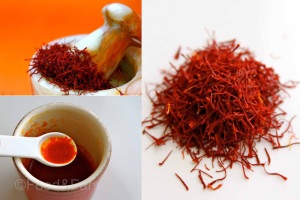
Saffron. Source: FoodandFarsi.com (Website link embedded within.)

Saffron. Source: FoodandFarsi.com (Website link embedded within.)

All the other notes are folded within that main trio. There are hints of a dry smokiness underlying Sehr el Kalemat, but it never feels like actual frankincense. The rose is extremely muted at this stage, and so is the undercurrent of honey. The woodiness can’t be teased out as something individually distinct or specific at first. At no point, however, can I detect any violet whatsoever in Sehr el Kalemat’s development, nor any bergamot, vetiver, or sandalwood (real or otherwise).

What does appear instead, especially if a very small amount of Sehr el Kalemat is applied, is cocoa and an almost cold, metallic scratchiness. While cardamom (listed in one version of the perfume’s notes) can occasionally take on a cocoa powder nuance, I’m detecting something more genuinely chocolate-y in tone. The first time I tested Sehr el Kalemat and applied only a little, the bouquet after 15 minutes was of cocoa-dusted berries with saffron, vanilla, synthetic dryness, honeyed amber, slight smoke, and a faintly oud-y wood. The cocoa was a rich, almost buttery, thick chocolate with a nutty undertone that soon mixed with a very custardy vanilla in the base. I chalk the cocoa up to the patchouli, though the latter generally tended to be more fruited in nature on my skin than the darker, earthier variation of the note. Either way, the cocoa and vanilla accord only seems to appear in the opening phase if a small amount of Sehr el Kalemat is sprayed. Now, as I repeat often, my skin amplifies base elements and sweetness, so that is perhaps the cause, as Sehr el Kalemat is not generally a super-sweet (let alone a gourmand) fragrance for most of its life.   
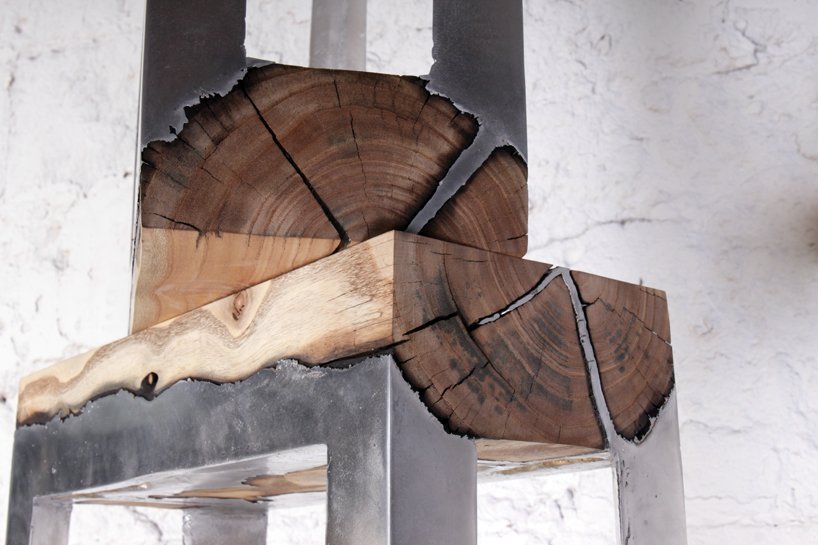
Wood and steel welding, via Wikitree and also jeanniejeannie.com.

Wood and steel welding, via Wikitree and also jeanniejeannie.com.

The scratchy, dry, dusty, almost metallic, steeliness in Sehr el Kalemat is a given, no matter how much of the fragrance I applied. It always appears about 15-20 minutes into the fragrance’s development, transitioning it from a very berried, fruity, saffron, honeyed amber scent into something that is distinctly drier, sharper, and smokier. Sehr el Kalemat has a definite smoke element, but it never feels like pure frankincense to me, and really verges more on the dusty, dry, almost sharp aroma of something burnt in the outdoors. Yet, it’s not the full-on sharp intensity of cade nor birch tar’s campfire smoke, either.

Photo: Jo Van Damme on Flickr. (Website link embedded within photo..)

Photo: Jo Van Damme on Flickr. (Website link embedded within photo..)

To me, it has the characteristics of guaiac wood: singed woods with an aroma like that of burnt leaves in a large autumnal bonfire. Something about it has a scratchy steeliness, which I realise makes no sense unless you’ve actually tried Sehr el Kalemat for yourself. The whole thing also feels rather synthetic in nature, if truth be told. It’s like guaiac wood’s dry smokiness on some sort of aromachemical steroids to make it extra arid, scratchy, and sharp.

What is disconcerting to me, and part of the reason why I’m so torn on Sehr el Kalemat, is that the steely burnt woods are simultaneously wrapped up with blueberry saffron compote, honeyed amber, and a touch of syrupy roses. It’s an oddly overwrought, jangling bouquet of opposites, as if Arabian Oud threw every contradictory thing that it had at the basic, original Kalemat structure. And yet… it grows on you. Sometimes. I think. Or perhaps not. Perhaps I’m merely oddly enraptured by blueberry-saffron-honey compote? Quite honestly, and in all candour, I don’t know what to make of it myself, or even how I feel most of the time about this very odd variation of Kalemat. Perhaps I merely like the parts of Sehr el Kalemat that resemble the original? One thing is definite though: I much prefer Kalemat to this flanker version.
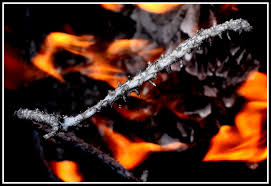
Burnt Wood, via Docmattk on Flickr. (Website link embedded within photo.)

Burnt Wood, via Docmattk on Flickr. (Website link embedded within photo.)

At the end of the first hour, the extremely dry, occasionally searing, burnt smoke vies with the fruited, saffron, patchouli, honeyed sweetness for dominance. A synthetic, sharp, but clean, oud aromachemical adds to the dusty, scratchy aridness of the top notes. The two together cut through a lot of Sehr el Kalemat’s jamminess, diffusing the sweetness. Underneath, far down in the base, there is the first real flicker of vanilla, but it too feels a little dry. 

The change in sweetness accompanies a change in sillage and weight. Initially, Sehr el Kalemat is seriously forceful and intense in projection, though very light and sheer in weight. This isn’t a dense, opaque, molten fragrance by any means, but its notes are very powerful and Sehr el Kalemat wafts a good 6 inches off the skin in its opening minutes with 4 sprays. A smaller quantity yields a smaller cloud with about a 3 inch radius. Up close, however, Sehr el Kalemat is very powerful. As time passes, that scratchy, steely, synthetic, burnt guaiac note seems to grow in prominence even more when the fragrance is sniffed up closed. After 90 minutes, however, the dry woods cut through the heavy top notes of fruited, saffron sweetness to such an extent that the fragrance feels almost thin, weak, and light in comparison to the opening.
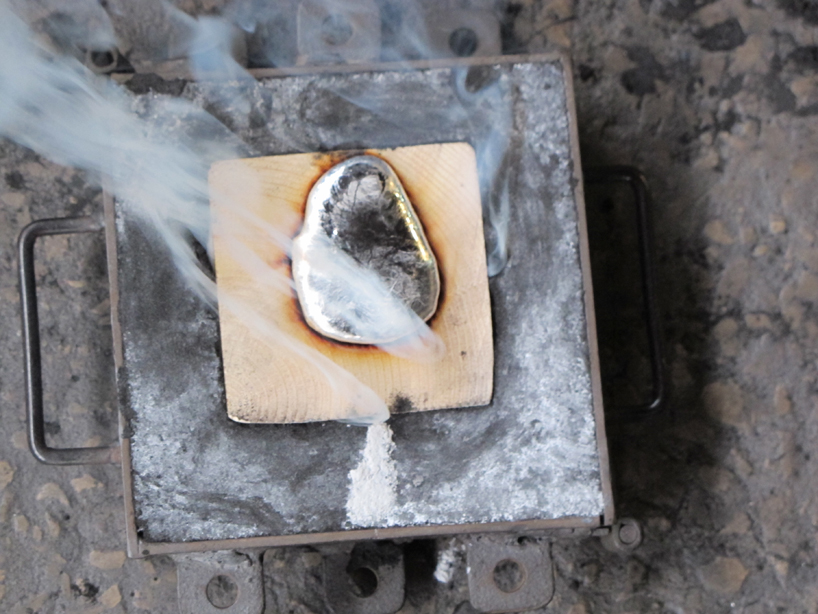
Wood and smoke casting. Source: www.jeanniejeannie.com -

Wood and smoke casting. Source: www.jeanniejeannie.com –

For the next few hours, Sehr el Kalemat doesn’t change its primary focus in any major way. The notes described above vary in prominence and strength, but the fragrance’s core essence remains as berries, burnt woods, and sharp smoke, followed closely by synthetic oud, saffron, jammy roses, honeyed amber, and a touch of vanilla. There is the faintest, tiniest dusting of amorphous spices, though it doesn’t really smell like cardamom and it definitely doesn’t smell of coriander, as one list mentioned. It’s more like a flicker of something verging on chocolate powder, but it’s extremely muted.

Amouage Interlude Man. Source: Vogue.ru

Amouage Interlude Man. Source: Vogue.ru

By the start of the fourth hour, Sehr el Kalemat smells of a super dry, smoky, somewhat oud-y, burnt woods, followed by blueberry-honey that is lightly infused with saffron and amber. It hovers right on the skin, and feels very thin.

I think the sharpness of the dry, smoky woods give Sehr el Kalemat a far greater similarity to Amouage‘s Interlude Man than the original Kalemat ever had, though I think the nature of the smoke is different. In Interlude Man, as well as in the original Kalemat, the note smells more like actual, black frankincense. In Sehr el Kalemat, it’s like burnt trees and burning leaves in an outdoor fire. The note is thinner, drier, more scratchy and sharp, and much less smooth than it is in either Interlude or Kalemat. Plus, Sehr el Kalemat has much more fruitiness than the other two fragrances. In contrast, Interlude has a green, herbal component that isn’t evident on my skin with either Arabian Oud brother. That said, in terms of how dry smoke dominates a stage of the perfume’s development, I can see some parallels between Sehr el Kalemat and the much more expensive Amouage fragrance.    

Source: middleearthadventurer.blogspot.com

Source: middleearthadventurer.blogspot.com

Sehr el Kalemat’s smokiness finally recedes at the end of the 6th hour, as the vanilla appears to soften the fragrance and return it to greater warmth. The perfume is now an abstract, dry, woody fragrance with plummy or blueberry fruits, saffron, honeyed amber, and vanilla, all in a sheer, thin gauze that coats the skin.

Increasingly, the scent turns warm and sweet, until it is merely blueberry amber with honey and vanilla. The saffron, oud, and burnt guaiac dance all around, weaving in and out in the smallest of ways, but they are increasingly hard to detect in any individual, substantial way. Once the real drydown or end-phase begins, Sehr el Kalemat is nothing more than a blurry haze of honeyed sweetness with traces of vaguely fruity, musky, and incense-like elements hovering at the edges.

Stock footage via shutterstock.

Stock footage via shutterstock.

Sehr el Kalemat’s longevity is fantastic. With four tiny squirts from the atomizer, the scent lasted just a fraction over 17.5 hours (!!!) on my perfume-consuming skin. I’ll give you a second to process that astonishing number. Yes, I didn’t quite believe it myself, and, truth be told, there were tiny, dime-sized spots on my skin that still had the faintest trace of honeyed sweetness even after that point. The sillage, in comparison, was generally moderate to low for about 13 of those hours. With a smaller dosage of two small sprays, Sehr el Kalemat’s longevity is naturally much less, but it still clocks it at over 13 hours on my nutty skin. The sillage, however, dropped to virtually nothing with that amount after 90 minutes. 

There aren’t really any in-depth, detailed reviews for Sehr el Kalemat that I can provide for comparative purposes. The Fragrantica entry for the perfume doesn’t have a single comment in it. There is a Fragrantica thread asking for additional feedback after someone fell in love with the fragrance, but the poster doesn’t describe the scent. All that they say is: “I fell in love instantly as it struck me as a hybrid between Guerlain and Amouage creations.” She hasn’t had any replies.

I did find one very succinct, brief review for the scent under the name Arabian Oud Seher Al Kalemat (aka Kalemat Black) on Notable Scents. The review reads, in part, as follows:

* Kalemat Black starts off with sweet incense grounded with dry herbs.

* The projection is powerful and massive, this one is not for the meek of heart.

* A boozy vanilla joins the top notes and the three blend together seamlessly.

* As it begins to calm down (after 3-4 hours), the vanilla dries out as the oud starts to come in.

* The base is a mild oud, nothing too gamey or aggressive.  A slightly sweet amber balances is out.

Kalemat Black is a modern-day powerhouse, lasting more than 24 hours on my skin.  Even after showering, I could still smell the base notes on my skin.  Though not office-friendly, its a really good fragrance for those who want an oud scent that is not medicinal or barnyard, but still referential to traditional Arabic perfumery.

The perfume’s Amazon page has two comments about the fragrance, but only one describes it:

Sehr el Kalemat starts out dry, austere, with something of the scent of a heated cast-iron skillet. At this stage it is very masculine. Over the next hour it evolves to a warm amber with dome fruit and spice, very different from Kalemat but equally unisex. At this point I love it on myself, so I spray an hour or so before work and let it evolve until it’s ready for the general public! But it smells good on men at every stage.

Sehr el Kalemat is slightly more expensive than the original Kalemat for American buyers. The fragrance comes in a 100 ml size (no matter what Arabian Oud may say about 75 ml on a portion of its Amazon description) and costs $89.99. Kalemat is priced in the U.S. at $59.99 price with a discount, though its retail price generally seems to be $99 worldwide.

I think Sehr el Kalemat might be a good choice for someone looking for an inexpensive, dry, woody, slightly masculine Middle Eastern fragrance that bears a microscopic similarity to Amouage’s costly Interlude Man. However, I must emphasize that I personally think the two fragrances are extremely different if you take out the smokiness issue. Interlude Man has a spectacular sandalwood drydown, for one thing, and an aggressive, sometimes difficult, pungently green, herbal start. It is also not a fragrance that I immediately think of as “fruited” or berried as one of its key, main characteristics. That element, however, is a definite part of Sehr el Kalemat on my skin. I also want to emphasize yet again that my skin amplifies base notes, and tends to increase sweeter elements in a fragrance. Those with a different skin chemistry may experience an even drier version of Sehr el Kalemat than I did, so please keep that in mind.

For me, personally, I prefer the original Kalemat. “Feral Jasmine” who sent me my sample says that Sehr el Kalemat grows on one. I can definitely see how it might, though I don’t think it will happen in my case. The things that I like about Sehr el Kalemat, I can simply get from Kalemat itself — and more of it, too. Plus, Kalemat has a lovely tobacco element that I can’t find here, the oud doesn’t smell sharply synthetic, and it doesn’t have that scratchy steeliness about the wood element. In Kalemat, it is dry cedar and frankincense, not burnt guaiac, which are at play, and that makes a difference for me personally. I think it’s also a substantially smoother fragrance that smells or feels more expensive in nature.

Ultimately though, as with everything related to perfumery, it’s a matter of personal tastes and style. I can see some men vastly preferring Sehr el Kalemat to Kalemat because of the significantly greater facade of dry, burnt smokiness, as well as the more noticeable oud element. I think most women (but not all) would have a much easier time with the original Kalemat, as it’s a warmer, more accessible, more inherently unisex fragrance. In all cases, however, if deeply dry, woody smokiness is your thing, you may want to give Sehr el Kalemat a try.  

DETAILS:
Cost & Availability: Sehr el Kalemat is available on Amazon (U.S.) for $89.99 for a bottle that is either 100 ml or “75 ml”, with a shipping cost of $16.48. (Arabian Oud combines shipment if two items are purchased, with a lesser price for shipping the second item.) I think Arabian Oud has a typo with the smaller size listed in the description of the perfume’s notes, as all other vendors have the perfume listed as being 100 ml. Outside the U.S.: Whatever the size, if you’re located outside of the United States, you can also find the fragrance on eBay. One vendor in Kuwait is currently selling the fragrance for $95, and ships worldwide. His eBay store is called Jawimall and carries a few Arabian Oud fragrances, so you are reading this review months from now, you can check to see if he has Sehr el Kalemat in stock. There is also the original, non-UK Arabian Oud website which sells it for (Saudi Riyal) 440 SAR which seems to come to a little over $117 or €85 at the current currency conversion rates. I believe they ship internationally. I don’t find the perfume listed anywhere on the UK Arabian Oud site, and I went through every section. (If you check there, you may want to immediately mute the volume on the site as it plays annoyingly repetitive music incredibly loudly.) Sehr el Kalemat is also not listed anywhere on the Zahras catalog for Arabian Oud. If you ever use the Zahra site, be warned that almost all their perfume notes and descriptions seem to be incorrect. Elsewhere, the fragrance is sold under the name Seher Al Kalemat by Kuwait’s Universal Perfumes in the 100 ml bottle for $115.99, and they ship worldwide. In South Africa, I found the fragrance sold under the same name at Fragrances Unlimited in a 100 ml bottle. Sehr el Kalemat is sold by a ton of Russian online sites, one of which is Gamma ParfumSamples: I obtained my sample from a reader of the blog. I could not find a single place that sold samples of Sehr el Kalemat, although I know The Perfume Court has a few others from the line, like the fragrance oils. However, it does not have the Sehr.

Ex Idolo Thirty-Three

Matthew Zhuk. Source: Ex Idolo.

Matthew Zhuk. Source: Ex Idolo.

There are some incredibly nice people with real talent emerging on the perfume scene, and I think the founder and perfumer behind Ex IdoloMatthew Zhuk, is one of them. He seems to be a genuinely nice chap with a thoughtful bent, a self-deprecating sense of humour, and a passion for perfumery, both vintage and modern.

Thirty-three. Source: Luckyscent.

Thirty-three. Source: Luckyscent.

Mr. Zhuk is a London-based perfumer who sent me his debut fragrance, Thirty-Three (spelled with the hyphen) with full knowledge about my reviewing policy and my tendency towards bluntness. His obviously genuine passion for vintage scents, his desire to create something outside the typical framework of oud fragrances (which he’s studied a lot), and his down-to-earth affability made me really want to love Thirty-three. Plus, it has the most stunning cognac-coloured liquid. Alas, Thirty-three is not for me for a variety of reasons.

Ex Idolo describes Thirty-three and its notes as follows:

Thirty-three is a fragrance crafted from very special ingredients. The soul of the fragrance is built around a vintage oud – distilled in 1980 and aged until its release in 2013. It is also the only modern perfume to use a significant amount of wild-harvested Chinese oud oil and natural Chinese rose oil to build the scent profile. Contrary to most ouds however, Thirty-three is a surprisingly soft and velvety fragrance, and genuinely fits in an innovative space in terms of the wider oud category. Thirty-three is a deep and dark unisex fragrance, with dry and cold facets.

Thirty-three packaging via the Ex Idolo website.

Thirty-three packaging via the Ex Idolo website.

As Mr. Zhuk wrote to me in an email:

Thirty-three is an oud, but in a time where the genre is rapidly commercializing, it sets itself apart with a number of differentiating points. The most important of those are the tone it projects, which is decidedly less harsh than what is typical in the genre, but also because it is the first “western” mainstream release to use a vintage oud in its formulation – in this case, distilled in 1980 (hence the name).

Thirty-three has an interesting set of notes:

Soft black pepper, Candied mandarin, Caoutchouc, Chinese white tea, Chinese rose, Taif rose, Orris, Damascus steel, Rare, natural vintage ouds, Aged patchouli, Heliotropin

Black pimento pepper by R.Boroujerd via Wikicommons.

Black pimento pepper by R.Boroujerd via Wikicommons.

When I smelled Thirty-three from the vial, it was a plethora of: jammy roses; fruited, sweet, purple fruit-chouli; black rubber; fiery black pepper with almost a pimento or chili-like bite; honeyed oud; and a boozy cognac element. On the skin, Thirty-three isn’t very different at first. It opens with the fiercest pepper and chili note imaginable, almost searing the nose, followed by heaping amounts of syrupy, jammy roses that are deeply infused with the purple, fruited, molasses-like patchouli that I hate so much.

Damascus or Wootz steel  in a sword's edge. Source: vikingsword.com

Damascus or Wootz steel in a sword’s edge. Source: vikingsword.com

Then, the discordant, surprising twist occurs. There is a sharp, industrial clang that is chilly, sharp, pungent, and metallic. It has to be the “Damascus Steel” in the notes, as the note genuinely feels frosted and cold. Underneath is a black rubber element that is dry, dry, dry, followed by a rather contradictory warm, boozy cognac tonality. I can’t get over the nose-clearing pepper, or that iced, industrial steel which I’ve never encountered before. I give kudos for originality, but that doesn’t mean I love it.

Milk of rubber or Caoutchouc tree that later turns to black latex rubber. Source: rubberroofingshingles.net

Milk of rubber or Caoutchouc tree that later turns to black latex rubber. Source: rubberroofingshingles.net

The truly unpleasant part is the profound dryness to Thirty-three that burns the back of my throat, creates a tightening in my nose, and sends a searing pain through my head each time I sniff my arm in the opening phase. I’ve tested Thirty-three a few times at different levels and dosages, and the dryness consistently renders my throat scratchy, irritated, and sore.

There must be something synthetic in the base that is triggering such an intense reaction each and every time. In the past, the only thing that has made my throat close up is Norlimbanol, but I don’t smell that in the way that I’ve encountered before. However, Thirty-three has the same sort of intense aridness, verging on the dust in a land undergoing a severe drought, that Norlimbanol can generate. Perhaps it stems from the Caoutchouc element which is the rubber latex from a rubber tree, even though I don’t smell “black rubber” in any significant way after the opening minutes. Whatever the cause, the dusty aridness feels completely discordant and contradictory with all the intensely syrupy, overly sweet, fruited roses.

Turkish rose petal jam via amideastfeast.com

Turkish rose petal jam via amideastfeast.com

The black pepper begins to pipe down after 10 minutes, enabling the other notes to come through, though they’re often hard to detect under the tidal wave of pink jam. There are tiny suggestions of the dried, candied orange, but much more noticeable is a slight woodiness that smells of dried cork with a singed nuance. It is fleeting, and certainly doesn’t smell like oud in any noticeable, individually distinct way. For the most part, all I detect with Thirty-three are roses infused with heaping amounts of syrupy, purple, fruited patchouli molasses. Perhaps the problem is one of skin chemistry; my skin takes fruit-chouli and runs with it, amplifying above much else. Thirty Three is no exception to the rule.

"Cottage Garden Rose-Petal Syrup." Photo: BecR on Food.com.

“Cottage Garden Rose-Petal Syrup.” Photo: BecR on Food.com.

From start almost to finish, Thirty-three is largely roses, roses, and more roses on my skin. There are tiny, subtle variations at first, but everything is muffled under the thick blanket of syrupy roses. About 45 minutes in, the fragrance mellows a little, losing some of its discordant jangle, and almost all of its chilled steel. There are tiny flickers of something vaguely like dry woodiness in the base, but it often feels like a figment of my imagination. There is no question of imagination about the synthetic dusty dryness, however, which remains for about 3.5 hours as a strong underpinning to that fruited rose.

Other changes pertain to sillage. With a large application of 4 sprays, the fragrance softens after 2.25 hours, dropping to about 2-3 inches above the skin, and later turning into a skin scent around the fifth one. With a small dose of 2 sprays, Thirty Three becomes a skin scent after two hours. It’s always a discreet scent as a whole.

A little before the start of the 4th hour, Thirty-three finally shifts. The syrupy, highly sweetened jammy roses finally take a small breather, and there is something vaguely discernible as oud. It’s dry, lightly honeyed, and refined. Texturally, it feels very smooth and almost creamy. Unfortunately, though, it is extremely subtle and muted. Neither the perpetual force-field of pink roses nor the extremely low sillage help detection much. Before I know it, less than an hour later, the note vanishes.

Source: wholeblossoms.com

Source: wholeblossoms.com

At the start of the sixth hour with a large dose, but the fourth hour with a small one, the roses becomes very pretty. They feel incredibly creamy, and petal soft. Though they are still infused with that bloody fruit-chouli, the delicacy of the floral note is really lovely. Gauzy, high-quality, and very refined, it’s the merest breath upon the skin. A subtle powderiness lurks underneath, as does a lingering touch of dryness.

Thirty-three soon transitions into its final drydown phase. At first, it’s a sheer whisper of a powdery rose, but soon the powder takes over completely. At the start of the 7th hour, Thirty-three is powder with a definite soapy tinge to it, and nothing more. It dies as an abstract, sheer blur of soapiness shortly about 9.25 hours from the start with a large dose of 4 sprays, but after 8 hours with 2 small ones.

Source: RGPeixoto on Flickr. (Website link embedded within photo.)

Source: RGPeixoto on Flickr. (Website link embedded within photo.)

As a whole, Thirty-three was a high-quality rose soliflore on my skin. It may not be to my personal tastes, but I can see how women, rose lovers, and those who don’t like conventional or masculine oud fragrances may enjoy it. For me, it’s very much in the same vein as Frederic Malle‘s Portrait of a Lady. I’m not a fan of the Malle, but then I loathe purple patchouli and syrupy sweet roses. Those who approach Thirty Three expecting a truly oud-centered fragrance — like something from Amouage or Xerjoff — may end up disappointed. The perfume may have been intentionally crafted to have a “surprisingly soft” focus and refinement, but to the point of having the oud be nearly invisible?

It’s not merely my opinion. The one review on Basenotes in the official Thirty-three entry reads:

Roses, Roses, Roseeeeeeesssss

Was intreagued by the add copy…..Im a sucker for a fancy presentation as well as oud so ordered a sample from Roullier White which arrived promptly in the mail. The liquid looked gorgeous with its dark almost cognac like hue and I applied it and…..enter The Rose. OK….roses are usually found alongside oud so now big surprise there but after 5 hours there is still just…..rose……

Granted,I dont have a mass spectrografer for a nose but I just cant smell the oud at all.

Quite a disappointment ……..

Well, I did detect other things in the fragrance, but, unfortunately, it was primarily the patchouli, and that incredibly unpleasant, dusty, synthetic element which gave me the most pounding migraine for a while.

Some people are big fans of Thirty-three. I’ll skip detailing the thoughts of Mark Behnke on CaFleureBon who loved Thirty-three, because he praises everything — always, lavishly, and uncritically. Instead, I’ll focus on some other perspectives. Octavian of 1000 Fragrances apparently wrote, sometime this summer, a positive review which I can no longer pull up to link for you. (His site is now closed down, and he has moved onto other things.) However, a small part is quoted on the Ex Idolo website, and reads:

One of the most spectacular compositions of the year comes from an unexpected place… Thirty Three is not “une odeur”, but “un esprit” a quality which refers to the ability of a perfume to “bloom” when you wear it like a living masterpiece.

Tara of Olfactoria’s Travels also enjoyed it, writing:

Thirty-three is extremely well blended. Apart from a burst of mandarin at the start and a beautifully deep red rose accord that persists throughout, the rest of the notes seep seamlessly into the pillowy bed of oud. It is sophisticated and seductive in the mould of the wonderful Rose Oud from By Kilian.

For some reason, I had suspected Thirty-three would be rather masculine, but that’s not the case. It isn’t a macho, hairy-chested, animalic oud at all. It’s highly refined and undeniably soft. It has that skin-melding quality which gives it a sensuous, understated elegance.

She’s right that Thirty-three isn’t masculine, and I actually agree on the issue of a similarity to a Kilian fragrance. In my case, however, I wasn’t thinking only of Rose Oud, but of Amber Oud which is remarkable for not smelling even remotely of oud on my skin. (Nor on that of many others.) Yes, Thirty-three is definitely a feminine fragrance with so little discernible, hardcore oud in it that it feels quite like a Kilian. High quality, pillowy, feminine roses all the way.

The feminine aspect was noted by a reviewer on a different Basenotes thread. As one of two people who had tried the perfume, “gandhajala” wrote:

Gave this a sniff briefly on a mouillette: the oud and whatnot came across as quite woody with slight spice/leather/ tobacco facets; the rose is nice, but personally, I’ve had my fill of oud+rose.
This is certainly not a dirty oud by oud standards and many people on the evening seemed to find the fragrance quite femme.

I didn’t enjoy Thirty-three, but it’s all a matter of personal taste and one’s subjective valuation of certain notes. I think there is a definite segment of the perfume market who may love the perfume. Those who enjoy the heavy patchouli-rose aspect of Malle’s POAL, the pillowy softness of a Kilian scent, the refined cleanness of his ouds, ultra-feminine rose soliflores, or fragrances with almost no major, masculine oud at all, may want to give Thirty Three a sniff. It’s clearly high-quality, and intended to be a super refined take on the note. I think Mr. Zhuk has definite talent, and I look forward to seeing what he does next.

Disclosure: Sample provided by Ex Idolo. That did not affect this review. I do not do paid reviews, and my opinions are my own. My first obligation is honesty to my readers.

DETAILS:
Cost & Availability: Thirty Three is an eau de parfum that is available only in a 30 ml size and which costs $120, CAD $125, or £90. In the U.S.: You can find Thirty Three at Luckyscent and the Twisted Lily. At the time of this review, Luckyscent is back-ordered. Outside the U.S.: In Canada, you can find Thirty Three at Etiket. In the UK, the perfume is available at Roullier White, which also sells samples and which ships throughout the EU. It is also sold at Fenwick, though I couldn’t find Thirty Three online. For other sites in the US, Canada, Hungary, and London, you can check out Ex Idolo’s Purchase page. Further vendors should carry the perfume in 2014. Samples: you can order samples of Thirty Three from a number of the sites listed above. You can also try Surrender to Chance which sells 33 starting at $5.99 for a 1/2 ml vial.

Comme des Garcons Series Luxe: Patchouli – Not Patchouli

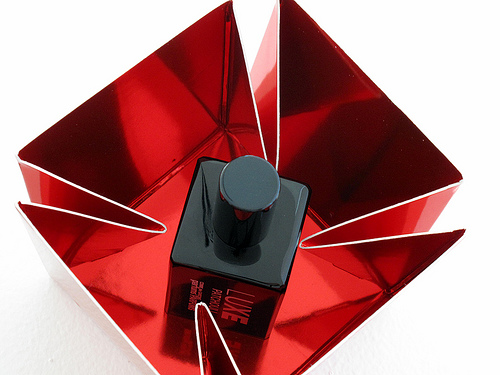
CDG Patchouli Luxe in the pyramid bottle. Source: Fragrantica.

CDG Patchouli Luxe in the pyramid bottle. Source: Fragrantica.

There should be some sort of law against false misrepresentation with perfume names. At the very least, there should be some sort of penalty box where perfumes are sent to be egged when they not only fail to smell of the very thing with which they are titled, but when their primary aroma is something not even mentioned on the bloody list! As you can tell, I’m feeling rather irascible, and the reason is Comme des Garcons‘ endlessly wordy, misleadingly named scent, Comme des Garcons Series Luxe: Patchouli. (Yes, that last bit seems to be the full, official name of the fragrance, which is why I will just refer to it as “Luxe Patchouli” or “Patchouli Luxe” from here on out.)

Luxe Patchouli EDP in the regular bottle. Source: Nathan Branch

Luxe Patchouli EDP in the regular bottle. Source: Nathan Branch

Patchouli Luxe was created by Antoine Maisondieu, and is an eau de parfum that was released in 2007. (There is also an eau de toilette version.) The notes as compiled from Fragrantica and Luckyscent include:

White pepper, fenugreek, bearberry, lovage, oak extract, opoponax [sweet myrrh], patchouli, cedar, vanilla, sandalwood, vetiver.

Photo: Karen Gallagher. Source: morningjoy.wordpress.com

Photo: Karen Gallagher. Source: morningjoy.wordpress.com

Luxe Patchouli opens on my skin with a burst of white pepper quickly followed by smoked, slightly singed cedar, a boozy, vanilla-infused Bourbon, and more white pepper. There are hints of dried greens, dried grass, dried herbs, and smoked vetiver. On their heels is black pepper, fenugreek, dill pickle, and something not included on any ingredient lists that I could see: immortelle. Subtle flecks of a leathery darkness pop in and out of the beautiful pepper and herbal top notes. It’s like a vista of dry yellow and green fields dotted with foraging sheep. The field lies at the edge of a dark cedar and vetiver forest that is smoking, so someone decided to douse the sparks and singed tinder with sprinkles of vanillic Bourbon.

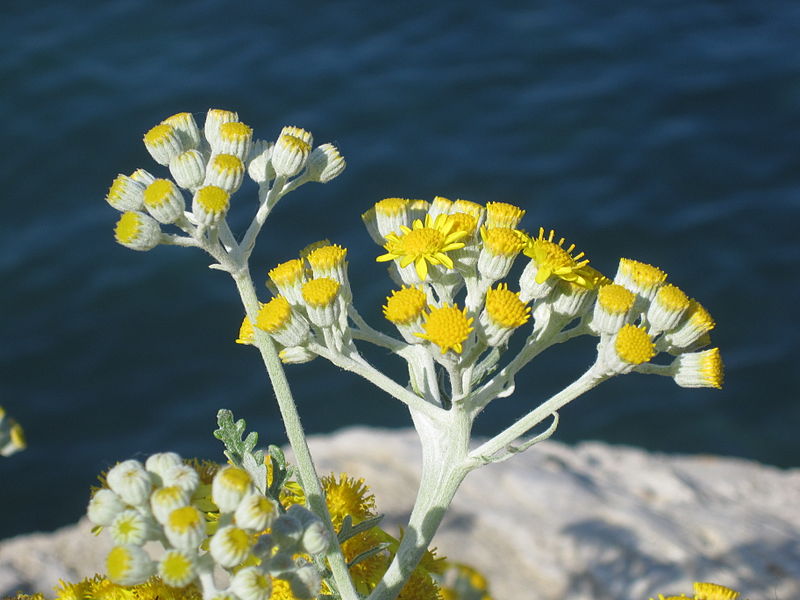
Immortelle, or Helichrysum in Corsica. Source: Wikicommons.

Immortelle, or Helichrysum in Corsica. Source: Wikicommons.

Less than five minutes in, the immortelle or Helichrysum suddenly springs into action, followed quickly by the fenugreek and a faint touch of mildewed woods. For me, Luxe Patchouli should really be called Luxe Immortelle since the flower seems to have been used by the bucketfuls. For a large part of the perfume’s development, the aroma reflects immortelle’s drier characteristics: a herbal floralacy that smells like dried chamomile, dandelions flowers, and yellow curry powder.

Source: indonesiapepper.com

Source: indonesiapepper.com

Soon, even more white pepper arrives on the scene, followed by sweet myrrh’s nutty warm smoke, and dry cedar. The pepper is absolutely lovely, as it smells exactly like the really expensive Muntok Indonesian kind you use in cream-based dishes. (Julia Child hated the use of black pepper in white sauces.) The white version isn’t something I’ve encountered frequently in perfumery, so I’m a big fan, though it vanishes in less than 10 minutes on my skin.

Dried fenugreek leaves via Suhana.co.in

Dried fenugreek leaves via Suhana.co.in

The immortelle’s curry powder characteristic is amplified by the fenugreek, which smells equally dried and herbal. Fenugreek is not something that a lot of people are familiar with, even in cooking, but I used to love using it and have a big bottle in my pantry. It has an aroma that is like concentrated dill mixed with parsley and dried leeks. It is often used to pickle vegetables in Indian food or is blended in South East Asian curries, while in Persian food it is responsible for one of the country’s most important dishes, a herbal, non-curried stew called Ghormeh Sabzi. For me, the aroma of the fenugreek combined with the immortelle in Luxe Patchouli actually brings the whole thing closer to another Middle Eastern dish called Baghali Polo (or sometimes, Sabzi Polo). (There is a recipe for Baghali Polo with lovely photos at Cooking Minette.)

Baghali Polo. Source: Cooking Minette.

Baghali Polo. Source: Cooking Minette.

In short, I smell of food and dried herbal flowers, with a touch of pickled dill, but there is nary a whiff of patchouli to be found anywhere. Actually, I am reminded distinctly of Serge LutensSantal de Mysore, which I’m pretty sure also contains a heaping amount of fenugreek and which made me think of the same dish. Luxe Patchouli is not as foodie, sweet, curried, or hotly buttered as the Lutens. It is a much more peppered, dry, woody take on the Lutens’ fenugreek Baghali Polo, but they definitely feel like cousins to me. I wasn’t a fan of the Lutens, and I’m not a fan of CDG’s bouquet either, though I do liked the singed cedar in the background.

Immortelle. Source: The Perfume Shrine.

Immortelle. Source: The Perfume Shrine.

CDG Luxe Patchouli simply does not change on my skin. Starting around 15 minutes into its development until its very end, it is primarily an immortelle and fenugreek perfume. There are subtle variations in characteristics of the immortelle, as well as in the prominence of the fenugreek, or the quantity of smoked, dry woods in the background, but, by and large, the fragrance is primarily some form of immortelle on my skin.

Patchouli? Not as I know it. Not green, medicinal patchouli, not conventional brown, spicy-sweet patchouli, or even the ghastly modern, fruited purple kind. Patchouli — luxe or otherwise — is simply not a factor in a fragrance whose name pays homage to that one, solitary note. I don’t understand any of it. While I could blame my skin for acting up, I’m not alone in finding Luxe Patchouli to be predominantly an immortelle scent. We will get to that shortly, since I should first give you the rest of the perfume’s development.

Luxe Patchouli has some unusual things going on with the sillage. Regardless of quantity, the fragrance hovers right on the skin within 45 minutes. At a larger dose, there are little tendrils that hover in the air around me, and the immortelle is noticeable from afar. As a whole, Luxe Patchouli feels very soft, very quickly. It’s a tiny, pillowy cloud of immortelle’s dryness, whether it is the dandelion and chamomile floral element, the dryness of its green stalks, or its faintly curry-like whiff. The whole thing is strongly infused with the fenugreek’s Middle Eastern dill, parsley, and leek herbal aromas, and the whole thing together combines to create a green, dry, herbal curry bouquet. The cedar lurks at the edges giving off singed smoke, but the vetiver, vanilla Bourbon, and white pepper have essentially vanished.

Source: pl.123rf.com

Source: pl.123rf.com

The immortelle does change, however. At the end of the first hour, it turns spicy and even more curried, instead of merely just dry, floral, or sweet. About 2.25 hours in, Luxe Patchouli is a mere skin scent with immortelle. There are indistinct, tiny hints of abstract, dry woodiness and smokiness at the edges, but they are very muted. Meanwhile, the fenugreek has started to retreat to the sidelines where it will remain for a few more hours. At the start of the 5th hour, Luxe Patchouli turns more sweet, as the immortelle’s maple syrup side emerges. There is some sort of quasi “sandalwood”-like note in the base that doesn’t feel like sandalwood, per se, but a generic creamy woodiness that is lightly spiced and sweet.

As a whole, the sweet elements are not enormous or extreme in Luxe Patchouli. They fade away about 6.75 hours in, along with any remaining traces of the fenugreek and curry, leaving a scent that is merely dry, dusty, herbal, floral immortelle. There is a hint of maple syrup, and the whole thing lies nestled in a cocoon of abstract woodiness that can just vaguely be made out as smoked cedar. By the start of the 8th hour, Luxe Patchouli is a smear of immortelle, abstract woods, and vanilla. In its final moments, a few minutes after the start of the 10th hour, it dies away as a haze of woody, dry sweetness. Not a whisper of patchouli showed up in any shape, size, or form on my skin, a fact I would find much less irritating if the whole scent were not intended to be “Luxe: Patchouli.”

Image: StocksbyAnnaforYou at stocksbyannaforyou.deviantart.com

Image: StocksbyAnnaforYou at stocksbyannaforyou.deviantart.com

As noted at the start, this review is for the eau de parfum version of Luxe Patchouli. I don’t have a sample of the eau de toilette that seems more commonly available, but, from what I gather, the two scents are alike in terms of how they smell. According to a Basenotes thread comparing the two, the differences are largely of depth and sweetness, with many finding the EDT to be drier, thinner, less original, and with less richness. Many called the EDT the “diet version.” A number of people who hate patchouli found Luxe Patchouli to be perfect for their tastes. I can’t figure out if that means they actually detected patchouli on their skins, if they don’t know what the real, brown, true patchouli smells like, or if they love the perfume because they didn’t detect it at all. I assume it was the latter, as a number of people who do describe themselves as patchouli fans found the EDT to leave them a little cold. One poster, “Hedonist222” wrote:

Frankly I don’t get much patchouli from it.
A lot of immortelle.

In fact, there are numerous Basenotes’ threads on the subject of the nonexistent patchouli. Let’s take just one, entitled “Comme des Garcons Luxe Patchouli – Where’s the patchouli?” A few of the responses:

  • All I get in this is what to me smells like angelica root. Angelica root is very powerful and tends to dominate anything it’s added to. It also smells like there is an attempt at synthetic irones as well (I have smelled some quality synthetic orris fragrance oils, and the note I get here is a close match).
  • I loved it, but not enough to purchase a FB. It’s basically immortelle and not much else. It’s very rich and dense; almost syrupy and SL-like. It’s not that complex and I would’ve bought it…say have it been 150.
  •  I tried this at the CdG shop here and it was a memorable experience because it was the only time I have felt compelled to find somewhere nearby to wash off all traces of a scent I have sampled as quickly as possible. If this is immortelle in the raw then I can live without it.

In the official Basenotes thread for the scent, a lot of people love Luxe Patchouli for all its non-patchouli characteristics. For one, it was a much better version than Annick Goutal‘s immortelle bomb, Sables. For another, Patchouli Luxe was all about the sweet myrrh. A third loved the angelica and fenugreek combination with the immortelle. A fourth chap, “Darvant,” wrote:

This is complex. A rich, spicy, sugary, very dark patchouli that is since the beginning smoky (sweet smoke) and with a sheer tarry and balsamic note of licorice in a link with something like anise or angelica (may be the bearberry) all surrounded by resins of oak, myrrh and vanilla. The aromatic blend ends smokey because of the influence of burnt woods from the top to the bottom but is aromatic and surprisingly green and earthy because of the influence of vetiver, bearberry and feengreek. The interaction of pepper, smoke, patchouli and  tarry-aromatics (immortelle, bearberry, feengreek?) grounds a very dark appalling structure  flanked by greens, hints of camphor and finally civilized and smoothed by a huge amount of balsams and resins. The fragrance itself is a tangle, the mildness is made of balsams and woods (sandalwood and cedarwood), the patchouli is well flavoured and hidden in the middle of a black  bitter-sweet shadow that is aromatic and earthy, tarry and mellow at once. All the elements are in a perfect balance. Ubermodern, futuristic fragrance with a huge amount of texture in my opinion, really searched and luxurious, perfect for clubbing in all the cozy, velvety, dark-violet club of the down town.

My experience was hardly as complex or as interesting. Whatever the momentary nuances of Patchouli Luxe’s opening minutes, it quickly devolved to nothing more than fenugreek dill, dill pickle, dried herbal flowers, and various manifestations of immortelle with a hint of singed cedar. If Darvant experienced all that far beyond the first 15 minutes, then I’m deeply envious. For myself and so many others, however, Luxe Patchouli was curried immortelle and little else.

Luxe Patchouli in its box. Source: Nathan Branch.

Luxe Patchouli in its box. Source: Nathan Branch.

Some bloggers seemed to have enjoyed Luxe Patchouli quite a bit, regardless of its quirks. For Lee at the Perfume Posse, the fragrance began as a refined patchouli, before the “second stage took me into an East Asian grocery[,]” and then ended as a “beautiful, truly dreamy immortelle kick.” For Nathan Branch (who has some truly exceptional photos of the bottle and box),

CdG Luxe Patchouli is warm, richly layered and exceptionally polished from front to finish. [¶] Whereas Le Labo’s terrific Patchouli 24 has a charred-wood quality that steers it in a darker, more unexpected direction, CdG Luxe Patchouli is nothing if not a smooth operator all the way through, definitely in the spotlight yet respectfully sharing the stage with a lush procession of incense, bourbon, dry wood, a touch of leather and a dash of salt.

I’ve spent so much time on other people’s experiences to give you an idea of the positive aspects of the fragrance if you’re looking for a dry, sometimes syrupy sweet, herbal, woody scent. I’m also trying to underscore as much as possible that you will be disappointed if you’re looking for a conventional, true, dark, brown patchouli with all its traditional characteristics. This isn’t it. This is indeed an “East Asian grocery” store, followed by immortelle.

Luxe Patchouli is a nice fragrance for what it is, though greatly over-priced at $290 for a mere 45 ml. It is refined and seamless; quite unisex; and its weak sillage (but good longevity) would make it appropriate for a conservative office environment. In my opinion, however, it is not a patchouli scent by any stretch of the imagination. If there were truth in advertising requirements about perfume names, someone at Comme des Garcons’ perfume or marketing department should get their knuckles rapped.

DETAILS:
Cost & Availability: Comme des Garcons Series Luxe: Patchouli is an eau de parfum that comes in a 45 ml bottle, shaped either like a cube or like a pyramid. It costs $290 or €190. In the U.S.: you can purchase Patchouli Luxe from Luckyscent in both shapes, though the pyramid one is currently sold out. The site also offers a sample at $6. The fragrance is also available in the cube bottle from BeautyHabit for $285. Outside the U.S.: In the UK, you can Patchouli Luxe EDP at Liberty London for £95. In France, the scent is available from Premiere Avenue, Paris’ Colette, or Pur-Sens for €190. The pyramid-shaped Patchouli Luxe is offered by Germany’s First in Fragrance for €190. The regular bottle is sold in Belgium by Senteurs d’Ailleurs, though they don’t have an e-store. In Russia it’s offered by Eleven7ru. I’m having difficulty finding more stores that carry the rarer EDP version. And there is no working, functional Comme des Garcons website. Samples: I obtained Patchouli Luxe from Surrender to Chance which sells vials starting at $4.99 for a 1/2 ml.

Farmacia SS. Annunziata Patchouly Indonesiano

Well, this will clear your nose! The most intense patchouli I have ever experienced is Farmacia SS. Annunziata dal 1561 Patchouly Indonesiano, which is also the longest named patchouli fragrance around. Patchouly Indonesiano is, quite literally, patchouli tripled: the best and highest quality leaves from Indonesia, from top to bottom, without a single thing to leaven them. It is quite… an experience.

Source: Fragrantica

Source: Fragrantica

Farmacia SS. Annunziata dal 1561 (or “Farmacia SS. Annunziata” as it is called for short) is an Italian niche house based in Florence whose history goes back to 1561, when a chemist called Brunetti worked with the Benedictine Nuns of San Nicolò to create all-natural beauty products and potions. As Roullier White explains, the ancient, original apothecary:

passed from the nuns to various owners until it was acquired by the Azzerlini family, who has now managed the brand for over three generations. However the apothecary which was recorded in existing documents in 1561 still survives, with white ceilings and dark wooden shelves decorated with apothecary jars from the 1800’s and although it preserves its old traditions, Farmacia SS Annunziata uses modern machinery and new materials to make its world renowned fragrances.

Source: Luckyscent.

Source: Luckyscent.

Patchouly Indonesiano is a concentrated eau de parfum which, in my opinion, is more like extrait de parfum that feels like undiluted perfume oil which you’d find in a naturalist’s store. Farmacia SS. Annunziata describes it quite simply as an

[a]roma that never sets, a symbol of history. Intense and eternal aroma. It surrounds the wearer of a seductive atmosphere. A fragrance with an unmistakable character, an earthly beauty.

Top notes: PATCHOULY

Heart notes: PATCHOULY

Base notes: PATCHOULY

Indonesian patchouli. Photo: Aromahead on Flickr. (Website link embedded within.)

An Indonesian patchouli plantation. Photo: Aromahead on Flickr. (Website link embedded within.)

Patchouly Indonesiano explodes on my skin with a blast that did, indeed, clear my nose. If you have sinus trouble, you may want to consider this fragrance because it has a seriously potent opening. It is a strong blend of: dry dust, dark earth, medicine, camphor, smoke, sweetness, raw black leather, and musk. Mere seconds later, a rubbery note, bitter coffee, and dark chocolate join the party, along with hints of something vaguely sweaty. The whole thing makes my head spin a little. The combination is truly intense and with powerful projection, though the sillage seems to drop almost instantly to coat the skin like a perfume oil.

Source: deseretnews.com

Source: deseretnews.com

It only takes a few minutes for the camphor that leads the charge to soften, and for Patchouly Indonesiano to shift a little. The nose-clearing menthol is joined by an oily smell that resembles castor oil, as well as by a strong element of paper. Patchouly Indonesiano’s primary bouquet is now of: paper, oil, menthol, dry dirt, black rubber, dust, and a hint of chocolate. It makes me think of an auto mechanic’s shop where a greasy pool of castor oil and the smell of rubber tires swirl with the scent from a nearby coffee-maker that is on a table with dusty old ledgers. The mechanic is wearing patchouli oil from a nearby health-food store, and eating a bar of dark chocolate. Outside, construction is going on, with a diesel-running machine uprooting mounds of dark earth, as dust particles fill the air.

Indonesian patchlouli fields. Source: boccecreative.com

Indonesian patchlouli fields. Source: boccecreative.com

I realise none of that sounds particularly good, but there is something oddly fascinating, even entrancing, about the panoply of aromas in Patchouly Indonesiano. It’s as the though the essence of nature with sweet, rich soil has mixed with the most intense manifestations of something industrial and mechanical. There is a sweet, spicy muskiness that is earthy and soothing underlying Patchouly Indonesiano, and that I like quite a bit.

Source:  quora.com

Source: quora.com

It’s just the rest of the bouquet that I’m dubious about and struggle with. The menthol is seriously medicinal, as if our car mechanic slathered himself in Vicks Vapor muscle rub, but it is the distinctly rubbery rawness of the patchouli that is the hardest to take. This is not  the more burnished, soft, richness of leather that can sometimes underlie the note. This is sharp, raw, black rubber with a hint of diesel fuel. The notes feel distilled down to their concentrated essence, then mixed with castor oil, and rubbed right into my nostrils. It actually made my eyes go a little cross-eyed at one point.

Patchouly Indonesiano is largely a linear scent where the notes vary only in degree and prominence. Fifteen minutes in, the dustiness, tobacco, and that fleeting drop of sweatiness vanish, while the smoke, paper, menthol, rubber, oil, and dirt elements go stronger. At the end of the first hour, the fragrance is primarily camphor and castor oil, followed by subtle nuances of black rubber and smoky woods. There are muffled, muted whispers of sweetness and spiciness, but they can’t counteract the rougher elements.

Source: 123rf.com

Source: 123rf.com

Things improve, however, about 2.5 hours in, when Patchouly Indonesiano becomes much more focused around the traditional aromas of the note. The scent is now a warm, brown, spicy, sweet patchouli scent with very little of the dusty, rubbery or diesel elements. There is still a hint of something mentholated lurking about, but Patchouly Indonesiano is much better balanced and mellower. The fragrance turns into a skin scent at the end of the second hour, and remains largely unchanged until its very end. By the end of the 6th hour, it is a mere blur of sweet woodiness, and then it fades away entirely about an hour later.

The reviews for Patchouly Indonesiano on various sites largely center around the fragrance’s dirtiness and its price (which is $160 for 100 ml). On Luckyscent, a number of people find the perfume to smell like simple patchouli essential oils that you can purchase from places like Whole Foods for $16. Others find it to be the truest and most refined patchouli scent around:

  • This is what I’ve been looking for, for years even. A gorgeous patchouli that has all the rich, earthiness and dry, woodiness without that nasty, unwashed hippie thing going on. This is an elegant, refined and very true patchouli that smells wonderful on its own, and layers very well with musks and ambers to create really sexy scent combinations. Outstanding!
  • I have tried many of the other Patchoulis (Patchouli Patch, Patchouli Leaves, LeLabo’s 24) but this is by far the loveliest and most refined. […]
  • This is the dirtiest patchouly I’ve ever smelled (and that’s a good thing). I really enjoyed sampling this scent, it is the rawest patch I’ve come across. This one is about as earthy/dirty as you can get, it’s pure patchouly oily and nothing else. Everytime I closed my eyes and smelled I pictured myself surrounded in a warm grassy dirt patch. This oil has a slightly above average longevity rating from me lasting just about all day and projects a strong 4-5 hours. Really good scent but it smells pretty close to your run of the mill patchouly oil you can find at any herbal store. I do find this to be a bit stronger and a slightly more unique than your typical patch oil but I can’t see paying the extra money for something you can find for around $20.

The focus on Fragrantica is more about the scent itself, with all its dusty complexity:

  • Patchouli + cobwebs. Very earthy, dry, dusty, and almost moldy. [¶] This is how an antique rocking horse that’s been sitting in an attic for several years would smell. [¶] All that being said, I like it. It’s full of character and smells like historical objects.
  • I love patchouli, and I guess I expected this to blow me away, but maybe I am learning that I like my patchoulis best when blended with other notes. It started out bracing, camphorous, and dirty, and within an hour it was a velvety smooth, warm, and woody skin scent, but Patchouly Indonesiano had very poor staying power on my skin and was barely detectable after that first hour. Four hours later there was no trace of it on my wrist. I like it for being a high-quality single note fragrance, but I would have to reapply it constantly to be able to fully enjoy it.
  • Dust and patchouly. And a little more earthy dust. In my imagination this is the type of dust that could be found settling on a crypt or kicked underneath the heels during a dry desert walk.
Dusty, dirt road in Laos. Photo: Daniel McBane. http://www.danielmcbane.com/laos/dusty-road-central-motorbike-loop/

Dusty, dirt road in Laos. Photo: Daniel McBane. http://www.danielmcbane.com/laos/dusty-road-central-motorbike-loop/

The most interesting comment for me comes from someone who has purchased two bottles of Patchouly Indonesiano, and is still ambivalent about it!

I have been through two bottles of this, and I have a ambivalent relationship with it. Most of the time I love it for it’s true, up-front patchouli note – it’s everything that patchouli is supposed to be. This would be: camphoraceous, dusty, earthy, dry, linear and even wine-like at at times.

However, sometimes I think that I’d get the same results by adding a good amount of aged patchouli absolute, iso e super, a touch of cedar and a synthetic musk (all easily obtainable) to some perfumer’s alcohol. This would probably result in a similar scent for a good deal less $$. There really isn’t much more to this other than patchouli and some bolstering modifiers.

It just depends on the day. Nonetheless, if you love patchouli, this will be absolute heaven for you – nobody will mistake what you’re wearing.

I adore patchouli, but I share the feelings of a number of those quoted up above. I’m starting to realise that I need some modifiers and softening agents to go with my patchouli. This sort of untamed, concentrated, and very raw form isn’t really my cup of tea. Patchouli Indonesiano is, as one commentator on Basenotes put it, “a balls-out, take no prisoners” patchouli. It would be lovely once in a blue moon, but not for $160, especially if there are similar scents which one can purchase as pure essential oils from a health food store for $16. Even if the fragrance were cheaper, the hard-core, balls to the wall (to paraphrase that Basenotes’ description) extremeness of the opening blast makes the scent too much like a novelty fragrance for me personally, while the poor sillage and minimal longevity on my wonky, unobliging skin would be frustrating.

I’ve been trying to imagine what would happen if a bottle of Patchouly Indonesiano fell into my lap, and the simple truth of the matter is that I doubt I would reach for it very often. Perhaps it might work as a layering scent, though I don’t really do that. It might be interesting as a bath oil (since the perfume really feels more like an oil), but that’s rather heretical and ridiculous for something that costs $160. I wouldn’t want my sheets to smell of castor oil and black rubber, so that would be out, too. I would probably do what some chap did on Luckyscent: give the bottle to someone who is a hardcore patchouli nut, and whose skin chemistry works wonders with the thornier elements in question. I have no idea who that imaginary person might be, but it’s definitely not me.

DETAILS:
Cost & Availability: Farmacia SS. Annunziata Patchouly Indonesiano is a concentrated eau de parfum that is available only in a 100 ml/3.4 oz bottle which costs $160. The European price seem to range from €110 to €129, but I can’t figure out the set retail cost. Farmacia SS. Annunziata does not seem to have an e-store, and it doesn’t provide any pricing information. Discount Price: I found Patchouly Indonesiano offered by an Italian eBuy boutique called Store Perfumery for $148 with free worldwide shipping. The exact link (which will obviously be inapplicable if the perfume sells out) is hereIn the U.S.: Patchouli Indonesiano is available for $160 from Luckyscent, along with a sample. Outside the U.S.: The entire Farmacia SS. Annunziata line of fragrances, body products and samples is available from Italy’s AllaVioletta. You can also find Patchouly Indonesiano at Profumeria Manuela for €110. Germany’s First in Fragrance sells the perfume for €121, while the Netherlands’ ParfuMaria sells it for €129. In Switzerland, Beauty Flash sells the fragrance for CHF 175. In the UK, some of the Farmacia SS Annunziata line is carried by Roullier White, but Patchouly Indonesiano is not listed on the website. Rich Perfumes in Buckinghamshire also carries the line, and you may have to call to see if they have the Patchouly. Samples: I obtained my sample from eBay, but you can also buy one from Luckyscent. Surrender to Chance does not carry Patchouly Indonesiano, and neither does The Perfumed Court.