
Last night, I was transported to the Dust Bowl of the American plains during the Great Depression of the 1930s.

The problem is, I wasn’t supposed to feel like Tom Joad in Steinbeck’s The Grapes of Wrath. I was supposed to be on horseback near orange groves and the moss-strewn craggy cliffs of Morocco’s coastline. I was supposed to be in Azemmour, one of the most ancient cities of the kingdom of Morocco, a Moslem and Jewish place of pilgrimage.

Not Azemmour, but Silves castle in Portugal. The photo conveys what I thought I would feel and experience.
That is the goal of Azemour by Marc-Antoine Corticchiato, the founder and nose behind Parfum d’Empire. And it is a goal in which he seems to have succeeded for 99% of the people who have tried Azemour, a critical darling and much-loved perfume that has received endless praise in the blogosphere. I seem to be in the 1% of people for whom the perfume simply did not work.
 I’m truly saddened by that fact, as Azemour was one of the perfumes which I was most eager to try in the last few months and one which I expected to adore. For one thing, on paper, the description of Azemour is not only breath-taking, but filled with notes that should send me into a state of euphoria. Orange, clementine, tangerine, orange blossom, neroli, rose…. My God, it’s as if it were tailor-made for me! And the description even surpassed some of the notes.
In fact, I cannot remember the last time I was so transported by the sound of a perfume as I was when I read the following on the Parfum d’Empire website:
This fresh, timeless chypre plays on all the facets of the orange tree: the sparkling zest and sunny flesh of the fruit, the dark green of the leave, the honeyed sweetness of the flower, the force of the wood. But the word “amour” which nests in AZEMOUR also expresses the perfumer’s deep love for the land where he was born, and this fragrance is an evocation of the Moroccan landscape with its dunes, wild grass and orange groves… AZEMOUR, timeless elegance in the kingdom of Morocco…
The city of Azemmour, Morocco.
A tribute to Azemmour, one of the most ancient cities of the kingdom of Morocco, a Moslem and Jewish place of pilgrimage; a tribute to his parents’ orange grove and to his long horseback rides on the lands that stretch along the Oum Er r’Bia wadi up to the ocean…
The golden light of the Moroccan Atlantic coast suffuses the top notes of AZEMOUR, a blend of sparking citruses dominated by the zest and flesh of orange, set in clementine, tangerine, grapefruit and citrus. Coriander, cumin, black pepper and pink pepper add their vibrancy to this burst of flavours; blackcurrant and galbanum set it in a dark green nest of leaves.
Then AZEMOUR speaks its heart with the freshness of neroli, intensified by geranium, fleshed out by suave, honeyed orange blossom absolute and delicately spicy old-fashioned rose.
Hay, moss and henna extracts conjure dry grass exhaling the day’s heat in the orange grove. Wood notes trace the undulating silhouettes of cypresses in the Atlantic wind. A tinge of saltiness evokes dunes swept with ocean spray…

Reading that lyrical imagery is almost enough to make one want to buy a plane ticket to Azemmour itself or, in the absence of that, just buy the perfume unsniffed! As for the notes which I mentioned earlier, the full and complete list (provided by Luckyscent) sounds simply marvelous:
orange, clementine, tangerine, grapefruit, coriander, cumin, black pepper, pink pepper, blackcurrant, galbanum, neroli, geranium, orange blossom, rose, hay, moss, henna and cypres[s].
Alas, on me, Azemour was not a trip to the orange grove by the sea. It was dry, dry, dry dust for a good portion of its opening, before settling into less dry green moss. My beloved orange notes were ghosts that taunted me, mocked me, laughed at me as they occasionally popped up for an instant before flitting away, teasing me with their presence in a constant vanishing act. The opening seconds of Azemour were a blast of bitter hay, strong henna powder, black pepper and moss with just the faintest hint of bitter orange. It smells of actual dust, and it evokes the barren, ravaged plains of America in the 1930s or the Sahara. Nor does it get better in those first ten minutes. In fact, as time passes, the dustiness just gets more bitter and green. The oakmoss is pungent and musty, evoking images of grey, mineralized lichen and dust. Usually, the scent of oakmoss in most fruity chypres (which is what Azemour is classified as on Fragrantica) is alleviated by the sweetness or freshness of citrus notes. Not here. Not on me. Instead, its pungent mustiness is accentuated by bitter hay and by the acrid greenness of galbanum. The overall impression is not helped by the dustiness of henna whose scent, here, occasionally, evokes ashtrays and leather.
As time passes, the oak moss becomes even more dominant but, still, no sweet mandarin, clementine, orange blossom, or zesty fruits. Instead, the dryness is joined by the faintly mentholated, tarry, pine notes of the galbanum and the dry woodiness of the cedar tree. There is the bite of black pepper, sea salt, and, fleetingly, that faint ashtray smell from the henna powder. Thirty minutes in, there is a light touch of cumin, coriander and some green geranium notes. It is at this point that the ghost of the orange notes becomes more evident but it is only momentary. It flits away like the very worst kind of tease.
My attempts at locating that ghostly note is not assisted by the fact that the sillage of Azemour drops substantially within the first hour. Quantity is not to blame, either, as I had put on a lot of the perfume in anticipation of loving the scent. (Plus, my vial partially broke on me at the time.) No, a solid, good dosage of the scent did nothing to help me locate the elusive orange. The perfume’s projection dropped so dramatically that — by the second hour — I was quite inhaling at my arm like a wild animal about to attack flesh. In all honesty, my discouragement and mood at this time were reaching an all-time low.
By the end of that second hour, Azemour was essentially just oakmoss, sea salt, an ambered leather accord, a hint of cumin and the occasional ghostly presence of orange. The oakmoss was, thankfully, much less pungent, musty and dusty than it was at first. To the extent that the leather felt “ambery,” I suppose you could say that was a subtle effect of the orange, blending with the leather for some resinous richness. And, in truth, the slightly animalic notes underlying the leather were quite nice. Or, perhaps, that’s just relief at smelling something other than dry dust for a while.
Nothing really changed for the remainder of the perfume’s development. For the last few hours, Azemour turned into a perfectly pleasant moss scent with ambered leather and a flicker of orange. There were traces of the perfume on my skin at the end of about five and half hours, I think, but I can’t be sure because, honestly, it was just so damn evanescent on my skin. I looked like a madwoman attacking my arm in hopes of smelling faint hints of something. And,yes, there were those hints. It just took monumental effort to find them! By the end, you can add intense frustration to the gamut of emotions that I experienced when testing this scent.
My experiences do not seem to mirror that of others who talk with gushing adoration of whole oranges, juicy pulp, citrus explosions over lovely mossy greens. My experiences don’t even seem to match in the longevity department, though that latter bit is not particularly surprising given my perfume-consuming skin. Others report that Azemour lasts on them for hours and hours, although many do say it’s an airy, light scent. But, as a whole, I seem to find few people who aren’t completely worshipful of the scent. There are a handful of slightly less enthused comments scattered here or there — and one person commented on Bois de Jasmin that she too smelled ashtray notes which Victoria also chalked up to the henna — but that’s about it.
I can’t even say it’s a gender thing. Yes, the vast majority of the worshipful reviews have come from men, but a large number of female bloggers have raved about Azemour, too. From Bois de Jasmin, to Grain de Musc, to Now Smell This — they’ve all loved the scent. Only Birgit at Olfactoria’s Travels noted that it could be a difficult scent to wear, but she too thoroughly enjoys wearing it from time to time. If the perfume smelled on me as it did on all of them, I might feel the same way. After all, I enjoy chypres and oakmoss, and I absolutely adore orange notes.
Unfortunately, what I experienced was simply too, too dry, dusty and masculine. I say that as someone who not only wears unisex perfumes, but who wears actual men’s colognes too at times. Azemour was simply not enjoyable in the way that it expressed itself on my skin. And I fear that the “for women” part of the title, as well as that stunning list of notes, may lead women who like more traditional, very feminine, “fruity” chypres into thinking this is the perfect scent for them. No, unless you like really DRY, dusty scents, this is not a perfume for you. As Birgit at Olfactoria’s Travels admits, this is “somber,” “severe and stern at times, hard and unyielding[.]” I think that’s very well stated. She thinks, however, that “in the end you realize that this inability to bend and give way is for your own good.”
I don’t quite agree with that. I think it depends on the person and their perfume experience. In my opinion, women who like more traditional, very feminine fruity chypres won’t bend and come to like this at all. Nor will those who prefer for more cozy, warm, or sweet scents. Or those who like more traditional, soft, feminine florals. Not one bit, and not even if they have the slightly more fruited experience that some others have done. In my opinion, this is a perfume for an adventuresome, very experienced perfumista who knows and likes niche scents, but who, most of all, can appreciate her pungent oakmoss on the masculine, dry, “severe” side.
Men, in contrast, will probably continue to worship at Azemour’s feet. And I have no doubt that it would smell wonderful on them.
DETAILS:
Azemour Les Orangers eau de parfum is available on Parfum d’Empire’s website where it costs $110 or €92 for a large 3.4 oz/100 ml bottle. You can also find it at Luckyscent which sells the smaller bottle in a 1.7 oz/50 ml size for $75, in addition to the large $110 bottle. Beautyhabitat sells the smaller size, The Perfume Shoppe sells the larger. For all other countries, you can find Azemour at a retailer near you using the Store Locator on Parfum d’Empire’s website. To test Azemour for yourself, Surrender to Chance sells samples starting at $3.49 for a 1 ml vial.
 Batucada is a fruity-floral fragrance from L’Artisan Parfumeur which seeks to evoke the beaches of Brazil, the Caipirinha cocktail, and Batucada itself, a type of samba dance that originated in Rio. The scent was launched in 2011 and created by perfumers, Karine Vinchon and Elizabeth Maier.

 animalic notes. There is leather, incense, musk and boozy amber, but still under the umbrella of Cherry Coke. Or perhaps it’s closer to root beer now? I can’t get the impression of an 1950s soda fountain out of my head. The perfume is — like all Bertrand Duchaufour creations, superbly well-blended — so different notes only occasionally rise to the foreground but there is no getting away from that initial soda impression. On me, the leather notes are very subtle; the incense and musk are far more predominant. During the final stage, Mon Numero 10 becomes quite lovely: incensed rose with amber that is just barely boozy but always rich. It’s like a sheer veil just touching my skin.
 This is a scent that replicates the pure rubbing alcohol, antiseptic, medicinal scent of a doctor’s office or a hospital. It opens with a pure blast of an incredibly metallic, medicinal scent of the stuff used to clean your arm before you get a vaccination shot. Except, here, it is combined with fake powdered vanilla and sugar. Despite that, the medicinal note doesn’t have any of the sweetness that often comes with the medicinal note in agarwood. Here, it is really like pure grained alcohol and cold antiseptics. It’s like being in a hospital room after they’ve scrubbed everything down and disinfected the counters, before trying to cover up the smell by spraying some Glade Powdered Vanilla in the air.
 collection. It was created by Calice Becker and is categorized on
  cloyingly synthetic, saccharine-sweet vanilla and musk. The orange and sugar notes dominate, however — by a mile. Or thousand. Though the inspiration is supposed to be marshmallow, I see more one of those bright orange taffy sweets that are pure sugar. There is absolutely nothing even remotely approaching an animalic, skanky civet note on my skin, no matter what the perfume notes may say.
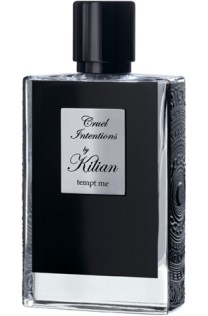 fragrance from the same 2007 collection. I’m not even going to bother writing about it. Something about the vanilla base in all these perfumes simply does not agree with me. I find Cruel Intentions to be equally unbearable, despite a