Perfume Review – Tom Ford Private Blend Arabian Wood: The Mossy Forest

Names can be misleading — and that is definitely the case with Tom Ford‘s Private Blend Arabian Wood. Though rumour has it that the perfume was originally a bespoke, unique creation for a sheikh, Arabian Wood is neither Arabian nor particularly woody. (It’s not very masculine, either.) Instead, it is a woody, floral chypre fragrance that takes you to a very verdant, mossy, flower-strewn forest floor in the middle of a secluded glen. 

Photo: Nora Blansett.

Photo: Nora Blansett.

Whatever the truth to the rumour of Tom Ford creating a custom-blended perfume for a well-known, wealthy sheikh, Arabian Wood was released in 2008 as a fragrance exclusive to the Kuwait market, before being made available world-wide in 2009. Neiman Marcus provides Tom Ford’s press release description for the scent:

[T]his woody chypre was inspired by the extraordinary confluence of the Middle East’s past and present aromatic wonders.

Tom Ford Arabian WoodCapturing the mystique of Arabia, a rare combination of precious woods, opulent green notes, rich florals, and exotic spices provides a footprint or modernity outlined in ethnic tradition. 

This exotic experience opens with top notes of aromatic lavender with the bold floralcy of Bulgarian rose, freesia, orange blossom, and green galbanum, brightened with sparkling bergamot. These effervescent notes are enhanced with hand-picked rose de mai. 

The heart pulses with the warmth and sensuality of lavish florals, including ylang ylang, rose absolute, jasmine, gardenia, and luscious honey and orris.

The base notes blend patchouli with cedarwood, oak moss, sandalwood, and honey, while tonka bean and radiant amber leave a distinct trail of opulence.

I always get extremely excited when I see a long list of notes, as it portends a fragrance with enormous depth, and Arabian Wood puts many fragrances to shame with a mind-boggling 28 notes. (Yes, I counted.) The most complete list comes from Nordstrom and reads as follows:

bergamot, freesia, lavender, orange blossom, Bulgarian rose, May rose, galbanum, gardenia, geranium, iris, jasmine, lily of the valley, rose, ylang-ylang, clove, honey, apricot, cedarwood, patchouli, sandalwood, vetiver, moss, oakmoss, amber, tonka bean, vanilla, honeycomb, raspberry.

Arabian Wood opens on my skin as the most classic of aromatic fougères. For those of you who are unfamiliar with the term, a fougère is a category of fragrance — often colognes, but not always — that have a citrus component atop a strongly herbal base that usually consists of lavender, coumarin, oakmoss, or some combination thereof. Here, Arabian Wood begins with a very traditional cologne opening of citrus with strong oakmoss that reminds me of Givenchy‘s Monsieur de Givenchy.

Dried oakmoss or tree moss.

Dried oakmoss or tree moss.

The scent is simultaneously light and aromatic, but with simply massive amounts of oakmoss. The first time I applied Arabian Wood, I went with a lesser dosage (about 2 big smears from the dab bottle), since moderation is often the wiser path with Tom Ford’s Private Blend line. But I was frustrated with the perfume’s projection so, the second time, I decided to apply almost three times as much. Quantity definitely impacts the nature of the moss with a lower amount creating something far more velvety, plush, fresh and brightly green in image. At the higher application level, the moss was much more akin to that in traditional chypres or fougère fragrances: dusty, dry, grey, mineralized, and with a sharply bitter component. Also fluctuating was the prominence of the galbanum. At a lower level, the galbanum in Arabian Wood isn’t sharply, bracingly dark but, rather, softer and with a gentler, earthier tone that rather evoked the damp, loamy floor of a forest. 

Fresh moss and lichen. Source: Lars Dahlin at Flick.

Fresh moss and lichen. Source: Lars Dahlin at Flick.

On both occasions, however, there were other notes lurking under the strong green facade. As the minutes passed and that initial burst of cologne-like citrus faded, there were noticeable accords of: herbal lavender; peppery cedarwood; earthy, dark, rooty vetiver; and what definitely felt like dry hay (coumarin). I don’t particularly like lavender but, here, it is modest and very well-blended into the very aromatic, herbal, sum total. When you throw in the very muted, almost ghostly hints of red-brown cloves, fuzzy geranium, and the slow start of a mossy patchouli, the final vision is really hard to escape: Arabian Woods transports you to the forest.

It’s a small, secluded part of an incredibly green Irish valley, a small nook where tall, red-brown trees cast shadows over the forest floor filled with touches of purple from almost hidden lavender bushes, darkened green-black galbanum, wet black soil, and a vast carpet of moss that varies from the brightest Emerald Isles green to the more pungently, lichen-like grey. There is simply nothing about the desert or Arabia in the picture that the perfume weaves — now or later. 
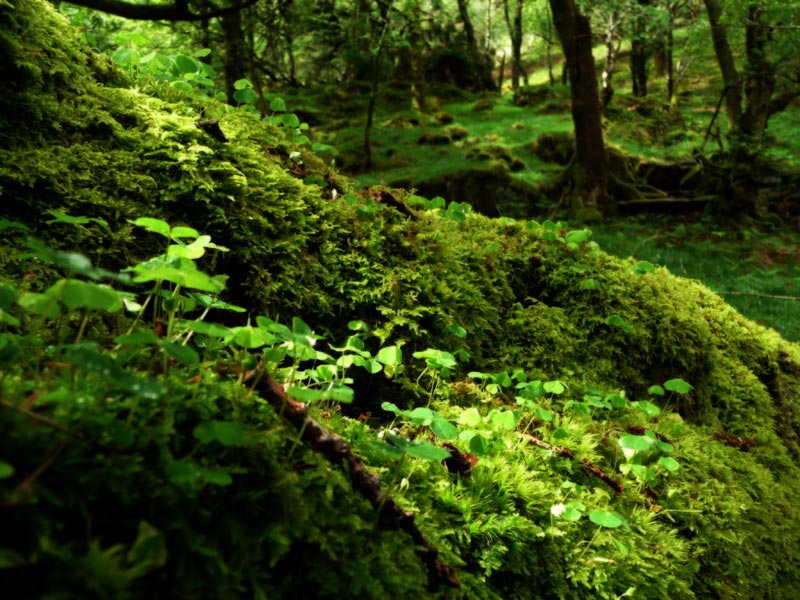
Photo: Jimpix.co.uk

Mossy forest in North Wales. Photo: Jimpix.co.uk free e-cards.

The initial burst of aromatic fougère and bitterness makes Arabian Wood a fragrance that, at first glance, seems very masculine. But, like the name, that too is misleading. With every passing minute, the citrus element wanes, while the green notes from the oakmoss, galbanum and geranium soften. The patchouli becomes more prevalent, but this is no 1970s, dirty, hippie, black patchouli. It’s softly mossy, almost green, and infinitely velvety. It’s beautifully blended in, just adding the perfect touch of sweetness to the notes. Arabian Wood is a true chypre under every possible definition of the term. I don’t know quite how Tom Ford managed it given the IFRA/EU restrictions on oakmoss, but this doesn’t smell like an ersatz, quasi or fake chypre at all!

Flowers in the Forest posterWithin less than the twenty minutes, the flowers arrive on the scene, pushing their way up through that earthy, rooty soil and slowly taking over the moss. The florals march in two by two, the rose and jasmine, unfurling in slow bloom. Trailing in their footsteps is orange blossom and ylang-ylang, then honey, and, finally, a touch of powder taking up the rear. It feels like a procession of notes determined to eradicate any vestige of sharpness, bitterness or strong masculinity from that opening. Almost like light coming in through the trees to brighten the darkness and the overwhelming blanket of green. The softening of the perfume extends also to its sillage. Arabian Wood drops sharply in projection after the first hour, hovering a bare inch (if that) above the skin. It is possibly the gentlest chypre I have experienced in a while.

By the start of the second hour, the perfume is truly pretty. The sandalwood has joined the party on the forest floor. It’s beautifully creamy, and its richness feels very much like the real thing, not a synthetic version. Together with that velvety patchouli, it’s a strong backbone for much of the perfume’s remaining development. The whole thing is a perfectly balanced, nuanced, layering of notes where jasmine and orange blossom vie with the rose, all over a rich woody base of moss, patchouli, sandalwood and honey, with powder and faint touches of peppery cedar. There is great sweetness in the scent that grows stronger with every hour, as more of the honey comes out. I also continue to smell something in the background that calls to mind coumarin’s dry hay notes but it is subtle. What I absolutely do not smell is any trace of lily-of-the-valley, gardenia, apricot, or raspberry to my nose; not on either of the two occasions that I tested the perfume.

By the start of the third hour, Arabian Wood is a sweetly honeyed, patchouli, sandalwood skin scent with very abstract floral notes. There is the feel of rose, jasmine and ylang-ylang, but it’s all blended into one very harmonious whole where the individual components are not particularly distinctive. What is individually noticeable, however, is the the increasing powdery undertone to the perfume. It doesn’t smell like a clear, definite, iris accord, nor like Guerlain’s sort of powder. Rather, the floral notes just feel as though they’re being filtered through a light dusting of powder, almost a bit like sweet pollen. It has to be the orris but, if so, it’s orris and iris done very well. Perhaps the honey is the reason since that is now a much stronger component of the perfume.

Arabian Wood remains that way for another 6 hours when the tonka bean arrives, followed by muted vanilla and some musk. The perfume is now very much soft oakmoss-infused patchouli, sandalwod, honey, tonka bean, powder, lightly sweetened musk, and dry, amorphous woody notes. It’s almost like a Guerlainade feel in some ways, but not quite. Perhaps because it seems more modernized in some ways, as well as more woody. Whatever the reason, Arabian Wood remains that way until it finally recedes away. With the lesser dosage, the longevity clocked in at around 6.5 hours; using three times as much made the perfume last about 8.5 hours. But throughout, the sillage after the first thirty minutes was low.

Arabian Wood is a lovely perfume by itself, but I keep hearing how extraordinary it is when layered with some other Tom Ford Private Blend fragrances. Specifically, Private Blend Oud Wood, Bois Marocain, and Italian Cypress. I haven’t tried the combinations myself, but I can see how Arabian Wood’s slightly feminine, floral, chypre qualities would go beautifully with more spicy or dryly wooded fragrances. Whatever Arabian Wood’s sandalwood and muted cedarwood elements, it’s really not a woody fragrance, per se. It’s most definitely a floral chypre, after that very intensely masculine beginning where it was all aromatic fougère. Nonetheless, I don’t want that to put off male readers. This is a unisex fragrance, and Arabian Wood is definitely worn by men. In fact, I obtained my sample as a very generous gift from a male reader, Ross, who loves to layer it with Tom Ford’s Oud Wood.

All in all, I very much liked Arabian Wood, but I wasn’t swept away. It doesn’t feel distinctive enough in some ways. It has the advantage of being an exceedingly gentle, smooth, richly-nuanced chypre that isn’t frightening in bitterness or pungency, but I think those who have a vast knowledge of vintage chypres may not be brought to their knees. And, for me personally, the extremely low sillage was very frustrating. I wanted more of the plush, soft, patchouli-sweetened mossiness, but at times, I had to forcibly inhale at my arm to detect the notes. Even applying three times the amount that I usually use for Tom Ford’s Private Blend didn’t solve the problem. I have problems with longevity, not sillage, and the Private Blend line is usually extremely powerful, so I have to admit to some surprise.

On Fragrantica, the votes are completely split on the issue of sillage. There are 6 votes for “soft,” 7 for “moderate,” 5 for “heavy,” and 4 for “enormous.” Clearly, it all depends on the person’s skin. The comments are also split, with some finding the perfume very soapy, others saying it has absolutely nothing arabian or woody about it, a few arguing  the fougère -vs- chypre issue, and a good chunk saying it is a very feminine fragrance. One person even compared it to vintage Cabochard Extrait, which brings me to another point.

The perfume blog, EauMG, had a very interesting list of similar perfumes or “dupes,” if you will:

… [as] this perfume settles, I get something that reminds me of the new formulation of Lancome’s Magie Noire, Piguet Bandit and Maja. [¶] […] Give Arabian Wood a try if you like perfumes like Balmain Ivoire, Jacomo Silences, Maja, Guerlain Vega, Van Cleef & Arpels First, and/or Piguet Bandit. [Emphasis added.]

I’ve tried most of those fragrances (though it’s been an exceedingly long time ago for some), but on my skin, Arabian Wood wasn’t as soapy as First and definitely didn’t have the ferocious, biting greenness (or galbanum) of Bandit. I can’t remember vintage Ivoire well enough now to compare the two, but I can see some definite similarities with Jacomo‘s Silences. Either way, the comparisons prove my point that Arabian Wood may not wow any vintage collector of chypres, though it is a great choice for anyone who can’t get their hands on those classics in their true (unreformulated) form.

I think Arabian Wood is a fragrance that would be incredibly sexy on a man, and quite alluring on a woman. There is a sophistication and elegance to the smoothness of the scent, a degree of luxurious depth and richness, and a subtle hint of mystery. It may be like a lot of vintage chypres — but there aren’t any vintage chypres that sold in stores today and exceedingly few regular, commercial ones! As such, Arabian Wood is a scent that will stand out. And, it’s definitely one worth looking into.

 

DETAILS:
Cost & Availability: Private Blend Arabian Wood is an eau de parfum, and is available on the Tom Ford website where it retails for: $205 for a 50 ml/1.7 oz bottle, $280 for a 100 ml/3.4 oz bottle or $495 for a 200 ml/8.45 oz bottle. In the US, you can also find it at fine department stores such as Nordstrom, Neiman MarcusSaks Fifth AvenueBergdorf Goodman, and others. In Canada, I believe Tom Ford is carried at Holt Renfrew, but I don’t see Arabian Wood listed as one of their 2 Tom Ford fragrances on the online website. In the UK, you can find it at Harrods or Selfridges. Both stores sell the small 1.7 oz/50 ml size for £135.00 or £300.00 for the super-large 250 ml bottle. The smaller size is also carried at House of Fraser. Tom Ford Beauty doesn’t seem to be carried by retailers in France, but it is in many European nations from Denmark and Belgium to the Russian Federation. You can use the store locator on the website to find a retailer near you. In Australia, I saw Arabian Wood on the MyShopping.com.au site where it retails for AUD$249.95. The Tom Ford line is supposedly carried at David Jones stores, but Arabian Wood is not one of the handful of Tom Ford fragrances carried on the David Jones website. Elsewhere, Tom Ford fragrances are carried in numerous different countries; hopefully, you can find one near you using the store locator on the Tom Ford website.
Samples: Surrender to Chance doesn’t have Arabian Wood at this moment, but you can try to find it at any of the department stores listed above to give it a test sniff. However, samples are available from The Perfumed Court (which I always think is more expensive than Surrender to Chance) and their prices start at $4.99 for a 1/2 ml vial.
.

Perfume Review – Tom Ford Private Blend Café Rose (The Jardin Noir Collection)

Subversive. Forbidden. IntoxicatingBewitching. Darkness that is so thrillingly beautiful it “could almost ruin you.”

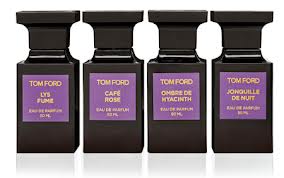
That was Tom Ford’s goal for his 2012 Jardin Noir collection, a subset of his prestige “Private Blend” line of fragrances. His twist on traditionally innocent flowers encompassed roses, narcissus, hyacinths, and lilies with Café Rose, Jonquille de Nuit, Ombre de Hyacinth and Lys Fume. I have three of fragrances and have already reviewed Ombre de Hyacinth.

This review is focused solely on Café Rose, a scent that triggered a wide array of emotions, but which ultimately left me feeling cold. To be honest, it was quite overwhelming at times. By the end, I felt simply tired out and beaten over the head. I am admittedly not a huge worshipper of rose fragrances, but there is something almost bullying, cloying, and deeply exhausting about Café Rose.

We’re getting ahead of ourselves. According to Tom Ford’s full press release description for the Jardin Noir collection on Bergdorf Goodman’s site, his vision for the Jardin Noir collection is as follows:

Jardin Noir explores the forbidden sides of four of perfumery’s most treasured blooms: narcissus, hyancinth [sic], rose, and lily.

Convention is abandoned and unexpected ingredients converge with bewitching and intoxicating results. Iconic flowers fall open, dropping their innocent facades to reveal the subversive beauty and fierce elegance they normally keep hidden.

The specific description of Café Rose is quite beautiful:

Enticing. Exotic. Seductive. Cafe Rose descends into a hidden labyrinth, where roses’ fine breeding gives way to darker pleasures.

Café Rose was created by Antoine Liu and, according to Fragrantica, the notes are:

Top notes are saffron, black pepper and may rose; middle notes are turkish rose, bulgarian rose and coffee; base notes are incense, amber, sandalwood and patchouli.

Tom Ford fragrances are the oddest thing on my skin because how they smell can vary substantially with how much you put on. Café Rose is no exception. I tried it on three times, each with slightly varying results for the opening stage. On each occasion, I put on less of the perfume with the third time having the very smallest amount. That time, the perfume opened with a faintly soapy musk note that was sweet with an almost vanilla-like undertone to the roses. It was definitely a plethora of white musk, which I am not particularly keen on, I must say.

With that outcome being a slight exception, my overall first impression of Café Rose has always been fruited roses — with only the concentration or degree of the note varying. There is an explosively sweet impression of roses — blood-red and tea-rose pink — with jammy notes that definitely evoke fruit. There is a dark grape, almost like Welch’s, as well as something that smells surprisingly a little like canned peaches.

I suspect the patchouli is responsible for that very “purple patchouli” fruited note; those who dislike it may want to want to steer clear of Café Rose because there really is no escaping it. It’s there almost from start to finish. It also adds a very thick, almost gooey and unctuous feel to the roses which, at times, can feel spectacularly sweet. That sweetness almost verges on “tea rose” territory, and those of you who were around for the infamous ’80s Tea Rose fragrance from Perfumer’s Workshop may shudder in response.

Despite the headiness and painful sweetness of Café Rose, the perfume is never oppressively heavy. Ten minutes after applying it in even a concentrated dose (2 good sprays), it becomes a much lighter, sheerer scent. The sillage drops as well, though this is one very persistent perfume. I don’t detect any saffron in its own right but there is a vague sense of creamy sandalwood underneath all that jammy fruit.

Two hours in, Café Rose turns darker with the presence of black pepper and coffee. The black pepper adds a slightly fiery, peppery bite to the sweetness of the floral note, though at times it feels more like pink peppercorns in a combination that is all too familiar these days. The coffee note is far more interesting. If you’re expecting the aroma of Starbucks or roasted coffee beans, you will be disappointed. Here, it’s more like the wet, black coffee grounds that you empty out of your filter after you’ve brewed a cup. It adds a faintly bitter, nutty, earthy note to that heavily jammy, very fruited rose note.

The fiery pepper and the bitter coffee make a valiant (though not wholly successful) effort at diluting the jamminess of the roses. Thank God for small favours, because, by the two-hour benchmark, my nose was quite oppressed by just how sweet this perfume is. Plus, to be quite frank, there is almost an artificial, synthetic aspect to things where it doesn’t smell wholly natural but, rather, just…. painful. It’s hard to explain, but there is something in this perfume that — no matter how much or how little you put on — simply feels cloying. And, really, there seems to be no escape from it.

That overwhelmed feeling probably explains why I couldn’t detect a plethora of notes in Café Rose. Over the course of its development, the degree of the black pepper and black coffee grinds rose and waned in differing degrees, but the oppressive presence of that very purple patchouli note dulled everything else to a large degree. There was some creamy sandalwood and, I suppose, faint smoke from the incense, but did I mention purple patchouli?

It did fade away, eventually, leaving me gasping like a stranded seal on a beach. At that point, about seven hours later, all that remained was the rose note, accompanied simply by vanilla and powder. Then, in the eighth and final hour, there was merely some vague, amorphous sense of a powdery soapy musk.

Oddly, on the third test, when I wore very little of the fragrance, the painful purpleness was much less. Instead, now, there was just that soapy white musk accord which I cannot stand. It felt clean and fresh, I suppose. If that’s damning with faint praise, it’s because it’s meant to be. 

Café Rose does have its fans, many of whom seem to find it a purely rose and coffee fragrance. However, a good number of people on Fragrantica find it to be a substantially poorer cousin to Tom Ford‘s Noir de Noir. I agree with that assessment. I liked a good portion of Noir de Noir (which I reviewed here) and, though I didn’t like its powdered violet finish, I think it’s a much better, more complex treatment of roses.

On Fragrantica, a number of others keep talking about Café Rose having an oud note — which frankly leaves me utterly bewildered. If I didn’t have a manufacturer’s sample with the card and labeling on the vial, I’d wonder if I tried the wrong perfume. There is absolutely no agarwood in this cloying sweet, peppered aberration.

I’m sure there is more to say on Café Rose — more talk of sillage and longevity, or some positive reviews I could link to, as well as other negative ones. To be honest, I simply lack the energy for that. After living with this bloody thing for two days, and making every effort possible to be fair, I find myself just wanting to be rid of it. I’m tired of Café Rose — on every possible level. I want it gone from my life forever. In fact, since I cannot bear another moment thinking of, discussing, or even wearing this blasted thing, I’m ending this here and now.

DETAILS:
For some odd reason, none of the Jardin Noir fragrances are listed anywhere on Tom Ford’s website. They are, however, available at numerous high-end department stores where its price is just like that of other Tom Ford fragrances: $205 for a 50 ml/1.7 oz bottle, or $495 for a 200 ml/8.45 oz bottle. In UK pricing, they sell for £135.00 or £195.00, depending on size. In the US, you can find Café Rose at Nordstrom, Saks Fifth Avenue, Bergdorf Goodman, Neiman Marcus and many others. In the UK, you can find it at Harrods and Selfridges.
Samples: If you are intrigued, but are also sane enough not to want to spend such a large amount without testing it out first, I suggest stopping by one of the stores listed above for a free sniff. However, you can also find samples of Café Rose starting at $3 on Surrender to Chance, or on other decant/sample sites like The Perfumed Court. I think Surrender to Chance has the best shipping: $2.95 for any order, no matter the size, within the U.S., and $12.95 for most orders going overseas. (It’s a wee bit higher if your order is over $150.) International shipping has leaped up in price (from $5.95) due to the U.S. Postal Service’s recently increased prices.

Perfume Review – Tom Ford Private Blend Ombre de Hyacinth (The Jardin Noir Collection)

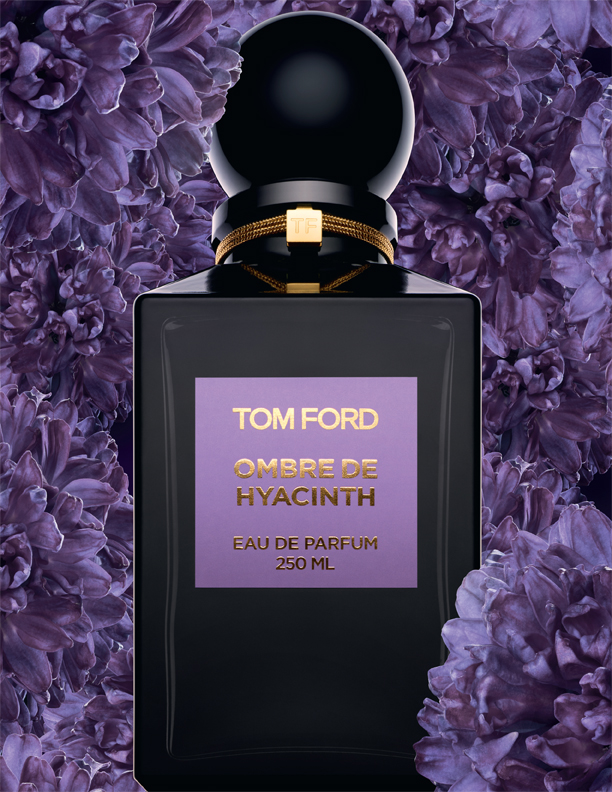
Jardin Noir CollectionIn 2012, Tom Ford released his Jardin Noir collection for his Private Blend line of fragrances. The collection consisted of four supposedly dark, twisted, “bewitching” takes on traditionally sweet, innocent flowers: narcissus, hyacinth, rose and lily. The fragrances are: Café Rose, Jonquille de Nuit, Ombre de Hyacinth and Lys Fume. I have three of the fragrances (Café Rose, Lys Fumé and Ombre de Hyacinth) and have tested two of them but, for reasons of length, this review is solely for Ombre de Hyacinth.

According to Now Smell This, Tom Ford had the following perspective and goal for the line:

When you showcase their darker and less innocent aspects, flowers can become so thrilling and beautiful, they could almost ruin you. That was the sensation I was after.

Bergdorf Goodman appears to have the full press release description for the Jardin Noir collection:

Jardin Noir explores the forbidden sides of four of perfumery’s most treasured blooms: narcissus, hyancinth [sic], rose, and lily.

Convention is abandoned and unexpected ingredients converge with bewitching and intoxicating results. Iconic flowers fall open, dropping their innocent facades to reveal the subversive beauty and fierce elegance they normally keep hidden.

OMBRE DE HYACINTHI had extremely high hopes for Ombre de Hyacinth as an ideal Spring fragrance with a slight edge. For one thing, I adore the scent of the flower which I always associate with March and certain cultural festivities in my family. For another, the description of the scent was beautiful:

Sophisticated. Voluptuous. Passionate. Ombre de Hyacinth creates bewitching tension as hyacinth cloaks its voluptuous beauty behind cool, aristocratic finery.

Ombre de Hyacinth was created by Calice Becker and, according to Fragrantica, the notes are:

Top notes are galbanum, violet leaf, magnolia petals and olibanum [frankincense]; middle notes are hyacinth, pink pepper and jasmine; base notes are galbanum, benzoin and musk.

The very first impression I had of Ombre de Hyacinth was soap. Light, airy, aldehydic, floral soap bubbles with an underlying note of powder. Mere seconds later, there was a strong note of zesty, fresh lemon and lime. The zesty lemon soap image was replaced after ten minutes by galbanum’s bitter greenness atop a woody element.

Galbanum is the bracingly bitter, distilled oil from a Persian shrub and it has a definite greenness; sometimes, it also has an earthy or slightly resinous undertone. Here, it was mostly just sharp, mossy,bitter, and fresh. On occasion, it faintly resembled the dark soil of a freshly tilled garden, but I had a much less earthy experience than some. There was also some sharp black pepper which added an even greater bite to the fragrance.

The peppered wood notes continued to increase in prominence, though the scent was still very green and dark. Thirty minutes in, there was a hint of musky jasmine. For those who struggle with jasmine, you might be relieved to know that it only lasted about twenty minutes on my skin before vanishing, and that it was always very sheer and light. All that was left was that impression of black pepper and wood with some amorphous “floral” notes, soap, and a hint of powder. There was the mere suggestion of hyacinth but, at this point, it was far from strong. It most certainly feels nothing like the actual flower to my nose and it’s a definite disappointment.

There was an odd aspect to the florals that I couldn’t pinpoint, so I looked up one of the ingredients that I was not familiar with — “Violet leaf” — on Fragrantica, and bingo! According to their description, violet leaf is a

metallic smelling, green and aqueous note that is common in modern masculine and unisex fragrances, providing a fresher and non-retro note compared to traditional sweet violet.

Yes, metallic, green and simultaneously aqueous was exactly what the florals smelled like. That mélange of notes, when combined with the bitter greenness of the galbanum and the soapy aspect of the aldehydes, was quite an odd twist on the typical fresh, Spring-like floral fragrance. And I can’t say I was crazy about it. 

Hyacinth from PicsToPin ComAfter about ninety minutes, the scent softened further becoming just some vaguely amorphous impression of freshness: lightly powdered, lightly soapy, lightly woody, lightly aquatic, fresh florals with a hint of greenness. Ombre de Hyacinth remains that way until shortly before the fifth hour when — finally — the hyacinth arrives on the scene. On par with the rest of the perfume, it is extremely light, airy, tinged by soap (again), endlessly fresh, and very redolent of Spring. I feel as though I’m repeating myself ad nauseam, but I can’t help it. This is not a complicated scent. And it’s about as “dark” and twisted as a poodle.

Personally, I would have much preferred a more concentrated essence of hyacinth instead of something that is really akin to a generic, fresh floral which just merely happens to have some quiet hyacinth touches. I would also have preferred something far less soapy and aquatic. However, for those who like fresh, clean florals that are sheer (bordering on translucent), Ombre de Hyacinth may be perfect.

This is not a strong floral or even a strong hyacinth fragrance. Everything about the scent is light — right down to its sillage. In the opening hour, the perfume’s projection is moderate and, thereafter, it drops to become very close to the skin. Its gauziness makes it extremely office-friendly. Yet, it has surprising tenacity for something so airy and translucent. All in all, Ombre de Hyacinth lasted just under ten hours on my perfume-consuming skin.

Nonetheless, I think it’s hugely overpriced for what it is. $205 at the low end of the scale seems very high for a light, fresh, soapy floral scent. It’s not exactly an uncommon category of fragrances, after all.

The Non-Blonde reached the exact same conclusion. She had a slightly similar experience to mine which she boiled down to four words: “nice French hyacinth soap.” But at least she was lucky enough to have a heavy hyacinth start at all! I quite envy her, especially as she initially felt as though she were in a Monet painting. (Lucky devil.)

After about fifteen minutes of walking around inside a Monet painting, the fantasy starts to fray at the hem and disintegrate. The abstract floral heart becomes very soapy and loses its best characteristics. There’s nothing narcotic or illicit in a rental vacation cottage out in the country, as clean and quaint as it might be. It smells good, but the composition flattens in front of my eyes (or nose) and loses any depth, shadows, and “decadence” that Ford aspired to have there. [¶] The dry-down remains bathroomy.

I experienced a lot more woody, peppery notes than she seems to have done — not to mention that disconcerting violet leaf metallic, aquatic accord — but, yes, it does really evoke a cottage out in the British countryside, especially once the more peppery notes subside. A less charitable person might just say it epitomizes expensive hotel soap. Or, as one poor sod on Fragrantica wrote, “This on me smells just like Carpet Fresh and Irish Spring soap – for hours”….

Nonetheless, I would be tempted to recommend it to those who like extremely fresh, clean, soapy scents. Except for one thing. To quote the Non-Blonde: “this Tom Ford fragrance is grossly overpriced for what it is.”

DETAILS:
Cost & Availability: For some odd reason, none of the Jardin Noir fragrances are listed anywhere on Tom Ford’s website. They are, however, available at numerous high-end department stores where its price is like that of other Tom Ford fragrances: $205 for a 50 ml/1.7 oz bottle, or $495 for a 200 ml/8.45 oz bottle. In UK pricing, they sell for £135.00 or £195.00, depending on size. In the US, you can find the fragrance at: Bergdorf GoodmanNeiman Marcus, NordstromSaks Fifth Avenue, and many others. In the UK, you can find it at Harrods or Selfridges. Elsewhere, Tom Ford fragrances are carried in numerous different countries; hopefully, you can find one near you using the store locator on the Tom Ford website.
Samples: If you are intrigued, but are also sane enough not to want to spend such a large amount without testing it out first, I suggest stopping by one of the stores listed above for a free sniff. However, you can also find samples of Ombre de Hyacinth starting at $3 on Surrender to Chance, or on other decant/sample sites like The Perfumed Court. I think Surrender to Chance has the best shipping: $2.95 for any order, no matter the size, within the U.S., and $12.95 for most orders going overseas. (It’s a wee bit higher if your order is over $150.) International shipping has leaped up in price (from $5.95) due to the U.S. Postal Service’s recently increased prices.

Perfume Review – Tom Ford Private Blend Lavender Palm

Perfume tastes never develop in a vacuum. Like ducklings, we are imprinted by the things around us, especially from an early age. Our childhood experiences, the perfume tastes of our family, the first scents we were exposed to and adored — these all help to shape our tastes as an adult. My early childhood experiences happened, at one point, to involve an excessive amount of lavender. Unlike other smells to which I was exposed at the time — such as orientals or powerhouse, indolic florals — I ended up having some hesitancy about the ingredient for much of the rest of my life.

As a perfume blogger, however, I try to keep an open mind and to be fair to all sorts of scents. But the reality is that perfume is a highly subjective thing, and some people are simply not the ideal, target audience for certain types of fragrances. Such is the case with me and Tom Ford‘s Private Blend Lavender Palm — a scent I can appreciate, but can’t relate to on a personal level. Some perfumes have changed my mind about ingredients that I previously struggled with, but Lavender Palm doesn’t. I find it quite schizophrenic and discordant at first, then far too simplistic and unbalanced. The very high cost for what later becomes a very simple fragrance further guarantees that I would absolutely never wear it. However, I think there are some who may find this to be a delightful twist on the more traditional lavender fragrances.

Source: Manface.co.uk

Source: Manface.co.uk

Lavender Palm is a unisex eau de parfum which Fragrantica puts in the category of “Aromatics.” The perfume was created for Tom Ford by Yann Vasnier and is described by Selfridges as:

Tom Ford’s creative take on the free–spirited ethos and chic elegance that defines California. It is a sensuous yet stylish remix of earthly lavender, bright citrus, moist palm leaf accord, clary sage, sensual woods and smooth tonka bean.

For some, Lavender Palm actually does seem to evoke California. One of my closest friends tried it months ago and wrote to me that, as he left Nordstrom’s, a waft of air brought out the perfume and strongly reminded him of home. He actually is from Southern California originally; and he had no clue about Tom Ford’s goal when he wrote to me. Others seem to have had the same impression, such as the reviewer at CaFleureBon who imagined Palm Springs and the big parties in the 1970s at the famous Kaufmann House. I’ve lived in California — both Northern and Southern — and I’m afraid I don’t see it.

According to Fragrantica, the notes in Lavender Palm are as follows:

two types of lavender, bergamot, lemon, clary sage, lime blossom, pink and white oleander, olibanum, green moss and vetiver.

Lavender Palm opens on my skin with an immediate burst of lavender and lemon, but there are vague hints of other things hiding underneath the surface. Less than a minute in, they start to rise to the surface. There are florals, but also, some very woody, earthy, musky, and herbal elements. The latter borders almost on the medicinal at times; it is sharply pungent and with a subtle whiff of something camphorous. At the same time, one can definitely smell a very root-y type of vetiver. It’s not fresh, bright or green, but dark brown and smoky.

Oleander flowers

Oleander Flowers.

There is also an extremely disconcerting talcum powder note that smells simultaneously of irises and of babies. It has to stem from the oleander plants which Fragrantica describes as having “talcum-like floral note, with hints of pollen sweetness.”  Here, the talc is a very disconcerting note when placed side-by-side with the earthy vetiver and the very pungent herbaceousness of both the lavender and the clary sage. When you add in the scent of the top of a baby’s head, it borders on the jarring and discordant for me. It’s almost as if the perfume is Dr. Jekyll and Mr. Hyde — two completely separate perfume personalities in one bottle.

Clary Sage. Source: TreeFrogFarm.com

Clary Sage. Source: TreeFrogFarm.com

Twenty minutes in, there is an odd creaminess that suddenly appears, along with an increasingly strong impression of medicinal camphor. I can’t pinpoint the cause, though I suspect it results from the clary sage (which is not the same sort of sage that you use in cooking). In my prior dealings with the plant, it smelled sweet, fresh, and with just a hint of lavender or peppermint. Fragrantica, however, describes the plant as having a “bracing herbaceous scent that smells like lavender with leathery and amber nuances, thus very popular from old times for perfumed products.”

Even if that’s the version which I’m smelling here, it doesn’t explain the more medicinal edge to the perfume. I can’t attribute it to either the Lavender Absolute or Lavandin (a lighter version of the scent) which CaFleureBon says were used in the perfume. And it doesn’t smell like the sort of pungency one finds in moss or oakmoss, either. It can’t come from the olibanum, because that’s just another word for frankincense. No, what I’m smelling are intensely mentholated, medicinal notes that almost resemble the camphorous aspects of pine trees or cypress wood.

But Lavender Palm isn’t finished yet. There is also something that is an oddly salty, almost aquatic note. It’s not wet, exactly, and it’s also not exactly like the beach, so it’s hard to explain but there is definitely an oddly aquatic element. I thought I was hallucinating, so I did a Google search for the “Lavender Palm and aquatic.” It turns out that I’m not the only one. One blogger, Full Time Ford, (and who seems to write about nothing but Tom Ford) wrote a whole review about how the perfume reminded him of the Adriatic Sea. But, on Basenotes, another poster (“rogalal“) was not so enchanted, writing:

That aquatic “seaweed” smell comes in and the lavender goes all metallic and artificial. At this point, it’s really only the leftover cumin that’s keeping Lavender Palm from smelling like hundreds of commonplace metallic aquatics. The base is a dark mix of piney tar smell and quinoline (that dark leather smell used most notably in Tuscan Leather), but the aquatic chemical smell sticks around, keeping the lavender very metallic and fake-smelling.

I don’t agree with a number of things in that review, not the least of which is the mention of cumin! (Really??!) I certainly don’t think the lavender ends up smelling metallic or fake. But I am glad to see that he also experienced the same aquatic smell and that he too noted a pine-tar smell.

So, to summarize, at the end of the first thirty minutes, I am simultaneously smelling: lavender, lemon, earthy vetiver roots, salty aquatic notes, something bordering on creamy, as well as mentholated and medicinal elements, iris, talcum powder, and the head of a newborn baby. I find that to be completely schizophrenic. Forget what I said about two perfumes personalities in one bottle. This is not bipolar; it’s Sally Field’s famous Sybil with multiple personality disorder.

To be fair, when I tried Lavender Palm a second time and put on much less, I had a different experience. As with many Tom Ford scents, the amount you use can impact what you smell — which is why I usually test each one at least twice. Using a lesser amount, I essentially smelled just lavender, lemon and vetiver — in one straight linear line. There were brief hints of more herbal elements like clary sage but, basically, it was just a big, simple, flat-line. I’m not sure if that’s much better….

In both tests, however, the perfume’s middle and final stages essentially turn into a simple triad of lavender, vetiver and lemon. No benzoin, no tonka, no vanilla, no soft mosses. Instead, the vetiver which often dominated over the lavender with hefty notes of earthiness and smokiness, and some occasional flickers of lemon. There really isn’t much more to say than that.

I like the idea of a lavender perfume that isn’t the usual soliflore or a predictable lavender vanilla scent. And I expected to love a lavender perfume that included vetiver, bergamot, and frankincense (which is one of my favorite notes). Unfortunately, this is just not a scent for me. I couldn’t wrap my head around that odd, schizophrenic opening in the first hour and then, subsequently, I found the fragrance both simplistic and imbalanced with the excessively top-heavy vetiver.

For those who are looking for a bright, fresh lavender, I don’t think this is the one for you, either. While the perfume is much lighter than many of the fragrances from the Private Blend line, it is light only on a relative basis. The earthiness and smokiness of the vetiver and the dark woods give it a far greater heft than what you may be used to in more conventional, sweet lavender fragrances. Those elements may also render it too masculine for some.

It may be perfect, however, for those who are looking for an unobtrusive but woody lavender perfume. From CaFleureBon to Basenotes to Fragrantica, the majority opinion is that the perfume is average to moderate in sillage and projection, especially by the standards of a Tom Ford fragrance. Unfortunately, it is also reported to have below-average duration. (I think that’s the first time I’ve seen a CaFleureBon reviewer say that!) On me, Lavender Palm had moderate-to-low sillage for the first hour, and then became close to the skin after two hours. All in all, on my perfume-consuming skin, it lasted about 6.5 hours — which is very low for a Tom Ford, especially from the super-concentrated Private Blend collection. On others, I’ve read reports ranging from “it does not last” to 6 hours to 10 hours. The huge Tom Ford fan blogger, Full Time Ford, claims he found faint traces on his skin over 24 hours later — but that sounds like a pretty unique case from all that I’ve read.

The real issue may be the cost. Tom Ford Private Blend perfumes are never exactly cheap. But, in my opinion, they normally have a lot more complexity and depth than Lavender Palm. One of the Fragrantica commentators who loved it and found it “simplistic… but done incredibly well” seemed to have drawn the line at the price:

What is though no laughing matter is the criminal price they charge for what is essentially a lemony lavender.

I think it more a vetiver-lavender, but I agree with his general point. Even more so when one considers that lavender is hardly the most expensive ingredient around. Lavender Absolute may be a slightly more costly version, but still, it’s lavender — and $205 for the very smallest bottle? (As a side note, in its limited-distribution run at just the Beverly Hills boutique, a 250 ml bottle was priced at $950. Yes, you read me correctly and no, that is not a typo. $950!!! The prices was adjusted downwards when the perfume was fully launched in January 2012.)

Nonetheless, as I always say, price is subjective, as is the whole issue of perfume itself. In fact, I think perfume is one of the most subjective things around, so if this is a scent that intrigues you, I hope you will give it a try at the very least.

But you may want to do it soon. Lavender Palm was released in limited distribution less than two years ago (in the fall of 2011) and just a year ago (in January 2012) on a world-wide basis. Yet, for reasons that I simply cannot understand, it is not listed anywhere on Tom Ford’s website! It’s not in the Private Blend section, the Women’s fragrance section, the men’s fragrances, or in any other part of the “Beauty” section. Believe me, I searched repeatedly!

I have read nothing to indicate that it has been discontinued, so I have no explanation for its omission unless, perhaps, Tom Ford is contemplating removing it from the line? The thing is, perfume houses rarely come out with an official announcement that they’re discontinuing something; it’s too much of a declaration of failure. Instead, they usually start by removing it from their website, and then wait for all their stock with retailers to be used up. Or vice-versa. I fear that may be what is happening here, though, if that is the case, then it must have be an extremely poor seller for Tom Ford to pull plug just a year after its global release. On the other hand, the recently discontinued Amber Absolute is still shown on the website, as are some of the musk line which I’ve read were discontinued, too. (You can find a list of discontinued Tom Ford fragrances at the Perfume Shrine but it is only updated as of Spring 2012.) So, who knows what is really going on? 

In the end, whatever my feelings about the scent itself, I give Tom Ford and Yann Vasnier enormous credit for imagining such an unusual twist on lavender. Salty, aquatic notes and floral, talcum powder, with earthy vetiver and heavy woods as well – it’s very creative and different. 5 points to Gryffindor!

DETAILS:
Cost & Availability: As noted above, this perfume is not listed anywhere on Tom Ford’s website. It is, however, available at numerous high-end department stores where its price is just like that of other Tom Ford fragrances: $205 for a 50 ml/1.7 oz bottle, or $495 for a 200 ml/8.45 oz bottle. In the US, you can also find it at fine retailers such as Neiman Marcus, NordstromSaks Fifth Avenue, and many others. In the UK, you can find it at Harrods where it sells for £135.00 or £195.00, depending on size. It is also sold at Selfridges. Elsewhere, Tom Ford fragrances are carried in numerous different countries; hopefully, you can find one near you using the store locator on the Tom Ford website.
Samples: If you are intrigued, but are also sane enough not to want to spend such a large amount without testing it out first, I suggest stopping by one of the stores listed above for a free sniff. However, you can also find samples starting at $3 on Surrender to Chance, or on other decant/sample sites like The Perfumed Court. I think Surrender to Chance has the best shipping: $2.95 for any order, no matter the size, within the U.S., and $12.95 for most orders going overseas. (It’s a wee bit higher if your order is over $150.) International shipping has leaped up in price (from $5.95) due to the U.S. Postal Service’s recently increased prices.