Perfume Review: Le Labo Rose 31

The kingdom of Pepper was sometimes affectionately called by its old, Norse name: Pepper & Pink. It wasn’t a vast land, but every square inch seemed to be populated by various forms of pepper. From the biting burst of freshly ground Malabar nuggets to the cedar trees which swathed its flanks from North to South and the great lakes of ISO E Super which dotted the landscape. It was ruled by a king called Ginger who was a chef at heart, willy-nilly tossing in spices off the royal balcony to his people below. For the most part, his subjects were a homogeneous people, descended either from the tribe of Pepper or from the royal house of Ginger. A small minority hailed from the nomads called Pink Rose. They were a demure lot, always dainty and shy, reeking of the pinkest, lightest, most translucent rose that was to be found. They were so quiet at times that haughty critics like Luca Turin sneering called them “Not Rose,” while others though they were mere myths and didn’t even believe they existed. Certainly, they were far outnumbered by the Peppers, with their fiery bite, and by the more rambunctious royal Gingers, but all of them were all ruled by the vast plains of cedar trees and the large lakes of ISO E Super.
Source: hdwallpapers4desktop.com

Source: hdwallpapers4desktop.com

That is the kingdom of Rose 31, a creation from the niche perfume house, Le Labo. A much-loved fragrance, Rose 31 is an eau de parfum whose number — 31 — purportedly refers to the number of its ingredients. Now Smell This explains more:

[Le Labo was] established by Fabrice Penot and Eddie Roschi (both formerly of Giorgio Armani fragrances) in 2006. Le Labo started with 10 fragrances by well-known perfumers, and is known for blending the essential oils with alcohol and water at the time of purchase and providing customized labels for the bottles.

Initial releases in early 2006 were Fleur d’Oranger 27, Jasmin 17, Labdanum 18 (originally Ciste 18), Ambrette 9, Iris 39, Bergamote 22, Rose 31, Vetiver 46, Patchouli 24 and Neroli 36. In each case, the number in the fragrance name refers to the number of notes that make up the scent’s composition, and the name is taken from the ingredient in the highest concentration; to take one example, Jasmin 17 has 17 ingredients, with jasmine being in the highest concentration. The names are thus not necessarily related to what the fragrance is meant to smell like.

Le Labo Rose 31The issue of not smelling like what it is named is something that actually comes up quite a bit with regard to Rose 31. Fragrantica classifies Rose 31 as a “floral woody musk” and says it was created by Daphne Bugey. Some of its 31 notes — as compiled from both Fragrantica, Luckyscent, and my own nose — are as follows:

Grasse rose, caraway, cumin, pepper, clove, nutmeg, cedar, ISO E Super, frankincense, amber, labdanum, vetiver, guaiac wood, animalic notes, and agarwood (oud).

I tested Rose 31 twice, to slightly different outcomes in terms of the opening burst. The first time, the perfume opened with almost entirely peppered, woody and spiced notes, followed on only much later by a minute trace of rose. The second time, the rose was upfront, and present from the start. I’ll cover both beginnings.

During that first test, Le Labo’s opening consisted of galloping amounts of pepper, sharp and backed by peppery cedary woods, and what felt like a light dash of ISO E Super. For those unfamiliar with the aroma-chemical, you can read my full description of its pros and cons here, especially as I’ll be mentioning ISO E Super quite a bit in this review. In a nutshell, though, the synthetic is used most frequently for two reasons: 1) as a super-floralizer which is added to expand and magnify many floral notes, along with their longevity; and 2) to amplify woody notes and add a velvety touch to the base. It seems to be particularly used in fragrances that have vetiver or, to a lesser extent, other wood notes like cedar. ISO E Super always smells extremely peppery and, in large doses, has an undertone that is like that of rubbing alcohol, is medicinal, and/or astringent. To those unfamiliar with the synthetic, all they detect is “extra, extra pepperiness.” Some people are completely anosmic to the note, while others get extreme headaches from it. (Ormonde Jayne fragrances, and others like Lalique‘s Encre Noire or Terre d’Hermès are particularly egregious in that respect.) I don’t get headaches from ISO E Super, but I cannot stand it in large quantities and I can detect its peppered element with its rubbing alcohol base a mile away.

Caraway seeds.

Caraway seeds.

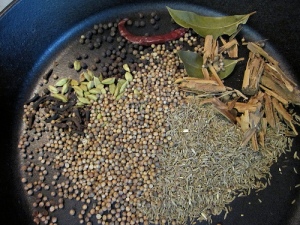
Thankfully for me, the ISO E Super is light at the start, outweighed fully by a glorious complement of spices that feel as though a mad chef went to town like a dervish. I really adore that first opening to Rose 31 that I experienced. There is the most miniscule dash of cumin — powdery, dusty, a wee bit animalic, and nothing like that used in Indian curries. Much more prominent, however, are the caraway seeds which feel nutty, a little anise-like in tone, and a bit woody. (Technically, there is a difference between caraway and cumin. The terms may be used interchangeably by many, but that would be a mistake as they are not the same thing and their aroma, to my nose at least, differs in undertone.)
Source: Girl's Gone Child at Girlsgonechild.net . (Link embedded within. Click on photo.)

Source: Girl’s Gone Child at Girlsgonechild.net. (Link embedded within. Click on photo.)
http://www.girlsgonechild.net/2011/12/eat-well-gift-of-garam-masala.html

Both spices share equal space on Le Labo’s stage with heaping cups of ginger that is, simultaneously, both freshly pungent and spicy, and slightly crystallized and sweet. There are whiffs of nutmeg that subtly add a sharp, bitter edge to the perfume, along with the spicy, red-hot kick of cloves. The whole thing is covered by a heavy veil of pepper that feels as though a chef just emptied an entire bottle of Malabar peppercorns with the rest of the spices into a sauté pan to roast, bringing out their bite, their fire, and their subtle earthy woodiness. In the background, there are flickers of white smoke from frankincense.

The dominance of the cedar, underscored by the ISO E Super, and the pepper ensures a perfect balance between woods and spices. Rose 31 never feels like a dusty, spice shop, but nor does it feel like a purely woody fragrance either. Well, at this stage, anyway. The powerful ginger that threads its way throughout much of Rose 31’s tapestry also ensures a subtle freshness and zing to the scent. When you add in the beautiful frankincense smoke — never cold, musty, earthy or dank, but sweet and almost earthy — the result in those opening minutes is utterly fascinating.
Source: HDwallpapers.

Source: HDwallpapers.

During that first test, I found myself agreeing a little with Luca Turin, the famous perfume critic, whose low, two-star review of Le Labo Rose 31 in Perfumes: The A-Z Guide is sneeringly entitled “Not Rose.” I hate agreeing with Luca Turin on anything; it almost offends my soul. Though I didn’t share his contemptuous views of the perfume as whole, I had to reluctantly admit that I couldn’t detect a trace of rose anywhere in that first hour. I even looked up some reviews for Rose 31 in which people wrote with utter bafflement about how completely nonexistent the rose was on their skin, no matter how many times they tested the perfume.

Then, I did the second test, and all the notes I wrote about earlier were backed from the start by the presence of the flower. It’s not huge, but the rose is definitely there, almost translucent in its pinkness and dainty freshness. Oddly, it never felt imbued by the heaping dollops of pepper; instead, to my nose, it almost stood apart, never tainted by the fiery, spicy notes, but remaining something dainty, sweet, and light. It was very pretty and well-meshed into the fragrance, but, unexpectedly, I found the non-rose opening in the first test to be much more interesting, and unusual. (The word “fascinating” appears more than a handful of times in my notes.)

Regardless of that small difference, the perfume’s development subsequently remained the same during both tests. Fifteen minutes in, the oud appears. It is not medicinal, astringent, or evocative of pink rubber bandages (my most hated form of oud). Instead, it is a bit more fiery and yet another source of pepper added to the mix. It also has a subtle, delicate undercurrent of honey which makes it quite lovely. As some of my regular readers know, I’ve got oud-fatigue, but this is an absolutely brilliant and fitting way to use the note, taking advantage of one of its intrinsic qualities to shore up the general peppered cocktail of notes. What helps with my enormous enthusiasm is the growing honeyed sweetness of Rose 31, the perfectly blended balance of notes, and the way in which each one mixes into a harmonious, greater whole. Truth be told, I was rather shocked by how much I initially liked this perfume, since I certainly didn’t expect it. Then again, I thought I’d be smelling yet another rose-wood-oud fragrance.

iStock photo via Wetpaint.com

iStock photo via Wetpaint.com

The oud is merely a muted backdrop player at this point, along side that other shadowing ghost, the ISO E Super, and all of them subsumed under the powerful ginger note. As time passes, the latter feels incredibly dominant, bringing back some memories of Versace‘s Crystal Noir in which pepper and ginger also perform a key duet. (Its top notes are pepper and ginger, with cardamom in lieu of the clove and nutmeg here.) Then, finally, at the end of the first hour, the rose makes its hesitant appearance. It’s slight, far from heavy in texture, and never feels jammy or fruited; instead, it’s almost watery and tea-rose like in nature.

Source: Wallsave.com

Source: Wallsave.com

Unfortunately for me and my joy at that wonderful opening, the 90 minute mark ushers in a strong wave of ISO E Super. Words cannot begin to describe my disappointment as that annoying subtext of rubbing alcohol begins its steady thrumming beat in the background. There is still heavy amounts of ginger, pepper and frankincense, but the growing force of the cedar woods and ISO E dominate. Even the oud and guaiac seem to have grown a little in strength — just two more sources of peppered woods that soon overtake the entire perfume. By the end of my second test, I felt almost browbeaten into submission but that constant, one-note, drumming beat.

The great nuances of the opening start, the complexity of the notes, the fascinating juxtapositions, and that perfect balancing act are all gone — thrown asunder by the top-heavy, unbalanced cedar-pepper-ginger-ISO E Super combination. Sure, there are flickers of other things that occasionally pop up: vetiver makes a late appearance with a darkly rooty, earthy accord; bitter nutmeg and honeyed labdanum dance around the far edges once in a blue moon; and subtle muskiness is a quiet vein underneath. But, they are tiny in nature and degree. Instead, for hours and hours and hours, it’s primarily just various sources of dark, peppered woods. The drydown doesn’t make me happier, either, because, five hours in, Rose 31 turns into an abstract, amorphous, generalized woody scent, with a hint of gingery rose and the start of soapiness. Eventually, that soapiness starts to take over until, in its final hours, Rose 31 is nothing more than a vague, musky, woody, soap scent. What a huge disappointment after that first glorious hour!

All in all, Rose 31 lasted just a wee bit over 9.5 hours on my perfume consuming skin. The sillage was initially excellent, though it quickly dropped after the first hour to become just a few inches above the skin. The perfume became a skin scent around the 5th hour, the same time when the drydown began and Rose 31 lost its shape entirely. On Fragrantica, the overwhelming majority of votes puts the sillage at “moderate” and the longevity at “long-lasting,” though there are a handful of votes for “poor” and “moderate” as well.

As noted earlier, Luca Turin is not a fan of Rose 31. In Perfumes: The A-Z Guide, his short, succinct assessment is incredibly harsh:

This aldehydic carrot juice was, unaccountably, composed by the brilliant Daphné Bugey, of Firmenich, who did Kenzo Amour and four sensational (and as yet unavailable) Coty reconstructions. Is Le Labo some sort of rehab where perfumers go when their noses are tired?

Ouch! Well, I rarely agree with Luca Turin, and I certainly won’t start now. I think the perfume is better than he believes, though I’m not sure that’s saying much. Clearly, Rose 31 is far from my personal cup of tea. As a side note about Daphné Bugey creating Kenzo Amour: that fragrance is listed as one of the perfumes with the most amount of ISO E Super, a whopping 48% according to the Perfume Shrine. As a result, it is often mentioned by people as a fragrance that gives them a searing headache. But ignoring the headache-inducing qualities of the ISO E Super, Rose 31’s eventual tidal wave of the synthetic — and the parallel way in which the pepper note is created by every possible source — suddenly makes a lot more sense. Perfumers who love ISO E Super just can’t seem to let go of it. (Geza Schoen, I’m staring straight at you!)

General reviews of Le Labo Rose 31 seem evenly split between those who find the cedar note to be unbalanced and overwhelming, and those who love the fragrance. A number of those in the latter category repeatedly comment on how the opening of Rose 31 reminds them of Caron‘s much beloved Poivre Sacré. I haven’t tried the latter, so I can’t help. But perhaps a sampling of Fragrantica opinions on the perfume will provide some light on whether you’d like the perfume or not:

  • Although I absolutely do not enjoy this fragrance, I need to give credit where credit is due. Immediately, the rose is detectable upon the initial spray/splash of the top notes and for me, that’s all I detect. It’s a very subdued yet masculine rose that exudes something very sensual but as the basenotes appear, that all changes. One thing, out of all the rose scents that I’ve encountered, this one has to be the most natural but when the cedar arrives, it ruins the whole aura of the scent. The cedar is too overpowering/cloying and masks everything the rose is trying to present. The two blended extremes almost seem to be competing with one another only the cedar always has the upper-hand. […] 
  • The top notes are very peppery in the same vibe of Caron’s Parfum Sacre, but then the cumin and cedar take top places, I find quite nice but I think suits a man better because of the cedar and have a very wood basenote.
  • Perfumes containing rose and spice are always dark, heavy, and complex. Rose 31 seems unnaturally crisp and ethereal. I think it contains a lot of Iso E Super, which usually smells so synthetic, but it seems to work so well here. [¶] The rose is a clean, magenta rose that reminds me of the Enchanted Rose in Beauty and the Beast that is protected under a crystal dome–perfect and sparkling in a way that only a fairy tale could be. [¶] I don’t smell cumin. Instead I smell a something like a translucent cinnamon hard candy. […]
  • there is hardly any rose in it, it is a very nice woody fragrance though
  • Dark prickly aldehydes and musk and woods. Like most Le Labos they seem to have forgotten to put the main ingredient in. […]
  • There’s no rose in this perfume. NO Rose. Period. [¶] What IS there? Well, there’s musk, woods, some kind of flower and some kind of vegetable, and more musk. Clean musk. Nothing spicy, nothing dirty. If one uses his imagination, it could be described as “dark”, I guess; but I wouldn’t.
  • smells like soap in bad way

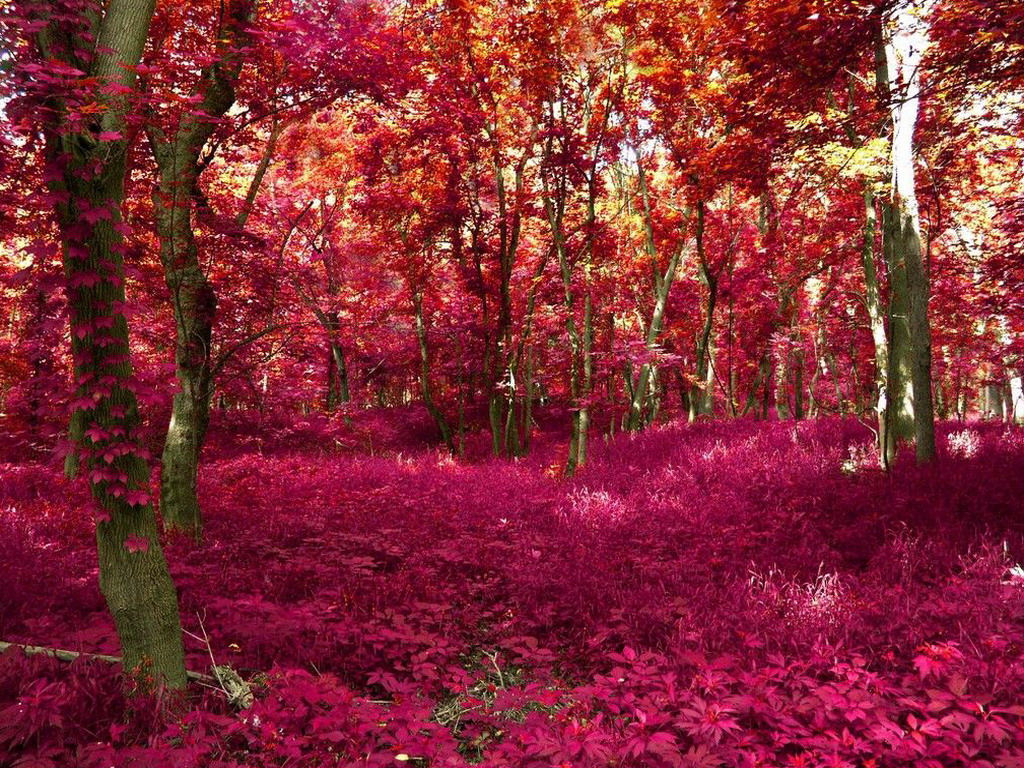
Confused? Well, as I mentioned at the start, the main issue seems to be whether the rose note appears or not. And the bottom line seems to be that — even for those who do smell it — the cedar and woodsy notes eventually take over and, then, fully dominate. Whether you smell the ISO E Super (and yay for one Fragrantica poster who smelled loads of it!), the musk, the soap, or the other spices, the main thing you’re bound to take away from the fragrance is dark, peppered, cedary woods. You may have noticed  that the photos of the woods in this review have gone from: rosy, warm, and multi-faceted; to gold-tinged and autumnal; to dark sepia; finally ending with dark black with soapy white. That’s very intentional. It’s really how this perfume feels to me in large part.

Source: Wall321.com

Source: Wall321.com

If you love cedar, then you should definitely try Rose 31. All the other notes may just be an added bonus. If you’re not a fan of highly peppered woods — especially in perfumes that bang that main drumbeat for hours on end — then you won’t enjoy Rose 31. It’s really as simple as that.


DETAILS:
Cost & Availability: Le Labo Rose 31 is an eau de parfum (though it also comes in a perfume oil) and comes in two sizes: 1.7 oz/50 ml for $145; and 3.4 oz/100 ml for $220. Le Labo Website Options: Rose 31 is available directly from Le Labo which says that it will personally make up the bottle for each customer: “all Le Labo products are personalized with labels that bear the client’s name.” The company has a variety of different country options for the website, from North America to UK to France to International. On its North American website, Rose 31 comes in everything from the Eau de Parfum to body lotion, shower gel, massage oil, and more. The prices are the same as listed above: 1.7 oz/50 ml for $145; and 3.4 oz/100 ml for $220. They also offer a tiny 15 ml bottle for $58. I’m assuming they ship to Canada, too, given the website name. On the UK website, Rose 31 eau de parfum costs £95 for the small size and  £138 for the larger 100 ml bottle. Other sizes are also available, including a small 15 ml/0.5 fl. oz bottle for £40. On the International Labo website, Rose 31 costs €110 and €170 for the 1.7 and 3.4 oz bottles, respectively. Le Labo also offers perfumes in a Travel Refill Kit of 3 x 10 ml bottles (of your choice, and which you can mix or match) for $120. Lastly, Le Labo also has a Sample Program: “Our sampling program comes in two forms – a Discovery Set of 3 x 5 ml  (0.17 fl.oz.) glass rods with spray and cap and a personalized label with your name on it, ideal for hard core testing of 3 different scents before making up your mind, and a standard (yet beautiful) sample of 1.5 ml (0.05 fl.oz.), available for all scents and ideal for more cost conscious clients who fall in love at first whiff.” I think the individual samples cost $6. As for their shipping prices, I’m afraid I can’t find any pricing information. Le Labo World Boutiques: Le Labo has store locations from New York to London and Tokyo, as well as retailers in a ton of countries from Australia to Italy to Korea. You can find a full list of its locations and vendors hereIn the U.S., Le Labo Rose 31 is also available from Barneys (in the big $220 size) and from Luckyscent, who also sells samples for $6, along with the perfume oil and what seems to be Rose 31 detergent. (???!!). Additional bath and body versions of Rose 31 are available from the Fairmont hotel online store, along with its Canadian counterpart. Outside the US: In Canada, Le Labo is carried by Toronto’s 6 by Gee Beauty, but not on their online website for direct purchase. Call to order by phone. In the UK, Le Labo is carried at Harrods’s Designer Department on the First Floor, and at Liberty which offers Rose 31 in a variety of different sizes and forms. For the Eau de Parfum, prices are £95 or £138, depending on size. In the Netherlands, you can find Le Labo products and Rose 31 at Skins Cosmetics which sells the Eau de Parfum for €111.85 or €172.90, depending on size. It also carries other concentrations or versions of Rose 31. In Australia, Le Labo is carried at Mecca Cosmetics. Mecca’s full listing of Le Labo Products can be found here. Rose 31 ranges in price from AUD$198 to AUD$308, depending on size. Samples: I obtained my sample from Surrender to Chance which sells the Eau de Parfum starting at $3.99 for 1 ml vials.

Perfume Review – Vintage Opium by YSL: A Tribute

Her name would go down in history as one of the greatest temptresses of all time: Salome. But, that night, she was not aware of the infamy which would forever follow her. As she stepped into the palace’s Great Hall, fire burned in her heart; she was a warrior with a mission. Not even the Great Hall could douse the bonfires of spice, smoke, sandalwood, cloved pepper, and molten amber which girded her golden limbs under the misleadingly sweet aura of roses, succulent oranges, heady jasmine, tart plums, and fleshy peaches.

"Salome Dancing before Herod", c.1876 by Gustave Moreau.

“Salome Dancing before Herod”, c.1876 by Gustave Moreau.

The hall was monstrously large, one vast chamber of onyx marble and gold. Her footsteps echoed as she passed the phalanxes of mighty columns, each one wider than ten men, and festooned with ropes of twisted gold. Rows of tall slaves created a corridor of flickering light, as each one struggled under the weight of a heavy, gold candelabra. The corridor led straight up to the throne, atop a large dias, but the fifteen-foot high, gold-and-jeweled monstrosity was empty. Before it, in a comfortable pile of silk pillows, lounged the King. Herod was too fat to fit into the throne; besides, he thought the bodies of the slave girls festooned around him, and hand-feeding him delicacies, would be a good cover to conceal the excitement that he would undoubtedly show. “She had finally agreed!,” he thought, as his eyes gleamed and he licked his plump lips wetly. The royal court seemed equally excited, chattering nervously about the fame of Salome’s beauty and dancing. They fell silent as she finally drew near and stared at her almost as greedily as the king.

She was a tiny figure, and all but hidden under a mountain of veils. Sheer, in and of themselves, their vast number completely obscured her raven hair and lithe, golden body. Thirty one in all, the veils were ornate, gauzy, in a variety of colours and, magically, made out of the most aromatic, perfumed ingredients: sandalwood ochre, bergamot green; plum purple; orange; blood-red rose; pure jasmine white; chocolate labdanum; dusty clove and cinnamon; the ivory-grey of frankincense smoke; the flesh colour of the ripest peach….

As the music started, she lifted one long arm from beneath the gauzy pile, flexing it like a swan, her long fingers fluttering in the air. Her chin was pointed straight up at that hidden ceiling, miles above, and one shapely, toned, muscular leg swept to the side. Folds of orange gauze glided over her fingers, while clove, cinnamon, frankincense, carnation, rose and bay leaf moved in time with her leg. The swishing of the veils radiated waves of scent out upon the silent courtiers, shimmering flecks of dust that twinkled amber gold in the candlelight. The scents melded together into the most perfect whole, each billowing out like a wave, each one more powerful than the last, until the courtiers swayed to the scent. King Herod forgot to eat, and moaned as he was hit by a tidal wave of spiced sandalwood tinged with heaps of cloves, citrus and cedar, myrrh and frankincense. Rumblings of dry woody notes, bay leaf and patchouli could be heard from beneath the folds of the veils, keeping time to the music as it became faster and faster.

Georges Rochegrosse (French, 1859–1929), "Salome Dancing Before King Herod," 1887. Joslyn Art Museum

Georges Rochegrosse (French, 1859–1929), “Salome Dancing Before King Herod,” 1887. Joslyn Art Museum

A horde of drummers suddenly appeared, clad in every hue of amber: tolu balsam, benzoin, and labdanum. “Bom, bom….bom, bom, bom…. bom, bom, bom, bom,” their hands moved faster and faster, as did Salome. She stood on one daintily arched foot, twirling in a pirouette of veils, reflecting colours like the jewels glowing on the giant throne. It became all a swirl of notes, a perfect dance of powerful spices atop her silken peach skin, tinged by jasmine that slinked up to the surface from the heat of her body.  Unbeknownst to the leering, panting king who watched her, pearls of sweat formed on her rose-tipped breasts, lending a subtle tinge of musk to the floral, citrus, spiced, patchouli amber radiating out from her like waves from the center of a vortex. She danced so fast, frankincense seeped out in white billows, and veils began to fall off her body. One arch of her back, and the carnation veil flew off to disappear atop King Herod’s head. He clawed at it, tossed it to the side in a frenzy of panic lest he miss a glimpse of her body, and the carnation vanished from sight.

"Tattooed Salome," c.1876 by Gustave Moreau.

“Tattooed Salome,” c.1876 by Gustave Moreau.

For hours and hours, Salome undulated and twisted, swayed and moved, arched and fluttered, until, finally, only seven veils were left. They blended into one beautiful, spiced whole, jasmine and roses on that main base of fiery spices, sweet musk, black smoke and vanilla. The veils just barely covered her lithe, muscular body made from a sinuous mix of sandalwood, patchouli and every possible resinous, balsamic, amber known to man. With a  flickering glance at the musicians, Salome suddenly dropped to the ground and the music stopped. There, she slithered like a sexual serpent across the floor, rolling around, and turning in a way that just revealed a glimpse of her musky flesh. As she clawed her way towards the king, she whispered, “Anything my heart desires, your Majesty? Anything in your kingdom? Do you swear it?” Herod could barely breathe. “Yes, yes.” He had no blood flow to his brain. “I have sworn it twice already. I swear it again before the court, may God strike me down if I don’t. I will give you anything your heart desires. Now, please. Finish.

Gustave Moreau - "Die Erscheinung," or "L'Apparition." 1875. Part of Moreau's Salome series.

Gustave Moreau – “Die Erscheinung,” or “L’Apparition.” 1875. Part of Moreau’s Salome series.

Salome nodded and, with a single move, was on her feet, swaying with the music that had started again and shedding her veils until she was a blur of naked, ambered flesh. Silky, smooth, creamy, heated, molten flesh — radiating spiced sandalwood, patchouli, endless layers of amber, vanilla, jasmine, and musk. Faster and faster, and faster, she moved until her body dropped in a pile of sinuous limbs. There was complete silence, punctuated by the king’s small moans and shallow breaths as he stared at Salome’s naked body. Still on the ground, she calmly lifted her head, stared at him, and coolly said: “His head. On a silver platter. I want St. John the Baptist’s head.

The story of Salome is many things but, ultimately, it is a story of a temptress and seduction. It is the story of the lure of sex. And, to me, few perfumes better represent seduction, temptation, tantalizing teases, sex, wild abandon, mystery, and, yes, a warrior’s fiery strength than Opium. YSL‘s magnificent creation is justifiably considered the benchmark oriental, the standard by which all others are measured. (And, in my opinion, the standard by which all others fail to measure up.) It is my beloved, my favorite perfume in the world, my equivalent of Gollum’s “Precious.” As with Gollum, Opium drives me a little mad, but it is also the most empowering perfume I’ve ever worn. I wear it when I need armour and feel like I will be riding out into battle, as much as I wear it to seduce.

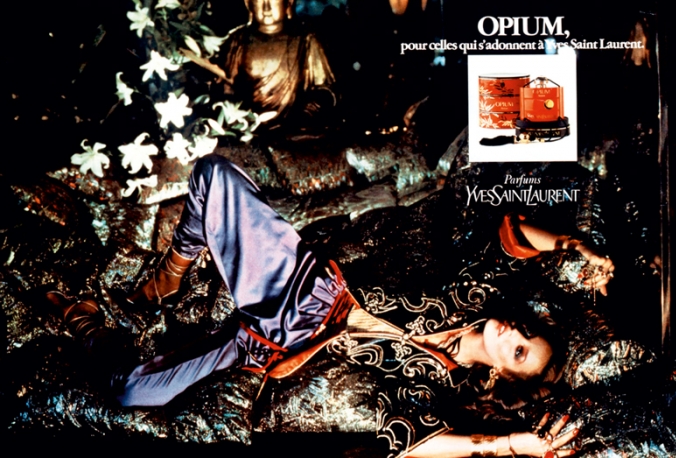
Opium ad, 1977, featuring Jerry Hall. Photo: Helmut Newton. Source: Marieclaire.it

Opium ad, 1977, featuring Jerry Hall. Photo: Helmut Newton. Source: Marieclaire.it

I refer, of course, only to the glory that is vintage Opium Eau de Toilette. The current version is a eunuch. It is a travesty which is not even worth acknowledging and which certainly does not deserve the name “Opium.” A complete and utter travesty. Adding insult to injury, there are plans for a future, additional reformulation of Opium already in the works, from what I’ve read, due to EU regulations that will take effect in the next year or so. The present abomination is bad enough; one can only shudder at what will happen when the eunuch is fully dismembered. So, to preempt a wave of tears at the thought of what has already happened to my beloved, and how much worse it’s going to get, let’s focus on the true, real, original Opium.

1977 Opium advert featuring Jerry Hall. Photo: Helmut Newton. Source: Vogue.com

1977 Opium advert featuring Jerry Hall. Photo: Helmut Newton. Source: Vogue.com

Opium was released in 1977, the creation of Jean Amic and Jean-Louis Sieuzac. It has a mind-boggling list of notes. Simply mind-boggling. Those of you who wonder why I’m rarely impressed by modern fragrances, well, it’s because most of them have a fraction of the notes present in old vintage classics. And notes equal depth, body, complexity, sophistication and richness. But even a lot of the old classics don’t have as many notes as my beloved. According to Fragrantica‘s listing (which is more for the current version than the vintage), Opium has 31 ingredients, but God only knows how much greater the number is for the vintage version, especially unofficially.

Top notes are coriander, plum, citruses, mandarin orange, pepper, jasmine, cloves, west indian bay and bergamot; middle notes are carnation, sandalwood, patchouli, cinnamon, orris root, peach, lily-of-the-valley and rose; base notes are labdanum, tolu balsam, sandalwood, opoponax, musk, coconut, vanilla, benzoin, vetiver, incense, cedar, myrrh, castoreum and amber.

I don’t like dissecting the notes for my truly, truly beloved fragrances as I generally do. I refused to do it for (vintage) Fracas, and I won’t for (vintage) Opium beyond what I’ve already written above as Salome’s Dance of the (31) Veils. For me, Opium is far too sacred for analysis, far too much a work of art. Plus, it is such a superbly blended masterpiece that a lot of the notes meld and melt into one multi-faceted whole. It’s like the bloody Hope Diamond. It’s just so big, so brilliant, so reflective of so much, but all in one giant piece.

That said, there are definite stages where some aspects shine a little more than others. In the beginning, it’s the burst of orange, infused with seemingly every ounce of fiery, dusty clove and cinnamon available on earth. It’s backed by a hint of plum and peach, but, to me, those notes have never radiated very brightly on my skin. Instead, there are dry woody notes, cedar, a dash of bay leaf, and two different kinds of incense: frankincense and myrrh. Hints of floral notes (especially jasmine) take full sway later, in the middle stage, along with the start of creamy coconut and vanilla. Later, as that phase is winding down, more and more of the amber resins start to dominate: from the more balsamic-heavy, dark, smoky Tolu amber; to the nutty, slightly animalic, minutely leathery labdanum; the sweeter, more vanilla-like tones of benzoin; and what I personally believe is ambergris (but which Fragrantica’s listing for the current version of Opium lists as just plain “amber.”) Opium also has castoreum which is detectable mainly in the dry-down in the slightly animalic leather note. Not a raunchy, harsh, obvious leather, but more of a leather feel like something sumptuously rich, thick, velvety and plush. The sort of heavy velvet that Henry VIII would wear.

My 1970s bottle of vintage Opium EDT. Note how the box says New York on it and "Made in U.S.A," in addition to the usual Paris notation.

My 1970s bottle of vintage Opium EDT. Note how the box says New York on it and “Made in U.S.A,” in addition to the usual Paris notation.

The problem is that some of these notes and, more importantly, their dominance seem to vary depending on just how vintage your bottle of Opium is. I have two bottles of eau de toilette. The tiny remainder of one from the early 1990s (1992, I think), and a large 1970s bottle which I bought on eBay late last year. It is, oddly and quite unusually, from a short, limited-distribution run when Opium was made in America, not in Paris. Unfortunately, the top notes have gone off, and that evaporation has just concentrated some of the spiced notes to an almost brutal degree. Once, however, you get past the thorny first 40 minutes, the glory of Opium’s base is revealed in full splendour, with gallons (and gallons!) of real Mysore sandalwood. It does not even remotely compare to my early 1990s bottle, though the latter has the benefit of Opium’s always spectacular orange, citrus start being intact.

While I miss that beautiful opening with my 1970s version (due to evaporation of the top notes), I find it interesting to compare the two versions because changes were clearly made in between that have nothing to do with the top notes. My 1970s bottle is a behemoth in sillage and longevity, as was the Opium that I grew up on and which bewitched a seven-year old child to the point of sneaking in sprays from her mother’s tasselled bottle. (Yes, I was an early bloomer, perfume-wise.) My 1990s version doesn’t create an enormous cloud around me at the start, becomes closer to the skin far more quickly, and doesn’t last as long on my perfume-consuming skin. My 1970s bottle clearly has real animal musk — something now prohibited for cruelty reasons. My 1990s version does not, since I believe that the prohibition against natural musk was in place by then. My 1970s version has real castoreum; I can’t smell much of its leathery undertone in the 1990s version. And the 1990s version has weaker undertones, especially the coconut and vanilla of the middle and final stages. In fact, every note is muted in the 1990s version (which should just tell you how bad the post-2000 versions are).

eBay photo showing a bottle and box identical to my 1990s version with all the swirls.

eBay photo showing a bottle and box identical to my 1990s version with all the swirls.

Perhaps the most immediately obvious difference is the huge chasm regarding the spices and the sandalwood accords. Even in the 1990s, Mysore sandalwood was becoming more scarce, and I think there is significantly less of it in my 1990s version than in the 1970s. But the truly overwhelming thing is in the spices, namely the cloves. A while back, I wrote a post centered on a Reuters article about IFRA, the EU and changes to legendary perfumes that have already been carried out, unannounced, often undetected, and definitely kept secret. Raymond Chaillan, who collaborated on the creation of Opium, told Reuters that his co-creation has hugely changed. One reason:

Clove oil and rose oil, which contain a component called eugenol. [¶]… When it was launched in 1977, the original Opium was full of eugenol and also contained linalool, and limonene found in citruses. In large doses, Eugenol can cause liver damage, while oxidized linalool can cause exzema and prolonged exposure to pure limonene can irritate the skin.

My personal (admittedly biased) response: unless one bathes daily and for hours in gallons of Opium, I can’t see anyone spraying enough of the perfume to cause liver damage! Regardless, judging between my two versions, I can absolutely see a sharp drop in the amount of clove, as well as the roses, in the later perfume. And 1992 was far, far before the IFRA/EU regulations of 2008!

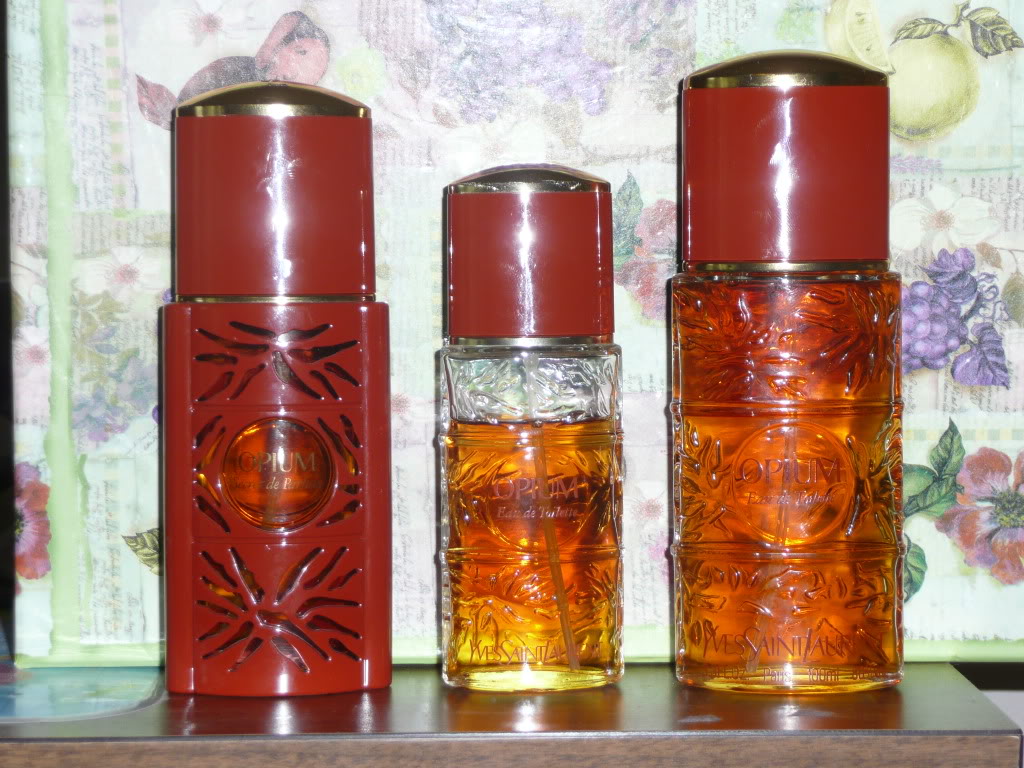
Vintage Opium bottles. Source: "Rizack2" on Fragrantica

Vintage Opium bottles. Source: “Rizack2” on Fragrantica

As a result, in my personal opinion, the best versions of Opium are from the 1980s, as well as any late-1970s bottles made in France, then any early 1990s version. I think that a 1980s version may have the best chance of keeping the top notes and avoiding evaporation, while still having that 1970s concentration. Obviously, though, it always depends on how a particular bottle of perfume was kept. It’s quite possible that a perfectly preserved, sealed 1970s bottle of Opium that was kept in a cool, dark place would be even better! My bottle was not sealed but was in almost pristine condition — and even so, it suffered. (Then again, it is 36 years old!) As for my 1992 bottle, though weaker than anything from the 1970s, it’s still much, much stronger than what followed it. I’ve read that Opium underwent a reformulation in 1999-2000. In fact, according to a poster on a Fragrantica thread, there may even have been another 1990s reformulation back in 1995! (Remember, the companies were continuously reformulating Opium, in secret, as my 1970s bottle demonstrates). The Fragrantica poster, “Andrapi” writes:

most likely Opium was reformulated in 1999-2000 (as the 99% of fragrances) due to the first wave of so-called “restriction laws”. You can clearly see because the “long-ingredients-list” on the box, became mandatory.

Then; remember before 1995 there was no bar-code : if the box lacks the bar-code, you can date the bottle as a very precious vintage one for sure [.]

More: during years 1995-2004 Saint Laurent batched its perfumes with 4-numbers code on the box and 5-numbers (the previous ones plus “1”) code on the bottom of the bottle (example: on the box 6321, on the bottle 63211. This means: 1996)

Since 2005 to 2011: 1 number plus 3 letters, both on box and bottles (example 7HAA , this means 2007).

The bastard eunuch version of Opium that is currently on the market. Note the lack of swirls in the glass on the bottle, and the very big difference in the box.

The bastard eunuch version of Opium that is currently on the market. Note the lack of swirls in the glass on the bottle, and the very big difference in the box.

So, let’s say you’re interesting in vintage Opium and are willing to brave the wilds of eBay to get one. How can you tell it’s vintage? Well, if you’re looking to purchase the glass EDT bottles, the best way to tell is by the swirls on the bottle. The new, castrated formulation has hardly any swirls in the glass, as compared to the original one. The box is also hugely different, losing its golden leaves just as the perfume has lost its notes and potency. There are a few threads on the matter at Fragrantica which might help you, starting with this one (which is where I obtained that photo of the three, vintage, glass, EDT bottles shown up above). An even more extensive thread, showing a ton of different bottles, from the pure parfum to various flankers can be found here (in that previously quoted Fragrantica thread).

Yves Saint Laurent, Opium, bottle designed by Pierre Dinand in 1977, photographed by Damien Fry (2011). Source: Phaidon.com.

Yves Saint Laurent, Opium, bottle designed by Pierre Dinand in 1977, photographed by Damien Fry (2011).
Source: Phaidon.com.

As a side note, all this discussion of Opium pertains to the eau de toilette which is the most common, usual form of the fragrance. There is an eau de parfum (as well as a pure parfum extract concentration), but I have the vague sense they were issued a few years after 1977. I am probably mistaken, however, especially as I know my mother had the tasselled, solid bottle (which is usually the shape of the eau de parfum bottle) back in 1977 and that is what is shown in all the adverts from the time. Regardless, the eau de parfum is not my area of speciality, and most of the discussions of “vintage Opium” usually pertain to the eau de toilette concentration. All I can tell you is that, in 2009, Opium (owned at this point by L’Oreal) re-issued the parfum version in what was supposedly a new bottle but which was also, in my opinion, yet another reformulation. Beyond that, however, I’m afraid I’m not a huge help on the issue of the parfum.

Non-vintage bottle.

Non-vintage bottle.

As for prices, they vary wildly. On eBay, it is all a question of patience and luck. Create a notification for vintage Opium, check the feedback scores of the seller, and then just pray that someone doesn’t outbid you. You may be lucky and get a small bottle for around $65, or you may be unlucky and end up paying around $150. For the parfum concentration, I’ve seen some sealed, 1 oz vintage bottles go for around $350. Granted, they are parfum and sealed, but it’s still high, even for Opium. Generally, though, whatever you pay, it will still be a lot cheaper than the retail cost of many modern, niche fragrances today, especially if you opt for a smaller size. The glass EDT bottles vary in size from 1 oz/30 ml to 1.6 oz, to sizes like my 2.3 oz bottle or the large 3.4 oz/100 ml bottles. You have to look at the photo of the bottles! The less swirls it has, the more it is absolutely certain that it is a new bottle of the reformulated garbage. Don’t listen to what the sellers say, either; right now, someone is selling a bottle entitled “vintage” which is clearly a post-1999/2000 bottle. (See photo to the right of the modern, reformulated eunuch Opium.) The glass has to be covered by swirls to be at least from the 1990s in age.

One last note, YSL issued an Opium for Men in 1995. It’s been a long time since I smelled it but, based on my recollection of it, it was significantly more muted, more citrus-y, less spiced, and with a very diluted sandalwood base. It’s fine, I suppose. But I wouldn’t bother with it. Men can absolutely wear Opium (original, women’s version), and honestly, I think it’s a thousand times more masculine than some of the unisex fragrances put out today for men. As between a fluffy, saccharine-sweet scent like By Kilian‘s Love (Don’t be Shy) and Opium for Women, I can tell you which one would be a better fit on a man — and it’s not the one that smells of cloying, orange marshmallows! Real Opium would be wickedly seductive on a man, but it would never suit someone used to tamer, milder scents. Opium is a powerhouse, a molten, living, breathing fire dragon that will chew you up and spit you out if you can’t handle her.

Even Luca Turin, the great perfume critic, said: “It is unquestionably one of the greatest fragrances of all time.” While the rest of his Five-Star review (entitled “Spice King”) is a more reflective contemplation on the limits of spicy oriental perfumes due to their focus on the drydown materials, he finally says that he personally tires of Opium:

Opium said one thing and one thing only, with tremendous force. While this was the most cogent statement ever made by balsams [the deepest kind of amber resin], one does tire of it.

Mr. Turin, there you go again. Just when I think I may finally agree with you, you come out with something like that. Well, His Majesty may tire of Opium, but I would shoot myself in the head if I went with some of the other Five-Star perfumes he praises, such as Davidoff‘s Cool Water, L’Artisan Parfumeur‘s Dzing! (which almost drove me to a complete meltdown), or L’Artisan Parfumeur‘s Vanilia which he cheerfully praises for being “vulgar” beyond all limits.

No, thank you, I will take instead what “is unquestionably one of the greatest fragrances of all time” with its 31 glorious notes, evoking raw sexuality, power, and a dragon’s fiery breath. I will keep Opium as my warrior’s shield and sword, as my source of molten ambered invulnerability, and as my means to seduce like Salome. I will wear it, and dance away its 31 glorious veils from sundown to sunrise. Then, when the sky is touched by morning flames of gold and red, I will spray on more of my liquid fire and smile at its secret power. My secret power. My Opium. My love.

Perfume Review: Guerlain Encens Mythique d’Orient (Les Déserts d’Orient Collection)

The treasures of the Middle East done in Guerlain’s incomparable style — that is the goal of Guerlain‘s exclusive Les Deserts d’Orient collection. Featuring a trio of perfumes created by Thierry Wasser (Guerlain’s in-house perfumer and creative director), perfumes consist of: Rose Nacrée du DésertEncens Mythique d’Orient, and Songe d’un Bois d’Été. The line was released in mid-2012, exclusively for the Middle Eastern market, before subsequently making its way to a few select Guerlain stores and retailers in Europe and America. I’ve now tested two of the three, and while I like Encens Mythique slightly more than Rose Nacrée, I’m still not won over.

Guerlain Les Desert d'Oriente collection

Fragrantica‘s description of the perfumes is enticing:

Straddling the line between contemporaneous sensibilities and antique exotic traditions, the newest collection Les Déserts d’Orient by Guerlain has the patina of aged woods and bronze artifacts hiding in some cave in the desert, yet its Frenchiness is undeniably there too.

Upon reading the description, I was sure I would finally find a modern Guerlain to love passionately and obsessively. I’ve barely concealed my enormous disappointment over many of Guerlain’s recent perfumes with their endless (often excessive) sweetness, their occasional thinness, and their lack of great nuance. In my opinion, if one were to compare the vintage versions of the legendary Guerlain classics with their sultry richness, incomparable sophistication, endless nuances and stunning layers to much of the current crop, the difference would be as wide as a chasm. But I was convinced that Les Déserts d’Orients collection would change that feeling. Well, not so far….

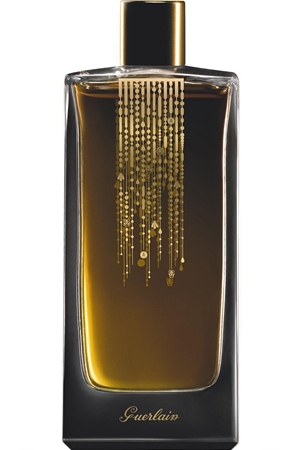
Encens Mythique. Source: Fragrantica.

Encens Mythique. Source: Fragrantica.

Like its sibling Rose Nacrée du Désert, Encens Mythique d’Orient (hereinafter just “Encens Mythique” or “Encens”) is centered on a dark, dusty rose. It is probably the same sort of unusual Persian damask rose which Thierry Wasser used in Rose Nacrée, sourced directly from Iran, but it is not the sole driving force in the fragrance. Aldehydes are just as significant, as is frankincense. Compiling the notes from both Fragrantica, The Non-Blonde, and Surrender to Chance, the full list of Encens Mythique’s ingredients seems to be:

aldehydes, Persian rose, frankincense, ambergris, saffron, orange blossom, neroli, patchouli, vetiver, musk and moss.

"Rose de Rescht," a type of Persian damask rose which originated from Rascht, Iran. Source: Flowerpedia.blogspot.com

“Rose de Rescht,” a type of Persian damask rose which originated from Rascht, Iran. Source: Flowerpedia.blogspot.com

The very first note of Encens Mythique on my skin is rose: dark, dense, dusky, very purple, almost beefy and very fleshy. The second is of aldehydes: a little soapy, but also quite fizzy and sparkling. Underneath the aldehydic rose is a mossy undercurrent, along with patchouli and what feels like the smallest pinch of citrus. If it weren’t for the moss-patchouli base, Encens Mythique would almost seem like a sparkling rose champagne, albeit one filled with soap bubbles. It is too weighed down, however, by that plush, potent, bright (but also, just a little bit dry) foundation to be anything quite so light as champagne. Adding to the velvety nature of the undertones is a subtle flickering of a rooty, earthy, dark vetiver which adds further depth and weight. There is almost a discordant juxtaposition between the frothy lightness of the fizzy soap bubbles and the darkness of that beefy rose and mossy base. It’s interesting and unexpected, though I should confess that I’m not a huge fan of aldehydes in general.

Source: Stockfresh.

Source: Stockfresh.

Five minutes in, the frankincense rises to the surface, turning the rose much more arid, dark, and almost a bit leathery in its smoky richness. The incense note is never separate or distinct, so much as it is an integral part of the rose. It imbues it with much character and darkness, ensuring that Encens Mythique’s rose is no simple rose; it’s not syrupy, fruited or merely jammy, especially given those aldehydes. To be honest, I’m having a few problems wrapping my head around the dichotomy of the white aldehydes and the black frankincense, though they’re both well-blended here and create a very different take on the traditional rose fragrance. Perhaps I just need to actually like aldehydes.

Around the twenty-minute mark, there is also the start of a light muskiness and hints of ambergris. The latter feels grey, complex, tinged with a wonderfully salty tone, and very much like the real (extremely expensive) stuff. The quality of the ingredients in Encens Mythique is without question, and few things demonstrate it more than the genuine ambergris with its rich, sensuous, slightly animalic facets.

Source: Dreamstime.com Royalty Free stock photos

Source: Dreamstime.com Royalty Free stock photos

Alas, on my skin, Encens Mythique is primarily soap bubbles and a smoked rose coated with more aldehydes, then followed by ambergris atop a powerful mossy-patchouli base. There is a hint of orange blossom, but it is extremely minimal and muted. I don’t detect the saffron in any significant, noticeable way. At all. The dash of subtle vetiver at the start is also gone. The main trajectory of the perfume remains generally unchanged for much of Encens Mythique’s development on my skin. True, the salty, musky ambergris grows in strength to a small degree, while the aldehydes recede a fraction by the start of second hour. But, it’s only a question of degree; for the most part, Encens Mythique is a predominantly an aldehydic rose touched by frankincense smoke.

Four hours in, close to the end of the drydown, Encens Mythique is a muted, musky, rather amorphous rose scent with tiny flickers of aldehydes, amber and smoke. In its last, dying moments, right around the 5 hour mark, it is just an abstract musky scent. At all times, the sillage was low on my skin. The opening projection was decent, but Encens Mythique became a skin scent on me around the two-hour mark. And its longevity wasn’t great. Granted, I have perfume-consuming skin — but I wasn’t the only one to have problems. (On Fragrantica, someone called it a “4 hour frag.”)

In fact, my experiences seemed slightly similar to that of The Non-Blonde who wrote:

Encens Mythique d’Orient on my skin is mostly an incense/rose perfume. The strong shot of aldehydes in the opening is the first surprise, as does the strong boozy element (more refined than in Guerlain’s Spiritueuse Double Vanille, but still strong) . There’s spice and sweetness, honey and saffron, wonderful richness and a powdery rose. There are stages in the development of Encens Mythique d’Orient that it almost created arabesques of sillage around me. But most of the plushness disappears too early. What’s left on my skin after two hours is an abstract woody rose. The husband says it’s nice and floral, I think it’s powdery and ambery. In any case, the longevity of Encens Mythique d’Orient is not the most impressive in this collection, but it might be the easiest one to wear.

I think I actually had better longevity than she did! I didn’t experience the saffron, booziness or powder that she did, but I agree that much of its plushness disappears very quickly. I also agree with her overall conclusion regarding the fragrance: “I expected Encens Mythique d’Orient to smell very exotic and enchanting in an Arabian Night way. While the fragrance definitely has those elements woven into its fabric, the overall result is actually very French, even if not necessarily a typical Guerlain perfume.” It’s quite true. (I actually I think Encens Mythique is perhaps much more of a chypre-oriental hybrid than a pure “Arabian Night” oriental.)

Fragrantica‘s own review for Encens Mythique was interesting:

The opening of Encens Mythique is reminiscent of retro shaving foam, part retro fern-like and mossy, part musky sweet, with a very decadent, rich feel to it that stems from an oriental Damask rose. The rosiness is allied to saffron, a classical combination that exalts the bittersweet facets of the spice into a warm embrace. But it is the coalescence of ambergris and sweet musks which “makes” the perfume a true Guerlain and at the same time a reverie into the Middle East.

Ambergris

Ambergris

I can definitely see why there would be a sense of “retro shaving foam” — it’s all those aldehyde bubbles! I definitely don’t agree that the perfume is a reverie into the Middle East judging by my own time there, but I do concur on her assessment of the ambergris as smelling “like a real tincture of the rare greyish matter, with all its nutty, buttery, smoky and salty intimate nuances intact.” Had the note been stronger on my skin, I might have more enthusiasm for Encens Mythique.

Commentators on Fragrantica are generally positive in their assessments of the scent. A sampling of some of their views:

  • A rich elegant perfume with a heart of rose/saffron accord (somewhat reminding me of Rose Barbare). It smells very “natural”, slightly green in the opening. I don’t find it smells of incense. There is really a vintage quality, it’s like something you would have smelled in the past. Like one of those “grande dame” aldehydics of the 1950s or 1960s. “Never-smelled-before” it is not, but who cares when quality is this good.
  • A distinct fragrance built around saffron, ‘real’ musk (neither animalic nor clean), rose (fresh and warm, not pungent), moss and a sultry, mellow neroli caught like exotic butterflies in a luxurious aldehyde glass house. It is the mix of individual colors – vibrant, velveteen and tender – that enthralls and then the touch of moss, that adds a dimension of earthiness and maturity and eccentricity
  • This is a lovely perfume but I can’t smell any incense or smoke, in fact it just needs something else to make it a bit more interesting.I gave myself a good spray last night and can still smell the divine amber lingering on me this morning. It is a very sweet perfume and this is what will probably put me off getting a fb.
  • A short burst of incense; spices, herbs, a gentle sweetness. Then, a distinct honey accord, which rounds out the fragrance. The dry down is warm, sensual and keeps the delicate spicy sweetness, with an undercurrent of woody notes. Very nice, but at the price, perhaps not FB worthy. (3/5)
  • If you are expecting incense such as that in the Comme des Garcons series or Messe de Minuit, think again. The incense in this perfume, if present at all, appears only as a wisp of smoked rose. The moss listed in the notes is not there; oakmoss usually lends a note of bitterness and there is nothing bitter here. Overall this is really a simple floral, and does not live up to its name. It’s pretty though, but not pretty or different enough for the price.

As you can see, there seems to be a big split on the issue of the incense and its dominance. On my skin, as noted early, it was infused into the rose, ensuring that it wasn’t just a simple, jammy or fruited rose, but it was never a wholly distinct, rich feature in its own right.

Some Fragrantica members also seemed to have issues with Encens Mythique’s price — and it’s a very valid consideration at $275 a bottle or €190 (though it may have gone up since that original Euro price). Ultimately, I think price is subjective, and all depends on someone’s love for the fragrance in question. I, personally, would not buy Encens Mythique — even at a significantly lower price. It is not my cup of tea and, in my opinion, not very special or hugely interesting. Plus, longevity is an issue. But it definitely has its fans. I suspect it would have many more fans were it easier to obtain. Though it is available with a bit of effort, Encens Mythique is not listed on Guerlain’s own website – which is rare even for their niche, prestige lines! It is, however, available via select stores which you would have to call in order to buy the perfume. (The details are below.)

All in all, if you’re a die-hard Guerlain fan and love rose scents of any variety, I’d encourage you to give Encens Mythique a sniff. It’s wearable, refined, has a slight twist, and is well-blended with high-quality ingredients. However, if you’re looking for something truly oriental or different, you may not find it to be a stand-out that is worth the price.

DETAILS:
Cost & Availability: Encens Mythique d’Orient is an eau de parfum that comes only in a 75 ml / 2.5 oz bottle and costs $275 or €190. (I think that may be the Euro rate. See below.) In the U.S., it is available at Guerlain’s Las Vegas boutique at The Palazzo (702-732-7008) with free shipping and no tax. It is also available at Bergdorf Goodman in New York; you can call (212) 872-2734 and ask for Alina. However, she informs me that there is shipping costs an additional $12.75, so you’d get a better deal ordering from Las Vegas if you test out the perfume and want to buy a full bottle. In New York, the Désert d’Orient collection is also available at Saks. If you’re outside of New York, you may try calling a Saks Fifth Avenue near you to see if they carry the line as well.
In Europe, I’ve read that the original European price was €190, but I don’t know if it remains at that price and can’t find the perfume listed on any online website to check. Encens Mythique is available at Guerlain’s flagship headquarters in Paris. Most of the exclusive Guerlains are also available at Haute Parfumerie Place Vendôme in Belgium (which ships internationally), but I don’t see the Désert d’Orient collection on their list, so I would definitely give them a call if you’re in Europe and interested. In the UK, I’ve read that the collection is supposedly available at London’s Harrods and Selfridges boutiques. However, it is not listed on the latter two stores’ websites.
In the Middle East & Asia: The perfume is obviously available in the Middle East, since the entire collection was originally created for that market to begin with, so your starting point might be the Paris Gallery perfume retailer which sells Encens Mythique for AED 990. They have stores at a huge number of UAE malls and locations which you can find using their Store Locator. In Asia, I know a lot of rare, expensive Guerlain fragrances are carried by Hong Kong’s Harvey Nichols boutique, so they may have this one too. If you’d like to check for locations of Harvey Nichols from Hong Kong to Istanbul, Riyadh and Kuwait, try here. I did see that Guerlain has a Japanese website, but I’m afraid I can’t read it to see what fragrances it carries (even using a Google translator). Outside of those regions, I would check with any Guerlain boutique or luxury department store in your country on the rare off-chance that they may carry it.
Samples: Surrender to Chance sells Encens Mythique starting at $4.59 for a 1/2 ml vial. You can also do what I did and opt for the whole Desert d’Orient trio in a sample set that begins at $12.99.

Perfume Review: Jour Ensoleillé by Sonoma Scent Studio

A sunny day, late in the summer and spent in dappled woods. Fall is around the corner, but the heat of that summer’s day is matched by the brightness of the sun. Jour Ensoleillé (“Sunny Day”) is a floral chypre perfume from the beloved, Indie, artisanal line, Sonoma Scent Studio (or “SSS”), which seeks to encapsulate the feel of that summer’s day in the woods.

Jour Ensoleillé via SSS. (34 ml bottle.)

Jour Ensoleillé via SSS. (34 ml bottle.)

Jour Ensoleillé was released in 2007, the creation of Sonoma Scent Studio’s founder and nose, Laurie Erickson. It is a largely natural perfume with minimal synthetics, and comes in what is essentially extract de parfum or pure parfum concentration. It is also cruelty-free — something which I always approve of most wholeheartedly — and almost vegan. (The beeswax prevents it from being purely vegan). The company describes the perfume on its website as follows:

Jour Ensoleillé (sunny day) marries a lively floral blend of orange blossom, tuberose, and jasmine with a soft woodsy, mossy base that is gently chypre in nature. Like the golden late summer sunshine as the season moves toward fall, Jour Ensoleillé warms your spirit with its uplifting blend of woods and florals. The woodsy base makes this fragrance appropriate for men as well as women, though the floral notes are prominent.

The image associated with Jour Ensoleillé from SSS.

The image associated with Jour Ensoleillé from SSS.

The notes are:

Orange blossom, neroli, tuberose, jasmine, beeswax absolute, labdanum absolute , myrrh, sandalwood, ambergris, vetiver, green leaves, oakmoss absolute.

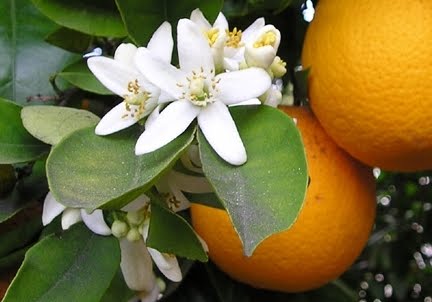
Orange blossoms via the Pattersonfoundation.org.

Orange blossoms via the Pattersonfoundation.org.

Jour Ensoleillé opens on my skin with strongly animalic orange blossoms, drenched and coated with honey. It is sweet, but also a little bit salty, with a musky, honeyed labdanum that doesn’t feel even remotely leathery or goaty. There is a strong mossy element that is also intertwined with the honeyed orange blossoms. It is neither the brightly green, fresh kind of moss, nor the completely dusty, pungent, arid, grey sort that sometimes feels almost more like lichen. Instead, it is somewhere in-between. When combined with the subtle touch of green leaves, the overall impression is of a very sunlit spectrum of green.

Jasmine

Jasmine

The real star, however, is the heavily honeyed orange blossom which is just faintly tinged by a little of the bitterness of neroli. Actually, it feels a little more like petitgrain with its slightly twiggy, woody facets. Together, the notes swirl together to create a glowing, orange blossom with deeper, musky, almost salty qualities atop a bed of bright and dark green. All around, dancing up to the orange floral notes, are powerful white flowers: heady tuberose and, perhaps more significantly, lush jasmine. They never feel sour, plastic-y or over-ripe; instead, they are very warm, bright, and lush. But they are also incredibly potent, and far from feeling dewy or fresh. They are indolic flowers in full bloom, and just a little droopy from the strength of the summer’s midday sun.

Underlying the flowers is a subtle woodsy note that is hard to pinpoint. It feels almost amorphous and abstract; it’s never dark or heavy, but it’s not like white woods, either. It’s also nothing like real sandalwood with its spicy, opulent heart. Whatever kind of sandalwood is used here, it’s not from Mysore and, honestly, is not really detectable at this stage in the perfume. I can’t figure out the wood note, but whatever it is and wherever it comes from, it does feel creamy and adds a subtle depth to the floral notes.

Labdanum compiled into a chunk. Source: Fragrantica

Labdanum compiled into a chunk. Source: Fragrantica

Honestly, the most intriguing part of Jour Ensoleillé’s opening is that animalic note. It feels nothing like usual labdanum (or even labdanum absolute) which can have quite a masculine, nutty, occasionally goaty and leathery feel. Here, it is deeply honeyed and even the musk seems different. It’s never skanky, dirty, raunchy or a little bit intimate in nature. Perhaps the reason is that both the musk — and the labdanum that triggers it — are deeply intertwined with the heavy, lush florals. The overall result is a floral labdanum which is quite unusual.

Even more unusual is the concomitant effect of the labdanum on the orange blossoms. They have a smoky, musky sweetness that feels both opulent and incredibly sensuous (though never sexual or intimate). The way they are drenched with honey and accompanied by heady, narcotically strong jasmine (and, to a lesser extent, tuberose) makes them feel a little feral, like a giant tiger that has been set loose. Granted, it is a tiger that is lazily and languidly stretched out in the sun, purring as it flexes its huge paws, but it is still quite a feral, feline take on orange blossoms. I don’t think I’ve smelled anything like it.

Painting by Gyula Tornai (1861-1928): "In the Harem."

Painting by Gyula Tornai (1861-1928): “In the Harem.”

I tested Jour Ensoleillé twice, and my reaction to those powerful, incredibly potent, opening stage differed quite a bit. The first time, I was quite bewitched. I thought the combination of the jasmine-tuberose twins with that dominant, glowing orb of an orange blossom, the unusual muskiness, and the honeyed, subtly smoky labdanum was utterly fascinating. While the perfume is supposed to evoke a summer’s day in the woods, it did absolutely no such thing for me during that first test. Instead, I envisioned the Sultan’s favorite odalisque, emerging from her morning bath, to spray Jour Ensoleillé all over her oiled, naked body, before she dressed to spend the day in the harem’s private, enclosed, secret garden, where she would lounge in the sun and smell the heady, white jasmine surrounding her.

The second time, however, using just a dab or two more in quantity, I found the smoky, musky, animalic white flowers to be too, too much. Coming from someone with my tastes — and who finds scents like Fracas to be child’s play without any troublesome extremeness or indolic negatives — that says quite a lot! I no longer saw the Sultan’s favorite concubine, sensuously purring out in the sun, nor that languid tiger. Jour Ensoleillé no longer felt quite so much like a glowing, jeweled orb above a lush base of dappled green, both mossy and leafy. Instead, the perfume seemed a little sharp, completely excessive, slightly verging on the territory of “cloying,” and far too indolic. The jasmine even reeked of mothballs — which almost never happens to me — and it stayed that way for a number of hours. Lastly, that honeyed note felt clangy and metallic. As a whole, I felt almost suffocated by heaviness, thickness, honey, musk, and over-ripe, blown florals. And I only used the dabbing equivalent of two medium sprays! Clearly, this is a perfume with ferocious potency in its early stage, and one which requires a very light hand to prevent it from turning unpleasant.

The rest of the perfume’s development was the same in both instances. After the two-hour mark, Jour Ensoleillé became a primarily orange blossom and jasmine duet atop a base of oakmoss infused with amber. It feels very much like a mossily green patchouli element is there, too, to help with that chypre base. And, as always, there is always that constant undertone of smoky honey and amber, thanks to the myrrh and labdanum. A quiet woodiness lurks underneath, but it’s very muted. Jour Ensoleillé is also, at this point, a skin scent on me. That potent, ferocious start softened with every moment until, exactly two hours in on both occasions, it clung right on top of the skin. It’s certainly strong whilst there, and if you bring your arm to your nose you can detect it, but the projection is minute, at best.

Four hours in, Jour Ensoleillé starts to feel a little abstract. The fragrance seems, primarily, like a well-blended, harmonious, but generalized, white floral fragrance atop light dashes of sweet oakmoss and honeyed amber. At times, the perfume throws off more noticeable, individual notes. Jasmine takes the lead from the orange blossoms, becoming significantly more pronounced, though the orange blossoms are still detectable. The tuberose which always lurked as a very distant third on my skin seems gone almost entirely. In its place is the start of the beeswax element, along with some soapiness. Jour Ensoleillé remains that way for hours in a generally linear line, becoming increasingly abstract, muted and soapy, until it finally dries down as a soft musk with florals and beeswax. All in all, Jour Ensoleillé had great longevity on my perfume consuming skin. To be precise, it lasted just over 9.5 hours during the first test, and 10.75 with the slightly larger amount during the second test.

Jour Ensoleillé is a hugely beloved fragrance from an even more beloved indie perfume house. And it is an extremely well-done, beautifully blended creation. It wasn’t my personal cup of tea, but I can see why so many adore it and associate it with the sunniest of days. I actually received my sample from Brie of The Fragrant Man blog; she is not only Sonoma Scent Studio’s biggest fan, but also a passionate advocate for Jour Ensoleillé, in particular. It is her “Desert Island” scent which truly says a lot given just how many fragrances she’s tried and, also, her love for the rich, vintage classics. In her emotional, deeply personal review for Jour Ensoleillé entitled “Coming Home,” she writes:

[U]pon first whiff,Jour Ensoleille touched a raw visceral nerve within my psyche in such a way that has never been matched by any other perfume. It was simultaneously euphoric and meditative, calming and exciting, gorgeously complex and extraordinarily simple in its exquisite beauty.  It was the perfume I turned to time and time again just to whiff straight out of the bottle and it was as if I was smelling it for the very first time.

I usually relegate my perfumes to certain days, seasons and/or moments in my life. But this is not the case with Jour. I don’t want that  distinct memory connection as I desire to be able to savor Jour wherever and whenever I please. […][¶]

[W]ere I ever to have the misfortune of being stranded on a deserted island Jour Ensoleille is the only perfume I would need in my possession if I were forced to choose just one. After 42 years of perfume wearing and 400 or so empty  bottles later, I am  finally home.

Another lovely review comes from the Eiderdown Press blog:

The sparkling, sunlit warmth of orange blossom, tuberose and jasmine falling on a cool mantle of grassy, mossy and woodsy base notes creates a rather distinct dichotomy in Jour Ensoleillé. […] The sweetness of the flowers and the bitterness of the base notes seem almost equally weighted, creating the kind of marked contrast that first struck me as odd and discordant. But it was an intriguing kind of odd—not at all strident or grating, but rather the kind of odd that, at first whiff, makes one say, “hmm, that’s different,” instead of “ooh, pretty!” and then rather quickly becomes the very thing that keeps you coming back to the fragrance wanting more, realizing it really is beautiful. (Sublime, really.)

While the herbaceous, woodsy base lends a contemplative air to the perfume and keeps the white florals from running riot in their usual erotically-charged way, this perfume is still every bit as sensual as it is thoughtful in spirit. Orange blossom and jasmine do indeed express their indolic nature within Jour Ensoleillé, adding to the lushness of the scent—completing it in a sense—and entreating the wearer to dream not only of afternoon sunlight, but also perhaps of “afternoon delight”: a romantic tryst leisurely taken or perhaps stolen, like kisses, from the golden middle part of the day.

On Fragrantica, the reviews are generally quite euphoric, too, though there are some dissenters who have issues with the orange blossom. One happy commentator, “Pisces3774,” writes:

Absolute perfection! I don’t normally gravitate toward chypres, but with all of the beautiful and balanced floral notes, the combination is intoxicating. The opening is bright and citrusy – a bit like Lauder’s Azuree. Then the white flowers are ushered in. They’re not whiny, thin, and polite-typical. They’re high-quality, and well blended. This is no tuberose monster. The white flowers mellow, the citrus mellows, and the creamy combination sets the stage for the chypric base. The result is a creamy, sophisticated, white-floral chypre. I get numerous compliments every time I wear it.

Another added something that I thought was quite interesting because it pertained to that opening stage and its potency. In her very positive review, “Khterhark” noted:

this is the third fragrance I’ve tried from this line, and I feel comfortable saying these wear like Caron Urn fragrances on me. They open rather harsh and unpleasant, and you have to wait a good 40 min before you are rewarded with a long lasting, beautifully harmonized, gorgeous composition.

I think she has a definite point, as Jour Ensoleillé’s opening is quite potent and heavy, indeed. One commentator on Fragrantica, who really liked the scent, actually wrote that her stomach “curdled” at the opening minutes. So, again, I caution, use a light hand when applying this fragrance, or you will experience something like what I went through on my 2nd test run.

While I hope the other reviews are helpful to you, I find them interesting, in part, because I noticed how the commentators rarely talk about the animalic, sweet, strong musk. They certainly didn’t seem to experience as much as I did. Also, on my skin, the labdanum’s honeyed undercurrents were as strong as the oakmoss (with its occasionally green-patchouli feel), so Jour Ensoleillé felt more ambered in its foundation than a pure chypre. Finally, some commentators, on both Fragrantica and on MakeupAlley, seemed to get significantly more tuberose than I ever did. But one thing that most people seem to agree is this: the very lush, indolic, sensuous feel of the perfume.

It’s always tricky to write about a perfume that one of your good blogosphere friends adores with a passion. So, I was rather relieved when I liked parts of Jour Ensoleillé, at least the first time around. As most of my regular readers know, I can be quite forceful and blunt when I hate something. And I don’t believe in protecting companies just because they are small and artisanal, especially when almost all of the reviews out there are positive. My loyalty is to the readers who expect my honesty, not to the perfumers.

So, my honest opinion is that Jour Ensoleillé is a pretty scent, and I can see why it is receives so many rave reviews. It’s an unusual twist on the orange blossom leitmotif, it can feel quite sensuous as well as bright, and it’s very feminine. Its opening is quite glowing, like a jeweled orb, and it becomes softer with time, though also a bit flat, linear and soapy on my skin. Ultimately, it’s not for me, but it has made me extremely interested in trying out the rest of the fragrances from Sonoma Scent Studio. All those raves about Laurie Erickson’s talent, creativity, and originality are clearly rooted in fact, not hype. I’m genuinely intrigued.

So, if Jour Ensoleillé’s notes sound interesting to you — and if you can take indolic white flowers — then I would definitely encourage you to give the perfume a sniff.


DETAILS:
Cost & Availability: Jour Ensoleillé is essentially pure parfum extract in concentration, and is exclusive to Sonoma Scent Studio. It is available via the company’s website in a variety of different sizes and prices: a 34 ml bottle costs $65; a $15 ml bottle costs $40; a 5 ml travel spray costs $16; a 3 ml sample spray costs $10.50; and a 1 ml dabber vial costs $3.50. SSS also offers Gift Sampler Sets in a black gift box: 10 carded samples of your choice for $40, or 12 perfume samples of your choice for $65. (The company is temporarily out of those but they will be in shortly.) The samples look like 1 ml vials. The company takes credit cards or PayPal, but is forced to impose California sales tax for California customers.
International Shipping: Due to postal regulations on alcohol-based perfumes, SSS is unable to ship directly to overseas customers except by the very expensive option of FedEx or UPS. However, the FAQ page provides some more affordable options in terms of freight forwarders who, in one past case, shipped even to Saudi Arabia. The full details, taken from the website, are as follows: “If you want to purchase directly from me, you can use a freight forwarding service that gives you a USA address; I ship to the freight forwarder in the USA and they collect and forward all your packages to you, or they can send them one by one. By consolidating your packages from several USA merchants, you can save on shipping. Most freight forwarders will not ship alcohol-based perfume by regular mail, but some of them have other methods of shipment to offer, depending on your country. One freight forwarder I have worked with on a shipment to Saudi Arabia can possibly help many of you. His name is Jim Rojas and he has an ebay shipping store. His shipping costs are very reasonable (though you may have duties depending on your country). You can get a quote from him if you give him the size and weight of the package, and I can give that information to you if you tell me what SSS items you would like to buy. Larger freight forwarding services also exist, like www.myus.com. Another option is for me to ship to a friend or family member here in the USA who can then get the package to you. And a third option is to buy from one of my retailers who ships to your country. Indie Scents in the USA does some international shipping and carries my boutique line.” Please note, however, Jour Ensoleillé is part of the Exclusives line and is not carried by Indie Scents.
Samples: Samples are available directly from SSS at the links listed above. It is also available from Surrender to Chance (which ships overseas via First Class Mail for $12.95 for all orders up to $150) in various sizes, starting at $4.99 for a 1 ml vial, $21.61 for a 5 ml spray, and going up to $64.87 for a large 15 ml decant.