
John Wayne riding through the arid desert canyons of New Mexico. Gary Cooper in a suit in the bracing, brisk air of Normandie. Two very different images of two very different men stemming from two very different fragrances in Dior‘s prestige La Collection Privée line of perfumes. (The line is sometimes called La Collection Couturier on places like Fragrantica and Surrender to Chance, but I will go with the name used by Dior itself on its website.) The fragrances are Leather Oud and Granville, and both were created by François Demarchy, the artistic director and nose for Parfums Dior, to reflect different aspects of the life of Christian Dior.
Category Archives: Fragrance Genres
Perfume Reviews: Library of Flowers Linden & Arboretum
It all started as somewhat of a dream when I, sleep-deprived from insomnia, decided to order some perfume samples at 4:27 a.m. upon email notice of a Flash Sale from Surrender to Chance. I wanted some floral scents to counterbalance the blog’s heavy focus on ambers, orientals, and woody fragrances. And I actually thought I was ordering another brand entirely — April Aromatics — which just goes to show you how little sleep I sometimes get. What started as a dazed dream ended up as a bit of a nightmare.

Source: The Perfumed Court.
Library of Flowers is the latest perfume house from Margot Elena, who also founded and owns Tokyo Milk and Lollia. The new brand focuses entirely on flowers, and is described as “American small batch perfumery” that has been “carefully crafted to create memorable journeys through sight and scent… [M]oments are captured in artful perfumes waiting to be released upon happy whim. The perfect pick me up to nourish the senses and inspire the gardens of the imagination.” It turns out that the line even got a small feature in the April 2013 issue of Oprah’s O Magazine. I ordered Linden and Arboretum — and one of them was absolute, unmitigated hell.
LINDEN:

Library of Flowers Linden.
Each Library of Fragrance perfume features a single top, middle and base note, and is an eau de parfum. Thus, for Linden, the notes are:
Top: Linden Blossom Middle: Narcissus Bottom: Clover Honey.
Linden blossom is sometimes called Lime Blossom, and comes from the Tillia tree. It has a sweet, bright, floral aroma that is infused with honey notes. I love honey in fragrances, so I was quite looking forward to Linden, ordering mistake notwithstanding.

Linden blossom. Source: www.selfsufficientish.com
Linden opens on my skin with airy, green, floral notes like magnolia and sweet honeysuckle combined, lightly sprinkled with honey and with a whisper of soapiness lurking underneath. The smell feels almost clear as a bell, except that there is an unusual fuzzy feeling around the edges. It almost feels like light, springy, fluffy, floral-infused cotton balls. The sweet coziness of the scent kept conjuring up images of those extraordinarily fluffy, plush, white, bathrobes you get at very expensive hotels, and which have a very clean, lightly soapy, floral aroma. As the moments progress, the whiff of soft cotton grows stronger underlying that billowy, airy, clear, clean, fresh, softly floral bouquet. I didn’t quite know what to make of it. True, there are faintly floral notes as well; there is a daffodil (narcissus) element that emerges briefly, but it smells more laundry-like than anything you’d smell in a field or florist shop.

Bounce fabric softener and anti-lint dryer sheets.
Then, exactly twelve minutes later, BOOM! Chemical, synthetic notes take over, screeching out exactly like Bounce fabric softener sheets for the dryer. It feels as though I’ve cloaked my entire arm with soapy, clean, white musk and chemicals, right down to Bounce’s underlying chemical florals. It’s unbearably hideous for someone like myself who finds the words “soapy, fresh and clean” — let alone “Bounce fabric softener sheets” — to be expletives in perfumery. And, actually, expletives were abounding out of my mouth as Linden progressed unchanged (and with initially powerful projection) to remain as the very pinnacle of chemical, laundry detergent artificiality for the next seven hours. Terrible, really terrible.
Shortly before the eighth hour, Linden suddenly decides to shift a little. The Bounce accord recedes, somewhat (it’s all relative), and the perfume manifest a strong honey note atop more individually distinct floral notes. Instead of amorphous, abstract, chemical florals, there is now a clear element of sweet honeysuckle mixed in with creamy magnolia. Lindn is still primarily a clean, fresh, white musk fragrance, though it is now, thankfully, a skin scent. Despite that sudden breakthrough, Linden eventually returns to being nothing more than a fresh, white, floral musk — abstract, chemical, and wholly artificial. It finally dies away 10.25 hours later. Words cannot express my utter disgust with the whole thing.
ARBORETUM:
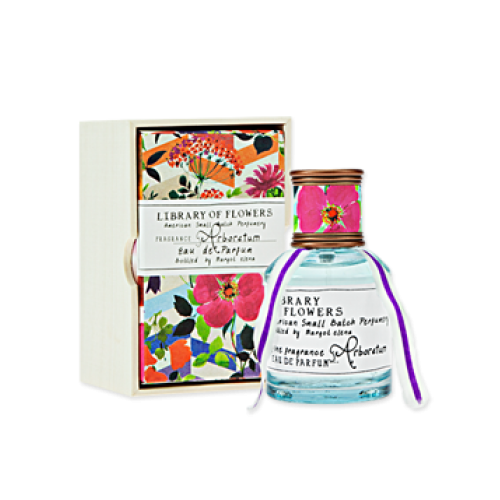
Arboretum with box.
Arboretum is an eau de parfum, and its notes are simple:
Green cardamom, ylang ylang, and amber resin.
Arboretum opens on my skin with green, floral notes infused by honey. There is a fresh, light, almost fruited cardamom that feels as though it is still a green pod on a tree, instead of dried and concentrated. The floral notes are interesting because, to my nose, they resemble white lilies — stargazer lilies, to be exact — more than anything close to ylang-ylang with its buttery, sometimes banana-like, custardy richness. The note is fresh, green, airy and crisp. Arboretum’s base is flecked by light dashes of sweet vanilla which feels quietly muted and somewhat synthetic, though nothing close to the horrifying degree of Linden. Twenty minutes in, Arboretum starts to gain some fresh, clean, white, synthetic musk accords in its base, but the primary bouquet is still of airy, green lilies. The sillage is decent at first, but quickly becomes much softer.

Ylang-ylang
Arboretum doesn’t change enormously for the first half of its life. By the middle of the third hour, it is a soft, white, floral musk with a tinge of soapy lilies underlying it, and very much a skin scent. Around the start of the sixth hour, however, Arboretum suddenly takes on amber hues, and the ylang-ylang makes a strong appearance. The fragrance is now a buttery, custardy, soft, velvety, slightly banana-like, ylang-ylang floral atop soapy amber and light musk. Arboretum no longers feels so crisply airy and green, but, rather, warm and very much like a silky, golden gauze. The fragrance continues to soften until, finally, around the middle of the eighth hour, it is merely a soft, abstract floral note tinged by a vague sense of something ambered.
As a whole, Arboretum was a pleasant scent, though I don’t know how much of my assessment is relative to the sheer horror that was Linden. Arboretum certainly never felt close to the painfully synthetic, cheap, and artificial qualities of its sibling. I somewhat enjoyed the lily parts, and I thought the green cardamom aspect was quite interesting. If you’re looking for an inexpensive, greenishly airy, white floral fragrance that eventually becomes slightly richer, warmer and more ambered towards the end, I suppose you could do a lot worse. But, under no circumstances, would I recommend Linden. Save yourself $54, and just take a few dryer sheets to scrub up and down your arm instead.
DETAILS:
LINDEN Cost & Availability: Linden is an eau de parfum that is available in 1.7 oz/50 ml bottles for $54 or as 70.8 g solid perfume for $21. It can be purchased directly from the Library of Flowers website (which also offers a variety of accompanying products like bath gel, handcream and a Linden candle) and which offers free domestic shipping on all orders over $75. For International shipping, call the company at t 1-888-896-6398 for details. You can also purchase Linden perfume from Beautyhabit which ships overseas. Samples: You can find Linden at Surrender to Chance where prices start at $2.99 for a 1 ml vial or at The Perfumed Court where prices start at $2.95.
ARBORETUM Cost & Availability: Arborteum is an eau de parfum that is available in 1.7 oz/50 ml bottles for $54 or as 70.8 g solid perfume for $21. It can be purchased directly from the Library of Flowers website (which also offers a variety of accompanying products like bath gel, handcream and a candle). You can also purchase Arboretum perfume from Beautyhabit. Samples: You can find Arboretum at Surrender to Chance where prices start at $2.99 for a 1 ml vial, or at The Perfumed Court. Both sites offer sampler sets of the whole Library of Flowers line should you be so interested.
Perfume Review: Jovoy Paris La Liturgie des Heures

Photo: StormchaserMike Photograph via Flickr (link to website embedded within.)
A sea of pine trees as far as the eye can see, half covered with snow, half green-grey and reflecting the cold winter light. Pine cones and needles blanket the forest floor, releasing their fresh, pungent, resinous oil with every crunching footstep. A thin stream of white smoke issues from a nearby church, its ancient stones protecting its darkened, dusty inner sanctum where priests are getting ready for Mass. They light the candles for Vespers and burn the myrrh. It’s time for the one of the oldest canonical rituals of the Catholic Church, the Liturgy of the Hours.
That is the vision which comes to mind when I wear Jovoy Paris‘ fragrance, La Liturgie des Heures (hereinafter “Liturgie des Heures” or just “Liturgie.”) Most hardcore perfumistas have heard of Jovoy, a Paris boutique that is a mecca for buying the most high-end, exclusive or rare fragrances, but what many people don’t know is that Jovoy was once a perfume house. As Luckyscent explains, Jovoy was founded in 1923 by Blanche Arvoy and “was known for selling perfumes for the ‘gentlemen’s nieces’, a polite way Parisian dandies described buying gifts for their mistresses[.]” Amusingly, Jovoy itself candidly admits to this twist in its past:
The perfumes of the early hours of Jovoy were made for the mistresses of the Paris of the Roaring Twenties. In other world, opulent fragrance for women who wanted to be seen, using in quantities prohibited by modern law, raw material now often missing.
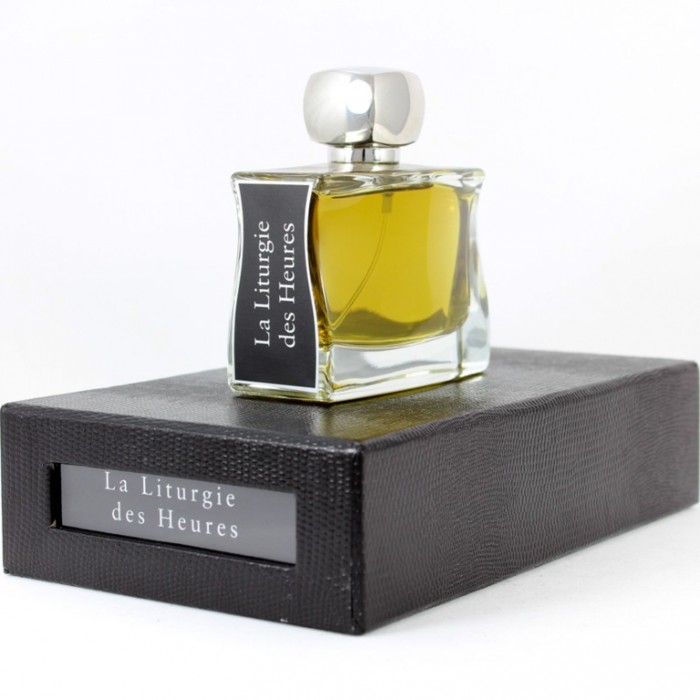
Jovoy Paris La Liturgie des Heures
Though the house declined in the bleak years of the Depression and ended completely during WWII, it was resurrected in 2006 by Francois Hénin who launched a new range of fragrances. In 2011, La Liturgie des Heures joined their ranks. It is an eau de parfum that was created by Robertet perfumer, Jacques Flori, and which is described by Francois Hénin as evoking “the image of an old monastery where the scent of burning incense fills the air just like the chanting of daily prayers.” Fragrantica lists its notes as follows:
Top notes: fresh green notes, cypress
Heart notes: incense, olibanum [frankincense], cistus [labdanum], myrrh
Base notes: musk

Source: listofimages.com
 La Liturgie des Heures opens on my skin with a burst of pine trees, incense and green notes, followed by traces of a sweet, almost nutty myrrh, slightly leathered labdanum, and musk. One is transported to a cold, pine forest covered by crisp snow, but I have to admit, the notes are a little too reminiscent of pure pine oil and verge on a non-chemical version of Pine-Sol household cleaner. There is almost an oily feel to the pine, as if you had just mashed up the tree’s needles in your hands, leaving a strong, overly fragrant, concentrated oil behind. The aroma feels a little odd juxtaposed next to the leather undertones and the very cold, dry, vaguely dusty undertones of High Church incense. Yet, once you wrap your head around the combination, it almost feels pleasant.
As the minutes pass, the undertones of frankincense, myrrh and leather undulate, swaying from the foreground to the background. Sometimes, Liturgie smells like nothing more than a Christmas tree; at other times, the subtle touch of sweetness from the myrrh and churchy incense meet the pine notes head-on. Thirty minutes in, the base notes rise fully to the surface and the perfume becomes sweeter, more layered, and less like Pine-Sol oil. The myrrh turns the frankincense warmer, less dusty and arid, while the leather adds touches of a darker, almost leathery resin to the pine. A subtle, clean muskiness joins the trio and, flickering in the background, a subtle whiff of soapiness.

Photo: David Gunter Source: Flickr (website link embedded within photo.)
Liturgie continues on for another two hours as a warm, slightly sweetened, incense-infused, resinous pine tree scent with fluctuating levels of soapiness and musk. By the third hour, however, the clean white musk has grown in strength. Sharp and synthetic, it makes Liturgie feel a lot like Heeley‘s Cardinal, especially now that the pine note has receded to the background. I truly can’t stand synthetic white musk, let alone soapiness, and both elements form a strong backdrop to the scent. By the middle of the sixth hour, La Liturgie des Heures is primarily centered around nutty myrrh, ambered labdanum, and the sweet church incense — all infused with soap and clean, white musk.
The fragrance sticks on its linear course for another few hours, until it fades away to an amorphous, abstract, musky, clean sweetness. All in all, Liturgie lasted 8.25 hours on my skin and with moderate-to-low sillage. Others, however, have reported significantly less time, with one commentator on Basenotes writing that “[p]rojection is on the low side of average and longevity is well below average at 2-3 hours on skin.”
Liturgie wasn’t my cup of tea, and my feelings for it strongly parallel those of Freddie from Smelly Thoughts whose brief review reads as follows:
La Liturgie des Heures opens not too dissimilar to April Aromatics’ Calling All Angels, with its dry woods and incense, only this is a touch more peppery, and more “sticky”. Along with the overload of bitter resins and incense – bits of harsh greenery cut through it: pine and cypress mainly… a mix of sticky, sweet forest floor, and more herbal coniferous greens.
It pretty much stays this way throughout it’s life. It’s totally not my kind of perfume and not how I like to smell (also very bored of the overload of foresty/incense fragrances)… but still, this is a solid enough example for people who like that kind of thing
Not bad!
I agree. It is a solid perfume that should please those who like churchy, incense fragrances — if they don’t mind either soapiness, white musk, or smelling just like a Christmas tree.
There are a number of High Church-type fragrances out there, but I’m only familiar with Heeley’s Cardinal. I think Liturgie has some similarities, but primarily in terms of the synthetic white musk. A Fragrantica commentator, “magic gingerbread,” who has far greater knowledge of this genre of fragrances has some interesting comparisons which may prove useful to a few of you:
Quite beautyful incense and coniferous fragrance reminding me somewhat Hinoki by CdG. Especially at the beginning when I smell raw olibanum resin and balmy, cold and fresh cypress note. This stage is unfortunately of rather weak sillage. Drydown is much stronger in projection, but no suprise in that, it is pure labdanum and that’s the way labdanum behaves – here it’s slightly sour, thick and oily, kind of like in Norma Kamali’s Incense. Nice, but I prefer olibanum stage.
The name “Liturgy of the hours” clearly suggests a churchy fragrance, but I don’t see it that way. Most certainly I don’t see any churchy association in corniferous olibanum note. However labdanum brings me some images of deep, old catacombs from the early age of christianity. Anyway, this is not catholic catherdal type of fragrance like Avignon or Cardinal.
Again, I’m not an expert on churchy fragrances, so I can’t comment on the comparisons. All I can say is that I love labdanum but didn’t enjoy its manifestation here, thanks to the impact of the terribly clean, soapy accord; and I found it hard to muster up much enthusiasm for La Liturgie des Heures as a whole. I think that stems, in part, because of some notes I really dislike, and, in part, because of Liturgie’s linearity. But it’s not a terrible fragrance and, if you’re really into churchy scents, then you may want to keep it in mind.
DETAILS:
Cost & Availability: La Liturgie des Heures is an eau de parfum that comes in a 100 ml/3.4 oz bottle that costs $180, €120, or £100. It is available directly from Jovoy Paris which also offers a smaller 1.7 oz/50 ml bottle for €80. In the U.S.: it is available at Luckyscent, MinNY, Aedes, and Aaron’s Apothecary. Outside the U.S.: in the UK, La Liturgie des Heures is available in both sizes from Bloom Perfume, with the smaller 1.7 oz bottle retailing for £70. The larger size is also available at Roullier White in the 100 ml size for £100, with a sample also available for purchase, along with Harvey Nichols and Liberty London. In Italy, Liturgie is sold at Vittoria Profumi and Sacro Cuoro Profumi for €120. In France, you can also purchase it from Soleil d’Or. In Russia, it is sold at iPerfume. For Germany and the rest of Europe, you can purchase it from First in Fragrance in Germany (which also ships worldwide and sells samples) but the price is €5 higher at €125 a bottle. Same story with Germany’s Meinduft. Samples: I obtained my sample from Surrender to Chance where prices start at $4.99 for a 1 ml vial. Many of the retailers listed above also sell samples of Liturgie.
Perfume Review: Armani Privé Les Éditions Couture Nuances (Limited Edition)
There is a great irony in calling a perfume “Nuances” when, for the vast majority of its life, it has none. Such is the case with the new, limited-edition, super expensive, ultra exclusive, iris fragrance from Giorgio Armani called Nuances. It is part of the prestige Privé line, and the even more exclusive sub-collection called Les Éditions Couture.
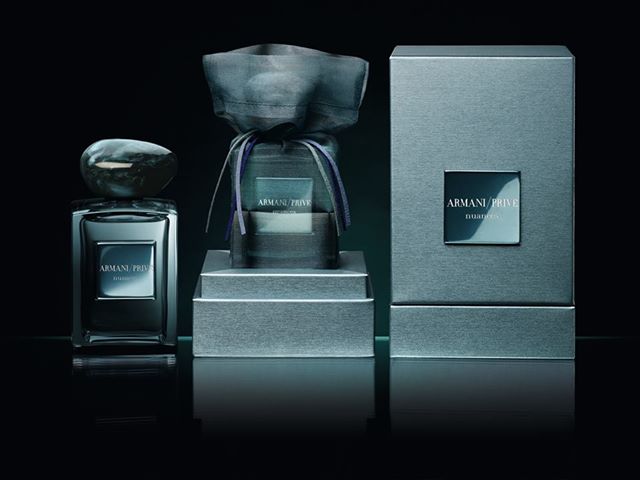
Nuances is an eau de parfum for men and women which was released in May 2013, and which takes refined elegance to such stratospheric heights that it’s practically bloodless and gasping for oxygen. It made me think of a perfectly coiffed, elegant, eighty-year old dowager doddering away in seclusion on her aristocratic British estate; or of a very pale, elderly gigolo immaculately garbed in Armani who tries to fade as unobtrusively as possible into the background at a cocktail party while his current patron makes the rounds. Nuances is bloodless, simply bloodless. It’s just there — except when it’s not, because it’s decided to take off for a jaunt for and act like a ghost until it decides to grace you with its presence again.
But let’s start at the beginning. In typical Armani understatement, his website barely bothers to discuss the perfume in any detail other than a brief, completely unhelpful paragraph that bleats on about nuances, prisms, and the “juxtapositions of light and colour.” Thankfully, other sources don’t believe in his obsession with minimalism. For example, The Moodie Report says that the inspiration for the perfume was a piece of fabric, and explains how iris is the olfactory thread that needles its way through all three of the Armani Privé Couture fragrances:
The scent was inspired by an Armani fabric print, which featured in the designer’s latest fashion collection. The origin of the print was a photograph, taken using optical prisms and mirrors.
Each of the 1,000 signature bottles is dressed in the organza print; every pouch is unique, and adorned with leather ties. The lacquered green bottle is topped with a marble-like cap, in different shades of black, turquoise and anthracite.
Iris is the key ingredient that connects all three Armani Privé Éditions Couture fragrances (Armani Privé La Femme Bleue features black iris; Armani Privé Nacre musky iris).
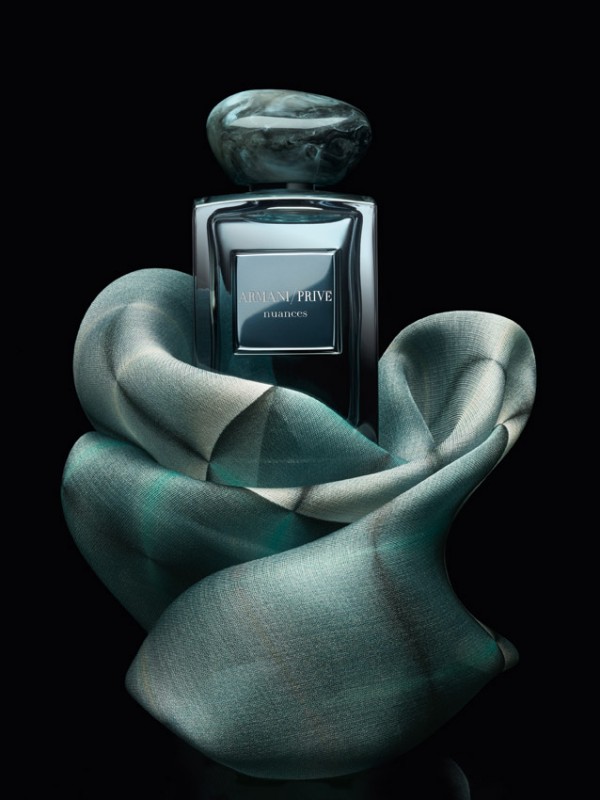
The press release quoted by Harrods adds even further information and detail:
Inspired by this season’s fashion collection, Armani Prive Nuances is a brilliant reflection of the multi-faceted world of Giorgio Armani. Each of the 1,000 signature bottles comes dressed in the organza print, specially selected from Mr. Armani’s workshops in Milan. Within the pouch, the bottle itself is a work of art. Its cap, reminiscent of smooth marble, is crafted in three colours of resin making each one of them unique.
The fragrance uncovers a woody-iris accord, build around Italian orris absolute. A juxtaposition of different notes reveal an enveloping fragrance, sophisticated yet radiant, with a light note of androgyny in its woody base.
Armani doesn’t bother to list the notes for Nuances, but the sum total — as compiled from the Moodie report and Fragrantica — seems to be:
Italian orris absolute, bergamot, cinnamon, heliotrope, vetiver, vanilla, cocoa, benzoin and sandalwood.

Source: Kootation.com
Nuances opens on my skin with a brief flash of bergamot, followed by iris. The latter is floral, rooty, earthy, and lightly powdered all at once. Within minutes, the iris is warmed by vanilla, but it is the louder, more dominant influence of vetiver which initially has the greatest impact. When combined with the iris, it creates an earthiness that feels almost like that of damp soil.

Heliotrope. Source: bestflowerwallpapers.com
The iris keeps flickering and changing in these early moments. One minute, it is infused by fresh bergamot, the next by a light, musky vanilla, then by earthy notes. Once in a while, it feels infused by an amorphous woodiness. Generally, however, Nuances is merely different degrees of floral rootiness backed by vanilla.
The vanilla is interesting because it’s a very light, sheer, dry note, but whiffs of other elements lurk underneath. Something warmer, richer, softer and creamier. It’s not custard, cinnamon, or cocoa, but some indecipherable combination of all of them. A few minutes later, the vanilla is joined by heliotrope which adds a strong element of sweet almonds that almost borders on pate d’amande or marzipan.
At the thirty minute mark, Nuances starts to shift a little. Now, it is primarily a woody, musky, iris fragrance with lightly powdered, almond-y heliotrope and vanilla. The rooty, earthy undertones have become much less dominant, as has the vetiver. Taking their place instead is a light sprinkling of white cocoa powder with the faintest dash of cinnamon. Nuances remains this way for the next hour without any significant change — except in the base. It is always an amorphous, abstract, woody muskiness infused by vanilla, but there is something increasingly unpleasant about it. There is a subtle nuance that, in some indescribable manner, feels a little cheap and almost synthetic, but not quite. Perhaps, it is the musk which reminds me of the white version in a lot of inexpensive, mass-market fragrances. Or, perhaps, it is the vanilla which feels surprisingly low quality for such an expensive fragrance. Adding to the subtle flickers of something unpleasant lurking down below is a humming in the base. Luca Turin once described ISO E Super as a “low woody hum,” and that is precisely how it is here. Later, alas, my synthetic nemesis makes a far greater appearance, resulting in a charming 2 hour headache.
Right around the 90-minute mark, Nuances becomes a skin scent and, by the two-hour one, it is nothing more than a faded, muted, almost abstract, woody muskiness with a soft, lightly powdered, floral veil that just barely — barely — translates to iris. There are no concrete, distinct, individual traces of sandalwood, vetiver, cocoa, cinnamon, or anything else for that matter.
Then, three hours in, Nuances vanishes. I put my arm right to my nostrils, and sniffed like a man dying for oxygen. I sniffed like the very best German Shepherd K9 in a drug squad. Nope, caput, finito, basta. I thought to myself, “okay, so much for longevity,” and shrugged. Then, lo’ and behold, an hour later, Nuances decides to suddenly come back. I have no idea where it decided to go, or why it decided to flounce off, but it apparently decided to revisit my arm. A few of the Chanel Exclusifs like to play “ghost,” as I call it (31 Rue Cambon, I’m looking at you in particular!), and clearly, Nuances is the same sort of animal. But, once Nuances decided to stay, it bloody well wouldn’t give up! All in all, it remained — in a nebulous, abstract, musky, woody, slightly powdered, monotonous, faintly iris-y hum — for another 11.5 hours. Granted, I had to practically inhale at my arm like a rabid, frothing, deranged animal to detect it a lot of the time, but it was absolutely there, no question about it.
Normally, I would test a fragrance with these sorts of odd characteristics at least twice — but I really couldn’t muster up the energy for Nuances. It’s not just that the perfume gave me a headache at one point from the subtle flickers of ISO E Super in the base; it’s mostly because Nuances was driving me a little mad with its linear refinement. It is so well-coiffed, so perfectly smooth, immaculate, conservative, sophisticatedly dull and unobtrusive, it verges on the mundane. I kept thinking of George Hamilton or Giorgio Armani having all the blood sucked out and replaced by embalming fluids, until they lost their perfect tans and their lifeless corpses were propped up on a chair somewhere. In fairness, I think a hardcore iris addict would probably love Nuances. Of course, that assumes that they could easily and consistently detect it on their skin — something about which I’m highly dubious. Yet, I think even they would admit that there are, in fact, few nuances to the fragrance, and that it is rather limited in both depth and range.
All of this makes Nuances shockingly over-priced. Yes, I understand it’s not only Armani Privé, but also limited-edition with only 1000 bottles made. But it’s £500.00! Nuances is not listed at all on the U.S. Armani website, so if we’re to go by the current exchange rate, that’s $760! If you want to pay a small fortune for an iris fragrance with actual nuances, and which is just slightly less difficult to obtain, then may I point you in the direction of Ormonde Jayne‘s Tsarina from the new Four Corners of The Earth Collection? It’s a lovely, incredibly elegant, sophisticated iris scent with layers, and without the many, varied problems of the Armani one. Plus, Tsarina is cheaper, too. (Well, purely on a relative scale of things….)
As you can tell, I was not a fan of Nuances. If it were a $100 (or even $150) bottle of perfume, and you were a hardcore iris addict who didn’t mind a really conservative, boring, but elegant, iris soliflore, then I’d definitely recommend giving Nuances a try to see if the nonexistent sillage and peculiar longevity issues work out for you. As it is, however, then no. Simply no.