Perfume Review – Arquiste Anima Dulcis: Conquistadors, Convents & Chocolate

It was a chilly day in Mexico City that November, long ago in 1695, and the kitchens of the Royal Convent of Jesus Maria were a beehive of activity. The haughty Mother Superior took the heavy key from the chain around her neck and unlocked the vault with the sisters’ most precious ingredients: bitter, dark chocolate, rich chilies, earthy spices, incense used in their religious ceremonies, and the heaviest of vanillas. The recipe for their famed “Anima Dulcis” was a secret one — even some of the nuns weren’t privy to its true magic. Were there flowers hidden under its dark depths? Was ancient incense responsible for its smoke, or was it darkened patchouli? The Mother Superior smiled to herself as she passed through the convent’s stone passageways and heard the younger sisters’ whispered questions. She, and she alone, would add the finishing touches.

Sao Roque Church, Lisbon, which is a little how I imagine the Royal Convent to appear. Photo: "ToonSarah" on VirtualTourist.com

The chapel of Sao Roque Church, Lisbon, which is a little how I imagine the wealthy Royal Convent in my mind. Photo: “ToonSarah” on VirtualTourist.com

Cornelis de Vos, Flemish Baroque painter, 1584-1651. Source: This Ambiguous Life Blogspot.

Cornelis de Vos, Flemish Baroque painter, 1584-1651. Source: This Ambiguous Life Blogspot.

The Royal Convent of Jesus Maria in Mexico City on a day in November 1695, is the explicit reference point for the “baroque gourmand” fragrance that is Anima Dulcis (loosely translated as “soul of sweetness”). It comes from the perfume house of Arquiste, founded by the Mexican architect and designer, Carlos Huber. Mr. Huber — who just won the Fashion Group International’s Rising Star award a few weeks ago — was inspired by the convent’s history and practices after he worked on renovating and converting the building in Mexico City.

Carlos Huber. Source: Etiket.com.

Carlos Huber. Source: Etiket.com.

As Mr. Huber explains on the Arquiste website, the Royal Convent of Jesus Maria had been founded in 1578 for the female descendants of the Spanish Conquistadors. (Or, at least, the very wealthiest and most aristocratic among them!) It was known for the nuns’ recipes which combined European and Asian ingredients with those particular to Mexico’s ancient history. Octavian, the highly respected perfume blogger of 1000 Fragrances, elaborates further in his beautiful review of the perfume:

The most carnal elements of the baroque cuisine were mixed in unexpected combinations, forgotten by the modern nose. Animalic jasmine, tuberose, petals of white flowers and all the temptations of the flesh were mixed with cocoa and hot spices to produce liqueurs and sweets. The nuns were discovering the fabulous scents of the new world, earlier than Europe. Vanilla, cocoa and tuberose, brought to Versailles, but still a great luxury before their massive use in the next century, made their debut in a Convent where the ancient Maya and Aztec flavors were tested and studied by Europeans. Anima dulcis, a modern interpretation of this magic encounter, tells the story of when the european sensibility started to use the “dark” ingredients of the New World – the discovery of cocoa, vanilla and chili pepper, reported by Cortez 150 years earlier. [Emphasis in the original.]

Using his research (and, I believe, the sisters’ actual recipes), Carlos Huber worked with twoAnima Dulcis perfumers, Yann Vasnier and Rodrigo Flores-Roux, to encapsulate the Convent’s creations. The result was Anima Dulcis which was released in 2011. It is classified on Fragrantica as an “oriental vanilla,” though I think “oriental chocolate” might be a more accurate summation. On its website, Arquiste says the notes include:

Cocoa Absolute, Mexican Vanilla, Cinnamon, Chili infusion.

Those official notes are just the tip of the iceberg. There is no way that the list is complete. I would venture a guess that the complete list might possibly look a little bit like this:

Cocoa Absolute, Mexican Vanilla, Cinnamon, Red Chili infusion, Jasmine Sambac (or some sort of florals), Seville Oranges, Cumin, Cardamom, Patchouli, Incense and, possibly, some sort of ambery resin.

Pre-Columbian chocolate with chilies. Source: CaFleureBon.

Chocolate with chilies and spices. Source: CaFleureBon.

Anima Dulcis opens on my skin with cinnamon-infused dark chocolate. It’s chewy, dusky, and spiced, but also, simultaneously, honeyed. Fiery red chilies counter the sweetness of the vanilla that just barely seems to breathe in the background. So does the earthiness of a dark patchouli — dirty and slightly smoky in the best way possible. The smoky notes seem to be further accentuated by some hint of light incense. It’s a lovely take on vanilla and chocolate, especially with the piquancy from the red chili pepper.

Mexican Hot Chocolate. Source: Zested.com. (Click on the photo for a link and a recipe.)

Mexican Hot Chocolate. Source: Zested.com. (Click on the photo to go to the website where you can find a tasty recipe.)

The chocolate note, however, is the real star. It’s unusual and nothing like the typical sort of chocolate notes which, to me, often feel more like powdery cocoa. At the same time, it’s also not like purely dark chocolate. Here, it’s more like the richest chocolate flourless cake covered with ganache made from bitter chocolate, covered by a dusting of smoky powder, cinnamon, cumin, cardamom, decorated with faint slivers of Madagascar vanilla pods, and then set on a plate of spicy, cinnamon red-hot candies. The richness almost has the feel of a British Christmas plum pudding, only tinged with incense.

It’s an incredibly cozy scent that is, at the same time, very sexy. There is a rich, meaty, chewy, dark aspect to it that can certainly be called “baroque” but, to be honest, aristocratic Mexican nuns descended from the Conquistadors are not really what comes to mind when I smell it.

Vermont West Hill House B&B.

Vermont West Hill House B&B.

Instead, I feel transported to a secluded wood cabin in Vermont on a very snowy, wintery night; there, by the light of a roaring fire which casts flickering shadows on the wall, a seduction scene full of deep long kisses and teasing nuzzles unfolds. Cups of spiced hot chocolate filled with dark liqueurs lie empty; the fire releases an occasional tendril of smoke; the light is glowing amber and red; and sensuality underlies the cozy warmth of the scene.

As time progresses, the baroque chocolate notes are joined by something that is definitely floral in nature. It’s lovely, adding a lightness and sweetness to the dry spices, but I can’t pinpoint the exact flower. Perhaps Jasmine sambac, with its earthier, muskier nature than regular jasmine? Octavian on 1000 Fragrances thinks it’s a green lily note and, while I can see some light greenness, I don’t think it’s the delicate lily flower. Either way, the perfume definitely has some sort of floral component. Carlos Huber may consider Anima Dulcis as a “baroque gourmand,” but, to my mind, it is much more of a spicy oriental perfume which just happens to have some gourmand elements. It’s also a very ambery perfume for something that is meant to smell like Mexican hot chocolate, and I wonder if there is some sort of resin in Anima Dulcis’ foundation. Whatever the specific notes, it’s a fascinating and addictive scent. I can’t stop sniffing my arm, and I just barely stifle the urge to put on more.

Nordic Christmas Oranges. Source: Trine Hahnemann & The Times of London.

Nordic Christmas Oranges. Source: Trine Hahnemann & The Times of London.

Two hours in, the perfume shifts and changes a little. It is now predominantly cinnamon orange with red chili peppers. There is a feeling of caramelized cooked fruit, where the caramel has burnt just a little. Or, maybe, it’s more like a sticky, toffee’d orange, salted and sweet, mixed with dark raisins stewed in rum and dark chocolate. It’s really hard to pinpoint; the perfume is superbly blended, leading all the notes to melt together in a decadently luscious, rich whole. The burnt note, unfortunately, lasts a wee bit too long for my liking, and seems to become just a tad bit more bitter and burnt with time. It’s not strong and over-powering — it’s not even the predominant note — but I think I would have liked just a little less of it or, perhaps, a little more sweetness to counter it.

After another hour, it fades, leaving Anima Dulcis as a lovely combination of bitter Seville oranges, dark patchouli, cinnamon, chili pepper and a soft dusting of sweet vanilla. Eventually, at the end of the fourth hour, the perfume turns into a soft amber with spices and just a flicker of orange, before finally ending up in its final stage as sweet vanilla and light white cocoa powder, with just a smidgen of dusty spice.

For all that these notes seem dark and heavy, the perfume itself actually is not. It’s neither narcotically heady nor cloyingly sweet. It’s not a light, clean, airy scent by any means — no laundry detergent freshness here —  but it’s surprisingly not heavy or opaque either. Octavian describes it as “light, woody, airy” and “delicate.” I think it’s a bit heavier than that; I wouldn’t want anyone to think this is a sheer, translucent scent or something like the minimalistic creations made by Jean-Claude Ellena. But, given the richness of some of its components, it is far from thick and never overbearing.

In fact, even the sillage is moderate. In the beginning, you can smell it on yourself but it’s far from overpowering. Someone across the room definitely won’t be gassed by it. After the first hour, the perfume becomes softer and, by the third hour, it was quite close to my skin. By the fourth hour, it took some determined sniffs, putting my nose right on the skin, to detect some of the nuances in the notes. As for longevity, it was moderate on my perfume-consuming skin. It faded away shortly before the sixth hour. On others, I’ve read lengths of time around varying between six and eight hours.

All in all, I really liked Anima Dulcis. A lot. The only thing stopping me from wanting a full bottle is the fact that, for my personal tastes, I would have preferred it if the scent were heavier, headier, and just a slightly bit sweeter. (Just a smidgeon!). I realise, however, that most people don’t share my preference for narcotically heady scents, so I think Anima Dulcis would be a real crowd-pleaser for many. It taps into the current trend for gourmand scents but, in my opinion, it really isn’t one. Those who are expecting a true dessert fragrance will be disappointed. This is not half as sweet as some of the niche Guerlains that are out there. Those, however, who share my feeling that a few of those Guerlains are a bit too gourmand should really look into Anima Dulcis. The same applies to anyone looking for a very high-quality, luxurious take on spicy Orientals without the heavy, boozy or opaque aspects that can sometimes accompany them. I should add that it is most definitely unisex!

Try Anima Dulcis, and see if a perfume twist on a recipe from the aristocratic descendants of the Conquistadors over three hundred years ago touches your sweet soul.


DETAILS:
Anima Dulcis costs US $165, CAD $200, £125.00 or €149. It comes only as an eau de parfum and is available only in a 55 ml/ 1.8 oz size. In the US, it is available on the Arquiste website, Barneys, and Aedes. In Canada, the Arquiste line is available at Holt Renfrew Bloor in Toronto (though I could not locate it on the overall Holt Renfrew website), or at Etiket in Montreal for CAD $200. Each store is the exclusive dealer for the Arquiste line in their city. In the UK, it is available for £125.00 at Liberty London. In France, you can find it at Jovoy Paris where it retails for €149. In Germany, it is sold at Aus Liebe Zum Duft. Elsewhere, you can use Arquiste’s “Stockists” page to find a retailer near you. Samples are available at Surrender to Chance where the price starts at $4.99 for a 1/2 ml vial. The site also sells all 7 perfumes from the Arquiste line in a sample pack for $33.99.

Perfume Review – Trayee by Neela Vermeire Créations: A Vibrant Kaleidoscope

In Rig Veda Psych4u  blogspot http://psych4u.blogspot.com/2010/05/in-rig-veda.html

I lost my heart to India many years ago. At the end of 1990, I spent about a month touring that magnificent country with some dear friends. India captivated my mind, overwhelmed my senses, and held me hostage. She brought me feelings of serenity, joy, amazement, and peace — a sense of having come “home” which was quite strange for someone utterly new to the country and who had lived the life of a wandering nomad. India was, quite simply, the most intoxicating, fascinating place I’d ever seen in my long list of travels. I fell in love and have never stopped. Among the many places in that gloriously dazzling country that stand out in my mind is Matheran. It is a hill station on the Western Ghat mountain range and a few hours outside of Mumbai. Every part of Matheran — and my trip up it — is etched indelibly in my mind. After a long drive, we arrived at the base of a giant mountain.

Source: BrooklynMeetsBombay Blog

Matheran. Source: BrooklynMeetsBombay Blog

Source: TouristLink.com

Source: TouristLink.com

Before us lay a vast, curling, climbing road covered in bright, terracotta-red dust. An endless phalanx of dark, leafy trees on either side provided shade and a green canopy above our heads through which peeked a bright blue sky. The trees were gnarled and twisted, their enormous, beige roots visible and clawing at what little remained of the dusty earth surrounding them, a victim of the battering monsoons. Everywhere, small taupe monkeys scampered around, chattering and talking a mile a minute as they ran ahead of us or leaped up on the trees.

Source: Trip Advisor

Source: Trip Advisor

Source: VirtualTourist.Com

Source: VirtualTourist.Com

You can’t drive up Matheran as it is one of the few places in the world where cars are completely forbidden, so you take donkeys or horses. Gingerly, you place yourself on their bony bodies as you slowly ride that long, winding, red trail up, up and up.

Matheran. Photo: Reza Ahmed Flickr

Matheran. Photo: Reza Ahmed Flickr

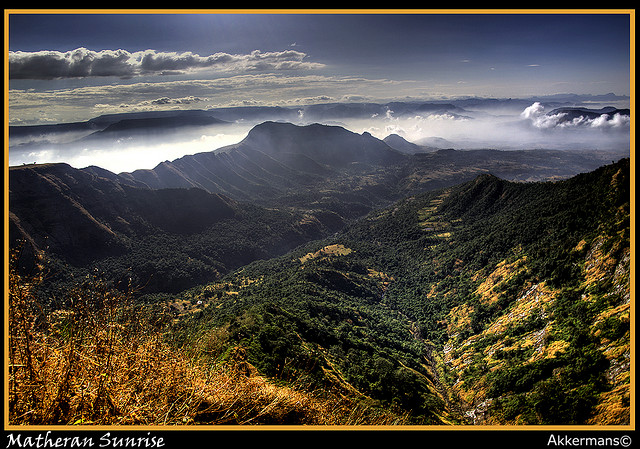
Eventually, you get to the very top to behold a canyon that seems as vast as America’s Grand Canyon — only this one is a sea of green trees and golden earth that stretches out as far as the eye can see. My friend had a large summer place at the very top, overlooking the canyon, and the sight at dawn and dusk rendered me utterly speechless. Words simply cannot convey any of it. Not even for one as verbose as myself.

Matheran. Photographer: Peter Akkermans. Site: http://www.fotoakkermans.nl/

Matheran. Used with permission from the talented photographer: Peter Akkermans. Site: http://www.fotoakkermans.nl/

Matheran is what flashed before my eyes when I first smelled Trayee (pronounced as “Try-ee’), a brilliant, complex, rich perfume from the Parisienne Indie line, Neela Vermeire Créations, Parfums Paris (“NVC”). The niche perfume house was founded in 2011 by Neela Vermeire, a lawyer born in India and educated in the UK who now lives in Paris and is a self-taught nose of enormous talent. She collaborated with the famous perfumer, Bertrand Duchaufour, to launched three perfumes paying homage to different phases in India’s history and each has garnered enormous praise. (They sent perfumistas chattering like those monkeys on Matheran!) One of them, Bombay Bling, was chosen by the prestigious perfume website, CaFleureBon, as one of their top 25 fragrances for 2011. The greatest recognition, however, came for Trayee with what would be the equivalent of a perfume Oscar when the Fragrance Foundation recognized its creative excellence and nominated it for a Fifi award in the Indie category. Trayee

The vibrant kaleidoscope that is India is at the very heart of Trayee — and it is amply demonstrated by the perfume’s long list of notes:

Madagascar blue ginger, elemi, cinnamon, ganja accord, blackcurrant absolute, basil, Sambac jasmine absolute, Egyptian jasmine absolute, cardamom absolute, clove, saffron, Javanese vetiver, Haitian vetiver, incense, Mysore sandalwood oil, patchouli, myrrh, vanilla, cedar, amber notes, oudh palao from Laos, and oak moss.

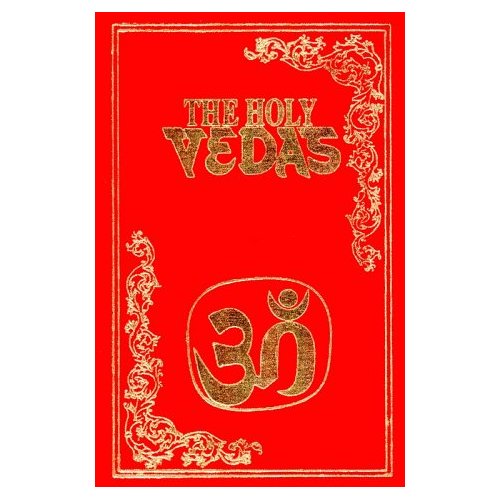
The Three VedasThe complex notes are quite intentional because Trayee is a concrete evocation of India’s Vedic period (1500 BC to 500 BC), a time of great antiquity shrouded in mystery but known to be the source for what eventually became modern Hinduism. As Luckyscent (Trayee’s exclusive U.S. distributor) explains, the perfume’s name is:

an allusion to the sacred origin of the first three Vedas, the most ancient sacred texts in India. The notes are drawn from the ingredients used in religious rituals and Ayurvedic medicine during the Vedic era. Rich in incense, myrrh and oud, the fragrance is a poignant blend of smoke, spices and resins that harks back to the very origins of perfumery – a burnt offering to the gods and an aid to meditation.

Trayee opens with a rich, potent burst of saffron, cardamom and oud. The oud was, as is often the case with agarwood, entwined with strong notes of rose. It was never synthetic or screechy, but true to the faintly medicinal, camphorous, chilly aspects of real agarwood. The combination of beautiful sweet saffron with the faintly nutty, aromatic sweetness of the cardamom provide a perfect counterbalance. Following on the heels of those notes is incense whose peppery, smoky accords provide a bit of a bite to the richness of the other ingredients.

That opening was the only consistent element in the two times that I tried Trayee. It is a perfume that is so magnificently blended that different elements peek out at different times, undulating like perfumed waves of richness, woodiness and spice. There is so much depth to Trayee that trying to pick out consistent notes is a bit of a hard task. In an interview with Bois de Jasmin, Ms. Vermeire summed up in one sentence much of my experience: “Trayee’s notes appear and reappear, keeping the wearer guessing and creating a memorable olfactory experience.” It is absolutely true. Equally true is Ms. Vermeire’s comment that:

Trayee is one of the most evocative fragrances for me. It is a rich woody composition, with sandalwood, oud, vetiver and incense lending it many facets. On me, it changes all the time.

Udaipur Market. Photo: Amos Rojter or "Brother Amos." Source: Redbubble.com

Udaipur Market. Photo: Amos Rojter or “Brother Amos.” Source: Redbubble.com

The very first time I wore Trayee, the opening was followed by hints of cassis (which is how I’ve always known “black currant”), cloves, and ginger. There was smoke that stemmed from either the incense, the myrrh, elemi, or the cedar, along with some woody elements, black pepper and sweetness. As always with Trayee, it’s hard to know what scents stem from what ingredients but it always evokes the rich kaleidoscope of India.

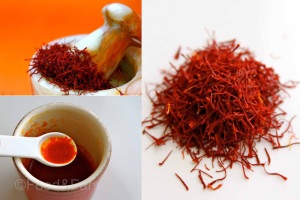
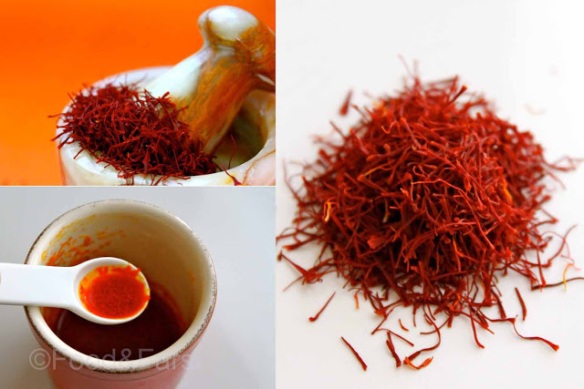
Saffron. Source: FoodandFarsi.com

Saffron.
Source: FoodandFarsi.com

All the notes were subsumed under the veil of saffron which is one of my favorite spices. There is a lovely floral nuttiness to the saffron due to the cardamom, and the combination calls to mind the richness of L’Artisan Parfumeur‘s Safran Troublant with its evocation of Persian Sholeh Zard or Indian Kheer desserts. Trayee, however, is like Safran Troublant heightened to the max and with a thousand more elements added to the mix for a richer, more intense, more spiced and luxurious experience.

The second time I wore Trayee, the usual beginning was followed by hefty doses of creamy, rich sandalwood mixed with the earthiness of vetiver. The sandalwood is absolutely real Mysore sandalwood, a rare thing in perfumery today given its prohibitive cost and the Indian government’s protection of this over-sourced prized wood. The expert perfume critic, Luca Turin, has often bemoaned the use of a synthetic replacement in “sandalwood” perfumes or the reliance on the very different Australian sandalwood, and he’s right. Real sandalwood is usually too expensive for most perfumers, especially if used in any significant quantity. Here, there is a significant amount of absolutely genuine, lovely sandalwood in Trayee. I smelled copious amounts of it during the dry-down in my first go-round, and even more of it in the opening hour on my second attempt.

It is remarkable and supports everything Ms. Vermeire has said regarding her goal of using only the finest raw materials and expensive essences in her perfume. In The Perfume Magazine, Ms. Vermeire said: “Trayee has a high concentration of pure Mysore sandalwood oil, nearly 1% pure oud, and two different types of jasmine.” And elsewhere, in a comment quoted by Portia of Australian Perfume Junkies (in a glowing review of Trayee for the Perfume Posse), she elaborated that the perfume was made without regard to cost:

I did not give a budget cap so Bertrand Dachoufour never had a budget – Trayee is one of the most expensive perfumes he has created. We made sure there are lots of high quality natural ingredients…. Most niche companies want to spend 150 euros or so max per kg of essence. We went more than 7 times that so the essences are expensive (and hopefully exceptional).

It shows. It really, really shows. The richness of the scent, the use of the most concentrated “absolute” form for many of the ingredients, and the pure smoothness of the notes seep out from every moment that you wear the perfume.

The quality of the ingredients is matched only by their superb blending, the sure sign of an expert hand like the famous Bertrand Duchaufour. The development of the perfume in its later stages differed on both occasions I wore it. Sometimes, the dominant note was Elemi, a tree from the Philippines that is related to those from which we obtain frankincense and myrrh. (You can read more about elemi in my Glossary but, in a nutshell, it opens with a lemony note that thereafter turns into spicy, peppered pinewoods.) At other times, one notices the tobacco leaves which combine with the patchouli and earthy vetiver to create a vaguely chocolate-mocha impression. There are times when the perfume is predominantly sandalwood and vetiver, followed by cardamom, jasmine and sweet amber. On occasion, the spices take on a dusty, earthy quality, like that red road up Matheran mountain. It’s a perpetually shifting mystery that makes Trayee intoxicating, endlessly sniffable and always entrancing.

Source: Fractal ArtistFlickr: http://www.flickr.com/photos/8720628@N04/2257117100/

Source: Fractal Artist
Flickr (Click on photo for the link)

As a whole, however, the middle to end stages of Trayee are much sweeter than the dryer, spiced early stage. The perfume warms up in a way, evoking colours of soft burnished bronze and warm copper. The unctuous, creamy, luxurious sandalwood and deeply resinous, smoky amber rise like waves of molten gold and red, enveloping you in a scent that is deeply sensuous.

Trayee’s richness impacts its projection and sillage. This is heady, potent stuff! The perfume projected strongly for about 4.5 hours before becoming softer and less pronounced. It didn’t become close to the skin until around seven hours in — something I found to be utterly astonishing. Trayee also had remarkable longevity. On my skin which voraciously consumes perfumes and on which very little lasts for an extensive amount of time, there were very faint traces after 12.5 hours. I think that’s a new record, and one which left me utterly stunned. Granted, I did go a little crazy in the application (which is what tends to happen when I smell saffron) but, nevertheless, that ecstatic application has happened before and the perfumes never lasted anywhere remotely close to Trayee’s duration. On Fragrantica and Basenotes, however, I have read of shorter longevity with some saying Trayee lasted approximately eight hours. So, clearly, a lighter application will impact the perfume’s duration.

My one dilemma when it comes to Trayee is its cost. It is not cheap. It costs $260 for a small 1.8 oz/55 ml bottle. I was lucky to obtain my sample from a friend and fellow perfume blogger, The Scented Hound, who generously provided some from his own collection. He fell in love with Trayee, calling it “luscious, joyous, fragrant” — “like a magical day in the heart of India” — and eventually succumbed to a full bottle. I worry about the price (especially when I think of how beloved the other two perfumes in the India series are and how I’m bound to be tempted by Bombay Bling, in particular), but there is no doubt in my mind that I will try to obtain some Trayee — even if it’s only a decant. (You can read my Beginner’s Guide to Perfume to learn about perfume splits and groups that offer decants for sale.)

Summer palace on the lake Jaipur

Jaipur – Summer palace on the lake.

Despite Trayee’s cost, I honestly think you are getting what you pay for. There are many similarly priced perfumes out in the luxury market (albeit, usually for a larger sized bottle) but the quality of Trayee’s ingredients make it truly stand out. To me, it is the equal of perfumes from Ormonde Jayne and the uber-luxury perfume house, Amouage, and far surpasses those of several other prestigious houses.

Jodphur - Temple at Mandore. Source: Travel Pictures Gallery.com

Jodphur – Temple at Mandore. Source: Travel Pictures Gallery.com

At the end of the day, though, Trayee is more than just decadently sumptuous. It is elegant and evocative, mysterious and seductive, complex and quite mesmerizing. Wearing it, I was transported back to India. I was back on Matheran, but I was also in the palaces of Jaipur, the ancient temples of Jodphur, and the bustling markets of modern Udaipur. Trayee represents each part of the mysterious, complex, ancient beauty that is India. It is, very clearly, a work of love.

DETAILS:

Cost & Availability: In the U.S., Trayee is available exclusively at Luckyscent where it costs $260 for a 50 ml bottle. Luckyscent also sells a small 0.7 ml sample for $7. (And the site ships world-wide.) In addition, Trayee can also be purchased as part of a Discovery Set which includes, Bombay Bling and Mohur, Neela Vermeire’s other two India collection perfumes. The set is available exclusively on the company’s website and costs €21 for three small 2 ml vials, or €85/90 (depending on your location) for three larger 10 ml decants. Shipping is included in the price and, apparently, Ms. Vermeire writes a personal note for each order. (How lovely and rare is that?!) In Europe, Trayee costs €200 for the 55 ml bottle and is available at Jovoy Paris, the Swiss Osswald Parfumerie and Munich’s Sündhaft. You can find a few additional retailers from the Netherlands to Moscow which carry Trayee on the store’s Points of Sale page.

Perfume Review – L’Artisan Parfumeur Safran Troublant: Saffron Delight

Swirls of dark orange from the most expensive spice in the world combine with the rich red of candied roses, the canary-yellow of creamy, custardy vanilla, and the sweet browns of cardamom to result in an instant reaction: “Heaven!”

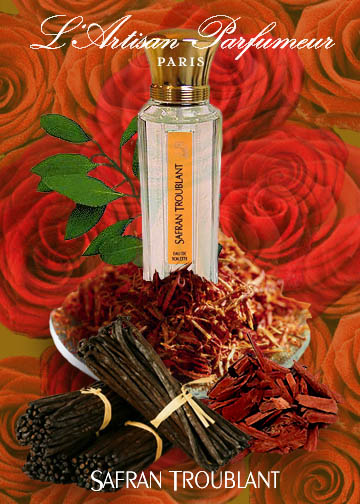
Safrant Troublant.Source: Olibanum WordPress Blog.

Safrant Troublant.
Source: Olibanum WordPress Blog.

Actually, at first, I just gave a faint moan upon smelling Safran Troublant from the French niche house of L’Artisan Parfumeur. That doesn’t happen often. Incoherent babblings of joy, and mutterings of “Heaven,” followed soon thereafter. The name may translate to “troubling” or “disturbing” saffron, but this is one completely comforting, absolutely delicious fragrance that is perfect for those of you who prefer your perfume to be discreet and unobtrusive. Those of you who prefer more sillage will be disappointed, however. And, all of you should take serious note of its fleeting nature.

Safran Troublant is a unisex, spicy oriental eau de toilette that was created by the famous nose, Olivia Giacobetti, and released in 2002. L’Artisan Parfumeur‘s website describes it as follows:

A potent portrayal of candied roses; alluring and just a little dangerous

Safran Troublant is an unsettling and potent portrait of a candied rose. The sensuality is heightened with the addition of sandalwood and spicy ginger notes. This makes for a seductive and unexpected fragrance, where the saffron serves to highlight the sheer opulence of the rose. Beautiful and a little dangerous to wear.

The notes are:

saffron, red rose, vanilla, ginger and sandalwood.

As a side observation, Fragrantica is flat-out incorrect in its summation of the perfume. First, they have continuously listed Bertrand Duchaufour as the nose behind its creation, despite numerous comments correcting them. They also seem off on the notes, since they insist on listing “passion fruit flower” when no-one — least of all the company itself — has given any such indication or has smelled any passion fruit.

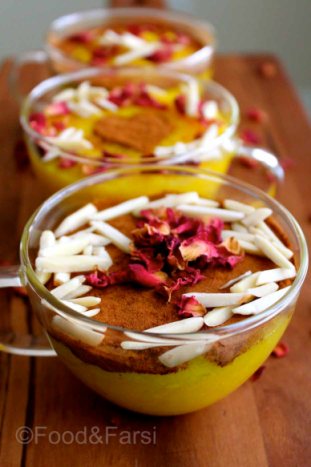
Sholeh Zard.Source: FoodandFarsi.com

Sholeh Zard.
Source: FoodandFarsi.com

The opening of Safran Troublant will be familiar to any of you who have had Indian or Persian saffron-rice desserts. “Sholeh Zard” is a Persian rice pudding with saffron, rose, cardamom and nuts. Its Indian counterpart is “Kheer” or “Payasam.” They’re both utterly addictive, though I personally think the Persian one is significantly heavier on the saffron which is probably why its colour is bright canary-yellow, whereas the Indian version is not. For a wonderful discussion of both saffron and Sholeh Zard, as well as recipe for how to make it, check out Food & FarsiThe Spice Spoon, or the other sites linked in the photos. (But don’t do it if you’re hungry. Really, I warn you. I learnt the hard way, and now I’m famished…)

Safran Troublant’s first minutes are a swirling delight of sugared rose: deep, dark and candied, but richer than anything in mere rose water. This is no cloying, saccharine-sweet tea-rose but a darker, heavier floral. It’s sugared and spiced, making this a great perfume for those who have problems with more traditional or girly rose perfumes. The sweet, almost nutty warmth of the cardamom combines with the almost peppered, earthy sweetness of the saffron to provide a richness to the perfume’s foundation.

Sholeh Zard. Source: Foodival.com

Sholeh Zard.
Source: Foodival.com

The vanilla here is incredibly lush. This is no cupcake vanilla or, even, the vanilla of bottled extract. It evokes tapioca pudding: creamy, heavy, and utterly unctuous. And it’s thick like the brightest, yellow egg custard!

About five minutes in, there is a strong hint of cumin. However, unlike many of my other experiences with the note, it’s not really earthy and never “skanky.” It just adds another layer of earthiness and spice to counter the sweetness of the scent. The ginger starts to make a greater appearance at this time, too. It’s not sharp or bitter but, rather, almost candied.

Saffron. Source: FoodandFarsi.com

Saffron.
Source: FoodandFarsi.com

Neither note, however, is the true star of the perfume. That role is taken almost entirely by the glorious saffron which remains throughout  the duration of the scent. It’s heady, rich, compulsively sniffable, and makes Safran Troublant far more than a simple vanilla or gourmand scent. It is absolutely the best parts of this lovely perfume.

Unfortunately, one of the worst parts is Safran Troublant’s fleeting nature. On one arm, where I put on my usual number of dabs, the perfume vanished entirely within ten minutes. Yes, TEN minutes! I’d read one commentator say that the perfume disappeared on her within minutes of application, but I thought that had to be an exaggeration — even for the typically light, ephemeral L’Artisan line. Apparently, not. On my other arm, however, where I had trebled the dosage due to my utter love for the fragrance, it was a different story. The perfume’s sillage dropped by about 85% within ten minutes but, to my surprise, the perfume itself remained. I can’t quite account for the differences but, clearly, one needs a lot of the perfume for it to stay even as a discreet skin scent.

And it is most definitely discreet! Far, far too discreet for my personal preferences but, for those of you who don’t like intrusive scents or who can’t always find perfumes appropriate for a strict work-environment, it should be utterly perfect. Well, assuming it lasts on you…..

The main criticism of this much-loved scent is its fleeting nature. You all know that I have skin that is incredibly voracious when it comes to perfume, but we’re talking about normal people here! From Fragrantica to Makeupalley, there are endless comments about how Safran Troublant barely lasts. Many give four hours as the maximum, while others give significantly less. The one review I mentioned above about how it lasted mere minutes came from “Goddess Dreams” on Makeupalley who wrote:

Well, well, well, now I too know what it’s like to have a scent that now you smell and then two seconds later “poof” and it is completely GONE! Where did it go? I’d love to know! But my, I love it so much, why did it have to leave so soon? This is ridicilous, I mean I sprayed it on, no joke a good spray I gave it too, but I’m talking within minutes (I was still at the L’Artisan counter and it was GONE – not slowly withered away – GONE ALL AT ONCE WITHOUT A TRACE). But, oh while it was there, for that charming special moment that it lingered on my skin – that was wonderful. I would have paid any money had it lasted only a touch, but my chemistry made NOTHING out of this. While it was there however, magical it was!

Again, on me, the scent remained on the one arm where I splashed it on heavily but, even there, it lasted a mere four hours. And I could smell it only if I brought my nose right up to arm. Still, what a glorious few hours it was. The notes didn’t alter in any way from what they were at the start — this is hardly a complex perfume that morphs and shifts with every hour — and I’m uncertain as to whether there is sandalwood in any significant amount, but the scent was hauntingly beautiful. It’s well-blended, too, and definitely unisex — though it think it may lean a wee more towards the feminine side for men who aren’t enormous fans of rose fragrances.

If I thought Safran Troublant would last in any way on me without constant re-spritzing, I would put aside my usual issues regarding discreet perfumes that are mere skin scents, and buy it immediately. However, at $145 a bottle, it’s a little too expensive for me to be re-applying it every few hours in gallopingly great, hefty doses. Still, I urge you to try it if you can. This is a scent that should appeal to everyone from those who like spiced florals or gourmand fragrances, to those who need low sillage perfumes for the workplace. And, with Valentine’s Day on the horizon, it is a particularly good choice for those who love rose fragrances. Frankly, it may be true love for many — regardless of the date in question.

DETAILS:
You can find Safran Troublant on the L’Artisan Parfumeur website where it costs $145 for a large 3.4 oz/100 ml bottle. No other size is offered, and the perfume only comes in Eau de Toilette concentration. Elsewhere, you can find it at Barneys, Beauty Encounter, or Lucky Scent. Though Sephora now carries the L’Artisan line, this is not one of the seven L’Artisan scents they offer. The same thing applies to Harrods which carries 24 of the brands’ fragrances, but not this one for some inexplicable reason. I also couldn’t find it on Neiman Marcus, Aedes or Nordstrom’s websites where, if it was shown at all, it was listed as “out of stock” (with pricing that was clearly from years ago). However, you can easily obtain samples from Lucky Scent at the link shown above, or at Surrender to Chance where prices start at $3.99 for a 1ml vial.

Perfume Review – Roberto Cavalli Eau de Parfum: My Guilty Pleasure

When you’re constantly writing about perfume, when you’re always testing something and have to concentrate on every nuance, every flickering whisper, every change over hours and hours, the end result is that you often turn to something uncomplicated, happy and comforting as your own personal choice. Mine happens to be a bit of a guilty pleasure, a scent that a perfume snob would probably recoil from in horror and disdain. RCI simply don’t care. I’m coming out of the perfume closet with my absolute favorite embarrassing love: Roberto Cavalli Eau de Parfum, the signature scent of the Italian fashion designer, Roberto Cavalli.

Roberto Cavalli Eau de Parfum (hereinafter “Roberto Cavalli”) came out in February 2012. Some months later, I stumbled upon it while browsing in Sephora. I sprayed it, blinked, sprayed more, and deeply inhaled with a faint moan. I went home and couldn’t stop sniffing my arm. A few days later, I went to Ulta and, there it was again, beckoning to me like some orange-blossom siren in a Roberto Cavalli silk dress. I resisted. (Just barely.) I went home, read a number of snotty reviews on it, but couldn’t stop thinking about the scent. A week later, I caved. That night, I positively doused myself in the perfume and announced on Facebook that I smelled so good, I …. Well, never mind what I said. Suffice it to say, it made me feel like a siren and a slithering panther, all in one. And that was before I watched the video!

Roberto Cavalli is classified as floral oriental on Fragrantica, but I think it would be more accurate to call it a fruity-floral Oriental. The Cavalli website describes it as follows:

“A luminous and sexy print” – Roberto Cavalli.

The Roberto Cavalli perfume belongs to the ambery floral family. It is an exuberant and sunny fragrance whose top notes, lit by pink peppers, exude a genuine strength of character. Vibrant and sensual, it exhilarates and mesmerises from the very first contact.

At the heart of the Roberto Cavalli perfume one finds all the majesty of the absolute of orange blossom. It is a colour as much as a scent that reveals an ultra-feminine trail and leaves no-one indifferent.Roberto Cavalli

This sensuality finally wraps itself into the captivating base notes of the tonka beans that leaves an appetizing imprint on the skin… essentially addictive.

Louise Turner, perfumer at Givaudan, created the Roberto Cavalli signature fragrance.

I’ve read some differing notes for the perfume. Fragrantica adds benzoin to the base and says the tonka bean is toasted. Macy’s, for some reason, adds Mirabelle plum in the base. So, the notes — to put it in a clearer form and as compiled — seem to be:

Top: Pink Peppercorn.
Middle: Orange Blossom Absolute
Bottom: Toasted Tonka Bean, Benzoin & Mirabelle Plum.

The only review I could find for Roberto Cavalli from a (primarily) perfume blog came from Angela at Now Smell This. She most definitely did not share my passion for the perfume which she calls Roberto Cavalli “For Her.” (A number of people and websites do call the perfume “For Her,” and I realise it can be quite confusing, but the name on Cavalli’s own website is simply “Roberto Cavalli.”) In a scathing review, she found the opening to be unoriginal but, still, it was okay: it was “juicy, fresh, and warm. This is the first impression that sells a thousand bottles.” And she loved the bottle — which is probably just as well for Roberto Cavalli since he spent a lot of money making a whole video to show it off.

But then came the bad part of her review:

After fifteen minutes comes the deal breaker: a wave of the nauseating, bug-spray woody musk that dominates way too many new releases often positioned as neo-chypres. It’s the one smell in perfume that gives me a headache. The woody musk is hard to describe, but if you’ve smelled it, you’ll know what I mean. It smells synthetic and stifling, like a mohair sweater sprayed with Raid and swathed in hot Saran wrap.

The comments to her post are almost entirely from people who haven’t smelled the perfume and who went on to have fun imagining a thousand different ways that this could have been a better fragrance. That’s perfectly fine. We all do it when reading a negative review. (And, honestly, who wouldn’t with a review like that quoted up above?!!) The thing is, months later, when people had actually smelled the perfume, a number of people wrote about how much they loved it.

And that love is shared on Fragrantica too, where the comments are overwhelmingly positive. (All the talk about it being “heavenly” and “falling in love” may explain why the perfume is frequently sold out on a number of different sites, as the details at the end of my post will show). On MakeupAlley, the 6 reviews are more mixed. Some find the scent to be very ’80s and dated, while others say that it is a lovely romantic scent that is reminiscent of Amarige but without the latter’s harshness. And a number detect something akin to tuberose, frangipani, sandalwood and/or amber.

I think all those comments are quite astute and correct to an extent — minus the NST bug spray comparison — but I would love Roberto Cavalli no matter what people said. It opens with a huge burst of African orange blossom. It’s massive, immediate, undeniable — and I adore it, especially in conjunction with the pink peppercorn that trails behind it like a handmaiden. There are strong undertones of peach, honeysuckle, tonka bean, musk, and something that smells like fake sandalwood. More subtle is the hint of plum that dances in the background. The orange blossom has, on different occasions, a light soapy aspect that always surprises me whenever it pops up. I shouldn’t like it, or even the occasionally synthetic note, but I do. (Probably because I don’t smell anything that Angela at NST did!)

Plus, the “synthetic” notes aren’t of the variety that I’m used to and normally recoil from. There is none of that extreme burning sensation or tightness in the bridge of my nose which is always a dead giveaway (to me) of synthetics and the precursor to an inevitable headache. This isn’t the same sort of sharply synthetic note that utterly felled me in Frederic Malle‘s Lipstick Rose and made me scrub it off less than two hours in, perfume review be damned. It’s not  even the synthetic note which drove me to whimpering agony in Illuminum‘s White Gardenia Petals, in Montale‘s Aouds, or in my two extremely painful forays into the L’Artisan Parfumeur line. (If nothing else, those examples should show you that synthetics are not limited to mass-market brands!) No, in Roberto Cavalli, it’s something else which I can’t quite pinpoint, but which doesn’t seem very real.

And, yet, I don’t care one whit! There is a cocooning, enveloping warmth to the perfume that takes me to an orchid in a warm Mediterranean climate, like Sicily perhaps, where the air is heavy with the narcotically heady orange blossoms that I adore so much. The orchid is filled with peach trees that lie low to the ground, heavy and overburdened with ripened fruit that beg to be eaten. I take a bite and, as the juice dribbles down my chin, the sweetness is almost as thick as the honey I smell. It’s a swirl of intense orange blossom, peach and honey with spiced amber and musk. Up ahead, I see plums and honeysuckle trees, beckoning. I’m transported there on a wave of ambered sweetness, emanating from warmly toasted, roasted tonka beans, and sensuous musk. Yes, there may be a bug or two hovering amidst the musk, but it is only a microscopic gnat, barely visible in the shimmer of sensuality that hovers above my skin. Plus, it may be just my imagination after having read the NST review.

As time progresses there is a buttery feel to the flowers which envelop me. They are indolic and heady but, on me, never verging on sour, plastic-y, or rotting fruit. (See the Glossary for an explanation of indoles and how indolic scents can turn on some skin.) I can see how some may wonder if there is tuberose or amber in the fragrance; it certainly feels like it sometimes. There is also an exuberant, bouncy, sunny feel to the scent that explains the comparisons to the poor, much maligned, notorious Amarige, a floral powerhouse fragrance which has been pilloried in the court of public opinion. But Roberto Cavalli is much spicier, much warmer and much more ambered, especially in its dry-down. And it’s actually not as heady, powerful or rich as Amarige. I’m not quite sure how Angela at NST found this to be a twist on a modern chypre, as I think it’s pure floral oriental.

My perfume cocoon is huge at first, pulsating its way about two to three feet ahead of me, but its intensity lasts only for the first 30 minutes, before becoming more moderate for another three hours. (On Fragrantica, the sillage is categorized as “moderate,” too.) Around the third hour, Roberto Cavalli becomes much closer to the skin, but the perfume lasts like a silken sheath over my skin. Hours and hours later, my orchid walk is at an end. It was a very long walk — perhaps 9 hours all in all– with the remaining three hours being very simple ones. A quiet path of peach, orange, amber and vanilla benzoin.

Few perfumes are so consistently easy, uncomplicated, comforting and “happy” for me to wear. It requires little thought or effort. When I’m worn out by deducing notes in intellectually challenging works of art (like many Serge Lutens fragrances), when I’m tired of thinking about perfume and just want to wear the bloody thing, Roberto Cavalli is often what I reach for. I wouldn’t say that Roberto Cavalli is a scent that demonstrates the highest-quality pure oils or ingredients, but I simply don’t care. It is exuberant, energizing, happy, and lush. I particularly love to wear it at night, after a long day and a hot bath, when I’m comfy in my pajamas and about to vegetate before some television show that I’m too tired to really watch with any focus. And, yet, despite the coziness of such a scenario, Roberto Cavalli always makes me feel deeply sexy. It’s a scent that calls out for the sheerest of silks and satins, and seduction in the boudoir.

It is not, however, a scent for everyone. Those who prefer light, airy, clean or fresh scents should stay far, far away. This is far too rich, indolic and heady for them. For those who love complicated, more nuanced, more high-end luxury scents, this isn’t for you, either. In fact, ideally, you would ALL stay away from Roberto Cavalli, so that I can be the only woman in the world to smell like this. My guilty pleasure. All mine.

Do you have a secret, guilty pleasure perfume? If so, what do you love about it?

DETAILS:
Cost: The perfume is available in a variety of different sizes and prices. Roberto Cavalli comes in a 1.0 oz/30 ml bottle that costs $48 or £35.00, but which I’ve only seen available on the Robert Cavalli website, not in stores. It is also available in a 1.7 oz/50 ml bottle that costs $65 or £48.00. Finally, it comes in a 2.5 oz/75 ml bottle that costs $85, but that size may be limited only to the US website and US stores. There is also an accompanying body lotion and shower gel, if you’re interested. The Roberto Cavalli website is a bit tricky to navigate, so I’ve broken it down. The perfume section of the US website for Roberto Cavalli can be found here. The UK version is here. There are also about 40 different countries for which Roberto Cavalli has product information and pricing, and you can find that section of the website here.

Availability & Locations: In the US, the 1.7 oz size is available at Sephora, but it is currently (and very often) sold out on the website! Also sold out is the $22 roller-ball in a 0.2 oz size. It is available on the Saks Fifth AvenueNordstrom, Bloomingdale’s and Macy’s websites in both larger sizes (1.7 oz and 2.5 oz), along with some special gift box deal at the latter. I don’t know if it is available in all the actual stores, though. A reader just informed me that Nordstrom no longer carries the line in its brick-and-mortar sites, though it is listed on the website. The perfume is also no longer carried by Ulta or, at least, it’s not on its website. However, if all else fails, it seems to be carried on AmazonIn the UK, Roberto Cavalli is available at Debenhams and Harrods. In France, I found Roberto Cavalli listed on the Printemps website, but no indication as to whether that included the perfume along with the clothes. I couldn’t find it on Gallerie Lafayette, but Roberto Cavalli has his own stores in Paris and France which should carry it. In Australia, I found it listed on Adore Beauty where the prices start at AUD$80 for the smallest size (1.0z/30 ml), but all sizes and all accompanying products are completely sold out! For all other countries, you can turn to the Cavalli website.