Perfume Review: Mona di Orio Ambre (Les Nombres d`Or Collection)

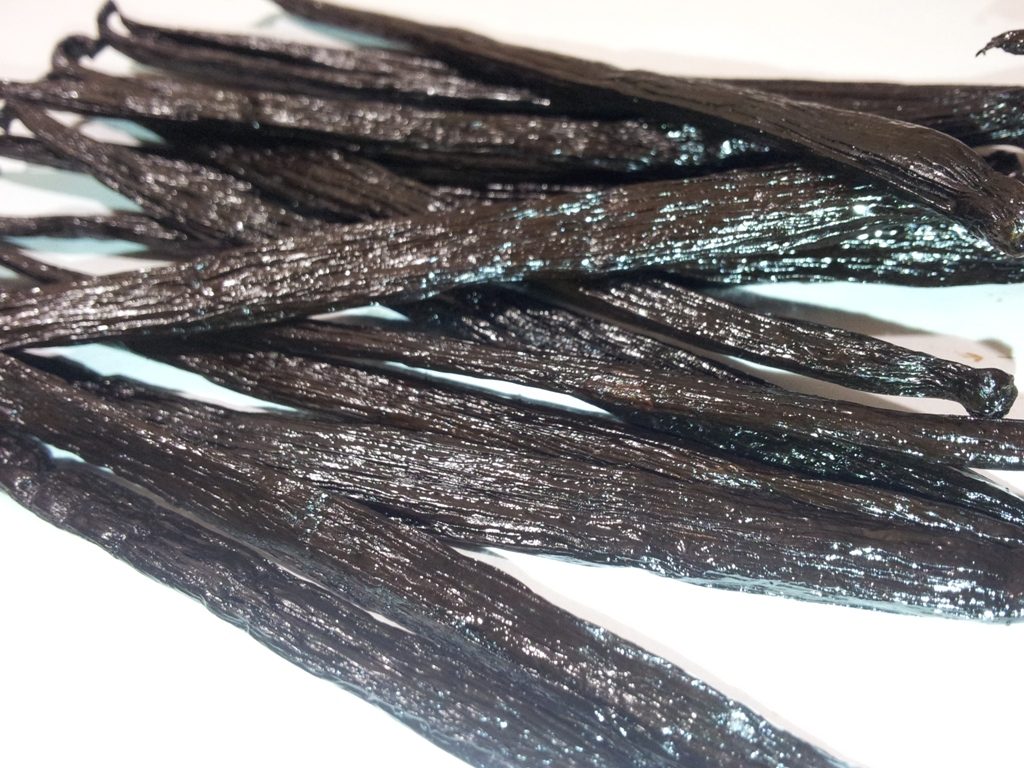
Vanilla Beans

Vanilla beans.

The chef’s kitchen was airy and sparkling white, almost dainty at times. So too was his mise en place: small crystal bowls filled with ylang-ylang, a silver tray covered with the finest Madagascar vanilla bean pods, and a large pile of cedar. He began with the vanilla pods, slicing them horizontally, scooping out the tender flesh inside and grinding it to a thick paste. He added some butter, a few yolks and gallons of cream, then whipped the whole thing into the airiest custard possible. Nay, actually, by the time he finished, it was more like a vanilla custard mousse, flecked with bits of the black bean pod.

Chef Tre Ghoshal via Flickr.

Chef Tre Ghoshal via Flickr.

The chef was a talented man who believed in invention and originality in his food, so he turned his attention to the ylang-ylang. It was a rich, buttery, heady flower that felt very yellow to him. So he ground it down into an emulsion filled with a few pinches of butter. He thought it would bring out the flower’s intrinsic nature. He took the emulsion, folded it into the vanilla mousse and then set about for the twist: he whipped in the lightest pinch of black pepper, and covered the whole thing with a veil of white, confectioner’s powder. With great care, he placed the bowl of powdered vanilla-ylang-ylang mousse over a smoker filled with cedar chips. As he set fire to the wood, its delicate smoke wafted up into the air. The chef added a glass dome over the contraption, trapping the smoke and letting its delicate tendrils seep into the powdered, floral, vanilla custard mousse. Phase One was complete.

Chef Michael Gillet of The Bazaar by José Andrés. Photo: Antoinette Bruno. Source: Starchefs.com

Chef Michael Gillet of The Bazaar by José Andrés. Photo: Antoinette Bruno. Source: Starchefs.com

Phase Two was almost a completely separate affair. About three hours after the frothy, airy smoked-infused mousse was finished, when all the powder had vanished, and only woody elements really remained, he waved his culinary magician’s hand over the creation and turned it to amber. He would never reveal his secret of how he made his dessert suddenly turn into something very different — far from the almost Guerlainade-like opening with its dainty vanillic powder and the unexpected cedar smoke atop that airy, custard mousse — but it was different.

Golden Champagne via PicStopinSuddenly, it was ambered, golden-bronze, dryer, smokier, spicier, and with a surprisingly unexpected undertone of nutty hazelnut. Or was it actually a light dusting of marron glacé? Whether it was glazed chestnuts or toasted hazelnuts, he would never tell, but everyone who tasted his ambered vanilla wondered. Their greatest surprise, however, was the complete disappearance of the powder, to be replaced by something that would have been boozy had it not been so gauzy and lightweight. It didn’t matter — they liked it. Even the critic who normally despised anything with a gourmand character liked it. Not enough perhaps to go out and actually buy it, but the critic would absolutely eat it again if it ever fell into his lap.

The chef’s tale is really the tale of Mona di Orio‘s Ambre, a surprising perfume that perhaps doesn’t warrant the name “Amber” for the full first half of its development but which I liked quite a bit. It is an extraordinarily easily, wearable perfume that traverses from being a slightly modern twist on Guerlainade — Guerlain’s signature of vanillic powder that is at the base of all their classic perfumes — to a completely different end of the spectrum. In a way, it’s almost as if Mona di Orio has upended the usual Guerlain pyramid that traditionally starts with one thing and ends with vanilla powder. This is the complete reverse. And, at all times, it’s light, airy, almost frothy and cheerful, with unexpected twists of cedary smoke, bits of pepper, and then, later, boozy amber whipped into gauzy air.

Mona di Orio AmbreAmbre was released in 2010 as part of Mona di Orio‘s Les Nombres d`Or Collection. It is an is an eau de parfum, though Luckyscent and Fragrantica both erroneously list it as an eau de toilette. The company categorizes it otherwise and, naturally, we’ll go with their designation. Mona di Orio’s website describes Ambre as follows:

As delightfully sensual as bias-cut silk, Ambre draws you in to its world with curls of smoky amber. Cedar draws you further into the mystery while vanilla adds a slightly sweet resinous kick that can’t help but delight. Ylang ylang adds a glaze of innocent soapiness to the Film-Noir aspects, but never completely obscures them; who would want to? Easily as at home, at a ball or an intimate evening out, Ambre manages to be both reminiscent of something from long ago yet as fresh as tomorrow, and always very, very French.

Its notes include:

Cedarwood from Atlas, Ylang Ylang from Comores, Benzoin, Tolu [amber resin], Absolu Vanilla from Madagascar.

Source: Soapgoods.com

Source: Soapgoods.com

The very first blast of Ambre on my skin is vanilla. Rich, concentrated, almost buttered, and very much like the paste that you scrape out of a black Madagascar vanilla pod. Immediately on its heels come the bucketfuls of the ylang-ylang. The flower’s similarly buttered, rich, almost banana-like nature feels almost velvety. When combined with the vanilla, result is the overwhelming impression of a thick vanilla custard — except this one feels so light, it might as well have been whipped into a mousse! The pairing of the two rich notes is prevented from being cloying or overly sweet by a heavy dose of cedar, adding a lovely, dry counterbalance to the perfume’s richness. It’s not peppery but, rather, more akin to tendrils of woody smoke. Amber is the last one on the scene, smelling like vanillic benzoin instead of anything thick, balsamic and molten like Tolu.

For my tastes, this is much more my sort of “vanilla” than Mona di Orio’s super-popular Vanille (also from Les Nombres d’Or collection) which I thought was painfully excessive in its buttered undertones and sweetness. Then again, I cannot abide gourmand perfumes as a general rule, and I rarely succumb to any vanilla fragrances to begin with. Perhaps the appeal of Ambre is that the vanilla is not meant to be the primary focus but, rather, second or third to the floral and woody notes; it falls much more in the oriental category than in any gourmand one. I know that when I think of Ambre, months from now, I will always think of it first and foremost as a vanilla perfume infused with florals and smoke, before having to remind myself about the amber.

Source: Wisegeek.com

Source: Wisegeek.com

I was musing on the issue of Ambre’s surprising appeal when, suddenly, less than three minutes in, I was hit by a huge wave of powder. It isn’t like makeup powder or talc but, instead, evokes a white veil of confectioner’s sugared powder suddenly blanketing my vanilla-ylang-ylang-smoke mousse. It takes over Ambre completely, dominating the top notes and leaving the ylang-ylang to peek up from underneath.

When the powder combines with the vanilla, the result calls to mind a riff on Guerlainade, the signature base for classic Guerlain perfumes. Here, it’s much tamer than in the old French classics, mostly due to the impact of the cedar. Though it seems completely non-existent in any individually distinctive way, the note’s effects are present in a certain dry, smoky woodiness at the base that alleviates that Guerlainade a little. Mona di Orio’s airiness is another difference which impacts the nature of the powder. In Guerlain perfumes, especially in its vintage beauties, the famous signature base can sometimes feel very heavy and plush. It’s also often marked by orris root which creates a makeup or lipstick impression. Here, however, the absence of the orris root — and the presence of the smoky wood in a perfume that is quite airy overall — shifts the Guerlainade-like note away from the full-on, traditional, makeup powder and to something much more modern. To me, it feels closer to confectioner’s powder with its sweetened nature, but I know others smelled only lipstick.

Less than fifteen minutes into Ambre’s development, it starts to shift a little, like a mousse that is starting to settle. Its sillage drops and the perfume softens. It feels incredibly floaty (to invent a word), hovering like gauze just an inch above the skin. The notes have blended into a perfect whole: powder-and-vanilla-custardy-mousse-with-florals-and-light-smoke. And it remains that way for quite a while, with only minor changes. Slowly, the vanilla feels less custardy and much lighter, while the powder element slowly starts to drop in prominence. The cedar with its light tinges of smoke begins to rise much more to the surface until, suddenly, three hours in, Ambre has completely changed. Now, it is smokier, dryer and with an unexpected booziness that definitely feels like the super-rich amber resin, Tolu Balsam. The powder has finally become less predominant, though it continues to mix and meld with the vanilla. In the background, subtle tinges of ylang-ylang adds some subtle, creamy, velvety richness.

Source: Wallpaperscraft.com

Source: Wallpaperscraft.com

For the most part, however, the impact of the powder and floral notes is minimal because Ambre has finally begun to match its name. Tolu Balsam is one of my favorite ambers because of its spicy nuance and its slightly smoky feel that, here, is further accentuated by the cedar. The wood, in turn, has shifted a little to reveal a tone that just almost, just barely, verges on peppered. And the whole thing sits atop a base of warm, cozy, rich vanilla infused by smoke. There are flickers of something interesting in that combination of Tolu and concentrated vanilla: nuttiness. There is definitely an undertone that calls to mind roasted hazelnuts with the smallest, faintest suggestion of marron glacé. The whole thing is extremely subtle, almost ghostly, especially given the strong vanilla note, but I found myself sniffing my arm in appreciation for its occasional flickers here and there. As a whole though, the perfume is primarily a vanillic-amber in nature.

I wish Ambre had remained that way for a while, but it didn’t. The lovely, spicy Tolu Balsam phase lasted just over two hours — and almost as a skin scent at that. Finally, about 5.5 hours in the perfume’s development, the drydown begins. It begins as a simple, vanillic, benzoin amber that has the smallest suggestion of woodiness and powder. It’s so sheer and light, you have to forcefully inhale at your arm to detect it. Finally, just short of the eighth hour, Ambre fades even more to become nothing more than a general, amorphous, woody-vanilla flicker.

Most people seem to classify Ambre as … well, an amber perfume. To me, and on my skin, it was primarily a vanilla. Not a gourmand vanilla, thank God, but definitely a vanilla. And I liked this “vanilla” significantly more than the perfumista favorite from Mona di Orio: Vanille. I truly couldn’t handle it, though I still recommend Vanille for those who enjoy sweet perfumes and want a non-traditional vanilla fragrance with a twist. My problem is that I cannot abide excessive sweetness. As a result, Vanille was too, too much, but — like Goldilock’s porridge — Ambre was the perfect balance with its floral, dry wood, and smoke notes. Taking the issue of relativity even further, as someone who worships potent, massively opaque, moltenly resinous Orientals, I find it well-nigh impossible to think of the perfume as an “Amber.” The strength of that vanilla absolute, even in the drydown phase, makes it the dominant note in my mind.

On that same scale, I have to rate Ambre as a very airy, gauzy fragrance. Others seem to agree, though the term a number of people use on Fragrantica and elsewhere is “silky” instead of “airy.” They also find the sillage to be, on average, very “moderate.” In terms of longevity, the largest amount of votes is for “moderate,” followed then by “long-lasting.”

The consensus seems to end there, however, as reviews for the perfume itself on Fragrantica are sharply split. One commentator, “Hélio Sérgio Rocha,” picked up on the two separate phases of the perfume, writing:

The opening is sweet, powdery and light. [¶] The Ylang Ylang gives a sweet floral aspect to this scent and i can feel some honey too.

Then this perfume gets smoky and silky itself. [¶] I do not see on it distinct phases on the ofactory pyramid, but I feel a combination of two different phases: a sweeter one; and darker another. […] 

Funny how this scent starts with a luminous amber and ends with an resinous aspect, so dark, mysterious and smoky. [¶]  

I felt i was wearing a silk made cloth as a second skin of mine …  [Paragraph and format alterations are my own, due to length.]

Many share his feelings, writing about how Ambre is an incredibly “cozy,” warm, “spiced,” amber fragrance that was “refined and elegant,” or “heaven in a bottle.” (The word “cozy” comes up repeatedly.)

On the complete opposite end of the spectrum, however, are those who shudder at Ambre’s powder, finding it to be far too excessive and, as a result, a complete deal-breaker. One woman thought the opening smelled just like baby powder, though she really liked the spicy amber phase (where she, too, smelled a nut-like undertone). And a good portion of men found the perfume to be too feminine, with one writing that it was “not unisex at all in my mind.”

As noted above, I really didn’t find the powder note to be akin to makeup or lipstick, and on my skin, it was far from overwhelming. I don’t like a lot of powder, especially if it smells like makeup or, even worse, like baby powder, so I would tell you if I detected that on my skin. I didn’t. In fact, I actually liked the powder stage a little — perhaps because of the rich ylang-ylang-custard-vanilla-smoke combination underneath it. Plus, I truly believe that the dry, smoky cedar note (and the absence of orris root) prevents the perfume from being very much like lipstick. Nonetheless, I completely agree with much of the other comments about how the amber stage was more enjoyable in its cozy spiciness, and how Ambre leans quite feminine. I don’t think this is a perfume that anyone should purchase blindly.

While I myself would never buy Ambre, I would absolutely wear it if a bottle somehow fell into my lap. I’d wear it frequently, in fact, and for one simple reason: it’s an incredibly easy perfume. I can see this as fitting a wide variety of circumstances, but especially when you’re in a rush and want to spray something simple while you’re on your way out the door. Ambre is the furthest thing from revolutionary, complicated, or novel. It’s hardly a masterpiece, and isn’t even particularly interesting on some levels. But it’s one of those very practical, daily staple-like perfumes that could be a good workhorse scent for someone who would like a little cozy comfort, a little sweetness, and a good amount of vanilla (with light amber) and no gourmand tendencies. Unfortunately, I think a full bottle costs a damn sight too much at $230 for such a simple, staple scent. On the other hand, that price is for a large 3.4 oz/100 ml bottle, and there are much cheaper alternatives available in terms of travel sets and minis. Plus, as I always say, price is a very subjective, personal matter.

Perhaps the biggest problem is that Ambre is not a perfume that will drive people wild with enthusiasm and excitement. But we all need perfumes that are easy, breezy, simple basics; perfumes that you can just spray and go. If you can handle some powder (or, perhaps, a lot of powder?), then Ambre fits the bill nicely.

DETAILS:
Cost, Sizes, Sets & Availability: Les Nombres d`Or Ambre is an eau de parfum, and comes in a variety of different options and sizes. The full bottle is 3.4 oz/100 ml and costs $230. It is available world-wide on the Mona di Orio website. In the U.S., you can find it at Luckyscent, Parfum1, and MinNewYork (which also offers free shipping within the US). There is also a Discovery Set of 8 x 5ml roll-on bottles of the entire Nombres d’Or collection which Mona di Orio sells for €90, and Luckyscent/ Parfum1 for $145. MinNY discounts the set for $5 off, pricing it at $140. Mona di Orio also offers a Travel Set of just the Ambre perfume in 3 bottles of 10 ml each, with the whole set priced at €85 (or about $110 with today’s currency conversion rate). That set is not offered at Luckyscent or Parfum1. In the UK, you can find Ambre at Les Senteurs which sells it for £135.00 and which also carries a sample vial for sale. The perfume is also carried on Roullier White in the UK. In Paris, I see Mona di Orio listed on the Marie Antoinette Paris website but can’t find prices or individual perfumes for the line. In the Netherlands, it is carried at Skin Cosmetics, but they say that they are out of stock at the moment. For the rest of Europe, you can turn to Germany’s First in Fragrance which carries the perfume for €160.00, along with a Travel Kit of 3 x 10 ml bottles for €85, and a smaller sample for purchase. In the United Arab Emirates, it’s sold at Harvey Nichols. In Australia, it’s sold at Melbourne’s Peony Haute Perfumerie for AUD $230. For all other countries from Russia to Spain, you can use the Store Locator guide on the company website. Samples: I obtained mine from Surrender to Chance which sells them starting at $6.99 for a 1 ml vial. Of course, you can also find samples at Luckyscent, Parfum1, and many of the European retailers linked to above.

Perfume Review – Vintage Opium by YSL: A Tribute

Her name would go down in history as one of the greatest temptresses of all time: Salome. But, that night, she was not aware of the infamy which would forever follow her. As she stepped into the palace’s Great Hall, fire burned in her heart; she was a warrior with a mission. Not even the Great Hall could douse the bonfires of spice, smoke, sandalwood, cloved pepper, and molten amber which girded her golden limbs under the misleadingly sweet aura of roses, succulent oranges, heady jasmine, tart plums, and fleshy peaches.

"Salome Dancing before Herod", c.1876 by Gustave Moreau.

“Salome Dancing before Herod”, c.1876 by Gustave Moreau.

The hall was monstrously large, one vast chamber of onyx marble and gold. Her footsteps echoed as she passed the phalanxes of mighty columns, each one wider than ten men, and festooned with ropes of twisted gold. Rows of tall slaves created a corridor of flickering light, as each one struggled under the weight of a heavy, gold candelabra. The corridor led straight up to the throne, atop a large dias, but the fifteen-foot high, gold-and-jeweled monstrosity was empty. Before it, in a comfortable pile of silk pillows, lounged the King. Herod was too fat to fit into the throne; besides, he thought the bodies of the slave girls festooned around him, and hand-feeding him delicacies, would be a good cover to conceal the excitement that he would undoubtedly show. “She had finally agreed!,” he thought, as his eyes gleamed and he licked his plump lips wetly. The royal court seemed equally excited, chattering nervously about the fame of Salome’s beauty and dancing. They fell silent as she finally drew near and stared at her almost as greedily as the king.

She was a tiny figure, and all but hidden under a mountain of veils. Sheer, in and of themselves, their vast number completely obscured her raven hair and lithe, golden body. Thirty one in all, the veils were ornate, gauzy, in a variety of colours and, magically, made out of the most aromatic, perfumed ingredients: sandalwood ochre, bergamot green; plum purple; orange; blood-red rose; pure jasmine white; chocolate labdanum; dusty clove and cinnamon; the ivory-grey of frankincense smoke; the flesh colour of the ripest peach….

As the music started, she lifted one long arm from beneath the gauzy pile, flexing it like a swan, her long fingers fluttering in the air. Her chin was pointed straight up at that hidden ceiling, miles above, and one shapely, toned, muscular leg swept to the side. Folds of orange gauze glided over her fingers, while clove, cinnamon, frankincense, carnation, rose and bay leaf moved in time with her leg. The swishing of the veils radiated waves of scent out upon the silent courtiers, shimmering flecks of dust that twinkled amber gold in the candlelight. The scents melded together into the most perfect whole, each billowing out like a wave, each one more powerful than the last, until the courtiers swayed to the scent. King Herod forgot to eat, and moaned as he was hit by a tidal wave of spiced sandalwood tinged with heaps of cloves, citrus and cedar, myrrh and frankincense. Rumblings of dry woody notes, bay leaf and patchouli could be heard from beneath the folds of the veils, keeping time to the music as it became faster and faster.

Georges Rochegrosse (French, 1859–1929), "Salome Dancing Before King Herod," 1887. Joslyn Art Museum

Georges Rochegrosse (French, 1859–1929), “Salome Dancing Before King Herod,” 1887. Joslyn Art Museum

A horde of drummers suddenly appeared, clad in every hue of amber: tolu balsam, benzoin, and labdanum. “Bom, bom….bom, bom, bom…. bom, bom, bom, bom,” their hands moved faster and faster, as did Salome. She stood on one daintily arched foot, twirling in a pirouette of veils, reflecting colours like the jewels glowing on the giant throne. It became all a swirl of notes, a perfect dance of powerful spices atop her silken peach skin, tinged by jasmine that slinked up to the surface from the heat of her body.  Unbeknownst to the leering, panting king who watched her, pearls of sweat formed on her rose-tipped breasts, lending a subtle tinge of musk to the floral, citrus, spiced, patchouli amber radiating out from her like waves from the center of a vortex. She danced so fast, frankincense seeped out in white billows, and veils began to fall off her body. One arch of her back, and the carnation veil flew off to disappear atop King Herod’s head. He clawed at it, tossed it to the side in a frenzy of panic lest he miss a glimpse of her body, and the carnation vanished from sight.

"Tattooed Salome," c.1876 by Gustave Moreau.

“Tattooed Salome,” c.1876 by Gustave Moreau.

For hours and hours, Salome undulated and twisted, swayed and moved, arched and fluttered, until, finally, only seven veils were left. They blended into one beautiful, spiced whole, jasmine and roses on that main base of fiery spices, sweet musk, black smoke and vanilla. The veils just barely covered her lithe, muscular body made from a sinuous mix of sandalwood, patchouli and every possible resinous, balsamic, amber known to man. With a  flickering glance at the musicians, Salome suddenly dropped to the ground and the music stopped. There, she slithered like a sexual serpent across the floor, rolling around, and turning in a way that just revealed a glimpse of her musky flesh. As she clawed her way towards the king, she whispered, “Anything my heart desires, your Majesty? Anything in your kingdom? Do you swear it?” Herod could barely breathe. “Yes, yes.” He had no blood flow to his brain. “I have sworn it twice already. I swear it again before the court, may God strike me down if I don’t. I will give you anything your heart desires. Now, please. Finish.

Gustave Moreau - "Die Erscheinung," or "L'Apparition." 1875. Part of Moreau's Salome series.

Gustave Moreau – “Die Erscheinung,” or “L’Apparition.” 1875. Part of Moreau’s Salome series.

Salome nodded and, with a single move, was on her feet, swaying with the music that had started again and shedding her veils until she was a blur of naked, ambered flesh. Silky, smooth, creamy, heated, molten flesh — radiating spiced sandalwood, patchouli, endless layers of amber, vanilla, jasmine, and musk. Faster and faster, and faster, she moved until her body dropped in a pile of sinuous limbs. There was complete silence, punctuated by the king’s small moans and shallow breaths as he stared at Salome’s naked body. Still on the ground, she calmly lifted her head, stared at him, and coolly said: “His head. On a silver platter. I want St. John the Baptist’s head.

The story of Salome is many things but, ultimately, it is a story of a temptress and seduction. It is the story of the lure of sex. And, to me, few perfumes better represent seduction, temptation, tantalizing teases, sex, wild abandon, mystery, and, yes, a warrior’s fiery strength than Opium. YSL‘s magnificent creation is justifiably considered the benchmark oriental, the standard by which all others are measured. (And, in my opinion, the standard by which all others fail to measure up.) It is my beloved, my favorite perfume in the world, my equivalent of Gollum’s “Precious.” As with Gollum, Opium drives me a little mad, but it is also the most empowering perfume I’ve ever worn. I wear it when I need armour and feel like I will be riding out into battle, as much as I wear it to seduce.

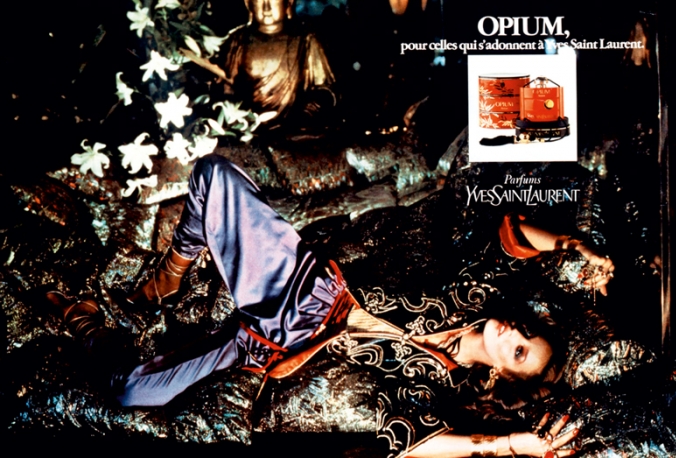
Opium ad, 1977, featuring Jerry Hall. Photo: Helmut Newton. Source: Marieclaire.it

Opium ad, 1977, featuring Jerry Hall. Photo: Helmut Newton. Source: Marieclaire.it

I refer, of course, only to the glory that is vintage Opium Eau de Toilette. The current version is a eunuch. It is a travesty which is not even worth acknowledging and which certainly does not deserve the name “Opium.” A complete and utter travesty. Adding insult to injury, there are plans for a future, additional reformulation of Opium already in the works, from what I’ve read, due to EU regulations that will take effect in the next year or so. The present abomination is bad enough; one can only shudder at what will happen when the eunuch is fully dismembered. So, to preempt a wave of tears at the thought of what has already happened to my beloved, and how much worse it’s going to get, let’s focus on the true, real, original Opium.

1977 Opium advert featuring Jerry Hall. Photo: Helmut Newton. Source: Vogue.com

1977 Opium advert featuring Jerry Hall. Photo: Helmut Newton. Source: Vogue.com

Opium was released in 1977, the creation of Jean Amic and Jean-Louis Sieuzac. It has a mind-boggling list of notes. Simply mind-boggling. Those of you who wonder why I’m rarely impressed by modern fragrances, well, it’s because most of them have a fraction of the notes present in old vintage classics. And notes equal depth, body, complexity, sophistication and richness. But even a lot of the old classics don’t have as many notes as my beloved. According to Fragrantica‘s listing (which is more for the current version than the vintage), Opium has 31 ingredients, but God only knows how much greater the number is for the vintage version, especially unofficially.

Top notes are coriander, plum, citruses, mandarin orange, pepper, jasmine, cloves, west indian bay and bergamot; middle notes are carnation, sandalwood, patchouli, cinnamon, orris root, peach, lily-of-the-valley and rose; base notes are labdanum, tolu balsam, sandalwood, opoponax, musk, coconut, vanilla, benzoin, vetiver, incense, cedar, myrrh, castoreum and amber.

I don’t like dissecting the notes for my truly, truly beloved fragrances as I generally do. I refused to do it for (vintage) Fracas, and I won’t for (vintage) Opium beyond what I’ve already written above as Salome’s Dance of the (31) Veils. For me, Opium is far too sacred for analysis, far too much a work of art. Plus, it is such a superbly blended masterpiece that a lot of the notes meld and melt into one multi-faceted whole. It’s like the bloody Hope Diamond. It’s just so big, so brilliant, so reflective of so much, but all in one giant piece.

That said, there are definite stages where some aspects shine a little more than others. In the beginning, it’s the burst of orange, infused with seemingly every ounce of fiery, dusty clove and cinnamon available on earth. It’s backed by a hint of plum and peach, but, to me, those notes have never radiated very brightly on my skin. Instead, there are dry woody notes, cedar, a dash of bay leaf, and two different kinds of incense: frankincense and myrrh. Hints of floral notes (especially jasmine) take full sway later, in the middle stage, along with the start of creamy coconut and vanilla. Later, as that phase is winding down, more and more of the amber resins start to dominate: from the more balsamic-heavy, dark, smoky Tolu amber; to the nutty, slightly animalic, minutely leathery labdanum; the sweeter, more vanilla-like tones of benzoin; and what I personally believe is ambergris (but which Fragrantica’s listing for the current version of Opium lists as just plain “amber.”) Opium also has castoreum which is detectable mainly in the dry-down in the slightly animalic leather note. Not a raunchy, harsh, obvious leather, but more of a leather feel like something sumptuously rich, thick, velvety and plush. The sort of heavy velvet that Henry VIII would wear.

My 1970s bottle of vintage Opium EDT. Note how the box says New York on it and "Made in U.S.A," in addition to the usual Paris notation.

My 1970s bottle of vintage Opium EDT. Note how the box says New York on it and “Made in U.S.A,” in addition to the usual Paris notation.

The problem is that some of these notes and, more importantly, their dominance seem to vary depending on just how vintage your bottle of Opium is. I have two bottles of eau de toilette. The tiny remainder of one from the early 1990s (1992, I think), and a large 1970s bottle which I bought on eBay late last year. It is, oddly and quite unusually, from a short, limited-distribution run when Opium was made in America, not in Paris. Unfortunately, the top notes have gone off, and that evaporation has just concentrated some of the spiced notes to an almost brutal degree. Once, however, you get past the thorny first 40 minutes, the glory of Opium’s base is revealed in full splendour, with gallons (and gallons!) of real Mysore sandalwood. It does not even remotely compare to my early 1990s bottle, though the latter has the benefit of Opium’s always spectacular orange, citrus start being intact.

While I miss that beautiful opening with my 1970s version (due to evaporation of the top notes), I find it interesting to compare the two versions because changes were clearly made in between that have nothing to do with the top notes. My 1970s bottle is a behemoth in sillage and longevity, as was the Opium that I grew up on and which bewitched a seven-year old child to the point of sneaking in sprays from her mother’s tasselled bottle. (Yes, I was an early bloomer, perfume-wise.) My 1990s version doesn’t create an enormous cloud around me at the start, becomes closer to the skin far more quickly, and doesn’t last as long on my perfume-consuming skin. My 1970s bottle clearly has real animal musk — something now prohibited for cruelty reasons. My 1990s version does not, since I believe that the prohibition against natural musk was in place by then. My 1970s version has real castoreum; I can’t smell much of its leathery undertone in the 1990s version. And the 1990s version has weaker undertones, especially the coconut and vanilla of the middle and final stages. In fact, every note is muted in the 1990s version (which should just tell you how bad the post-2000 versions are).

eBay photo showing a bottle and box identical to my 1990s version with all the swirls.

eBay photo showing a bottle and box identical to my 1990s version with all the swirls.

Perhaps the most immediately obvious difference is the huge chasm regarding the spices and the sandalwood accords. Even in the 1990s, Mysore sandalwood was becoming more scarce, and I think there is significantly less of it in my 1990s version than in the 1970s. But the truly overwhelming thing is in the spices, namely the cloves. A while back, I wrote a post centered on a Reuters article about IFRA, the EU and changes to legendary perfumes that have already been carried out, unannounced, often undetected, and definitely kept secret. Raymond Chaillan, who collaborated on the creation of Opium, told Reuters that his co-creation has hugely changed. One reason:

Clove oil and rose oil, which contain a component called eugenol. [¶]… When it was launched in 1977, the original Opium was full of eugenol and also contained linalool, and limonene found in citruses. In large doses, Eugenol can cause liver damage, while oxidized linalool can cause exzema and prolonged exposure to pure limonene can irritate the skin.

My personal (admittedly biased) response: unless one bathes daily and for hours in gallons of Opium, I can’t see anyone spraying enough of the perfume to cause liver damage! Regardless, judging between my two versions, I can absolutely see a sharp drop in the amount of clove, as well as the roses, in the later perfume. And 1992 was far, far before the IFRA/EU regulations of 2008!

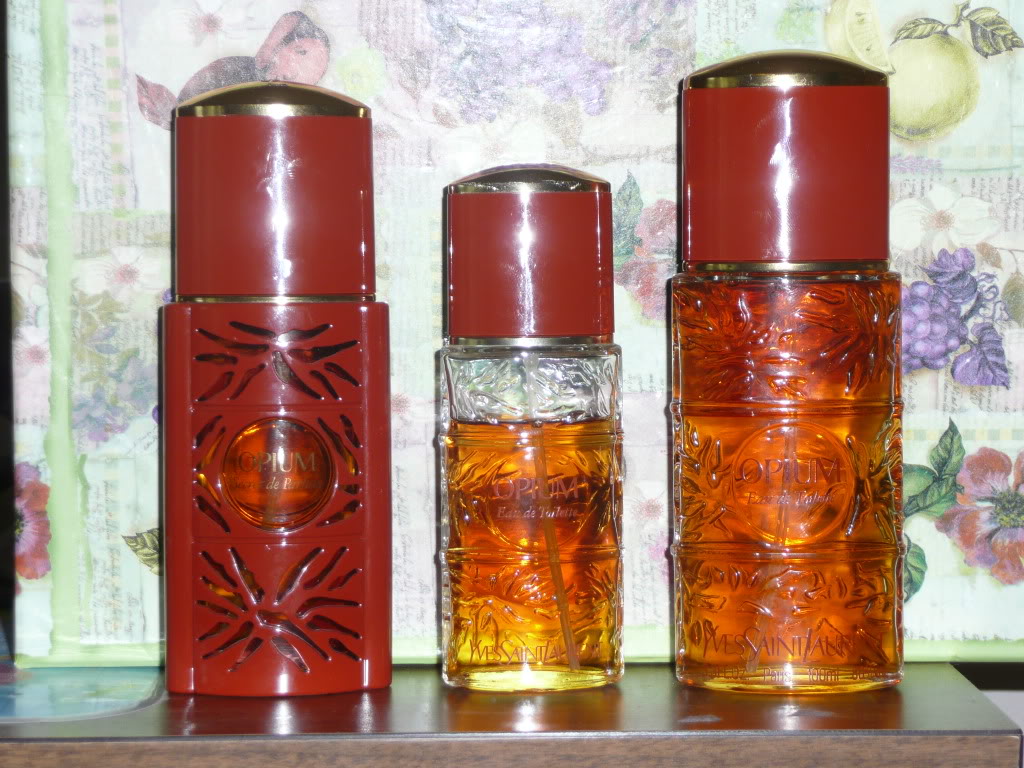
Vintage Opium bottles. Source: "Rizack2" on Fragrantica

Vintage Opium bottles. Source: “Rizack2” on Fragrantica

As a result, in my personal opinion, the best versions of Opium are from the 1980s, as well as any late-1970s bottles made in France, then any early 1990s version. I think that a 1980s version may have the best chance of keeping the top notes and avoiding evaporation, while still having that 1970s concentration. Obviously, though, it always depends on how a particular bottle of perfume was kept. It’s quite possible that a perfectly preserved, sealed 1970s bottle of Opium that was kept in a cool, dark place would be even better! My bottle was not sealed but was in almost pristine condition — and even so, it suffered. (Then again, it is 36 years old!) As for my 1992 bottle, though weaker than anything from the 1970s, it’s still much, much stronger than what followed it. I’ve read that Opium underwent a reformulation in 1999-2000. In fact, according to a poster on a Fragrantica thread, there may even have been another 1990s reformulation back in 1995! (Remember, the companies were continuously reformulating Opium, in secret, as my 1970s bottle demonstrates). The Fragrantica poster, “Andrapi” writes:

most likely Opium was reformulated in 1999-2000 (as the 99% of fragrances) due to the first wave of so-called “restriction laws”. You can clearly see because the “long-ingredients-list” on the box, became mandatory.

Then; remember before 1995 there was no bar-code : if the box lacks the bar-code, you can date the bottle as a very precious vintage one for sure [.]

More: during years 1995-2004 Saint Laurent batched its perfumes with 4-numbers code on the box and 5-numbers (the previous ones plus “1”) code on the bottom of the bottle (example: on the box 6321, on the bottle 63211. This means: 1996)

Since 2005 to 2011: 1 number plus 3 letters, both on box and bottles (example 7HAA , this means 2007).

The bastard eunuch version of Opium that is currently on the market. Note the lack of swirls in the glass on the bottle, and the very big difference in the box.

The bastard eunuch version of Opium that is currently on the market. Note the lack of swirls in the glass on the bottle, and the very big difference in the box.

So, let’s say you’re interesting in vintage Opium and are willing to brave the wilds of eBay to get one. How can you tell it’s vintage? Well, if you’re looking to purchase the glass EDT bottles, the best way to tell is by the swirls on the bottle. The new, castrated formulation has hardly any swirls in the glass, as compared to the original one. The box is also hugely different, losing its golden leaves just as the perfume has lost its notes and potency. There are a few threads on the matter at Fragrantica which might help you, starting with this one (which is where I obtained that photo of the three, vintage, glass, EDT bottles shown up above). An even more extensive thread, showing a ton of different bottles, from the pure parfum to various flankers can be found here (in that previously quoted Fragrantica thread).

Yves Saint Laurent, Opium, bottle designed by Pierre Dinand in 1977, photographed by Damien Fry (2011). Source: Phaidon.com.

Yves Saint Laurent, Opium, bottle designed by Pierre Dinand in 1977, photographed by Damien Fry (2011).
Source: Phaidon.com.

As a side note, all this discussion of Opium pertains to the eau de toilette which is the most common, usual form of the fragrance. There is an eau de parfum (as well as a pure parfum extract concentration), but I have the vague sense they were issued a few years after 1977. I am probably mistaken, however, especially as I know my mother had the tasselled, solid bottle (which is usually the shape of the eau de parfum bottle) back in 1977 and that is what is shown in all the adverts from the time. Regardless, the eau de parfum is not my area of speciality, and most of the discussions of “vintage Opium” usually pertain to the eau de toilette concentration. All I can tell you is that, in 2009, Opium (owned at this point by L’Oreal) re-issued the parfum version in what was supposedly a new bottle but which was also, in my opinion, yet another reformulation. Beyond that, however, I’m afraid I’m not a huge help on the issue of the parfum.

Non-vintage bottle.

Non-vintage bottle.

As for prices, they vary wildly. On eBay, it is all a question of patience and luck. Create a notification for vintage Opium, check the feedback scores of the seller, and then just pray that someone doesn’t outbid you. You may be lucky and get a small bottle for around $65, or you may be unlucky and end up paying around $150. For the parfum concentration, I’ve seen some sealed, 1 oz vintage bottles go for around $350. Granted, they are parfum and sealed, but it’s still high, even for Opium. Generally, though, whatever you pay, it will still be a lot cheaper than the retail cost of many modern, niche fragrances today, especially if you opt for a smaller size. The glass EDT bottles vary in size from 1 oz/30 ml to 1.6 oz, to sizes like my 2.3 oz bottle or the large 3.4 oz/100 ml bottles. You have to look at the photo of the bottles! The less swirls it has, the more it is absolutely certain that it is a new bottle of the reformulated garbage. Don’t listen to what the sellers say, either; right now, someone is selling a bottle entitled “vintage” which is clearly a post-1999/2000 bottle. (See photo to the right of the modern, reformulated eunuch Opium.) The glass has to be covered by swirls to be at least from the 1990s in age.

One last note, YSL issued an Opium for Men in 1995. It’s been a long time since I smelled it but, based on my recollection of it, it was significantly more muted, more citrus-y, less spiced, and with a very diluted sandalwood base. It’s fine, I suppose. But I wouldn’t bother with it. Men can absolutely wear Opium (original, women’s version), and honestly, I think it’s a thousand times more masculine than some of the unisex fragrances put out today for men. As between a fluffy, saccharine-sweet scent like By Kilian‘s Love (Don’t be Shy) and Opium for Women, I can tell you which one would be a better fit on a man — and it’s not the one that smells of cloying, orange marshmallows! Real Opium would be wickedly seductive on a man, but it would never suit someone used to tamer, milder scents. Opium is a powerhouse, a molten, living, breathing fire dragon that will chew you up and spit you out if you can’t handle her.

Even Luca Turin, the great perfume critic, said: “It is unquestionably one of the greatest fragrances of all time.” While the rest of his Five-Star review (entitled “Spice King”) is a more reflective contemplation on the limits of spicy oriental perfumes due to their focus on the drydown materials, he finally says that he personally tires of Opium:

Opium said one thing and one thing only, with tremendous force. While this was the most cogent statement ever made by balsams [the deepest kind of amber resin], one does tire of it.

Mr. Turin, there you go again. Just when I think I may finally agree with you, you come out with something like that. Well, His Majesty may tire of Opium, but I would shoot myself in the head if I went with some of the other Five-Star perfumes he praises, such as Davidoff‘s Cool Water, L’Artisan Parfumeur‘s Dzing! (which almost drove me to a complete meltdown), or L’Artisan Parfumeur‘s Vanilia which he cheerfully praises for being “vulgar” beyond all limits.

No, thank you, I will take instead what “is unquestionably one of the greatest fragrances of all time” with its 31 glorious notes, evoking raw sexuality, power, and a dragon’s fiery breath. I will keep Opium as my warrior’s shield and sword, as my source of molten ambered invulnerability, and as my means to seduce like Salome. I will wear it, and dance away its 31 glorious veils from sundown to sunrise. Then, when the sky is touched by morning flames of gold and red, I will spray on more of my liquid fire and smile at its secret power. My secret power. My Opium. My love.

Perfume Review: Guerlain Encens Mythique d’Orient (Les Déserts d’Orient Collection)

The treasures of the Middle East done in Guerlain’s incomparable style — that is the goal of Guerlain‘s exclusive Les Deserts d’Orient collection. Featuring a trio of perfumes created by Thierry Wasser (Guerlain’s in-house perfumer and creative director), perfumes consist of: Rose Nacrée du DésertEncens Mythique d’Orient, and Songe d’un Bois d’Été. The line was released in mid-2012, exclusively for the Middle Eastern market, before subsequently making its way to a few select Guerlain stores and retailers in Europe and America. I’ve now tested two of the three, and while I like Encens Mythique slightly more than Rose Nacrée, I’m still not won over.

Guerlain Les Desert d'Oriente collection

Fragrantica‘s description of the perfumes is enticing:

Straddling the line between contemporaneous sensibilities and antique exotic traditions, the newest collection Les Déserts d’Orient by Guerlain has the patina of aged woods and bronze artifacts hiding in some cave in the desert, yet its Frenchiness is undeniably there too.

Upon reading the description, I was sure I would finally find a modern Guerlain to love passionately and obsessively. I’ve barely concealed my enormous disappointment over many of Guerlain’s recent perfumes with their endless (often excessive) sweetness, their occasional thinness, and their lack of great nuance. In my opinion, if one were to compare the vintage versions of the legendary Guerlain classics with their sultry richness, incomparable sophistication, endless nuances and stunning layers to much of the current crop, the difference would be as wide as a chasm. But I was convinced that Les Déserts d’Orients collection would change that feeling. Well, not so far….

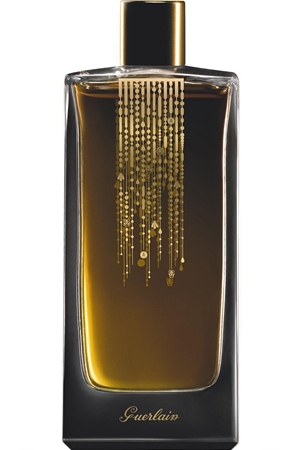
Encens Mythique. Source: Fragrantica.

Encens Mythique. Source: Fragrantica.

Like its sibling Rose Nacrée du Désert, Encens Mythique d’Orient (hereinafter just “Encens Mythique” or “Encens”) is centered on a dark, dusty rose. It is probably the same sort of unusual Persian damask rose which Thierry Wasser used in Rose Nacrée, sourced directly from Iran, but it is not the sole driving force in the fragrance. Aldehydes are just as significant, as is frankincense. Compiling the notes from both Fragrantica, The Non-Blonde, and Surrender to Chance, the full list of Encens Mythique’s ingredients seems to be:

aldehydes, Persian rose, frankincense, ambergris, saffron, orange blossom, neroli, patchouli, vetiver, musk and moss.

"Rose de Rescht," a type of Persian damask rose which originated from Rascht, Iran. Source: Flowerpedia.blogspot.com

“Rose de Rescht,” a type of Persian damask rose which originated from Rascht, Iran. Source: Flowerpedia.blogspot.com

The very first note of Encens Mythique on my skin is rose: dark, dense, dusky, very purple, almost beefy and very fleshy. The second is of aldehydes: a little soapy, but also quite fizzy and sparkling. Underneath the aldehydic rose is a mossy undercurrent, along with patchouli and what feels like the smallest pinch of citrus. If it weren’t for the moss-patchouli base, Encens Mythique would almost seem like a sparkling rose champagne, albeit one filled with soap bubbles. It is too weighed down, however, by that plush, potent, bright (but also, just a little bit dry) foundation to be anything quite so light as champagne. Adding to the velvety nature of the undertones is a subtle flickering of a rooty, earthy, dark vetiver which adds further depth and weight. There is almost a discordant juxtaposition between the frothy lightness of the fizzy soap bubbles and the darkness of that beefy rose and mossy base. It’s interesting and unexpected, though I should confess that I’m not a huge fan of aldehydes in general.

Source: Stockfresh.

Source: Stockfresh.

Five minutes in, the frankincense rises to the surface, turning the rose much more arid, dark, and almost a bit leathery in its smoky richness. The incense note is never separate or distinct, so much as it is an integral part of the rose. It imbues it with much character and darkness, ensuring that Encens Mythique’s rose is no simple rose; it’s not syrupy, fruited or merely jammy, especially given those aldehydes. To be honest, I’m having a few problems wrapping my head around the dichotomy of the white aldehydes and the black frankincense, though they’re both well-blended here and create a very different take on the traditional rose fragrance. Perhaps I just need to actually like aldehydes.

Around the twenty-minute mark, there is also the start of a light muskiness and hints of ambergris. The latter feels grey, complex, tinged with a wonderfully salty tone, and very much like the real (extremely expensive) stuff. The quality of the ingredients in Encens Mythique is without question, and few things demonstrate it more than the genuine ambergris with its rich, sensuous, slightly animalic facets.

Source: Dreamstime.com Royalty Free stock photos

Source: Dreamstime.com Royalty Free stock photos

Alas, on my skin, Encens Mythique is primarily soap bubbles and a smoked rose coated with more aldehydes, then followed by ambergris atop a powerful mossy-patchouli base. There is a hint of orange blossom, but it is extremely minimal and muted. I don’t detect the saffron in any significant, noticeable way. At all. The dash of subtle vetiver at the start is also gone. The main trajectory of the perfume remains generally unchanged for much of Encens Mythique’s development on my skin. True, the salty, musky ambergris grows in strength to a small degree, while the aldehydes recede a fraction by the start of second hour. But, it’s only a question of degree; for the most part, Encens Mythique is a predominantly an aldehydic rose touched by frankincense smoke.

Four hours in, close to the end of the drydown, Encens Mythique is a muted, musky, rather amorphous rose scent with tiny flickers of aldehydes, amber and smoke. In its last, dying moments, right around the 5 hour mark, it is just an abstract musky scent. At all times, the sillage was low on my skin. The opening projection was decent, but Encens Mythique became a skin scent on me around the two-hour mark. And its longevity wasn’t great. Granted, I have perfume-consuming skin — but I wasn’t the only one to have problems. (On Fragrantica, someone called it a “4 hour frag.”)

In fact, my experiences seemed slightly similar to that of The Non-Blonde who wrote:

Encens Mythique d’Orient on my skin is mostly an incense/rose perfume. The strong shot of aldehydes in the opening is the first surprise, as does the strong boozy element (more refined than in Guerlain’s Spiritueuse Double Vanille, but still strong) . There’s spice and sweetness, honey and saffron, wonderful richness and a powdery rose. There are stages in the development of Encens Mythique d’Orient that it almost created arabesques of sillage around me. But most of the plushness disappears too early. What’s left on my skin after two hours is an abstract woody rose. The husband says it’s nice and floral, I think it’s powdery and ambery. In any case, the longevity of Encens Mythique d’Orient is not the most impressive in this collection, but it might be the easiest one to wear.

I think I actually had better longevity than she did! I didn’t experience the saffron, booziness or powder that she did, but I agree that much of its plushness disappears very quickly. I also agree with her overall conclusion regarding the fragrance: “I expected Encens Mythique d’Orient to smell very exotic and enchanting in an Arabian Night way. While the fragrance definitely has those elements woven into its fabric, the overall result is actually very French, even if not necessarily a typical Guerlain perfume.” It’s quite true. (I actually I think Encens Mythique is perhaps much more of a chypre-oriental hybrid than a pure “Arabian Night” oriental.)

Fragrantica‘s own review for Encens Mythique was interesting:

The opening of Encens Mythique is reminiscent of retro shaving foam, part retro fern-like and mossy, part musky sweet, with a very decadent, rich feel to it that stems from an oriental Damask rose. The rosiness is allied to saffron, a classical combination that exalts the bittersweet facets of the spice into a warm embrace. But it is the coalescence of ambergris and sweet musks which “makes” the perfume a true Guerlain and at the same time a reverie into the Middle East.

Ambergris

Ambergris

I can definitely see why there would be a sense of “retro shaving foam” — it’s all those aldehyde bubbles! I definitely don’t agree that the perfume is a reverie into the Middle East judging by my own time there, but I do concur on her assessment of the ambergris as smelling “like a real tincture of the rare greyish matter, with all its nutty, buttery, smoky and salty intimate nuances intact.” Had the note been stronger on my skin, I might have more enthusiasm for Encens Mythique.

Commentators on Fragrantica are generally positive in their assessments of the scent. A sampling of some of their views:

  • A rich elegant perfume with a heart of rose/saffron accord (somewhat reminding me of Rose Barbare). It smells very “natural”, slightly green in the opening. I don’t find it smells of incense. There is really a vintage quality, it’s like something you would have smelled in the past. Like one of those “grande dame” aldehydics of the 1950s or 1960s. “Never-smelled-before” it is not, but who cares when quality is this good.
  • A distinct fragrance built around saffron, ‘real’ musk (neither animalic nor clean), rose (fresh and warm, not pungent), moss and a sultry, mellow neroli caught like exotic butterflies in a luxurious aldehyde glass house. It is the mix of individual colors – vibrant, velveteen and tender – that enthralls and then the touch of moss, that adds a dimension of earthiness and maturity and eccentricity
  • This is a lovely perfume but I can’t smell any incense or smoke, in fact it just needs something else to make it a bit more interesting.I gave myself a good spray last night and can still smell the divine amber lingering on me this morning. It is a very sweet perfume and this is what will probably put me off getting a fb.
  • A short burst of incense; spices, herbs, a gentle sweetness. Then, a distinct honey accord, which rounds out the fragrance. The dry down is warm, sensual and keeps the delicate spicy sweetness, with an undercurrent of woody notes. Very nice, but at the price, perhaps not FB worthy. (3/5)
  • If you are expecting incense such as that in the Comme des Garcons series or Messe de Minuit, think again. The incense in this perfume, if present at all, appears only as a wisp of smoked rose. The moss listed in the notes is not there; oakmoss usually lends a note of bitterness and there is nothing bitter here. Overall this is really a simple floral, and does not live up to its name. It’s pretty though, but not pretty or different enough for the price.

As you can see, there seems to be a big split on the issue of the incense and its dominance. On my skin, as noted early, it was infused into the rose, ensuring that it wasn’t just a simple, jammy or fruited rose, but it was never a wholly distinct, rich feature in its own right.

Some Fragrantica members also seemed to have issues with Encens Mythique’s price — and it’s a very valid consideration at $275 a bottle or €190 (though it may have gone up since that original Euro price). Ultimately, I think price is subjective, and all depends on someone’s love for the fragrance in question. I, personally, would not buy Encens Mythique — even at a significantly lower price. It is not my cup of tea and, in my opinion, not very special or hugely interesting. Plus, longevity is an issue. But it definitely has its fans. I suspect it would have many more fans were it easier to obtain. Though it is available with a bit of effort, Encens Mythique is not listed on Guerlain’s own website – which is rare even for their niche, prestige lines! It is, however, available via select stores which you would have to call in order to buy the perfume. (The details are below.)

All in all, if you’re a die-hard Guerlain fan and love rose scents of any variety, I’d encourage you to give Encens Mythique a sniff. It’s wearable, refined, has a slight twist, and is well-blended with high-quality ingredients. However, if you’re looking for something truly oriental or different, you may not find it to be a stand-out that is worth the price.

DETAILS:
Cost & Availability: Encens Mythique d’Orient is an eau de parfum that comes only in a 75 ml / 2.5 oz bottle and costs $275 or €190. (I think that may be the Euro rate. See below.) In the U.S., it is available at Guerlain’s Las Vegas boutique at The Palazzo (702-732-7008) with free shipping and no tax. It is also available at Bergdorf Goodman in New York; you can call (212) 872-2734 and ask for Alina. However, she informs me that there is shipping costs an additional $12.75, so you’d get a better deal ordering from Las Vegas if you test out the perfume and want to buy a full bottle. In New York, the Désert d’Orient collection is also available at Saks. If you’re outside of New York, you may try calling a Saks Fifth Avenue near you to see if they carry the line as well.
In Europe, I’ve read that the original European price was €190, but I don’t know if it remains at that price and can’t find the perfume listed on any online website to check. Encens Mythique is available at Guerlain’s flagship headquarters in Paris. Most of the exclusive Guerlains are also available at Haute Parfumerie Place Vendôme in Belgium (which ships internationally), but I don’t see the Désert d’Orient collection on their list, so I would definitely give them a call if you’re in Europe and interested. In the UK, I’ve read that the collection is supposedly available at London’s Harrods and Selfridges boutiques. However, it is not listed on the latter two stores’ websites.
In the Middle East & Asia: The perfume is obviously available in the Middle East, since the entire collection was originally created for that market to begin with, so your starting point might be the Paris Gallery perfume retailer which sells Encens Mythique for AED 990. They have stores at a huge number of UAE malls and locations which you can find using their Store Locator. In Asia, I know a lot of rare, expensive Guerlain fragrances are carried by Hong Kong’s Harvey Nichols boutique, so they may have this one too. If you’d like to check for locations of Harvey Nichols from Hong Kong to Istanbul, Riyadh and Kuwait, try here. I did see that Guerlain has a Japanese website, but I’m afraid I can’t read it to see what fragrances it carries (even using a Google translator). Outside of those regions, I would check with any Guerlain boutique or luxury department store in your country on the rare off-chance that they may carry it.
Samples: Surrender to Chance sells Encens Mythique starting at $4.59 for a 1/2 ml vial. You can also do what I did and opt for the whole Desert d’Orient trio in a sample set that begins at $12.99.

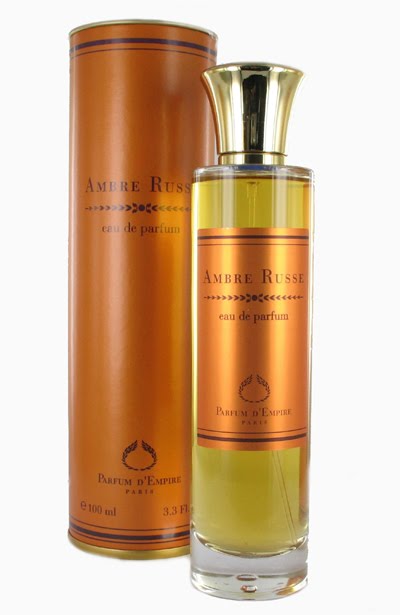
Perfume Review – Parfum d’Empire Ambre Russe: Old Mother Russia

St. Basil's Cathedral. Source: Tripthirsty.com

St. Basil’s Cathedral. Source: Tripthirsty.com

It was a cold Spring, that April in 1986, when I went behind the Iron Curtain and visited the Soviet Union. Snow still lingered in parts of Moscow and the rural countryside that my group visited. I remember the grimness of Moscow, and have crazy stories about my time there: from our Russian minders; to the bugs in the telephone at the vast hotel where we stayed (either the Hotel Ukraina or the Cosmos) in Moscow; to stomping through birch forests to use a medieval, wooden out-house; and how I was interviewed on camera in the lobby for a news piece about the recent U.S.-Russian ballistic nuclear arms treaty. They quickly yanked and cut that interview when the journalist discovered I wasn’t just some mindless, young tourist who would babble about the glories of peaceful Mother Russia. To his unmitigated horror, I answered his question by giving a concise, Cold War breakdown of the history of nuclear arms talks and treaties between the U.S. and the U.S.S.R. going back to the 1960s. His dirty looks followed me all across the giant lobby as I left….

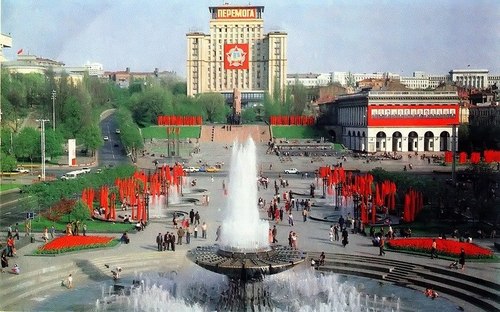
Kiev in the 1980s. Source: Englishrussia.com. For the full post on great colour photographs of Russian cities from 1968-1984, click on the photo. Link embedded within.

Kiev in the 1980s. Source: Englishrussia.com. For the full post on great colour photographs of Russian cities from 1968-1984, click on the photo. Link embedded within.

My group ended up being kicked out of the Soviet Union after someone on it was caught engaging in black market dealings and a few other transgressions. (Not me!) It was probably just as well since we were in Kiev at the time and, as I mentioned, it was April 1986. Kiev, for those of you who don’t know, is in the Ukraine, and less than an hour’s drive from Chernobyl where the worst nuclear reactor disaster in history occurred only a few days later. We would have been there, but, instead, I was back in Paris when news of the disaster hit. The prevailing winds drew most of the radioactive fall-out away from the city, but my mother was still relieved that we left earlier than planned, even if it was under less than glorious circumstances.

Source: www.ruskerealie.zcu.cz

Dormition Cathedral. Source: www.ruskerealie.zcu.cz

Though I went to the Soviet Union, I saw enough of old Russia during my time there, from the magnificent old churches to the palaces. It is always Vladimir, however, which comes instantly to mind when I think of that trip. It was one of the ancient capitals of medieval Russia, and two of its cathedrals are now World Heritage sites. The solemn grandeur of those enormous, dark, often candle-lit churches — and Dormition Cathedral, in particular — with their huge walls covered in icons, painted figures and gold is something I will never forget. It instantly took me back in time to the Russia of Rasputin and Catherine the Great.

Dormition Cathedral in Vladimir. Photo by O1e9. Source: Flickr

Dormition Cathedral in Vladimir. Photo by O1e9. Source: Flickr

In a way, so too does Ambre Russe by Marc-Antoine Corticchiato, the founder and nose behind Parfum d’Empire. Well, it takes me back to Russia, though it’s more to a tea room filled with large samovars and smoke as people lounge on velvet or leather sofas and knock back drinks over plates of sweetened fruits. But it’s certainly more than I expected. Unfortunately, the perfume was also significantly less than I expected. It didn’t live up to its wonderful opening and that trip back in time; it was too sheer, light and airy to be the true molten, luxurious, opaque marvel of Rasputin’s boozy, intense, dark, opulent Russia. However, those who prefer more lightweight, airy approaches to their booze and amber Orientals, may enjoy Ambre Russe very much indeed.   

Ambre RusseI don’t think any perfume house has better stories or descriptions to accompany their fragrances than Parfum d’Empire, and Ambre Russe is no exception:

An opulent elixir, as passionate as the Slavic soul. In this intense elixir, the opulence of the Russian Empire is conjured by the golden warmth of ambergris, intensified by vibrant spices, the smoky aroma of Russian tea and the spirituality of incense. Ambre Russe, a fragrance for impassioned souls. […]

In the flamboyant world of Ambre Russe, nothing is done in half-measures: parties are as intoxicating and sparkling as the champagne that flowed in Imperial Russia but they can end in the white brutality of an icy shot of vodka.

Ambre Russe also conjures the warmth and comfort of dachas where Russian tea, laced with cinnamon and coriander, is brewed all day long in samovars. It’s slightly smoky aroma melds with those of the birch and juniper tar rubbed into the legendary Russian leather. At last the golden facets of Ambre Russe are burnished by the incense of the Orthodox Church, before melting into a cloud of musk. And the celebration ends in mystic ecstasy. Ambre Russe: as impassioned and uncompromising as the Slavic soul.. 

I don’t know who writes Parfum d’Empire’s descriptions, but I want to meet him or her, and bow down in awe. As for the perfume notes, Luckyscent offers the following:

tea, incense, vodka, champagne, cumin, coriander, cinnamon, ambergris, vanilla, leather.

The Russian Tea Room, with an iced Russian bear & vodka display. Source: Therussiantearoomnyc.com

The Russian Tea Room, with an iced Russian bear & vodka display. Source: Therussiantearoomnyc.com

Ambre Russe opens on my skin with so much depth, complexity and nuance that I couldn’t stop sniffing my arm. The very first thing you detect is citrus note like that in really good champagne. It is light, fresh, fruity-sweet, and absolutely sparkling. It is followed by a “chaser” of vodka and spices. The alcoholic blast is accompanied by: treacly cardamom; slightly woody-citrusy coriander; endlessly spiced, rich honey, the slightly tarry aspects of the birch tree; browned, aged leather; and, finally, rich ambergris. The amber, honey and boozy sweet notes combine with the tarry, leathery undertones of the birch to create a note of tobacco. Rich, warm and just like that in fruited pipe tobacco. 

Despite those many notes, it is truly the intense booziness of the scent, combined with the plethora of spices, which dominates those opening minutes. It feels a lot like the opening to my beloved Alahine, though the latter lacks some of the leather and tobacco undertones that are here. Ambre Russe also has a significantly drier feel to it, along with a faintly bitter, smoky edge and black tea notes that truly conjure up a Russian samovar. And, as the clock ticks by, Ambre Russe becomes even drier, woodier, dustier, and smokier. Hints of cumin appear, though they never evoke curry, stale sweat, or body odour. Instead, the cumin feels much like the dry, dusty powder. Unless you are a truly extreme cumin-phobe, I wouldn’t worry; the cumin is so minute and fleeting a note in Ambre Russe that I don’t think most people would detect it, especially given the extreme booziness of the scent.

Source: Orangette.blogspot.com (Website link embedded within. Click on the photo.)

Source: Orangette.blogspot.com (Website link embedded within. Click on the photo.)

Speaking of which, the champagne note slowly turns more into that of spiced rum, accompanied by the vast amounts of dried, stewed fruit that are a large part of the perfume’s base. The fruits feel like rum-raisin and stewed prunes, but there is also a surprising amount of stewed oranges to the note, thanks to the champagne. At times, the combination feels closer to fruity champagne, while, at other times, its more like simple, rich, spiced fruit. It flickers back and forth, but the truly odd thing about it is just how damn light, airy and sheer it feels. For a perfume with such strong notes, especially in the beginning, Ambre Russe is surprisingly lightweight in feel.

Hermès saddle. Source: eBay.com

Hermès saddle. Source: eBay.com

The swirl of dusty spices and fruit sit atop a subtle leather note. It feels honeyed, aged, and rich — much like the old, burnished, and oiled leather riding saddle that I once had. There is a faint powderiness that also appears, but it is generally well hidden under the warm smoke from the incense, the equally smoky black tea, and the strong hints of pipe tobacco.

You almost feel as if you’re in an old Russian tea-room in Kiev. The ceilings are a little black from decades of smoke, old icons cover the wall, birch trees logs are tossed into the fireplace, and the bells from a medieval cathedral chime in the background. As you collapse into the comfortable, soft leather banquets, a server puts champagne flutes on the table, next to strong black tea from the Samovar that is infused with massive dollops of cinnamon-honey. Stewed fruit are the only thing to save your stomach, as you ponder the baffling question of why a tea room is filled with sacks of dry, slightly dusty spices.

About 90 minutes in, Ambre Russe turns into a cinnamon-flecked amber perfume with incense smoke. Yes, there are undertones of honey, leather, tobacco, birch, and stewed fruit but they are light and grow increasingly subtle. To be honest, after that glorious opening and particularly after the second hour, Ambre Russe settles into little more than a light, cinnamon, boozy amber on my skin, and remains that way until the very end.

It is also incredibly — and, for my personal tastes, disappointingly — sheer. As early as the thirty minute mark, Ambre Russe starts to get sheerer and softer until, midway in the fourth hour, it feels as gauzily transparent as a thin, ambered kleenex. On my skin, the overall development of Ambre Russe was fully in the mold of a Jean-Claude Ellena fragrance — and I do not mean that as a compliment. In fact, there are quite a few tonal similarities between Ambre Russe and Ambre Narguilé, especially given the boozy rum, smoke, pipe tobacco, and stewed fruit notes. But, ultimately, Ambre Russe is significantly drier, woodier, and more dustily spiced. It also does not tip-toe up to the edges of the gourmand category in the way that Ambre Narguilé does.

Sillage and longevity also differ. In the first 20 minutes, Ambre Russe had good to average sillage, but after that, it projects little and its insubstantial weight turns the perfume into a skin scent surprisingly quickly. I tried it twice and, on both occasions, Ambre Russe turned into amber kleenex on my skin before the end of 2nd hour. (Far before Ambre Narguilé did on my skin.) Thereafter, Ambre Russe remained as dry, dusty spices and smoke over the lightest possible boozy amber base. That’s truly about it. However, Amber Russe has surprisingly longevity and lasted approximately 11 hours on both occasions on my perfume-consuming skin. At the end of the day, though, I found it to be an anorexic scent with little body and overall depth in the long haul.

I realise that not everyone shares my love for opaque, thick, molten perfumes, but that isn’t the real issue here, in my opinion. It’s that Ambre Russe’s beautiful, skeletal structure is there, but without the depth, complexity and nuance of its early start. It feels like a Lite or Diet version of a true, boozy, spiced amber. That said, those who prefer lighter, sheerer ambers may find Ambre Russe to be a perfect compromise, especially in light of some of the spices. Its lack of sillage, but serious longevity, may also make it perfect for those who worry about wearing serious orientals to a conservative office-environment.

I should note that I seem to be in the minority on the issue of Ambre Russe being far too thin. Take, for example, Luca Turin‘s admiring, four-star review in Perfumes: The A-Z Guide in which he writes:

Ambre Russe is quite simply the biggest, most over-the-top, most expansive, most nutritious amber in existence. If there was a cross between pipe tobacco and pain d’épices, this would be it. To call this an oriental is like saying that Nicholas II was no genius.

Notwithstanding that incredibly amusing last line, I couldn’t disagree more on the “nutritious,” expansive nature of Ambre Russe. But then, I rarely seem to agree with His Majesty….

There is a lot of love for Ambre Russe out there, along with a few polar opposite reactions. Perhaps the funniest (and my favorite) description for the perfume comes from Patty at The Perfume Posse who writes:

This amber rolls in fueled by vodka and lust after a handful of Exstasy and Coke hit the pleasure palace center of the brain, and you settle in for the long night partying in Kiev.  As the morning light reveals the detritus of the night’s Pan-like revelry, you find yourself deep in conversation with a beautiful/handsome poet who talks about life and love as an art form, and the amber turns to beautiful glowing warmth, glad for human comfort and conversation.  If only you could find your clothes, car and dignity, this would have been a great night.

Absolutely fantastic! Another favorite comes from Fragrantica where “Espi” writes:

Wearing Ambre Russe is like sitting next to a drunk but very attractive Russian sailor in a nice and comfortable pub. The only thing I don’t really get is why he’s got spiced honey smeared all over his body! 🙂 Quite the intoxicating smell [….]

Others talk about leather armchairs, expensive cognac, cigars, and old-world, sophisticated opulence. On Luckyscent, more than a few have given descriptions similar in spirit to this one from “yonderblues” who writes about “a room lit by candles filled with ladies in brocade dresses, surrounded by chavalier in their tall leather boots, sabers slapping their thighs and the scent of tobacco trailing after them.” I personally think these descriptions would be more apt if Ambre Russe were not quite so lightweight and gauzy since that completely destroys any sense of “opulence” in my mind, but, again, I have very different standards and personal tastes.

The main objection by those who hate Ambre Russe is the booziness. On both Fragrantica and Luckyscent, the negative reviews seem to center upon the opinion that there is just too much damn alcohol and vodka in the perfume. A handful of those commentators state that they don’t drink and don’t want to smell as though they do (“I hate vodka. I don’t drink.”) which is an extremely valid consideration. I honestly don’t think the vodka is that strong, especially after the first 15 minutes, and thought the fruity champagne note was much more pronounced, but, clearly, it’s all still too much alcohol for some people. As with everything in perfumery, interpretations are subjective and depend on your personal tastes, preferences, and history. 

All in all, if the notes sound appealing to you, and if you love very dry, boozy, spiced amber Orientals, I would definitely give Ambre Russe a sniff. Those who are completely phobic about cumin — in even its mildest, most microscopic manifestions — may think that the perfume smells like “Rasputin’s armpit” (to quote one commentator at the Perfume Posse), but I don’t think most people will. It’s a very pretty spiced amber, and I think it’s extremely evocative of Old Mother Russia. 

DETAILS:
Cost & Availability: Ambre Russe is an eau de parfum and is available on Parfum d’Empire’s website where it costs €92 for a large 3.4 oz/100 ml bottle. In the U.S., you can also find it at Luckyscent which sells the smaller bottle in a 1.7 oz/50 ml size for $75 and the larger 3.4 oz bottle for $110, in addition to a sample for $3. MinNewYork sells that same small 50 ml bottle for $100. Canada’s The Perfume Shoppe sells the large 3.4 oz bottle for $110 but you should contact them for the Canadian price. (The Perfume Shoppe website always confuses me a little.) In Europe, First in Fragrance sells the large 3.4 oz bottle of Ambre Russe for €115, along with samples. In Australia, Libertine carries a few of the Parfum d’Empire line, but not Ambre Russe. For all other countries, you can find a retailer near you using the Store Locator on Parfum d’Empire’s website. To test Ambre Russe for yourself, Surrender to Chance sells samples starting at $3.49 for a 1 ml vial. Parfum d’Empire also offers two different sample sets directly from its own website. The first Mini Sample Set is for 3 fragrances of your choice in 2 ml vials for €6 or €10 (depending on your location) with free shipping, while the Full Sample Set of all 13 Parfum d’Empire fragrances also is for 2 ml vials with free shipping and costs €14 or €22 (for the EU or the rest of the world).