Majda Bekkali Fusion Sacrée (Lui): Drunken Gourmand

“Rum is for drinking, not burning,” is the opinion of one hardcore rock group with a song by that same name. Apparently, Bertrand Duchaufour and Majda Bekkali think otherwise, judging by their fragrance Fusion Sacrée Pour Lui. It is a firmly unisex celebration of hot buttered rum that sets sail like a battleship in a sea of a thick, gooey caramel flecked by flotsam of sweet oranges, bitter neroli, lavender, coffee, vanilla, and seemingly every other element under the sun. The whole thing is then set on fire, burnt with smoke, though it does little to alter the vessel’s gourmand heart. Hours later, it washes up on vanilla sands where it rests in a haze of sweetness.

Wallpaper by Njanj. Source: scenicreflections.com

Wallpaper by Njanj. Source: scenicreflections.com

Majda Bekkali launched her eponymous perfume house — Majda Bekkali Parfums or Majda Bekkali Sculptures Olfactives — in 2010. According to her website, she did so after years of developing fragrances for luxury brands because she wished to move away from commercial imperatives and marketing approaches. Initially, Ms. Bekkali began with two fragrances for her new house but, in 2012 or 2013, she released Fusion Sacrée.

Fusion Sacrée via Luckyscent.

Fusion Sacrée via Luckyscent.

The eau de parfum comes in dual Men’s and Women’s versions, both of which were created by Bertrand Duchaufour. In my opinion, Fusion Sacrée Pour Lui is, despite its name, a very unisex fragrance, thanks to its richly gourmand heart. Speaking of names, Luckyscent calls the scent Fusion Sacrée Obscur (Lui), but that seems unusual. “Obscur” is also not part of the perfume’s title on Ms. Bekkali’s website, where it is listed as “Fusion Sacrée Pour Lui.” (For convenience and speed, from this point forth, I’ll simply call the fragrance, “Fusion Sacrée.”)

On her website, The Sculptures Olfactives, Majda Bekkali describes Fusion Sacrée as follows:

A battle of contrasting forces is at the heart of everything. A divinely balanced equilibrium.

A contrasting note which in the first place proposes its delicious, mouth-watering facet with a drop of rum and celery and an outpouring of opulent spices. Fusion Sacrée Obscur then reveals a voluptuous and velvety heart where creamy notes of white coffee and tuberose unite. The base notes are earthy, woody and resinous conferring this miraculous moment of sacred fusion with a vibrant and unforgettable aura.

Caramelized sauce amberAccording to Luckyscent, the many notes in Fusion Sacrée include:

Rum, citron, celery, sweet orange, neroli, cardamom, lavender, davana, bergamot, white coffee, tuberose absolute, cloves, geranium, sweet william pear, liquorice, benzoin resinoid, opoponax [sweet myrrh] resinoid, ambergris, cedar, sandalwood, vanilla, caramel and musk.

There are 23 notes on that list, and I’m only slightly exaggerating when I say that they all hit me at once when I put Fusion Sacrée on my skin. At once. Simultaneously. All of them! Well, all right, there is a wee bit of hyperbole, simply because the tuberose, cloves, sandalwood, and davana flower took a little longer to show up, but, honestly, I felt as though I’d been hit by a force-field of incredibly strong, multifaceted olfactory notes.

Source: iwallpapersfive.com

Source: iwallpapersfive.com

Fusion Sacrée really is that intense of an opening salvo, especially if you commit the error that I did the first time around and apply a lot. In the case of Fusion Sacrée, though, “a lot” is quite a relative thing; 3 sprays from my tiny atomizer (or the equivalent of 2 good sprays from an actual bottle) sent me reeling. You really need to get used to this scent and its concentrated richness. The second time around was better, because I expected the early blast and had steeled myself. In fact, I generally prefer really potent, strong fragrances but good God, that first time….! And even on subsequent wearings, working my way up with cautiously larger amounts and a slow sense of adjustment, even then, Fusion Sacrée is quite something.

Source: Chef Keem at chefkeem.squidoo.com

Source: Chef Keem at chefkeem.squidoo.com

Part of the issue is the nuclear velocity of the perfume in the opening half-hour, but I found myself equally overwhelmed by the sheer deluge of notes. I could smell a good 15 of those 23 ingredients in the mere opening seconds alone, but they don’t hit you one after another. No, they hit your nose simultaneously. The most obvious, dominant elements are burnt sugar, rum, fierce artemisia, bitter neroli, syrupy orange, green celery, amorphous spices, buttered caramel, nutty sweet myrrh, dusty cardamom and lavender. These are just the most obvious ones….

Source: Simplyrecipes.com

Source: Simplyrecipes.com (website link to recipe for caramel sauce embedded within. Click on photo.)

Fusion Sacrée is overpoweringly cloying, syrupy sweet, pungent, bitter, green, herbal, boozy, woody, spicy, and gourmand, all at once. My initial notes are headlined by “drunken gourmand,” in capital letters with lots of exclamation marks, and a few mutterings about “Sybil” (or multi-personality disorder). Yet, for all that Fusion Sacrée is meant to be a boozy fragrance, its core essence doesn’t translate to actual “rum” to my nose. Don’t get me wrong, there is certainly a lot of sweet liqueur in Fusion Sacrée, especially in its opening hour, but the dominant impression I always have is of generalized syrupy, sweet goo.

The caramel, hot buttered rum, and sticky orange sherbet congeal into a giant, dense ball. From its curves jut out other elements like little shards of coloured glass: bitter green neroli, pungent purple lavender, cream-laced coffee, and burnt black smoke, to name just a few. In fact, the hard, dense mass of diabetic sugariness throws out random notes like a disco ball. They vary in their prominence and role, making it even harder to dissect the perfume as I usually do.

Artemisia Absinthium

Artemisia Absinthium

There are a few notes that stand out amidst that buttered, orange-caramel syrup. On my skin, the artemisia (or wormwood) is particularly powerful with its very sharp, woody, green bitterness. Artemisia is a note that was used in absinthe liquor and, according to one Basenotes thread, is also central to Krizia Uomo, Aramis, and One Man Show fragrances where it was used for its long-lasting, intense pungency.

Geranium pratense leaf, close-up. Source: Wikicommons

Geranium pratense leaf, close-up. Source: Wikicommons

Here, its green forcefulness in Fusion Sacrée is matched by equal amounts of neroli. They infuse the hot buttered, diabetes-inducing goo with intense bitterness, and, yet, none of it balances out. In fact, in a strange feat, the end result feels even more cloying and sickly to me. Honestly, this odd match of green, extremely sharp bitterness with extreme sweetness may be the most difficult part of the entire scent for me. Have you ever bitten deep into the rind of an orange? If so, you know how you get that bitter oil lying thickly like a mealy layer in your mouth? Well, imagine that taste multiplied tenfold, then covered by heavy caramel, sharp bitter herbs, pungent lavender, Bourbon vanilla, and hot buttered rum. That is what Fusion Sacrée reminds me of, and I find it much worse than the perfume’s sweetness.

Coffee with cream. Source: sixpackabs.com

Coffee with cream. Source: sixpackabs.com

Other elements are tossed into the mix as well, though they are hardly as dominant on my skin. There are brief, subtle pops of geranium, usually manifesting themselves as the slightly peppered, fuzzy leaves. During one test of Fusion Sacrée, using a slightly higher dosage, there was even a moment of tart tanginess from the orange, but it was soon blanketed by the hot buttered rum. After 20 minutes, even more notes arrive. There is a lovely dose of coffee, followed by hints of black licorice, and a burst of smoke. The coffee note is smooth, creamy, but also a tad spicy, thanks to a light dusting of cardamom. I wish the it were stronger, but the coffee is an extremely subtle, small wave in the tsunami of hot, buttered, boozy, caramel, orange, artemisia and neroli.

It is probably at this point that I should repeat what regular readers know full well. I’m not particularly enamoured with the gourmand genre. I don’t have a sweet tooth when it comes to perfumery, which makes Fusion Sacrée even harder for me to deal with. In addition, my skin amplifies both base notes and sweetness as a whole, though Fusion Sacrée is clearly intended to be an over-the-top boozy gourmand on everyone. It is loved for precisely that reason, and the perfume certainly accomplishes its task well.

I may not be in Fusion Sacrée’s target audience, but I struggle with the perfume for other reasons. To be honest, this is one perfume that has too much going on even for me! It feels as though someone told Bertrand Duchaufour, “More. No, more, more, more. No, I mean it, seriously, I want MORE!” And he so responded by throwing everything and the kitchen sink at the wall, to mix one’s metaphors, to see if that would finally be enough. I would like Fusion Sacrée if the balance didn’t feel so grossly out-of-whack, with certain elements being as overpowering as a Five Alarm Fire.

Source: wallpaperup.com

Source: wallpaperup.com

The degree of ridiculous excess is clearly intentional, for there is no other way to explain it, especially from a master of finesse like Bertrand Duchaufour. Majda Bekkali must have specifically sought everything from the diabetic sweetness that hurts my teeth, to the overpowering barrage of notes that shoot out at you in the opening minutes like bullets fired from a .50 caliber rifle. All this makes Fusion Sacrée a scent that is heaven for many people. I, unfortunately, am not one of them.

Nonetheless, I fully recognize the skill behind Fusion Sacrée. For one thing, it is a very prismatic scent, something which is never easy to accomplish. As a result, the exact progression of notes has never been precisely identical on the different occasions that I have worn it. Sometimes, the nutty sweetness of the opoponax is more apparent in the opening hour, at other times the licorice, clove, and geranium. Cedar flits in and out like a darting bee, and there is always a subtle suggestion of celery that lingers as a very disorienting, odd touch.

Sulphur smoke at an Indonesia mine. Photo by Andy VC. Source: www.andyvc.com/sulfur-miners/

Sulphur smoke at an Indonesia mine. Photo by Andy VC. Source: www.andyvc.com/sulfur-miners/

Yet, the mass at the heart of Fusion Sacrée doesn’t change enormously until the end of the first hour. At that point, the smoke suddenly intensifies, if one can even call it smoke. The note is extremely hard to explain, but it is simultaneously a bit sulphurous, a bit like burnt plastic, and a bit like badly singed woods — all at once. The first time that I tested Fusion Sacrée, something about the scent reminded me of how really concentrated honey can feel sharp and burnt to the point of actual sulphur smoke. The second time I tested Fusion Sacrée I was reminded instead of the smell of burnt plastic. Neither description actually fits the smell perfectly, but they’re as close as I can come to convey the oddness of that “smoky” accord.

I don’t like either version. I particularly don’t like how it adds to Fusion Sacrée’s strange discordance. Diabetic sweetness, artemisia bitterness, unctuous buttered hot rum, pungent herbs, sticky orange sherbet syrup, caramel, coffee, celery, and now some sulphurous smoke. (Celery? Seriously? With everything else?! Why, for the love of God, why?!)

tuberoseThen, making matters more difficult is the sudden, ghostly burst of a green tuberose that pops up. Yes, tuberose, on top of everything else. It darts about with the other tertiary notes, like the cedar and the occasional whisper of sweet myrrh. None of them are prominent or key aspects of the perfume on my skin, least of all the tuberose, but they add to the dizzying quality of the scent. God, I wanted to like Fusion Sacrée so much, and yet I frequently found myself feeling utterly queasy instead. Like, “get it off me, I feel sick” queasy. It is probably the fault of my skin, amplifying the sweetness, but Fusion Sacrée on my skin is both cloying and completely nauseating.

The perfume’s potency doesn’t help matters. This is one powerful scent, even for me with my admittedly skewed love for fragrance bombs. In the opening minutes, Fusion Sacrée wafted a good 6 inches around me with a few tiny squirts from the atomizer. To put this into context, 3 atomizer spritzes of Fusion Sacrée felt to me like the equivalent of 5 sprays of Coromandel from an actual bottle, all applied to the same area. Another equivalent example, 4 large sprays of either Hard Leather or Alahine. All of these fragrances are very potent at the start, but even a small amount of Fusion Sacrée can easily match them.

Yet, Fusion Sacrée is also imbued with a surprising airiness. A reader of the blog, Tim, who kindly gifted me with my sample of the Fusion Sacrée is a huge Bertrand Duchaufour fan. Tim coined the perfect phrase to describe the perfumer’s signature style: “heavy weightlessness.” That is precisely the situation with Fusion Sacrée. The cloud that billows out around you may feel like a ten-ton frigate, but the forcefulness of the notes belies their actual lightness. At the end of the first hour, the powerful sillage drops, and Fusion Sacrée hovers a mere 1-2 inches above the skin. (Yes, I was grateful. No, it did not help my nausea.)

Photo: Anita Chu via Bunrab.com

Photo: Anita Chu via Bunrab.com

Fusion Sacrée may be quite prismatic when it comes to its notes, but the perfume itself is rather linear as a whole. I frequently say that there is nothing wrong with linearity if one likes the notes in question, and I hold to that view here. There is absolutely nothing wrong with this marvel of gourmand engineering if that is your personal cup of tea. Fusion Sacrée glorifies hot buttered rum and caramel syrup to an impressive degree.

At the start of the third hour, the fragrance hovers just above the skin, but the gourmand cocktail is imbued with a growing amount of dryness. There is also a very nebulous tinge of woodiness that lurks in the shadows, though it never reads as “sandalwood” to me. At most, there is a touch of cedar. By the start of the 4th hour, Fusion Sacrée is a skin scent centered around buttered caramel, sticky orange, bitter artemisia, neroli, vanilla, and burnt notes (that are occasionally sulphurous), all on a warm, golden base.

Image "delicious caramel cream" by Scaloperion on Deviantart.com

Image “delicious caramel cream” by Scaloperion on Deviantart.com

A few hours later, all the notes lose their shape and individual distinction. They blend seamlessly into each other, as Fusion Sacrée turns into an abstract haze of golden, sticky, resinous sweetness with vanilla, smoky dryness, and a lingering but subtle vein of green bitterness. In its final moments, the fragrance is a mere coating of sweetness. All in all, Fusion Sacrée lasted a little over 11.5 hours with 3 atomizer sprays, with that number rising or dropping depending on how much more or less of the fragrance I applied. Generally, Fusion Sacrée turns into a skin scent on me around the 4th hour, though it’s easy to detect until a good number of hours later.

I seem to be in a distinct, tiny minority when it comes to Fusion Sacrée, for this is one very beloved scent. Some bloggers didn’t find the sweetness to be intolerably cloying at all, though I don’t know what their definitional standards or tastes are like when it comes to gourmand scents as a general rule. Take, for example, Ron from Notable Scents who found Fusion Sacrée to be “sweet but not overly sweet.” He added that “[t]his is a gorgeous scent which is sold as a masculine but could easily be worn by women.” One reason is that Fusion Sacrée’s “base is a snuggly mix of caramel, vanilla, and woods.”

Source: hdwalls.info

Source: hdwalls.info

Mark Behnke who wrote about Fusion Sacrée on CaFleureBon also enjoyed the sweetness, writing:

Fusion Sacree for Men is connected to its feminine partner by tuberose in the heart and benzoin in the base. Despite that Fusion Sacree for Men strongly displays its genetics with a deep resinous woody chest bump. Cardamom, orange, and lavender whisper across the early moments before M. Duchaufour uncorks a bottle of rum. M. Duchaufour is much too versatile a perfumer to be pigeonholed by one note but speaking solely for myself when he adds rum to the early going of a perfume he makes it always seems to work for me. It is probably why I often envision M. Duchaufour as a bit of a pirate. The boozy rum accord finally starts to be pushed aside by tuberose but the tuberose is accompanied by clove to accentuate the mentholated quality of the tuberose over the sweeter aspects. Geranium also keeps it slightly greener than you might expect from tuberose. The base begins with an unusual candied diptych as M. Duchaufour combines licorice and caramel. The bite of really good black licorice is tempered with the thick nature of caramel. This combination is so surprisingly good I look forward to its appearance every time I wear Fusion Sacree for Men. Benzoin, opoponax, ambergris, musk and sandalwood apply the finishing depth.  I wore Fusion Sacree for Men on the first bitterly cold day of 2013 and it was a perfect companion under my cashmere sweater.

Source: tomsguide.com

Source: tomsguide.com

On Fragrantica, the vast majority of people absolutely adore the fragrance. Five reviews use the word “masterpiece,” while others opt instead for gushing raves. To give just one example of the latter:

Before Fusion Sacree, there were none; after Fusion Sacree there will be no more. I hope I have everyone’s undivided attention…This stuff is so good it made me edit my other reviews. This aroma is competitive to all the gourmand greats such as Gourmand Coquin, Ambre Naugille, etc. So many notes to choose from where do I start.. A rummy opening aggregated with extreme caramel capsized by tons of harvest. There’s also a slight smokey ingredient that I have yet to figure out. To sum up everything, Rum and Caramel headlines the scent throughout making pit stops to each note. The Rum and Caramel then races back onto the track in search of the next set of notes to tangle with. IMMEDIATE WORDS: Comforting, Smooth, Sweet, Dandy, Delicate, Delicious, Week at the knees, Will You Marry Me. It would be disrespectful to call this sublime. The word to describe this haven’t been concocted.

A woman wrote that she didn’t care if Fusion Sacrée is for men, she had to have it. Really, the fragrance is so unisex, she shouldn’t have to worry about ridiculous gender marketing. It would be like calling Guerlain’s Spiritueuse Double Vanille a scent that is meant only for one gender. Nonsense! Speaking of vanilla, I should add that one chap found that note to dominate on his skin, instead of the boozy rum: “A masterpiece indeed for gourmand lovers. Very vanilla on me. I was hoping for more rum and licorice.”

I was more interested in two other comments. First, one Fusion Sacrée admirer warned that you need to go easy on the trigger when applying the perfume, which is excellent advice. Second, I was glad to see a second person notice the odd, smoky element underlying Fusion Sacrée:

Ok, this one is getting on me. A true gem I have to say. At first I wasn’t blown away by this, but after a few testing and wearings this one gets better and better. It’s so good that this will be one of my favorite fall/winter scents. And I’m not talking about the amazing gourmand vibe from the caramel and the rum, the vanilla and amber sweetness, no, what I really love is the smokiness that kicks this scent into another level. I don’t know where this bonfire smoke comes from, but I guess it’s the amber in combination with the musk that is of superb quality. This smoke melts every note into a notes trip through the whole process from beginning to end. This one makes you hunger for chilly fall days and cold winter evenings.

Source: appszoom.com

Source: appszoom.com

In the midst of Fragrantica’s love fest for Fusion Sacrée, a rare handful were distinctly unenthused:

why is this shit right here so overhyped ? it smells like celery mixed with rum. who whants to smell like that?? if you want a nice caramel scent go for a men. it beats the shit out of this one.

The other review entailed too many strings of “zzzzzzzzzzzzzzzz”s denoting extreme boredom to be worth quoting, but the basic bottom line is that the reviewer found Fusion Sacrée to be largely generic in nature.

As you can see, my perspective on Fusion Sacrée is distinctly that of the odd man out. Perhaps it’s because my skin amplifies sweetness, or perhaps it’s because I don’t share the current obsession with syrupy gourmands. It’s probably both those things, combined with the nature of the scent itself: a discordant, chaotic barrage of notes. For me, Fusion Sacrée is not a case of “everything but the kitchen sink” because the sink actually has been tossed in as well — along with every other contradictory note in sight.

That would still be fine in many cases. I love complicated, complex fragrances, not to mention powerhouses, but there needs to be harmony and balance when you have a profusion of contradictory notes. I found neither here in the juxtaposition of cloying goo with pungent bitterness, sharp herbal elements, syrupy fruits, dessert caramels, coffee, tuberose, hot buttered rum, and a burnt plastic note that verged on sulphurous smoke. In fact, I would give anything to know how the creative process went with Bertrand Duchaufour, because I suspect his personal tastes skew towards a much more finessed approach than this explosion of excess. But over-the-top excess seems to be what the client wanted, and it’s what he delivered. In spades.

If gourmand fragrances are your passion, do not listen to a thing I say. Go order a sample of Fusion Sacrée immediately, as there is every likelihood that you will fall in love with it. If you’re a woman, then pay no heed to the “Lui” or Men’s label, as this is a fragrance that you could easily wear so long as you enjoy booziness to go with your sweetness. Plus, it is very affordable (in the skewed world of niche prices) at a “low” $125 for a 50 ml bottle.

However, if you’re one of the rare few nowadays who dislikes ultra sweet fragrances and whose skin amplifies such notes, then it should be obvious by now that Fusion Sacrée is one to avoid. You might end up huddled in a foetal position, rocking back and forth with queasiness, and whimpering Lady Macbeth’s refrain at your tainted arms, “out, damned spot! Out, I say!”

That may or may not have happened to me….

DETAILS:
Cost & Availability: Fusion Sacrée (Lui) is an eau de parfum that comes in two sizes. There is a 50 ml bottle which costs $125 or €90; and a 120 ml/4 oz bottle which costs $230 or €185. In the U.S.: you can find Fusion Sacrée in both sizes at Luckyscent and MinNY. Outside the U.S.: Majda Bekkali has a website with an e-store, but Fusion Sacrée is, oddly enough, not one of the handful of choices available. In France, you can find Fusion Sacree at Paris’ Jovoy for €189 for the large 4 oz bottle. Germany’s First in Fragrance has both sizes for €90 and €189, respectively, as does Italy’s Alla Violetta. In the U.K., Majda Bekkali’s fragrance’s are sold at Roja Dove’s Haute Parfumerie on the 5th floor of Harrods. In Russia, you can find Fusion Sacrée at ry7. For all other European vendors from Armenia to many others in Russia, you can turn to Majda Bekkali’s Store Locator page. Alas, I don’t think Majda Bekkali is carried in Australia, Oceana, the Middle East, or Asia. Samples: I obtained my sample from a friend, but you can order from Luckyscent or MinNY. You can also try The Perfumed Court where prices start at $4.99 for a 1 ml vial.
.

Profumum Sorriso

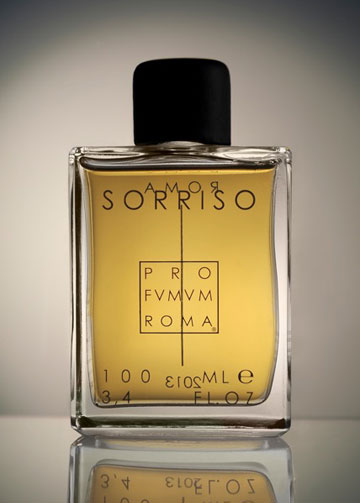
Source: Profumum website.

Source: Profumum website.

Everyone has a few perfume houses that they have a soft spot for, and generally like. Profumum (or Profumum Roma) is one of those for me, a brand whose focus on doing one thing in the richest way possible appeals to me very much. I like their aesthetic, even when some of their fragrances don’t suit my personal tastes or style. In fact, there has only been one Profumum scent that I found to be a massive disappointment. Well, now there are two.

Source: Profumum Roma website.

Source: Profumum Roma website.

Sorriso (the Italian word for “smile”) is the newest fragrance from the Italian niche perfume house, an eau de parfum that was released in late 2013. Profumum‘s website describes the perfume very simply:

The taste of life and the enthusiasm of
an embrace will donate her marvalous smile.

[Notes:] Bitter chocolate, bitter orange, vanilla, tropical woods

Sorriso opens on my skin with a concentrated, somewhat boozy, intensely sweetened vanilla note which is overtaken seconds later by dusty cocoa powder, a hint of musky oil, and a subtle woodiness. As the dry cocoa asserts its supremacy, the vanilla melts into it, losing its boozy undertone at the same time and turning slightly drier.

Source: Saveur.com

Source: Saveur.com

The bouquet in the first five minutes is nothing more than that of a swirled chocolate and vanilla milkshake. It’s deep, smooth, rich, and decadent. The chocolate is lovely, feeling simultaneously like the powdered, dusty, semi-sweet kind and a milk-based hot chocolate. There is absolutely no orange that appears on my skin, but there is a faint whisper of something a bit like dried roses wafting about for three or four minutes. The less pleasant aspect is the hint of a musky oiliness.It smells a lot like a sweetened, but very generic, inexpensive oil before eventually turning into the smell of a common, drugstore Shea butter.

Sorriso barely changes, except for the growing prominence of the sweetened, musky oil. Twenty minutes in, Sorriso is a simple chocolate milkshake scent whose every molecule is infused with vanilla, all enveloped in a musky, wholly artificial-smelling, common oiliness. Sorriso is sweet, yes, but it is also a relatively dry sweetness. This is not a syrupy or diabetically gooey gourmand on my skin. It is also a very soft scent that is surprisingly thin in feel for a Profumum. It lacks the heft, viscosity and potency of the other fragrances in the line, particularly Ambra AureaDulcis in Fundo, Patchouly, and Arso. It is also much thinner in feel than Fiore d’Ambre, though it is richer than the unpleasant, wholly synthetic Santalum. Sorriso’s projection is as soft as its weight, wafting out 2 inches at best from my skin with 3 massive smears. 

Source: Bath & Body Works.

Source: Bath & Body Works.

There is a woody note underlying Sorriso that is hard to place. It doesn’t smell like Australian Sandalwood or any of its generic, beige, synthetic substitutes. If I had to take a guess, I’d say it smells more like Cashmeran. I own a hand cream from Bath & Body Work‘s True Blue Spa Line called “Shea Cashmere,” and it smells a lot like Sorriso, minus the cocoa powder. None of these comparison to common products — whether drugstore Shea butter or a B&BW cream — is meant as a particular compliment, by the way. Not at Profumum’s prices.

Sorriso stays on its uninspired trajectory for eons, taking Profumum’s general singularity to a new level. I always say that there is nothing wrong with linearity if you like the notes, but the issue here is that they are so unimpressive and mediocre. The other problem is that, even by Profumum’s soliflore standards, its scents usually have more variegated layers or nuances than Sorriso. There are changes in such Profumum scents as Arso, Ambra Aurea, Acqua di Sale, Olibanum, or the like, even if they can occasionally be subtle or a question of degree. Sorriso makes Ambra Aurea look like one of Serge Lutens’ morphing, complex, twisting, bell jar masterpieces. Hell, it makes the entire rest of the Profumum line look like something out of an Amouage catalog, particularly in terms of quality.

Source: 123rf.com

Source: 123rf.com

Sorrio’s scent is a fatally boring flat-line, with the most noticeable changes being to the weight, body, and sillage. It takes a mere hour for Sorriso’s notes to fold onto themselves, and for the fragrance to turn into a relatively thin choco-musk bouquet with vanilla, a hint of woodiness, and musky, Shea-like butter. By the end of the second hour, it’s soft and not particularly deep, though it’s not exactly gauzy either. At the end of the 4th hour, Sorriso is a skin scent, though you can still easily detect the unchanging, mediocre bouquet if you sniff it up close.

The one, solitary change is the sudden appearance of the orange towards the middle of the 7th hour. Its unexpected arrival was almost shocking in the novelty of having something different finally happen! Unfortunately, the orange was both minor, hazy, and muted, doing nothing more than to underscore the continuing impression of Sorriso as a scent whose main characteristic from afar is dry-sweetness. Up close, if you sniff really hard with your nose on your skin, the perfume’s primary essence remains unchanged: a nebulous, sweetened, choco-musk bouquet, though even the cocoa is massively faded by now. In any event, the orange only lasted 20 minutes on my skin, so it doesn’t really matter anyway.

All too soon, Sorriso devolves into nothing more than an abstract, amorphous smear of musky, woody sweetness. There it remains until its very end, 9.75 hours from the start. I was thoroughly unimpressed with almost all of it, except for the opening two minutes which were relatively pleasant but still nothing to write home about. (Plus, the longevity was a big disappointment as compared to the rest of the Profumum line.)

1980s Bain de Soleil ad via Pinterest.

1980s Bain de Soleil ad via Pinterest.

I actually tested Sorriso twice, and my first experience was extremely different. These next words may not mean anything to anyone who didn’t live through the early 1980s, but I think it will definitely ring a bell for those who did: Bain de Soleil! At the time, my family and I were living in New York during the school year, and the big thing in America at the time were the commercials and print adverts for the suntan oil. The television commercials were especially catchy with their refrain, “Bain de Sole-ay/ For the St. Trop-ay/Tan.” It always amused me, because I never saw anyone IN St. Tropez or the South of France actually using the stuff. But I loved the commercials and how they mentally took me away from a place (and school) that I did not enjoy. So, I bought the damn thing, and rather liked the smell, primarily because it was nothing like the greasy, heavy, coconut aroma of the Hawaiian Tropic oils. Instead, the Bain de Soleil of my memory smelled of musky, sweetened Shea oil, with a touch of vanilla, some indistinct dryness, and a vague sense of a dried, abstract brown…. something. Dried fruits? Who knows? It was all so nebulous, except for the sweetened oil.

Bain de Soleil ad, 1983. Source: Pinterest.

Bain de Soleil ad, 1983. Source: Pinterest.

When I applied only a small quantity of Profumum’s Sorriso, the aroma on my skin smelled exactly like my memory of Bain de Soleil: sweetened, musky oil with a Shea oil-like aroma that was dry and infused with some intangible dried fruitiness. Bain de Soleil wasn’t at all tropical like usual suntan oils, and neither is Sorriso. But the similarities left me rather astounded for hours on end, transporting me back in time. With the small dosage, the cocoa was virtually nonexistent on my skin except as some sort of dusky, dusty…. something. The main aroma was… well, Bain de Soleil. There is no other way I can describe its nebulous, amorphous oddness. I couldn’t get over it. So, I was quite relieved when I tested Sorriso a second time around using the 3 massive smears, and detected chocolate from the start. Unfortunately, as I’ve already explained, it all went downhill from there.

My overall reaction to Sorriso isn’t boredom. It is more along the lines of, “Seriously??! This is it?!” My main problem is that Sorriso really lacked the luxuriousness that is Profumum’s signature, as well as the brand’s concentrated, hefty, rich elegance. Sorriso felt generic, cheap, and wholly pedestrian. I couldn’t help comparing it to Profumum’s gourmand take on vanilla, Dulcis in Fundo, which is one of the richest, most over-the-top vanillas that I’ve encountered, even if it is too much for my personal tastes. Sorriso does not do the same for chocolate.

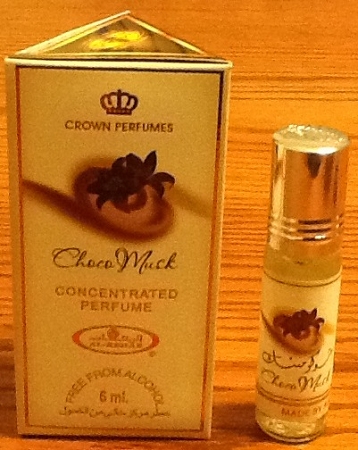
Choco Musk perfume oil. Source: Al-Rashad and Amazon.

Choco Musk perfume oil. Source: Al-Rashad and Amazon.

In fact, I consistently found myself pondering whether the massively inexpensive Choco Musk oil from Al Rehab would be deeper and heavier. I haven’t tried it, but I’ve heard talk of Choco Musk, and I bet it is the same as (if not better than) Sorriso, especially for the price. It only costs $3.75 for 6ml on Amazon. Sorriso, in contrast, costs $265 which is either a rare exception to the usual Profumum price, or part of the company’s new, anticipated price hike for the line which was supposed to occur either sometime this month or in March. I’m going to order the Choco Musk just to compare, because Sorriso? Bah.

The blog reviews for Sorriso thus far are either ambivalent or negative. For Jessica on Now Smell This, the main problem seemed to be the longevity, though it doesn’t scream enthusiasm to me as a whole. Her short review states:

Just as Vanitas feels like a smoother, better constructed version of Confetto (minus the almond), Sorriso is an improvement on Battito d’Ali’s theme. It doesn’t have Battito d’Ali’s strange sharp after-taste; the vanilla helps to encourage the chocolate’s sweetness, without turning it into cake frosting, and the “bitter orange” note is meshed with a subtle anise and some mysterious additional aromatic-herbal note. The main problem with this fragrance, for me, is its lack of longevity — if Sorriso is a smile, it’s a fleeting one. And, as for much of the line, the price seems high for compositions that aren’t particularly innovative or complex. I like a guilty-pleasure gourmand as much as anyone, but to me, it shouldn’t cost more than a perfume from Editions de Parfums or Serge Lutens.

The Non-Blonde couldn’t stand Sorriso, though she had no longevity problems at all. She wrote, in part:

I was very excited about Sorriso, the new fragrance from Profumum. […] It sounds like a gourmand heaven for my chocolate-loving heart. The problem started right away: Sorriso greeted me with a harsh and loud saccharine confection that reminded me of dairy-free whipped desserts. It’s frothy, sweet, vanillic, and utterly artificial. The worst part? On my skin this perfume smells cheap.

No matter how much I tried, the chocolate Profumum had promised never arrived for me (neither did the bitter orange). I tested Sorriso in the cold air and while working out. No chocolate, but … I kept getting this piercing not-really vanilla foam. I did not enjoy the process. The husband’s skin was not much help, either. Sorriso on him was a bit fatty with a hint of a coconut-like suntan lotion. Not real coconut, just that manufactured oiliness. No chocolate either.

As is often the case with overly sweet perfumes that trigger my Do.Not.Want reflex, Sorriso has the tenacity and  determination of Her Majesty The Queen. […] I enjoy several Profumum creations, mostly the masculine woody ones. I guess Sorriso will join Dulcis in Fundo and Acqua e Zucchero, two other hugely popular Profumum gourmands that I simply can’t stand.

I smirked when I read about her husband’s experience and the fatty suntain oil. (I wonder if he’s ever smelled Bain de Soleil?) It does seem as though the Non-Blonde herself doesn’t like serious, heavy gourmands, though her issue here was clearly more with the total domination of a synthetic-smelling vanilla than with anything else. I don’t like hardcore gourmands, either, but Sorriso wasn’t one on my skin. It wasn’t anything, frankly, except wishy-washy and utterly mediocre, at best. If it had at least tried to be like Dulcis in Fundo, I would respect it for meeting the Profumum standard, but it doesn’t. In fact, Sorriso falls far short of it, in my opinion. And we won’t even start on how over-priced it is for what you’re getting!

On Fragrantica, there are only two reviews for Sorriso thus far, and they are widely divergent. The first is positive:

If Dulcis in Fundo can be called a magnificent orange dreamsicle, then Sorriso can sit beside it in the freezer as a magnificent Fudgesicle. [¶] It’s a prominent, yet soft, cocoa on a creamy vanilla base, tempered by a touch of popsicle stick. I get no orange here (certainly nothing like Dulcis in Fundo).

I find it gentle and appealing, something I would be happy to wear. I would be tempted to go for a full bottle if I had not already invested in Gourmand Coquin. Gourmand Coquin is *in your face* divine, while Sorriso is more reserved. They don’t serve quite the same purpose, but it would take a budget bigger than mine to justify owning both.

The second review is from “Alfarom,” a poster with whom I often seem to share the same opinion of things. In fact, his second sentence is verbatim what I wrote in my notes a few times:

What? Are they serious? Considering the name of the fragrance, I don’t think so. Italian word *Sorriso* stands for english word *Smile* but I think at Profumum they understimated the hilarious power of this stuff. It would have probably better be labelled as *Laugh* or, considering how juvenile this stuff smells, even *LOL*.

A cheap and vile concoction of cacao and hyper-sweet vanilla with a tad of the sweetest sandalwood thrown in. It would suck even in the I Tesori d’Oriente’s range. Meh!…with a laugh.

Rating: 3/10.

I quite agree. “Are they serious?” sums it up perfectly. 

DETAILS:
Cost & Availability: Sorriso is an Eau de Parfum that only comes in a large 3.4 oz/100 ml bottle which costs $265 (or €190, I think). Profumum unfortunately doesn’t have an e-shop from which you can buy their fragrances directly. In the U.S.: Sorriso is available at Luckyscent. While most of the Profumum Roma line is carried by OsswaldNYC, Sorriso is not included for some odd reason. Outside the U.S.: In the UK, Profumum perfumes are sold at Roja Dove’s Haute Parfumerie in Harrods. My problem in trying to give you European retail links this time around is that I can’t find a single seller who carries Sorriso online! All the traditional Profumum vendors do not show Sorriso on their website, even though it was released several months ago. I have no explanation, but if you’re reading this post much later from its original date of publication, you can generally find Profumum sold at: Osswald in Zurich, Paris’ Printemps store, Premiere Avenue in France (which also ships worldwide, I believe), France’s Soleil d’Or, the Netherlands’ Celeste, Hungary’s Neroli, and Russia’s Lenoma boutiques. According to the Profumum website, their fragrances are carried in a large number of small stores from Copenhagen to the Netherlands, Poland, France, the rest of Europe, and, of course, Italy. You can use the Profumum Store Locator located on the left of the page linked to above. Samples: Surrender to Chance carries samples of Sorriso starting at $3.99 for a 1/2 ml vial. You can also order from Luckyscent.

Guerlain Cuir Beluga

Source: de.flash-screen.com

Source: de.flash-screen.com

A cashmere cloud of cream and pink, with the soothing comfort of Mary Poppins telling you take a spoonful of sugar at bedtime. There is no medicine to go with that sweetness in this case, only marzipan treats, powdered meringues, and vanilla milk. It’s an absolutely addictive spoonful of deliciousness that, alas, fades away to a lingering whisper all too quickly.

Source: pop.com.br

Source: pop.com.br

Cuir Beluga from Guerlain reminds me of Mary Poppins, the comfort of the nursery at bedtime with softened lights adding a warm glow, and endless plates of almondy confections with marzipan, all accompanied by vanilla cream. I have never been so enchanted by the opening of one of Guerlain’s modern, niche perfumes, or more crushed when it evaporated to a silken wisp less than 20 minutes in. It remained there for many more hours, but the true glory was gone astonishingly quickly, and that is a serious problem for me.

Source: forum.bodybuilding.com

Cuir Beluga is part of Guerlain’s exclusive L’Art et La Matière Collection which was launched in 2005. The name of the line means “Art and (raw) Materials,” and represents Guerlain’s goal of creating olfactory Art through the use of the finest raw materials in perfumery. As Fragrantica further explains, “L’Art et la Matière” is also “a pun after the French expression L’Art et la Manière – the art and manners.” As for the “Beluga” part of the perfume’s name, I’ve read that it refers to one of two things: either the word for “white” in Russian, or to the whiteness of a Beluga whale (which is also sometimes called a “white whale”). In either case, the point is whiteness, with a pun on the luxurious of caviar, but the scent has absolutely nothing to do with fishiness whatsoever.

Cuir Beluga is an eau de parfum that was released in 2005, and was created by Olivier Polge, the son of Chanel‘s famous in-house perfumer, Jacques Polge. On its website, Guerlain describes the scent as a “velvety oriental” and writes:

Light and shade meet on the skin.

With Cuir Beluga, the Guerlain perfumer chose to interpret the softness of white suede in an absolutely luxurious and addictive version. Like an intense, warm light on the skin, the fragrance opens with an aldehyde mandarin accord drawn out into an everlasting flower note and then wrapped in a voluptuous cloud of amber, heliotrope and vanilla. An intense and totally unexpected sensorial experience.

In a different part of the same Cuir Beluga entry, Guerlain adds that the leather is “a white suede for women and men, as enveloping as cashmere,” and also says the fragrance is:

Luminous, rare, enveloping.
Top notes: aldehydes, mandarin.
Heart notes: patchouli, everlasting flower [Immortelle].
Base notes: vanilla, amber, heliotrope, white suede note.

Photo: Crystal Venters via Dreamtime.com

Photo: Crystal Venters via Dreamtime.com

It is impossible to analyse Cuir Beluga without discussing heliotrope, so a brief description of the note may be useful for those unfamiliar with the name. Fragrantica has a great explanation of both its aroma, and how it appears in the other, well-known, heliotrope-centered fragrances:

The odour profile is powdery, like vanilla meringue with a helping of almond. The characteristic comforting scent of heliotrope has been proven to induce feelings of relaxation and comfort, a pampering atmosphere that finds itself very suited to languorous oriental fragrances and delicious “gourmands”.

In Kenzo Amour the heliotropin take is on the vanillic side, boosted by milky notes. In Love, Chloe we encounter the retro-smelling pairing of heliotropin and violet notes producing a powdery effect, reminiscent of makeup products. […] In Lolita Lempicka eau de parfum heliotropin takes a anisic mantle and becomes a full-blown gourmand, while in the older Cacharel Loulou it’s the comforting billowy background alongside tonka bean (with which it shares an almond and hay facet) and orris, producing a true floriental. In L’Eau d’Hiver (F.Malle) heliotropin is almost reduced to its pure state: fluffy, like a late afternoon cloud. [Emphasis to names added by me.]

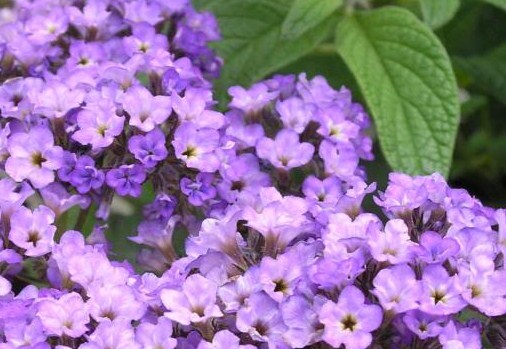
Heliotrope.

Heliotrope.

In the past, Guerlain has loved using heliotrope in conjunction with other elements, but one of the goals of the L’Art et La Matiere collection is to highlight a single raw material. Cuir Beluga may have leather in its name, but, in my opinion, the material being highlighted here is actually the Heliotropin of so many old Guerlain masterpieces. As that Fragrantica page explains:

classic scents have also greatly benefited from heliotropin, notably the nostalgic L’Heure Bleue by Guerlain which pairs the vanillic facet of heliotropin with anise on top, soft flowers in the heart (violet and carnation) and benzoin, iris and Tonka bean in the base to compliment the floral-oriental character of this iconic composition. Or the more ethereal Guerlain Apres L’Ondee which is mainly the pairing of warm heliotropin with cool and shy violets. [Emphasis to names added by me.]

Meringues via motherearthnews.com

Meringues via motherearthnews.com

Cuir Beluga opens on my skin with a brief touch of light boozy sweetness, followed by heliotrope and a hint of honeyed floral Immortelle, all wrapped in a soft, rich, deep, amber embrace. The heliotrope smells simultaneously like delicate flowers, almond paste, meringues, powder, and sweetened Play-Doh. It’s an incredibly soothing, comforting mix, and instantly made me think of Mary Poppins wrapping someone up in a warm, pink flannel, while telling them to have a spoonful of sugar. The boozy touch quickly vanishes, as does the immortelle. The latter never smells of any of its usual manifestations on my skin. It’s not dry, dusty, green, curry-like, or heavy maple syrup. Instead, it was merely a brief touch of warm flowers, that accentuated the delicate floralacy of the heliotrope.

Marzipan almond paste. Source: vancouversun.com

Marzipan almond paste. Source: vancouversun.com

Within minutes, Cuir Beluga turns into a deliciously pillowy, fluffy blend of Play-Doh (one of heliotrope’s main characteristics) with almond-y marzipan and a whiff of flowers in a vanilla cocoon that is just barely flecked with amber. I have a massive soft spot for heliotrope when it’s done well, and it most certainly is in this instance. Marzipan is also one of my favorite confectionary sweets, which pretty much makes me a goner for Cuir Beluga’s opening minutes. I’ve tried the perfume a few times over the last few months, and the beautifully balanced sweetness of the marzipan, almond vanilla grows more addictive with each wearing. It’s never cloying, heavily sugared, cheap, or artificial in nature.

Carnation condensced, sweetened milk. Sourc: coloribus.com

Carnation condensed, sweetened milk. Source: coloribus.com

Instead, the perfume takes a mere 15 minutes to turn into the epitome of creaminess. Every note in Cuir Beluga is streaked through with something that, alternatively, makes me think of Carnation condensed milk, sweetened milk, ice-cream, or pure cream infused with vanilla and almonds. It’s perfectly balanced, luxuriously rich, but incredibly airy all at once. As the almond meringue and Play-Doh aspects of the heliotrope grow stronger, along with the subtle whiff of sweetened powder, I think back to Fragrantica’s description of heliotrope as an aroma that induces relaxation. I would love to wear Cuir Beluga to sleep and sprayed on my sheets, because it’s so incredibly comforting.

If only that gloriousness lasted…. Cuir Beluga starts as a very soft scent that hovers 2 inches above the skin, at best, in its most concentrated, opening minutes. With the equivalent of 2 sprays, it takes a mere 30 minutes for the perfume to drop to something that lies right above the skin. It slowly begins to soften even more, losing minute by minute what ever richness and weight that it had. My skin has problems with longevity but almost never with sillage, so I was taken aback by the speed with which Cuir Beluga started to vanish from the aether.

A mere 75 minutes in, Cuir Beluga is a complete skin scent on me, and I’ve tested it a few times. I suppose you can push that time frame more if you apply a lot, but I doubt even a massive amount could give you more than 2.5 hours at most before the perfume slips away into a gauzy whisper. Plus, given the cost of the perfume, do you really want to be dousing yourself with 5 or 6 (or more) sprays each time? Of course, there is a chance that it might merely be my skin, but given other reports elsewhere (that we will discuss in a minute), I doubt the problem is unique to me.

Source: totallylayouts.com

Source: totallylayouts.com

Despite the unobtrusiveness of the scent, Cuir Beluga is still very pretty. At the end of the second hour, the notes all blur into each other, leaving a general impression of creamy Play-Doh, sweetened almonds, milk, and Tonka vanilla powder. You may notice that I have not mentioned the word “leather” even once in my descriptions thus far. Well, for me, and on my skin, Cuir Beluga is a “leather” scent the way Queen Latifah is the Queen of England. The mere use of a word has absolutely nothing to do with reality. Near the end of the second hour, for a fleeting moment, I had the impression of sweetened, white, leathered suede, but honestly, I’m pretty sure it was merely a figment of my imagination. In any event, that tiny whiff of “suede” vanished within minutes.

Source: popularscreensavers.com

Source: popularscreensavers.com

Cuir Beluga is a very simple, uncomplicated, linear scent on my skin. It never changes in any substantial way, except to become even more discreet and harder to detect. About 3.5 hours into its development, it is the merest gauziest trace of heliotrope Play-Doh and vanilla on my skin. It’s far too thin and translucent to be creamy in the same way that it once was. In the same way, it’s too sheer to even come across as heavily powdered in the usual Guerlain way. Both elements are there in the most muted, muffled way imaginable, but Cuir Beluga is largely a vanilla and heliotrope scent on my skin, then just vanilla with some powder. In its final moments, the perfume was merely a blur of sweetened powder. All in all, Cuir Beluga lasted just over 9.25 hours with two sprays, and just under 8 hours with one.

The most important of all perfume critics, Luca Turin, doesn’t seem to think much of Cuir Beluga. In Perfumes: The A-Z Guide, he categorizes Cuir Beluga as a “powdery amber,” and spends a good portion of his three-star review talking about how Guerlain used the L’Art et La Matiere collection to finally acknowledge the impact of niche perfumery — primarily and specifically of Serge Lutens. (He more or less implies that Guerlain flat-out copied Lutens “in the structure of the fragrances, their cod-poetic names, and the tall rectangular bottle.”) When he does talk about the actual fragrance, Luca Turin doesn’t seem very enthused, and he certainly didn’t consider Cuir Beluga to be a leather scent:

Cuir Beluga’s name, with its suggestion of large sofas and small portions of caviar, is no doubt intended to flatter a French fondness for naff luxury. The fragrance is basically a light, heliotropin vanillic amber with a touch of floral green notes in the heart and a smidgeon of suede. It has a pleasant color and texture, and no discernible shape at all.

Almond marzipan treats via parentedge.in

Almond marzipan treats via parentedge.in

I agree with him on almost all of it, but I like the scent significantly more than he does. At least, I do until I remember the price. $250 for an uncomplicated, linear, simplistic Play-Doh, vanilla scent that becomes incredibly hard to detect in a short amount of time seems a bit like Rolls Royce prices for the most souped-up, luxurious, opulent Honda around.

I’m not the only person who had some problems with Cuir Beluga’s sillage. On Fragrantica, one person writes:

I love this pretty scent, but it is the quietest of skin scents on me. I’d have to douse myself in it to be able to smell it, which is a disappointment.

Quite a few others talk about something similar. Of course, there are people who adore discreet, wholly unobtrusive fragrances, but I think the majority of them would like to be able to smell their perfume even moderately if they are paying as much as $250 for it.

Putting aside the wispiness of Cuir Beluga, it seems much beloved by those who have tried it, though the majority of its fans seem to be women. There are some critics, however, and a number of men seem to struggle with the fragrance’s sweetness, lack of leather, or its simplicity. Here are a range of opinions:

  • Cuir Beluga is not a leather perfume; nor is it particularly sexy or exciting. It smells to me of tapioca custard, i.e. a fairly simple, cozy scent. There are plenty of other, far less pricey, cozy fragrances out there.
  • Extremely sweet. A vanilla invasion for the nose. Powdery, and floral as well. Don’t see my self wearing this alone, maybe mixed. This to me will fit a woman better. Great quality.
  • I love leather perfumes, that slightly animal and sensual vibe a good leather perfume has, but this is much more soft and in the line of Daim Blond and Cuir de Lancome. Not leather but suede. It’s so elegant, and for a vanilla perfume not really gourmand or extremely sweet. Very wearable for many occasions. [¶] Sadly, sillage was very weak on me and therefor I’d think I’d prefer the more daring SDV or the powderpuffy Tonka Imperial over this. But she’s really interesting and really something to try if you like understated chique yet comforting scents.
  • I feel a velvety aurea, comfortable, looks leather with caramel, amber acts that way, blended with vanilla, I feel in a Rolls Royce in the streets of Monaco, eating a caramel trifle. [¶] Rich, important and compelling for all these aspects, Guerlain as always sensational.
  • This is my Shalimar! It is classic, refined and rich in every sense of the word. A decadent feast of powdery vanilla with the subtle essence of leather in the background. I find myself craving this scent. It is almost intimidating how elegant it is to begin with, but then it softens and becomes a beautiful comforting smell that I liken to someone of distinguished esteem. It smells wealthy without the pretentiousness.
  •  I agree that this has a wonderful vintage feel and where Shalimar for me is unwearable (Oh the horror!!!), this works. As soon as I sprayed it I immediately thought even if my bottle didn’t have a label this is so absolutely recognizable as Guerlain you would know what house created this scent. For me, as with some other Guerlain scents, this one needed 15 minutes to relax a bit. As is typical with Guerlain, this scent is all about powdery vanilla leather. If you love Guerlain and its beloved Shalimar this is sure to move you. I know I always rave about Guerlain (what can I say…I’m a fan) but this scent is blended so beautifully resulting in this rich powdery soft vanilla.

I found Cuir Beluga to be too gourmand, simplistic, and sweet to really be akin to Shalimar, at least vintage Shalimar with all its complexity and its strong backbone of leather and smoke. However, The Non-Blonde found a similarity in the classical feel or style of the two scents. In a 2010 review, she writes:

Guerlain and perfumer Olivier Polge didn’t take much of a risk in creating Cuir Beluga, but I’m not complaining. Compared to so many of the other Guerlain releases of the last five or ten years, Cuir Beluga is as close to the classics as one can get nowadays. More Shalimar than Mitsouko, this is not a difficult perfume in any way, and the large doses of very sweet vanilla make it go down easily for just about anyone (other than vanilla haters, but if you’re one, chances are that Guerlain is not really your thing to begin with).

What little drama we get in this perfume comes from the smooth leather. Some smell suede and compare Cuir Beluga to Daim Blond, but I don’t agree. To my nose it’s the finest most luxurious leather you can find. I have a pair of tall Jimmy Choo boots that feels this soft and timeless. It’s something that could have existed 50 years ago and has both an air of mystery and a determined backbone, despite the softness and the obvious sex appeal. I love touching and smelling my boots (us scentheads tend to shove our schnozes into the weirdest things and places) as it gives me a similar thrill to experiencing Cuir Beluga. I just wish the leather note in the perfume would have lasted longer before it becomes all vanilla, all the time.

Even if the leather note didn’t last long on her skin, she obviously experienced a lot more of it than I did. On me, the leather was nonexistent, and I suspect the suede was a figment of my imagination. I didn’t mind, though, because I loved my marzipan-almond meringue and vanilla cream, and found it delectable while it lasted. I would absolutely wear Cuir Beluga to bed, if I didn’t have to spend $250 for about 30 minutes of true, undiluted gloriousness.

Obviously, skin chemistry is going to make a difference in terms of how Cuir Beluga’s sillage, sweetness, “leather,” and powder manifest themselves on your skin. Given the perfume’s cost, I would recommend more than ever for you to test it first or order a sample. However, I must emphasize that, if you go into Cuir Beluga expecting a true leather scent, you will probably be disappointed. This is a primarily a gourmand fragrance with sweetness, powder, and vanilla. It also skews quite feminine in my opinion.

I think Cuir Beluga is very over-priced for what it is, but cost is a subjective determination and, in the case of this particular Guerlain at least, there is the quality and luxuriousness to back it up. In short, to paraphrase Mary Poppins, you may want to take a spoonful of sugar to make the price easier to swallow, as you wrap yourself in the pillowy, cashmere softness of Play-Doh, almond marzipan, and powdered vanilla.

DETAILS:
Cost & Availability: Cuir Beluga is an eau de parfum that costs $250 or €185 for 2.5 fl. oz/75 ml. It is available at Guerlain boutiques, and is listed on its U.S. and International website, but Guerlain doesn’t sell the fragrance online except on its French Guerlain website where it is priced at €185. I don’t know if they ship to the rest of Europe. In the U.S.: Cuir Beluga is available on the NordstromNeiman MarcusSaks Fifth Avenue, and Bergdorf Goodman websites. (With the exception of Bergdorf Goodman which definitely carries the more exclusive line of Guerlain fragrances in-store, I don’t know if it is actually available in the other shops themselves as a general rule.) Outside the U.S.: In the U.K, you can find Cuir Beluga at Harrods and, apparently, London’s Selfridges, but neither store offers the fragrance online. As for the U.K. price, I read that, back in 2011, this Guerlain collection retailed for £175. I don’t know how much it is now, but it must be much more. In France, Cuir Beluga is obviously available at Guerlain stores. For all other countries, you can use Guerlain’s Store Locator on its website. Samples: If you’d like to give Cuir Beluga a test sniff, you can get a sample from Surrender to Chance where prices start at $4.99 for half of a 1/2 ml vial.

Serge Lutens Bois et Fruits: Autumnal Sweetness

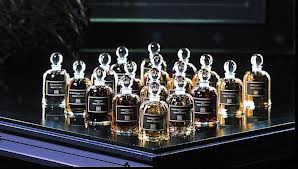
Some of the Lutens Bell Jars. Source: Barneys.

Some of the Lutens Bell Jars. Source: Barneys.

A funny thing happens when a Serge Lutens addict visits the mothership in Paris. A profusion of scents, sensations, sights, and lust floods over you, leaving you rather at a loss to make objective decisions on the spot. Or perhaps that was merely my experience in visiting Les Palais Royal. In any event, it took me two visits to make up my mind about what to buy, and one of the main bell jar candidates was Bois et Fruits.

The rare, 50 ml spray bottle of Bois et Fruits. Source: Luckyscent.

The rare, 50 ml spray bottle of Bois et Fruits. Source: Luckyscent.

In the end, I walked out with Fourreau Noir and De Profundis, but I kept thinking about Bois et Fruits. I know it is a favorite of Serge Lutens’ personal assistant, the Paris boutique manager, Suleiman, with its blend of wooded, spiced, and candied fruits. Upon my return, I took the wild chance of looking up the fragrance to see if this expensive $310 bell-jar might possibly have been released in another form at some point. After all, Rousse and some other Paris Bell Jar exclusives seemed to have come out in a cheaper, limited-edition 50 ml spray bottle from time to time, so perhaps Bois et Fruits as well? To my joy, it had. And not only that, but the $200 retail price in the U.S. was significant undercut by discount retailers who offered it for around $82. Score! I’ve never hit the “Buy” button quite so quickly. Bois et Fruits is not the perfect scent, and it has some flaws which make it hard for me to swallow at $310, but it’s certainly fantastic and perfect enough for $82.

The official bottle for the perfume, the Bell Jar version. Source: Serge Lutens Facebook page.

The official bottle for the perfume, the Bell Jar version. Source: Serge Lutens Facebook page.

Having started at the end of the tale, let’s go back to the beginning. Bois et Fruits is an eau de parfum that was created by Christopher Sheldrake, and released in 1992. It is one of a quartet of “Bois” (or wood) fragrances to follow from Lutens’ ground-breaking, debut perfume, Féminité du Bois for Shiseido. The latter is a highly admired, much-loved fragrance which essentially served as the mothership for all the Bois siblings which followed.

Luca Turin, the famous perfume critic, has a very useful explanation of the history of the Bois line, their perfume structure, and how Bois et Fruits differs from both its mother and its siblings. In Perfumes: The A-Z Guide, he talks of how the “woody-fruity structure of Féminité du Bois was first devised by the perfumer Pierre Bourdon, … and then passed on to perfumer Christopher Sheldrake, who developed it with Lutens… to keep it as dark and transparent as possible.” When Lutens decided to open his own perfume house, he needed more perfumes for his line, and decided to do variations on his uber-successful Féminité.

Enter the technique known as overdosage, widely propagated by Bourdon, in which a backstage component in one perfume is moved to the forefront in a new composition, a sort of rotation in perfume space. From Féminité du Bois came four variations, three of which create new effects by bold-typing one of the components of the original: musk (Bois et Musc), fruit (Bois et Fruits), amber (Bois Oriental).

Source: laundryetc.co.uk

Source: laundryetc.co.uk

Serge Lutens explicitly states that Bois et Fruits is the fruit-dominated child of Feminité du Bois:

Like candied fruit.

This is another descendant of Féminité du bois, whose base notes contained a complex blend of several types of plums. Here, unadulterated, it’s like candied fruit.

It’s an accurate assessment, but it is only part of the story. It leaves out the important counter-balance to those sweetened fruits: the spices and wood. Luckyscent puts the woods front and center at the start of its description of Bois et Fruits:

A cornucopia of luscious woods and succulent fruits, Bois et Fruits is what we think Paradise would smell like…We are addicted to the candied cedar note in the heart of the fragrance. Surrounded by ripe, honeyed plums, figs, apricots and peaches, the woody note of Bois et Fruits is absolutely delectable. We would not call this darkly-sensual concoction gourmand in an obvious manner, but there is a sweet, lush quality in Bois et Fruits that is nothing short of mouthwatering. A blissful, endlessly enjoyable bled that is as sensuous as it is comforting, Bois et fruits is divine!

As always, Serge Lutens keeps the notes in his fragrance secret, so it’s a guessing game to know what is involved. Fragrantica, Luckyscent, and Surrender to Chance estimate that Bois et Fruits contains:

cedar, plum, fig, peach and apricot.

Barney’s tosses in cinnamon and Turkish rose, but doesn’t think there is apricot. I would include a lot more than that. To my nose, the notes in Bois et Fruits would be, in order of importance:

Plum, Peach, Cedar, Cumin, Apricot, Cloves, and Figs. Possibly, vanilla, almonds, and either licorice or anise.

Source: RebootwithJoe.com

Source: RebootwithJoe.com

Bois et Fruits opens on my skin with the dripping juices of sun-sweetened peaches, followed by plums and the tiniest hint of apricots. The fruits are infused with a distinct, definite note of cumin, and something strongly resembling chewy, black licorice. The entire bouquet is cocooned by dry, dusty cedar, then softened with what I’d swear is a touch of almond-y vanilla. In the distance, the fig flits about, simultaneously a bit leathered and quite milky. The whole thing is a very soft, airy cloud that radiates out by a foot in the opening minutes, but soon softens to something tamer.

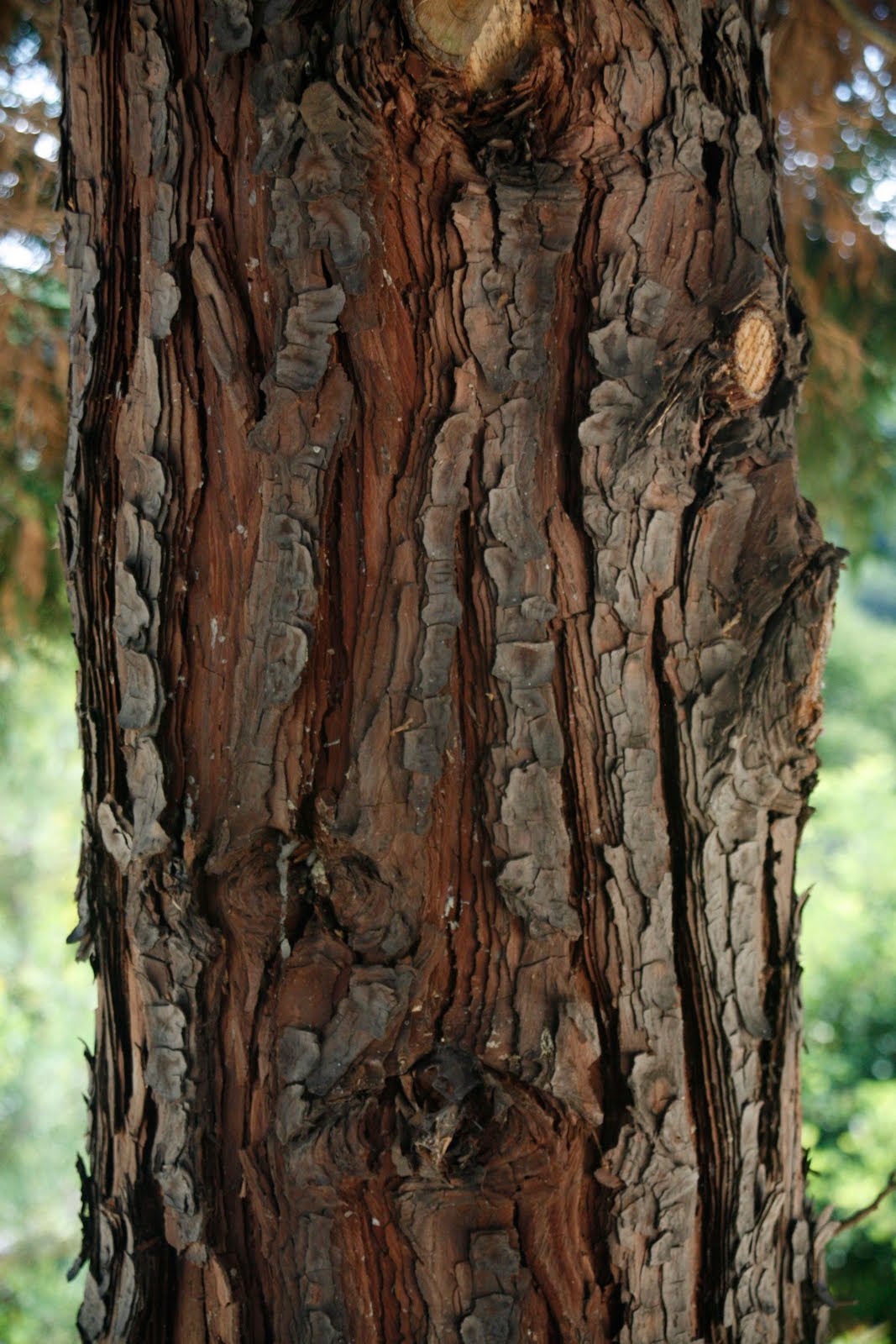
A young cedar tree trunk.

A young cedar tree trunk.

I enjoy the sweetness of the fruits so much that I sprayed Bois et Fruits onto my other arm during my test for this review, and I was completely taken aback to see that the fragrance had quite a different opening. I generally stick to one arm for all my tests, out of some odd thought about scientific conformity, but maybe that idea isn’t so weird after all, as the notes in Bois et Fruits were all jumbled up in a different order and with different strengths.

While the two scents soon ended up in the same place, on my other arm, Bois et Fruits opened with a very cognac-y, boozy note, followed by peaches, dusty cedary, and sweet, light, almost osmanthus-like apricots. The cedar was strong and pronounced, but there wasn’t a lot of plum at first. And there was absolutely no cumin at all — to the point that I thought I’d gotten it all wrong, until it suddenly popped up after about eight minutes. There was also no any licorice, almond, or fig tonalities, and very little vanilla. On the other hand, there was a milky anise element that flitted in and out, and anise is related to licorice. In any event, the two versions end up in the same place after about 20 minutes, so the minor differences aren’t significant in the long run, and I’ll just stick to writing about the version on the arm that I usually use for testing.

Photo: David Hare. Source: open.az

Photo: David Hare. Source: open.az

After 10 minutes, the notes seamless blend into each other. The fruits are on top, and the woods are diffused throughout, but in the base, the cumin adds a soft, muffled growl. It’s not a sweaty note like body odor, the way cumin can sometimes be, but it’s definitely a subtle touch of animalism and light “skank.” It works subtly from afar to add complexity to what would otherwise be primarily a two-pronged scent. I’ve seen one person describe the cedar as a “sweaty” note, but I would bet my bottle of Bois et Fruits that there is the cumin in the fragrance. For the most part, it’s a dusty note, like the powdered kind you’d find in a spice market, but with a distinct earthiness underneath. I have to admit, it’s my favorite part of the fragrance, even though I’m not usually enamoured by cumin. Something about the spicy dryness and earthy muskiness adds a brilliant counter-balance to the sweetened juices of the fruits, while simultaneously accentuating the dryness of the cedar.,

Soon, a subtle creaminess starts to stir and rises to join the top notes. It’s not vanilla or almonds, but neither is it purely milky fig, either. It’s like a teaspoon of ice-cream flecked with sweetness, as if the lactonic qualities of the fig had melded with the dryish vanilla to create the impression of textural creaminess. I still wonder about the black licorice note that I initially detected because, at the same time as the creaminess, there seems to be some sort of milky white anise lurking about.

Cloves, close up. Source: www.toothachesremedies.net

Cloves, close up. Source: www.toothachesremedies.net

About 30 minutes in, there is an accord which strongly resembles parts of Serge LutensSerge Noir, a fragrance dominated, in part, by cloves and cumin. Christopher Sheldrake and Serge Lutens reportedly worked on Serge Noire for more than 10 years, and it was released in 2008. It wouldn’t surprise me one bit if the cumin-clove-cedar trio in the 1992 Bois et Fruits was later “overdosed” in the way that Luca Turin describes above to become the foundation for Serge Noire. The difference is that the trio are much more subtle and balanced in Bois et Fruits, while they’re tripled in strength in Serge Noire. In any event, both my arms are most definitely radiating cloves, but it’s so well-blended that, from afar, the whole thing merely translates to dry, brown spices.

The unusual thing about Bois et Fruits’ overall development is how the notes never seem to stay in the same place from one minute to the next. It’s like a horse race where several contenders are all racing neck-and-neck near the finish line. Sometimes the Peach-Plum horse takes the lead and dominates, but the next minute, it’s the Clove-Cumin chestnut horse, and three minutes after that, it’s the Cedar stallion. Trailing far, far behind is the vanilla, looking like just a speck in the distance.

Source: narutoforums.com

Source: narutoforums.com

About 2.5 hours in, the horse race looks a little different. The clove has faded away, and the cumin softens to a dryly spiced woodiness with a very earthy feel. The cedar adds a similarly dry touch to counter the fruits which are primarily just plum now, with much weaker amounts of peach. The apricot never really showed up on my skin, beyond the opening minutes, and the almond note didn’t last much longer. What is more noticeable throughout is the muskiness lingering at the edges. It melts into the cumin’s earthiness, evoking the image of heated skin. To be precise, a guy’s skin under layers of thick, winter clothing after he’s exerted himself. Let me be clear: it does not smell fetid, and there is absolutely no impression of ripe body odor or smelly armpits, but there is a subtle sweatiness that evokes warmed, musky skin.

An hour later, around the 3.5 hour mark, Bois et Fruits is a discrete, very soft sheath of dark brown silk. Yet, the scent is still strong up close, and tendrils of spiced plum occasionally float in the air around you. It’s an airy, gauzy, balanced blend of plum, cedar, cumin, with just a touch of peach. Slowly, Bois et Fruits grows more abstract, the cumin and peach fade away, and the remaining notes lose their shape or distinctness. In its final moments, Bois et Fruits is merely plummy sweetness with a hint of dry woodiness. All in all, it lasted just a hair above 8.75 hours on my skin with 3 sprays from an actual bottle (as opposed to an atomizer). Through out it all, Bois et Fruit evoked images of an autumnal forest filled with trees bearing heavy, ripe fruits in a colour palette of red, orange, and dark brown softness.

Source: wallpapervortex.com

Source: wallpapervortex.com

On Fragrantica, the perfume has received mixed reviews. Judging by the longevity votes, a number of people think Bois et Fruits doesn’t last long, and it also has moderate to weak sillage. Quite a few posters talk about Feminité du Bois, the mother perfume, with most commentators agreeing that Bois et Fruits is much more fruited in nature. One woman, “woodlandwalk,” had an interesting comparison of the two fragrances, and her experience with Bois et Fruits mirrors my own to some extent:

Very Autumnal! I find Bois et Fruits easier to wear than Feminite du Bois. I love Feminite du Bois because I love the smell of cedar wood, but often FdB can feel a bit one dimensional – so if you find FdB a little too ‘wood workshop’, Bois et Fruits might suit you.

The sweaty cedar and boozy plum of FdB are softened considerably here with fig and apricot, so Bois et Fruits is a little more pillow-like – you can relax into it. The fig adds a lactonic (milky) note so it just feels more smooth. There’s a ‘nutty’ quality to it – a sort of bitter-sweet almond that again gives a softer edge

The apricot is slightly syrupy in feel, so this with the fig and less spicy notes makes for a sweeter, cosier, easier to wear perfume, still boozy though, and very warm. Friendly.

On me the silage is fairly close to skin, longevity soft to moderate. This perfume is growing on me and I might upgrade from decant to full bottle.

I obviously detected a lot more spices than she did, but little apricot. On the other hand, I’m glad I’m not crazy, and that she noted the almonds too! I also agree that Bois et Fruits feels quite pillowy soft.

Others describe the scent in the same vein, talking about autumn and sweetness:

  • Bois et Fruits is a fragrance that would be perfect for fall and winter- and in a way makes me think of Christmas and those very rich cakes with dried fruit and spices. The fragrance is heavy, oozing with sweet, juicy and smoky plum and apricot. If I could give it a texture, it would be that of a liquid honey that has been warmed up. I would classify it as oriental-gourmand, although it does not feature vanilla nor honey, it is very sweet, almost edible. The scent is so intense and long lasting, 5 hours later smells as if it was just sprayed.
  • I love the dried,succulent fruits(mainly apricot on my skin), against the warm, spicy cedar. It`s like an imagenary tree covered in red,brown and yellow leaves with peaches, plums and apricots(.All growing at the same tree.) Under the heavy loaded branches, a dragon is sleeping peacefully, only opening one eye now and then just in case.. Perfect for autumn!

Some people were not as enthused. Some prefer Feminité du Bois, while a few thought Bois et Fruits smelled “pungent,” no doubt due to the cedar. One thought the fragrance was too cedary, while another thought it was too fruity instead. There is also the same sort of split amongst the Fragrantica critics about whether the fragrance is too dry or too sweet.

In short, for Bois et Fruits more than for most scents, it’s really going to come down to your skin chemistry. Mine happens to amplify base notes and sweetness, and, yes, I happen to find the fragrance very sweet. It would be too much so for me normally, but it works in this rare instance because of the dryness and spices that lurk underneath. Plus, I find the cumin to make all the difference. It is the perfect, well-calibrated amount to add character, while simultaneously helping to cut through the fruits. Still, if your skin chemistry is like mine, then you should try Bois et Fruits only if you enjoy the possibility of a very sweetened, fruity fragrance with a lesser dose of dry woodiness.

All the blog reviews that I’ve found for Bois et Fruits are positive, though none of them rave about the scent as a complex masterpiece. It’s not, as it is too simple for that. But it is still very appealing, as Perfume-Smellin’ Things reports. In fact, it is seems to be her favorite Lutens out of them all, and she imagines it to be “the scent of Paradise”:

Les Eaux Boisées are my favorite part of Les Salons du Palais Royal collection, and of them, Bois et Fruits is the most beloved.

Bois et Fruits combines cedar with notes of peach, apricot, figs, and plums, and thus emphasizes the fruity side of its “Great Mother”, Féminité du Bois. Having said that, Bois et Fruits is actually much drier and less sweet than Féminité. It starts with a dry cedar note, within seconds the ripe fruitiness of figs and plums becomes apparent, the fruits balance the dryness of the woods and cedar keeps the potentially excessive sweetness of fruits in check. The overall effect to my nose is that of dried fruits mixed with a slightly incensy, sometimes even almost leathery accord. Bois et Fruits is a subtler scent, it is much less forceful than Féminité du Bois, and even though it has fruits in its title, it actually translates much less fruity on my skin that its predecessor. I always imagine that Bois et Fruits is the scent of Paradise, or at least of the woodier, wilder part of the Garden of Eden.

Victoria of Bois de Jasmin also didn’t think Bois et Fruits was all that sweet, and she liked it. In her four-star review, she wrote:

Chris Sheldrake and Serge Lutens’s Bois et Fruits (1992) captures a moment of autumn before one becomes aware of its farewell connotations. Warm cedarwood is folded over lusciously ripe fall fruits—figs, peaches, and plums, which speak more of a voluptuous aspect of autumn than of its nostalgic side. This fragrance is one of few instances when fruit is not rendered as treacly and artificial. Instead, sweet resinous cedar married to fruit results in a very elegant scent with the brightness of sweet-sour plum courting the soft powderiness of fig.

I think her four-star rating (which is what Luca Turin also gives it in his Perfumes Guide) is perfect, because the fragrance does have some flaws. I agree with those on Fragrantica that its sillage and longevity tend to be on the lighter side of things, but there is also something else. For me, Bois et Fruits doesn’t stand out enough to warrant inclusion in the Bell Jar line. Those are the most complex, nuanced, morphing, and twisting Lutens scents, so their high price is understandable and usually worth it. They are the masterpieces that, whether or not you can wear them, are brilliant works of olfactory art for the most part.

Bois et Fruits doesn’t measure up to that standard. For me, it would be a perfect addition to the regular export line, and it’s well-worth it at $82. It’s great for autumn, and it also works wonderfully as a layering scent to go with much drier or smokier fragrances. But I’m very dubious about the U.S. retail cost of $200, and I honestly could not imagine spending the much-inflated U.S. Bell Jar price of $310 on Bois et Fruits. Not in a million years.

The bell jar is cheaper in Euros at €145, without the annoying, extra-high U.S. mark-up, and I think it may have been €135 back when I was in Paris. Yet, if you notice, I didn’t buy it even at that price, and the main reason is that it didn’t stand out as much as its siblings in the bell jar line. It simply didn’t feel special, complex, or strong enough — lovely and succulent as it may be. Fourreau Noir, De Profundis, Boxeuses, Un Voix Noire, and some of the other Bell Jar fragrances are in a different class, in my opinion. However, I found one European online retailer to carry the rare, discounted 50 ml spray bottle of Bois et Fruits, which is priced €105, and that may be much more reasonable for what it is.

I wouldn’t recommend Bois et Fruits for everyone. You must like sweet perfumes, and a lot of fruit. You also have to appreciate cedar, and a touch of cumin. If you do, and if you can buy Bois et Fruits at a discount, I think you’ll enjoy it very much. It’s not very intense or edgy, it’s definitely not very complicated, but it is quite an Autumnal treat.

DETAILS:
General Cost & Discounted Sales Prices: Bois et Fruits is an eau de parfum that comes in a 2.5 oz/75 ml bell jar that costs $310 or €145. However, you also can find it in a 1.7 oz/50 ml spray bottle which retails for $200, but which is massively discounted on some sites for much less. Bois et Fruits is currently on sale at FragranceNet where the 1.7 oz/50 ml bottle is priced at $84.31, when you include their an additional 15% OFF with the coupon code RESFT5. (I think I bought mine for $82, so it may have gone up a wee bit since then.) The site offers free domestic shipping, but they also ship world-wide. Bois et Fruits is also discounted on Amazon, where the seller is listed as Serge Lutens, and the perfume is priced at $96.87. Beauty Encounter sells the perfume for $99 if you use their 20% off code.
You should also check eBay as the fragrance is sometimes deeply discounted there. At the very least, it is commonly in the $95-range. 
Serge Lutens: you can find Bois et Fruit in the expensive bell jars on the U.S. and International Lutens website, with non-English language options also available for the latter.
U.S. sellers: Bois et Fruits in the 50 ml atomizer bottle is available for $200 at Luckyscent, Barney’s, and AedesBarney’s also sells the very expensive bell jar form.
Outside the U.S.: In Canada, you can find Bois et Fruits at The Perfume Shoppe for what may be CAD$200 or US$200. I’m never sure about their currency choice, since it is primarily an American business. They also offer some interesting sample or travel options for Lutens perfumes. In the UK, I couldn’t find any vendors as this is primarily a Paris exclusive bell jar. However, in France, I found it sold at Laurent Mazzone’s Premiere Avenue in the 50 ml atomizer bottle for €106, and the site ships worldwide. French Sephora carries a lot of the Lutens perfumes, but again, Bois et Fruits is a Palais Royal Paris exclusive. In Australia, the perfume is on sale at the FragranceNet site for AUD $94.41, with the discount code, instead of what it says is the Australian retail price of AUD $223.96. 
Samples: You can test out Bois et Fruits by ordering a sample from Surrender to Chance where prices start at $6.99 for a 1 ml vial. There is also a Five Lutens Sample Set for $18.99 where you get your choice of five non-export, Paris exclusives, each of which comes in a 1/2 ml vial.