Perfume Review – Bombay Bling by Neela Vermeire Créations: Dance, Dance, Dance!

Source: National Geographic

Source: National Geographic

India stole my heart. I’ve said it before, and I will no doubt say it again, but it really did. While the ancient temples and palaces left me in awe, while the stunning beauty of Matheran left me speechless, it was really Bombay (as it was known then) which did it. For someone like myself with a nomadic upbringing and who stopped counting all the places she lived in before she was even twenty-one, Bombay somehow felt like home. It was the perfect mix of East and West, a city of contrasts with such incredibly high energy and with such a gusto for life that it left one feeling just a little more alive.

Marine Drive, aka The Queen's Necklace. Source: Floyd-n-Milan Deviant Art

Marine Drive, aka The Queen’s Necklace. Source: Floyd-n-Milan Deviant Art

Source: UncorneredMarket.com

Source: UncorneredMarket.com

Among my many memories of Bombay was one day which began with lunch at the Queen’s Necklace, a sweeping, gleaming curve of beautiful white buildings by the sparkling, electric-blue sea, and which ended at the wee hours of the morning the next day, staggering out from an exclusive nightclub to see lines of mango sellers with their stalls before us. There were cars and people everywhere, the street lights glittered, and the sheer volume of noise outside quite rivaled anything inside. Mumbai at night is as much an electric jolt of energy as Mumbai by day — perhaps more so.

Dadar Flower Market, Mumbai. Photo: Ravindra Zende. Source: Kemmanu.com

Dadar Flower Market, Mumbai. Photo: Ravindra Zende. Source: Kemmanu.com

From Moscow and Shanghai to New York or Paris, I’ve never quite seen or felt anything to rival the brightness, bustle and expresso-in-the-arm energy of Mumbai. Nor have I ever encountered a perfume that encapsulates the sights, the sounds, the colours, and the very feel of a city. Not until Bombay Bling, a ravishing, euphoric explosion that really has to be tried to be believed. I fear that I simply won’t be able to do it justice, this wildly energetic creation that — unbelievably — has managed to bottle a whole city’s bursting zest for life.

Bombay Bling is one of a trio of Indian-inspired scents from the Indie perfume house, Neela Vermeire Créations, Parfums Paris (“NVC”), and it was justifiably chosen by the prestigious perfume website, CaFleureBon, as one of their top 25 fragrances for 2011. Launched in late 2011, it is the result of collaboration between Ms. Vermeire and the famous perfumer, Bertrand Duchaufour. Each of the three fragrances that they created is meant to pay homage to a different part of India’s history, with Bombay Bling (the third and last in the line) representing modern India and, in specific, the glorious vitality of Mumbai.

As the company’s website explains:

This joyful creation embodies every aspect of the very modern, colourful, eclectic, esoteric, ecstatic, liberal, happy side of buzzing India, a world economic power, where nothing is to be taken for granted, where the underbelly of the big city combines with the glitter of Bollywood on the vast sandy stretches of Juhu Beach and the Queen’s Necklace. Fortunes are made and lost on the Bombay stock exchange and gambling dens of Mumbai. Abandon yourself to the nightlife as dawn breaks over the city. There is nothing like it and there will be nothing like it. Welcome to a vibrant new India!

I can’t recall the last time I read a press release or perfume backstory and thought to myself, “I’ve actually experienced part of that tale!” And I have with Bombay Bling. (Well, minus “the fortunes made and lost” bit, unless you count the small fortune I lost shopping and at the races.) But I can tell you that Bombay Bling delivers on its promise because it truly took me back to the city, collapsing space, time and geography in a remarkable way.

The perfume manages this feat, in part, due to its long list of notes. Unlike many perfumes nowadays with their six or, maybe, eight ingredients, Bombay Bling has seventeen! The fruity-floral oriental has:

Mango, lychee, blackcurrant, cardamom, cumin, cistus, Turkish rose, jasmine sambac, Madagascar ylang-ylang, tuberose, plumeria [frangipani], gardenia, patchouli, tobacco, sandalwood, cedar, vanilla.

Bombay Bling opens with a veritable BOOM of mango! It’s an explosion of the mumbai-mango fiascogelato dot cazestiest, sweetest, juiciest mango you’ve ever tried — short of cutting in twenty fresh ones and reducing them down to their most concentrated levels. It’s unbelievably fresh and bright. Even though Ms. Vermeire has used green mangoes — not yellow ones — yellow, red and orange are the colours that practically shine before your eyes. 
Black currants or cassis. Source: NWWildfoods.com

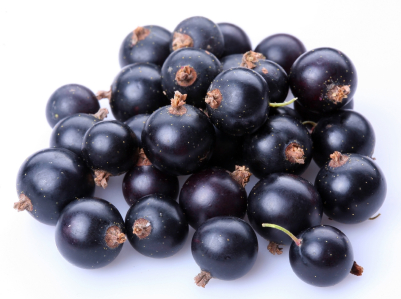
Black currants or cassis. Source: NWWildfoods.com

Seconds later, other notes follow. There is tart black currant (or, as I call it, “cassis”), carrying a hefty punch of zesty tanginess, and sweet, light lychee. There are also light hints of jasmine and rose, too, but the accompanying floral notes are primarily dominated by sweet plumeria. It’s soft, fruity, almost peachy, and has a subtle creaminess.

Thirty minutes in, the fruity-floral notes take on another hue with the arrival of sandalwood. It adds a slighty smoky creaminess and an element of woodiness to the mix. There is also a growing whisper of tobacco. It’s not sweet or fruited like pipe tobacco, nor is it anything close to cigars, but rather, like tobacco leaves being cured in the sun: honeyed, dry, and a little woody, as well as a little nutty. Or perhaps that last note comes from the cardamom — it’s sometimes hard to tell with a perfume that’s as superbly well-blended as this. Either way, the tobacco note adds a lovely depth and contrast to the perfume’s sweetness. It’s never masculine, heavy, or coarse but then, nothing in this lovely perfume is.

Source: Riflebirds.com

Source: Riflebirds.com

For some reason, my nose also detects something that really smells like bright, zesty lemon, along with a hefty dose of fresh ginger. To my surprise, there is also something that smells distinctly like anise or black licorice. None of these ingredient are in the perfume, but that’s what it smells like.

Plumeria or frangipani.

Plumeria or frangipani.

What I don’t really smell in the perfume is any one particular flower. Though there tuberose, rose, gardenia and ylang-ylang, they’ve all been blended into a single, very feminine, sweet floral accord. This isn’t a perfume where you can smell, for example, tuberose in any dominant way; by the same token, neither the ylang-ylang nor the rose trump all the others. Perhaps the plumeria does most of all but, as a whole, no single flower really stands out — and that’s a very good thing. Tuberose, gardenia and ylang-ylang can be very indolic, heavy, even bullying notes. In less capable hands, they can lead to headaches and a sense of over-ripeness that verges on rotting fruit, sourness or plasticity. None of that ever happens here.

All these new additions add further complexity to the perfume and take it far beyond the confines of a mere “fruity” scent. The sudden spiciness, subtle dryness, and smokiness are a noted contrast to zesty mango and the tart cassis fruits, as well as to the sweetness of the slightly tropical florals. Each note adds up to much more than individual parts, creating a balanced, harmonious whole that is never boring, singular, or generic.

The combination of these contrasting elements means one thing: Bombay Bling simply doesn’t smell like any fruity-florals I’ve encountered. And it is a testament to the very sure, very expert hand of the legendary Bertrand Duchaufour that all these eclectic, rich notes melt so perfectly together without any discord or abruptness.

Shopping at Colaba Causeway, Mumbai. Source: MyGola.com

Shopping at Colaba Causeway, Mumbai. Source: MyGola.com

By the second hour, there are still further newcomers on the scene. This time, it’s pine needles! The cedar tree has a distinct role here, adding some chilled freshness and coolness to the mix. It brings to mind a pine forest where the floor is covered with sweet florals but there are tangy black currant berries in bushes nestled near the giant roots of the tree. It’s unexpected — like much of this perfume — and it’s the one time that Bombay Bling didn’t truly evoke Mumbai for me. Then again, eclecticism and sharp contrasts is perhaps the ultimate embodiment of that city of paradoxes.

Four hours in, Bombay Bling is a fascinating mix of tart cassis, cool cedar pines, creamy sandalwood, and some slightly musky jasmine, with just a faint dash of earthy, dry cumin. The earthiness and spiced dustiness underlying the sweetness really brought me back to the dusty, spicy, sweet aromas of Bombay’s bustling street bazaars. But the really entrancing part is the sandalwood. It’s copious and positively swoon-worthy.

As Ms. Vermeire showed in the astoundingly beautiful Trayee, she prefers to use real Mysore sandalwood. That is a very rare thing in perfumery today given its prohibitive cost and the Indian government’s protection of this over-sourced prized wood. The expert perfume critic, Luca Turin, has often bemoaned the use of a synthetic replacement in “sandalwood” perfumes or the reliance on the very different Australian sandalwood, and he’s right. Real sandalwood is usually too expensive for most perfumers, especially if used in any significant quantity.

Here, as in Trayee, there is a significant amount of absolutely genuine, lovely sandalwood. And it dominates the final hours of Bombay Bling’s development. At the ninth hour, the perfume is sandalwood and cedar with tart black currant and hints of some musky jasmine. By the thirteenth hour, it’s just sweet, soft vanilla and creamy sandalwood. Yes, I said the thirteenth hour. Bombay Bling’s pure essences and rich ingredients makes this one very long-lasting perfume! Even on my voracious skin where very little lasts for a significant amount of time, Bombay Bling had incredible longevity. I smelled faint traces of it here or there well past thirteen hours, truth be told.

It is remarkable and supports everything Ms. Vermeire has said regarding her goal of using only the finest raw materials and expensive essences in her perfume. For example, her amazing Trayee was made without regard to cost:

I did not give a budget cap so Bertrand Duchoufour never had a budget – Trayee is one of the most expensive perfumes he has created. We made sure there are lots of high quality natural ingredients…. Most niche companies want to spend 150 euros or so max per kg of essence. We went more than 7 times that so the essences are expensive (and hopefully exceptional).

The same “to hell with the cost, we’ll only use the very best” approach shows with Bombay Bling, too. Neela Vermeire Creations is a tiny company that clearly has put the bulk of their resources in their production costs. The perfumes are not cheap, but they don’t work with giant distributors to add further mark-ups to their expenses. There is no corporate slickness behind any of this. When you order from the company, you will receive a handwritten note from Ms. Vermeire herself.

The goal is one thing and one thing only: to make truly rich, luxurious-smelling perfumes that are the very best they can possibly be. And Neela Vermeire Creations has succeeded in that goal with one perfume, Trayee, receiving a Fifi award nomination (the perfume world’s equivalent of an Oscar nomination) and the other, Bombay Bling, being critically-acclaimed as one of the best perfumes of its year.

Bombay Bling deserves that accolade without question. What you have is an unbelievably vibrant, bouncy, joyous scent. Like the Bollywood movies that it is a partial nod to, Bombay Bling screams out high-octane energy and begs you to “be happy!” and “go dance!”

It’s hardly surprising, therefore, that when the perfume blog, Olfactoria’s Travels, recently asked “What is the most uplifting perfume you know?,” the repeated answer was “Bombay Bling!”  Read the answers; the references to Bombay Bling are so numerous, that Birgit at one point said it should be considered as “prescription medicine.” It’s not just the readers of Olfactoria’s Travels, either. On numerous different sites or perfume groups, people repeatedly turn to Bombay Bling when they’re blue, when the weather is grey and chilly, or when they’re in need of an energetic pick-me-up.

On Fragrantica, there is almost a uniformly gushing assessment of the perfume. One commentator raves that it is like ” like the spirit of Mardi Gras or Carnival captured in a bottle,” while another writes “[h]appiness and sunshine in a bottle, this makes me see the perfume in rainbow of colours. Full bottle worthy???? Every last penny of it to me.” Clearly, Bombay Bling’s happy, incredibly exuberant heart seems to make it people’s “secret happiness weapon.”

Bombay Bling is not cheap. It costs $260 for a 1.8 oz/55 ml bottle. In perfumery, as in many other things in life, cost is no guarantee of either quality or a positive experience. But, in this case, I think you are actually getting what you pay for. There are many similarly priced perfumes out in the luxury market (albeit, usually for a slightly larger sized bottle) but the luxuriousness of Bombay Bling’s ingredients make it truly stand out. To me, it is the equal of perfumes from Ormonde Jayne and the uber-luxury perfume house, Amouage, and far surpasses many fragrances from better-known, luxury perfume houses. Thankfully, however, Ms. Vermeire offers a Discovery Set (see below, in the Details section) which lets you try 10 mls of all three of her perfumes for a very reasonable price. 

I highly recommend Bombay Bling. The complex notes mean that you don’t have to be just a fan of fruity-florals to like this scent. Nor do you have to be a woman. There are a number of men who adore and wear Bombay Bling. On Luckyscent, the perfume is categorized as “unisex,” and I think it is.

The sillage is not overwhelming, either, so it is definitely something that can be worn to the office. In fact, I was surprised by how moderate the projection was for a perfume with notes as rich and as heady as these. After the first thirty minutes, I’d say the perfume could be detected only from a distance of about two feet away. It’s a strong perfume, and you can smell it on yourself, but it’s softer than Trayee. And it’s definitely no Fracas that’s going to immediately overwhelm someone across the room. Thereafter, the projection became much less and you’d have to be close to someone to detect it. I also noted that Bombay Bling is even more moderate when you only dab on a little, as opposed to applying a few sprays. It’s office-friendly, but it’s also something that is extremely versatile. I could see this being used as an antidepressant in a bottle, to go on a date, or just to have dinner with friends.

In short, it’s sexy, it’s happy, and it wants you to dance, dance, dance! I suggest you take it up on its offer.

Disclosure: My sample was courtesy of Neela Vermeire Creations. However, that did not impact this review in any way.


DETAILS:

Full bottle, boxed, of Bombay Bling.

Full bottle, boxed, of Bombay Bling.

Cost & Availability: In the U.S., Bombay Bling is available exclusively at Luckyscent where it costs $260 for a 50 ml bottle. Samples are also offered at $7 for a 0.7 ml vial. (And the site ships world-wide.) A much better offer comes from Neela Vermeire Creations itself which offers Bombay Bling as part of a Discovery Set that includes the award-nominated Trayee and Mohur, Neela Vermeire’s rose perfume.The set is available exclusively on the company’s website. It costs: €21 (or about $27) for three, much larger, 2 ml vials; or $117 or €85/90 (depending on your location) for three large 10 ml decants. Shipping is included in the price. In Europe, Trayee costs €200 for the 55 ml bottle and is available at Jovoy Paris, the Swiss Osswald Parfumerie and Munich’s Sündhaft. You can find a few additional retailers from the Netherlands to Moscow which carry Trayee on the store’s Points of Sale page. 

Perfume Review – Dior Mitzah (La Collection Privée): A Worthy Tribute To Dior’s Muse

Beijing Lama Temple

Source: BeijingFeeling.com

The Buddhist temple was vast and ancient, but well-tended by its many yellow and red-robed monks. Its colours gleamed lacquered Chinese red and gold; vast, bronze dragons stood guard and snarled from odd corners; and the smell of incense was in the air. Enormous bronze vats filled with it, in fact; the many, brightly coloured sticks stuck in sand and billowing out heaps of smoke. It was a religious holiday, maybe even Buddha’s birthday, that cold day in November when I visited the Yonghe Lama temple monastery in the northern part of Beijing. Throngs of people filled in the vast courtyard, holding sticks of incense, bowing and praying, and monks were everywhere.

Lama Temple, Beijing. Source: George Oze, Flickr. (Click on the photo for the Oze page showing the photo in full, amazing size.)

Lama Temple, Beijing. Source: George Oze, Flickr. (For the Flickr link and his other amazing photos of China, click on the photo.)

Beijing incense burning on Buddha's birthday. Photo: Jason Lee/Reuters via the WSJ

Beijing incense burning on Buddha’s birthday. Photo: Jason Lee/Reuters via the WSJ

Smoke curled and swirled in the air, becoming almost a wall in its own right. One portly, bald, yellow-garbed monk smiled at me and I’m pretty sure he gently tilted his shaved head towards the large bronze urns filled with fiery logs, as if to tell me to light the sticks of incense in my hands and join the crowds of worshipers. I smiled back at him, then moved past him and the phalanxes of his gentle, smiling brothers, to join the crowds looking like ants before the most gigantic, amazing Buddhist statue I have ever seen.

Beijing and its stunning Lama temple filled with flowers and incense are what come to mind when I wear the absolutely enchanting, elegant Mitzah from Dior. It is from the fashion house’s La Collection Privée line of perfumes which are sometimes called elsewhere (like Fragrantica and Surrender to Chance) La Collection Couturier. I’ll stick to Dior’s own name for the line which is exclusive to Dior boutiques (only one in the US, in Las Vegas) and to its website.  Dior’s La Collection Privée began with three perfumes but, in 2010, the company issued seven more fragrances — all intended to illustrate and celebrate the life of its founder, Christian Dior. Mitzah was one of them.

Mitzah Bricard. Original photo by Louise Dahl-Wolf. Source: Luxus.Welt.De

Mitzah Bricard. Original photo by Louise Dahl-Wolf. Source: Luxus.Welt.De

Right: Mitzah Bricard. Left: 2011 model for Dior's Mitzah makeup collection. Source: Beautylish.com

Right: Mitzah Bricard. Left: 2011 model for Dior’s Mitzah makeup collection. Source: Beautylish.com

The perfumes were created by Francois Demarchy, the artistic director and nose for Parfums Dior, and his goal for Mitzah was to evoke Dior’s greatest muse, Mitzah Bricard. She was a socialite with a mysterious background who always wore something in a leopard print and whose personal style was a huge influence in Dior’s New Look creations and beyond. In fact, she became Dior’s chief stylist and advisor. Mitzah, the perfume, is meant to pay “tribute” both to her role in Dior’s creations and to Ms. Bricard herself as “an extremely sensual woman, with a divinely chic allure and captivating presence.”

Source: Fragrantica.

Source: Fragrantica.

According to the Australian Perfume Junkies, Mitzah is going to be discontinued next month, sometime in March 2013. If that is true, then it’s an enormous shame as Mitzah is an incredibly beautiful labdanum, incense and spiced rose oriental perfume whose richness comes with huge delicacy and a surprising airiness. My personal taste veers towards for the opulently opaque, the resinously heavy, the really baroque, or the ultra-feminine and, yet, there is something about this lightweight perfume that makes me actually want to buy one of the giant bottles (more on that later) right away, even if only to split it with friends.

[UPDATE – 3/2/2013: I just spoke with the Dior Beauty Stylist, Karina Lake, at the Dior Las Vegas boutique. The perfume is NOT being discontinued from either the Dior website or from actual free-standing Dior boutiques. She just returned from Paris and a training session at Dior Beauty; she is adamant that the perfume is permanent. It is, however, being removed temporarily from Dior shops in department stores, such as Neiman Marcus, Galleries Lafayette, and the like. Apparently, Dior rotates out 6 of their Privée fragrances at a time in such venues, to make way for others in the collection. That is what is happening to Mitzah. However, Mitzah will remain continuously on the website and at their actual shops.]

[Update as of 5/16/13: Dior seems to have changed their mind. The perfume IS being discontinued after all, along with Vetiver. You can read the full details here.]

The notes for Mitzah, as compiled from the Dior website and Fragrantica, are as follows:

Russian coriander, Damascena Rose, spices, Sri Lankan cinnamon, vanilla, honey, labdanum, Indonesian patchouli, Somali frankincense and incense.

Mitzah opens on my skin with rich, boozy resin and incense. The resin is unbelievably captivating, rich and sweet but, in an odd dichotomy, it’s very airy. There is a raisin-y rum feeling that is also surprisingly light, but note doesn’t last long. Underlying the rich amber are a fleet of other accords: honey; chewy, dark, slightly dirty patchouli; coriander that smells woody and nutty; dusty cinnamon; and a rich, beefy, dark damask rose.

Labdanum compiled into a chunk. Source: Fragrantica

Labdanum compiled into a chunk. Source: Fragrantica

There is almost a chocolate-y note from the combination of the spices, the patchouli, and the labdanum. The latter is extremely luxurious and extremely balsamic. You can almost picture tear drops of resin oozing out in dark, chocolate-y ambered hues. It’s slighty animalic, but not in a musky, skanky way. Rather, it’s like dark, molten, honeyed amber with the edge of something slightly more complex, masculine, and dirty.

It’s the oddest thing: none of this is heavy! Mitzah is almost like a gauzy veil. Don’t get me wrong, it’s a rich scent, but it’s not opaque and thick. It’s never overpowering, bullying, or brazen.

Mitzah Bricard.

Mitzah Bricard.

It’s probably a bit like what Mitzah Bricard was like herself. Judging from the photos, she was distinctively stylish, and never hesitant in being a strong, commanding presence. But she was always elegant and a lady about it. Mitzah, the perfume tribute, is much the same way. I confess I’m quite fascinated by how they made ingredients smell so rich and, yet, simultaneously, feel so airy.

Twenty minutes in, the incense and frankincense notes become stronger. So, too, do the spices acting in the background as supporting players. There is a definite feel of Chanel’s fabulous Coromandel to everything. Actually, to be specific, I keep imagining Coromandel, Serge Lutens’ Borneo 1934, and Arquiste’s Anima Dulcis in a three-way triangle. I think it’s because there is a very cinnamon-chocolate feel to Mitzah. It lacks the mentholated camphor of Borneo 1834, the white cocoa powder of Coromandel, and the more gourmand, bitter chocolate aspects of Anima Dulcis, but Mitzah has a definite kindred spirit tie to different aspects of each of those perfumes. For example; the patchouli-chocolate aspects of Borneo 1834; the labdanum, incense and frankincense of Coromandel; and the sweetness, cinnamon-chocolate, incense aspects of Anima Dulcis. All this with a fair greater lightness than should be expected from a scent with such rich notes as Mitzah.

China Incense - Don Daniele at 500px Com

Incense at a Buddhist Temple. Source: Don Daniele at 500px.Com

Clearly, none of this makes Mitzah a hugely original perfume. One might easily argue, however, that there really aren’t a lot of particularly original amber and incense perfumes anyway. At least, not incredibly wearable, comfortable scents. Dior was not seeking to create an avant-garde twist on resinous, smoky ambers but to make something elegant. It not only succeeded, but it also made something that is hugely versatile. I can see myself wearing Mitzah as much with jeans and a t-shirt, as with leather pants and stilettos, a little black dress, or a suit. It would work for the office, for a date, or for a night just curled up watching a movie. I’m utterly in love with this, and I’m sorely tempted to beg some friends to split a bottle with me! But I’m getting ahead of myself.

A damask rose.

A damask rose.

An hour in, the frankincense (which, to my nose, is smokier and darker than incense) and the resinous labdanum become even richer and more concentrated. The deepening amber note takes on almost a caramel quality in its sweetness. The cinnamon also starts to make an appearance, adding a faintly dusty, nutty element. And then there is the rose. My heavens! One imagines the deepest, most blood-red, baroque roses have been plucked and reduced down to concentrated nectar for a note that is as full-blooded as this one. It’s never cloying; it’s nothing like a British tea rose; and it’s almost fiery in its sensuality. But, unfortunately, it is just merely a glimmer here and there, and I would have been far happier with a touch more of it.

One might argue that Mitzah is such a superbly blended perfume that all the notes blend into one, and it would certainly be true. This has been done absolutely beautifully. But one could also argue that it is quite a linear scent — and that would be true, too. It doesn’t morph into something different in any drastic way. It is predominantly a labdanum-frankincense perfume first, second and third — and all the rest of the notes are merely incidental additions that pop up only occasionally, and never in a way that truly competes with that ambered resin and smoky frankincense. That one vein carries through from the start to the finish of the perfume — and its strength certainly gives weight to the argument that it’s basically a one-trick perfume.

Perhaps. But damn, what a stunning trick it is. In its later stages, Mitzah turns into pure honeyed perfection — sweet but still subtly tinged with that smoke. There is depth to it from the sweetness of the labdanum, and it sometimes throws in a ghostly chocolate undertone to the mix as well. At the same time, there is also a hint of the vanilla, but it is not powdered as in the dry-down to Coromandel. 

All of this occurs with perfume that is not overpowering in its sillage. Not at all. In fact, I think the elegance, airiness and moderate (to low) sillage of Mitzah would make it perfect for those who want a discreet, sexy, smoky oriental that is never obvious. On me, the sillage was moderate to strong for the first twenty minutes, but it was hardly something that could be smelled across the room. Mitzah is far too airy to be overpowering; it’s like a silken gauze on your skin. After that, it became much closer to the skin. In fact, it became a bit too damn discreet for my personal liking! By the fourth hour, I had to somewhat forcefully inhale at my arm, and I think others would have to nuzzle your neck to get a good whiff of it.

It was also a bit too evanescent for my liking. There were faint traces of it during the sixth hour and it died entirely midway during the seventh, which is too short a period of time for my liking. Yet, this is one perfume that I would not hesitate to re-spray, despite my usual dislike of having to do that. I haven’t fully comprehended why I would make so many exceptions for Mitzah — but I would. Perhaps because it is so comfortable, while still being sexy. It feels like wearing the perfect, airy, silky-soft cashmere sweater with just the hint of a silky teddy underneath.

The real problem with Mitzah is not its sillage or longevity but something else entirely: the size of the bottles. They are just enormous! The smallest bottle clocks in at 4.25 fl oz or 125 ml. Most perfumes start at 1.7 oz or 50 ml, going up to 3.4 oz or 100 ml in the large size. Mitzah’s largest bottle is an enormous 8.5 fl. oz or 450 ml! More than four times as large!

Per ounce, they are far, far cheaper than most niche or exclusive-line perfumes. The “small” bottle costs $155, so that is approximately $36 an ounce — the price of mass-market perfumes. The gigantic “large” 8.5 oz size costs $230 for $27 an ounce — far less than any perfume at Sephora or Macy’s! But, tell me seriously, how many people will ever finish an 8.5 oz bottle?! Who? Even for someone like myself whose perfume-consuming skin would require frequent re-applications during Mitzah’s moderate-to-short duration, I can’t imagine anyone ever finishing the large bottle! On the other hand, the size makes it perfect for splitting among friends which, if the story about discontinuation is true, makes Mitzah incredibly tempting.

If you are a fan of smoky ambers and orientals, I urge you to order a sample of Mitzah as soon as you can from Surrender to Chance or the Perfumed Court. Then, find a friend and go in with them for a split. It’s worth it. Oh, is that labdanum and incense worth it!

[Update as of 5/16/13: Dior seems to have changed their mind. The perfume IS being discontinued after all, along with Vetiver. You can read the full details here.]

DETAILS:
Mitzah is available exclusively at Dior boutiques or on Dior online. In the US, it is sold only at Dior’s Las Vegas boutique [call (702) 369-6072]. However, what I would do is to call this number instead — (702) 734-1102 — and ask for Karina Lake, the Dior Beauty Stylist at the Las Vegas store. She will give you a free 5 ml mini bottle of the Dior perfume of your choice, along with 3-4 small 1 ml dab vial sample bottles. Even better, you will get free shipping and pay no tax! As noted above, Mitzah comes in two sizes: the 4.25 fl oz/125 ml costs $155, while the 8.5 fl oz/250 ml costs $230. Though New York’s Bergdorf Goodman and San Francisco’s Neiman Marcus carry the Dior Privée line collection of perfumes, Mitzah is no longer available there.
Outside of the US, you can use the Points of Sale page on the Dior website to find a location for a Dior store near you. You can also navigate the Dior website’s International section to buy the perfume online. The problem is that the site is not very straight-forward. If you go to this page, look at the very far right to the bottom where it will say, in black, “International Version” and click on that. You should see options for Europe, Asia-Oceana, and South America. Within Europe, there are different sub-sites divided by country. The one closest to you should have Mitzah available for sale.
If you want to give Mitzah a sniff, samples are available at Surrender to Chance which is where I obtained my vial. Prices start at $3.00 for a 1 ml vial. If you’re interested in trying the whole Privée line, Surrender to Chance sells all 13 fragrances in a sampler set for $35.99. Samples are also available at The Perfumed Court, but not at Luckyscent.

Perfume Review- Serge Lutens Datura Noir: Hells Bells

The Devil’s Weed. Hell’s Bells. It sounds like something from a gothic novel, a Regency romance, or a horror movie. Perhaps, even the street name for a drug. The latter might actually be quite an appropriate context for the “Devil’s Weed,” a toxic, poisonous, hallucinogenic plant which (Wikipedia says) once drove the soldiers of Jamestown mad, back in 1676.

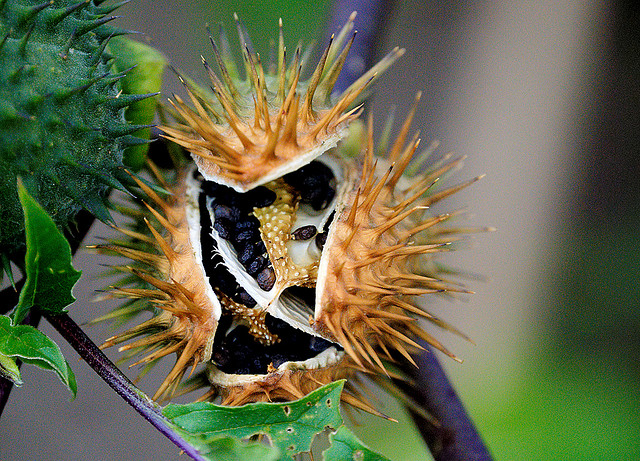
Datura Seed Pod. Source: Flick, KurtQ/KurtQvist.http://www.flickr.com/photos/kurtq/3971036475/

Datura Seed Pod. Source: Flick, KurtQ/KurtQvist. http://www.flickr.com/photos/kurtq/3971036475/

The Devil’s Weed (aka, Hell’s Bells, Devil’s Trumpet, Angel’s Trumpet, Brugmansia, and many other names) is scientifically known as the Datura Stramonium plant and is a type of deadly nightshade with truly revolting looking pod seeds that resemble something out of a Tim Burton movie. Yet, its delicate, summer-blooming flowers are often used in perfumery because they are said to smell of sweet apricots or plums. In perfume, the Devil’s Weed goes by the much more innocuous sounding name of the Datura flower.

That flower is the ostensible inspiration behind Datura Noir, a perfume created by Christopher Sheldrake for Serge Lutens. It was released in 2001 and it seems that it may soon be discontinued. Though there has been no official announcement (there rarely is), I’ve read numerous comments claiming that the perfume will be discontinued in as soon as a few months. It is currently on the Serge Lutens website which describes the perfume as follows:

Like a diabolic trail of smoke left by Satan in Paradise.

Some say this fragrance will enthrall you; others that it will make you crazy. Others still that excessive exposure will kill you dead.
To be precise, one night I took brugmansia, also known as Angel’s Trumpet, and distilled the notes of its lingering memory.

What a description! My word! If only the perfume lived up to it….

Datura Noir BottleLet me be as blunt as possible: Datura Noir is about as satanic, dark, “Noir” and diabolical as raindrops on roses and whiskers on kittens. It is a perplexing perfume that has left me completely unable to make up my mind about anything but the fact that it is most definitely NOT diabolically dark. You see, Datura Noir is all creamy white coconut, creamy white tuberose, and bitter white almonds. I like two of the three things very much. Unfortunately, creamy coconut… not so much. And, on my skin, this is a very coconut-y perfume.

Fragrantica classified Datura Noir as an Oriental Vanilla (I’d call it a Floral Vanilla, myself), and provides the following notes:

coconut, tuberose, tonka bean, almond, lemon blossom, mandarin orange, musk, chinese osmanthus, heliotrope, myrrh, vanilla and apricot.

The first time I tried Datura Noir, it opened on my skin with an explosion of buttery vanilla and almond, followed a few minutes later by fruity floral notes that were hard to isolate. For a second, I also thought I smelled green plums and, possibly, apricots — but it soon disappeared. Underlying them all was coconut which resembled just slightly Hawaiian tropical oils. I’m not usually crazy about the note and, yet, it worked in some odd way — perhaps because it was extremely mild and fleeting, and because it was alleviated by the almond note.

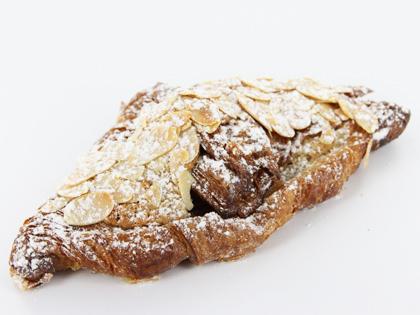
Croissant au amandesThe almond was absolutely heavenly. At times, it was bitter; at others, sweet and warmed by the vanilla. I detected the heliotrope which not only resembles almonds but which also has a slightly sweet powdery element with a touch of light violets. While heliotrope can sometimes lead to a “Play-Doh” impression, it doesn’t here. This is all almonds and vanilla, and it strongly brings to mind the almond paste with vanilla (pate d’amande) that French patisseries love to use in some croissants. I’m rather in love with it, especially as it isn’t cloying or insanely sweet. The reason is that the sweetness has a definite bitter edge, like the kernels of fruit were freshly crushed. In addition, the vanilla isn’t like highly sugared cupcake frosting. At times, it was rather like French patisserie dusting powder; strong but simultaneously light. At other times, it was rich vanilla, as if from pure Madagascar beans, and had a definitely custardy, creamy aspect to it.

That lovely, slightly gourmand opening happened the first time I tried Datura Noir. The second time, however, it was almost entirely thick coconut and tuberose. It was an astonishing — and extremely stark — difference. I actually couldn’t quite believe it. Yes, there was some bitter almond vanilla, but it skulked in the background as if it were a red-headed stepchild about to be beaten by its abusive parents. This opening was overwhelmingly hotly buttered, heavy, gooey coconut with indolic tuberose trailing just a step behind. The almond-vanilla notes came later — as if the order had been reversed — but even then, it was still mild and submissive.

Datura's flower. Source: Indee on Flick: http://www.flickr.com/photos/indee/3741757903/

Datura’s flower. Source: Indee on Flick: http://www.flickr.com/photos/indee/3741757903/

The sharp contrast certainly substantiates the review at Now Smell This which noted how the perfume can change on your skin from day-to-day:

At times it seems to perfectly conjure up the mystical connotations of the Datura flower, and so I tend to think of it as a sexy, secret rendezvous kind of perfume, not something to be worn by the light of day. Other times, the almond in particular seems to strike a jarring note, as though you had shown up for an assignation with a tall, dark stranger and found only a dainty plate of Amaretti cookies. Then there is nothing to do but scrub it off and try again another day.

I’m not sure that Datura Noir ever became “a sexy, secret rendezvous kind of perfume” on my skin. Irrespective of the opening, the perfume consistently developed in its middle and final stages into a buttery coconut and creamy tuberose scent. There were always traces of almond and vanilla, but they never trumped the other two, more dominant notes. There were also varying degrees of soft apricot from both the osmanthus and the datura, but the aroma was more like the almond-y kernel than that of the sweet fruit. Lastly, there was an extremely light musk note that consistently developed on both occasions during the final hour but it was extremely subtle; powdered vanilla was a much greater undertone. None of this screams sexy, clandestine rendezvous to me. And I’m afraid the perfume never morphed beyond what I described. Unlike a few reviewers, I never once smelled myrrh (which I think might have helped) or mandarin orange peel.

In short, I never found anything remotely evoking seductive danger. Had I not read up on the history and nature of the Devil’s Weed, I would have been utterly baffled by the references in reviews such as the enormously positive one at Perfume-Smellin’ Things. There, she found Datura Noir to be the scent of a sweet woman driven to dark things:

In my imagination, the delicate, passive Farnesiana [by Caron] has an alter ego…because there is only so much a sweet-natured girl can take… push her to the limit and we’ll be looking at your necrologue in The NY Times. If you make her really, really angry, Farnesiana turns into Datura Noir, which is anything but delicate or passive. What unites the two for me is the bitter almond quality presented on a creamy floral background. And it is that quality that also makes them oh so different.

In Farnesiana, the almond-heliotrope accord is a soft, if melancholy embrace. In Datura Noir, it is a soupçon of cyanide in your champagne. […] The tuberose, the presence of which lends the composition a languid, tropical feel, is wonderfully creamy, and makes a perfect seductive accomplice to the evil almond. “Very few of us are what we seem,” warns Agatha Christie. That certainly describes Datura Noir. Delicious but poisonous, beautiful but lethal, creamy-white but with the heart of darkness, it will kill you, but softly…if that’s any consolation.

My position is much closer to that The Perfume Shrine which found Datura Noir to be “schizophrenic,” changing perceptibly each time, and not necessarily for the better:

It has the almond nuance of cyanide we read about in novels, yet dressed in edible apricot and tropical fruit and floral notes (candied tuberose clearly present) as if trying to belie its purpose, while at the same time it gives the impression of coconut-laced suntan lotion smelled from afar; as if set at a posh resort in a 1950s film noir where women are promiscuous and men armed to the teeth beneath their grey suits and there’s a swamp nearby for dumbing [sic] bodies in the night…

Initially, I didn’t agree one whit with the scene described but, on my second test of Datura Noir, I could definitely understand why it came to mind. The second version of Datura Noir actually does have a very 1950s Miami gangster/moll vibe to that tropical tuberose accord; one can definitely imagine an overly sexual, over-blown blonde bombshell in a bathing suit, hanging by the side of a Mafia henchman. And, in fact, the Starz premium-cable network has a series called Magic City set in the 1950s that is about the exact scenario invoked by the Perfume Shrine. (Really. A Miami hotel, the Mafia, beautiful women, and dead bodies dumped repeatedly in an ocean grave.)

A scene from "Magic City."

A scene from “Magic City.”

A similar — but significantly harsher — impression came from “Feysparrow” on Makeupalley who wrote:

Usually a perfume that says ‘bad girl’ this shamelessly is found in drugstores…[b]ut Datura Noir, expensive it might be, was designed to smell this cheap. It’s quite clever in a way, right up there with selling ‘antiqued’ furniture and ripped jeans.

It’s tropical and cloying. It’s brazen. It tells passersby, ‘I have done things with many people and I will do those things with you, if you like’. I’m not extrovert enough to even begin to imagine I could carry this off, the thought alone makes me feel headachy and dissolute. I like the scent of datura flowers in real life but here their scent is duplicated with an accord of white flowers, one of which is tuberose which smothers the others to death before I can tell what they were. The tuberose is in turn slaughtered by the coconut, my least favorite note of all time – but of course it has to have coconut, it just wouldn’t be cheap-smelling enough without a heavy hit of coconut. Finally, a flood of almond, apricot, and sweet vanilla adds a gourmand quality to the indigestible heap and in a last gesture of vulgarity, the bad girl says, “Eat me.”

Ouch! I don’t think Datura Noir smells cheap (in the sense of low-cost, poor quality ingredients), but I can understand the comparison to a cheap, brazen woman. It’s all due to that bloody coconut which is simply too over the top here. Too unctuous, too heavy, too dominant, too much of a bad partner for something as rich as tuberose.

As you can tell, I much preferred my first version of Datura Noir, though the coconut element was still a bit too much for me even then. But, as should be equally clear from some of these comments, one doesn’t seem to have a guarantee as to which version of the perfume will show up. To be fair, there are a few really positive reviews for it on Makeupalley and even more on Fragrantica (where it is occasionally compared to Dior’s Hypnotic Poison). However, as a whole, this is a scent which seems to trigger a strong “love/hate” reaction — sometimes within the same person. I felt a bit like the MakeupAlley poster, “myolderbrother,” who wrote: “Unfortunately, the awesomeness isn’t consistent. I’m quite confused with this scent and seem to have a love/dislike affair with it.”

Equally inconsistent are the reports on the perfume’s sillage and longevity. On me, the perfume had good-to-great projection for the first hour on my first try when I put on a fair bit; it had good-to-low projection on my second test when I put on less. In both cases, however, the perfume became much less powerful in the second hour and almost close to the skin. It became fully close to the skin in the third hour. On Fragrantica, the majority of people found the sillage to be merely “moderate.” In terms of longevity, on my first test, there were lingering traces of the scent in the seventh hour; on the second attempt, it didn’t last past five hours. Elsewhere, the reports range from “it barely lasted” to comments about great longevity.

One thing should be noted about Datura Noir. Its name seems to come up often in discussions of Guerlain‘s Mayotte or, as it is more frequently called, Mahora (the perfume’s original name). I’ve reviewed the notorious Mahora and I have to say, the two perfumes are nothing alike. For one thing, there is no edible, gourmand component to Mahora. For another, Mahora had some seriously green aspects to it at first, before turning into a predominantly tuberose perfume with some coconut in it. Datura Noir, in contrast, is a primarily coconut-tuberose (and almond) perfume and the difference in degree is quite large. While both are very, very buttery, Datura Noir seemed much lighter and airer (relatively speaking) the first time around, but significantly heavier the second. I think I prefer Mahora — not only because of the way that the tuberose manifested itself, but also because it wasn’t such a bi-polar, bewildering perfume.

If all of this leaves you confused, well, join the club. I simply don’t know what to think of Datura Noir. Normally, I have an opinion one way or another — but Datura Noir is a bit too much of a drastic chameleon for me to know its true nature. The Perfume Shrine called it a schizophrenic kaleidoscope, and said so with a shiver. But those who love it, seem to do so passionately. If the rumours about it being discontinued soon are true (and I’m hearing them repeatedly), then you may want to give it a sniff soon to decide for yourself. It will either be your “Angel’s Trumpet,” or you’ll find yourself swearing, “Hells Bells, this is the Devil’s Weed!”


DETAILS:
Cost & Availability: Datura Noir is an eau de parfum which comes in a 1.7 oz/50 ml bottle that is usually priced at $120. It is currently being discounted on a number of different sites. Right now, it is on sale as the “Deal of the Week” at Beauty Encounter for $96.95 with free shipping. I don’t know how long that special will last. It is also available on: Fragrancenet for $98.19, Amazon for $98.87, Parfum1 for $108 and StrawberryNET for $111. The extent and number of these discounted offerings tend to add to the perception that it may be discontinued soon. At the moment, it is still listed on the Serge Lutens website where it costs $120. Datura Noir is also available at Barney’s. In the UK, you can find Datura Noir at Harrods where it costs £69.00 for a 1.7 oz/50 ml bottle. For other countries, you can use the Store Locator on the Lutens website. Sample vials to test it out can be bought at Surrender to Chance starting at $3.99. 

Perfume Review – Arquiste Anima Dulcis: Conquistadors, Convents & Chocolate

It was a chilly day in Mexico City that November, long ago in 1695, and the kitchens of the Royal Convent of Jesus Maria were a beehive of activity. The haughty Mother Superior took the heavy key from the chain around her neck and unlocked the vault with the sisters’ most precious ingredients: bitter, dark chocolate, rich chilies, earthy spices, incense used in their religious ceremonies, and the heaviest of vanillas. The recipe for their famed “Anima Dulcis” was a secret one — even some of the nuns weren’t privy to its true magic. Were there flowers hidden under its dark depths? Was ancient incense responsible for its smoke, or was it darkened patchouli? The Mother Superior smiled to herself as she passed through the convent’s stone passageways and heard the younger sisters’ whispered questions. She, and she alone, would add the finishing touches.

Sao Roque Church, Lisbon, which is a little how I imagine the Royal Convent to appear. Photo: "ToonSarah" on VirtualTourist.com

The chapel of Sao Roque Church, Lisbon, which is a little how I imagine the wealthy Royal Convent in my mind. Photo: “ToonSarah” on VirtualTourist.com

Cornelis de Vos, Flemish Baroque painter, 1584-1651. Source: This Ambiguous Life Blogspot.

Cornelis de Vos, Flemish Baroque painter, 1584-1651. Source: This Ambiguous Life Blogspot.

The Royal Convent of Jesus Maria in Mexico City on a day in November 1695, is the explicit reference point for the “baroque gourmand” fragrance that is Anima Dulcis (loosely translated as “soul of sweetness”). It comes from the perfume house of Arquiste, founded by the Mexican architect and designer, Carlos Huber. Mr. Huber — who just won the Fashion Group International’s Rising Star award a few weeks ago — was inspired by the convent’s history and practices after he worked on renovating and converting the building in Mexico City.

Carlos Huber. Source: Etiket.com.

Carlos Huber. Source: Etiket.com.

As Mr. Huber explains on the Arquiste website, the Royal Convent of Jesus Maria had been founded in 1578 for the female descendants of the Spanish Conquistadors. (Or, at least, the very wealthiest and most aristocratic among them!) It was known for the nuns’ recipes which combined European and Asian ingredients with those particular to Mexico’s ancient history. Octavian, the highly respected perfume blogger of 1000 Fragrances, elaborates further in his beautiful review of the perfume:

The most carnal elements of the baroque cuisine were mixed in unexpected combinations, forgotten by the modern nose. Animalic jasmine, tuberose, petals of white flowers and all the temptations of the flesh were mixed with cocoa and hot spices to produce liqueurs and sweets. The nuns were discovering the fabulous scents of the new world, earlier than Europe. Vanilla, cocoa and tuberose, brought to Versailles, but still a great luxury before their massive use in the next century, made their debut in a Convent where the ancient Maya and Aztec flavors were tested and studied by Europeans. Anima dulcis, a modern interpretation of this magic encounter, tells the story of when the european sensibility started to use the “dark” ingredients of the New World – the discovery of cocoa, vanilla and chili pepper, reported by Cortez 150 years earlier. [Emphasis in the original.]

Using his research (and, I believe, the sisters’ actual recipes), Carlos Huber worked with twoAnima Dulcis perfumers, Yann Vasnier and Rodrigo Flores-Roux, to encapsulate the Convent’s creations. The result was Anima Dulcis which was released in 2011. It is classified on Fragrantica as an “oriental vanilla,” though I think “oriental chocolate” might be a more accurate summation. On its website, Arquiste says the notes include:

Cocoa Absolute, Mexican Vanilla, Cinnamon, Chili infusion.

Those official notes are just the tip of the iceberg. There is no way that the list is complete. I would venture a guess that the complete list might possibly look a little bit like this:

Cocoa Absolute, Mexican Vanilla, Cinnamon, Red Chili infusion, Jasmine Sambac (or some sort of florals), Seville Oranges, Cumin, Cardamom, Patchouli, Incense and, possibly, some sort of ambery resin.

Pre-Columbian chocolate with chilies. Source: CaFleureBon.

Chocolate with chilies and spices. Source: CaFleureBon.

Anima Dulcis opens on my skin with cinnamon-infused dark chocolate. It’s chewy, dusky, and spiced, but also, simultaneously, honeyed. Fiery red chilies counter the sweetness of the vanilla that just barely seems to breathe in the background. So does the earthiness of a dark patchouli — dirty and slightly smoky in the best way possible. The smoky notes seem to be further accentuated by some hint of light incense. It’s a lovely take on vanilla and chocolate, especially with the piquancy from the red chili pepper.

Mexican Hot Chocolate. Source: Zested.com. (Click on the photo for a link and a recipe.)

Mexican Hot Chocolate. Source: Zested.com. (Click on the photo to go to the website where you can find a tasty recipe.)

The chocolate note, however, is the real star. It’s unusual and nothing like the typical sort of chocolate notes which, to me, often feel more like powdery cocoa. At the same time, it’s also not like purely dark chocolate. Here, it’s more like the richest chocolate flourless cake covered with ganache made from bitter chocolate, covered by a dusting of smoky powder, cinnamon, cumin, cardamom, decorated with faint slivers of Madagascar vanilla pods, and then set on a plate of spicy, cinnamon red-hot candies. The richness almost has the feel of a British Christmas plum pudding, only tinged with incense.

It’s an incredibly cozy scent that is, at the same time, very sexy. There is a rich, meaty, chewy, dark aspect to it that can certainly be called “baroque” but, to be honest, aristocratic Mexican nuns descended from the Conquistadors are not really what comes to mind when I smell it.

Vermont West Hill House B&B.

Vermont West Hill House B&B.

Instead, I feel transported to a secluded wood cabin in Vermont on a very snowy, wintery night; there, by the light of a roaring fire which casts flickering shadows on the wall, a seduction scene full of deep long kisses and teasing nuzzles unfolds. Cups of spiced hot chocolate filled with dark liqueurs lie empty; the fire releases an occasional tendril of smoke; the light is glowing amber and red; and sensuality underlies the cozy warmth of the scene.

As time progresses, the baroque chocolate notes are joined by something that is definitely floral in nature. It’s lovely, adding a lightness and sweetness to the dry spices, but I can’t pinpoint the exact flower. Perhaps Jasmine sambac, with its earthier, muskier nature than regular jasmine? Octavian on 1000 Fragrances thinks it’s a green lily note and, while I can see some light greenness, I don’t think it’s the delicate lily flower. Either way, the perfume definitely has some sort of floral component. Carlos Huber may consider Anima Dulcis as a “baroque gourmand,” but, to my mind, it is much more of a spicy oriental perfume which just happens to have some gourmand elements. It’s also a very ambery perfume for something that is meant to smell like Mexican hot chocolate, and I wonder if there is some sort of resin in Anima Dulcis’ foundation. Whatever the specific notes, it’s a fascinating and addictive scent. I can’t stop sniffing my arm, and I just barely stifle the urge to put on more.

Nordic Christmas Oranges. Source: Trine Hahnemann & The Times of London.

Nordic Christmas Oranges. Source: Trine Hahnemann & The Times of London.

Two hours in, the perfume shifts and changes a little. It is now predominantly cinnamon orange with red chili peppers. There is a feeling of caramelized cooked fruit, where the caramel has burnt just a little. Or, maybe, it’s more like a sticky, toffee’d orange, salted and sweet, mixed with dark raisins stewed in rum and dark chocolate. It’s really hard to pinpoint; the perfume is superbly blended, leading all the notes to melt together in a decadently luscious, rich whole. The burnt note, unfortunately, lasts a wee bit too long for my liking, and seems to become just a tad bit more bitter and burnt with time. It’s not strong and over-powering — it’s not even the predominant note — but I think I would have liked just a little less of it or, perhaps, a little more sweetness to counter it.

After another hour, it fades, leaving Anima Dulcis as a lovely combination of bitter Seville oranges, dark patchouli, cinnamon, chili pepper and a soft dusting of sweet vanilla. Eventually, at the end of the fourth hour, the perfume turns into a soft amber with spices and just a flicker of orange, before finally ending up in its final stage as sweet vanilla and light white cocoa powder, with just a smidgen of dusty spice.

For all that these notes seem dark and heavy, the perfume itself actually is not. It’s neither narcotically heady nor cloyingly sweet. It’s not a light, clean, airy scent by any means — no laundry detergent freshness here —  but it’s surprisingly not heavy or opaque either. Octavian describes it as “light, woody, airy” and “delicate.” I think it’s a bit heavier than that; I wouldn’t want anyone to think this is a sheer, translucent scent or something like the minimalistic creations made by Jean-Claude Ellena. But, given the richness of some of its components, it is far from thick and never overbearing.

In fact, even the sillage is moderate. In the beginning, you can smell it on yourself but it’s far from overpowering. Someone across the room definitely won’t be gassed by it. After the first hour, the perfume becomes softer and, by the third hour, it was quite close to my skin. By the fourth hour, it took some determined sniffs, putting my nose right on the skin, to detect some of the nuances in the notes. As for longevity, it was moderate on my perfume-consuming skin. It faded away shortly before the sixth hour. On others, I’ve read lengths of time around varying between six and eight hours.

All in all, I really liked Anima Dulcis. A lot. The only thing stopping me from wanting a full bottle is the fact that, for my personal tastes, I would have preferred it if the scent were heavier, headier, and just a slightly bit sweeter. (Just a smidgeon!). I realise, however, that most people don’t share my preference for narcotically heady scents, so I think Anima Dulcis would be a real crowd-pleaser for many. It taps into the current trend for gourmand scents but, in my opinion, it really isn’t one. Those who are expecting a true dessert fragrance will be disappointed. This is not half as sweet as some of the niche Guerlains that are out there. Those, however, who share my feeling that a few of those Guerlains are a bit too gourmand should really look into Anima Dulcis. The same applies to anyone looking for a very high-quality, luxurious take on spicy Orientals without the heavy, boozy or opaque aspects that can sometimes accompany them. I should add that it is most definitely unisex!

Try Anima Dulcis, and see if a perfume twist on a recipe from the aristocratic descendants of the Conquistadors over three hundred years ago touches your sweet soul.

DETAILS:
Anima Dulcis costs US $165, CAD $200, £125.00 or €149. It comes only as an eau de parfum and is available only in a 55 ml/ 1.8 oz size. In the US, it is available on the Arquiste website, Barneys, and Aedes. In Canada, the Arquiste line is available at Holt Renfrew Bloor in Toronto (though I could not locate it on the overall Holt Renfrew website), or at Etiket in Montreal for CAD $200. Each store is the exclusive dealer for the Arquiste line in their city. In the UK, it is available for £125.00 at Liberty London. In France, you can find it at Jovoy Paris where it retails for €149. In Germany, it is sold at Aus Liebe Zum Duft. Elsewhere, you can use Arquiste’s “Stockists” page to find a retailer near you. Samples are available at Surrender to Chance where the price starts at $4.99 for a 1/2 ml vial. The site also sells all 7 perfumes from the Arquiste line in a sample pack for $33.99.