Perfume Review: Valentino Valentina Assoluto

I sometimes get a little obsessed with things, completely out of the blue and for reasons that I don’t always understand. Trying out the new Valentino fragrance, Valentina Assoluto Eau de Parfum Intense, became one of those things. It is supposed to be an entirely new take on Valentino’s popular Valentina perfume but, according to its creator, the well-known Olivier Cresp, it is not a flanker. (Yes, actually it is.) Instead, it’s supposed to be a new, smoldering “seductive” and “nocturnal” take on a chypre with only some of the original Valentina‘s facets and supposedly, none of the latter’s strawberry heart.

Valentina_Assoluto_A3

Valentina Assoluto was first launched in 2012 in Europe and the Middle East, but it is only now, in April 2013, being officially released in the U.S. The description on the little manufacturer’s sample that I bought states as follows:

The alluring fruitness of a sensual smeggia peach enhanced with white Alba truffle.

The magnetism of a precious white flower bouquet, touched by delicate vanilla.

The mystery of a voluptuous chypre signature, fusion of patchouli, oakmoss and vibrant cedar wood.

Valentina A the-bottle

The notes, as compiled from Fragrantica and Nordstrom, seem to be:

Key notes: bergamot, peach, white truffle, jasmine, tuberose, cedarwood, patchouli, oakmoss, Madagascar vanilla.

I should note that the text copy for Nordstrom mentions orange blossom too, which I think is also in the perfume. The more important thing, however, is what no-one mentions: strawberries. It is the key note of the original Valentina and, to my nose, is also a big part of the Assoluto sequel.

Valentina AssolutoFragrantica classifies the perfume as a “Chypre Floral.” I think that is following the ad copy far too slavishly. Valentina Assoluto is a fruity floral scent, first and foremost, with a heavy emphasis on “fruity;” it is an oakmoss or chypre fragrance only by the very loosest possible definition.

Macerated strawberries. Source:PeaceAndLoveInTheKitchen.com

Macerated strawberries. Source:PeaceAndLoveInTheKitchen.com

Valentina Assoluto opens on my skin with a forceful sweetness that strongly calls to mind those candies like a Jolly Rancher or something similar. There is a note of heavy, over-ripe, lush peaches which almost immediately turns to strawberries. The fruit is macerated with sugar, almost like a syrup that you see on some desserts. Its sweetness just barely falls short of strawberry jam. Seconds later, there is a dry undertone of some vaguely abstract, amorphous “chypre” element, but it is extremely faint. Much stronger is the patchouli and an undertone of vanilla. Minutes later, a very muted sort of earthiness appears, and it feels like white truffle — except it’s buried under piles of strawberry syrup. There is also a vague hint of something citrusy but it’s minimal. The strawberries turn even sweeter and, though they occasionally have ripe peaches as an undertone, they are the main star of the show at this stage.

Picnic outdoor strawberriesI haven’t the faintest idea how any of this is supposed to be “nocturnal.” I feel quite ready for a summer picnic with strawberry desserts in the bright, cheerful sun. I think those who love sugar bombs like Victor & Rolf‘s Flowerbomb will love this part of the perfume because it’s very exuberant and happy. Those who prefer more modulated, more well-balanced and less sugared florals will find this to be excessive.

Exactly fifteen minutes after the start, Valentina Assoluto turns dry and woody. It happened almost on the dot on both occasions that I tested the perfume. There is smoky cedar which appears and which slowly starts to muscle the strawberries to the side. There are subtle elements of jasmine, but like the patchouli and vanilla of the opening minutes, it’s merely flickering at the outside edges. Instead, the perfume turns a smoky, lightly peppered cedar fragrance on the base of some amorphously abstract fruity elements. At its final moments, Valentino Assoluto became a simple, light mix of woods with tiny touches of vanilla, patchouli and musk. 

I have to admit, I find the whole thing incredibly odd. For one thing, I’m not familiar with a plethora of strawberry fragrances. For another, the rapidity of the abrupt and very sharp change is quite unusual. To go from a candy-sweet fruity fragrance to a very dry, peppered, smoky cedar one is quite a contrast. And in fifteen minutes?! Odder still is the unusual juxtaposition of notes. Cedar and strawberries? I have to give points for huge originality.

I suspect the sharp transition would have been made smoother if I’d smelled the actual Alba truffle in the opening; its earthiness might have provided a bridge between stages, as would some of the floral elements. To my sadness, there was no tuberose on my skin. In the same vein, some freshness from the citrus notes would have helped alleviate the incredible sweetness of the scent. But, on my skin, none of those things happened on both occasions that I tested the perfume. Valentina Assoluto is barely floral and has little to no earthy truffle, fresh citrus, or pungent oakmoss.

The whole thing is extremely light and surprisingly sheer given the heaviness of the initial sugary notes. The perfume is strong for about five minutes but then quickly drops in sillage, hovering mere inches above the skin for about forty minutes, until turning into a skin scent. The first time I tested the perfume, I applied about 4 sprays and it lasted just over two and a half hours on my skin. The second time, I applied 2 sprays, and the perfume died after an hour and thirty minutes. Yes, I have perfume-consuming skin but, looking at Fragrantica, I was not the only one who had troubles with longevity.

I suspect fans of the original Valentina might like this one, since a few comments on Fragrantica lead me to believe they are extremely similar for the most part. Interestingly, a number of people seem to have experience a lot of tuberose in the scent — which I did not. The overall reviews on the site seem to be quite mixed, with people expressing everything from huge love, to those less enamoured of its “sweet, sweet, sweet” nature and a few being bewildered by how it turns “very woody.” Some simply couldn’t bear the heavy tuberose/patchouli combination.

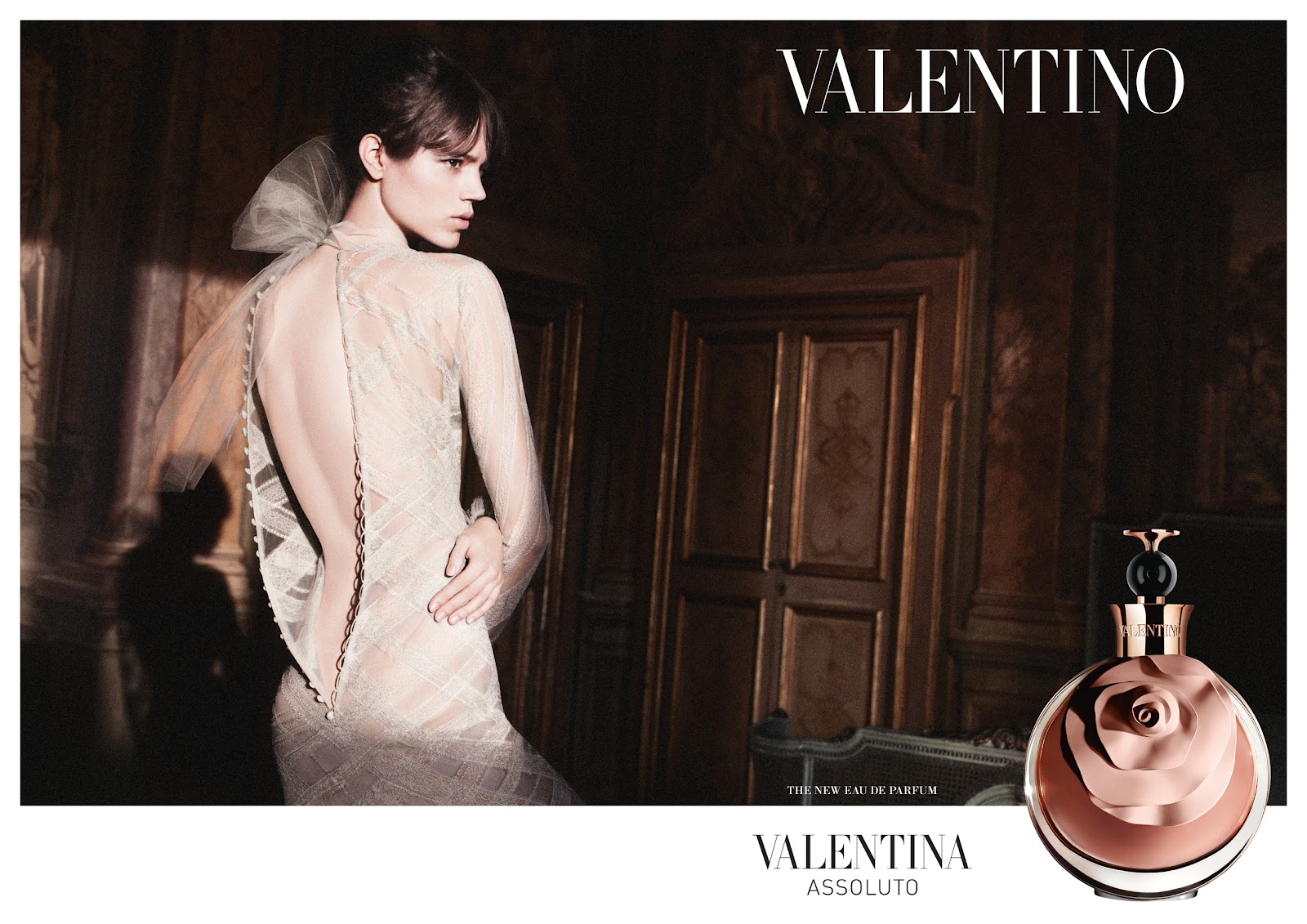
Personally, I was disappointed by just how unremarkable it was; it’s not complex, nuanced, well-balanced, or long-lasting. And, even by the standards of mass-market fragrances, it’s a little boring. But if you like extraordinarily sweet perfumes with a suddenly dry twist, if you prefer sugared skin scents, or if you loved the original, then you may want to give this one a try. For everyone else, you may enjoy Valentino’s short “behind the scenes” clip for the campaign shot by David Sims and featuring the model, Freja Beha Erichsen, in a gorgeous backless Valentino dress.


DETAILS:
Valentina Assoluto Eau de Parfum Intense is available on the Valentino website where it retails for €82 for a 50 ml/1.7 oz bottle or €106 for the 80 ml/2.7 oz size. The perfume only comes in Eau de Parfum concentration. Valentino also has a list of countries that it ships to and a store locator on its website. In the US, you can find Valentina Assoluto at Nordstrom where it costs $88 for the small size and $117 for the larger one. Nordstrom also has a gift set for $119 which includes a body lotion in addition to the large 2.7 oz bottle. The site also sells all sorts of accompanying products to go with the scent. In the UK, it is available at Harvey Nichols or Harrods where it retails for £61.00 for the smaller 50 ml/1.7 oz bottle. John Lewis seems to be selling it at a slight discount of £54.90. In Europe, some of the Sephora online sites — like Sephora Italy — seem to carry it, so you may want to check the Sephora for your country. In Australia, I found the perfume offered on Cosmetics Now for AUD$112.95 and $146.95, depending on size.

Perfume Reviews: Lubin Galaad, Akkad & Korrigan

Ancient history, the mysteries of the Middle East, Galahad atop his fiery steed in the Holy Lands, the Balm of the Sacred Mountain, luminous amber with sacred herbs, and mythical creatures who concoct elixirs in celebration of Dionysius — those are the inspirations behind a trio of fragrances from the French niche perfume house of Lubin. Created by Delphine Thierry and Thomas Fontaine, Galaad, Akkad and Korrigan are three Oriental fragrances released in 2012 for a perfume house whose history is far more fascinating that the perfumes themselves.
Lubin coat of arms logo

Lubin was founded in 1798 by Pierre François Lubin, soon after the French Revolution. He had apprenticed under the perfumer who served Marie-Antoinette but this was a new political climate. Lubin soon won favour with Napoleon’s Imperial court and his scents were beloved by both Empress Josephine and Napoleon’s influential sister, Pauline. The royal courts of Europe soon followed suit, from the King of England to the Tsar of Russia. Once Napoleon fell, the seemingly wily, pragmatic Lubin managed to curry favour with the new royal dynasty by dedicating his fragrances to the Bourbon queen, Marie-Amélie. A very ambitious man, Lubin seemed to need more worlds to conquer and, in 1830, became the first perfume-maker to conquer the New World with perfumes that reached the banks of the Mississippi. I have no idea if that last part of biographical past was embellished a little bit but, frankly, I didn’t care one whit. For a history geek like myself, it was all utterly fascinating.

Unfortunately, I far preferred the history to the new perfumes. Everything about the background stories for the fragrances has been done with finesse, poetry and beauty, but the perfumes themselves left me feeling cold. And I’m genuinely saddened by that. If you ever have time to spare, I urge you to check the Lubin website for their gorgeous graphics and story for each scent. They’re really incredibly well-done.

GALAAD:

Galaad from the Lubin website via MrNyStyleandTravel.com.

Galaad from the Lubin website via MrNyStyleandTravel.com.

Galaad is classified on Fragrantica as an “oriental woody,” and is centered on leather and myrrh. The story behind Galaad involves the “Balm of the Sacred Mountain,” the Arthurian knight, and the most precious of the Holy Land’s ingredients:

Out of Egypt come caravans to fetch myrrh in my land of Galaad. My name is the same as that of the land that witnessed my birth, for I am Galaad, the knight of the Holy Mountain. It is rich with honey from our hives, tall cedars that shade it and resins brought to Pharaoh. With frankincense, cypress and dried grass from Atlantis, we refine the precious balm used by the lords of the East to perfume themselves.

Lubin GalaadThe press release shared by Luckyscent adds to the beauty of the story and describes its notes as follows:

A heart of myrrh is topped with spices that bring out refreshing head notes (cardamom), and sustained by aromatic base notes (rosemary, cypress). The base is cool leather with wood and tobacco (blond tobacco, Atlas cedar, agar oud).

Delphine Thierry, who created Galaad, invites us to a tranquil morning ride in the mountains of the Middle East, when the scents of myrrh bushes blend with cypress resins and the woody fragrance of cedars. The leather of saddle and gloves gently warm up in the first rays of sun, while the little Arab horse snorts amidst the morning dew that has settled on Judean balsam trees and on the vines climbing along the mountain slopes of Galaad.

Notes: Cardamom, cypress, rosemary, myrrh, honey, copahu balm, Agar oud, Atlas cedar, cipriol, blond Burley tobacco.

Beautiful! If only the perfume smelled that way….

Instead, on my skin, Galaad was the rankest of sweaty leather. It opened with cardamom and honeyed myrrh with a very animalic, dirty, nutty, sweaty leather feel. Copahu balm is said to be a very sweet, balsamic resin and, here, it shares some characteristics with labdanum. Only much, much skankier. The leathery undertones to the perfume compete with some very sweetened wood notes that have an oddly herbaceous element to them. At the same time, there is a hint of dry tobacco that almost evokes the pages of a very ancient manuscript. I ascribe that to the cipriol which is another name for papyrus grass.

Source: Equisearch.com

Source: Equisearch.com

There is something odd about the smell that I really struggle to describe and cannot quite pinpoint. There is something not quite… right… about it all. The mix of honey and dirty ambered resin calls to mind a very sweaty saddle covered by sweetness; there are salty aspects; papery notes; dry, peppered woods; and something a bit rank. It’s not even the eventual smell of sweaty crotch that appeared after about an hour. It’s something that I can’t quite describe. And I didn’t like it very much at all. I tried Galaad twice to be sure and, the second time, it was even more rank on me with a skanky, fecund undertone that evoked unwashed private parts. It wasn’t huge and it was subtle, but it was most definitely there.

Lucas of Chemist in the Bottle was also not a fan of Galaad. He found “something sweaty” in it, along with a note of burnt plastic. He also detected oud in the perfume; I did not. But maybe I was just overwhelmed by the overall unpleasantness of the skanky, raunchy leather.

Thankfully, the sillage and duration of Galaad are not enormous. The perfume is quite thin, oddly enough, and didn’t have great projection on my skin after the first 20 minutes. It hovered a few inches above the skin for about an hour, became close around the 3 hour mark, and then died altogether after about 5.5 hours. I was quite relieved.

KORRIGAN:

Source: Miriadna.com desktop wallpapers.

Source: Miriadna.com desktop wallpapers.

Another absolutely beautiful story. This time for Korrigan, classified as an “oriental vanilla” and set in the verdantly lush, green isles of the United Kingdom. As the Lubin website explains:

A Korrigan is a small mythical creature that haunts the moors of Brittany, Ireland, Scotland and Wales, whisking us away to the folklore and legends of Celtic civilisation. [… They] know recipes for elixirs offered as libation at Beltane and Samhain, festivals to celebrate the change of seasons.

An occasion of course to evoke the strong beverages of the somewhat bleak moors. Whisky is one of them, in the form of a smooth, fragrant cream liqueur, accentuate by a counterpoint of oudh accord, which brings to mind dark caves where secrets lie hidden.

“Korrigan” is therefore a fragrance to accompany Dionysian rites. […] In the Armorican countryside the Korrigans frolic at night. They come to harvest juniper berries and wild beechnuts. Then, in dark caves, they distil barley into spellbinding spirits, spicing them with saffron, musking them with ambrette, scenting them with lavender. During the solstice festivals, they all drink their elixirs out of leather pouches, causing bodies and souls to capsize.
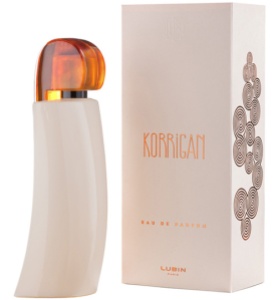
Lubin KorriganThe specific goal of perfumer Thomas Fontaine was to create, in the words of the Lubin website, “Caramel Wood Liqueur.” Luckyscent provides the following notes for the perfume:

Juniper berry, saffron, cognac, Lavender, ambrette, whiskey, Cedar, oudh, leather, vetiver, musk. 

“Caramel Wood” pretty much nails the description of this disconcerting, cloying and quite perplexing fragrance. Korrigan opens on my skin as caramel-infused wood with a herbaceous undertone. It is like Drambuie’s herbal, whisky liqueur with a definite cloying sweetness that verges on the synthetic. I don’t detect saffron, vetiver, or anything close to the evergreen aspects of juniper. Just caramel woods.
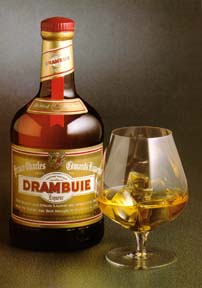
drambuieSomething about it is truly bewildering and, again, I cannot find the words to describe exactly why. I’ve smelled numerous fragrances with a boozy undertone, woody undertones, gourmand vibes and more, but something about Korrigan’s combination of gourmand caramel with whisky, white woods, pepper, and herbalized, honeyed leather leaves me at a loss. The odd combinations and Korrigan’s cloying sweetness also leave me feeling distinctly queasy.

The wood notes are also a bit odd. I don’t smell oudh or agarwood the way some did on Luckyscent, so much as white, soft woods that are peppered and yet, incredibly sweetened at the same time. It’s a different kind of sweetness than that cloying caramel, however, but I cannot explain it. All of this is going on simultaneously with very honeyed leather that seemed soaked in Irish whisky and a very strange herbal element. I don’t think the latter is my old nemesis, lavender, though it may be how lavender transforms itself here in combination with the other notes and that caramel.

After hours of something caramel-like that I cannot properly describe, the perfume turns into a simple amber fragrance along with hints of musk, vanilla and soft leather. The perfume lasted just over 7.5 hours with generally soft to low sillage throughout.

I’m sorry I can’t explain its development better to you, but some discordant aspect of this perfume leaves me absolutely stumped. There are reviews on Fragrantica which may help you more, ranging from those who love its woody caramel creaminess and bought a full bottle, to those who found it extremely “weird,” a highly acquired taste, or a “sticky, sour wood and a sweat note… [A] disaster.” You can also turn to Lucas from Chemist in the Bottle who liked Korrigan the most out of the trio, finding it to be “like a milky vanilla toffee” with an “alcoholic vibe of warming cognac and whiskey” combined with subtle lavender and other notes. His experience sounds infinitely more appealing than the queasy mess that it was on me.

AKKAD:

Akkad website photo from MrNYStyleandTravel com

Akkad photo from the Lubin website via MrNYStyleandTravel.com

Luminous amber. That was the goal for Akkad. According to the press release quoted by Beautyhabit:

Lubin AkkadDelphine Thierry, who composed this creation, imagined an amber note that is both spicy and luminous. The opposite therefore of the dark, mystical ambers that bring to mind the smoke of frankincense in ancient temples.

Akkad amber opens with an aromatic citrus head note of mandarin and bergamot, enhanced by Clary sage. Clary sage, also known as “the sacred herb”, is renowned for its euphoric, harmonizing properties.

The heart unfolds in the rich, balmy, spicy notes of frankincense and styrax, evocative of the ancient east, cooled by elemi, a fresh, soothing herb, and intensified by cardamom.

The base with its two ambers of plant and animal origin centers on the woody richness of patchouli, sweetened with a sensual vanilla.

Notes:
Top: Mandarin and Bergamot from Italy, essence of Clary Sage.
Middle: Essence of Cardamom, Elemi, Frankincense, Styrax.
Base: Amber and Cistus-Labdanum, Vanilla and Patchouli.

Akkad was my favorite of the three fragrances and the reason for that was simple: it smelled like a very close, sheer relative of the wonderful Mitzah from Dior‘s Privée Couturier line. I loved Mitzah and its robust labdanum heart, intermixed with incense and other notes. Akkad is not as rich or complex at Mitzah, and it lacks the latter’s quiet undertone of roses and spices, but it is a definite kissing cousin.

Akkad opens on my skin with sugared orange that is slightly burnt, along with patchouli and leathery, nutty labdanum over a sheer hint of powder. Cardamom and frankincense soon follow to join the amber party. But, in less than a minute, Akkad turns into a predominantly labdanum, frankincense, and patchouli fragrance. There is the merest feel of abstract spices (cinnamon and ginger) with just the slightest suggestion of burnt orange, but it’s infinitesimal. There is a definitely dirty, hippie, ’70s feel to the smoky, leathered, animalic labdanum and patchouli combination, and it is the fundamental core of the perfume. Those who don’t like labdanum with its dirty, masculine, nutty — and, here, slightly animalic — undertones may want to stay away from Akkad. There really isn’t much more to say about the perfume. It’s labdanum, light smoke and patchouli for hours. At the very end, it turns into a very light amber with a sort of caramel, butterscotch undertone and with a hint of vanilla.

Despite the seemingly heavy notes, Akkad is surprisingly lightweight in texture and feel. It’s even lighter than Mitzah and the sillage is quite moderate. Akkad remains just a few inches above the skin for hours, before becoming finally becoming a skin scent around the sixth hour. Akkad had good longevity on my perfume-consuming skin, lasting just a little over 8.5 hours. I prefer Mitzah with its greater nuances, but Akkad may be a good substitute for those who want something even airier and simpler.

SUMMARY:

I had great hopes for Lubin’s trio of orientals but, alas, ultimately, none of them really blew me over. Akkad was the best of the lot, in my opinion, but given how much I hated the sweaty-crotch feel of Galaad’s leather and the cloying, peculiarly baffling mélange of Korrigan’s caramel, I realise it seems as though I’m damning it with faint praise. Akkad truly was nice, I swear. The problem is that Akkad (like its siblings) costs $180 for a 3.4 oz/100 ml bottle, when the Dior Mitzah that I prefer costs $155 for a 4.25 oz/125 ml bottle. (If you love labdanum, frankincense and patchouli, you really must try Mitzah!) Still, if you have the chance, you may want give the perfumes a sniff if you stumble across them. Who knows, you may find Korrigan’s gourmand take on woods and leather to be interesting. But Galaad… no, I really wouldn’t recommend it.

DETAILS:
You can find all three fragrances on the Lubin website. Each costs $180 for a 100 ml/3.4 oz eau de parfum bottle. The website also offers a list of retailers from Hong Kong to the United Arab Emirates. In the US, you can find the trio on Luckyscent, Aedes, and on BeautyHabit. MinNY also carries them and is currently discounting each fragrance by a $1.80, selling them for $178.20 instead of $180. I find that microscopic discount to be extremely peculiar. In Europe, Essenza Nobile carries all three fragrances with two of them being €145 and Korrigan being €139. The site also sells samples. In the UK, Harrods normally carries Lubin fragrances but the website does not list this trio. If you’d like to try samples of any or all the fragrances, Surrender to Chance offers all three in a sampler set of 1 ml vials for $14.99. That’s what I chose to do since, individually, each 1 ml would be $5.49.

Perfume Review: By Kilian Flower of Immortality

The daintiest of Chinese watercolours with sheer, minimalistic and translucent brush strokes. That is what comes to mind when I wear Flower of Immortality, the new fragrance from the luxury perfume house, By Kilian.

Chinese watercolour. Source: Xiami.com

Chinese watercolour. Source: Xiami.com

Flower of Immortality is an eau de parfum which will be released next week, in early April 2013, as the third in Kilian’s Asian Tales series of perfumes which first launched in 2012. It is a simple, uncomplicated, fruity-floral scent which is pretty but alarmingly evanescent — and not just for my skin.

Source: Tumblr.

Source: Tumblr.

Flower of Immortality celebrates white peaches, the flower of which represents immortality in ancient Chinese folklore. The perfume was inspired by “A Tale of the Fountain of the Peach Blossom Spring” where a fisherman follows the scent of peach blossoms and ends up in Utopia. Luckyscent has the full details on the scent which it describes as follows:

For Kilian, Flower of Immortality is, above all, an olfactory homage to the peach blossom and its very strong symbolism in China. This blossom, whose pink petals are unveiled only in the middle of the winter, is believed to have the power to bewitch the human soul and to make it immortal. It is the set of symbols and myths that surround the flower that Kilian wanted to recreate in this new fragrance.

peach blossomFlower of Immortality was composed as the memory of the utopian paradise, where the fragrance of peach blossoms brings a promise of hospitality and immortality. The smooth and juicy scent of White Peach, interweaved by the sweet and powdery notes of Carrot and Iris. A dazzling breeze of Blackcurrant Bud absolute refreshes while the exquisite Rose Crystal is softened by the Tonka Bean and the scent of Vanilla beans drying in the sun.

By Kilian FOI 50 ml Bottle.JPGThe perfume was created by Calice Becker and the full list of its notes, as compiled from both Fragrantica and LuckyScent, is as follows:

White peach, carrot seeds, blackcurrant bud, freesia, iris, rose, vanilla, tonka bean, and white musk.

Flower of Immortality opens on my skin with the very sweetest of white peaches. There is nothing heavy or ripe in the note which blossoms like an airy cloud on the skin. Seconds later, there is a fleeting touch of black currant (or cassis) with a touch of tart juiciness — but it doesn’t last very long. Soon, it is replaced by notes of fresh carrots and light roses on a white musk base. I happen to like the sweet touch that carrots can bring and think it adds a little depth to the very predominant fruity aspects of the perfume. There are also some very quiet, subtle floral hints from the freesia; like the black currant, that doesn’t last long, either. I don’t detect any iris at all in the perfume.

Source: TheCleverCarrot.com

Source: TheCleverCarrot.com

A few minutes in, Flower of Immortality turns predominantly into a white peach scent. It’s almost like a watery nectar in its airy, shimmery, gauzy feel. There is the muted hint of white musk and, like a ghost popping up every now and then, some extremely subtle touches of carrot. None of these notes change the simpleness of the basic scent: it feels as though I have the lightest veil of actual white peach juice on my skin, and not much else. It’s very pleasant for what it is, but this is a not a complex fragrance by any stretch of the imagination.

The perfume continues as a white peach and musk scent for another hour. And then it dies. Completely. One doesn’t aim for “immortality” in perfumes, but this is too bloody short! If I sniff my arm with intense determination to find it — somewhere, anywhere — I tell myself that I can detect some lingering traces in tiny, random patches for another twenty minutes. Honestly, I think it’s the mere power of suggestion.

The frightening thing is that I — with my perfume-consuming skin — was actually luckier than one poor woman (“raw umber“) on Fragrantica whose entire experience lasted just 20 minutes. Her frustration is quite telling:

Flower of Immortality opens with sugar-covered yellow & pink Haribo peach gummy candies in a cut crystal dish with zingy black currants and a powdery floral note. Mmhm… not bad at all.

[¶] … Only 15 minutes after application, I am holding my nose to my skin in disbelief. Did I spray perfume here once? I swear it smells like peaches, but it must be my imagination. Or maybe… It was a ghost!!!

Perhaps there is an intentional inverse relationship between the Immortal in the name, and the life-span of this scent? 20 minutes in, I’m smelling basenotes as if the perfume had been applied three days ago and this is all that remains. 

I want to put the paddles on this fragrance and shock it back to life. Alas, before I can reach for my cell phone charger, my flame thrower, or my sample vial for a refresher, ANYTHING that might in some way help… Flower of Immortality is already going… going… 

gone.

By Kilian fragrances are not cheap, though thankfully there are a few more affordable options in terms of travel-sizes and refill bottles. Flower of Immortality costs $235 (or €175) for 1.7 oz/50 ml in the traditional lock-box version, but $135 if you want to purchase the refill bottle instead. Either way, that’s expensive for a linear, uncomplicated peach scent which disappears after 20 minutes or, if you’re lucky, an hour. And this is an eau de parfum, so it’s not as if you can try to buy it in a more concentrated, lasting form!

Chinese Peach blossom paintings from FengSuej com

To be frank, I thought the Chinese watercolours I found while writing up my post were a lot prettier and more interesting than the perfume. Don’t get me wrong, Flower of Immortality is perfectly pleasant, even if it’s a little boring. If you like airy, sheer, minimalistic, peach nectars, you may truly enjoy the scent. But I would highly recommend testing it out on your skin before buying it blindly. For those who aren’t a fan of the peach note, you may want to stay away entirely.

DETAILS:
Cost & Availability: Flower of Immortality is an eau de parfum that costs $135, $145 or $235 (depending on the form in which you buy it). It is available on By Kilian’s international website where it costs €175 for a 1.7 oz/50 ml bottle. The site also has the more affordable options. In the U.S., Flower of Immortality is available for pre-order now on Luckyscent with the perfume to be shipped out on April 4, 2013. The site also offers samples for $4 for a 0.7 ounce vial. Samples are also available at Surrender to Chance and cost $3.99 for a 1/2 ml vial. I obtained my sample from Saks Fifth Avenue, thanks to the generosity of a sales assistant. Saks also carries the scent, though it won’t be available for purchase in the actual stores until April 4th. I was going to give you the link to the Saks website but, somehow, between the time that I got the sample and saw it online, and the time of writing this post, the perfume is no longer shown online. 

Perfume Review: Ramon Monegal Pure Mariposa for Neiman Marcus

Spring is in the air, though clearly some parts of the world don’t seem to be so fortunate. Nonetheless, it seemed to be a good time to try out a few light, fresh fragrances that epitomize the upcoming season. One, in particular, caught my attention: Pure Mariposa, the new perfume created by the Spanish niche perfume house of Ramon Monegal for the American luxury department store, Neiman Marcus. Pure Mariposa is a bespoke perfume exclusive to the store and was released in February 2013.

One Neiman Marcus store with a floating butterfly decor. Source: Flickr.

One Neiman Marcus store with a floating butterfly decor. Source: Flickr.

Neiman Marcus' butterflies.

Neiman Marcus’ butterflies.

“Mariposa” means butterfly in Spanish and is not only a reference to Neiman Marcus’ happy, bright symbol of butterflies but the perfume’s point of inspiration.

In the press release for the perfume, Ramon Monegal said: The butterfly is an extraordinary creature that embodies many of the values that motivate me when I look for inspiration to fashion an olfactory tale in the form of a perfume.”  That “olfactory tale” seems to be one of flowery nectar in an airy, ozonic green forest:

Pure Mariposa will offer a floral-nectar accord with a festive tone in a dew-covered green forest, surrounded by a breeze of ozonic air, on a rich bottom accord of amber and musk.

Ramon Monegal Pure Mariposa

Neiman Marcus describes this as a “fruity, green-floral, woody scent” and lists the notes with great descriptive flair. Since it is their perfume, let’s go with their version, but note how Ramon Monegal or Neiman Marcus is trying to cover every possible base or category of perfumery imaginable:

Top Note

  • Fresh festive colorful: orange, grapefruit, bergamot.
  • Fruity vital, cheerful: yuzu, black currant, plum.
  • Ozonic pure, graceful: helional, melonal, calone, ultrazur. (molecules)

Middle Note

  • Green natural: oakmoss, grass accord, fig.
  • Floral rich, elegant: Osmanthus, jasmine, lily of the valley, rose wardia, tuberose.

Base Note

  • Woody powerful, harmonious: sandalwood, cashmeran (m), iris, anchouli (m). 
  • Silky sophisticated, majestic: peach, tonka bean, amber.

I assume the “(m)” abbreviation stands for “molecules” but the reference to “anchouli” made me blink, so I turned to Fragrantica. To my relief, it doesn’t seem to stand for some sort of anchovy oil. Instead, “anchouli” seems to be either a typo (like another on Neiman Marcus’ page) or a reference to some sort of synthetic “patchouli.”

I’m not a fan of synthetics — and particularly not of calone — so the listing of six different aromachemicals gave me great pause. I approached Pure Mariposa with some trepidation and first just gave the small decant a sniff. It was absolutely gorgeous in the bottle! Let me repeat that again: gorgeous! A beautiful scent with fresh, sweet, fruited and bright green notes. I could detect grapefruit that was yellow and sweet, not red and tart, along with fresh yuzu, juicy, sun-ripened yellow citrus, sweet (non-artificial) melon, sweetly green lily-of-the-valley, and fig. There was also that cheerful, happy note of freshly cut grass that is so evocative of the summer and sunshine. I was thrilled, and quite relieved.

Then, I put it on my skin. And it was a very different story…. A huge waft of synthetics and chemicals immediately hit my nose, followed quickly by incredibly dry, pungent, bitter oakmoss and equally bitter grass. There were also a panoply of sour notes from the citrus elements which contrasted strongly with the sweetness of the melonal aromachemical. The pungently dry aspects of mineralized oakmoss were side by side with sweet melon and sour citrus —  all on a base of synthetics and artificially peppered woods. Soapy lily-of-the-valley lurked in the corners, adding a different sort of green and white impression to the whole ghastly mélange.

I don’t know if my skin magnifies synthetic aromachemicals or if there is simply too damn many of them in Pure Mariposa, but the contrast between the beautiful brightness of the perfume in the bottle and its manifestation on my skin was a huge disappointment. That robust underpinning of aromachemicals remained long after the perfume’s opening changed to something much less bitter and dry, and much more melon-y sweet, metallic and airily green.

Ten minutes in, the perfume became simultaneously even more bitter but, also, more sweet. The very dusty, dry, grey mineralized feel of the oakmoss competed with the green lily-of-the-valley’s sweetness, the freshness of yellow citrus and the feel of a green honeydew melon mounted on aquatic underpinnings of calone. The calone is just brutally strong in this perfume and truly dominates everything at its heart, while the melonal runs over the top of everything like a bulldozer. Yet, at the same time, there are synthetically peppered woods with a definite metallic, somewhat alcohol-like undertone.

Two hours in, I’m surrounded by a cloud of calone and melonal: aquatic melon freshness is everywhere. Within the cloud projecting several feet from my arm, the bitterness of very dry oakmoss remains but it’s underneath and on the skin, not wafting around. Some vaguely amorphous, abstract floral notes dance around, joined by occasional, fleeting flickers of powder and soap. At the same time, there is that annoying metallic, alcohol note that pops up every now and then, like a ghost flitting about under the endless mushroom cloud of fresh melon. The metallic note is not continuously present, but it never completely leaves, either. My mind is utterly confused by the endless contrast of bitter and sweet, dry and fresh, sour and aquatic, flowers and alcohol.

And the perfume remained that way for hours and hours without any fundamental change. The sillage dropped after about four hours but, like many perfumes with aromachemicals, it has persistent longevity. On my perfume-consuming skin, it lasted about 9 hours until I simply couldn’t take it any more and desperately sought a change. Yes, I washed it off. There is only so much melon and metallic alcohol a person can take, after all!

On Fragrantica, there is only one review thus far for Pure Mariposa and it’s not an endorsement:

fresh but weird scent…drydown..is a cloying nutty smoky (think ur fireplace and throw orange peels in and let them dry out…took days to take off my skin…good last power..but the scent is kinda like beautiful(C KLEIN)..but with burnt notes…im not fond of.

I’m sad to say that I think their experience was still better than mine.

For the sake of fairness, I should point you to The Non-Blonde who received an early press sample and who had a very positive experience with the perfume, though she shared my initial trepidation when reading the large list of synthetics in the notes:

Ramon Monegal chose to also list several of the synthetic molecules: helional (a green hay-like grassy odor), melonal (excatly [sic] what it says), calone (usually the worst marine-ozonic offender), ultrazur (another fresh-ozonic beast, sweeter and greener than calone). It sounds like a warning sign and it took all my trust in Ramon Monegal’s perfumery skill and style to make me take that first spritz on my wrist.

I shouldn’t have worried. While Pure Mariposa opens with a burst of sharp and fresh citrus oil, I don’t smell the sea or any rotten melons; just air from a window opened early in the morning, letting in cool air. It’s a mix of bright yellow and bright green: the freshly mowed grass, a glass of freshly squeezed grapefruit juice, meyer lemons arranged in a bowl on the table. Then things become more floral as the day (and Pure Mariposa) starts to unfold. New blossoms open every day, white, pink, and orange. The heart is rather abstract, I can’t say “here’s muguet! there’s rose!”, but it is very floral, slightly honeyed (those fresh water molecules are gone and forgotten), juicy and a bit pulpy. I do smell quite a bit of peach and it goes hand in hand with a strong tuberose note. There’s a point that Mariposa becomes a blend of powder and tuberose, very feminine on my skin (dry and woody on the husband) and if you over spray it really takes over the room.

On her skin, Ramon Monegal lasted 16 hours. In my opinion, that is further testament to the synthetic nature of the perfume since we all know that synthetics can make a perfume last forever — even when you wish the perfume would die, and die now.

Clearly, something about my skin chemistry seems to turn aromachemicals into something pretty extreme. I was with two people who aren’t perfumistas, but who absolutely loved the scent of Pure Mariposa that pulsated in the air like a sound wave. They found it “fresh and sweet.” (Apparently, they love melonal more than I do.) Nonetheless, when one of them smelled it on my arm, they grimaced.

My reviews are based solely my personal (and, therefore, obviously subjective) experience with a scent. And, on my skin, there is something incredibly artificial, chemical, and unpleasant about Pure Mariposa. If you love very fresh, melon-y, floral, green, woody fragrances and if you can’t smell any metallic undertone to calone’s aquatic notes or aren’t sensitive to aromachemicals in general, then this may be one for you to try. But make sure you don’t just smell it in the bottle or on a strip of paper. This is one you need to actually apply to your skin! Also, beware the amount that you apply and perhaps reconsider wearing it to the office. As the Non-Blonde noted, this is a “robust” scent, so “be careful if you’re around grumpy office people who don’t appreciate this colorful scented presence.”

Personally, I wouldn’t recommend this with a ten-foot pole unless you know ahead of time that you like synthetics, especially melonal and calone. Not for $200 a bottle. Oh, did I not mention the cost? It’s $200 for a 1.7 ounce bottle of eau de parfum. I won’t bring up Neiman Marcus’ pejorative nickname, but I think those of you outside America should count yourselves fortunate that this exclusive item is not available for shipping overseas.

All in all, a huge disappointment. 

DETAILS:
Pure Mariposa is an Eau de Parfum that comes only in a 1.7 oz/50 ml bottle and costs $200. It is exclusive to Neiman Marcus. Unfortunately, the department store will not ship or export the perfume outside of the United States. I went to the page and tried numerous different countries in the “Shipping to” link at the top, and each time received a message in the lower right-hand corner stating, “We are sorry, but we are unable to ship this item to _______[insert country’s name].” As for samples, I don’t see the perfume listed yet on any of the US perfume decanting sites.