Perfume Review: Olivier Durbano Black Tourmaline

Black Tourmaline. Source: anobanini.net

Black tourmaline. Source: anobanini.net

Most perfumistas wear fragrances for themselves, for how it makes them feel, and for their own personal olfactory journey. Yet, we all like it when those around us sniff the air with delight or lean in closer, seduced by the glory of the fragrance wafting around us. Unfortunately, my experience with Olivier Durbano‘s Black Tourmaline led to wrinkled noses, pleas that I scrub off the fragrance, or, failing that, remove myself from the immediate vicinity. That’s not a good sign, even if I loved the fragrance. Thankfully for those who sought to have me exiled, I do not.

Black tourmaline. www.rainbowdoorways.com

Black tourmaline. Source: rainbowdoorways.com

Olivier Durbano is a French jewelry designer in Paris who specializes in creations using semi-precious stones. His line of fragrances now number eight in total, each one inspired by a different semi-precious stone. All the perfumes, however, are his own creation and without the assistance of a perfume “nose.” In 2007, Monsieur Durbano released Black Tourmaline which his website describes as follows:

Stone of protection in the former legends, the Black Tourmaline would protect against the pernicious influence[….] It look like bruned wood by her aspect, the oil of earth, the smell of blown flame. […]

Source: Luckyscent

Source: Luckyscent

Eau de Parfum inspired by legend and symbolize of black tourmaline:

Fragrance typewoody, spicy, smoky

Top notes: cardamom, coriander, cumin, frankincense, pepper

Middle notes: smoked wood, oud, leather, precious woods

Base notes: musk, amber, moss, patchouli  [Emphasis in the original.]

Source: Boston.com

Source: Boston.com

Black Tourmaline opens on my skin with a powerful duality of cold, churchy incense and pine notes. Within minutes, the eau de parfum becomes warmer and significantly spicier. Nutty, dusty cardamon merges with fiery pepper and smoky woods to quickly dispel the subtle, soapy, white, High Church-like incense. Myrrh (or olibanum) is not listed as one of the notes in Black Tourmaline, but it really feels as though it’s there. There has to be, especially given the almost licorice-like, salty, aniseed undertone to the bouquet. In the base, a subtle sweetness starts to grow, while, up top, the strength of the incense creates almost a burnt feel.

Something about that burnt, smoky blackness brings to mind birch tar. Like the myrrh, birch is not listed as part of Black Tourmaline’s notes, but I wouldn’t be surprised if it were a part of the fragrance as well. Here, the note is not mentholated at all, and it never feels electric or soldered as it is in Tauer‘s Lonestar Memories, but the burnt, black, viscous, thicky smoked aroma here definitely feel similar to that of the birch tree. I’m also reminded of a different scent. Something about the spiciness, the hints of sweetness underlying the scent, and that burnt, sharp, black smokiness all together makes me think of the “opium” accord in Profumum Roma‘s Fiore d’Ambra. Black Tourmaline is a wholly different fragrance, but the burnt, smoking opium character of both the incense and the burnt woods here feels similar.

Beijing's Hongluo Temple. Source: topbeijingtravel.com

Beijing’s Hongluo Temple. Source: topbeijingtravel.com

Five minutes in, Black Tourmaline turns deeper. Rich resins with a nutty, deeply balsamic, toffee character mix with the cardamom, smoky woods, incense, and burnt licorice note to create a very different fragrance from the cold, wintery, church feel of the opening. This is now a church incense fragrance only if the church in question were a very dusty, ancient Buddhist temple in Beijing or Kyoto. Black Tourmaline is increasingly dry, dusty, sweet, spicy, fiery, resinous, slightly piney, tarry, and hugely smoky — and it’s quite intriguing. As the perfume grows sweeter and richer, flecks of amber now join the mix, as does the merest hint of beeswax. At the fifteen minute mark, the coriander leaves start to become noticeable, adding a lemony nuance to the pine or fir-tree element.

Black Tourmaline shifts and morphs in its nuances quite a bit in the first hour. Notes come and go with increasing rapidity. First, it’s the beeswax which becomes quite pronounced, standing in equal measure with the pine-fir, the sharp frankincense, and the subtle touches of resin. A few minutes after that, there is a subtle leather nuance that pops up, but it quickly fades away. At times, there is a bouquet of amorphous, dry woods which lurks around the edges, adding further depth to the pine note, but they don’t last long either. The cardamon and licorice fade away equally quickly, retreating to the outskirts of Black Tourmaline where they have a subtle effect on the fragrance but are not distinguishable in any individual, concrete form.

Source: chaoswallpapers.com

Source: chaoswallpapers.com

In fact, the very fast revolving door of notes is one of my problems with Black Tourmaline. All these elements sound great, and would have added much-needed complexity or depth to the fragrance if they stayed. But they don’t. Instead, in the blink of an eye, Black Tourmaline starts to slowly devolve into scent that is primarily pine evergreens with sharp incense and tarry blackness atop a thin, small layer of sweetness. It doesn’t take 30 minutes for the fragrance to take on a nebulous, hazy feel, and for the pine to bulldoze over almost everything else in its path. By the end of the first hour, Black Tourmaline feels completely flat, and is largely just pine with burnt incense on my skin. Many of the other notes — from the cardamom to the amber, the beeswax, dust, and coriander lemon — have retreated to a blurry speck in the horizon. A few of them (the licorice and leather, in particular) seem to have vanished completely. Only the sweet resinous base with its subtle tinge of birch tar remains.

Source: picstopin.com

Source: picstopin.com

And this is where the real problem lies. As the pine top note increases in prominence on my skin and the other notes (except for the smoke) fade away, Black Tourmaline starts to smell somewhat unpleasant. Pine is always a very tricky note in perfumery; fragrances built primarily around it can easily tip into the “household cleaning product” category, or into something resembling car fresheners in terms of people’s mental associations. Serge Lutens circumvented that problem with his Fille en Aiguilles by making the fragrance as much about spiced plum molasses and frankincense smoke as it was about the evergreens. (For me, actually, more so.) Black Tourmaline, however, lacks the sweetness of the Lutens, and its focus isn’t so spread out between different accords. Instead, Black Tourmaline starts to become increasing myopic in vision, focused on just a barrage of pine with incense, and very little else else.
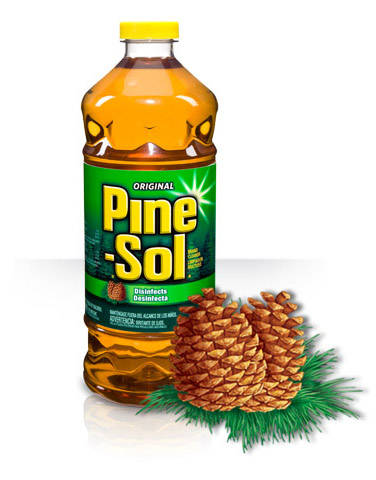
pine-solIt was a huge problem for those who were around me as I tested the fragrance. Initially, it was just a comment about “lemon.” Then, quickly, the comment turned into mutters about “Pine-Sol,” the piney-lemon household cleaning product. Less than three hours later, when Black Tourmaline was full-on, hardcore, smoky pine, there was an actual plea that I wash it off “now” or, failing that, “leave.” Though it was said with affection, my dinner companions simply couldn’t bear it any more. There was even a strangled moan about how I smelled like “toilet bowl cleaner.” (It was expressly suggested to me that I do a side-by-side comparison, because “I bet you they’re the same.”)

Green Shield Pine Toilet Bowl cleaner. Source: iHerb.com

Green Shield Pine Toilet Bowl cleaner. Source: iHerb.com

I hate to admit it, but they’re right. My skin simply doesn’t work well with Black Tourmaline for a good portion of its lifespan. In fact, the perfume’s flat, singular, pine-dominated nature somehow becomes worse by the end of the second hour. It lacks any major nuance or body, and the sillage has dropped, though apparently not enough for my dinner companions’ liking. (I was starting to get some glares at this point, and one person tried to move their chair further away.) Black Tourmaline now hovers just above the skin as a blur of incense-infused pine oil atop a thin, subtle, base layer of resinous, tarry sweetness. At the end of the third hour, a tiny whiff of soapy myrrh returns, but all that does is to create a slightly clean, room freshener impression. By the time the fifth hour rolls around, yes, I do, in fact, smell exactly like Pine-Sol “toilet bowl cleaner” mixed with black, smoky accords. Black Tourmaline sits right on the skin at this point, though the sharpness of the incense is still extremely potent when smelled up close. 

Relief is around the corner, however, when Black Tourmaline’s final drydown commences. You may not believe me when I say that Black Tourmaline turns into something truly lovely, but it does. Around the start of the seventh hour, the bloody pine note finally starts to retreat, and the other elements have a chance to compete. The birch tar and darkly sugared resins rise up from the base, and become much more noticeable. By the middle of the eighth hour, they fully join the other players on the main stage, turning Black Tourmaline into a very sweet, warm, richly smoked, resinous fragrance with dry woods and birch tar, and only a whisper of pine. There are also flickers of sweetened leather that pop up from time to time, too. Eventually, the remaining traces of pine fade away entirely, leaving only the base notes alongside the black incense. In its final moments, Black Tourmaline is merely abstract smoky, woody sweetness with a touch of tar. The whole thing was gorgeous; how I wish it had been that way from the start!

Source: spicewallpaper.blogspot.com

Source: spicewallpaper.blogspot.com

All in all, Black Tourmaline lasted just short of 11 hours on my skin. The sillage was initially very strong, and seriously forceful, but it turned much more moderate after a few hours. However, someone standing very close to you will (as I learnt) find the perfume’s projection to be quite potent and unbearably intense for the first five hours or so. Consequently, I would recommend using caution in application if you want to wear Black Tourmaline to work, and if you work in a conservative environment with perfume-sensitive co-workers. 

People’s reactions to Black Tourmaline generally tend to be enormously positive and hardly anyone seems to have had my experience with the fragrance. Take, for example, the review from Robin at Now Smell This:

The opening is a rush of spices, with plenty of pepper and cumin (other notes: cardamom, coriander, frankincense, smoked wood, oud, leather, precious woods, musk, amber, moss and patchouli). The dry down is dusty-smoky and dry, and smells like incense, smoldering logs and warm earth. There is a touch of leather, slightly scorched, and a touch of human sweat, and the slightest hint of something vaguely medicinal. Only a perfumista (or a crazy person), I suppose, could write those last two sentences and then follow with how absolutely wonderful Black Tourmaline smells?

I said Black Tourmaline was churchy, but it is a deeper and darker scent than Comme des Garçons Avignon (my own gold standard for church incense), in fact, it is more of everything than Avignon: more spice, more smoke, more wood; and while there is nothing feminine about Avignon, Black Tourmaline has a rougher, more obviously masculine slant. Black Tourmaline has a kind of swagger about it that is in stark contrast to Avignon’s austerity, and I wouldn’t be surprised if many people found it to be just too much. [¶] I love it, but I’m not sure it’s something I’d wear just anywhere.

The love fest continues on Fragrantica where there are repeated references to how the perfume is a “masterpiece” or a “piece of art.” As with the NST reviewer, it’s perhaps a little too much beautiful “art” for a couple of fans: they don’t feel they could wear Black Tourmaline all year round, or find it to be a very versatile, easy scent, no matter how much they love it. Some of the admirers get a “gothic” vibe from the fragrance, and one person thinks it conjures up images of an ancient pagan ceremony. However, a few are left a bit bewildered by such comparisons, stating that they don’t see it at all or that Black Tourmaline merely feels like a classic men’s fragrance. One commentator said he found its resemblance to Polo to be “quite discomforting.” (I don’t see the comparison to Polo at all!) A tiny handful find Black Tourmaline to be an okay scent but somewhat over-priced, especially when compared to other famously dark, smoky, black scents like Nasomatto‘s Black Afghano. Yet, as a whole, the reviews are extremely laudatory, and they’re multiplied even more so on Luckyscent where almost everyone gushes about the smoky campfire woods and incense.

Source: Wallsave.com

Source: Wallsave.com

Rare as it is, there are some vocal dissenters. On Fragrantica, only two people wholeheartedly hate Black Tourmaline, writing:

  • Oh man, I hate this, it smells like burnt rubber, or burnt wood that’s been peed on. No, no, a million times no.
  • Main thing that stands out is tar, wtf? [¶] Really why would anyone want to smell like you just got off a crew taring a roof at minimum wage?

There are only a handful of haters on Luckyscent as well. The most amusing comment comes from the woman who spent two hours trying to scrub Black Tourmaline off her skin and who loathed the fragrance so much that she thought of buying it for her ex-husband. “[I]t would be great for revenge.”

A few people on Luckyscent astutely note that you really have to have the right skin chemistry for Black Tourmaline, and I think that’s absolutely correct. My skin obviously brought out the pine, the smoke, and very little else for a good chunk of Black Tourmaline’s lifespan. I’m afraid I simply don’t like pine as a primary note, even when it is infused with incense. And, no matter how much I liked that gorgeous drydown phase, I would never spend a lot of money to smell like “toilet bowl cleaner” to people around me. However, it would probably be a different matter if I were one of the many people whose Black Tourmaline experience was almost all smoky incense mixed with some combination of dark woods, oud, leather, and spices.

Regardless of how the perfume manifested itself on my skin, you may want to test Black Tourmaline for yourself if you adore very dark, smoky, woody, somewhat masculine fragrances. Too many people have had an experience wholly different to mine, and your skin chemistry may turn Black Tourmaline into the fantastic, smoky, woody beauty that so many people adore. Black Tourmaline is not a fragrance to buy blindly, however, even if the perfume were easily available. As of this moment, it’s not — unless you buy Black Tourmaline directly from Olivier Durbano himself. In terms of retail vendors, I have the impression Luckyscent in Los Angeles is the only retailer (possibly worldwide) that carries the fragrance, but they’re not currently shipping any out until February 2014! Judging by a few of the comments on Luckyscent’s Black Tourmaline page, and my difficulty in finding any other retailers (anywhere) who sell the perfume, there seems to be something going on with both the pricing and vendor access to the fragrance. I’m afraid I have no idea of what or why.

Have you tried Black Tourmaline? If so, how was it on you?
DETAILS:
Cost & Availability: Black Tourmaline is an eau de parfum that comes only in a 100 ml/3.4 oz size and which costs €150. There seems to be an issue about its U.S. price which I’ve read was once increased from $125 to $200, but which seems to be down to $150 now on Luckyscent. Unfortunately, the latter site says it won’t or can’t ship bottles for another six months (!) until February 2014. I’ve also read in the comments there that Black Tourmaline is not available from any other retail vendor. I’m not sure if I can believe that, but I have not been able to find the perfume available for purchase anywhere else except directly through Olivier Durbano’s e-Store. It costs €150, and I believe he ships all over. Samples: I obtained my sample from Surrender to Chance where prices start at $4.99 for a 1 ml vial. Luckyscent also sells samples.

Perfume Review: Infusion d’Iris L’Eau d’Iris by Prada (Limited Edition)

Man cannot live solely on oriental perfumes, though clearly I do my best to try. Still, I recently decided to test Infusion d’Iris L’Eau d’Iris, the new flanker fragrance from Prada. The extremely wordy “Infusion d’Iris L’Eau d’Iris” (which I shall call just simply, “L’Eau d’Iris“) is a limited-edition eau de toilette which was released in March 2013 and which seems to be exclusive to a particular retailer in each country. For example, in the U.S., it is Macy’s department store; in Canada, it seems to be Holt Renfrew.

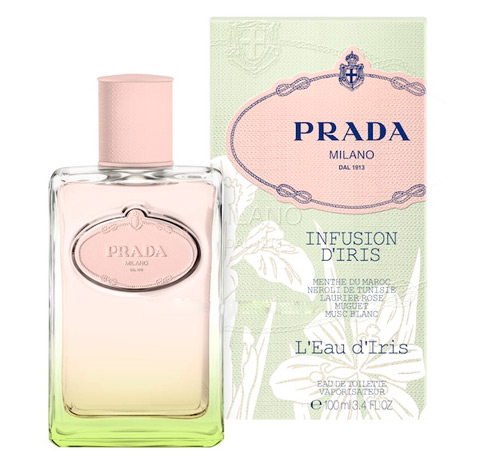
Prada Infusion d'Iris L'Eau d'IrisL’Eau d’Iris is a light-weight summer fragrance that follows on the heels of Prada’s original, 2007 hit, Infusion d’Iris. There have been a few other flankers since then, and you can read about the various versions from the men’s fragrance to the Eau Absolue (with photos of the differences in packaging or bottles) at The Perfume Shrine. Like all its siblings, L’Eau d’Iris was created by the perfumer, Daniela Roche Andrier (of Givaudan) and, according to Fragrantica, was “inspired by spring flowers and the fusing of iris and laurel in the gardens of Tuscany.” Its notes include:

Top notes: Moroccan mint, Tunisian neroli.

Heart: pink laurel bay, iris, rose, lily of the valley, orange blossom.

Base: white musk, woody notes, vanilla.

I have absolutely no idea what “pink laurel bay” smells like, and it wasn’t easy to research amidst all the references to regular bay leaves, but “laurel bay” appears to have an almond-like, powdery aroma. And, in truth, that is a large part of this very fresh, clean fragrance.

Source: Wallpaperban.com

Source: Wallpaperban.com

L’Eau d’Iris opens on my skin with a citrus note that has a faintly soapy edge, followed by white musk and hints of powdery iris. A muted touch of rose lurks around the edges, but, like everything else to do with L’Eau d’Iris, it is soft and light. Less than five minutes into the perfume’s development, the iris takes over, the citrus element fades away, and an almond note rises to the surface. It is a little powdery and smells very much like heliotrope, a note often mixed with iris to create a lightly powdered, floral aroma. As many of you know, the smell of an iris can’t be extracted from the petals, so the scent is often recreated through distillation of its root, as well as through the addition of other elements. For those of you who are unfamiliar with what “iris” smells like, the note has often been compared to boiled carrots, lipstick, or powdery violets. Sometimes, the smell is slightly rooty, if there is a lot of orris root used in the fragrance, but generally it’s a rather cool, floral note. Here, in L’Eau d’Iris, the aroma is powdery, floral, and a little like that of sweet, boiled carrots.

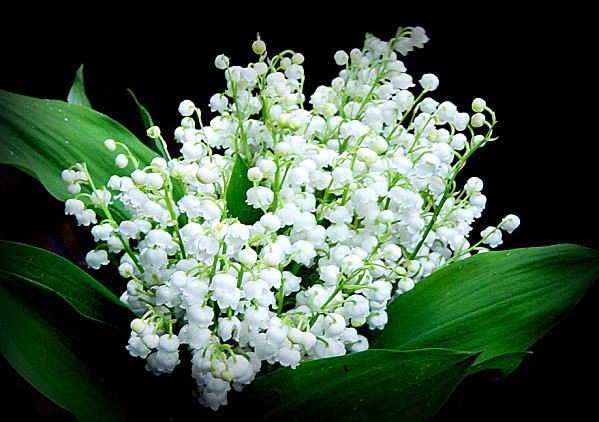
Lily of the Valley, or Muguet.

Lily of the Valley, or Muguet.

Thirty minutes into the perfume’s development, L’Eau d’Iris shifts a little. For one thing, it becomes a complete skin scent that is much harder to detect. For another, the light, green, lily of the valley note and the whisper of rose that lurked at the perfume’s edges become even more muted. Taking their place is vanilla and almonds. The vanilla note starts off being light, thin and subtle, but it soon grows stronger and combines with the laurel leaf’s almond essence to create L’Eau d’Iris’ second most dominant accord.

Other elements start to become noticeable. From the start, there was a light alcohol element lurking at the edges of the fragrance. Midway during the second hour, it grows into something chemical and synthetic that really bothered me and gave me a slight headache. I can’t pinpoint if it stems from the white musk (which is always a synthetic ingredient), or from something else. In addition, the powder takes on a sour nuance that I found unpleasant. The second hour also saw the emergence of an amorphous, vague “woody” undertone that was very beige and slightly synthetic. It makes the iris note feel a little more rooty and dry, less purely floral; it also helps to cut through the vanilla and almond.

Source: 123rf.com

Source: 123rf.com

As a whole, L’Eau d’Iris was primarily a simple fragrance of powdered iris, vanilla, and clean musk. There are tiny flickers of muguet (or lily of the valley) that lurk in the background, but they are always very subtle. Equally subtle is the light soapiness underlying the scent; it’s almost more of an indirect thing that simply adds to the overall impression of a fresh, clean scent. In its final moments, L’Eau d’Iris was a sheer, abstract, lightly powdered, floral, iris fragrance with a subtle carrot-like nuance, soapy musk, and the merest suggestion of woodiness. At no time did I smell mint, orange blossom, or neroli. On occasion, the fragrance did evoke the scent of makeup powder. All in all, L’Eau d’Iris lasted just short of 5.5 hours on my skin, with moderate sillage at first that quickly dropped even further to become a virtual veil on the skin. At times, it was extremely hard to detect in its sheerness and lightness. I realise that L’Eau d’Iris is meant to be a light “eau” version of an eau de toilette, but I’m not the only one who thought the scent was extremely weak.

Take, for example, the review from Makeup Stash which is the only in-depth assessment that I could find for L’Eau d’Iris. The blogger described the scent as “fleeting,” and seemed singularly unimpressed with the perfume as a whole. (I share her feelings.) The review reads, in part, as follows:

The pink laurel carries an almond hint, while the iris is clearly powdery-floral. […][¶] Pleasantly powdery with a high floral note, I could barely discern the mint of Morocco (meant to illuminate the composition) whose faint whiff edges the scent. When I first learnt of this fragrance, I was intrigued and pleased by the unusual inclusion of the mint. I’d expected its presence to be more apparently – intrusive, even – so the barely-there nature was a bit of a disappointment. Still, it’s nice to have this lively sprinkle.

Unfortunately, the scent disappears very quickly. In this aspect, it surely lives up to its ephemeral inspiration. While it is an agreeable scent and very likely a crowd-pleaser, it is more fleeting than I’d expected it to be. The brand depicts it as being ‘transient yet unforgettable’ but the latter part is hard to live up to, if the fragrance doesn’t last long enough for me to grasp its essence. In my many days of using it, it’s still hovering on the periphery of memorable. Perhaps a scent memory moment will hit me one day and it’ll finally be of recollective substance.

I didn’t smell mint at all, but I completely agree on the gist of her review: L’Eau d’Iris has a pleasant, transient and wholly forgettable nature.

On Fragrantica, in contrast, there is quite a bit of love for L’Eau d’Iris. And, in fact, a lot of people detected the mint note, with one commentator writing: “This is too boring. It’s fresh, sweet and minty. The most dominant notes are iris and mint.” There seems to be a split on another issue, namely the soapiness. One person called L’Eau d’Iris “the soapiest perfume I have ever smelled,” though she loved it. Another said it was not as soapy or dry as the original, Infusion d’Iris, but more floral and green. One couldn’t stand the sour baby powder note that she detected, while another loved all the powder. But no-one talked about orange blossoms or neroli. I have to say, I have a loathing of extremely soapy fragrances, but I thought the note was quite manageable in L’Eau d’Iris. I struggled much more with the synthetic white musk.

All in all, I think that L’Eau d’Iris is a perfume that will appeal to those who like light, fresh, clean, soft, powdery, soapy florals of an extremely unobtrusive nature. It is the furthest thing from my personal cup of tea, but then I’m not one for iris scents in general, let alone something like this. However, if I were to put myself in the shoes of someone who likes these sorts of fragrances, I would probably write a review like that of the Fragrantica commentator, “Vintage_Scent“:

This is my new Spring in a bottle! It is soft pastels and delicate pink petals all riding on a fluffy, powdery cloud! The iris is just as beautiful as ever, but it is definately a light-as-a-feather soft pastel iris. […] The mint is light, but it is always there, all the way through the drydown, which is simply sublime. The drydown is probably my favorite part. It is so soft and angelic, like angels’s wings. […]  I must say that midway through this perfume has to be the soapiest perfume I have ever smelled…then the lovliest iris blooms at the end in the most romantic way. Beautiful.

I can completely see how someone who adores fresh, clean, soft florals might view the fragrance that way. At the same time, I have to caution those who may not be a fan of powdery fragrances, especially as the note turned a little sour on someone other than myself. And if you’re looking for a perfume with sillage, forget about it!

I’m trying to be fair to L’Eau d’Iris, but I really don’t think it’s particularly special or noteworthy. However, if you love Prada’s hugely popular original, Infusion d’Iris, or if you love powdery, clean scents in general, then it is probably worth a sniff.


DETAILS:
Cost & Availability: Infusion d’Iris L’Eau d’Iris is a Limited Edition Eau de Toilette. It is only available in 3.4 oz/100 ml. In the U.S.: the fragrance is exclusive to Macy’s where it retails for $77. Macy’s has free domestic shipping on orders over $50. Nowhere else will sell this particular, limited-edition flanker — not Nordstrom, not Sephora, not Neiman Marcus. Also, I don’t know for how long this perfume will be available, or whether it will be common to all Macy’s brick-and-mortar stores. Outside the U.S.: In Canada, I’ve read that the perfume is available at Holt Renfrew. For other countries, I honestly have no clue where L’Eau d’Iris may be sold. It seems to be exclusive to one retailer in each country. Oddly, I don’t see it listed even on Prada’s own website. It has to be available in Prada boutiques, however, so you may want to check the Store Locator guide on the company’s website or to call one of their stores near you. Samples: The Perfumed Court sells samples starting at $3 for a 1 ml vial.

Perfume Review – Mademoiselle Piguet by Robert Piguet

I was incredibly excited to try Robert Piguet‘s Mademoiselle Piguet, one of the company’s 2012 five-piece Nouvelle Collection. “Mademoiselle” (as the company simply calls it) is supposed to be “part Lolita and part Louise Brooks,” and a tribute to orange blossoms. I have a huge soft spot for the Robert Piguet brand, as a whole, for personal, childhood, historical and nostalgic reasons. In fact, I was practically weaned on Fracas, alongside YSL‘s Opium. Plus, I love orange notes and orange blossoms. So something that seemed like a lighter but orange blossom-based version of Fracas had to be fantastic, right? It had to be a guaranteed safe bet for me and a shoo-in, right? How wrong one can be….

Mademoiselle PiguetMademoiselle Piguet is a floral eau de parfum that was released in 2012 and created by star perfumer, Aurélien Guichard. Robert Piguet describes Mademoiselle as follows:

She is delicate and irresistible, innocent and sultry, part Lolita and part Louise Brooks. With Mademoiselle Piguet, Robert Piguet Parfums has chosen to pay tribute to both the romantic and sensual associations of orange blossom. Mademoiselle Piguet is a new generation floral fragrance, but its alluring character makes it a perfect addition to the Piguet family of feminine masterpieces.

The notes, as compiled from both Fragrantica and the Robert Piguet website, seem to be:

Top note is bergamot; middle note is orange blossom complimented by almond and apricot tones; base note is tonka bean.

Mademoiselle Piguet opens on my skin with a deafening salvo of green. The note is so sharp, pungent and abrasive that it makes my head spin. This is an orange blossom that is much closer to the most bitterly green of bigarade or petitgrain, so green that is completely raw, and far from the delicate sensuality of the flowers. In some crazy way, it almost feels like the greenness abrasiveness of galbanum. A minute later, the perfume suddenly turns incredibly sweet. It’s bewildering to have so much raw, sharply bitter, petitgrain-type orange alongside so much sweetness that a dentist would be alarmed. As the moments pass, the initial toxic blast softens, a little, as the sugary syrup grows and a hint of the orange blossoms emerges amongst all that neroli. It made my teeth hurt.

Source: Kongregate.com

Source: Kongregate.com

Alas, another thing rears its head: a hugely synthetic note is exactly like mosquito repellent. It is also oddly mentholated, leading me to imagine an orange blossom version of Serge LutensTubereuse Criminelle, only one combined with tropical bug spray, saccharine levels of sweetness, and nuclear amounts of bitter greenness. I suspect that, even if the bug spray doesn’t show up on everyone’s skin, many will find the sweetness of Mademoiselle Piguet to be extremely cloying, especially when the vanilla base starts to stir.

I have to admit, at first, I found the strange polarity and contrasts of Mademoiselle Piguet to be quite fascinating — even if only intellectually — once the DEET-like, mentholated aspect stopped beating me over the head. I said, “at first.” My interest didn’t last long because, frankly, there wasn’t a huge amount more to Mademoiselle Piguet than sugary-sweet orange blossoms, bug spray, bitter green undertones, and a subtle vanilla base. That truly was about it. For hours and hours, and hours…..

In fairness, there were some minute, microscopic changes to the perfume. By the end of the third hour, the bug spray element did die down to a mere squeak, and I did detect the smallest iota of almonds fleetingly in the middle of the fourth hour. Yes, the green undertone eventually faded, around the sixth hour. And the perfume’s sillage did change quite profoundly: from a huge, enormous wallop in the first 20 minutes, to something significantly softer by the 90 minute mark, before dropping further with subsequent hours.

Nonetheless, the changes were of degree, not of kind. Mademoiselle Piguet’s core essence never budged, remaining in one constant, linear line until the bitter end when it became just a faint trace of orange blossoms with a slightly powdered vanilla. It took 12.75 hours for it to die on my voracious, perfume-consuming skin — a sure testament to the synthetics underlying it.

There is a vast split in opinion about Mademoiselle Piguet. On Fragrantica, posters seem in two opposite camps, with people either adoring the pure blast of “orange blossom absolute,” or despising it with the fiery passion of a thousand suns. A small sampling of thoughts:

  • Not for me, this one! Something sweet and cloying and artificial IMHO. Even if I am not fond of a fragrance, I usually give it time for both of us to calm down. Couldn’t this time. A scrubber.
  • This will definitely not be on my buy list; the sniff test seemed OK at best, but on my skin it was terrible. An overly sweet, overwhelming floral that had a very synthetic tone.
  • Medicinal start, but a semi-sweet medicine, which is at least more appealing than a straight bitter herbal. I don’t believe floral/woody/musk is the correct classification for this – it seems more like an oriental woody. […] for me, is just tolerable. Definitely a try before you buy.
  • Beautiful deliciously sweet honeyed Orange Blossoms in full bloom! Stunning!!! I love this so much, must get a bottle asap. If your an Orange Blossom fan, please do try this, it is so sweet its like honey has been added for good measure. I find this is incredibly strong & long lasting, which is also a huge plus.
  • Love the warm powdery scent with subtle peach undertone. Starts off a bit chemical but warms up quickly. Agree with others that it could be classidied as a milky tuberose.
  •  it’s overwhelming me in the most unpleasant way. I tested a small sample upon my wrist hours ago and the florals attacked my nose in an aggressive manner. I can’t believe there are only three notes in this bottle of juice. I smell florals, on top of florals, on top of florals, in the top, middle and base notes. The smell is really intense but not in an invigorating manner. [… The] florals in this perfume are so heavily dealt in this fragrance to the point that it’s a big turn-off instead of a memorable turn-on. It smells more like an air freshener that has been sprayed way too many times. […] Please don’t buy this one blindly. It’s an experience you’re likely to never forget.

I must say, I don’t smell any tuberose in this as a few of the Fragrantica commentators found, nor any other florals or peach. I do, however, agree that Mademoiselle Piguet hardly seems to be a “Floral Woody Musk,” as Fragrantica contends.

There aren’t a ton of in-depth, blog reviews for Mademoiselle Piguet. The Perfume Magazine loved it, calling it a “head-turning” and one of the most feminine perfumes the reviewer has smelled in years, before adding that it was perfect for brides or for something like a Cotillion. The Perfume Posse‘s Ann liked it quite a bit, despite finding its start to be synthetic:

Mademoiselle Piguet was quite nice on my skin, bergamot and orange blossom making pretty at the start, but easing later into some milky warmth, courtesy of the tonka. No hint of citrusy tang here; the OB is sweetened and smooth, almost candied. And that little something I mentioned above [the synthetic note] bothered me for a moment and then it was gone. […] Mademoiselle Piguet isn’t going to knock any orange blossom favorites out of rotation at my house, but it has a sweet, romantic, uncomplicated vibe that’s pleasing.

Finally, the Persolaise blog received samples of the full Nouvelle Collection from Robert Piguet back in 2012 and seemed to enjoy Mademoiselle more than the rest, writing:

Mademoiselle is the instant smile-inducer. A soft, sweet, pretty-as-daisies citrus-floral (complete with aldehydes and a powdery, vanillic base) it radiates naive charm and an almost adolescent optimism. In those selfish moments when parents of girls hope that their little princesses won’t ever grow up, this is probably the scent that accompanies their tender imaginings.

I wish I could like it, especially given my huge soft spot for Robert Piguet. The most positive thing I can say is that the longevity is extraordinary. But I would never recommend Mademoiselle Piguet — even for those who like incredibly sweet, sugary florals — without a definite skin test first. Please, this is not one to buy blindly. Ever.

DETAILS:
Cost & Availability: Mademoiselle Piguet is an eau de parfum that comes in a 100 ml/3.4 oz bottle and which costs $150 or £130.00. It is available from the Robert Piguet website, Neiman Marcus and Bergdorf Goodman. I don’t see it listed on the Saks or Nordstrom websites. In Canada, you can probably go through The Perfume Shoppe which has a Canadian branch. You should drop them an email as I can only see the U.S. site. In the UK, Mademoiselle Piguet costs £130.00, and can be found at Harvey Nichols and Liberty London. I don’t see it on the Harrod’s website. In France, Robert Piguet products are usually carried at Printemps or Au Bon Marché. In Australia, you can find Mademoiselle at Libertine where it costs AUS$190. As a general rule, Robert Piguet perfumes can be found at a discount price on eBay. Samples: You can order samples of Mademoiselle Piguet from various sites, including eBay. I bought mine from Surrender to Chance where prices start at $4.99 for a 1 ml vial.

Perfume Review: Ramon Monegal Pure Mariposa for Neiman Marcus

Spring is in the air, though clearly some parts of the world don’t seem to be so fortunate. Nonetheless, it seemed to be a good time to try out a few light, fresh fragrances that epitomize the upcoming season. One, in particular, caught my attention: Pure Mariposa, the new perfume created by the Spanish niche perfume house of Ramon Monegal for the American luxury department store, Neiman Marcus. Pure Mariposa is a bespoke perfume exclusive to the store and was released in February 2013.

One Neiman Marcus store with a floating butterfly decor. Source: Flickr.

One Neiman Marcus store with a floating butterfly decor. Source: Flickr.

Neiman Marcus' butterflies.

Neiman Marcus’ butterflies.

“Mariposa” means butterfly in Spanish and is not only a reference to Neiman Marcus’ happy, bright symbol of butterflies but the perfume’s point of inspiration.

In the press release for the perfume, Ramon Monegal said: The butterfly is an extraordinary creature that embodies many of the values that motivate me when I look for inspiration to fashion an olfactory tale in the form of a perfume.”  That “olfactory tale” seems to be one of flowery nectar in an airy, ozonic green forest:

Pure Mariposa will offer a floral-nectar accord with a festive tone in a dew-covered green forest, surrounded by a breeze of ozonic air, on a rich bottom accord of amber and musk.

Ramon Monegal Pure Mariposa

Neiman Marcus describes this as a “fruity, green-floral, woody scent” and lists the notes with great descriptive flair. Since it is their perfume, let’s go with their version, but note how Ramon Monegal or Neiman Marcus is trying to cover every possible base or category of perfumery imaginable:

Top Note

  • Fresh festive colorful: orange, grapefruit, bergamot.
  • Fruity vital, cheerful: yuzu, black currant, plum.
  • Ozonic pure, graceful: helional, melonal, calone, ultrazur. (molecules)

Middle Note

  • Green natural: oakmoss, grass accord, fig.
  • Floral rich, elegant: Osmanthus, jasmine, lily of the valley, rose wardia, tuberose.

Base Note

  • Woody powerful, harmonious: sandalwood, cashmeran (m), iris, anchouli (m). 
  • Silky sophisticated, majestic: peach, tonka bean, amber.

I assume the “(m)” abbreviation stands for “molecules” but the reference to “anchouli” made me blink, so I turned to Fragrantica. To my relief, it doesn’t seem to stand for some sort of anchovy oil. Instead, “anchouli” seems to be either a typo (like another on Neiman Marcus’ page) or a reference to some sort of synthetic “patchouli.”

I’m not a fan of synthetics — and particularly not of calone — so the listing of six different aromachemicals gave me great pause. I approached Pure Mariposa with some trepidation and first just gave the small decant a sniff. It was absolutely gorgeous in the bottle! Let me repeat that again: gorgeous! A beautiful scent with fresh, sweet, fruited and bright green notes. I could detect grapefruit that was yellow and sweet, not red and tart, along with fresh yuzu, juicy, sun-ripened yellow citrus, sweet (non-artificial) melon, sweetly green lily-of-the-valley, and fig. There was also that cheerful, happy note of freshly cut grass that is so evocative of the summer and sunshine. I was thrilled, and quite relieved.

Then, I put it on my skin. And it was a very different story…. A huge waft of synthetics and chemicals immediately hit my nose, followed quickly by incredibly dry, pungent, bitter oakmoss and equally bitter grass. There were also a panoply of sour notes from the citrus elements which contrasted strongly with the sweetness of the melonal aromachemical. The pungently dry aspects of mineralized oakmoss were side by side with sweet melon and sour citrus —  all on a base of synthetics and artificially peppered woods. Soapy lily-of-the-valley lurked in the corners, adding a different sort of green and white impression to the whole ghastly mélange.

I don’t know if my skin magnifies synthetic aromachemicals or if there is simply too damn many of them in Pure Mariposa, but the contrast between the beautiful brightness of the perfume in the bottle and its manifestation on my skin was a huge disappointment. That robust underpinning of aromachemicals remained long after the perfume’s opening changed to something much less bitter and dry, and much more melon-y sweet, metallic and airily green.

Ten minutes in, the perfume became simultaneously even more bitter but, also, more sweet. The very dusty, dry, grey mineralized feel of the oakmoss competed with the green lily-of-the-valley’s sweetness, the freshness of yellow citrus and the feel of a green honeydew melon mounted on aquatic underpinnings of calone. The calone is just brutally strong in this perfume and truly dominates everything at its heart, while the melonal runs over the top of everything like a bulldozer. Yet, at the same time, there are synthetically peppered woods with a definite metallic, somewhat alcohol-like undertone.

Two hours in, I’m surrounded by a cloud of calone and melonal: aquatic melon freshness is everywhere. Within the cloud projecting several feet from my arm, the bitterness of very dry oakmoss remains but it’s underneath and on the skin, not wafting around. Some vaguely amorphous, abstract floral notes dance around, joined by occasional, fleeting flickers of powder and soap. At the same time, there is that annoying metallic, alcohol note that pops up every now and then, like a ghost flitting about under the endless mushroom cloud of fresh melon. The metallic note is not continuously present, but it never completely leaves, either. My mind is utterly confused by the endless contrast of bitter and sweet, dry and fresh, sour and aquatic, flowers and alcohol.

And the perfume remained that way for hours and hours without any fundamental change. The sillage dropped after about four hours but, like many perfumes with aromachemicals, it has persistent longevity. On my perfume-consuming skin, it lasted about 9 hours until I simply couldn’t take it any more and desperately sought a change. Yes, I washed it off. There is only so much melon and metallic alcohol a person can take, after all!

On Fragrantica, there is only one review thus far for Pure Mariposa and it’s not an endorsement:

fresh but weird scent…drydown..is a cloying nutty smoky (think ur fireplace and throw orange peels in and let them dry out…took days to take off my skin…good last power..but the scent is kinda like beautiful(C KLEIN)..but with burnt notes…im not fond of.

I’m sad to say that I think their experience was still better than mine.

For the sake of fairness, I should point you to The Non-Blonde who received an early press sample and who had a very positive experience with the perfume, though she shared my initial trepidation when reading the large list of synthetics in the notes:

Ramon Monegal chose to also list several of the synthetic molecules: helional (a green hay-like grassy odor), melonal (excatly [sic] what it says), calone (usually the worst marine-ozonic offender), ultrazur (another fresh-ozonic beast, sweeter and greener than calone). It sounds like a warning sign and it took all my trust in Ramon Monegal’s perfumery skill and style to make me take that first spritz on my wrist.

I shouldn’t have worried. While Pure Mariposa opens with a burst of sharp and fresh citrus oil, I don’t smell the sea or any rotten melons; just air from a window opened early in the morning, letting in cool air. It’s a mix of bright yellow and bright green: the freshly mowed grass, a glass of freshly squeezed grapefruit juice, meyer lemons arranged in a bowl on the table. Then things become more floral as the day (and Pure Mariposa) starts to unfold. New blossoms open every day, white, pink, and orange. The heart is rather abstract, I can’t say “here’s muguet! there’s rose!”, but it is very floral, slightly honeyed (those fresh water molecules are gone and forgotten), juicy and a bit pulpy. I do smell quite a bit of peach and it goes hand in hand with a strong tuberose note. There’s a point that Mariposa becomes a blend of powder and tuberose, very feminine on my skin (dry and woody on the husband) and if you over spray it really takes over the room.

On her skin, Ramon Monegal lasted 16 hours. In my opinion, that is further testament to the synthetic nature of the perfume since we all know that synthetics can make a perfume last forever — even when you wish the perfume would die, and die now.

Clearly, something about my skin chemistry seems to turn aromachemicals into something pretty extreme. I was with two people who aren’t perfumistas, but who absolutely loved the scent of Pure Mariposa that pulsated in the air like a sound wave. They found it “fresh and sweet.” (Apparently, they love melonal more than I do.) Nonetheless, when one of them smelled it on my arm, they grimaced.

My reviews are based solely my personal (and, therefore, obviously subjective) experience with a scent. And, on my skin, there is something incredibly artificial, chemical, and unpleasant about Pure Mariposa. If you love very fresh, melon-y, floral, green, woody fragrances and if you can’t smell any metallic undertone to calone’s aquatic notes or aren’t sensitive to aromachemicals in general, then this may be one for you to try. But make sure you don’t just smell it in the bottle or on a strip of paper. This is one you need to actually apply to your skin! Also, beware the amount that you apply and perhaps reconsider wearing it to the office. As the Non-Blonde noted, this is a “robust” scent, so “be careful if you’re around grumpy office people who don’t appreciate this colorful scented presence.”

Personally, I wouldn’t recommend this with a ten-foot pole unless you know ahead of time that you like synthetics, especially melonal and calone. Not for $200 a bottle. Oh, did I not mention the cost? It’s $200 for a 1.7 ounce bottle of eau de parfum. I won’t bring up Neiman Marcus’ pejorative nickname, but I think those of you outside America should count yourselves fortunate that this exclusive item is not available for shipping overseas.

All in all, a huge disappointment. 

DETAILS:
Pure Mariposa is an Eau de Parfum that comes only in a 1.7 oz/50 ml bottle and costs $200. It is exclusive to Neiman Marcus. Unfortunately, the department store will not ship or export the perfume outside of the United States. I went to the page and tried numerous different countries in the “Shipping to” link at the top, and each time received a message in the lower right-hand corner stating, “We are sorry, but we are unable to ship this item to _______[insert country’s name].” As for samples, I don’t see the perfume listed yet on any of the US perfume decanting sites.