Perfume Reviews – Jo Malone “Sugar & Spice” Collection: Ginger Biscuit and Bitter Orange & Chocolate

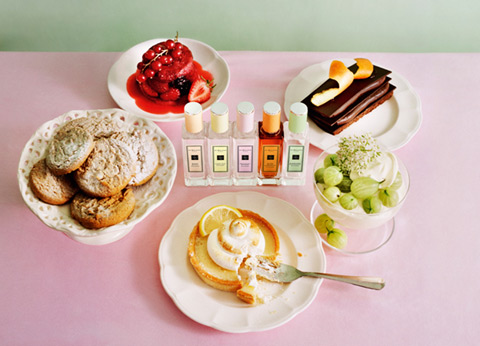
Jo Malone just launched her limited-edition Spring collection of perfumes inspired by British cakes and desserts. The collection is called “Sugar & Spice” and numbers five fragrances in all, each in the super light cologne concentration.

Jo Malone Sugar and Spice Collection

Source: Fragrantica

According to Basenotes, the perfumer is Christine Nagel of Mane who “spent time with the Jo Malone Creative Studio eating cake in Fortnum and Masons, Claridges and various other fine cake establishments to familiarise herself with the local sweet treats.” The line includes: Redcurrant & Cream, Ginger Biscuit, Lemon Tart, Bitter Orange & Chocolate and Elderflower & Gooseberry.
Source: Fragrantica

Source: Fragrantica

The company has really outdone itself with the campaign for this collection. There is a really fun, bubbly, happy video (see midway down below) featuring Adam Ant’s famous 80s hit, Goody Two Shoes, and also, just in case you missed the food aspects to the collection, the company also released four dessert recipes to accompany the fragrances. (I couldn’t find one for Bitter Orange & Chocolate.) You can find the compiled list of all of them at The Daily Mail, though I will provide the direct link to the appropriate recipe in each fragrance’s discussion section.

I have samples of all five colognes, and I’ll review two of them — Ginger Biscuit and Bitter Orange & Chocolate — in this post. You can find my reviews for the other three perfumes in the collection — Elderflower & Gooseberry, Lemon Tart, and Redcurrant & Cream — here.

GINGER BISCUIT:

The Jo Malone website describes Ginger Biscuit as follows:

Just-baked biscuit. Spiced with ginger, nutmeg and cinnamon, melting into caramel. Butter-crumbly with roasted hazelnuts. Warmed by tonka bean and vanilla. Irresistible.
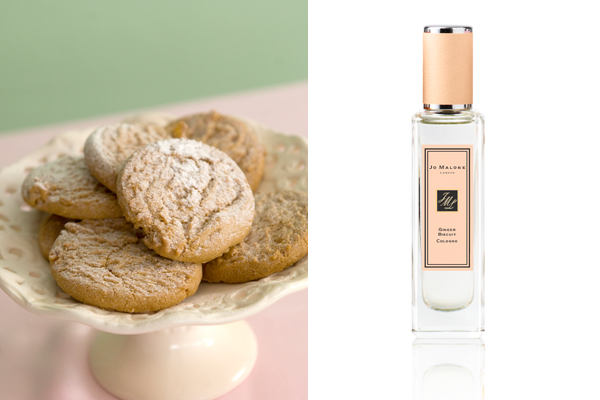
Source: The Style Insider.com.

Source: The Style Insider.com.

According to Basenotes, the perfumer, Christine Nagel, had the following vision in mind for the fragrance:

‘I wanted to recreate the equivalent deliciousness of a just baked biscuit enlivened with grated ginger.’ says Nagel, ‘Texture was important in this fragrance; the sharp natural note of ginger is set against the sensation of a baked, crumbly biscuit.’

Notes include ginger, nutmeg and cinnamon, caramel, roasted hazelnuts, tonka bean and vanilla.

Ginger Biscuit opens on my skin with a strong note of aldehydes. You can read more about aldehydes and the role they play in perfumery in the Glossary linked at the very top of the page, but, in a nutshell and the simplest terms, aldehydes smell soapy and/or waxy. Here, both aspects are present, though the soap eventually fades after about ten minutes. In those opening minutes, there is also the smell of warm cookies. There are definite and strong notes of vanilla, followed soon thereafter by a light touch hazelnut. Ginger Biscuit smells essentially just like a cookie or biscuit candle, only about a thousand times milder and lighter. 

Unfortunately, soon thereafter, something else becomes much more dominant than hazelnut or sweet cookies. There is now a strong note of alcohol — as in rubbing alcohol. Its sharpness makes me think that the “ginger” component is extremely artificial and synthetic. While you can smell ginger, fleetingly, underneath or around it, the note is much more like disinfectant mixed in with vanilla.

I’m rather horrified. It feels exactly like you’ve gone to the doctor’s office and the nurse has swabbed your arm before taking blood with some antiseptic, except, here, it happens to be cloaked in cheap vanilla. If this is “ginger,” then you can get much more genuine and natural-smelling ginger in some of the pre-packaged jars in your supermarket.

On the barely more positive side, the whole damn perfume is so bloody light and ephemeral, you have to practically douse yourself and wolf at your arm to have much hope of smelling anything detailed. And I’m talking about the very first few minutes here! From a distance of about a foot away, you can smell some extremely generic wafts of vanilla and rubbing alcohol. Further than that, and I wouldn’t count on it for the average spray or two.

After the first twenty minutes, the perfume’s low sillage becomes even less. Then, thankfully, shortly before the second hour, the whole thing dies away entirely. It never changed much beyond the main vanilla and alcohol scent I described above, adding a whole new twist on simple, minimalistic and linear.

Lest it was not clear from this review, I think this is a horribly cheap-smelling, synthetic fragrance. I find it revolting, and I think even Bath & Body Works has better cookie or vanilla “fragrance sprays.” They cost about $14 for 8 oz which is about 7 more ounces than this stuff. For example, one of their vanilla fragrance sprays is Warm Vanilla Sugar. It doesn’t have “ginger” in it but, if we’re using Ms. Nagel’s definition of “ginger,” that’s just as well. I’ve smelled a lot of ginger in a lot of perfumes, and what’s in Ginger Biscuit does not seem at all like real, genuine-smelling, good ginger but, rather, like something concocted in a lab. Warm Vanilla Sugar is hardly the best vanilla cookie scent I’ve tried but it’s extremely affordable, lacks the screechingly sharp disinfectant note, and is a damn sight better than Ginger Biscuit, in my opinion. Plus, the Bath & Body Works fragrances don’t have a soapy undertone in the opening minutes.

I cannot believe Jo Malone is asking $60 for this. And for a miniscule bottle, to boot! Outrageous.

To wipe away the bad taste of cheap chemicals, I suggest watching the wonderful, incredibly fun, bubbly video launched as part of the Jo Malone ad campaign for the “Sugar and Spice” collection. It shows all the makeup and food they used in a “behind the scenes” look. Plus, the classic Adam Ant song is always an incredibly peppy and cheerful way to brighten your day:

Finally, if the perfume isn’t your cup of tea (and I really hope it isn’t), you can always try making the recipe for Stem Ginger Biscuits which can be found at this Daily Mail page.

BITTER ORANGE & CHOCOLATE:

Jo Malone’s website describes Bitter Orange & Chocolate as follows:

The bite of bitter orange, layered with dark chocolate.  Orange peel counterpoised with warm, powdery cocoa, milky coconut and coumarin.  Sumptuous and addictive.

Basenotes quotes Nagel as saying,  

[this fragrance is] very special and unexpected. Orange is a classic raw material for a perfumer so we chose to shake things up with a mix of bitter and sweet orange notes. When combined with the chocolate many interesting qualities began to develop. The chocolate is dark, powdery and creamy but the orange adds energy and bite.

Source: Jo Malone.

Source: Jo Malone.

Bitter Orange & Chocolate opens with an absolutely gorgeous note of rich orange peel and the darkest of bitter chocolate. The orange is sweet, heady and reminiscent of the Seville oranges used in marmalade, only more slightly sugared. It is mouth-watering, delicious, and a simply lovely, lovely note! The chocolate is simultaneously like the dark slabs used in baking but, after ten minutes, it’s also like hot chocolate.

As time passes, the chocolate note starts to dominate, adding an occasionally dusty cocoa powder appearance to its other two faces. The orange recedes (alas) to the background, popping up in visibility for brief moments here or there, but generally content to let the chocolate take the lead in this dance. I don’t smell any coconut, milky or otherwise. After thirty minutes, there is the vaguest hint of coumarin that starts to pop up. This version of it is sweet and faintly hay-like, but also with vanilla undertones. The coumarin is very subtle, yet it adds an interesting subtext of dryness to counter the sweet overtones. In its final stage, the perfume turns into a sheer veil of powdered chocolate with some coumarin.  

The whole thing is very light, sheer and subtle, with minimal projection. You can detect definite whiffs of it in the opening minutes from about half a foot away. Perhaps less. Soon thereafter, you can still smell it if you bring your arm a few inches away from your nose. At the thirty minute mark, you have to put your wrist right under your nose to detect it, and it becomes even more minimal after that. Its duration was much shorter than some of the fragrances in the line: the fragrance died away entirely after about 1.5 hours.

All in all, Bitter Orange & Chocolate was my favorite out of the collection. I say that not only because I have an oft-repeated love for orange notes but, also, because this fragrance lacked some of the serious deficiencies of the others in the line. It was neither too, too sweet, nor too artificial and chemical-smelling. There were no notes of sharp disinfectant, soap, or synthetics. It was lovely and well-balanced. It’s not a particularly complicated scent — but, then, it wasn’t trying to be.   

The problem is that $60 is a lot for a fragrance that is both very simple and of very short duration. Bitter Orange & Chocolate lasted around 1.5 hours on me, and was barely detectable for much of that time unless I jammed my arm under my nose. Some people don’t mind re-application of their scents, but a 90-minute benchmark requires a lot of re-spraying! Even if someone has skin that doesn’t go through perfume as quickly as mine, Jo Malone fragrances are NOT known for their longevity as a whole. So, when your $60 bottle is a tiny 1 oz., those constant re-applications will finish things off quickly and makes the perfume a bit more costly than it might otherwise appear.

I read somewhere that Jo Malone representatives suggest layering some of these scents with others from her Tea Fragrance Blends collection. That’s fine, and should help in adding some minor modicum of complexity or depth to some of the scents. The problem is, that Tea collection was from 2011 and is no longer available. But even if it were, or even if you used the current Earl Grey & Cucumber fragrance (which is all that remains available from that collection), perfumes can and should be judged on their own merits. They should not be assessed based on how they smell by buying another $60 bottle to help things along. Besides, I highly doubt that layering would significantly change the duration problem.

Like all the fragrances in the collection, Bitter Orange & Chocolate doesn’t suit my personal style or taste, but it is definitely the one I would recommend the most out of the five. You can find my reviews for the other three fragrances in the collection here.

DETAILS:
Cost & Availability: Each of the colognes in the range costs $60. There is only one size: a very tiny 30 ml/1 fl. oz. As noted earlier, the set is a limited-edition release, but I have no idea how long “limited-edition” means in the Malone world and when they will be removed. Each fragrance can be purchased directly from the Jo Malone website which also offers free shipping “and the fragrance samples of your choice at checkout.” I don’t know how many samples you can get. You can also find the Sugar & Spice Collection at various stores. For example, here is Bitter Orange & Chocolate at Neiman Marcus (with the other perfumes in the series being listed and linked at the bottom of the page). Bergdorf Goodman also carries the full line. Unfortunately, according to a note on their page, neither Bergdorf nor Neiman Marcus ships to Canada. You can also find the collection at Nordstrom. Bloomingdales carries the whole line, along with some sort of Bonus Offer as well.
If you want to try out samples, you can find them at Surrender to Chance which is where I purchased my set. That set is currently sold out, but you can purchase samples of each individual fragrance starting at $2.99 for the smallest size (1/2 a ml vial). I highly recommend that you sign up for Surrender to Chance’s email and newsletter as they send out their monthly discount codes. If you’re interested in trying out the Malone fragrances (or any perfumes from StC, for that matter), here are the codes for March: 5% off orders with the code: nomoresnow. However, orders over $75 can get 8% off with the code: wewantspring.  Shipping for all orders of any size within the US is $2.95. Due to the massive increase in international shipping rates by the US Postal Service, international shipping has gone up everywhere. At Surrender to Chance, it is — alas — now $12.95 for all orders under $150.

Perfume Reviews – Jo Malone “Sugar & Spice” Collection: Redcurrants & Cream, Elderflower & Gooseberry; and Lemon Tart

Jo Malone just launched her limited-edition Spring collection of perfumes inspired by British cakes and desserts. The collection is called “Sugar & Spice” and numbers five fragrances in all, each in cologne concentration.

Jo Malone Sugar and Spice Collection

Source: Fragrantica

According to Basenotes, the perfumer is Christine Nagel of Mane who “spent time with the Jo Malone Creative Studio eating cake in Fortnum and Masons, Claridges and various other fine cake establishments to familiarise herself with the local sweet treats. The line includes: Redcurrant & Cream, Ginger Biscuit, Lemon Tart, Bitter Orange & Chocolate and Elderflower & Gooseberry.” 

Source: Fragrantica

Source: Fragrantica

The company has really outdone itself with the campaign for this collection. There is a really fun, bubbly, happy video (see midway down below) featuring Adam Ant’s famous 80s hit, Goody Two Shoes, and also, just in case you missed the food aspects to the collection, the company also released dessert recipes to accompany four of the fragrances. (I couldn’t find one for Bitter Orange & Chocolate.) You can find the compiled list of all of the recipes at The Daily Mail, though I will provide the direct link to the appropriate recipe in each fragrance’s discussion section.

I have samples of all five colognes, and I’ll review three of them — Elderflower & Gooseberry, Lemon Tart, and Redcurrant & Cream — in this post. You can find my review of Ginger Biscuit and Bitter Orange & Chocolate here.

REDCURRANT & CREAM:

The company’s website describes Redcurrant & Cream Cologne as “[a] summer pudding. Sharp-scarlet juices of redcurrants, lush strawberries and raspberries rippling through creamy musk. Vivacious and enticing.”

According to Basenotes,

the fragrance uses a molecular extraction technique, exclusive to Mane, to extract notes from red fruits such as strawberries and raspberries, which cannot be obtained with traditional methods. Nagel likens the technology to a pianist having a piano with some new notes on it (the same technique was used by Mane to create the fig notes for Womanity.)

The perfume smells exactly as described: redcurrants, strawberries, and raspberries with a gentle touch of light musk. It opens with a definite flash of red, as the fruits gently swirl in a gauzy, sheer veil above the skin. It’s sweet but, in the first ten minutes, it also has a minimal, extremely light flash of tartness that ensures it’s not pure saccharine in a bottle. The fact that it’s gossamer light also helps.

Source: Jo Malone via the Daily Mail.

Source: Jo Malone via the Daily Mail.

However, that faintly tart edge vanishes after the first thirty minutes, leaving a scent that seems to become even sweeter. By the end, it verges a bit on the cloying side to my nose. I definitely feel as though I’m wearing Strawberries and Cream sponge cake on my arm with a delicate touch of raspberries and a hint of a redcurrant purée.

The sillage on the perfume is very low. In the first hour, you can detect it from half a foot away. Maybe. At best. After that, it becomes even closer to the skin. Its lack of projection is a problem for me, but I have no doubt it will make the scent perfect for those who are normally fragrance-averse. The longevity is equally minimal since it is a cologne and, as such, the very lightest possible version of a fragrance. On my perfume-eating skin, it lasted just a little over 1.5 hours on me. 

It’s not a hugely complex scent — but it’s not trying to be. I happen to adore redcurrants, so I think it’s an attractive take on a gourmand fragrance. That said, it’s very sweet. Neither dessert scents nor things with minimal duration are my personal style, so I would never wear Redcurrants & Cream, but I have no doubt it will be a very popular fragrance. The specific recipe launched with this fragrance can be found at this Daily Mail page.

ELDERBERRY & GOOSEBERRY:

Jo Malone’s website describes Elderflower & Gooseberry as follows:

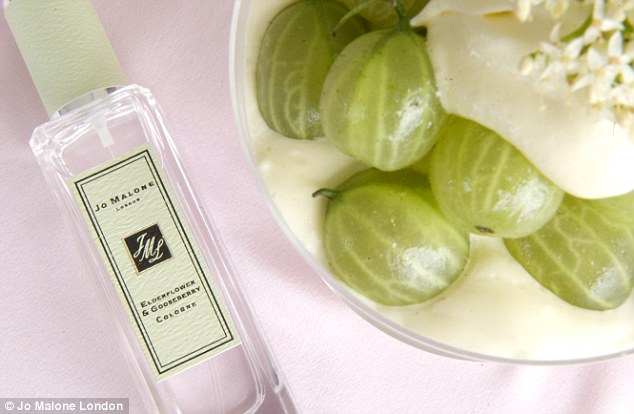
A voluptuous gooseberry fool. Crushed, summer-green gooseberries, juicy with lychee, enfolded into the soft delicacy of elderflower. Tender and feminine.

According to Basenotes, “Nagel says that ‘elderflower and gooseberry are two ingredients that do not exist in perfumery so I had to recreate these notes.'”

Source: The Daily Mail

Source: The Daily Mail

I’ve never personally smelled an elderflower, so I have no idea how accurate the fragrance is, but Elderflower & Gooseberry opens on me with delicate, soapy floral notes. The colour hue before my eyes is spring green and lavender. It’s definitely “tender and feminine,” with a soft, gauzy, sheer feel. It’s sweet and, unlike Redcurrants & Cream, never has even a faint tartness. The soapy aldehydes dominate the opening hour of the scent, leaving the strong impression of expensive floral soap. To be honest, I don’t like aldehydes, but I can tolerate them if done well. I don’t think this is done well.

The real problem is that something in this scent kept making me want to cough. It hurt and irritated the back of my throat, too, which has never happened to me. Usually, the only bad reaction I have had to fragrances is an extreme tightness at the top of my nose and a headache — sure signs of a fragrance with very synthetic ingredients. But this insistent, incredible irritation and scratchiness in my throat is a new one, and much worse. Given that Nagel says she had to invent the scent of the two main notes, I have no doubt she used some artificial concoction in a lab. This does not smell rich, luxurious or particularly natural. My personal opinion is that $60 is too high for a floral soap scent such as this, but the synthetic aspect to it strengthens that opinion.

As time passes, the perfume changes a little bit, but not by much. There is something that evokes lily-of-the-valley in my mind, with perhaps a touch of iris. There is also a very slight powdery feel underlying the notes. The sweetness lessens and the scent feels much more Spring-like.

Elderflower & Gooseberry is not a gourmand fragrance in my opinion, though it can be quite sweet at the start. It is much more a light Spring floral that starts with soap and ends up as a floral powder. In its final drydown, it has somewhat of a baby powder aspect to it.

The projection and longevity are much like Redcurrants & Cream, though I think Elderflower & Gooseberry is a tad stronger and not as sheer. Elderflower lasted a little over 2 hours on me. I’m not a fan of any part of it, least of all the increased scratchiness and irritation in my throat which remained long after the scent died out.

In an attempt to remain positive, however, I absolutely loved the incredibly fun, bubbly, happy video launched as part of the Jo Malone ad campaign for the “Sugar and Spice” collection. It shows all the makeup and food they used for the photographs. Plus, the classic Adam Ant song is always an incredibly peppy and cheerful way to brighten your day:

Finally, if the perfume isn’t your cup of tea, you can always try making the recipe for Gooseberry & Elderflower Fool. (“Fool” is a type of traditional British dessert.)

LEMON TART:

Source: The Daily Mail.

Source: The Daily Mail.

Jo Malone describes Lemon Tart Cologne as follows:

The mouth-watering tang of lemon tart sparking with citrus fruits and verbena, contrasted with swirls of meringue and lemon thyme. Refreshing.

The perfume is exactly as described. It opens with the fresh, light zesty zing of bright lemons. The tartness of the citrus is accompanied by thyme, not dryly arid or dusty, but, rather, fresh and herbal. The perfume is definitely refreshing in its opening moments with a perfect amount of sweetness just lingering daintily in the background. There is a slight soapy note, too, but it’s never heavy and nothing like the dominant, irritating aldehydes in Elderflower & Gooseberry. (Thank God!)

As time passes, the perfume changes a little. First, the sweetness increases just a tiny bit. There are notes of light vanilla, almost like that in an actual custard, but never as heavy or as rich. The real star of show, however, is the lemon which is perfectly underscored by the lovely verbena undertone.

The arrival of the verbena at the ten minute mark is the second change. Verbena is a type of semi-woody, flowering plant that has a very lemony aroma. Here, it adds a slightly floral aspect like that of lemon flowers. When the verbena is combined with the vaguely woody herbaceousness of the thyme, it ensures a perfect balance in the notes. They also serve to make this a much less of a foodie, dessert fragrance than something like Redcurrant & Cream.

Unfortunately, as time passes, much of that zesty lemon freshness fades. The soapy notes overtake the zing and brightness. Lemon Tart turns into a predominantly soapy scent with some thyme and a touch of lemon. There is a very light undercurrent of some artificial white musk. It’s light, but to my nose, it’s evident and feels somewhat synthetic. It’s not terrible, especially if you like soap with a whisper of musk underneath, but I much preferred that sparkling, bright, refreshing opening with its definite ZING.

Lemon Tart is a versatile scent for all seasons, in my opinion. It’s feminine, but also very unisex. Lemon verbena is an old classique in men’s cologne, so I definitely think a man could easily wear the sweetened, creamy version of it. The sillage and longevity of Lemon Tart were on par with the others, though I’d put this one somewhere in the middle of the two prior fragrances in terms of sillage. It projects a touch more than the super light Redcurrant, but a wee bit less than Elderflower. Like Elderflower, it also lasted around two hours on me. (By the way, the recipe released to accompany the fragrance is “Lemon Curd Meringue Tarts” and can be found at The Daily Mail.)

Like all the fragrances in the collection, Lemon Tart doesn’t suit my personal style or taste, but I have no doubt it will be popular with those who like light, airy, minimalistic and sweet scents. Just don’t expect any complexity; these are simple, one-dimensional, and linear fragrances. Given that fact, they’re not exactly giving it away at $60, especially for a mere 1 oz. Compare that to, for example, the fabulous Mitzah from Dior which I just reviewed (and succumbed to a full bottle purchase). That is $155 for 4.25 oz — or $36 an ounce! (Even less, at $27 an ounce, if you buy the large bottle.)

Personally, Lemon Tart is the one that I would recommend the most out of the three that I’ve tried thus far, with Bitter Orange & Chocolate being my favorite as a whole. I would not recommend Elderflower & Gooseberry at all. It’s not because of the soapiness nor even because of the baby powder finish. After all, some people like that. No, I wouldn’t recommend it simply because of how synthetic it smells. Plus, if it irritated my throat (when I’m rarely sensitive to perfumes), then I wouldn’t be surprised if it bothered someone much, much more sensitive to fragrance.

You can find my review for the other two, remaining fragrances in the collection — Bitter Orange & Chocolate and Ginger Biscuithere.

DETAILS:
Cost & Availability: Each of the colognes in the range costs $60. There is only one size: a very small 30 ml/1 fl. oz. As noted earlier, the set is a limited-edition release, but I have no idea how long “limited-edition” means in the Malone world and when they will be removed. Each fragrance can be purchased directly from the Jo Malone website which also offers free shipping “and the fragrance samples of your choice at checkout.” I don’t know how many samples you can get. You can also find the Sugar & Spice Collection at various stores. For example, here is Lemon Tart at Neiman Marcus (with the other perfumes in the series being listed and linked at the bottom of the page). Bergdorf Goodman also carries the full line. Unfortunately, according to a note on their page, neither Bergdorf nor Neiman Marcus ships to Canada. You can also find the collection at Nordstrom. Finally, Bloomingdales carries the whole line, along with some sort of Bonus Offer as well.
If you want to try out samples, you can find them at Surrender to Chance which is where I purchased my set. That set is currently sold out, but you can purchase samples of each individual fragrance starting at $2.99 for the smallest size (1/2 a ml vial). I highly recommend that you sign up for Surrender to Chance’s email and newsletter as they send out their monthly discount codes. If you’re interested in trying out the Malone fragrances (or any perfumes from StC, for that matter), here are the codes for March: 5% off orders with the code: nomoresnow. However, orders over $75 can get 8% off with the code: wewantspring.  Shipping for all orders of any size within the US is $2.95. Due to the massive increase in international shipping rates by the US Postal Service, international shipping has gone up everywhere. At Surrender to Chance, it is now (alas) $12.95 for all orders under $150.

Perfume Review – Dior Mitzah (La Collection Privée): A Worthy Tribute To Dior’s Muse

Beijing Lama Temple

Source: BeijingFeeling.com

The Buddhist temple was vast and ancient, but well-tended by its many yellow and red-robed monks. Its colours gleamed lacquered Chinese red and gold; vast, bronze dragons stood guard and snarled from odd corners; and the smell of incense was in the air. Enormous bronze vats filled with it, in fact; the many, brightly coloured sticks stuck in sand and billowing out heaps of smoke. It was a religious holiday, maybe even Buddha’s birthday, that cold day in November when I visited the Yonghe Lama temple monastery in the northern part of Beijing. Throngs of people filled in the vast courtyard, holding sticks of incense, bowing and praying, and monks were everywhere.

Lama Temple, Beijing. Source: George Oze, Flickr. (Click on the photo for the Oze page showing the photo in full, amazing size.)

Lama Temple, Beijing. Source: George Oze, Flickr. (For the Flickr link and his other amazing photos of China, click on the photo.)

Beijing incense burning on Buddha's birthday. Photo: Jason Lee/Reuters via the WSJ

Beijing incense burning on Buddha’s birthday. Photo: Jason Lee/Reuters via the WSJ

Smoke curled and swirled in the air, becoming almost a wall in its own right. One portly, bald, yellow-garbed monk smiled at me and I’m pretty sure he gently tilted his shaved head towards the large bronze urns filled with fiery logs, as if to tell me to light the sticks of incense in my hands and join the crowds of worshipers. I smiled back at him, then moved past him and the phalanxes of his gentle, smiling brothers, to join the crowds looking like ants before the most gigantic, amazing Buddhist statue I have ever seen.

Beijing and its stunning Lama temple filled with flowers and incense are what come to mind when I wear the absolutely enchanting, elegant Mitzah from Dior. It is from the fashion house’s La Collection Privée line of perfumes which are sometimes called elsewhere (like Fragrantica and Surrender to Chance) La Collection Couturier. I’ll stick to Dior’s own name for the line which is exclusive to Dior boutiques (only one in the US, in Las Vegas) and to its website.  Dior’s La Collection Privée began with three perfumes but, in 2010, the company issued seven more fragrances — all intended to illustrate and celebrate the life of its founder, Christian Dior. Mitzah was one of them.

Mitzah Bricard. Original photo by Louise Dahl-Wolf. Source: Luxus.Welt.De

Mitzah Bricard. Original photo by Louise Dahl-Wolf. Source: Luxus.Welt.De

Right: Mitzah Bricard. Left: 2011 model for Dior's Mitzah makeup collection. Source: Beautylish.com

Right: Mitzah Bricard. Left: 2011 model for Dior’s Mitzah makeup collection. Source: Beautylish.com

The perfumes were created by Francois Demarchy, the artistic director and nose for Parfums Dior, and his goal for Mitzah was to evoke Dior’s greatest muse, Mitzah Bricard. She was a socialite with a mysterious background who always wore something in a leopard print and whose personal style was a huge influence in Dior’s New Look creations and beyond. In fact, she became Dior’s chief stylist and advisor. Mitzah, the perfume, is meant to pay “tribute” both to her role in Dior’s creations and to Ms. Bricard herself as “an extremely sensual woman, with a divinely chic allure and captivating presence.”

Source: Fragrantica.

Source: Fragrantica.

According to the Australian Perfume Junkies, Mitzah is going to be discontinued next month, sometime in March 2013. If that is true, then it’s an enormous shame as Mitzah is an incredibly beautiful labdanum, incense and spiced rose oriental perfume whose richness comes with huge delicacy and a surprising airiness. My personal taste veers towards for the opulently opaque, the resinously heavy, the really baroque, or the ultra-feminine and, yet, there is something about this lightweight perfume that makes me actually want to buy one of the giant bottles (more on that later) right away, even if only to split it with friends.

[UPDATE – 3/2/2013: I just spoke with the Dior Beauty Stylist, Karina Lake, at the Dior Las Vegas boutique. The perfume is NOT being discontinued from either the Dior website or from actual free-standing Dior boutiques. She just returned from Paris and a training session at Dior Beauty; she is adamant that the perfume is permanent. It is, however, being removed temporarily from Dior shops in department stores, such as Neiman Marcus, Galleries Lafayette, and the like. Apparently, Dior rotates out 6 of their Privée fragrances at a time in such venues, to make way for others in the collection. That is what is happening to Mitzah. However, Mitzah will remain continuously on the website and at their actual shops.]

[Update as of 5/16/13: Dior seems to have changed their mind. The perfume IS being discontinued after all, along with Vetiver. You can read the full details here.]

The notes for Mitzah, as compiled from the Dior website and Fragrantica, are as follows:

Russian coriander, Damascena Rose, spices, Sri Lankan cinnamon, vanilla, honey, labdanum, Indonesian patchouli, Somali frankincense and incense.

Mitzah opens on my skin with rich, boozy resin and incense. The resin is unbelievably captivating, rich and sweet but, in an odd dichotomy, it’s very airy. There is a raisin-y rum feeling that is also surprisingly light, but note doesn’t last long. Underlying the rich amber are a fleet of other accords: honey; chewy, dark, slightly dirty patchouli; coriander that smells woody and nutty; dusty cinnamon; and a rich, beefy, dark damask rose.

Labdanum compiled into a chunk. Source: Fragrantica

Labdanum compiled into a chunk. Source: Fragrantica

There is almost a chocolate-y note from the combination of the spices, the patchouli, and the labdanum. The latter is extremely luxurious and extremely balsamic. You can almost picture tear drops of resin oozing out in dark, chocolate-y ambered hues. It’s slighty animalic, but not in a musky, skanky way. Rather, it’s like dark, molten, honeyed amber with the edge of something slightly more complex, masculine, and dirty.

It’s the oddest thing: none of this is heavy! Mitzah is almost like a gauzy veil. Don’t get me wrong, it’s a rich scent, but it’s not opaque and thick. It’s never overpowering, bullying, or brazen.

Mitzah Bricard.

Mitzah Bricard.

It’s probably a bit like what Mitzah Bricard was like herself. Judging from the photos, she was distinctively stylish, and never hesitant in being a strong, commanding presence. But she was always elegant and a lady about it. Mitzah, the perfume tribute, is much the same way. I confess I’m quite fascinated by how they made ingredients smell so rich and, yet, simultaneously, feel so airy.

Twenty minutes in, the incense and frankincense notes become stronger. So, too, do the spices acting in the background as supporting players. There is a definite feel of Chanel’s fabulous Coromandel to everything. Actually, to be specific, I keep imagining Coromandel, Serge Lutens’ Borneo 1934, and Arquiste’s Anima Dulcis in a three-way triangle. I think it’s because there is a very cinnamon-chocolate feel to Mitzah. It lacks the mentholated camphor of Borneo 1834, the white cocoa powder of Coromandel, and the more gourmand, bitter chocolate aspects of Anima Dulcis, but Mitzah has a definite kindred spirit tie to different aspects of each of those perfumes. For example; the patchouli-chocolate aspects of Borneo 1834; the labdanum, incense and frankincense of Coromandel; and the sweetness, cinnamon-chocolate, incense aspects of Anima Dulcis. All this with a fair greater lightness than should be expected from a scent with such rich notes as Mitzah.

China Incense - Don Daniele at 500px Com

Incense at a Buddhist Temple. Source: Don Daniele at 500px.Com

Clearly, none of this makes Mitzah a hugely original perfume. One might easily argue, however, that there really aren’t a lot of particularly original amber and incense perfumes anyway. At least, not incredibly wearable, comfortable scents. Dior was not seeking to create an avant-garde twist on resinous, smoky ambers but to make something elegant. It not only succeeded, but it also made something that is hugely versatile. I can see myself wearing Mitzah as much with jeans and a t-shirt, as with leather pants and stilettos, a little black dress, or a suit. It would work for the office, for a date, or for a night just curled up watching a movie. I’m utterly in love with this, and I’m sorely tempted to beg some friends to split a bottle with me! But I’m getting ahead of myself.

A damask rose.

A damask rose.

An hour in, the frankincense (which, to my nose, is smokier and darker than incense) and the resinous labdanum become even richer and more concentrated. The deepening amber note takes on almost a caramel quality in its sweetness. The cinnamon also starts to make an appearance, adding a faintly dusty, nutty element. And then there is the rose. My heavens! One imagines the deepest, most blood-red, baroque roses have been plucked and reduced down to concentrated nectar for a note that is as full-blooded as this one. It’s never cloying; it’s nothing like a British tea rose; and it’s almost fiery in its sensuality. But, unfortunately, it is just merely a glimmer here and there, and I would have been far happier with a touch more of it.

One might argue that Mitzah is such a superbly blended perfume that all the notes blend into one, and it would certainly be true. This has been done absolutely beautifully. But one could also argue that it is quite a linear scent — and that would be true, too. It doesn’t morph into something different in any drastic way. It is predominantly a labdanum-frankincense perfume first, second and third — and all the rest of the notes are merely incidental additions that pop up only occasionally, and never in a way that truly competes with that ambered resin and smoky frankincense. That one vein carries through from the start to the finish of the perfume — and its strength certainly gives weight to the argument that it’s basically a one-trick perfume.

Perhaps. But damn, what a stunning trick it is. In its later stages, Mitzah turns into pure honeyed perfection — sweet but still subtly tinged with that smoke. There is depth to it from the sweetness of the labdanum, and it sometimes throws in a ghostly chocolate undertone to the mix as well. At the same time, there is also a hint of the vanilla, but it is not powdered as in the dry-down to Coromandel. 

All of this occurs with perfume that is not overpowering in its sillage. Not at all. In fact, I think the elegance, airiness and moderate (to low) sillage of Mitzah would make it perfect for those who want a discreet, sexy, smoky oriental that is never obvious. On me, the sillage was moderate to strong for the first twenty minutes, but it was hardly something that could be smelled across the room. Mitzah is far too airy to be overpowering; it’s like a silken gauze on your skin. After that, it became much closer to the skin. In fact, it became a bit too damn discreet for my personal liking! By the fourth hour, I had to somewhat forcefully inhale at my arm, and I think others would have to nuzzle your neck to get a good whiff of it.

It was also a bit too evanescent for my liking. There were faint traces of it during the sixth hour and it died entirely midway during the seventh, which is too short a period of time for my liking. Yet, this is one perfume that I would not hesitate to re-spray, despite my usual dislike of having to do that. I haven’t fully comprehended why I would make so many exceptions for Mitzah — but I would. Perhaps because it is so comfortable, while still being sexy. It feels like wearing the perfect, airy, silky-soft cashmere sweater with just the hint of a silky teddy underneath.

The real problem with Mitzah is not its sillage or longevity but something else entirely: the size of the bottles. They are just enormous! The smallest bottle clocks in at 4.25 fl oz or 125 ml. Most perfumes start at 1.7 oz or 50 ml, going up to 3.4 oz or 100 ml in the large size. Mitzah’s largest bottle is an enormous 8.5 fl. oz or 450 ml! More than four times as large!

Per ounce, they are far, far cheaper than most niche or exclusive-line perfumes. The “small” bottle costs $155, so that is approximately $36 an ounce — the price of mass-market perfumes. The gigantic “large” 8.5 oz size costs $230 for $27 an ounce — far less than any perfume at Sephora or Macy’s! But, tell me seriously, how many people will ever finish an 8.5 oz bottle?! Who? Even for someone like myself whose perfume-consuming skin would require frequent re-applications during Mitzah’s moderate-to-short duration, I can’t imagine anyone ever finishing the large bottle! On the other hand, the size makes it perfect for splitting among friends which, if the story about discontinuation is true, makes Mitzah incredibly tempting.

If you are a fan of smoky ambers and orientals, I urge you to order a sample of Mitzah as soon as you can from Surrender to Chance or the Perfumed Court. Then, find a friend and go in with them for a split. It’s worth it. Oh, is that labdanum and incense worth it!

[Update as of 5/16/13: Dior seems to have changed their mind. The perfume IS being discontinued after all, along with Vetiver. You can read the full details here.]

DETAILS:
Mitzah is available exclusively at Dior boutiques or on Dior online. In the US, it is sold only at Dior’s Las Vegas boutique [call (702) 369-6072]. However, what I would do is to call this number instead — (702) 734-1102 — and ask for Karina Lake, the Dior Beauty Stylist at the Las Vegas store. She will give you a free 5 ml mini bottle of the Dior perfume of your choice, along with 3-4 small 1 ml dab vial sample bottles. Even better, you will get free shipping and pay no tax! As noted above, Mitzah comes in two sizes: the 4.25 fl oz/125 ml costs $155, while the 8.5 fl oz/250 ml costs $230. Though New York’s Bergdorf Goodman and San Francisco’s Neiman Marcus carry the Dior Privée line collection of perfumes, Mitzah is no longer available there.
Outside of the US, you can use the Points of Sale page on the Dior website to find a location for a Dior store near you. You can also navigate the Dior website’s International section to buy the perfume online. The problem is that the site is not very straight-forward. If you go to this page, look at the very far right to the bottom where it will say, in black, “International Version” and click on that. You should see options for Europe, Asia-Oceana, and South America. Within Europe, there are different sub-sites divided by country. The one closest to you should have Mitzah available for sale.
If you want to give Mitzah a sniff, samples are available at Surrender to Chance which is where I obtained my vial. Prices start at $3.00 for a 1 ml vial. If you’re interested in trying the whole Privée line, Surrender to Chance sells all 13 fragrances in a sampler set for $35.99. Samples are also available at The Perfumed Court, but not at Luckyscent.

Perfume Review – Arquiste Anima Dulcis: Conquistadors, Convents & Chocolate

It was a chilly day in Mexico City that November, long ago in 1695, and the kitchens of the Royal Convent of Jesus Maria were a beehive of activity. The haughty Mother Superior took the heavy key from the chain around her neck and unlocked the vault with the sisters’ most precious ingredients: bitter, dark chocolate, rich chilies, earthy spices, incense used in their religious ceremonies, and the heaviest of vanillas. The recipe for their famed “Anima Dulcis” was a secret one — even some of the nuns weren’t privy to its true magic. Were there flowers hidden under its dark depths? Was ancient incense responsible for its smoke, or was it darkened patchouli? The Mother Superior smiled to herself as she passed through the convent’s stone passageways and heard the younger sisters’ whispered questions. She, and she alone, would add the finishing touches.

Sao Roque Church, Lisbon, which is a little how I imagine the Royal Convent to appear. Photo: "ToonSarah" on VirtualTourist.com

The chapel of Sao Roque Church, Lisbon, which is a little how I imagine the wealthy Royal Convent in my mind. Photo: “ToonSarah” on VirtualTourist.com

Cornelis de Vos, Flemish Baroque painter, 1584-1651. Source: This Ambiguous Life Blogspot.

Cornelis de Vos, Flemish Baroque painter, 1584-1651. Source: This Ambiguous Life Blogspot.

The Royal Convent of Jesus Maria in Mexico City on a day in November 1695, is the explicit reference point for the “baroque gourmand” fragrance that is Anima Dulcis (loosely translated as “soul of sweetness”). It comes from the perfume house of Arquiste, founded by the Mexican architect and designer, Carlos Huber. Mr. Huber — who just won the Fashion Group International’s Rising Star award a few weeks ago — was inspired by the convent’s history and practices after he worked on renovating and converting the building in Mexico City.

Carlos Huber. Source: Etiket.com.

Carlos Huber. Source: Etiket.com.

As Mr. Huber explains on the Arquiste website, the Royal Convent of Jesus Maria had been founded in 1578 for the female descendants of the Spanish Conquistadors. (Or, at least, the very wealthiest and most aristocratic among them!) It was known for the nuns’ recipes which combined European and Asian ingredients with those particular to Mexico’s ancient history. Octavian, the highly respected perfume blogger of 1000 Fragrances, elaborates further in his beautiful review of the perfume:

The most carnal elements of the baroque cuisine were mixed in unexpected combinations, forgotten by the modern nose. Animalic jasmine, tuberose, petals of white flowers and all the temptations of the flesh were mixed with cocoa and hot spices to produce liqueurs and sweets. The nuns were discovering the fabulous scents of the new world, earlier than Europe. Vanilla, cocoa and tuberose, brought to Versailles, but still a great luxury before their massive use in the next century, made their debut in a Convent where the ancient Maya and Aztec flavors were tested and studied by Europeans. Anima dulcis, a modern interpretation of this magic encounter, tells the story of when the european sensibility started to use the “dark” ingredients of the New World – the discovery of cocoa, vanilla and chili pepper, reported by Cortez 150 years earlier. [Emphasis in the original.]

Using his research (and, I believe, the sisters’ actual recipes), Carlos Huber worked with twoAnima Dulcis perfumers, Yann Vasnier and Rodrigo Flores-Roux, to encapsulate the Convent’s creations. The result was Anima Dulcis which was released in 2011. It is classified on Fragrantica as an “oriental vanilla,” though I think “oriental chocolate” might be a more accurate summation. On its website, Arquiste says the notes include:

Cocoa Absolute, Mexican Vanilla, Cinnamon, Chili infusion.

Those official notes are just the tip of the iceberg. There is no way that the list is complete. I would venture a guess that the complete list might possibly look a little bit like this:

Cocoa Absolute, Mexican Vanilla, Cinnamon, Red Chili infusion, Jasmine Sambac (or some sort of florals), Seville Oranges, Cumin, Cardamom, Patchouli, Incense and, possibly, some sort of ambery resin.

Pre-Columbian chocolate with chilies. Source: CaFleureBon.

Chocolate with chilies and spices. Source: CaFleureBon.

Anima Dulcis opens on my skin with cinnamon-infused dark chocolate. It’s chewy, dusky, and spiced, but also, simultaneously, honeyed. Fiery red chilies counter the sweetness of the vanilla that just barely seems to breathe in the background. So does the earthiness of a dark patchouli — dirty and slightly smoky in the best way possible. The smoky notes seem to be further accentuated by some hint of light incense. It’s a lovely take on vanilla and chocolate, especially with the piquancy from the red chili pepper.

Mexican Hot Chocolate. Source: Zested.com. (Click on the photo for a link and a recipe.)

Mexican Hot Chocolate. Source: Zested.com. (Click on the photo to go to the website where you can find a tasty recipe.)

The chocolate note, however, is the real star. It’s unusual and nothing like the typical sort of chocolate notes which, to me, often feel more like powdery cocoa. At the same time, it’s also not like purely dark chocolate. Here, it’s more like the richest chocolate flourless cake covered with ganache made from bitter chocolate, covered by a dusting of smoky powder, cinnamon, cumin, cardamom, decorated with faint slivers of Madagascar vanilla pods, and then set on a plate of spicy, cinnamon red-hot candies. The richness almost has the feel of a British Christmas plum pudding, only tinged with incense.

It’s an incredibly cozy scent that is, at the same time, very sexy. There is a rich, meaty, chewy, dark aspect to it that can certainly be called “baroque” but, to be honest, aristocratic Mexican nuns descended from the Conquistadors are not really what comes to mind when I smell it.

Vermont West Hill House B&B.

Vermont West Hill House B&B.

Instead, I feel transported to a secluded wood cabin in Vermont on a very snowy, wintery night; there, by the light of a roaring fire which casts flickering shadows on the wall, a seduction scene full of deep long kisses and teasing nuzzles unfolds. Cups of spiced hot chocolate filled with dark liqueurs lie empty; the fire releases an occasional tendril of smoke; the light is glowing amber and red; and sensuality underlies the cozy warmth of the scene.

As time progresses, the baroque chocolate notes are joined by something that is definitely floral in nature. It’s lovely, adding a lightness and sweetness to the dry spices, but I can’t pinpoint the exact flower. Perhaps Jasmine sambac, with its earthier, muskier nature than regular jasmine? Octavian on 1000 Fragrances thinks it’s a green lily note and, while I can see some light greenness, I don’t think it’s the delicate lily flower. Either way, the perfume definitely has some sort of floral component. Carlos Huber may consider Anima Dulcis as a “baroque gourmand,” but, to my mind, it is much more of a spicy oriental perfume which just happens to have some gourmand elements. It’s also a very ambery perfume for something that is meant to smell like Mexican hot chocolate, and I wonder if there is some sort of resin in Anima Dulcis’ foundation. Whatever the specific notes, it’s a fascinating and addictive scent. I can’t stop sniffing my arm, and I just barely stifle the urge to put on more.

Nordic Christmas Oranges. Source: Trine Hahnemann & The Times of London.

Nordic Christmas Oranges. Source: Trine Hahnemann & The Times of London.

Two hours in, the perfume shifts and changes a little. It is now predominantly cinnamon orange with red chili peppers. There is a feeling of caramelized cooked fruit, where the caramel has burnt just a little. Or, maybe, it’s more like a sticky, toffee’d orange, salted and sweet, mixed with dark raisins stewed in rum and dark chocolate. It’s really hard to pinpoint; the perfume is superbly blended, leading all the notes to melt together in a decadently luscious, rich whole. The burnt note, unfortunately, lasts a wee bit too long for my liking, and seems to become just a tad bit more bitter and burnt with time. It’s not strong and over-powering — it’s not even the predominant note — but I think I would have liked just a little less of it or, perhaps, a little more sweetness to counter it.

After another hour, it fades, leaving Anima Dulcis as a lovely combination of bitter Seville oranges, dark patchouli, cinnamon, chili pepper and a soft dusting of sweet vanilla. Eventually, at the end of the fourth hour, the perfume turns into a soft amber with spices and just a flicker of orange, before finally ending up in its final stage as sweet vanilla and light white cocoa powder, with just a smidgen of dusty spice.

For all that these notes seem dark and heavy, the perfume itself actually is not. It’s neither narcotically heady nor cloyingly sweet. It’s not a light, clean, airy scent by any means — no laundry detergent freshness here —  but it’s surprisingly not heavy or opaque either. Octavian describes it as “light, woody, airy” and “delicate.” I think it’s a bit heavier than that; I wouldn’t want anyone to think this is a sheer, translucent scent or something like the minimalistic creations made by Jean-Claude Ellena. But, given the richness of some of its components, it is far from thick and never overbearing.

In fact, even the sillage is moderate. In the beginning, you can smell it on yourself but it’s far from overpowering. Someone across the room definitely won’t be gassed by it. After the first hour, the perfume becomes softer and, by the third hour, it was quite close to my skin. By the fourth hour, it took some determined sniffs, putting my nose right on the skin, to detect some of the nuances in the notes. As for longevity, it was moderate on my perfume-consuming skin. It faded away shortly before the sixth hour. On others, I’ve read lengths of time around varying between six and eight hours.

All in all, I really liked Anima Dulcis. A lot. The only thing stopping me from wanting a full bottle is the fact that, for my personal tastes, I would have preferred it if the scent were heavier, headier, and just a slightly bit sweeter. (Just a smidgeon!). I realise, however, that most people don’t share my preference for narcotically heady scents, so I think Anima Dulcis would be a real crowd-pleaser for many. It taps into the current trend for gourmand scents but, in my opinion, it really isn’t one. Those who are expecting a true dessert fragrance will be disappointed. This is not half as sweet as some of the niche Guerlains that are out there. Those, however, who share my feeling that a few of those Guerlains are a bit too gourmand should really look into Anima Dulcis. The same applies to anyone looking for a very high-quality, luxurious take on spicy Orientals without the heavy, boozy or opaque aspects that can sometimes accompany them. I should add that it is most definitely unisex!

Try Anima Dulcis, and see if a perfume twist on a recipe from the aristocratic descendants of the Conquistadors over three hundred years ago touches your sweet soul.

DETAILS:
Anima Dulcis costs US $165, CAD $200, £125.00 or €149. It comes only as an eau de parfum and is available only in a 55 ml/ 1.8 oz size. In the US, it is available on the Arquiste website, Barneys, and Aedes. In Canada, the Arquiste line is available at Holt Renfrew Bloor in Toronto (though I could not locate it on the overall Holt Renfrew website), or at Etiket in Montreal for CAD $200. Each store is the exclusive dealer for the Arquiste line in their city. In the UK, it is available for £125.00 at Liberty London. In France, you can find it at Jovoy Paris where it retails for €149. In Germany, it is sold at Aus Liebe Zum Duft. Elsewhere, you can use Arquiste’s “Stockists” page to find a retailer near you. Samples are available at Surrender to Chance where the price starts at $4.99 for a 1/2 ml vial. The site also sells all 7 perfumes from the Arquiste line in a sample pack for $33.99.