Perfume Review- Serge Lutens Five O’ Clock Au Gingembre

Tea at Buckingham Palace. That is Serge Lutens‘ goal and inspiration for Five O’ Clock Au Gingembre. It is a cozy, versatile, unisex fragrance that takes woody oriental notes to the edges of the gourmand category in a symphony of milky tea, candied ginger, honey, dark chocolate, spices and woodsy notes. It’s not revolutionary or particularly complex, but it is quite lovely. Even better, it is a fragrance that is currently heavily discounted for US buyers on a variety of different sites as Serge Lutens is discontinuing this fragrance from his American rotation.

British "High Tea" at the Chesterfield Hotel, London. Source: Bookatable.com

British “High Tea” at the Chesterfield Hotel, London. Source: Bookatable.com

We’ll get to the discontinuation issue shortly but, first, the perfume itself. Serge Lutens describes the scent as

Tea at Buckingham Palace.

Centered on candied ginger, this fragrance is a ritual ceremony.
It caters to the quicksilver in us, to our imagination dressed in white gloves.

Serge Lutens 5 O ClockThe perfume was created in 2008 by Christopher Sheldrake and its full set of notes, as compiled from Fragrantica and Luckyscent, seem to be:

Top notes are tea and bergamot; middle notes are candied ginger, cinnamon and woodsy notes; base notes are dark cacao, honey, amber, patchouli and pepper.

I’ll be frank: nothing about this scent evokes a formal, regal, reserved, diamond-clad, white-gloved Queen Elizabeth II to me (or any other British royal for that matter). In this instance, that is a very good thing because this is not an aloof, distant, haughty or baroque scent. Instead, it is an infinitely cozy scent that covers you in a light, soft veil of sweet, spicy notes like your favorite, creamy cashmere sweater.

Five O’ Clock Au Gingembre opens on my skin with fresh, zesty lemon that quickly turns spiced from the lightly smoked woods that feel almost like cedar. For a split second, the lemon note feels a little like the start of a man’s cologne but the impression is fleeting and the citrus is soon warmed by the woods and by the advent of ginger. The latter is simultaneously like the fresh ingredient and like its candied, crystallized version. Hints of cinnamon (and something that feels like cloves) also appear, along with the subtly orange undertone to bergamot.

Ginger, honey, lemon tea.

Ginger, honey, lemon tea.

The citrus notes are lovely but, alas, a little too fleeting for me. Within minutes, they are overshadowed by far sweeter tones. There is rich, dark honey which is surprisingly airy and light in feel, and never thick, cloying or excessively sweet. The honey is tinged with a dark chocolate element which is chewy and rich like a dark ganache, and subtly sprinkled with cinnamon powder. Dancing along the edges are quiet touches of patchouli, black pepper, and amber.

The whole thing may sound like a very heavy combination of elements, but the perfume is extremely light, beautifully well-blended, never overdone, and surprisingly soft. It projects very little beyond one’s body even from the start, and just gets closer and closer to the skin as time goes by. The very discreet notes cover you in an airy cocoon of spiced, candied ginger infused with other, alternating elements and, while it tiptoes to the very edge of the gourmand category, it never really crossing over.

Tea with milkOne reason may be the more oriental dry notes. Even apart from the cedar-like woods, light black pepper, and dry spices which undercut some of the sweetness, there is the key issue of tea. At the ten minute mark, Five O’ Clock Au Gingembre starts to evoke a lovely cup of milky tea. It’s not strong and black like Oolong or a much richer Chai, but soft and mild like the more fragrant Earl Grey. On my skin, alas, the note isn’t particularly strong or long-lasting; it vanishes after less than thirty minutes. On others, however, the bergamot, citrus and tea notes seem to last quite a decent amount of time.
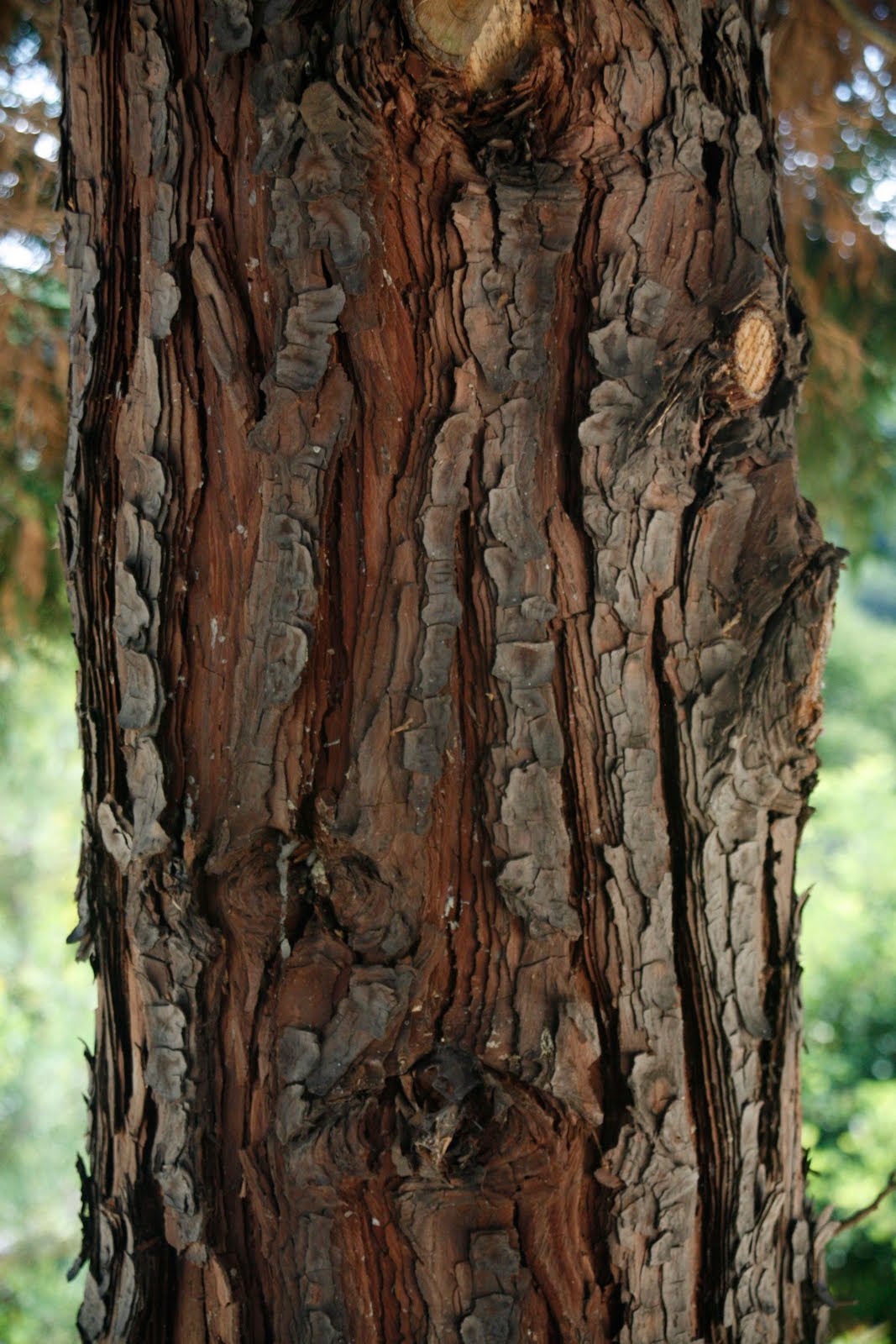
A young cedar tree trunk.

A young cedar tree trunk.

As time passes, the perfume subtly changes. At the twenty-minute mark, the pepper, patchouli and cinnamon become more prominent, the ginger becomes much less candied, and a subtle note of beeswax makes its appearance. Then, forty minutes in, the wood notes start to become much more significant. There is almost an oud/agarwood-like element to the note. It’s quietly smoky with a faintly chilled, mentholated, peppered edge. I suspect that is due to the combination of cedar-like wood with its occasionally evergreen undertones and the patchouli which can have a lightly mentholated aspect. At least, it does whenever it is handled by Christopher Sheldrake; I’d say mentholated notes are his signature! Here, there is nothing camphorous, unpleasantly medicinal, or even rubbery like pink bandaids; there is merely a definite cool, chilled aspect to the patchouli and woodsy notes. It serves to further undercut some of the sweetness of the perfume which is now far less honeyed and much more dryly chocolate-y in nature.

Chocolate-dipped, candied ginger. Source: SinfulSweetsOnline.com

Chocolate-dipped, candied ginger. Source: SinfulSweetsOnline.com

For the next few hours, different notes wax and wane in prominence, but the core elements remain fundamentally unchanged. By the end, Five O’Clock Au Gingembre is predominantly a light, sheer mix of: candied ginger; dusty dark chocolate; gauzy amorphous amber; and subtle patchouli. To my surprise, it’s not very sweet, especially as compared to that very honeyed opening. In fact, I would say that the final hours are actually a bit dry in nature due to the slightly powdery nature to the dark cocoa.  

Another surprise was the sillage and duration of the scent. Five O’ Clock Au Gingembre is very, very, soft. The sillage is low from the start and becomes close to the skin in as little time as an hour. For those who like their perfumes to be discreet and unobtrusive, that will be a definite bonus; for others, like myself, that incredible shortness of time may be an issue.

The duration was also problematic for me. I may have perfume-consuming skin, but Five O’ Clock Au Gingembre definitely clocked in at the low-end of the scale by just barely reaching the five-hour mark. To be honest, I actually thought it had vanished after four hours, but some very determined, obdurate sniffing detected faint traces lingering on a few parts of my skin. So, I’ll say that it’s five hours in length, even though the majority of the scent disappeared on me after four. I have had much better luck with many of the other Lutens fragrances. One of my friends who is a hardcore Lutenista has this theory (with which I agree) that the lighter the colour of Lutens’ juice, the lighter its duration. And Five O’ Clock Au Gingembre is an extremely watery (though very pretty) light-brown colour.  

Despite the longevity issue on my particular skin, I definitely enjoyed Five O’ Clock Au Gingembre. And I think others would too, unless they disliked sweet notes that seem to be “foody” in even the smallest way. It’s incredibly versatile and wearable — every day and throughout the year. Its lightness and low sillage makes it eminently suitable for even the most conservative office environment. And, it is also very unisex, though a few women have found it to be a wee bit too masculine. (I suspect that is because of the woodsy and peppered undertones that appear after an hour.)

Five O’ Clock Au Gingembre is also a great deal at the moment, particularly for American buyers. As noted earlier, Serge Lutens discontinued this scent from its US retailers in 2012 and, as a result, it is hugely discounted at a number of places. (Full pricing information and details below, including links to places that ship internationally.) However, the perfume is currently available on the Serge Lutens website and will continue to remain there for the foreseeable future. Oddly enough, despite the repeated and widespread discontinuation comments, Five O’ Clock Au Gingembre is still available on the Barney’s website. I have no idea how long that will last, but why spend $120 with possible tax when you can buy the perfume for $87 with no tax and free domestic shipping within the US? Who doesn’t love a bargain?

In short, Five O’ Clock Au Gingembre may not take you to have tea with the Queen at Buckingham palace, but (to mangle the old song) it is definitely tea, ginger & sweet sympathy.

 

Details:
Cost & Availability: Though Five O`Clock Au Gingembre normally retails for $120 for a 1.7 oz/50 ml bottle, it is currently on sale on Overstock.com for $86.99 and the site also offers free shipping within the US. The site ships out internationally but for a fee and with some restrictions. Five O’ Clock Au Gingembre is also discounted on FragranceNet where the price is slightly higher at $97.19 but there is an extra 15% off for first-time customers or with the coupon code RESFT5. I believe they ship all over the world. For regular retail price, you can find it on the Serge Lutens website for $120, and I assume it will remain there. From what I’ve read, the discontinuation seems only to apply to US retailers, not to the perfume as a whole and most certainly not at Lutens’ Paris headquarters or Lutens online. In terms of other retailers, Barney’sLuckyscent and Aedes all carry the 1.7 oz/50 bottle for $120. In the UK, I found it listed at Harrods for £69.00. In Australia, I found it on the Australian StrawberryNet website where the 1.7 oz/50 ml bottle seems to be on sale for AUD $108.50 instead of AUD $117. I think there may be an additional 10% off at checkout, but I’m not certain. For other countries, you can use the Store Locator on the Lutens website.
Sample vials to test it out can be purchased at Surrender to Chance (where I bought mine) and start at $3.99 for a 1/2 ml vial. Surrender to Chance has the best shipping rates, in my opinion: $2.95 for orders of any size within the U.S.. Unfortunately, with the US Postal Service’s recent price increase, international shipping has now jumped from $5.95 to $12.95 for all international orders under $150. However, price increases for international shipping have occurred across the board at most other sites, too. 

Perfume Review: Seville à L’Aube by L’Artisan Parfumeur

There are perfumes that one should theoretically love but which, in reality, one simply cannot bear. Seville à L’Aube (Seville at Dawn) is one of those fragrances for me. A perfume that has sent the blogosphere into an utter tizzy, accompanied by a book of seemingly great sexiness, and a back-story of even greater romanticism, it is centered on one of my favorite notes: orange blossom. It is a perfume that would seem to be tailor-made for me. Ultimately, however, I couldn’t stand it. My personal perfume profile — and a particular note that I always struggle with — made Seville à L’Aube a very difficult experience for me.

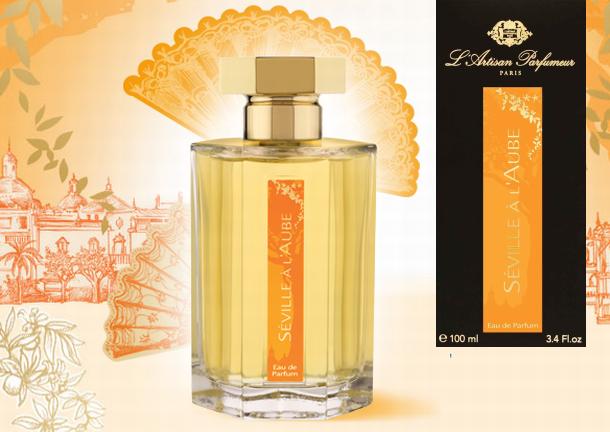
Seville a L'Aube L'Artisan

Seville à L’Aube is a limited-edition eau de parfum released in 2012 and made for L’Artisan Parfumeur by the great Bertrand Duchaufour in conjunction with the writer and perfume blogger, Denyse Beaulieu of Grain de Musc. According to a quote from Ms. Beaulieu on Now Smell This, the perfume is supposed to represent one night in Seville and the start of a passionate affair between Ms. Beaulieu and her Spanish lover:

[Séville à l’aube] was inspired by one of the most beautiful nights in my life, in Seville during the Holy Week under an orange tree in full blossom, wrapped in incense smoke and the arms of a Spanish boy…

seville2

Fragrantica provides even more details on Ms. Beaulieu’s encounter:

I am in Seville, standing under a bitter orange tree in full bloom in the arms of Román, the black-clad Spanish boy who is not yet my lover. Since sundown, we’ve been watching the religious brotherhoods in their pointed caps and habits thread their way across the old Moorish town in the wake of gilded wood floats bearing statues of Christ and the Virgin Mary. […]

[The statue of the Madonna] is being carried into the golden whorls of a baroque chapel, smoothly manoeuvred in and out, in and out, in and out – they say the bearers get erections as they do this – while Román’s hand runs down my black lace shift and up my thigh to tangle with my garter-belt straps. […] I am in the pulsing, molten-gold heart of Seville, thrust into her fragrant flesh, and there is no need for Román to take me to bed at dawn: he’s already given me the night.

"The Perfume Lover." US Edition.

“The Perfume Lover.” US Edition.

Bravo! If the story doesn’t leave one heated and intent on trying the perfumed encapsulation of that night, then I have no idea what will. I certainly was keen to test the perfume, and the blogosphere’s gushing, often poetic reviews only strengthening that determination.

Denyse Beaulieu with her book. Source: The Perfume Magazine.

Denyse Beaulieu with her book. Source: The Perfume Magazine.

Things seemed to have reached a crescendo this week with the U.S. release of Ms. Beaulieu’s book, The Perfume Lover: A Personal History of Scent, which describes, in part, the process of creating Seville à L’Aube with Mr. Duchaufour. (Apparently, the book also covers quite a bit of Ms. Beaulieu’s sex life, according to an article in The New York Times yesterday.)

I wasn’t aware that the book’s release was this exact week (and I hadn’t intended to cover the perfume until next week), but I have been feeling unwell lately, so I thought my beloved orange blossoms would be the perfect antidote and pick-me-up. It wasn’t until I read the perfume’s notes that a flicker of worry crossed my mind. The notes as compiled from Lucky Scent and Now Smell This include:

Orange blossom, lavender, pink pepper, petitgrain, lemon tree leaves, jasmine, magnolia, beeswax, incense, Benzoin Siam, Luiseiri lavender.

lavender-550pxYou see, I really do not like lavender very much. I really, really do not. And Seville à L’Aube opens on my skin with a veritable tidal wave of dry, pungent, concentrated lavender, followed by bitter petitgrain and overwrought orange blossoms. I can tolerate lavender in small doses, but this degree of super-concentrated, intense lavender was well-nigh unbearable for me. It was akin to the most concentrated lavender oil, but with a particularly bitter, pungent, dry character. When combined with the equally bitter petitgrain (the distillation of the twigs from an orange blossom tree) and some incredibly peppery notes, the overall result passes into forcefully unpleasant territory.

The orange blossoms weren’t my salvation, either. Sometimes, orange blossoms can impart a faintly soapy undertone but — though there was just a hint of that here in the opening moments — the real issue for me was the impact of the other notes. They turned the orange blossom into something extremely dry with a definitely pungent, woody, almost herbaceous, peppery twist. There is some relief from the sweet magnolia flower which adds a soft, velvety, plush floral note with some fruity nuances — but not much. At this stage, it is predominantly lavender, bitterness, dryness, more lavender, and orange blossom.

Fifteen minutes later, the overpowering lavender has started to meld a little better with the orange blossom. The notes turn into one spicy-sweet accord with some pungent green notes, but it’s still an ordeal and I still struggle. As time passes, the lavender starts to recede a little, the orange blossom takes the lead and the perfume turns much sweeter.

Orange Blossom Syrup.

Orange Blossom Syrup.

Except now, it is too sweet. Revoltingly so. I’m having strong flashbacks to Tom Ford‘s Neroli Portofino which I found to be a similarly excessive, cloyingly sweet, orange blossom scent. It’s as though the flower has been put on steroids, in both perfumes. And, frankly, there is something very unnatural and artificial about the extremeness. I am strongly reminded of the thick, concentrated orange blossom syrup used in Middle Eastern desserts — but amped up with aromachemicals. Just as with Neroli Portofino, Seville à L’Aube makes me feel physically queasy. (Perhaps I can’t handle perfumes that are essentially orange blossom soliflores?)

My intense queasiness and nausea continue for quite a long time, leaving me wondering if I shouldn’t just save myself and scrub this off. To be honest, the first time I tried Seville à L’Aube, I completely gave up but, since I had an appointment I couldn’t miss at the vet, I simply sprayed another perfume over it to be free of it.

The second time, however, I persevered and, around the 2.5 hour benchmark, the perfume finally became less of an ordeal. That unnatural, extreme and painfully cloying sweetness starts to slowly dissipate. Somewhat. The lavender has — thank God — retreated for the most part, to be replaced by a quiet note of beeswax and vanilla benzoin. Soft touches of jasmine lurk behind the orange blossom and there is also the advent of a subtly smoky base, though the incense is never more than a faint shimmer in the background. From the start, the perfume has always been incredibly airy and lightweight in feel, though also surprisingly strong and powerful. Now, near the 3 hour mark, it finally drops in sillage and power. It is still, however, far too sweet for my liking.

For the next seven hours, the perfume is predominantly orange blossom with some light vanillic benzoin. It’s an incredibly persistent, long-lasting scent. It’s not completely terrible; there are times when I even think I may like it. Then I remember that brutal opening — and shiver. I could never go through that again, but I fully recognise that my reaction is due to my own personal discomfort with some notes. That said, I really do think that the perfume is overly sweet by more than just my standards. I made two people sniff my arm, and both thought the same thing with one actually recoiling in aversion.

We’re not alone in that conclusion, though we are in the minority. Bloggers may generally (with some exceptions) adore Seville à L’Aube, but the reaction from general commentators is distinctly more mixed. On Fragrantica, a number of people mention the “cloying” nature of the perfume or how it is “a little nauseating.” (See, it’s not just me!) On Luckyscent, some of the reviews are equally unenthused:

  • urgh, not sure how I feel about this. Lots of orange blossom. Gives an impression of orange and green. It’s somehow too much, has a weird gourmand quality, like a big too-sweet meringue covered in candied flowers and orange leaves. Also a tiny trace of celery.
  • I so eagerly awaited a decant, only to discover this smells uncannily like Fruity Pebbles. The opening (as much as I could ascertain with my sample) is smoky and sexy with the sweetness of orange blossom but the dry down is straight Fruity Pebbles. I was really hoping for smoky holy days and my garters getting tangled.
  • I get a lot if benzoin in this one, and the same rooty, astringent carrot from Nuit de Tubereuse. The orange blossom note has a burned sugariness to it, so that it isn’t airy, but syrupy. Definitely a fall perfume.
  • The opening is a lively orange blossom composition with some unusual notes. But that lasts only a few minutes. The drydown is a sweet, fairly generic orange blossom cologne. It’s gone completely in 45 minutes on my skin, according to my housemates. There is one note in common with Nuit de Tubereuse that actually sears my nose briefly. No idea what the aromachemical is, but it can be a bit painful.

Oddly, there are a number of comparisons on the Luckyscent reviews to Nuit de Tubereuse which is also from Bertrand Duchaufour and L’Artisan Parfumeur. I couldn’t stand that one, truth be told, but I can’t see the similarities unless it’s in the area of unpleasant aromachemicals. I think Seville à L’Aube is a much better scent, relatively speaking — though given my feelings about Nuit de Tubereuse, I’m not sure that’s saying much.

I should also add that I know others who do not have issues with lavender but who, nonetheless, struggled with Seville à L’Aube. Some found it painfully dry at the start. A few found it “sour,” like my friend and fellow perfume blogger, The Scented Hound, who also described the perfume as “a cross between floor cleaner and sour shampoo,” and called it “purgatory.” One blogger, Almost au Naturel, suffered entirely different notes, summing up the scent as “funky, sexed up baby powder.” Though she ended up appreciating Seville à L’Aube for what it was, she begged people not to fall for the hype.

I definitely agree with that last conclusion. Don’t let the hype lead you to unrealistic expectations. If you love lavender, orange blossom and very sweet perfumes, then Seville à L’Aube may be one for you to consider. (However, the perfume is limited-edition and, with the advent of the U.S. edition of the book, it is even hotter than it was before, so I suggest you test it out very soon if you want to try to obtain a bottle.) For those who are less than enamoured of those notes, however, it may be “purgatory” and you might want to stick with reading the book.


DETAILS:
Seville à L’Aube is a limited-edition Eau de Parfum that is only available in a 100 ml/3.4 oz bottle. At the time of this post, the perfume is temporarily sold out on L’Artisan Parfumeur’s US website where it retails for $165 but it is available on the company’s UK website and costs £88.00. (The same price is listed on the Euro version of the site.) US buyers can also purchase the perfume from Luckyscent, though it is currently back-ordered and won’t ship out until April. The perfume is carried at Aedes de Venustas (along with the book, The Perfume Lover), but they too are currently sold out of the scent. In Europe, you can find the scent available at Ausliebezumduft where it retails for €105.00. If you’d like to try a sample, you can find Seville à L’Aube on Surrender to Chance where prices start at $4.49 for 1 ml vial.

Perfume Review: Nawab of Oudh by Ormonde Jayne (Four Corners of the Earth Collection)

The Nawab of Oudh is a nonpareil, an oriental perfume of such magnificent richness and beauty that it left my jaw agape. There is no chance that I shall be — as the famous writer, William Safire, once famously penned — a nattering nabob of negativity. No, Ormonde Jayne‘s latest creation is simply spectacular.

The Raja of Mysore. Source: Victoria & Albert Museum.

The Raja of Mysore. Source: Victoria & Albert Museum.

OJ NawabNawab of Oudh is one of the new Four Corners of the Earth collection which was released in late 2012 and which pays homage to the different parts of the world that have inspired Ormonde Jayne’s founder, Linda Pilkington. The collection is the result of collaboration between Ms. Pilkington and the perfumer, Geza Schoen, and consists of four fragrances: Tsarina, Qi, Montabaco and Nawab of Oudh. (I have samples of all four fragrances, provided courtesy of Ormonde Jayne, and am working my way through the collection. You can find my review for Tsarina here.)

A nawab (sometimes also spelled as “nabob”) can mean, alternatively, a ruler of an Indian province, or a European person who made a vast fortune in India or overseas. Ormonde Jayne was inspired by the first meaning for the term, describing the fragrance as follows :

Source: Shanti Barmecha blogspot

Source: Shanti Barmecha blogspot

Nawab (Ruler) of Oudh is a province of central India. The perfume is inspired by the Nawabs who once ruled over it.  It is a potent blend of amber and rose with a soft oudh edge. Yet surprisingly not one ingredient stands out from the others. It achieves a perfume synergy that defies traditional analysis, releasing a pulsating pungency, brooding and hauntingly beautiful, a rich tapestry of fascinating depths, a jewelled veil to conceal its emotional complexity and extravagance.

Every single part of that description applies to the magnificent richness of this stunning perfume. It is no doubt helped by the perfume’s long list of notes, seventeen in all:

top: green notes, bergamot, orange absolute, cardamom, aldehyde. 
heart: rose, magnolia, orchid, pimento, bay, cinnamon, hedione. 
base: ambergris, musk, vetiver, labdanum, oudh.

The Nawab of Oudh opens on my skin with a burst of bright, juicy, sweet green notes that have a distinctly tropical, fruited underpinning. There is something that feels very much like green mangoes, alongside the bright, fresh, plump, sun-sweetened lemons and oranges. There is also a heady rose note — sweet, fragrant, dark as the reddest damask, and almost beefy in its richness. Following closely in its footsteps is a spectacular element of velvety magnolia. The whole combination is beautiful beyond words, and I actually said “Wow” out loud as the symphony of notes wafted up to my nose.

The bright, fresh, sweetly floral and fruited tonalities quickly give way to something earthier and spicier. The bay leaf starts to appear, adding an unusual herbaceous and earthy aspect to the sweetness. Dark, rooty vetiver also helps undercut some of the richness, but it is the surprisingly fiery note of red chili peppers that really adds the perfect counterbalance. Together, they work to transform the scent into something much more than a mere floral with zesty citrus notes.

Further depth and complexity are added with the advent of ambergris, and I’m convinced this has to be the real stuff. It smells much richer, almost dirtier, and definitely slightly muskier than the usual amber accords, though the labdanum undoubtedly plays a role in that impression, too. Whatever the particulars, the ambery note has enormous depth but it’s never heavy, molten or gooey. Rather, it’s sheer and light. At the same time, the perfume itself is very strong and heady, encompassing me in a lovely cloud of scent that projects about two feet in distance in these opening moments.

Ten minutes later, the orange absolute is much more noticeable, as is the orchid flower. Both accords mix with the magnolia and rose to create a floral juxtaposition to the various herbaceous, woody, citrus, ambered and slightly musky notes. The final result is a beautifully balanced opening that is never singular nor too sweet. The sweetness is further undercut when the woody notes start to appear. Speaking of appearing, on my second test of the perfume, the bay leaf gained in intensity in opening moments of the scent; during the first test, however, to my surprise, it disappeared after ten minutes. So, too, did the fiery red chili pepper and the earthy vetiver. I point this out because I know some of you struggle with those notes, respectively, and I want to reassure you that (to my nose) they are not an enormous presence or particularly sharp.

Purple rose at Warwick Castle, England. Photo provided with permission by CC from "Slightly Out of Sync" blog.

Purple rose at Warwick Castle, England. Photo provided with permission by CC from “Slightly Out of Sync” blog.

In fact, nothing in this beautifully crafted, smooth as a well-buffed piece of amber, perfume is sharp or unmodulated. That applies to the agarwood (or oud) as well. It is simply perfect: never medicinal, astringently sharp, pungent or antiseptic. No camphorous elements or images of pink rubber bandages. Instead, you have a very smooth, incredibly rich, and highly sweetened oud note. It waxes and wanes in prominence in that first hour, never dominating but floating just under the flowers. The oud is perfectly interwoven with that rich, dark rose, but neither are the primary focus of the scent at this time.

Instead, Nawab of Oudh is in harmonious balance; this is a superbly well-blended perfume that throws off notes the way a chandelier throws off prisms in the light. I am strongly tempted to add the phrase “it’s beautiful” to the end of every paragraph, but I fear I will sound like a broken record before I’m halfway finished. Nonetheless, my God, is this perfume beautiful!

Magnolia. Source: Kathy Clark via FineArtAmerica.com

Magnolia. Source: Kathy Clark via FineArtAmerica.com

If any single note were perhaps to dominate in the first ninety minutes, it would be the magnolia. There are many global varieties of this velvety, opulent flower, but it is an incredibly popular and symbolic part of America’s Deep South, in particular. In fact, there is a Texas town called Magnolia that is just outside Houston. In addition, the flower has been the symbol of the state of Louisiana since 1900. (I won’t even get into the famous movie, Steel Magnolias, involving the state of Georgia.) Magnolias have a creamy, rich aroma with a slightly citrus-y nuance and a floral scent that is somewhat similar to gardenia at times and, at other times, closer to jasmine. Here, however, there is a definitely tropical feel to the flower’s velvety lushness and creaminess. It’s heady and strong, but never indolic or sour. Its combination with the orange absolute — and with what I am convinced must be green mangoes — adds a beautiful tropical aspect to the scent. And, yet, its citrus-y aspects also provide some freshness and lightness. The whole thing is simply an incredibly creamy, velvety floral composition of great complexity.

Sir Digvijaysinhji, Maharaja Jam Saheb of Nawanagar in 1935 wearing the emerald and diamond necklace created by Cartier London in 1926 for his uncle, Maharaja Jam Saheb Ranjitsinhji Vibhaji. Source: TheCultureConcept.com

Sir Digvijaysinhji, Maharaja Jam Saheb of Nawanagar in 1935 wearing the emerald and diamond necklace created by Cartier London in 1926 for his uncle, Maharaja Jam Saheb Ranjitsinhji Vibhaji. Source: TheCultureConcept.com

Two hours in, Nawab of Oudh changes. Now, it is oud with cardamom, what feels like cloves, red chili peppers, and the very first hint of labdanum. The magnolia is still present, but it has now receded much more to the background. For the next two hours, the perfume reflects different facets — much like jewels gleaming around a maharajah’s neck. There is: agarwood sweetened by sweet damask rose; dusty, dry spices (cardamom in particular); a touch of muskiness; a hint of jasmine; and rich ambergris. The red chilies pop up now and then, but the perfume is not fiery. It’s a perfectly modulated rosy, spiced, woody amber perfume that is endlessly luxurious, and made with what are, clearly, very expensive, top-quality ingredients.

From the fifth hour until the perfume’s end around 8.5 hour mark, Nawab of Oudh is labdanum heaven. Now, as some of you know, labdanum is one of my all-time favorite notes; I simply adore the more nutty, slightly leathery, dirty and masculine twist on a resin. Here, it’s treated beautifully — intertwined in a lover’s kiss with the heady red rose. It’s a bit too light for my personal, utterly biased tastes — and I would have preferred a more molten, opaque treatment — but nothing about this airy, lightweight (though strong) perfume is about molten heaviness. Instead, labdanum’s ambery note is light, warm, sweet, and infused by a subtle undertone of spices. Its interplay with the heady rose was so beautiful that I will make an embarassing confession: I spent a good chunk of 30 minutes simply lying on my sofa with my nose glued to my arm and inhaling the nutty, rose-strewn amber in ecstasy. It was, quite simply, the perfume equivalent of a food coma.

Nawab of Oudh has good sillage and longevity. The opening phase of the perfume had about 2 feet in projection for the first hour, before dropping considerably. However, it only became really close to the skin around the 4th hour. To be honest, for some of the remaining hours, I had to forcefully inhale at my arm to detect it — though, clearly, I found that no hardship whatsoever! As for longevity, as noted above, it lasted around 8.5 hours on my perfume-consuming skin. I should note, however, that the sillage and longevity drop even further if you don’t put on a lot; on my second test, the sillage became close to the skin at around 2.5 hours and the scent lasted only seven hours. As a whole, Nawab of Oudh a wee bit too airy for my personal liking, but not everyone shares my passion for the most opulently heavy, powerful scents. For those who prefer a less forceful, and more modulated, tempered fragrance, Nawab of Oudh will be ideal.

The only real problem with Nawab of Oudh is its cost. I winced and grimaced when converting the British pound sterling price of £335.00 to U.S. dollars; at the current exchange rate, that comes to approximately $506! The perfume only comes in Eau de Parfum concentration and in a large 100 ml/3.4 oz bottle, so there aren’t cheaper alternatives in a smaller size. If, however, it were more affordable, I would buy Nawab of Oudh in a heartbeat; without a doubt, it has shot up to replace Tolu as my favorite Ormonde Jayne fragrance.   

It is probably, therefore, a mixed blessing that Nawab of Oudh is not widely available at the moment. The perfume is not even listed yet on the company’s website (though it probably will be soon). It doesn’t seem available at other European retailers and, as always, Ormonde Jayne fragrances are not sold anywhere in America. However, Nawab of Oudh is available at Ormonde Jayne’s two boutiques in London and is also available online at Harrods. [UPDATE: My apologies but, reading the fine print, it seems that Harrods does not export this item. I assume it has something to do with the UK’s postal regulations on the shipment of perfume. I’m afraid that I have no other purchasing alternatives for you at this time if you live outside London or the UK.]

If you love spicy, rich, complex Orientals (as I do), then Nawab of Oudh will be your personal heaven. It makes me think of Klimt’s The Kiss with its initial start of green, turned into creamy, lush, almost tropical florals, then to sweet, spicy roses and woody, nutty, oriental ambered richness. Frankly, I can give no higher praise than The Kiss.

Klimt The Kiss

Disclosure: My sample of Nawab of Oudh was provided courtesy of Ormonde Jayne. However, that did not impact this review. My primary commitment is, and always will be, to be as honest as possible for my readers.

DETAILS:
Price & Availability: As noted, above, Nawab of Oudh is an Eau de Parfum which comes only in a large 100 ml/3.4 oz size and which costs £335.00 or, with today’s present exchange rate, $506. Although Nawab of Oudh and the Four Corner Collection are not presently up on the Ormonde Jayne website, you can find the entire collection in the Ormonde Jayne stores, as well as at Harrods which ships out internationally. Ormonde Jayne’s two London boutiques are at Old Bond Street and Sloane Square with the precise addresses listed on the website here. As for samples, none of the perfume decant sites in the US currently offer any of the Four Corners of the Earth collection. When places like Surrender to Chance start selling the collection, I will update this post accordingly.

Perfume Review: Tsarina by Ormonde Jayne (Four Corners of the Earth Collection)

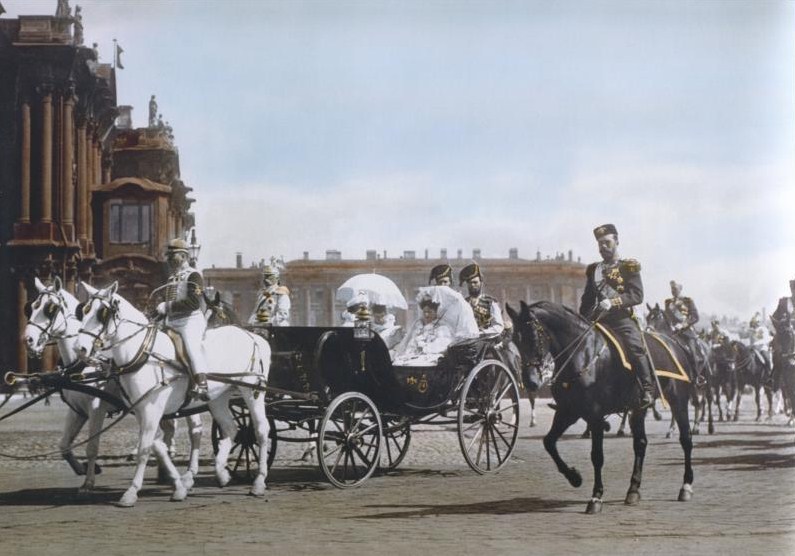
The icy steppes of Russia, the opulence of a Romanov Tsarina, a mix of hauteur and passion, brocades and fur, sweeping dresses and fabulous jewels….

Photo of Tsar Nicholas II accompanying Tsarina Alexandra and Dowager Empress Maria Feodorovn, at the Winter Palace Photograph circa 1901 by Burton Holmes. Source: Angelfire.com

Photo of Tsar Nicholas II accompanying Tsarina Alexandra and Dowager Empress Maria Feodorovna, at the Winter Palace. Photograph circa 1901 by Burton Holmes. Source: Angelfire.com

Those images are the source of inspiration for Tsarina, the new fragrance from the London luxury perfume house, Ormonde Jayne. It is one of four fragrances in the new Four Corners of the Earth collection which was released in late 2012 and which pays homage to the different parts of the world that have inspired Ormonde Jayne’s founder, Linda Pilkington. The collection is the result of collaboration between Ms. Pilkington and the perfumer, Geza Schoen, and consists of four fragrances: Tsarina, Qi, Montabaco and Nawab of Oudh. I have samples of all four fragrances, provided courtesy of Ormonde Jayne, and will review each one in turn, starting now with Tsarina.

OJ TsarinaOrmonde Jayne describes Tsarina as follows:

Tsarina captures opulence and passion. It demands fur, leather, brocade, heavy silks in sweeping dresses and fabulous jewels to go with her haughty heritage. To call it a floral oriental is to misunderstand its rich complexity, it is more baroque. The perfume is profound, blending leather notes, rich Madagascan vanilla, amber and orris butter.’ This is a powerhouse perfume, ravishing and regal, distinctive and synonymous with the glamorous world of luxe.

Tsarina’s notes include:

top: mandarine, bergamot, coriander, cassis.
heart: hedione, freesia, jasmine sambac, iris, suede. 
base: sandalwood, cedar, vanilla bean base, labdanum, musk.
Alix Romanov, last Tsarina

Empress Alexandra Romanov, née Alix of Hesse.

The description of Tsarina, along my past historical writings on both royalty and the Russian Imperial Family, led me to anticipate either Catherine the Great or Alexandra Romanov, last Tsarina of that ill-fated family. I expected images of snowy St. Petersburg, furs, jeweled chains of opulence, and a heady, baroque oriental that epitomized hedonistic splendour and excess.

Grace-Kelly-handbag

Princess Grace of Monaco.

Instead, I found an incredibly elegant, soft iris and suede scent that — to my mind — consistently evoked the cool, restrained, pale beauty (and occasional hauteur) of Princess Grace. Tsarina is, at times, as fizzily fresh and crisp as the best champagne (if there were ever a citrus, lemon champagne), at other times icily cool, but always romantic with a plushly soft heart like the finest suede coat matched with dove-grey gloves.

Tsarina opened on my skin with the freshest burst of citrus imaginable. It was so zesty, it felt as though you’d just cut into a lemon and been squirted by its juices. Light and bright, it mixes with the sweet, airy scent of freesia, some subtle musk, and an underlying note of soft, white woods. There was also a very faintly soapy element that creeps around the edges, mixing with the citrus accord, to add to the impression of a very fresh, Spring-like scent. The woody note is subtle, but even more subtle was the orange tonality which flickered for a brief moment before vanishing entirely. I tested out Tsarina three times, and mandarin never appeared for me at all during the other two tests.

Everything feels green, fizzy and bright, thanks, in part, to the hedione which seems to be a very significant molecule in 20th century perfumery. (You can read Bois de Jasmin‘s discussion of its uses in everything from highlighting jasmine to its role in Eau Sauvage, Diorella, and Van Cleef & Arpel’s First.) The Perfume Shrine explains that hedione is an aromachemical that is often used as a substitute for jasmine absolute, “but also for the sake of its own fresh-citrusy and green tonality.” It is said to “give fizz to citrus notes much ‘like champagne’.” Here, with Tsarina, it does just that, lending a sparkling quality to the bergamot lemon, while also adding its own green touch.

Prss Grace via TumblrLess than ten minutes into the opening of the Tsarina, the perfume’s strong backbone of suede raises its head. Soft, buttery, white-dove grey is the colour that comes to mind, tinged with delicate iris, and the whole thing set against a backdrop of lemon. As time passes, the citrus note fades and the iris suede takes over completely. It smells exactly like the soft, light interior to a very expensive purse. There are growing peppery smoke notes from the cedarwood, combined with the light musk and those airy, pastel freesia blossoms. The merest hint of soap weaves its way around all those notes, joining another subtle thread in Tsarina’s tapestry: powder. Iris often has a very powdery characteristic, but it’s very light here. Instead, the much plusher orris butter creates a velvety soft image, accentuating the grey suede note. It’s very cool in tone; never quite icy but never effusively warm, either. It has a regal hauteur and quiet aloofness, if you will.

The perfume is surprisingly soft and lightweight in texture, though strong in its initial moments. However, after less than forty minutes, the sillage drops dramatically. It’s as gauzy and light as the softest pashmina scarf, resting just lightly on your skin with a grey-pastel touch of iris, suede, heaps of freesia and a touch of vanilla.

The wood and smoke notes flicker here and there, popping around like ghosts. Often, in other treatments, cedarwood can seem excessively peppery and smoking, verging sometimes on the mentholated. Here, however, the impression is of soft cashmere woods with something a bit unexpected. On two of my three tests of Tsarina, I picked up something that definitely smelled of anise. It’s as though the often mentholated aspect of cedar has been tamed or quietened to such a degree that there is just the merest hint of its chilly, smoky, licorice-y character, now diluted down to a faint soupçon of mere anise. It’s in perfect keeping with the restrained, elegant aspect of the perfume.

Three hours in, the base notes of Tsarina start to emerge. There are quiet elements of sandalwood, vanilla, and sweet notes from the jasmine, but the real end of Tsarina is labdanum. It is a rich, nutty, slighty leathery, minutely dirty and animalic resin that is one of my absolute favorite notes. Here, it’s light and sheer, far from opaquely thick or molten. The labdanum is subtly tinged by the other notes at times but, for the most part, Tsarina’s dry-down consists primarily of the ambery resin, some powder, and little else. It’s pretty but, for my tastes, too light, sheer and simple.

All in all, Tsarina lasted just under 6 hours during my first test and a bit under 5 hours on the subsequent tests when I applied a lesser quantity. I have perfume-consuming skin, but I was nonetheless surprised at the moderate-to-short longevity for an eau de parfum concentration. (My beloved Tolu which is also an Ormonde Jayne eau de parfum lasted 7 hours when I reviewed it and just over 8 hours on a recent wearing.) The softness of Tsarina and its delicate notes are, perhaps, one explanation. The sillage began by being relatively good for the first 20 minutes, then dropped down to moderate-to-low thereafter. It became extremely close to the skin by the second hour; by the fourth, I thought the scent had vanished completely but faint traces lingered on, here or there, for another one to two hours (depending on test run).

There aren’t a ton of reviews on Tsarina out there. One of the few is from the Candy Perfume Boy who seems to have a very different experience than I did:

Everything about it is evocative of the opulent jewellery, furs and textiles that the description mentions and the Russians are famous for. It opens diffusive and bitter, hinting at the animalics to come but what’s really noticeable is a warm plushness, tinged by a darkness that comes from a combination of the powder of iris and indole of jasmine.

The whole thing is, dare I say, rather Guerlainesque with its bergamot, sweet floral powder and balsamic funk. Tsarina is like Shalimar Parfum Initial but on a bigger budget (we’re talking a Tsars budget here people), cutting straight through the fruit and heading straight for the rooty iris and gorgeous, filthy base of proper Shalimar. It doesn’t mess around, to put it frankly.

Tsarina is an incredibly feline fragrance, like a beautifully sleek black cat come in from the cold, slinking and weaving itself between your legs. Like a cat it is incredibly precious but not afraid to use its claws to assert it’s authority. There’s glamour here of course, but there’s also a steely strength just beneath the surface that says; “I may be incredibly beautiful but I’m even more dangerous”.

I didn’t get any of that, I’m afraid. My experience evoked not just Grace Kelly, but the softness of an Impressionist painting of winter. Something by Claude Monet, in fact.

Claude Monet. "Winter on the Seine, Lavacourt."

Claude Monet. “Winter on the Seine, Lavacourt.”

All in all, I thought Tsarina was pretty and I liked it, though I expected to truly love it. Had I smelled the mandarin orange and leather — and had the labdanum been heavily resinous and opaque, thereby evoking furs, leather and baroque richness — I probably would have. Instead, Tsarina was predominantly velvety soft iris and suede on my skin. All three times I tried it! I should note that iris is not one of the notes which drives me wild with passion. In fact, it can be a note I struggle with, depending on what accompanies it. That said, I think this is one of the best treatments of iris that I have encountered in a while. In addition to my iris issues, however, Tsarina was also far too soft, gauzy and sheer for my personal tastes — both in terms of weight and in sillage. The longevity was also a problem, though the speed with which my skin can consume perfume is not the norm.

I’m afraid my heart still belongs to Tolu, though I have to admit that there is something about Tsarina’s plush, velvety softness that is quite alluring. Its cool elegance is comfortable and easy, like the best pashmina cashmere scarf or the richest suede caressing your skin. I know a number of my regular readers are complete fiends for soft, harmonious iris scents and, to them, I say, I think this will knock your socks off!

Unfortunately, Tsarina is not the easiest thing to get your hands on right now. It is not even listed yet on the company’s website (though it probably will be soon), and doesn’t seem available at other European retailers. As always, Ormonde Jayne fragrances are not sold in the U.S. At the moment, Tsarina is available at Ormonde Jayne’s two boutiques in London and is also available online at Harrods. That seems to be about it. Even worse, none of the perfume sample sites in the US currently offer any of the Four Corners of the Earth collection. So, you can’t even get the chance to sniff it! (When places like Surrender to Chance start selling samples of the collection, I will update this post accordingly.) Given the price, this is not something I would recommend buying blindly and unsniffed unless you know you love soft iris scents. The perfume comes only in one size — a large 100 ml/ 3.4 oz bottle — and costs £280.00. At the current exchange rate, that comes to approximately $422!

I think cost is all relative and subjective. It depends on the person and how much they adore something. So, for those who love harmonious, elegant. quietly restrained scents, especially of iris and suede, Tsarina is definitely one to try out.

Disclosure: My sample of Tsarina was provided courtesy of Ormonde Jayne. However, that did not impact this review. My primary commitment is, and always will be, to be as honest as possible for my readers.
DETAILS:
Price & Availability: As noted, above, Tsarina is an Eau de Parfum which comes only in a large 100 ml/3.4 oz size and which costs £280.00. Although Tsarina and the Four Corner Collection are not presently up on the Ormonde Jayne website, you can find the entire line at Harrods which ships out internationally. Ormonde Jayne’s two London boutiques are at Old Bond Street and Sloane Square with the precise addresses listed on the website here. When US perfume sample sites, like Surrender to Chance, start to offer Tsarina, I will update this post with the appropriate link.