Let’s Play Questions… Vol. 5 – Food, Wine & Perfume

I SMELL FRIDAY!

Happy Friday everyone! As I work through a super long test for the next perfume, I thought it would be fun to play another round of Questions. This time, the focus will be on food and wine pairings.

As a few of you know, my first love in life is gastronomy, not perfume (which actually ranks about fourth or fifth on my list of interests). This summer, I’ve become completely obsessed with the UK’s Masterchef Professionals series which focuses on Michelin-level fine dining and some of the top restaurants in the world. (It’s on BBC America, and is absolutely nothing like the heinous Fox Television reality show.) Under the auspices of Michel Roux, Jr. from the famed Roux culinary dynasty, the final three chef contestants are taken into the kitchens of some of the world’s best restaurants to create food that is actually more art than anything else. It’s an utterly addictive show, but it also made me think about what perfumes would be if they were specific food dishes or drinks.

So, your mission, should you choose to accept it, is this: pick any 3-5 perfumes and tell me what they would be if they were a specific dish and alcoholic beverage. The issue is not what the perfumes would directly translate to via their notes, but, rather, what dish and drink best embodies, represents or symbolizes that perfume in your mind. What is the feel of the perfume, for you, in culinary terms? You can pick any 3-5 fragrances that you love or, if you want to be naughty, that you hate. Or, if you like, you can pick 3-5 in the love category and have a separate listing for the fragrances that trigger horrible culinary/drink associations in your mind. Whatever you prefer. If you can, please share why you have made that particular pairing.

I know it’s not easy, because I was initially rather stumped on everything but the first of my choices, but I think this is what I would choose:

1. Vintage Opium: Szechuan Hot Pot & Red Zinfandel wine. Why? Because Opium feels like a fiery, spicy, smoldering flame of heat, and there can’t be anything hotter than a Szechuan Hot Pot (which is far too hot for me to even try it). The Red Zin wine because it often has some of the highest alcohol content amongst the red wines, and has a rich, dark, peppery, but smooth, intensity that seems to fit Opium.

2. Dior’s Mitzah: Boeuf Bourguignon and Tawny Port. Why? Because Boeuf Bourguignon isn’t a very complex dish, but it’s infinitely rich, luxurious, deep and smooth, just like the perfume. It’s also comfort food that can be done in a very elegant way. As for the Tawny port, it has the same golden rich sweetness that Mitzah can have, and the colour can represent the slightly leathered, honey nuances to Mitzah’s labdanum. That said, I’m a bit conflicted here as Ruby Port would work equally well.

3. Serge Lutens’ Fille en Aiguilles. No question in my mind: gingery sugar plums with Amarone wine. The sugar plums would be the spicy, fruited plummy molasses in Fille en Aiguilles, which would be matched by Amarone’s deep, rich, fruited intensity.

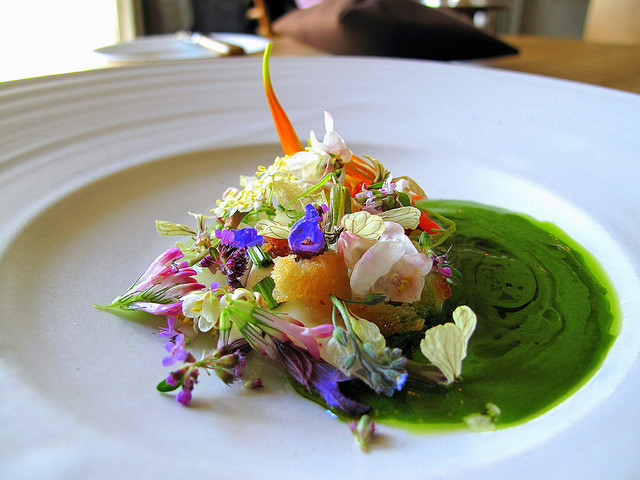
Noma salad. Source: www.tiboo.cn

Noma salad. Source: tiboo.cn. Even better close-up here: http://tinyurl.com/lh4ly62

4. Serge Lutens’ De Profundis. I struggled a lot with this one, but I think it would be a dish from the famed Noma restaurant in Copenhagen. A forager salad with dainty, purple, edible flower blossoms, a few sprigs of micro-greens, and edible leaves. The dish seemed to mirror De Profundis’ delicate colours and floral nature. As for the drink, perhaps a delicate Elderberry Cordial.

El Celler de Can Roca's candied, reconstructed apricot. Source: tripadvisor.com

El Celler de Can Roca’s candied, reconstructed apricot. Source: tripadvisor.com

5. YSL’s discontinued Champagne/Yvresse. This one is actually quite easy, thanks to my new summer addiction of the UK Masterchef Professionals series. The 3 finalists went to Spain’s legendary, El Celler de Can Roca, the #2 restaurant in the world behind Noma and run by the three Roca brothers. (Some rank El Celler de Can Roca as the best restaurant in the world.) The youngest Roca brother just does the desserts, and he recreated through molecular gastronomy an “apricot” the likes of which I have never, ever seen. The amount of work, science, and creativity that went into that dish was jaw-dropping. I can’t even begin to try to describe the process, or how that photo does not show an actual apricot. Yvresse is a very sparkling, peach-dominated, fruity fragrance, but that Roca dessert is what comes to mind when I think of it. And, naturally, it would be paired with champagne. It’s a gorgeous, gorgeous fragrance that has long been one of my favorites (and which I will get around to reviewing eventually), and it deserves the beautiful dessert from one of the world’s most famous, lauded pastry chefs.

I have to admit, there are a few perfumes that I hate that, mentally, I would link with the spoiled, rotten, green slime that you may find at the bottom of your fridge’s vegetable drawer. There are also perfumes which I adore and which would be totally represented by such comfort foods as fried chicken, pizza, or gooey caramel. (Actually, if I could have given an extra choice, it would be all about comforting caramel with perhaps hot Chai latte as a drink.) But these 5 are what stuck in my mind.

What would be your choices?

Perfume Review: Tom Ford Private Blend Plum Japonais (Atelier d’Orient Collection)

Tom Ford does Serge Lutens. Or, to be more precise, Tom Ford tries desperately to be Serge Lutens, but falls flat on his face. That is my grumpy analysis of Plum Japonais, the latest Private Blend fragrance from Tom Ford. It is part of a brand-new collection of fragrances within his Private Blend line, and was just released in July 2013. The collection is called Atelier d’Orient, and consists of four perfumes: Shanghai LilyPlum JaponaisFleur de Chine, and Rive d’Ambre. Today is Plum Japonais‘ turn.

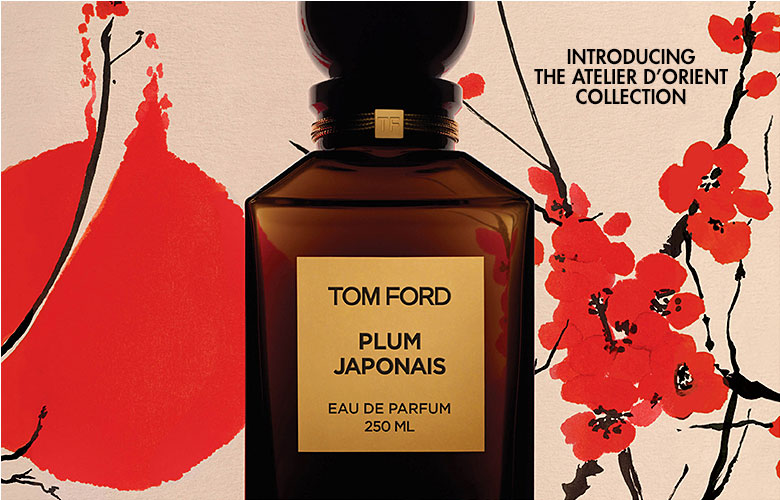
Source: Neiman Marcus

Source: Neiman Marcus

According to the Moodie Report, Tom Ford’s inspiration for Plum Japonais was the ume fruit:

Plum Japanais, as its name suggests, was inspired by the ume plum. ‘I have always been fascinated by unusual ingredients from exotic cultures,’ Ford revealed. ‘The ume plum…has great meaning in Oriental culture; in Japan and China, it is a sacred symbol of Spring. I wanted to craft a fragrance around the ume, because it has a texture and aroma that is so luscious.’

Now, I have searched and searched for some official word on who is the actual perfumer responsible for the Atelier d’Orient collection, or for Plum Japonais in specific. I can’t find it anywhere, which is slightly unusual these days when a perfumer’s name is frequently mentioned in press releases or in articles about a new fragrance.

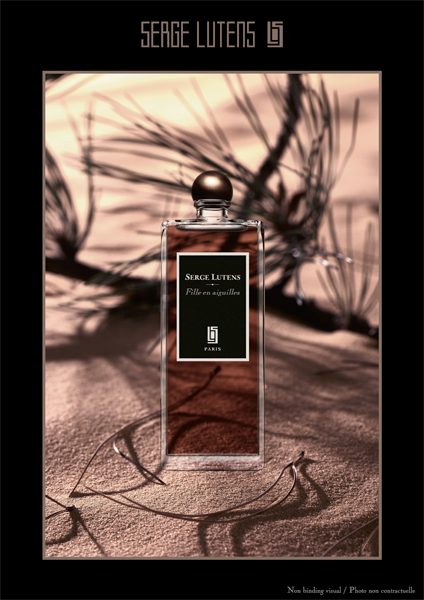
Fille en Aiguilles. Source: Serge Lutens' Facebook page.

Fille en Aiguilles. Source: Serge Lutens’ Facebook page.

Still, it wouldn’t be important or significant except for one thing: Plum Japonais is a total rip-off of Christopher Sheldrake‘s gorgeous, stunning Fille en Aiguilles for Serge Lutens. It is a fragrance that I love with a passion, and it may be my favorite Lutens that I’ve tried in recent memory. So, you can imagine my grumpiness and sour mood when I thought about how Tom Ford was so blatantly copying about 90% of the Lutens/Sheldrake masterpiece. Yes, there are differences, but they are so minor that I will stick with my numeric assessment that 90% of Plum Japonais is Fille en Aiguilles. It’s so close that much of the detailed break-down of Plum Japonais feels almost redundant (though I will do it shortly), but the main thing you should take away is this: Plum Japonais is Fille en Aiguilles done very, very badly.

Some perfumistas have compared Tom Ford’s style of perfumery to that of a frat boy with his fragrances’ over-the-top loudness and their hyper-sexualized marketing. I don’t always agree because I think Tom Ford is quite capable of producing more restrained, elegant pieces, though his marketing definitely verges on the bold and, sometimes, crass. But Plum Japonais definitely felt like a frat boy took a sledgehammer approach to Uncle Serge’s gorgeously refined, well-balanced, utterly beautiful masterpiece. Fille en Aiguilles may not rank among the best-known Lutens, but it is massively beloved amongst almost everyone who has tried it, some of whom rate it as their favorite Lutens perfume ever. And Plum Japonais simply cannot measure up. It’s as though One Direction attempted to cover John Lennon.

Christopher Sheldrake. Source: jonathanfrantini.com

Christopher Sheldrake. Source: jonathanfrantini.com

During my initial test of Plum Japonais, my irritation was becoming increasingly sharp and hostile, so I decided to make a more concerted effort to find out which perfumer was responsible for ripping off Christopher Sheldrake‘s creation for Uncle Serge. You cannot imagine my shock when I finally dug up the rumoured answer: Christopher Sheldrake himself! [Update: 8/4/13see the note at the end of this review for the information that a different nose seems to be responsible for the creation of Plum Japonais.]

According to the blog, Best Things in Beauty, “[t]he fragrance has been unofficially attributed to perfumer Christopher Sheldrake.” I haven’t seen that attribution mentioned anywhere else, so I have no idea if it’s true or not. But it probably is, given the enormous similarity between the two fragrances — and that just irritates me for a whole new set of reasons. It’s not the fact that Christopher Sheldrake is cheating on Uncle Serge (perfumers are allowed, after all, to work freely where they want, and not just for one client). Rather, it’s the fact that he’s taken his Lutens creation, and so barely tweaked it for Tom Ford that it feels almost insulting to Fille en Aiguilles. It’s damn lazy. And, making matters even worse, the result is a nondescript, utterly imbalanced, very flat, badly done, uninteresting version of Fille en Aiguilles. If Fille en Aiguilles were a person, it should sue for defamation and copyright violation. So, let’s get to Sheldrake’s One Direction-like olfactory copy of the Fille en Aiguilles.

Fragrantica classifies Plum Japonais as “Floral Fruity,” and the notes, as compiled from both that site and Premiere Avenue, include:

Japanese ume plum, saffron, Cinnamon Bark Orpur, immortelle, plum blossom, camellia, agarwood (oud), amber, benzoin, fir and vanilla.

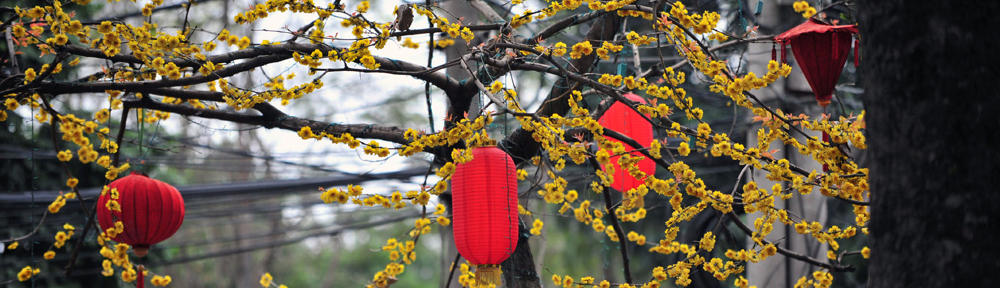
Ume plums or Umeboshi. Source: Hudson Valley Magazine, hvmag.com

Ume plums or Umeboshi. Source: Hudson Valley Magazine, hvmag.com

Plum Japonais opens on my skin with plum liqueur, plum molasses, brown sugar syrup, lots of ginger, strong frankincense smoke, and a subtle woodiness. It’s totally Fille en Aiguilles. Flittering around Plum Japonais’ edges are saffron, muted traces of fir resin, and candied immortelle. The latter shows off both its sides here: its herbal floral face, and its slightly maple syrup one. Once in a blue moon, the oud will pop up in the minutest trace, feeling as muted as the fir resin. 

Cinnamon tree bark. Source: indiamart.com

Cinnamon tree bark. Source: indiamart.com

Within minutes, Plum Japonais’ syrupy plum sweetness turns darker and significantly woodier. There is almost a burnt undertone to the combination which probably stems from the cinnamon tree bark, which is a whole, different animal than mere cinnamon powder. Amusingly, it’s an ingredient that Sheldrake featured front and center in another Lutens’ creation, the woody cinnamon oriental, La Rousse. The bark has an aroma that is spiced, but more akin to very dry, somewhat bitter, acrid, smoky wood. I wasn’t crazy about its odd nuances in Rousse, and I’m not crazy about it here. Still, it’s very subtle at this point, adding just an indirect effect to the overall woodiness running like a vein through all of Plum Japonais’ sticky, fruity sweetness and smoke.

Ten minutes in, something else rises to the surface. An odd floral note that I assume is the camellia. It’s a very creamy, velvety, white, languid scent with a strange but subtle lemony undertone, and it feels quite out-of-place amidst the increasingly dry, smoky, woody bouquet. The spices feel more noticeable, too. The saffron adds a definite kick of fieriness to the fragrance, though the note is not very distinct in its own right. For a few minutes, it adds such a bite to to the fragrance that it almost seems as though a red-hot chili pepper were thrown into the mix, but that impression quickly fades. By the 15-minute mark, Plum Japonais actually feels a little off-kilter. The lemony, creamy floral camellia attempts to balance out the increasingly harsh smoky-woodiness set amidst all that plum molasses and liqueur, but it can’t pull it off. The note is too muted. And, I still think it feels totally out of place.

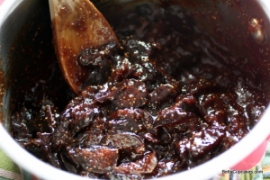
Fruit Jam. Source: Bettycupcakes.com (For recipe or website, click on photo. Link is imbedded within.)

Fruit Jam. Source: Bettycupcakes.com (For recipe or website, click on photo. Link is imbedded within.)

Nonetheless, Plum Japonais is still almost entirely Fille en Aiguilles, only with minor differences. The very piney, evergreen forest hues of the Lutens beauty are practically non-existent in Plum Japonais, the inclusion of “fir” or “fir resin” in the notes notwithstanding. Sheldrake (if it is indeed he who is behind Plum Japonais) has substituted instead a different sort of woodiness to the scent. Yet, woody dryness is hardly the main, dispositive characteristic of Fille en Aiguilles. It’s the bloody spiced plum liqueur infused with frankincense smoke, that trademark Lutens’ signature of stewed fruit made more concentrated and plummy, with brown sugar sap, and heaping, walloping, hefty doses of sharp, black incense. And Plum Japonais has that in spades, from start to finish.

The problem is that Plum Japonais is like a knock-off of an expensive designer suit, only all the proportions are wrong. Lutens’ Fille en Aiguilles is stunningly balanced, whereas Plum Japonais is not. It feels significantly more acrid, more unbalanced in the sharpness of the smoke and the dryness of the woods. And nothing in the first two hours changes my impression, even though some of the other notes wax and wane in prominence. The immortelle occasionally rises to the surface, feeling like the herbal-floral version now, and not the maple syrup one, but it is muted and vague as a whole. The spices feel a little punchier than they did in the opening minutes, and I continue to think that there is ginger mixed in the blend. The camellia, in contrast, has now retreated to the background where it adds just a quiet, shy, creaminess and muted floral whisper to the overall bouquet.

The more interesting thing is the oud. It was just a whisper in the opening, hiding in the shadows behind all that plum liqueur. Now, however, the agarwood is more a wave that surges, ebbs, and then repeats the process. Sometimes, it feels muted, but it becomes increasingly significant at the start of the second hour, turning Plum Japonais into a fragrance where the dry woods almost compete with the incense-infused plum molasses. Unfortunately, I don’t particularly like these dry woods as compared to the richer, deeper, and significantly more interesting pine ones in Fille en Aiguilles.

As for the smoke, it varies as well. On certain parts of my arm, it feels quite bitter, pungent, and harsh, while, elsewhere, it’s more blended into the fruit. I think the cinnamon tree bark is behind some of the differences. Its smokiness in Serge Lutens’ Rousse felt quite acrid and bitter at times, and I think the note here has combined with the frankincense to create a combination that feels quite harsh at times. It’s never the smooth, almost sweetened incense that you’d expect, or, indeed, the gorgeous smoke in Fille en Aiguilles. This is much sharper and drier in nature, with a slightly bitter undertone.

Japanese Plum Liqueur, Yamazaki. Source: tokyowhiskyhub.blogspot.com

Japanese Plum Liqueur, Yamazaki. Source: tokyowhiskyhub.blogspot.com

It takes 50 minutes for Plum Japonais to soften and lose some of its harsh edges. The plum top notes start to feel flatter, while the smoky oud and the woods in the base seem smoother and less sharp. There is still a bitter, slightly burnt, pungent nuance to the woods, but the perfume as a whole feels a bit less askew and out of balance. Unfortunately, Plum Japonais also starts to feel a little murky and muddy at this time, both texturally and in terms of the distinctness of its notes. It’s starting to blur into a pretty smoky-woody-fruity fragrance just barely dominated by plum. By the end of the second hour, Plum Japonais is starting to fizzle out with notes that feel increasingly amorphous. The sillage has changed too, as the perfume just barely hovers an inch above the skin, if that. Plum Japonais is now just flat, stewed, sweet plummy jam with vague smoke and dry woody notes. In short, the Serge Lutens signature of dried, sweetened, dark fruits with oriental touches, but without the Lutens oomph and drama. At the 3.5 hour mark, Plum Japonais is a total skin scent, and has devolved to mere plummy sweetness barely flecked by some amorphous dryness and smoke. It remains that way until the very end, growing even more hazy, until its dying moments when it’s just vague sweetness.

All in all, Plum Japonais lasted a little over of 6.75 hours on my perfume-consuming skin, with incredibly restrained, soft sillage after the first hour. I applied quite a hefty portion too, as I had a very large sample from Neiman Marcus, so I basically wetted a long patch on my forearm with the equivalent of about 5 huge smears. If I’d applied my normal amount, I suspect the numbers would be significantly lower.

I have to admit, given the strength of Plum Japonais at first, and the power of Tom Ford’s Private Blends in general, I’m a little surprised at the shortness of time, as well as the restrained nature of the fragrance when taken as a whole. However, the fact that the perfume is ultimately quite subdued makes a lot more sense if you put it into context and in conjunction with the similar characteristics of Shanghai Lily. Both Atelier d’Orient fragrances seem intentionally designed to be more quiet, restrained takes on a spicy Oriental. I suspect that Tom Ford is aiming this collection at wealthy buyers in Asia, buyers who may not appreciate his usual, brash style, or a truly hardcore, intense Oriental in the style of something like Amouage. Plum Japonais is an attempt to give them a more subdued take on a masculine, woody, fruity oriental, with Shanghai Lily attempting to do the same for the more feminine, floral oriental version. That said, I want to emphasize that Plum Japonais is not a masculine scent at all. It’s wholly unisex for everyone except those whose perfume preferences lean towards the fragrances that are either fresh, clean, soapy, dainty, powdery, aldehydic, or some combination thereof.

Plum Japonais is too new for there to be many reviews available for comparison. My sense of how people generally see the Atelier collection as a whole is that they think it’s nondescript and uninteresting, with Plum Japonais being the best of the lot. That does not mean that they think it’s a great perfume, however. The Basenotes review section for the fragrance has only three reviews up at this time. One of them, “kende,” seemed to share my views about Plum Japonais’ development:

The problem is how short lived this wondrous moment is. Within 15 minutes the scent begins to feel more and more flat. The complexities start to vanish and what suddenly remains is a puny, underwhelming “perfumey” base that smells like a very commonplace generic perfume type of scent. This doesn’t take hours, mind you. It takes no greater the length of 45 minutes to unravel from that rich, opulent opening. […]

This perfume could’ve really been something special, that opening is something every perfumista should experience, but there is no backbone to hold Plum Japonais up over the hours. It goes on like a work of art and but feels more and more like a cheap photocopy as the minutes turn to hours. […]

The scent is 4 stars.

The longevity is embarrassing for a Tom Ford private blend. 0 stars.

Kende doesn’t know it, but Plum Japonais absolutely is a “cheap photocopy[,]” and he or she needs to go try Fille en Aiguilles. Over in a separate Basenotes board thread, the common consensus for Plum Japonais is, and I quote, “meh.” As one poster put it, “I’m honestly not impressed with any of the new Atelier scents. I guess this would be the stand out, but thats not saying much.”

No-one talks about Fille en Aiguilles because, as I noted up above, it’s not one of the better-known Lutens fragrances. But the perfume blows Plum Japonais out of the water! It is also significantly cheaper than Tom Ford’s ersatz, wanna-be copy which costs $210 for the smallest version. Fille en Aiguilles retails for $140, but can easily be found discounted at a number of online perfume retailers, with the lowest price I’ve seen being $80. (See the Lutens review for full retail links.) Honestly, writing out that price differential just offends me even more. Plum Japonais is such a total waste of money. It’s one thing to take a great perfume and use it as a source of inspiration for another; lots of perfumers create scents that have some overlap or a common signature. But Plum Japonais is such a completely out-of-whack, wholly unbalanced, fizzling, flat, totally lazy, “cheap photocopy” of such a supremely stunning, refined, mysteriously seductive, incredibly evocative, utterly mesmerizing scent that it’s positively insulting. The irrational side of me feels like shaking Christopher Sheldrake — who may be my favorite perfumer ever — and asking him, “Why? Why??!!”

In fact, I think I’m too irate to continue this review.

[UPDATE: 8/4/2013– According to one commentator to the blog, “Mike,” who left an answer below, Christopher Sheldrake did not mutilate his creation because Yann Vasnier of Givaudan is the actual nose behind Plum Japonais. Mike cites as sources two unnamed bloggers who contacted Tom Ford. He later directed me to a review at CaFleureBon which states that Yann Vasnier is the creator of Plum Japonais. That review was posted just yesterday, a few days after my own, so the information wasn’t available to me at the time, but I’m very grateful to Mike for telling me about it. I would like to extend to Christopher Sheldrake my heartiest apologies for thinking he had plagiarised himself with a bad copy, and for wanting to shake him like a rag doll.]

DETAILS:
Cost & Availability: Private Blend Plum Japonais is an eau de parfum which comes in three sizes that retail for: $210, €180, or £140.00 for a 50 ml/1.7 oz bottle; $280 or £320.00 for a 100 ml/3.4 oz bottle; or $520 for a 200 ml/8.45 oz bottle. The line is not yet listed on the Tom Ford websiteIn the U.S.: you can find Plum Japonais at Neiman Marcus and Bergdorf Goodman. I don’t believe Nordstrom or Saks has the new collection yet. Outside the U.S.: In Canada, I believe Tom Ford is carried at Holt Renfrew, but they only list 2 of the old fragrances on their online website. In the UK, you can find Plum Japonais at Harrods (which only has the small size), Selfridges (which carries both sizes), or House of Frasier (both sizes). The small size is also carried by Harvey Nichols. All the stores sell the small 1.7 oz/50 ml size for £140.00, while the super-large 250 ml bottle costs £320.00. In France, Plum Japonais is available at Premiere Avenue which sells the 50 ml bottle for €180. For other all other countries, you can use the store locator on the Tom Ford website to find a retailer near you. Samples: You can buy samples of Plum Japonais at Surrender to Chance starting at $3.99 for a 1/2 ml vial.

Perfume Review: Tom Ford Private Blend Shanghai Lily (Atelier d’Orient Collection)

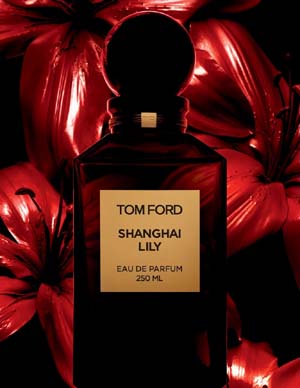
The dainty, fragile, green lily transformed into a smoky, spicy, rich flower of the Orient. That is the essence of Shanghai Lily, the latest Private Blend fragrance from Tom Ford. It is part of a brand-new collection of fragrances within his Private Blend line, and was just released in July 2013. The collection is called Atelier d’Orient, and consists of four perfumes: Shanghai LilyPlum JaponaisFleur de Chine, and Rive d’Ambre. I’d heard that the first two were the best, so I focused solely on those, starting with Shanghai Lily. (You can find my review for Plum Japonais here, but, to summarize it in a nutshell, Tom Ford tried to copy Serge Lutens and his gorgeous, magnificent Fille en Aiguilles. Tom Ford failed. Badly.)

Tom Ford Shanghai LilyNone of the new Atelier d’Orient fragrances are listed yet on Tom Ford’s website, but, according to the Moodie Report, Tom Ford’s inspiration for Shanghai Lily was the famed, ancient Silk Road:

This fragrance began with a dream of the Silk and Spice Roads – the ancient, Asian trading routes for luxurious and precious goods[.] I imagined caravans piled high with treasures, and being surrounded by a multi-sensorial abundance of opulence.

 Fragrantica classifies Shanghai Lily as an “Oriental Floral,” and says the notes include:

spicy notes, floral notes, olibanum [frankincense], vanilla, bitter orange, pink pepper, black pepper, cloves, jasmine, rose, tuberose, vetiver, cashmere wood, benzoin, castoreum, labdanum, guaiac wood and incense.

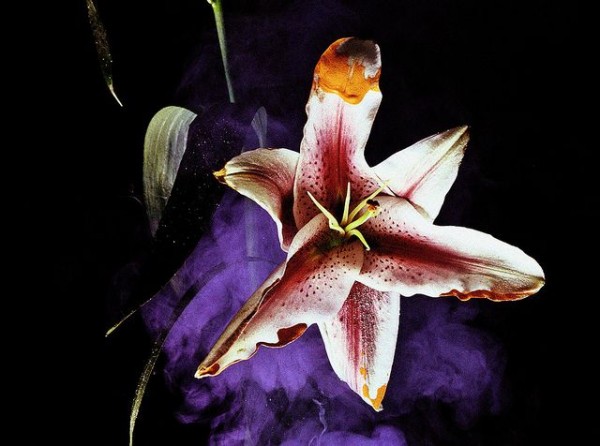
Photo: Henry Hargreaves Photography. "Smoke and Lily" series. Source: Trendland.com http://trendland.com/henry-hargreavess-smoke-and-lily-photography/

Photo: Henry Hargreaves Photography. “Smoke and Lily” series. Source: Trendland.com http://trendland.com/henry-hargreavess-smoke-and-lily-photography/

Shanghai Lily opens on my skin with the daintiest of lily notes. Fresh, green and airy, it turns within seconds into something sultry and smoky. Sharp incense smoke, a touch of resins, and a cloud of spices transform the white flower into something dark, thick, rich, and heady. There is a subtle orange note lurking alongside which feels, simultaneously, bitter and like the concentrated oil from a freshly grated orange rind. Quickly, a hint of cumin rises out of the dusty spice blend, smelling sweet and strong, and flecked with incense smoke. It’s quite unexpected, but cumin-phobes should not worry. It lasts all of about three minutes.

Shanghai Lily’s base is interesting. In those early minutes, there is a surprising, almost foody aroma of sweet, yeasty bread that pops up out of nowhere. It’s a scent that I’ve now come to associate with certain kinds of beige woods, not only cashmere blends or the ersatz “sandalwood” in some fragrances, but also, sometimes, guaiac wood. The latter often has a very dry, smoky aroma that can sometimes feel like burnt autumnal leaves but, here, in Shanghai Lily, it’s taken on a sweet edge at first. Later, it turns sour and bitter in one of my least favorite aspects of the fragrance. Also lurking in the base is castoreum. It has a plush, velvety feel which adds to the amber and resinous notes that make up the base. The overall combination is a heady, slightly musky, velvety amber mixed in with dry, smoky woods.

The top notes in Shanghai Lily are initially all about the smoke and spices. The fragrance is heavy with a gorgeous burst of ancient, oriental, frankincense mixed with the fiery kick of black pepper and a powerful note of cloves. The way that the trio combines with the bitter orange is vaguely reminiscent of my precious holy grail fragrance, vintage Opium from YSL, but the similarity is fleeting. For one thing, Opium has a powerful start of juicy plum, citruses, and bergamot, and the minor, muted sprinkling of bitter orange in Shanghai Lily cannot compare. For another, vintage Opium was centered on true, Mysore sandalwood, with a heavily resinous feel, real animal musk, and a good amount of castoreum. None of the notes in Shanghai Lily can compare in depth, quantity or intensity, though I’d bet that Opium — that legendary, glorious, benchmark oriental fragrance — was a strong inspiration for Tom Ford. The heavy infusion of cloves mixed with incense is too clear a signal.

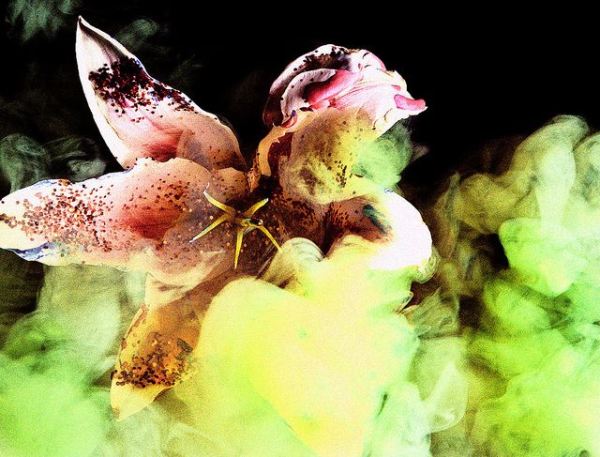
Photo: Henry Hargreaves Photography. "Smoke and Lily" series. Source: Trendland.com http://trendland.com/henry-hargreavess-smoke-and-lily-photography/

Photo: Henry Hargreaves Photography. “Smoke and Lily” series. Source: Trendland.com http://trendland.com/henry-hargreavess-smoke-and-lily-photography/

Shanghai Lily’s opening minutes are not much about the lily, though that soon changes. At first, the lily is hidden and muted behind the heavy veil of that gorgeous clove-incense-spice mix. Less than 10 minutes into the perfume’s development, it starts to emerge in much greater strength. It feels as though a Stargazer lily has suddenly been dunked in a syrup made from dark resins, bottles of cloves, and a hearty, exuberant, uninhibited tossing of frankincense. Flickers of vanilla dance all around the edges, adding to the sweetness of the floral bouquet. The castoreum feels much more distant now than in the opening, as does the dry, woody guaiac, but there is still a subtle muskiness that infused the scent.

Source: hdwallpaperspics.com

Source: hdwallpaperspics.com

Shanghai Lily becomes increasingly floral in nature. The lily is joined by jasmine that is potent, heady, and languorously indolic. There are hints of rose and tuberose that flitter about, and something that resembles the purple, airy, fresh delicacy of violets. The overall bouquet is infused primarily with frankincense smoke and cloves; the orange and cumin are long gone by the twenty-minute mark. Yet, for all the heady, heavy, oriental opulence of the florals, Shanghai Lily has some dryness, too. The smoke and lurking, distant guaiac wood create some balance to the sweetness, ensuring  that it’s never pure goo or syrup. Still, the fragrance is extremely potent in strength, and somewhat heavy in feel, at least initially.

Source: fr.123rf.com

Source: fr.123rf.com

At the end of the first hour, Shanghai Lily is primarily a quartet of cloves, lilies, jasmine, and frankincense atop a base of amber and woods, and it remains that way for a number of hours. Although the notes don’t change significantly, the lily and jasmine do fluctuate in strength, as do some of the background florals like the tuberose. I also noticed that the lily becomes much more prominent when the fragrance is worn in the heat and humidity.

The main change in the first few hours, however, is in texture. Around the 90-minute mark, the perfume’s edges blur, and the notes start to overlap. Shanghai Lily still emits its main bouquet of notes, but a lot of the sweetness has faded, as has the strength of the smoke. The dark, syrupy resins underlying the scent seem much fainter, too, though the vanilla still lingers. Shanghai Lily feels much drier and woodier, with slightly more peppered, smoky woods that now have a somewhat sour, bitter edge to them. Still, as a whole, Shanghai Lily is a rich, spicy floriental with a dry, woody smokiness. It’s not as dense in feel, and it hovers just an inch above the skin with substantially reduced sillage as well.

One thing I’ve always noticed about Tom Ford fragrances is that it is better to err on the side of caution when it comes to dosage and application amounts. His Private Blend fragrances, in particular, carry a wallop at first, so spraying your usual amount of perfume can be a deadly thing. Not only is their projection enormous, but the potency of the Private Blends can overwhelm the nose, sometimes making it harder to detect all the subtle nuances. Spraying (as opposed to dabbing) simply compounds the problem, as aerosolization just makes fragrances stronger. With Shanghai Lily, as with many Tom Ford fragrances, I tested it twice, with the second time focused solely on the perfume’s range and sillage in the first 3 hours. The first time, I was recklessly dabbed on a very large amount — about 4 large smears or the equivalent of 2 extremely large sprays– and the sillage was unbelievably potent at first. The perfume also showed a good range of layers and notes. However, during my second test, I applied only about 2 medium-ish smears (the amount you’d get from about 1 moderate spray), and I noticed a difference. Shanghai Lily turned flat, amorphous, and abstract shortly after the first hour. The notes all blurred into each other, and the fragrance lacked significant nuance. It’s something to keep in mind when you test the fragrance for yourself.

Photo: Henry Hargreaves Photography. "Smoke and Lily" series. Source: Trendland.com http://trendland.com/henry-hargreavess-smoke-and-lily-photography/

Photo: Henry Hargreaves Photography. “Smoke and Lily” series. Source: Trendland.com http://trendland.com/henry-hargreavess-smoke-and-lily-photography/

Yet, even with the greater dosage, Shanghai Lily becomes a skin scent much faster than that initial power and potency would lead you to believe. Less than 2.25 hours in, Shanghai Lily is just a sheer, unobtrusive, soft veil right on the skin. It’s also almost wholly abstract in nature, a vague puff of white flowers just barely dominated by lily and which have a slightly bitter, spicy, incense nuance. Around the start of the third hour, that odd, sour bitterness in the woody base bothers me even more, but I’m starting to be distracted by something else: the vanilla. The light flecks of vanilla that darted around Shanghai Lily’s edges in the opening are now becoming very noticeable.

At the end of the third hour, the vanilla starts to feel like the only individually distinct, concrete note in the spicy, floral blur, and it’s quite lovely. It’s creamy, frothy, airy, and very smooth. It almost feels rich enough to be called “custardy,” but the note is ultimately too sheer and gauzy for that adjective to truly apply. It’s a very well-balanced element that is far from sweet, thanks to the woody dryness and the black, frankincense smoke underlying it. From this point forwards, for the next three hours, Shanghai Lily is primarily a dry, smoky vanilla scent on my skin. The other notes — from the amber and spices to the florals — are wholly nebulous, amorphous, and tangential blurs in the background. Around 6.25 hours in, even the vanilla turns hazy, and Shanghai Lily is nothing more than smoky sweetness. It remains that way until the end, though the perfume’s smokiness sometimes seems much stronger than it was during the nebulous middle stage.

Source: Micks Images. http://www.micksimages.com/Smoke-II(2399572).htm

Source: Micks Images. http://www.micksimages.com/Smoke-II(2399572).htm

All in all, Shanghai Lily seems to have three distinct stages. In the first, the fragrance is dominated by a very spicy, smoky floral quartet of notes (lily, jasmine, cloves and incense) atop a plushly ambered base. In the middle stage, the perfume becomes more vague, hazy, and the edges between the notes blur. It also becomes woodier, and drier. There are growing hints of vanilla which helps Shanghai Lily transition into its final stage of being a very airy, frothy, vanillic confection infused with dry smoke. In its final moments, the fragrance is merely a lingering trace of smoky sweetness. Shanghai Lily lasted just over 9.25 hours on my perfume-consuming skin with a large dosage (about 4 large smears), and the projection was extremely soft after the first potent hour. I suspect those numbers would differ dramatically if one sprayed, instead of dabbed, and if one sprayed on a lot.

I like Shanghai Lily, quite a bit, and, yet…. it doesn’t move me. It hits all the right notes on paper: I adore the walloping clove-incense combination; I love lilies and tuberose; and I enjoyed the drydown. But Shanghai Lily didn’t evoke anything emotionally, it didn’t transport me, or conjure up visions in my head. I like it more than a number of existing Tom Ford Private Blends, but something is holding me back. I don’t know what it is, but I suspect the nebulousness and the flatness of the notes after the first 90-minutes have a lot to do with it. Something about Shanghai Lily simply doesn’t seem as interesting as it might have been, given those notes and that powerful spicy, complex beginning. I suppose the fragrance just seems to go a little downhill, a little too quickly, and nothing about the middle phase or even the last one is all that interesting, dramatic, or original. When I smell the opening, I perk up a little, but I suspect I’ll remember Shanghai Lily in the months to come as “that perfume with the really lovely opening that I should have liked more but ultimately didn’t, because it wasn’t interesting.” None of this is helped, of course, by Tom Ford’s prices which have just gone up to $210 for the smallest size. I could tolerate a fragrance that goes from interesting to amorphously flat and abstract, if Shanghai Lily weren’t such a muted creature with a hefty price tag. And, yet, I have to repeat again, it’s actually quite a lovely perfume. It simply isn’t lovely enough, for me, especially for the price.

Bois de Jasmin doesn’t share my ambivalence towards Shanghai Lily. She adores it, though she wishes she didn’t, given Tom Ford’s prices. Her review reads, in part, as follows:

I like my flowers with a twist, and Shanghai Lily is a white floral with a dark mood. The jasmine and tuberose are warmed up and cossetted with plenty of spices and dark resins, which is already interesting. But the best part is that nothing about Shanghai Lily is heavy or oppressive. Instead, it sparkles from its gingery top notes to the incense accented drydown. […]

As much as it pains me to admit it, given Ford’s price tag, Shanghai Lily is beautiful. I love how it sizzles with pepper and clove, which are then toned down by orange. The promised lily is composed out of different floral notes, and its waxy white petals take shape slowly out of rose, violet, and jasmine. And then suddenly, you have on your skin a corsage of Madonna lilies powdered yellow with sweet pollen.

Later, the lilies wilt, leaving you with the scent of an antique rosewood box that not only smells of wood shavings, but also of incense, musk, and something earthy and smoky. The sweetness is mild, the darkness is tempered, and yet without being heady or dramatic, Shanghai Lily clings to the skin for hours. […] (On the other hand, if you want something to announce your presence, this won’t fit the bill).

At the end of her review, Victoria says Shanghai Lily is significantly easier to wear than some other famous florals, like Serge Lutens’ “femme fatale” perfume, Fleurs d’Oranger: “[Shanghai Lily] is mild stuff, but it’s also easier to carry.” Perhaps that’s my problem. My style is not about “wilting” and “mild stuff.” I like hardcore Orientals that bloody well epitomize “heady or dramatic,” and “mild stuff” simply doesn’t cut it for me. I want my damn vintage Opium, not some wanna-be copy that wimps out after an hour and descends into a nebulous blur, while charging me $210 for the dubious pleasure.

For everyone else, however, Shanghai Lily may be the perfect ticket. Those who find Amouage‘s intense, heady, opulent, complex, powerhouse Orientals to be too much will undoubtedly be grateful for the tame, mild version offered by Tom Ford. It’s a very feminine floriental that is unobtrusive and subdued, but with great longevity, and some interesting bits. It’s easy to wear, versatile, approachable, and may even be suited for conservative office-environments if you’re extremely careful with the amount you apply. And I really do think it’s a sexy, seductive scent. In fact, I have no doubt that Shanghai Lily will be a best-seller, especially as Tom Ford doesn’t have anything else quite like it. (If I’m not mistaken, it is his first non-oud Oriental that is primarily floral in nature, and with heady white flowers instead of the usual roses.) So, I definitely encourage those of you who love white flowers and Orientals to give it a sniff, but if you’re used to really dramatic, heady, smoldering scents like those from Amouage, I fear you may be a little ambivalent as well.


DETAILS:
Cost & Availability: Private Blend Shanghai Lily is an eau de parfum which comes in three sizes that retail for: $210, €180, or £140.00 for a 50 ml/1.7 oz bottle; $280 or £320.00 for a 100 ml/3.4 oz bottle; or $520 for a 200 ml/8.45 oz bottle. The line is not yet listed on the Tom Ford websiteIn the U.S.: you can find Shanghai Lily at Neiman Marcus and Bergdorf Goodman. I don’t believe Nordstrom or Saks has the line yet. Outside the U.S.: In Canada, I believe Tom Ford is carried at Holt Renfrew, but they only list 2 of the old fragrances on their online website. In the UK, you can find Shanghai Lily at Harrods or Selfridges. Both stores sell the small 1.7 oz/50 ml size for £140.00 or £320.00 for the super-large 250 ml bottle. The smaller size is also carried at House of Fraser and UK-5th Village. In France, Shanghai Lily is available at Premiere Avenue which sells the 50 ml bottle for €180. For other all other countries, you can use the store locator on the Tom Ford website to find a retailer near you. Samples: You can buy samples of Shanghai Lily at Surrender to Chance starting at $3.99 for a 1/2 ml vial.

Perfume Review – Profumum Acqua di Sale: The Bottled Sea

Source: Coastalcare.org

Source: Coastalcare.org

Photo: Dayle Ann Clavin Photography, used with permission.

Photo: Dayle Ann Clavin Photography, used with permission.

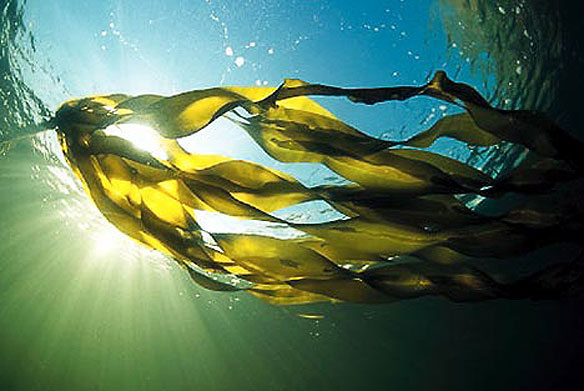
The beach stretched on for miles, dotted with rocks, and garlanded by long necklaces of seaweed. A brisk, chilly Atlantic wind stirred the waters to a salty fury, and carried the smell of the myrtle and cedar trees that lined the cliffs. Though the sun shone warmly, that fragrant wind cut through the heat, bring the forest to the beach. Dry cedar danced with the herbal, mentholated aromatics of the myrtle, but both were wrapped with ribbons of kelp as if the sea insisted on joining the game. On the beach, as the water glittered in alternating shades of cold blue and warm turquoise, solitary walkers were covered with a fine spray of salt which mixed with their heated skin, creating an interplay of salty and sweet, amber and white, gold and green.

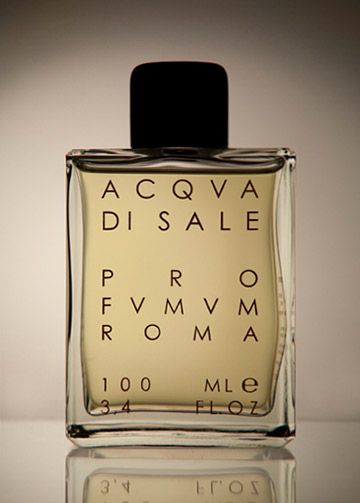
Sun, surf, sand, and fragrantly herbal, mentholated trees are the simple bouquet of Acqua di Sale, an eau de parfum from Profumum Roma. It is an Italian niche house founded in 1996, and commonly called Profumum by most. (The name is also sometimes written as “Profvmvm,” but, making matters more complicated, the company puts it as “Pro Fvmvm” on their website). As regular readers will know, I’ve become utterly obsessed with Profumum’s fragrances, after trying their two great, incredibly rich ambers, Fiore d’Ambra and Ambra Aurea. I ended up falling hard for the latter with its gorgeous, rare, salty, expensive ambergris. In fact, I think is the best, richest, and most luxurious amber fragrance around.

Source: Profumum Roma

Source: Profumum Roma

Given the scorching heat of the summer, it seemed natural that my next foray into Profumum’s wares would be the salty, sea fragrance, Acqua di Sale. Profumum‘s website describes it very simply:

The sea waves that brake on the shore donate new shells,
with a multitude of sizes and shapes,
to the sand that glimmers in the morning sun of August.
In the desert beach flutter heedlessness and freedom.

The notes, as compiled from Fragrantica and Luckyscent, consist of:

virginia cedar, seaweed or marine algae, salt and myrtle.

Source: squidoo.com

Source: squidoo.com

Acqua di Sale opens on my skin with a burst that takes me immediately back to the sea: salty kelp lying on the rocks, sea air, pure salt, and a splash of salty water. Yet, the forest is there, too, with the minty, aromatic, herbaceous notes of myrtle fused with dry, peppery cedar. There is a surprising creaminess to Acqua di Sale’s base that definitely lends itself to the Noxema comparisons made by a few commentators. For non-American readers, Noxema is a thick, white, face cream and cleanser that first came out in 1914, and which has a very herbal aroma. The reason for the similarity here is due to the myrtle which has a herbal, Mediterranean aroma, and whose essential oil is very similar to eucalyptus in aroma. Noxema is infused with camphor, menthol, and eucalyptus. Yet, the Noxema nuance to Acqua di Sale is very subtle and, for me, extremely fleeting.

Photo: Dayle Ann Clavin Photography, used with permission. Website Link embedded within photo.

Photo: Dayle Ann Clavin Photography, used with permission. http://www.dayleannclavin.com/

Moments later, there is a strong undercurrent of watery saltiness that strongly evokes a beach. It’s not the sort of beach that you’d find in Rio or Hawaii with its aroma of tropical florals and suntan oil. Instead, the beach in Acqua di Sale is either in the Atlantic, in Normandie or Bretagne, or nestled somewhere in the South on the rocky coast of the Mediterranean. It’s a windswept, desolate, slightly chilly beach where the salty air is filled with brisk, bracing herbaceousness and woodiness, and where the kelp far outnumbers the humans.

Yet, to be honest, there is something initially quite synthetic in the base that supports Acqua di Sale’s woody, sea facade. It feels like a subtle tinge of clean, fresh, musk mixed with slightly artificial ozonic and aquatic elements. It can’t be helped, I suppose, since neither salty kelp nor salty water is a natural scent in perfumery, and light musk is always synthetic. In fairness, the synthetic accord is a lot less abrasive, fake, or extreme than it is in many ozonic, clean, maritime scents. Acqua di Sale is not Armani‘s Acqua di Gio for me — and it’s a fact for which I’m enormously grateful. Even better, it only lasts a brief time, thanks to the strength of the other notes. 

Fifteen minutes into Acqua di Sale’s development, the cedar and myrtle emerge with a roar. The combination feels crystal clear, pealing like a bell’s single note in the wilderness, a strong, bracing, brisk aroma of herbal, aromatic, chilly eucalyptus and woods. The smell is actually far more herbaceous and dry than purely mentholated, and it never feels medicinal. It’s lovely, especially when subsumed under that veil of sea water and salty kelp, though it is a very simple bouquet when all’s said and done.

Photo: Dayle Ann Clavin Photography, used with permission. http://www.dayleannclavin.com/

Photo: Dayle Ann Clavin Photography, used with permission. http://www.dayleannclavin.com/

Acqua di Sale doesn’t change in any profound way for a few hours. Around the 75-minute mark, the perfume becomes softer, rounder, and smoother. Any synthetic traces have long gone, leaving a very briskly refreshing, cool, airy fragrance. Close to the end of the second hour, Acqua di Sale’s projection drops quite a bit, hovering now just a few inches above the skin, though the perfume is still somewhat strong within its tiny cloud.

Then, suddenly, just after the end of the third hour, Whoa Mama! Acqua di Sale turns into amber. The brisk, bracing, maritime, herbal, mentholated eucalyptus, cedar, and salt perfume transforms unexpectedly into almost pure, gorgeous, salty, sweet, ambered silk with just a sprinkling of herbal dryness around the edges. I couldn’t believe just how drastic the change was from the first hour. Now, Acqua di Sale is an incredibly snuggly, soft, plush amber first and foremost. Its sweet, almost cushiony warmth is infused with saltiness, leading me to believe that there is some ambergris in the perfume’s base as well. I’ve noticed in the past that Profumum doesn’t seem to give a very complete list of notes, and they seem to love their ambergris, so I wouldn’t be surprised at all if they tossed it into Acqua di Sale as well.

Photo: Dayle Ann Clavin Photography, used with permission. http://www.dayleannclavin.com/

Photo: Dayle Ann Clavin Photography, used with permission. Website link at end of review.

The result is so lovely, I want to burrow in it. It evokes the feeling you have after a long day at the beach when your sun-soaked skin radiates a lingering soft, salty, sweet warmth, and your slightly chilled body is wrapped in a dry towel. The aroma is incredibly soothing, relaxing, and comforting, especially given the hints of dry, eucalyptus-infused cedar to give it some character. I can’t pinpoint the cause of the sweetness which is too rich to be vanilla, and, yet, there is something vaguely similar in Acqua di Sale’s undertones. I suspect it’s some sort of resin, perhaps something like Tolu Balsam which is somewhat vanillic in character but also more than that. The base and drydown in Acqua di Sale has a similar sort of sweet, golden richness, and it hovers like the finest silk right on the skin.

Around the 4.75 mark, Acqua di Sale is a sweet, salty, golden, creamily smooth amber that feels as plush as a plump pillow. It’s just barely speckled with bits of fragrant, aromatic cedar and myrtle, creating a fragrance that is incredibly cozy and elegant. I feel like snuggling in, burrowing my nose deeper and deeper into that, alas, very soft, skin scent. How I wish it were stronger, but Acqua di Sale is too fine, sheer and gauzy at this stage. And it just gets softer still. At the start of the sixth hour, Acqua di Sale is an abstract veil of sweet, slightly salty amber, and it remains that way until the very end.

All in all, Acqua di Sale lasted just short of 10.75 hours on my perfume-consuming skin. It would sound like a hell of a lot, but Profumum Roma makes what may be the richest, most concentrated perfumes on the market, containing between 43% and 46% perfume oil. It’s astonishing, but so, too, is their longevity. The last, faintest traces of Ambra Aurea died away after almost 16 hours on my difficult skin, and that was with just a few small dabs. (It’s one of the many reasons why I love it so!) On normal skin, I could easily see the longevity of Ambra Aurea exceeding 20 hours or more, especially when sprayed. I’ve heard stories of people getting some insane numbers from Profumum across the board, with a few saying traces of their fragrance lasted even through a shower — and I fully believe it. So, if 2 small-to-medium dabs of Acqua di Sale lasted 10.75 on my voracious, crazy skin, those of you with normal skin should expect substantially longer. The sillage, however, is not profound or even moderate, which may be expected from a scent that is so aquatic, maritime and herbal for a portion of its lifespan. It simply won’t be as strong as an oriental amber fragrance.

Profumum’s fragrances seem to consistently reflect a very Italian signature. Their style seems very similar to that of famous, high-end, Italian fashion designers, like Giorgio Armani, who intentionally opt for fluid, minimalistic, clean, very simple lines but always put together with great refinement and the richest fabrics. Profumum’s perfumes are very much the same: they have just a handful of notes done in a simple, somewhat linear manner, but with great richness and at the most concentrated levels. The downside to that is that the fragrances are easily, and with some justification, accused of being… well, too simple and linear. They are. No question about that at all. And it makes Profumum’s prices far too high for some people. Again, I won’t argue that, though I do believe that price can be a very subjective issue. 

For me, however, there is just something about the Profumum fragrances that I’ve tried thus far that drives me a little wild. Quite simply, it’s that ambered base. I love it, even in the Fiore d’Ambra perfume that didn’t sweep me off my feet as much as Ambra Aurea. There is a rich, infinitely creamy, satiny lushness and luxuriousness about the amber that differs from all those I’ve tried before. If Acqua di Sale didn’t have it, I would still find the fragrance to be a refreshing, brisk, well-crafted summer scent and I would like it. Not a hell of a lot, because it isn’t really my personal style, but I would like it. However, with that sudden twist into amber plushness, Acqua di Sale becomes quite lovely. It transforms into a more interesting, but balanced, version of two different fragrances with one half being refreshingly brisk for the summer’s hot, humid days, and one half being a snuggly, cozy, relaxing scent for the summer’s cooler evenings.

The reviews for Acqua di Sale are extremely mixed. On Basenotes, a number of people like it, but the Italian commentators seem to loathe it with the passion of a thousand fiery suns. I suspect that they may actually have issues more with Profumum itself than with Acqua di Sale, given the various comments like:  “In italy this is a cult scent for all the snob-ish ladies without class but with a biiiiiig credit card. A scent that litterally makes me laughing so hard I cant’ breathe.” Or, from another Italian: “Mediocre scent despite the caos that in Italy turns it as a cult among the ignorant members of the middle class guided by the great joystick.” However, the perfume does have its admirers, though even some of those don’t find Acqua di Sale to be hugely complex or “dramatic.” I would agree with them, if it weren’t for that unexpected shift into amber that I experienced and which I don’t see much talk about in discussions about the fragrance. Still, the fans on Basenotes are hugely outweighed by the critics (even the those who aren’t Italian snobs) who find Acqua di Sale to have an artificial, synthetic or chemically sweet element that they couldn’t bear.

Fragrantica reviewers, however, are significantly more enthusiastic about Acqua di Sale. To wit, one calls it an Italian “masterpiece” that is “oceanic, wild, salty. I imagine seaweeds on a reef in the ocean. I imagine a lighthouse in the middle of a stormy sea. Is is pure freedom, also dramatic if you think to the power of the ocean.” A number of people find the scent to be extremely evocative and, at times, almost sexual:

  • This perfume melts to your skin. This is what sex on the beach smells like.
  • There is something special about this fragrance for me. It is salty and marine, woody and herbal but also sweet. It is thick, fresh and aromatic (thanks to cedar and myrtle). Very sensual and sexual. As some say – it is like a wet warmed-up naked skin by the seaside in the heat of summer, like “sex on the beach fantasy”. Sexy, sensual and provocative.
  • At first it feels as if I`m walking in a pine forest,very green and tangy, I am approaching the sea, I can smell it in the distance,
    as I walk on a cedar chip trail.Now I am on the beach, the salty air and mist of cold ocean hit my face in a sudden gust of wind.A cold fog rolls in, I smell seaweed as it dances with the tide. Very
    realistic indeed! […]P.S.,although suitable for men and women,I feel like a mermaid when I wear this:-) !! [Formatting changed and spacing added for this comment.]

Others are not as enthused, calling Acqua di Sale “over-priced” (which it is), or saying that it will “only make you smell like an elegant codfish.” (Actually, that comment comes from another Italian. I wonder why they all hate it so much?) One poster found Acqua di Sale to start with a screechingly artificial, sweet note that evoked Coppertone, before it turned into a lovely “ozonic chypre” with a “complex woody drydown” that she really liked. 

There aren’t a ton of blog reviews for Acqua di Sale out there. Perfume-Smellin’ Things has a short paragraph on the scent which Marina actually expected to fully dislike, but it surprised her:

Described by Luckyscent as “the most realistic ocean scent”, with notes of “aroma of salt on the skin”, myrtle, cedarwood and marine algae, it was meant to be my least favorite of the bunch. It is actually not bad on me at all, i.e. it is not too obviously, too nauseatingly aquatic. In fact, it is really quite good. It is the scent of the skin after a long swim in the sea. In a cold, Baltic Sea. I don’t know why, this is how it smells to me. It is understated but still has a presence and certain sensuality about it. It is slightly minty, very subtly sweet, and a little spicy. It is very nicely done, it surprised me. If ever I were on the market for this kind of scent, this would be the scent I’d buy.

Etretat, near Bretagne in Northern France. Photo: Dayle Ann Clavin, used with permission.

Etretat, near Bretagne in Northern France. Photo: Dayle Ann Clavin Photography, used with permission.

There is a more unqualified, rave review at The Scentualist, who calls it “the authentic perfume for the sea lovers, a scent that is capable to transport you into a universe filled with marine algae and a reminder of the delightful moments spent in the summer sun.” Meanwhile, Confessions of a Perfume Nerd was not only surprised to find Acqua di Sale to be her “perfect sea scent” (when she doesn’t normally like that sort of thing, it seems), but she also found it beautifully evocative:

Aqua di Sale is the sea at an forgotten, rocky bay at the mediterrean during autumn storms.

Aqua di Sale is the smell of a salty sea, but also soft notes of the cilffs, the air and the far away forrest. Aqua di Sale make me long for a mediterrean sea off-season, with abandoned taverns and beaches in rain and fog, taking long walks along empty shore lines and now and sit down on a rock and feel the smell of sea. Have you ever dreamed of being a lighthouse keeper on a distant island, Aqua di Sale may help your daydreams and imagination a little.

Clearly, Acqua di Sale triggers feelings that span across the board. From those who find it to smell fishy or like Noxema, to those who find it chemical or just plain dull, to those who adore it and find it to be, quite literally, the olfactory sensation of “sex on the beach” or a chilly, oceanic “masterpiece,” the reactions are quite strong. Obviously, this is not a perfume to buy blindly, especially at Profumum’s prices.

I personally like Acqua di Sale and would wear it if a bottle were to miraculously drop into my lap. However, I would do so primarily because of the drydown which, on me, was gorgeous, soft, luxuriously smooth, sweet, salty amber in essence. The rest of Acqua di Sale was pretty and very refreshing, but I’m generally not one for sea fragrances, no matter how powerfully evocative or well done. Or, rather, to be more precise, I’m not one for sea fragrances at $240 or €180 a bottle. So, it’s a mixed bag, all in all. One thing is for certain: my interest in Profumum Roma remains quite strong.

Postscript: I’d like to express my gratitude and thanks to Dayle Ann Clavin Photography who was generous enough to allow me to use her magnificent photos. All rights reserved. You can find more of her award-winning images at her website (link embedded), where she offers a wide range of services. Her work encompasses everything from photo-journalistic series, to business-related imagery, personal portraits, and wedding photos. 

DETAILS:
Cost & Availability: Acqua di Sale is an Eau de Parfum that only comes in a large 3.4 oz/100 ml bottle which costs $240 or €179. It also comes in a concentrated body oil, and a shower gel. Profumum unfortunately doesn’t have an e-shop from which you can buy their fragrances directly. In the U.S.: it is available at Luckyscent, along with the concentrated body oil which Luckyscent describes as follows: “Body Oil Concentration; No alcohol. Made with almond oil, sunflower seed oil and gingko biloba extract.” Acqua di Sale in perfume form is also sold at OsswaldNYC. Outside the U.S.: In the UK, Profumum perfumes are sold at Roja Dove’s Haute Parfumerie in Harrods. Elsewhere, you can find Acqua di Sale at Paris’ Printemps store, Switzerland’s OsswaldPremiere Avenue in France (which also ships worldwide, I believe),France’s Soleil d’Or, the Netherlands’ Celeste (which sells it for €180, along with the shower gel), and Russia’s Lenoma (which sells it for RU16,950). According to the Profumum website, their fragrances are carried in a large number of small stores from Copenhagen to the Netherlands, Poland, France, the rest of Europe, and, of course, Italy. You can use the Profumum Store Locator located on the left of the page linked to above. Samples: Surrender to Chance carries samples of Acqua di Sale starting at $4.99 for a 1/2 ml vial. You can also order from Luckyscent.