Arabian Oud Kalemat: Rivers of Gold & Affordable Luxury

You have to buy this! I don’t usually start my reviews with that blunt, bottom line, but stylistic rules be damned. Kalemat from the company Arabian Oud is a gorgeous amber in a rich, heady, potent, incredibly long-lasting brew that is both affordable and utterly addictive. From its start as a molten river of caramelized amber creme brulée, Kalemat turns into a heady cloud that encompasses every nuance and range on the amber spectrum: a floral amber, a slightly fruity one, a woody one, a herbal one, a musky one, a sweetly honeyed one, and a lightly pipe tobacco and oud one. It’s beautiful, I bought it for myself, and the mere scent of it on my skin led a family member to purchase a bottle moments later! There are a few practical draw-backs to the Arabian Oud system, and you basically have to order blindly, but we’ll get to those issues at the very end of this review. The thing you need to know is that Kalemat is absolutely gorgeous, and if you love opulent amber Orientals, you really should consider it.

Source: rockgem-at-deviantart http://stock7000.deviantart.com/art/Stock-Texture-Molten-Lava-165584521

Source: rockgem-at-deviantart http://stock7000.deviantart.com/art/Stock-Texture-Molten-Lava-165584521

Having started with the end of the story first, let’s go back to the beginning. Kalemat (sometimes written as Kalamet and a few other linguistic variations) is an eau de parfum from the Saudi perfume house of Arabian Oud. I’d heard a lot about the fragrance from such perfume sites as Basenotes where it is a small cult favorite, so I couldn’t resist popping into Arabian Oud‘s Paris Champs-Elysées store upon my recent trip. I’ll talk more about that store and their bewildering array of options at the end, but all you need to know now is that Kalemat was actually the third or fourth on my list of favorites. I think that tells you something about the other three, as well as the quality of this perfume house as a whole.

One downside to the brand is that it is an organisational nightmare in terms of all practical considerations as an uninformed shopper or curious, prospective perfumista. There really is no other way to put it but the phrase “hot mess” — and even that doesn’t give you the full picture. Take the issue of perfume notes, for example. It’s not exactly easy to find out what is in each of the perfumes, as the accounts vary depending on site and source. In fact, the main Arabian Oud site has no description for Kalemat at all. Luckily, I stumbled upon the UK version thanks to the company’s (totally unused) Twitter account. It’s slightly easier to navigate and substantially more informative.
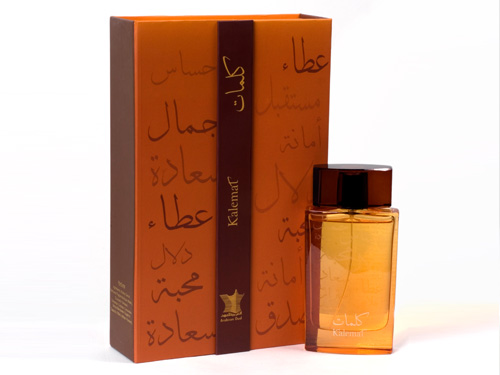
Kalemat with its box that opens like a book.

Kalemat with its box that opens like a book.

According to the London Arabian Oud website, the notes in Kalemat include:

Bilberry, anise, rosemary, Kashmir wood, musk, sweet amber, honey leaves.

Fragrantica gives a slightly different list:

Top notes are blueberry and anise; middle notes are rosemary, cashmere wood and floral notes; base notes are musk, amber and honey.

Kalemat opens on my skin with an enormous burst of richness and opulence. Two small squirts from my sample vial led to a heady, billowing cloud of amber infused with a fruity berry note. I’m not generally one for fruity fragrances — and Kalemat isn’t one at its core — but the berry element works wonderfully. If I didn’t know it was “blueberry” or “bilberry” (whatever that is), I would never have guessed it. To me, it smells more like a tangy, tart, juicy touch of black currant, mixed with a hint of blackberry. It’s never cloying or syrupy, though it initially feels as dense as the rest of the perfume.

Source: fr.123rf.com

Source: fr.123rf.com

Kalemat’s opening symphony is deepened almost instantly by a touch of honey and musk, resulting in an aroma of a creme caramel whose top has been lightly singed with a cooking torch to create a delicate shell of darkened, caramelized sugar. There is a touch of some fresh, aromatic green herbs, but it’s just a light touch that is soon overtaken by a rich Ta’if-like, ruby rose. Ta’if roses are a type of Damask rose but with 30 petals, and, according to Fragrantica, have an aroma that is significantly richer and deeper than most Damascena varieties. It is very common to Arab perfumery, and to attars in specific. Within a few minutes, the rose note has turned Kalemat into the loveliest, attar-like, opaque, boozy, floral amber with just the lightest hint of honey. Its richness feels like a running river of molten lava and gold. In fact, my skin actually has a light gleam and sheen from the concentrated oils that make up the fragrance. This is serious stuff.

Ta'if rose: perfumemaster.org

Ta’if rose: perfumemaster.org

Yet, for all of Kalemat’s richness, I really don’t think it’s ultimately a heavy perfume in terms of its weight. The potent, heady, concentrated, and very narcotic cloud that billows out around one is not unctuous, gooey, or dense in mass. As an analogy, I would say that Kalemat feels less chewy or opaque than some Profumum Roma fragrances, but significantly more powerful in sillage, especially in the first two hours. At the same time, Kalemat is substantially heavier in weight to the LM Parfums line and, once again, stronger in initial projection. In short, it is very typical and representative of traditional Middle Eastern perfumes, and yet airier in feel than something like Amouage‘s concentrated attars.

Dried tobacco leaves. Source: colourbox.com

Dried tobacco leaves. Source: colourbox.com

There is a subtle undertone to Kalemat that repeatedly reminds me of Serge Lutens‘ much adored, cult favorite, Chergui, only concentrated by a thousand. Something in Kalemat feels very much like sweet pipe tobacco, even if it’s just a subtle vein running below the perfume’s surface. Tobacco is not listed in Kalemat’s notes, but the reference to “honey leaves” (honey has leaves?) makes me wonder. Chergui’s aroma is, in part, of sweetened tobacco leaves set out to dry in the sun. Perhaps that is what Arabian oud means by its term? All I know for certain is that I was walking around Paris one evening, wafting Kalemat, and repeatedly wondering why the fragrance felt so familiar when I suddenly realised: concentrated Chergui! There is much more to Kalemat — and I was reminded of many other fragrances as well, as you will soon see — but I wouldn’t be shocked if there was a bit of some tobacco in Kalemat as well.

Kalemat isn’t a twisting, morphing creature with many stages, but it’s not completely linear either. The fragrance does subtly change, but over time and without fanfare. It is such a superbly blended fragrance that it slides almost seamlessly from one stage to another, rippling as smooth as water. In its very first opening hour, Kalemat is an opulently rich, custardy smooth, silky amber that is perfectly blended with fluid swirls of ruby Tai’if rose, dry woodiness, musk, honey, and hints of tobacco, herbs, and berries. There is almost a gourmand feel to the richness of the sweet brew, but it is not an actual gourmand fragrance as a whole. Perhaps a more helpful description would be to say that Kalemat’s opening phase comes close to straddling the Oriental and Gourmand genres, but never fully tips over into the latter.

The sweet, opulently over-the-top richness of Kalemat’s first stage explains why some people think the fragrance bears a resemblance to Tom Ford‘s Tobacco Vanille. Judging by what appeared on my skin, I think the two fragrances are different. On me, Tobacco Vanille has a plum pudding feel that is heavily accented with tobacco, and an almost potpourri-like blend of spices. Kalemat lacks those elements, along with the vanilla heart underlying the Tom Ford fragrance. To me, Kalemat seems much closer to Serge Lutens’ Chergui, only without the latter’s touch of powder and, as stated, a substantially more concentrated feel. It’s also much sweeter, deeper, and creamier than the Lutens.

To me, in the opening stage, Kalemat bears a closer resemblance to another famous amber fragrance — HermèsAmbre Narguilé — than to the more heavily spiced Tobacco Vanille. If you took certain aspects of Ambre Narguilé, changed the type of fruit to a blueberry, combined it with Chergui, and reduced the overall mix down to a thicker, more dense, almost vicous-like attar, then you’d have Kalemat. I think fans of Guerlain‘s much loved Spiritueuse Double Vanille would adore Kalemat, as it shares some similarities in terms of richness, but with honeyed amber and woodiness as the focus instead of ambered vanilla.

Source: fr.123rf.com

Source: fr.123rf.com

Slowly, slowly, almost before you realise it, Kalemat turns softer, woodier and bit darker in visual hue. At the start of the third hour, the fragrance is gentler, more rounded, and a bit blurry around the edges. There is something like the most restrained touch of oud flickering just below the surface, along with a gentle, slightly fresh, green herbaceousness. Kalemat has lost more than half of its rose floral undertone, and is less sweet, less honeyed. Now, it slowly begins its second phase where it is primarily a woody amber infused with a whiff of oud, tobacco, musk, and herbs. Only the lightest fruity and floral elements remain, but they’re minor, light, and blended seamlessly into the larger whole.

Near the end of the third hour, Kalemat also feels softer in weight and projection, though that is only relative to the powerhouse opening of the first hour. Now, it hovers 2-3 inches above the skin, and is noticeable when you bring your arm near to your nose. It doesn’t announce its presence with quite as much fanfare in the space around you. Honestly, I find Kalemat to be so addictive that this lowered sillage phase always leaves me wanting to spray on more. More, more, more, until I have surrounded myself with a nuclear mushroom cloud. Luckily for me, Kalemat comes in a 100 ml/3.4 oz bottle because I have plans to lock myself in my house on the night that it arrives, insulate all windows and doors, and apply at least 10 sprays. The Mars Rover may be able to smell me in outer space, but I don’t care.

"Abstract streams of gold." Photo: Jason Tockey. Site: jstimages.wordpress.com

“Abstract streams of gold.” Photo: Jason Tockey. Site: jstimages.wordpress.com

Kalemat’s sillage continues to drop, though the perfume gives absolutely no signs of dying anytime soon. Around the 4.5 hour mark, Kalemat hovers just an inch above the skin as a woody, sweet amber. It’s as golden as a cloud, but still much richer than that comparison would imply. Oddly, I’m somewhat reminded of a honeyed, unpowdered, more opulent version of Ambre 114 from Histoires de Parfums. Kalemat has the same sort of golden aura that made Ambre 114 conjure up James Bond’s Goldfinger for me.

Yet, for all that visual similarity, Kalemat is now primarily a woody sort of amber. The oud element waxes and wanes in how noticeable it is at the very top layer of the fragrance, but it is always there. Around the 5.5 hour mark, Kalemat is an amber with slightly musky oud, vaguely herbal dryness, an occasional flicker of rose, and a lingering whisper of tobacco. At the 7.5 hour point, Kalemat turns into a complete skin scent. The notes are almost wholly abstract: amber, a blur of sweetened wood that is barely decipherable as something oud-y, and other indistinct, dry elements. In its very final moments, Kalemat is nothing more than lightly sweetened dryness.

Kalemat’s longevity is fantastic. With two tiny squirts from the atomizer, Kalemat lasted just a fraction over 12 hours on my perfume-consuming skin, though the sillage was moderate to low for about 7.5 of them. In the past, when I’ve worn Kalemat, I’ve applied a far greater amount, and both the longevity and projection were even higher. On one occasion, I applied 5 sprays (from an atomizer that yields much less than a normal bottle would, due to a small hole), and Kalemat lasted over 16 hours on me. As regular readers to the blog know, my skin is absolutely voracious when it comes to perfume and I struggle constantly to find things that will last. If Kalemat gives me these sorts of hours, I think normal people would get astounding results.

Source: wallsave.com

Source: wallsave.com

I think Kalemat is something that people should try for a number of reasons. First, it is a completely versatile, extremely easy to wear, very cozy, comforting fragrance. It is far too powerful to wear to a really conservative, perfume-phobic office environment, but it works almost everywhere else. Second, I think Kalemat would work wonderfully on both a man and a woman. While men seem to be the ones who talk about it the most on sites like Basenotes, it was a female family member who took one whiff of Kalemat on me, and purchased it ten minutes later. If you’re a woman who likes Tobacco Vanille, Chergui, or Guerlain’s Spiritueuse Double Vanille (and there are vast numbers of you who do), then you can absolutely wear Kalemat.  

Third, Kalemat has the quality and richness of some incredibly expensive, very high-end perfumes. Kalemat is not comparable just to the prestige lines of such brands as Hermès, Guerlain, or Tom Ford, but also to such luxury perfume houses as AmouageIn fact, I’ve heard that some people think that Kalemat is very similar to Amouage’s Interlude Man, due to I think its second stage as a woody, slightly oud-y fragrance. I’m not sure I’m really qualified to speak to that, because, on my skin, Interlude Man was such a shape-shifter that it manifested itself differently on each of the 3 occasions that I tested it. It is such a complex chameleon that I could probably wear it 10 times, and experience 10 different versions.

However, judging by the three types I encountered, I think Amouage’s Interlude is different. Its herbal start can be enormously dominant, and sometimes aggressively pungent. Kalemat is hardly a herbal fragrance during any of its stages, and has only a little green touch in the background. With Interlude, its sharp greenness is then followed by a significant incense, smoky period, before ending in a stunning sandalwood drydown. Kalemat is substantially less complex. In addition, whatever smokiness it has is extremely subtle and seems merely to be the effect of other notes, instead of actual frankincense, let alone a lot of it!
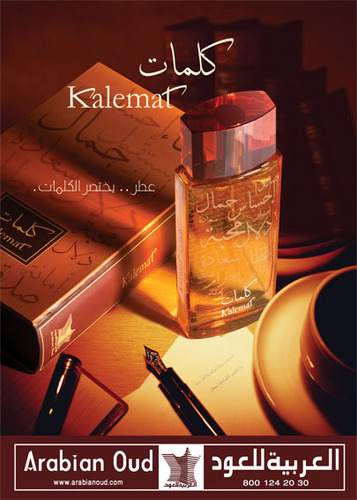
Source: paradiseperfumesandgems.co.uk

Source: paradiseperfumesandgems.co.uk

There are other differences, too. Kalemat is more floral and fruited at the start; the oud is extremely mild; it has no sandalwood; but it does include some honey. I would say that all the individual elements are toned down more, and that the overall effect is substantially smoother. The elements also blend into each other more seamlessly. Yet, it does share the luxurious feel and richness of an Amouage fragrance. When you consider that you can buy 100 ml of Kalemat on Amazon at a discounted price of $59.99 (without shipping), versus the $290 retail price of Interlude Man, I honestly don’t know how you can beat this amount of richness, depth, body, and addictive opulence for the price.

The only drawback I can see to Kalemat is that the company simply does not make it easy for consumers new to the brand. I’m going to spend a bit of time on this issue because I think it’s important to understand what your retail options are, some of the practical difficulties in learning more about the line, and the reason why Arabian Oud may be a brand you’ve rarely heard discussed. I truly think that Western perfumistas are missing out in not trying some of the company’s amazing fragrances, and that easier, more straightforward access would make them a name on everyone’s lips. As it is, however, it’s an extremely frustrating situation.

In addition to Arabian Oud’s aforementioned disorganisational chaos on its website, there is no place where you can test it or sniff the perfumes outside of London, Paris, or Arabian Oud’s several hundred stores in the Middle East. The decant/sample site, Surrender to Chance, does not carry Arabian Oud. The Perfume Court offers a few of its fragrances, but not Kalemat. And Arabian Oud does not sell samples on its website.

In fact, trying to navigate Arabian Oud’s websites consistently makes me want to throw something at the monitor. The main Saudi version is in English, but it’s a hodge-podge of categories, it doesn’t list perfume notes in a particular perfume entry, and the similarity between some perfume names is confusing. The fact that “Mukallet” seems to be the term for an attar or perfume oil that is stuck on half the perfumes doesn’t help.

The real problem, however, is sheer, overwhelming quantity of selection. According to Fragrantica’s page for Arabian Oud, Kalemat is one of 160 fragrances (!!!!!) offered by the house. The fact that that long Fragrantica listing does not include three of my favorite Arabian Oud fragrances should tell you just how many fragrances we’re talking about. Fragrantica also says that the 160 perfumes were “all launched in 2012” — something which is not only highly unlikely, but also inaccurate. The 2012 mistake (along with Fragrantica’s description of the company as a “new” one) is undoubtedly yet another victim of Arabian Oud’s utterly disorganized state of affairs. While the Saudi site provides no details, the London version says the company’s history actually goes back to 1982 when it was founded by Sheikh Abdul-Aziz Al Jasser who opened his first store in the old Alzal souk of Riyadh, Saudi Arabia.

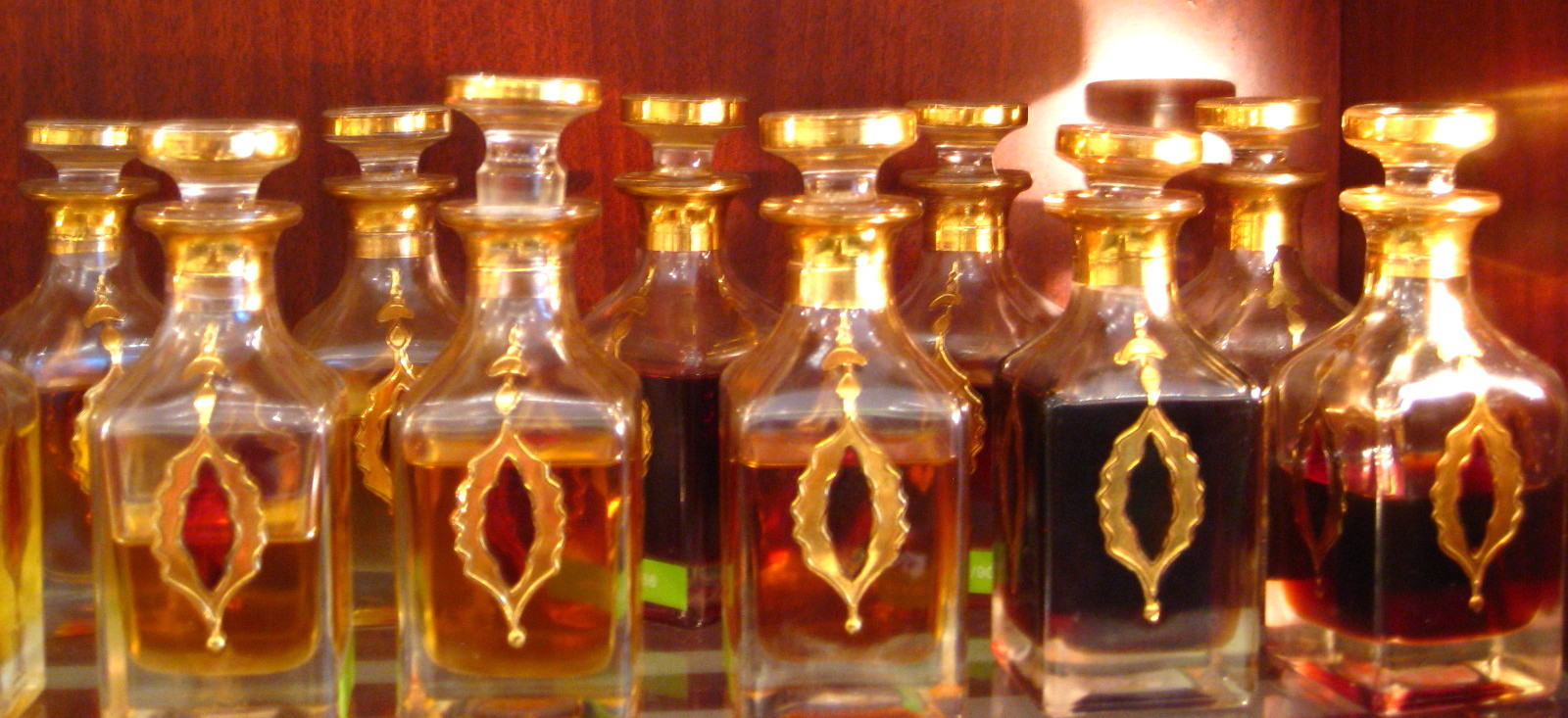
If you’re lucky enough to be in London or Paris, with easy access to one of the Arabian Oud stores, and want to just pop in for a sniff, you’re likely to be overwhelmed just as much as if you merely checked out the company’s website. When you go in, you’re confronted by shelves of elaborately ornate, fancy, decorated, Middle Eastern bottles which rarely seem to have an actual name on them. To give you an idea, I’ll share with you some photos I took in the store, though I need to repeat my frequent caveat that they won’t be great. As I’ve said elsewhere, my camera seems to have chosen this holiday to decide that it absolutely hates perfumery, so 6 out of every 10 perfume shots were wholly unusable. In the case of Arabian Oud, only two are decent (and a third is blurry), but a least it will give you an idea of things. Photos of just one small portion of the Paris store:
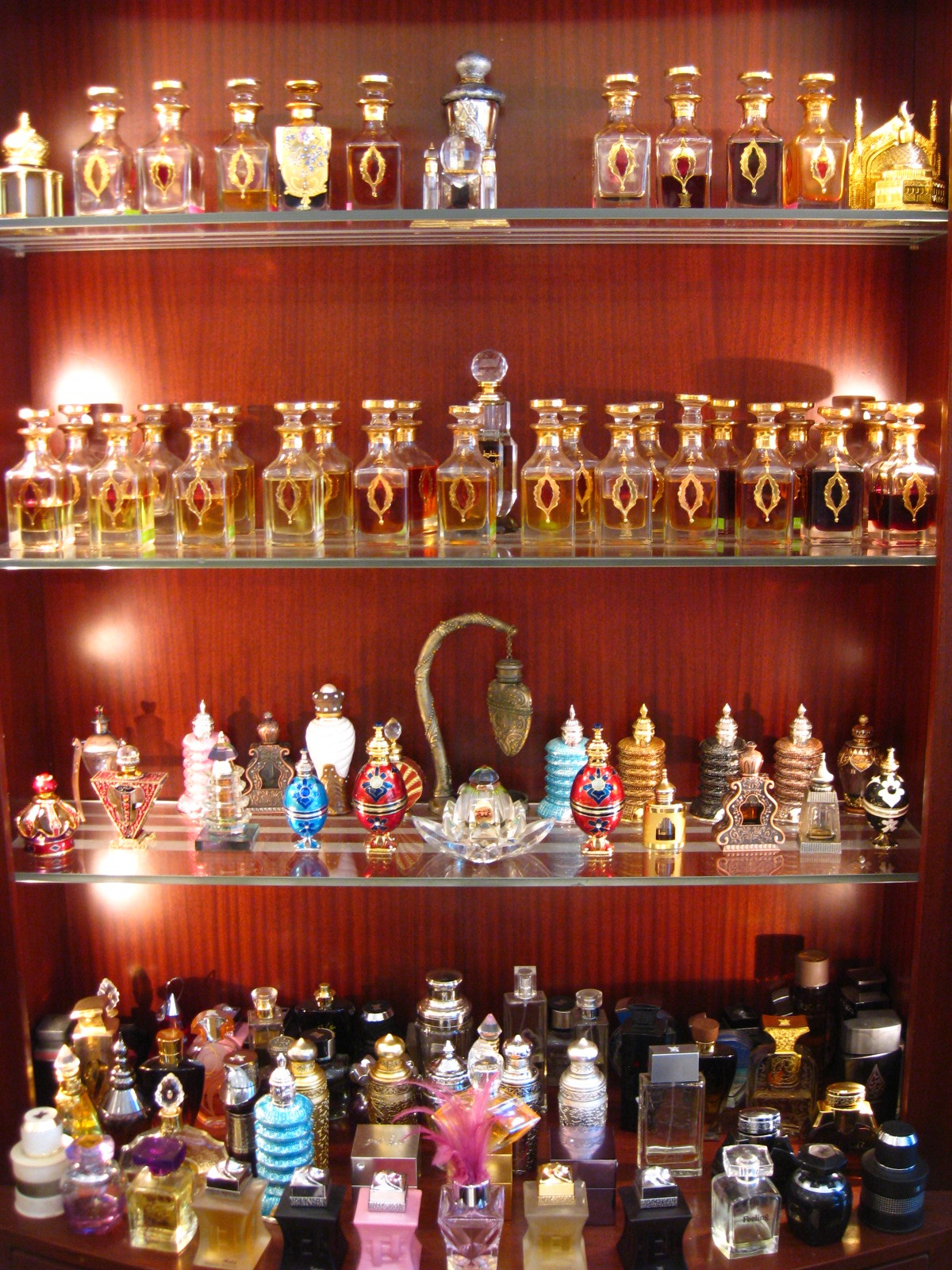

Arabian Oud2 Arabian Oud

So sorry it's blurry!

So sorry it’s blurry!

It is a testament to the quality of Arabian Oud’s products that Kalemat was actually not my favorite of the things that I tried. One of them, a perfume attar called Taj Mahal blew me out of the water. It is one of the most spectacular florientals I’ve tried in years, surpassing any and all Amouages (including Fate Woman) in its lush, deep, opulent beauty. Based on my memory of it, it was an orange blossom, jasmine, rose, sandalwood oriental oil that almost glowed in its rich sheen on my skin, and which cost (at its lowest, most affordable price) about €60 or $80 for a few drops. (Something like 4 ml. Its price on Zahras, the American-based website for Middle Eastern perfumes, is inflated to a ridiculous $371 for a tiny 6 ml bottle!) If I’d encountered Taj Mahal at the start of my trip, and had time to test it out properly on my skin, I would have bought that small vial without a qualm. As it was, I went to Arabian Oud on the last day of my holiday, after having purchased many other fragrances, and while wearing too many scents for a proper test, so the situation didn’t quite work out. The high price also made a mere sample impossible to obtain. 

It is a true sign of Arabian Oud’s disorganized chaos that Taj Mahal is not even listed on the company’s own websites. (Neither is another one of my other favorites, Dinon or Dinan, whose name the salesman wrote down for me in a scrawl to ensure that I had the correct spelling!) Happily, interested parties can always call the Paris store directly to order it, and one day, I shall have my Taj Mahal. The third one on my list of favorites was Ghroob, a concentrated perfume attar which is listed on the original Arabian Oud site without any notes, but which isn’t listed on the London version no matter what sort of spelling variation I tried. (Are you getting an idea yet of just how complicated it is to try to order a perfume from these people without pre-existing, advance knowledge?!) [UPDATE: In the comments below, you can read more about Ghroob, its floral-oriental-sandalwood notes, and its supposed resemblance to Amouage‘s $350 Homage attar. I have reviewed Ghroob here, and don’t see an similarity to Homage. Arabian Oud has discounted it on Amazon at around $44, and offers a lower price of shipping if you purchase more than one item. Also, as a side note, if you are relying on the Zahras site that I linked up above for information, please be careful. The notes that they list are not always accurate or the same as what Arabian Oud lists for their fragrances.]

Thankfully for my fourth favorite, and the subject of this review, Kalamet is easily available not only on all the Arabian Oud company websites, but also on Amazon (U.S.). Arabian Oud is the actual vendor and seems to have discounted the listed retail price of $99.99 by 40%, selling the 100 ml bottle of eau de parfum (really more like pure parfum extrait, if you ask me!) for an incredibly low price of $59.99. There is a shipping cost of $16.48 for a total of $76.47, but I paid no tax, and the final price is still substantially lower per ml for any analogous pure parfum extrait of that quality. You’re essentially paying about .76 cents per ml, when Amouage’s stunning Tribute attar is available from decanting sites for $14.99 for a 1/4 ml! Granted, the two fragrances have substantial differences in notes, smell, ingredients and concentration, but still!

Helping matters further, Arabian Oud’s Amazon shipping (from Saudi Arabia?) seems to be both fast and extremely professional. The company’s Amazon rating is 4.8 stars out of 5 with 48 votes, and consistently positive praise from buyers. A friend of mine purchased Kalemat blindly on the basis of my passing raves about it, and he was extremely pleased with the speed of the delivery, the packaging of his bottle, and Arabian Oud’s polite service. Another reader of this blog, “Laird Angus,” bought Kalemat blindly and his gushing review on Amazon talks about both the perfume’s original packaging, and the beauty of its smell. It’s an extremely accurate assessment and the best one I’ve seen on the scent, so I’d like to quote a large part of it.

Calling Kalemat a “reference amber,” he writes:

In ancient times, books were rare and precious objects. The learned elite treasured them. Scholars and holy men spent countless hours transcribing and illustrating them. Calligraphy held a place at the high table of the arts.

Kalemat, which means “words” in Arabic, pays tribute to this lost era in its exquisite packaging. It arrives in a beautiful oversized box designed to look like an antique arabic book. When opened, the box reveals a smaller, ribbon-bound tome which contains the bottle of perfume itself. And so even before the first spray, you know that this an oriental perfume in its full glory–dramatic, confident, mysterious, exotic, precious beyond compare.

Inside Kalemat's "book." Photo via eBay.

Inside Kalemat’s “book.” Photo via eBay.

The juice itself does not disappoint. Kalemat opens with a lush jammy berry accord, balanced perfectly by incense and a hint of dry woods. The berry note is apparently bilberry, which was new to me. It is sweet and perhaps slightly tart. Wonderful. Novel. 

After 20 minutes or so, the berry notes recede, leaving behind a sumptuous base of incense, woods, and lightly jammy rose. This is the heart of Kalemat, and it is apparently inspired by the Middle Eastern hospitality traditions around bakhoor, a household incense of dried wood and rose. It reminded me somewhat of Jubilation XXV by Amouage, but Kalemat is somehow deeper and rounder. There are no jagged edges here. Although it is not listed in the ingredients or the notes, I am convinced that there is a trace of high quality synthetic oud in this as well. It is used here not as an individual note, but as a fixative and an amplifier of the other notes. Perfect!

Over the next 8-10 hours, the rose fades out, then the incense, leaving only the driest cedar-like scent, like the inside of an ancient chest found in an old Cairo apartment.

Kalemat is everything I had hoped it would be. I’ve been searching for an authentic and wearable Arabian scent. It is no easy thing! I’ve sampled virtually every offering from Amouage, a number of rare attars, low cost oils from al Rehab, and various western “interpretations” of middle eastern fragrances. None has come close to Kalemat. It is a deeply relaxing scent, perfect for stressful days at the office. It speaks something of eternal truths, of timeless values, of the cycle of life-death-rebirth that renders all of our transient worldly concerns puny by comparison.  [Emphasis to the names added by me.]

I would hardly go so far as to say Kalemat speaks to eternal truths, but, yes, it is an absolutely gorgeous amber that is opulent, heady, full-bodied, and deeply comforting. That is why I will go to so far as to say that you should definitely consider a blind buy of Kalemat if (but only if) you’re a huge fan of any of the perfumes that I’ve mentioned in this review. If you love wispy, gauzy, sheer, light, fresh, clean scents, Kalemat is not for you. This is a fragrance for a die-hard lover of amber, oriental or oriental-gourmand fragrances, and I don’t think you will be disappointed.

You should consider a blind buy even more if some of those other fragrances I’ve mentioned have been out of your reach due to their high cost. I can’t recall if I have ever recommended that people buy a perfume blindly and untested, but Kalemat’s price is low enough that I’m breaking my usual rule. If you absolutely hate it or if your skin chemistry inexplicably makes things go wonky, I don’t think you’d have much difficulty in selling your bottle on eBay, where Kalemat is usually listed for almost double the Amazon price and rarely offered by US sellers.

If you’re located outside of the United States, I don’t know if you can purchase Kalemat at the discounted Amazon price and have Arabian Oud simply ship it to you elsewhere. I couldn’t find Kalemat on the Canadian, German or Brazilian Amazon sites, so I suspect that price is limited to U.S. buyers. Even without Amazon, though, it’s still not hugely expensive to buy Kalemat as it retails for $99, and you have several other vendor options. You can find the fragrance on the Arabian Oud site for 300 SAR which seems to come to a little over €58 at the current currency conversion rates, and I believe they ship internationally. On the UK Arabian Oud site, the perfume is offered for £52, discounted from £87. The site’s flash options don’t seem to let me use a direct, saved link to Kalemat’s specific page, but you can find it easily with a word search. (You may want to immediately mute the volume on the site as it plays annoyingly repetitive music incredibly loudly.)

For all other countries, you may can use the Universal Perfumes retailer in Kuwait that I introduced to you months ago, and which is very reliable. It sells Kalemat for $99, with a flat-rate, international shipping price of $6.99 for the first item. I’ve heard it takes about two weeks for its packages to come from Kuwait to the States, so I assume it will be around the same for other destinations. Lastly, you can always try eBay which has a number of British and Middle Eastern sellers who offer the fragrance.

At the end of the day, Kalemat is not a revolutionary, complicated, complex scent, but it is such an utterly addictive, luxurious, rich, comforting, soothing one, that I find it utterly irresistible. If you hear a bellow of joy on or around November 8th, you will know that my perfume package has arrived, that irrational amounts of spraying will follow, and that a golden mushroom cloud of amber will explode shortly thereafter from this part of the Western hemisphere. I cannot wait.

[UPDATE 3/23/2015 — I’ve just reviewed Kalemat Amber concentrated oil, and it’s even better. Simply outstanding! Kalemat Floral is equally lovely. There are also Wood, Musk, and Oud versions of Kalemat. Right now, Arabian Oud London is willing to help readers of the blog to buy the Kalemat oils (in any version) and to ship them world-wide. The details of the special deal are in my review for Kalemat Amber. The company no longer sells on Amazon, but some third-party vendors do have Kalemat eau de parfum. However, the oils are not available there from anyone. Kalemat Wood or Kalemat Musk are sometimes sold on eBay. However, the best of the lot from the ones I’ve tried are Kalemat Amber and Kalemat Floral.]
Puredistance Black: Shades of Purple & Pink

The night is dark, and full of terrors.”

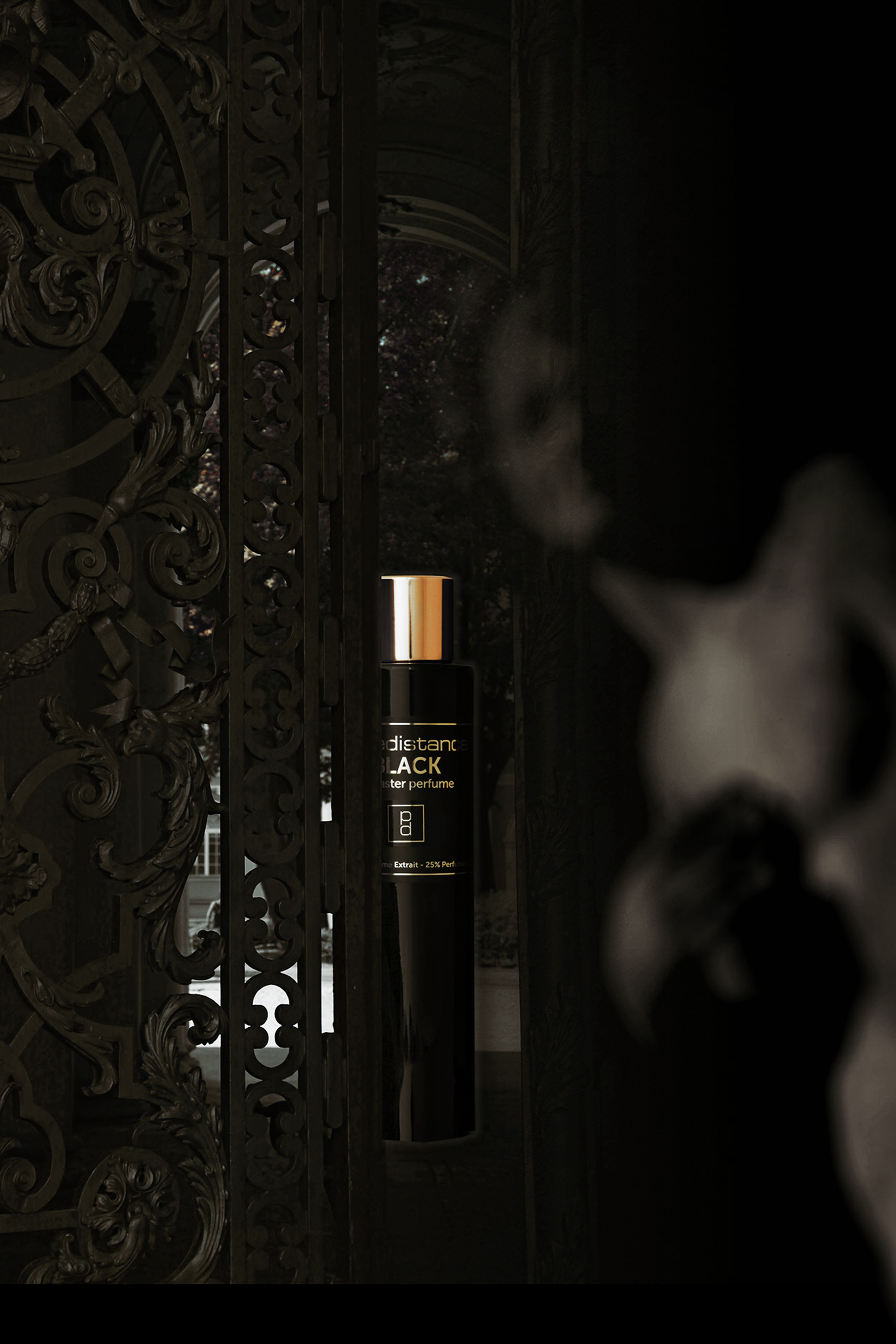
Source: Puredistance.

Source: Puredistance.

That is one my favorite quotes from the television series, Game of Thrones, and I often come up with fun variations for different occasions. It’s a line which sticks in my head, so I wasn’t surprised when it popped back up just before I began testing Black, the new, about-to-be-released fragrance from one of my favorite perfume houses, Puredistance. The luxury brand talks about how the scent was inspired by “the concept of black,” and about how it is a “mysterious fragrance that stays in the shadow, giving away – only every now and then – part of its nature.”

Upon reading that part of the press release, and seeing the image sent by the company, all I could think of was, “the night is dark (black), and full of luxury.” Well, not quite. As it turns out, Black is indeed an extremely luxurious fragrance that smells very expensive, but I found it to be as purple and pink as humanly possible. At one point, it evoked fluffy pink clouds, and I almost expected a chubby cherub to be sitting on one and offering me turkish delight. For me, “Black” is the absolute furthest thing from its name, and is not my personal cup of tea. It’s not a bad fragrance by any means — in fact, it’s well done and clearly emanates luxury — but we all have subjective tastes or things that we struggle with, and I struggled quite a bit with Black.  

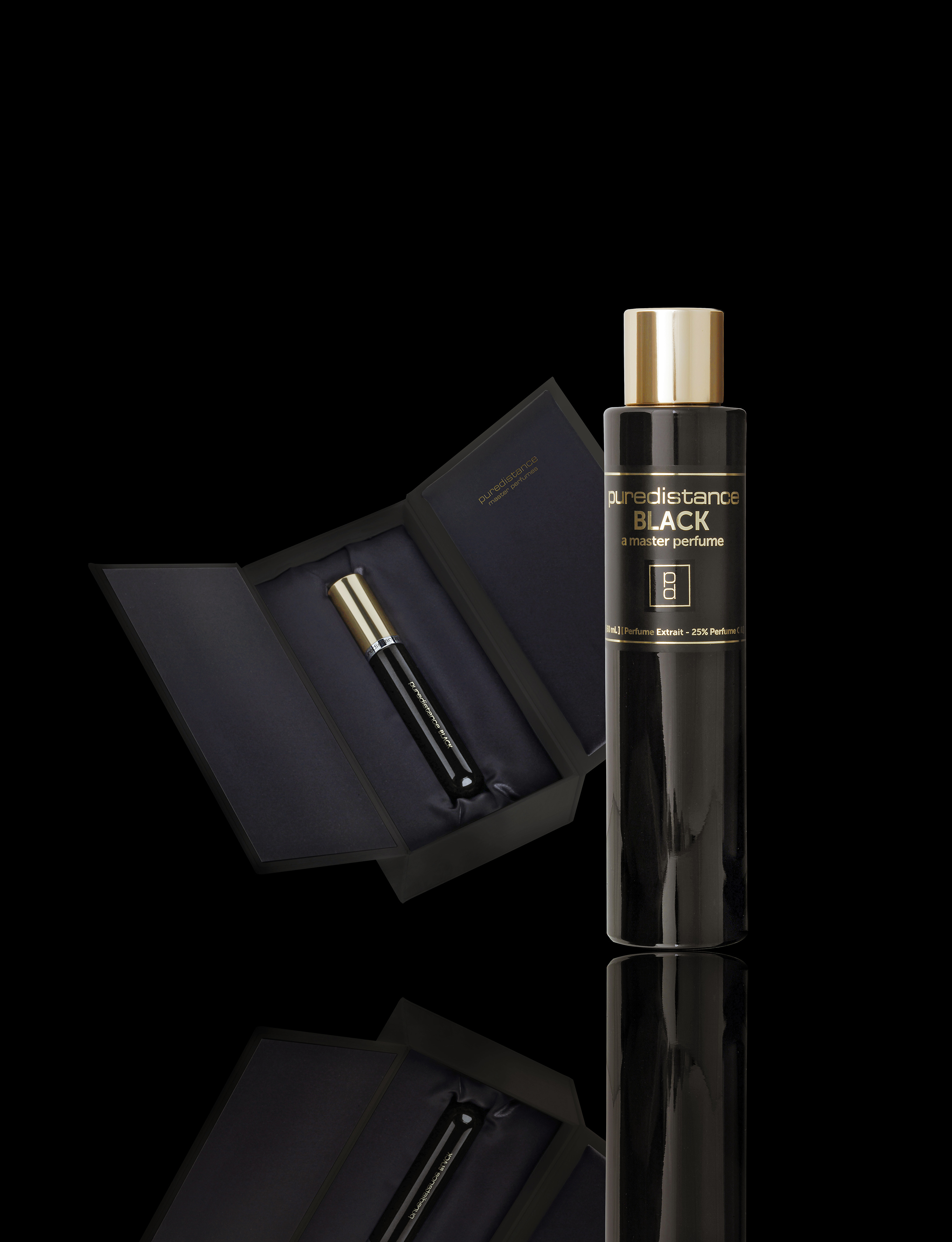
Black in the 17.5 travel flacon. Source: Puredistance.

Black in the 17.5 travel flacon. Source: Puredistance.

Like all of Puredistance’s fragrances, Black was created by a master perfumer, in this case, Antoine Lie, and is the very highest perfume concentration, an extrait de parfum. Black clocks in at 25% perfume oil, a figure that is surpassed only by Puredistance’s exquisite floral, Opardu (which has 32%). Black will be released at the start of December, and is described as follows:

Puredistance Black is an understated elegant and mysteriously charming perfume inspired by the concept of BLACK; a concept that for centuries has been associated with secrets, mystery and style.

Puredistance BLACK is created in Paris by the famous French Perfumer Antoine Lie based on a concept of Puredistance founder Jan Ewoud Vos. The essence of the concept was to create a perfume that is close to the wearer and releases sensual and elegant scent layers in a whispering way – without shouting. A mysterious fragrance that stays in the shadow, giving away – only every now and then – part of its nature.

Black in bottle, non-travel form.

Black in the regular, non-travel, bottle form.

As part of the whole concept of mysterious shadows, Puredistance wants you to treasure the “beauty of the unknown,” and merely describes the scent as one that is more “masculine and oriental” than Puredistance “I.” The company is keeping secret Black’s perfume notes, saying only that you should “Envision, Smell, Feel. Don’t analyse.” If you’re a regular reader, you all know how well I manage not to analyse things…. It’s hopeless. I was incapable of just smelling, feeling, letting go and not analysing with the uber-luxury brand, JAR, and it’s not possible here, either. It simply is not my personality or forte in life, given my obsessiveness with both facts and details. 

So, based on what I smelled, let me give you my guess of the notes in Puredistance Black:

Ginger, cardamom, absinthe wood (wormwood), saffron, rose, patchouli, myrrh, opoponax (sweet myrrh), amber, sandalwood (not from Mysore), and benzoin.

What I’m less absolutely certain of is the possible inclusion of oud, a tiny touch of elemi wood or guaiac as an additional source of woody smoke, and a drop of vanilla. It’s extremely possible, but I wouldn’t bet my life on it.

Cardamom. Source: www.kitchenheadquarters.org

Cardamom. Source: www.kitchenheadquarters.org

Puredistance Black opens on my skin with a blast of cardamom, immediately followed by ginger, amber, absinthe wood, incense, saffron, patchouli, and a whisper of rose. There is a balanced sweetness, a suggestion of sandalwood, and a saffron that is neither buttery nor hot, but wonderfully spicy. The ginger adds a lovely, fresh, piquant bite that works beautifully with the sweeter notes and the woodsy notes.

Speaking of the latter, I guessed absinthe (or wormwood) for a few reasons. First, even before I tested the perfume and simply upon taking the vial out of its white, satin pouch, I was hit by an extremely strong blast of oud-like woodiness that was herbal, spicy, and green — too much so to be real agarwood. It was also extremely similar in smell to the wood note in Amouage‘s Fate Man, a fragrance that officially includes wormwood. On the skin, the woodsy notes was surprisingly less dominant and forceful than what was wafting out of the vial, but it felt even less than complete, total agarwood in nature. Absinthe shares a few cursory, initial similarities with oud, so that’s what I’m going on.

purple smokeThe initial opening of Black in the first two minutes is lovely, but then, my nemesis takes over: purple, fruited patchouli. For all that I love black/brown patchouli, I despise the purple kind that is ubiquitous and everywhere in modern perfumery. A friend asked me the difference the other day, and I think my explanation may help some other people too.

For me, traditional (and rather 1980s) patchouli is brown/black in hue, with chewy undertones of sweet amber, spice, leather, wood, and incense smoke. The current, modern version of patchouli is purple in hue because it’s fruity, syrupy, jammy, incredibly sweet, and with grape and berry undertones. The very original type of patchouli is the 1970s, hippie kind that is really, really black, dirty patchouli and that people describe as a “head shop” scent. Some examples of fragrances with a strong purple patchouli note would be: almost every commercial, department store perfume containing “patchouli,” Marc JacobsLola, Chanel‘s Coco Noir, Le Labo‘s Ylang 49, Frederic Malle‘s Portrait of a Lady, and, now, alas, Puredistance Black. An example of black/brown, more traditional patchouli would be something like Profumum Roma‘s Patchouly, Serge LutensBorneo 1834, Chanel‘s Coromandel, or Reminiscence‘s Patchouli. It’s not a long list at all because that sort of patchouli is incredibly uncommon nowadays.

Source: Tasty Yummies blog. (Link to website embedded within photo. For recipe for Concord grape jam, click on photo.)

Source: Tasty Yummies blog. (Link to website embedded within photo. For recipe for Concord grape jam, click on photo.)

I spent all this time outlining the specific smell and nature of purple, “fruit-chouli” because it is the heart of soul of how Puredistance Black manifests itself on my skin. No less than three minutes into the perfume’s development, the saffron-oud blast takes on an almost grape-y, berry, jammy overtone that is incredibly sweet. Five minutes in, I feel as though I’ve been covered by fruit syrup. Twenty minutes in, I feel as though I’ve been transformed into a berry tart with unctuous, cloyingly sweet, fruited, purple Smucker’s jam, then sprinkled with rose petals and a dusting of saffron. I have to be honest, I lost my appetite — and I hadn’t eaten in over 12 hours.

I wish there were a substantial counter-balance to the deluge of fruit-chouli in the opening hour. There is a herbal, woody note that flitters about like a tiny hummingbird, but it’s far, far underneath, and wholly unable to compete with the grape-y, berry onslaught that is stomping over my arm like a Panzer unit in full fury. I know my skin tends to amplify base notes, but this is a bit ridiculous. I think sadly back to that absolutely lovely opening with its spicy, gingered, slightly herbal, ambered woodiness, but it’s gone, smothered by unctuous, purple, saffron-rose-infused molasses. Even the absinthe gasps for air, then retreats to the corner to hide its head.

"Purple Velvet Gold Flakes" by *Will3style at Deviantart.com. http://will3style.deviantart.com/art/Purple-Velvet-Gold-Flakes-258099755

“Purple Velvet Gold Flakes” by *Will3style at Deviantart.com. http://will3style.deviantart.com/art/Purple-Velvet-Gold-Flakes-258099755

There is no salvation in low sillage, either. That promised description of a wispy perfume that “stays in the shadow”? Ha! Black’s opening is strong and potent, with significant sillage, wafting in a purple cloud almost a foot around me. I normally would be thrilled, but the fruit-chouli is starting to crush my spirit. For a whole hour, I’m drenched by jammy, grape-berry molasses, that is just lightly infused by particles of saffron-infused rose, incense, absinthe wood, and honeyed amber. The ginger is no longer noticeable, and neither is the cardamom.

Source: hdwallpaperplace.com

Source: hdwallpaperplace.com

It was with enormous relief that things start to slowly — very slowly — improve at the end of the first hour. The Smucker’s patchouli jam lessens fractionally, allowing the rose to finally come out properly from its gooey purple shadow. The rose is sweet, just slightly dewy, and pink in visuals. With each passing moment during the second hour, it takes on a weight of its own, and starts to diffuse the fruitedness of the perfume. The woody notes and light incense are also more noticeable, though they’re largely blended into the greater whole.

Rose-flavoured Turkish Delight.

Rose-flavoured Turkish Delight.

By the start of the third hour, Puredistance Black’s purple hues have turned into a gorgeous shade of pink. The perfume wafts about 2 inches above the skin, and has a soft, creamy texture like a fluffy cloud of saffron-rose. In fact, Black takes on a Turkish Delight, or loukhoum quality, though without any of the sugared powderiness often associated with that confection. The patchouli remains, but it is quite mild as compared to its original, completely nuclear blast. Instead, it merely adds to the loukhoum association with a soft touch of grape. It actually works perfectly and brilliantly now. The absinthe wormwood and touch of incense lurk in the shadows, leaving an image that is primarily that of a pink, fluffy, creamy cloud. I almost expect to see a pink-cheeked cherub sitting on one of them.

I mean it quite sincerely when I saw that I enjoyed this phase of Black. I really did. It reminded me of a significantly richer, creamier, more luxurious version of the drydown phase of Tom Ford‘s Noir de Noir. There, the syrupy, very baroque rose with saffron, truffle earthiness, and the merest, speckled touch of oud also turned into a loukhoum confection in its final stage, but there are big difference. Noir de Noir was much thinner at that point than Black, had an almost violet-y touch, and, more to the point, was extremely powdered in nature. I wasn’t particularly fond of the violet, vanillic powder of the drydown, and I’m relieved that Puredistance Black has none of it at this stage.

Source: 8tracks.com

Source: 8tracks.com

Even better, Black is infinitely deeper, smoother, richer, creamier, and more opulent. The perfume is fluffy, but rich; sweet but not excessive; and an utterly beautiful, creamy, deep, pink rose with just the right amount of fruited patchouli. There is also the very necessary touch of woodiness which Noir de Noir lacked in its drydown, adding a balance to the floral sweetness. Here, the woody element has the faintest flicker of herbaceousness, but, more importantly, a creamy smoothness that makes me wonder if there is generic, Australian sandalwood or cashmeran underneath.

Black remains as this lovely mix for a few hours with only minor alterations. For example, at the start of the fifth hour, the perfume drops to lie just barely above the skin. The herbal absinthe wood that continues to hide behind the floral loukhoum changes in strength, fluctuating from mild to weak on the overall scale of things. And there is a growing hint of something anisic that is rising to the surface.

At the 6.5 hour mark, however, Black begins to transform. It takes on a licorice undertone and slight whiteness which makes me think that it must have myrrh. It is a note which is known to display an anisic, herbal facet, in addition to a slightly churchy, cold, white, incense note. The latter is extremely subtle in Black, but it’s there as well. At the same time, there also is a flickering shade of something honeyed which resembles very much sweet myrrh or opoponax. In addition, Black is starting to show a slightly vanillic powderiness that makes me suspect the presence of benzoin. In its final change, the perfume has turned into a gauzy veil that sits right on the skin, though it is still easily noticeable and potent when sniffed up close.

"Pink abstract" by Montserrat Lopez Ortiz via fineartamerica.com

“Pink abstract,” painting by Montserrat Lopez Ortiz via fineartamerica.com

Black still smells of a floral confection first and foremost, but the newcomers become increasingly noticeable. And, in all honesty, I’m not completely thrilled by the overall effect. There is a cloying undertone to the rose Turkish delight when combined with the anisic, slightly cold, white incense-y myrrh, the sweet myrrh, and the vanillic powder. It’s not helped by a new spiciness that faintly resembles All-Spice powder and/or star anise. In small doses and for a short period of time, the sum total is perfectly fine, but Black stays this way for hours on end. I found it a little fatiguing, if truth be told.

In its very final stage, starting at the 9th hour, Black turns into a whisper of sweet vanillic powder with rose, a vague blur of myrrh, a flicker of abstract woodiness, and an odd underlying tinge of sourness. It’s all a shadow of its former self, coating the skin like the sheerest, thinnest glaze. Black finally fades away about 14 hours from the start with four squirts from the small sample, and 15.25 hours with 5 medium sprays. (Note: My sample atomizer didn’t release the same amount as would be available from a regular bottle as it had a very small hole and a wonky release, so the quantity applied was not as large as those numbers may suggest. It would really be the equivalent of 3 small-to-medium smears from a dab vial, and 4 large ones.)

I tested Black twice, and I’m afraid I wasn’t very enamoured on either occasion. I don’t mind the middle phase, but I wasn’t crazy about the last one. And there aren’t words whatsoever to describe my reaction to the opening hour. As I said, I thought Black significantly and substantially improved at the start of the second hour, but the first one was rough.

Yet, it’s important to put my comments into context: I absolutely loathe purple, fruited patchouli. I try to grit my teeth and get over it when the note is minor, but when it is significant, substantial, and potent, then I simply can’t bear it. I don’t think others have quite the intensity of my reaction to fruit-chouli, which isn’t helped by having a skin chemistry that amplifies the note. In short, my reaction is very subjective and personal to me.

It’s also a reaction that is not even remotely common to others who have tested perfume. Black has generally been greeted with uniform admiration and liking, even by those who usually share my perfume tastes and skin chemistry. Take, for example, The Non-Blonde who writes, in part:

Puredistance is stepping into unexpected new territory with Black, a dark and romantic fragrance created by perfumer Antoine Lei[.] … Black [is] an oriental with an edge that could have come straight out of the labs at Amouage.  […]

Puredistance Black holds my interest from the very first second. A medicinal camphoric note there that lets you know that the raw materials here are real and uncompromising. Soon it becomes honeyed and steeped in booze, making the maybe-oud go down easily and deliciously. Perfumes of this kind, from Amouage to By Kilian often use their sillage to assert themselves as luxury. Not here, though, and as the press materials stress– this is a feature, not a bug. And I have to say that I love it. Black is not exactly a skin scent but it lives and thrives on skin level;  the emotional storm is very much there, manifesting itself for one’s own personal pleasure for a full day and night, just without broadcasting it to the world.

My reaction was also different from those who did detect the patchouli, but had a completely different perception of its nature. In a gushing rave, The Perfume Shrine described Black as follows:

a quasi-brutal opening with a tangy citric fruitiness allied to the darkest, earthiest patchouli possible, like snails coming out of the bush in the dusk, but the cloak of the night soon mollifies it with a woody cluster of honeyed plummy-cedar notes reminiscent of the Lutens canon and a “suede” orientalism. The sweet melange is also reminiscent of pipe tobacco, laced with a boozy aftertaste that lingers. (I hypothesize smoky cypriol/cyperus and vetiver should be featured too). Chewy, a meat course for non vegetarians. […]

Puredistance Black reminds me of the darkness and weirdness factor of Goutal’s Un Parfum Cheri, par Camille, fueled by an intense Indonesian patchouli grade replete with all its earthy chocolate and darkness “dirty” facets. […] Black would be also liked by those who appreciate Borneo 1834 and Bois de Violette or by oudh and tobacco fragrances fans, as the bittersweet oriental feel would appeal.

I’ve tested both the Lutens fragrances that she mentions, and I see absolutely no similarity between the patchouli in Borneo 1834 and Black. Not even remotely. As for Bois de Violette, I don’t think mere fruited sweetness with wood is enough to make the perfumes comparable in style. Clearly, we have very different skin and skin chemistry.

Patchouli — of any kind — isn’t mentioned at all by two bloggers with whom I generally have very similar perfume opinions, as well as perfume tastes. Take the lovely Caro of Te de Violetas who writes:

The initial impression is one of chaos: its fiery opening smolders with notes of chili pepper, cinnamon, and green cardamom, soon overlapped by the bitterness of saffron and absinthe. A smoky touch of oud dominates the blend for a while and brands its character. I am not especially devout of oud but the effect here is restrained and it suffices to cast a veil of mystery. The whole effect is opaque but lightweight and refined. As I near my nose to my wrist, I can’t shake from my head images of Bogart and Bacall. The progression is as smooth as velvet. As it turns softer, well into the drydown, vanillatobacco and tonka ensure a plushy sweetness but the darkness never completely fades away.

As a woman, I can wear Black more comfortably than the rugged M, but I still prefer to smell this on a beloved man or on a handsome stranger.

The Scented Hound also never mentions patchouli, though parts of his experience sound to me as though they involved both absinthe wood and myrrh:

WHAT I SMELL:  Black opens with a sweet and deep incense and smoky accord.  I want to say there’s some bergamot and what seems to be a bit of floraled honey mixed with the smokiness.  That initial smokiness breaks away somewhat to reveal this almost butter like creamy light almond.  But as soon as I notice that, the incense starts to waft up from the bottom again, this time with what seems to be a bit of sueded leather. There’s a bit of sour that makes an appearance that doesn’t detract, but like the smoke and incense, seems to pop in and out.  After around 15 minutes it seems like there is a bit of peppered metallic that makes an appearance.  Again, it comes and goes like all of the other notes which seem to intermix seamlessly without one note dominating.  In the end you’re left with a very light, close to the skin, smooth and elegant slightly woody incensed perfume.

As all of this should make clear, Puredistance Black is different things to different people. All these reviews are dissimilar, though mine seems to veer furthest outside any common thread.

So, the bottom line is that you should try Black for yourself, and make up your mind. If, by chance you generally share similarities with my type of skin and perfume taste, don’t be put off by my review. For example, if you love Tom Ford’s Noir de Noir, or if you would like an even richer version of its drydown, you absolutely should consider Puredistance Black. I will only caution you on one thing: if you’re expecting another, darker, woodier version of Puredistance’s absolutely spectacular “M,” then you will be disappointed. They are nothing alike — and every reviewer who mentions “M” is absolutely consistent on that point.

Perhaps that is small part of why I struggled with Black. M happens to be one of my all-time favorite (modern) fragrances, an absolutely magnificent marvel that is in my Top Ten, and which I would bathe in, if it were possible. The chypre-oriental-leather-amber mix is also the perfect representation of my perfume tastes. I don’t do well with sweetness, and Black turned into a very extreme, very pink example of that. If I had experienced something actually black in hue, with smoky, woody, dark Orientalism, then I suspect M might have had some stiff competition. As it is, I’m afraid it doesn’t.

DISCLOSURE: My small vial of Black was provided courtesy of Puredistance. That did not impact this review. I do not do paid reviews, my opinions are my own, and my first obligation is to my readers.

DETAILS:
Cost & Availability: Black is an extrait de parfum concentration (the highest), will officially debut in December 2013, and will be available in a variety of different sizes on the Puredistance website. Its European retail price will be as follows: €165 for the 17.5 ml travel spray, €275 euro for 60 ml (about 2.1 oz), and €490 euro for the 100 ml/3.4 oz bottle. The American prices are, respectively: $198, $330, and $590. Until its official release, samples of Black are being temporarily offered as part of a promotional special from Puredistance (at the website linked up above). The promotion involves: 2 x 2ml vials of the Extrait for $39 or €29, with free shipping. Retailers: Upon its release, Black will be offered at the usual Puredistance retailers which include: Luckyscent and MinNY in the US; Jovoy in Paris; and London’s Roja Dove’s Haute Parfumerie division on the 5th floor of Harrods. You can already pre-order at Luckyscent. For all other countries, you can use Puredistance’s Store Locator which lists retailers from Australia and New Zealand to Austria and Russia. I will try to remember to update this post later with more direct links, as well as links to sample sites like Surrender to Chance which normally offers Puredistance fragrances in vials that you can buy for testing.

Holiday Travelogue – Part III: Paris Food, Cheese & Chocolate Delights

Alexandre III bridge, Paris. Source: wallpaperscraft.com

Alexandre III bridge, Paris. Source: wallpaperscraft.com

For all that the French are respected for their perfumes, they are perhaps even more known for their food. It is something that is an inherent part of their way of life, beyond just the rarefied, perhaps more sophisticated confines of Paris. Food permeates every part of the French life and cultural psyche, be it a truck driver in Normandie or a wealthy housewife in Cannes. It’s no different in Paris, though the breadth, nature and diversity of the offerings may be slightly greater.

As someone whose primary passion in life is food and gastronomy instead of perfume, Paris was a visual bonanza, as much as any actual one. From the beauty of the windows at the competing, rival houses of Ladurée and Pierre Hermé, to the bounty of an extremely small, ordinary food market, to elaborate haute cuisine menus from the “Chef of the Century, Joel Robuchon, or simple oyster displays at a local restaurant, Paris is truly “a moveable feast” for the eyes.

Luckily, I got to actually eat a few things, too, particularly my beloved French cheese. As regular readers of the blog will know, I have an incredible passion — nay, an obsession, in fact — with that particular French speciality. And I was utterly spoiled in Paris — a situation which was sharply borne home to me upon my return to America. A recent attempt to get 10 favorite French cheeses at a very high-end store here resulted in my being told that 8 of them were illegal in this country, and could not be imported in due to FDA rules. (My feelings on that subject are as bitter as my feelings on IFRA/EU restrictions.)

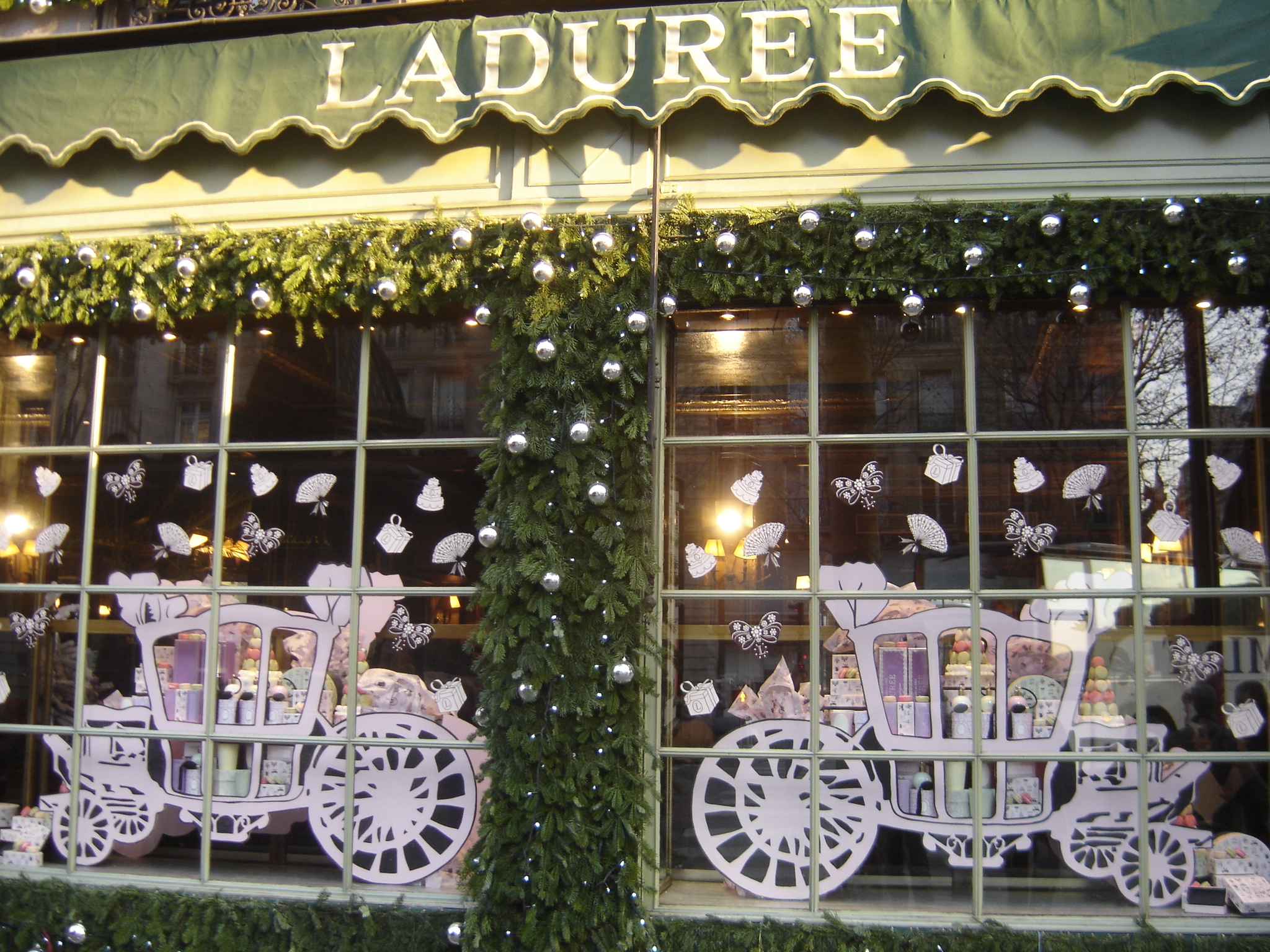
Ladurée via Wikicommons.

Ladurée. Photo via Wikicommons.

You know that famous, old saying, “We’ll always have Paris”? Well, I’ll always have my photos. So, without further ado, let’s have some food porn. (For non-Americans, the term refers to a visual feast of photos highlighting deliciously tempting food.) First up, chocolates. As some of you know, the two big rival houses are the very old, established Ladurée which dates back to 1862, and the newer star of the macaron scene, Pierre Hermé. Macarons (which are not the same as macaroons) consist of a double-decker of two thin, pastry (or cookie) shells which are stuffed in-between with a creamy ganache filling. According to Wikipedia‘s entry for the company, Ladurée is the one who first invented this structure in the 1930s.

While some swear that Ladurée makes the best macarons (and chocolates) in the world, others vehemently insist that it is really Pierre Hermé, who Vogue once called “the Picasso of pastry.” Wikipedia explains his significance and background much more succinctly than I could manage:

Pierre Hermé macarons are airy cookies of egg-white and almond chair, sandwiching a cream filling. Perhaps his most famous is the Ispahan, made with rose, lychee, and raspberry; he likened it as their “Chanel suit” — the one they sell the most.[1] [¶] Hermé’s chocolates are also renowned. His chocolate cake made it on The Observer‘s “50 best things to eat in the world” list in 2009.[2]

His cooking philosophy: He prefers discreet pastry decors and “uses sugar like salt, in other words, as a seasoning to heighten other shades of flavor.”[3] He often makes daring use of savory ingredients in his desserts: traces of balsamic vinegar, Parmesan or olives in his cakes and layered dessert creams; he has even used grilled corn in a cake. […]

Pierre Hermé began his career at the age of 14 as an apprentice in Paris with the acclaimed pâtissier Gaston Lenôtre, who Hermé says is his greatest influence. At age 24, he became the pastry chef at the fine food merchant Fauchon, where he remained for 11 years. […] Pierre Hermé was the youngest person ever to be named France’s Pastry Chef of the Year, and is also the only pastry chef to have been decorated as a Chevalier of Arts and Letters.

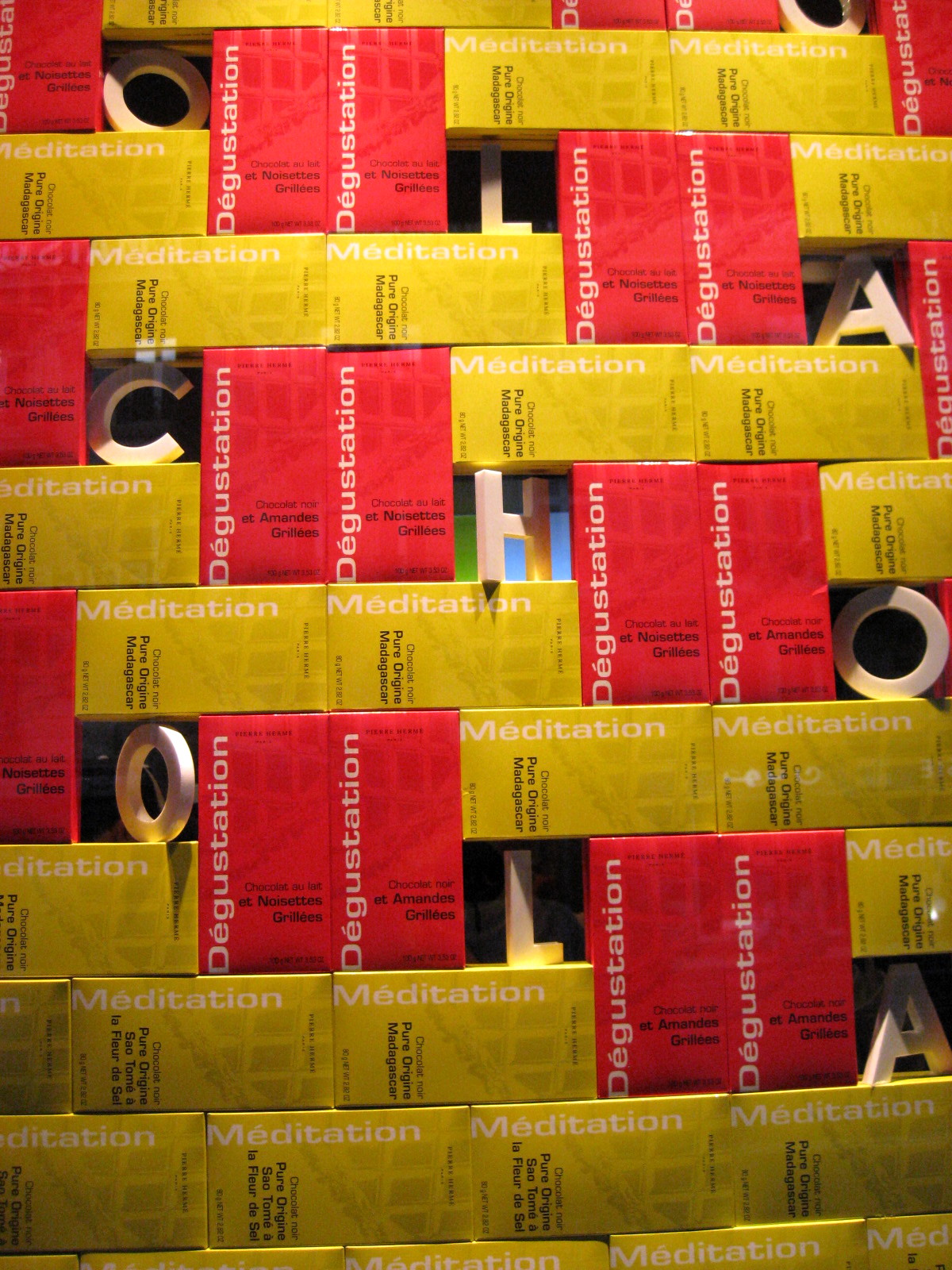
I went to both Ladurée and Pierre Hermé, at various different locations, and my vote goes to the latter. Pierre Hermé’s macaron shells were truly like air, while Ladurée’s were thick, chewy, and incredibly dense. The ganache filling inside also was more intensely flavourful at Pierre Hermé, though only by a hair. However, Ladurée wins hands down for the chic-est shops, all across Paris, inside and out, and with the best displays. The Pierre Hermé location near the l’Opera was dark like a cave, and I didn’t think much of the latticed tea boxes in the window. It was better at the St. Gérmain location where the window had cocoa beans presented as lollipops, but it still couldn’t quite compare to the elegance of the Ladurée displays. Speaking of that cocoa bean display, I got to stare at it quite a bit, as I had to consistently stand in long queues streaming out the door and onto the sidewalk merely in order to get into the store which is tiny, narrow, and smaller than some walk-in closets. Still, it was worth it for the sheer delight of his macarons! A photo comparison of the two brands:

Ladurée:

The window of the Ladurée store near the Place Vendome.

The window of the Ladurée store near the Place Vendome.

More of the full window.

More of the full window.

Ladurée chocolate cake.

Ladurée chocolate cake.

Inside the store.

Inside the store.

Some of the Ladurée macarons, with the green ones being pistachio if I remember properly and the light ones to the left having a passion fruit center.

Some of the Ladurée macarons, with the green ones being pistachio if I remember properly and the light ones to the left having a passion fruit center.

A Ladurée macaron cake.

A Ladurée macaron cake.

Ladurée chocolate boxes.

Ladurée chocolate boxes.

Now for Pierre Hermé:

Pierre Hermé window in St. Gérmain.

Pierre Hermé window in St. Gérmain.

Pierre H's Opera store window with teas, for which he is quite well-known.

Pierre H’s Opera store window with teas, for which he is quite well-known.

Inside Pierre Hermé's Opera location.

Inside Pierre Hermé’s Opera location.

Caramels and nougats in boxes and lightly chilled in a refridgerated section.

Caramels and nougats in boxes and lightly chilled in a refrigerated section.

Pierre Hermé chocolates at the St. Germain location.

Pierre Hermé chocolates at the St. Germain location.

While both stores feature plenty of “eye candy,” there were numerous shop windows or restaurant displays that also caught my eye. From street sweets on a cart near the Pompidou center, to a shop filled with things like violet candies, to the gorgeous sea food and the oyster menu of one restaurant which offered the high-end Gillardeau Especiales oysters that Neela Vermeire once mentioned in her interview as being her absolute favorite. My eye was also caught by the menu on the exterior wall of one bistro which featured quite a few of my favorite things, from rognons de veau (veal kidneys that are usually done in a red wine sauce) to tarte tatin (a thick, twice baked, hot, caramelized apple pie that is cooked upside down). Then, there was the adorable Jewish deli and bakery in Le Marais, the old Jewish quarter of Paris that is also home to a lot of Russians and Poles. Some of the photos in small thumbnails that you can click on to expand:

As some of you may remember from another holiday post, I spent most of my time in Paris staying with a friend from high school. She is one of my oldest friends, knows me and my tastes extremely well, and was an incredible host who practically greeted me with a large platter of cheese. It is hyperbole, but not all that far off the mark.

In addition to replenishing the cheese stock each and every day, she also made what was the single most delicious quiche I’ve ever had in my life. And that part is not hyperbole at all. As we stood talking in her kitchen, she casually whipped up — from scratch and with nary a look at a recipe — a cheese and ham quiche that was something so glistening, so huge, so bursting with flavour, and with such an enormously high, buttery, golden crust, that I’m actually swallowing my saliva as I write.

Emmanuelle's Cheese & Ham Quiche.

Emmanuelle’s Cheese & Ham Quiche.

I have decided that her savory delight was so remarkable that I have officially christened it as Emmanuelle’s Quiche, or Emma’s Ultimate Quiche. The photos do its magnificence no justice at all. The airy, smooth, fluffiness of the creamy egg mixture was infused with the somewhat sweet, incredibly nutty, aromatic, lightly salted flavours of Comté cheese. It’s a bit like really aged Emmenthal or Gruyère cheese, only stronger, nuttier, a bit sharper, and more distinctive. Mixed in were bits of salty, smoky ham from off the bone, and even more cream — all of which was then poured onto a flaky crust that was I suspect was laden with butter.

Emma's Ultimate Quiche.

Emma’s Ultimate Quiche.

That’s it. Nothing more. Incredibly simple, uncomplicated, and yet so bursting with flavour that I barely controlled myself from eating the entire, enormous pie. I tasted a lot of really good food on this trip, but Emma’s Ultimate Quiche remains one of my favorite dishes. It’s all about the quality of the ingredients, and while that is a clichéd mantra that every chef says, it’s very true. You also can’t beat the sheer intensity of genuine French cheeses, made and served in France itself. Their hardcore, heavy, intensely flavourful characteristics somehow get completely lost in translation, because I’m telling you, I had Port Salut cheese in Paris, and Port Salut last night for dinner here — and my version was like bland cardboard in comparison. Whatever they’re feeding those cows, goats, or sheep in France, I only wish they would do it here!

Joel R AtelierAt the other end of the culinary spectrum is Joel Robuchon, one of the most influential chefs in the 20th-century, and a god of High Gastronomy. He has 28 Michelin stars, the most of any chef in the world, and has mentored other famous culinary talents like Eric Ripert of the Michelin three-star Le Bernadin in New York, Gordon Ramsey (also three stars), and many others. His influence is enormous, his name legendary, and his chic Atelier de Joel Robuchon restaurants all around the world reflect an obsessive perfectionism over the smallest detail.

So, when I accidentally passed his Paris Atelier one afternoon, I stopped dead in my tracks. I certainly couldn’t just pop in for a bite to eat, not because it was 3:30 in the afternoon, but because one needs to make a reservation far in advance and, more significantly, a rather large wallet. So, I contented myself with photos of his menus, including his tasting menu. The €175 (or $250) price for the latter actually wasn’t bad at all (on the wonky relative scale of luxury restaurants), but my eyes did pop a little at a $100+ dish! Thumbnails below:

Though I didn’t manage to eat at Joel Robuchon, I did have haute Lebanese food one day. Neela Vermeire of Neela Vermeire Créations learnt that I would be in town, and kindly invited me to lunch at Rimal in the 17th arrondissement. From hummus, whipped into the airiest fluff and served with bits of schwarma meat, to livers cooked in a deliciously tangy, sweet, garlicky sauce, eggplant baba ghanooj, and more, it was enormously tasty. The thing is, the very stylish Ms. Vermeire is such incredibly fun, engaging, witty company, it was hard to really care much about the food.

She is not only as passionate, exuberant, outgoing, intense, and direct as she seems in person, she is actually a thousand time more so! I found myself laughing enormously at her refreshingly blunt opinions on various things, while also learning a lot from her astute insights into more serious matters as the state of affairs in France today, the political situation, and the people’s mood. She also had great sensitivity towards the current difficulties faced by people on all sides of the socio-economic equation, and I was genuinely impressed by her depth. What struck me, though, was that Ms. Vermeire seems to be the sort of person who would treat a street-sweeper and a king in precisely the same warm, forthright, candid, and genuinely sincere, interested manner. It’s a gift that not many people possess. But this is a post about food, and not about one of the coolest people in the perfume world, so here’s a little of the mezze-style delights that we had. Please excuse the impact of the shadows and sunlight hitting the plates through the restaurant window, as well as the occasional blurriness:

On a purely visual level, my favorite thing — hands down — was a tiny food market that I stumbled upon in Le Marais. From an artisanal producer of ciders, jams, and nutty treats, to bright glowing jewels of fresh fruit and berries, to a bounty of seasonal vegetables, and the slightly slimy denizens of the sea at the fishmonger — it was unbelievable fun! And that was before I got to the cheese stall! I’m afraid it deserves its own spotlight, without the limitations of expandable thumbnails, because…. Good God above! You really can’t imagine the range of offerings at this one, completely ordinary, market stall.

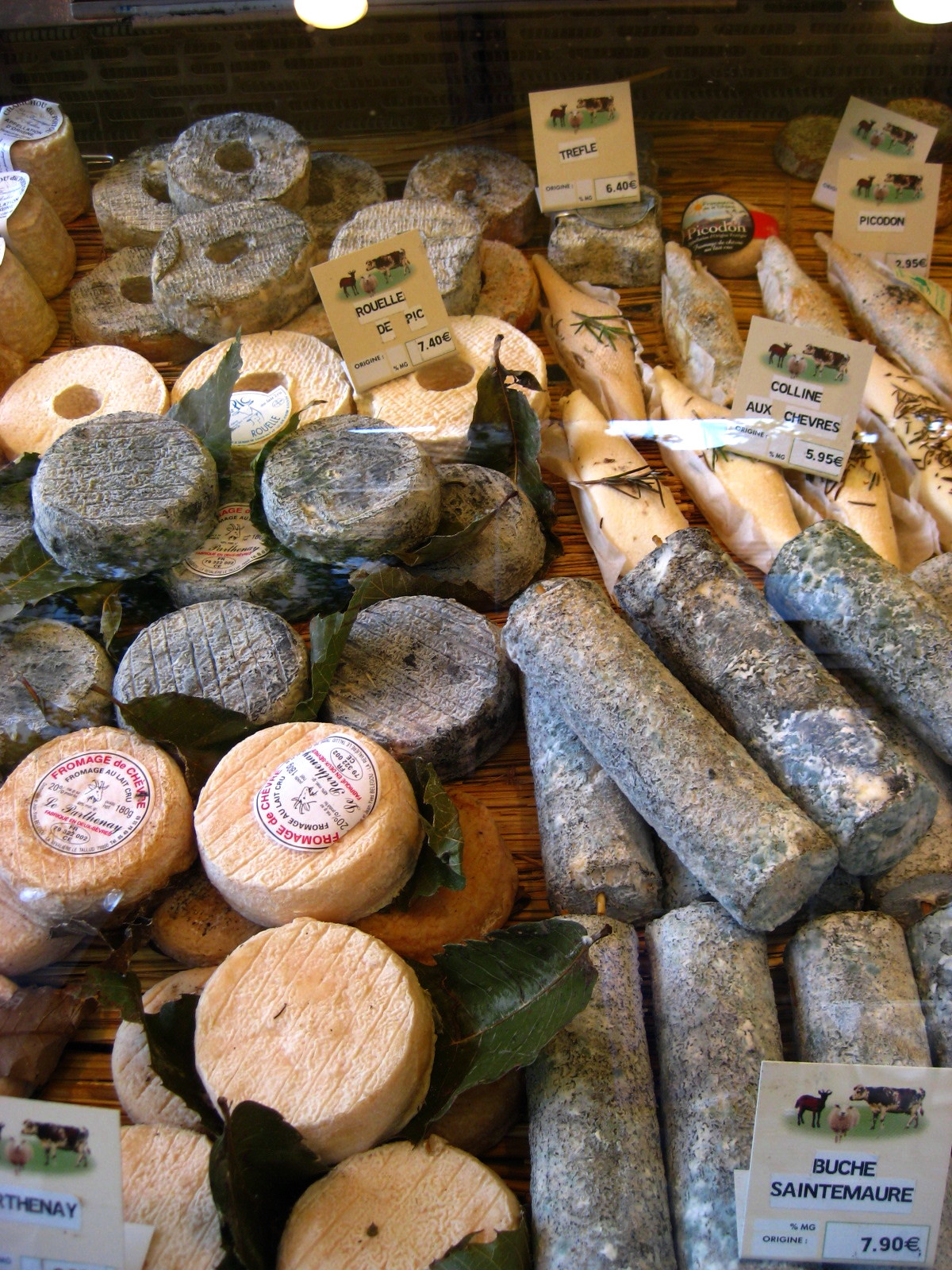
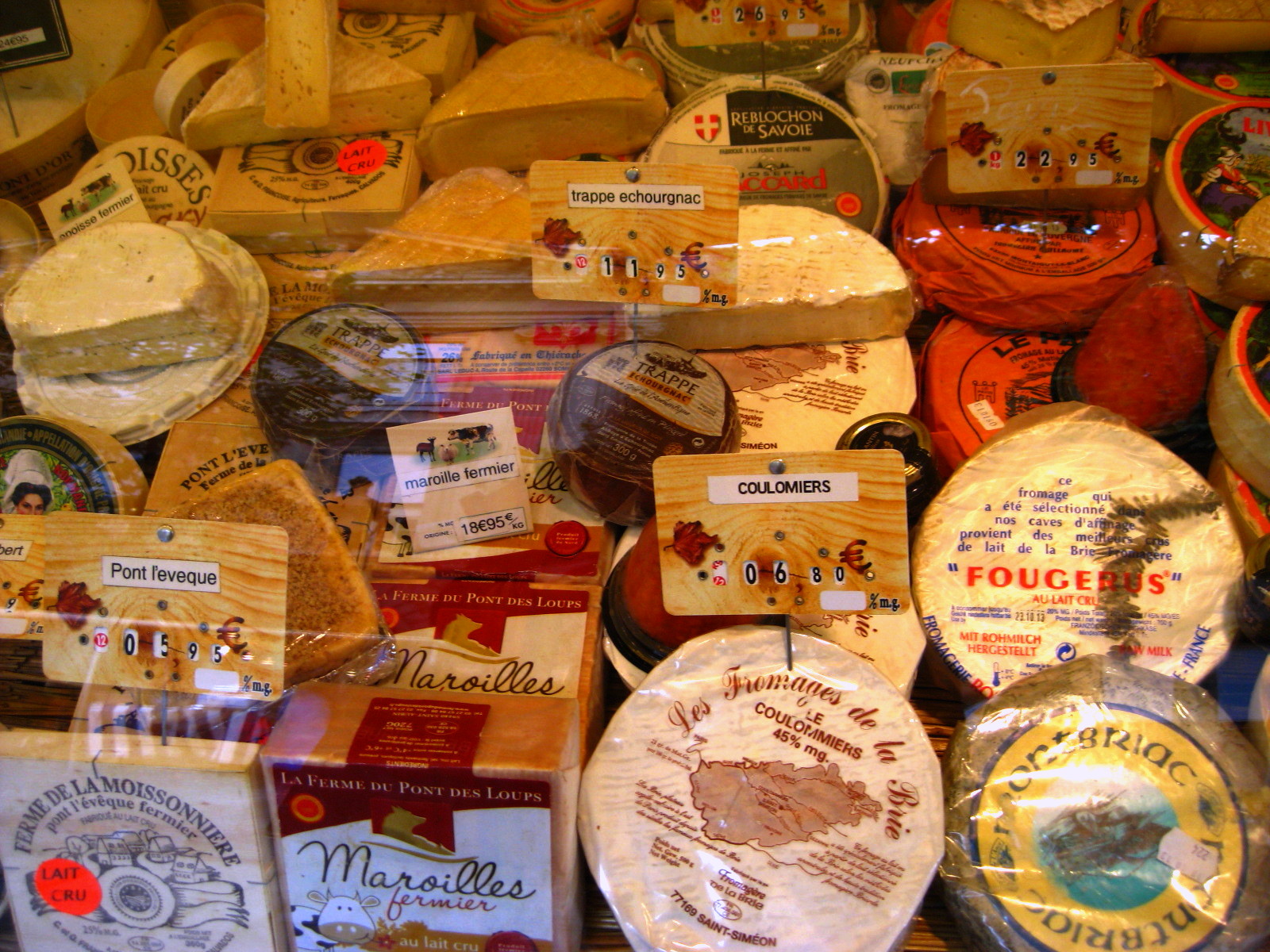
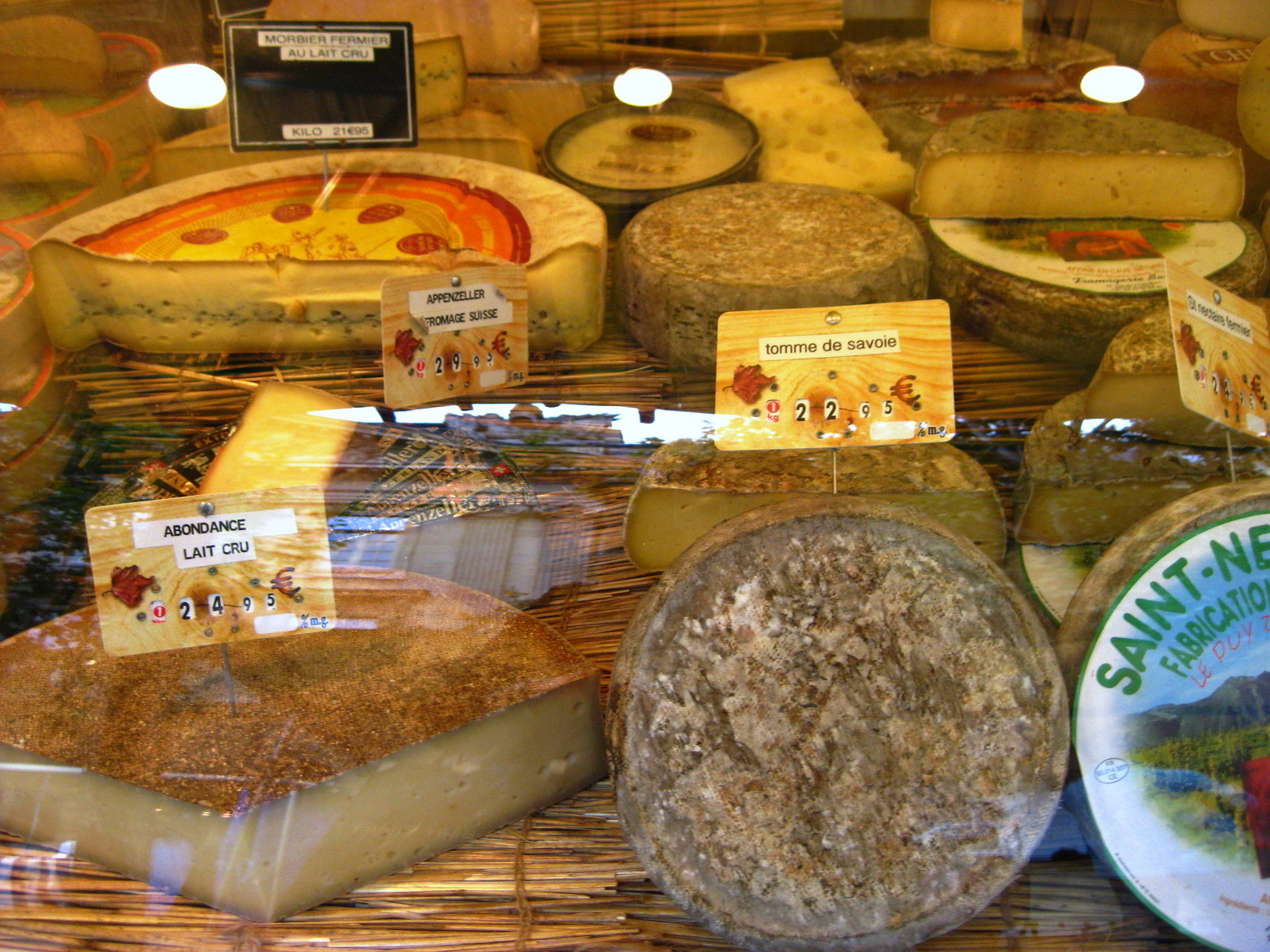
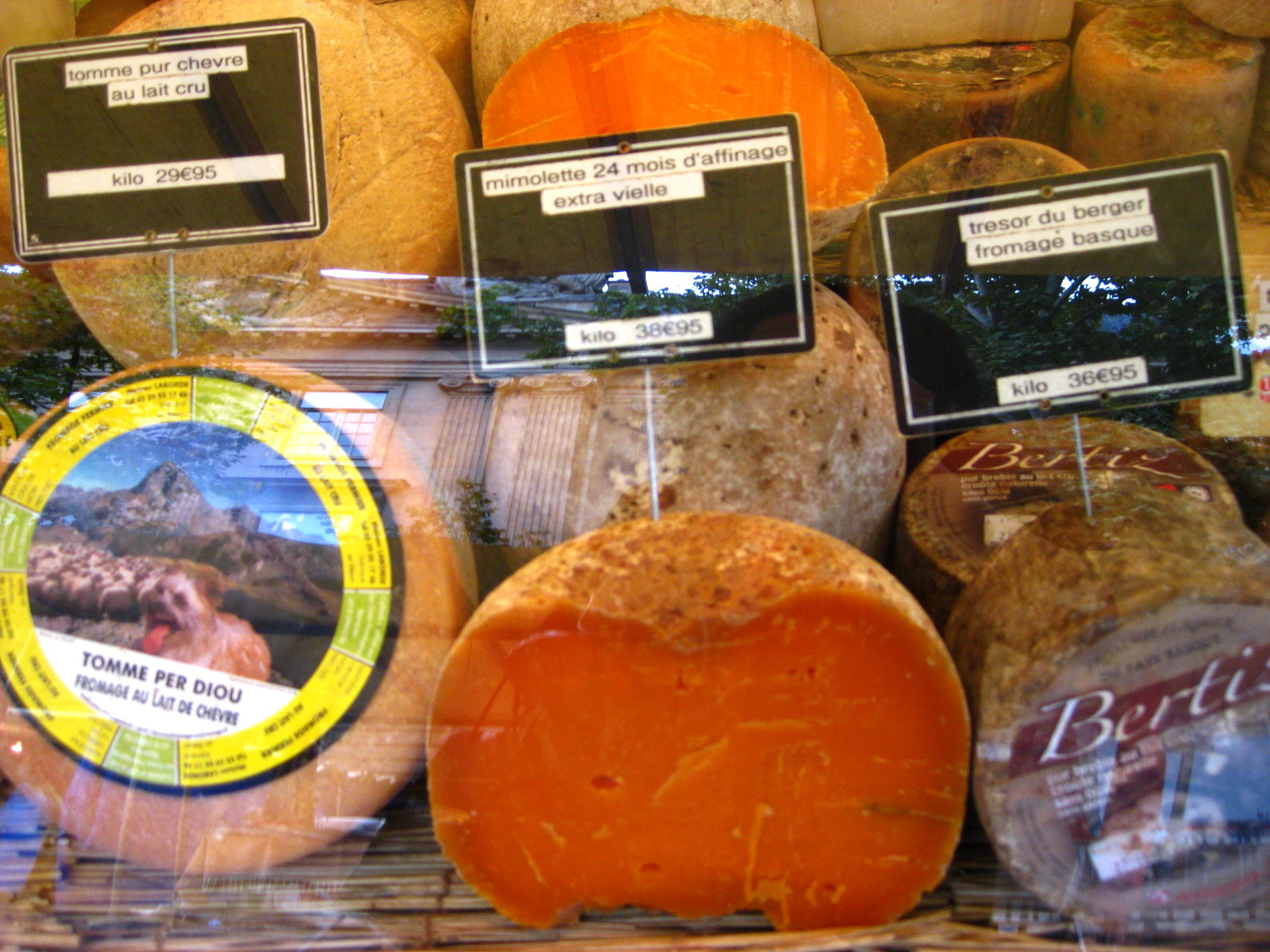
Paris Market Cheese and Cremerie

Paris Market Cheeses 1 Paris Market Cheeses 2 Paris Market Cheeses 3 Paris Market Cheeses 4 Paris Market Cheeses 5 Paris Market Cheese 2 Paris Market Cheese 3 Paris Market Cheese 4

Visual delights abounded at other stalls, too. At one stall, crimson groseilles or red currants gleamed in the light like Dorothy’s ruby slippers. At another, an incredibly tempting line-up of artisanal jams, alongside fresh nuts. Some expandable thumbnail photos below:

The fishmonger’s stall was much less appetizing to look at, though definitely eye-catching with his platters of octopus tentacles, slimy squid, expensive turbot fish, and the like.

I have quite a few more photos — of food I cooked myself, to dessert tartlets that made my mouth water — but I fear I’ve quite outstayed my welcome on this subject, and don’t want to bore you further. Thank you for all your patience with this exhaustive photo essay, and with the detour away from perfumery with the travelogue series as a whole. Lastly, if anything caught your eye, made you drool, or piqued your curiosity, do let me know. Food is always best when shared!

Holiday Travelogue – Part II: For the Love of Paris

Life is better when one’s joys are shared with friends. I firmly believe that. I simply enjoy things more when I feel as though friends are exploring, tasting, seeing, or feeling things with me. For that reason, I fear this post is going to be a very long one, visually, because I have a lot of photos of Paris. A lot!

You all know Paris is a magical city, but I love its quirky side just as much as its majestic one. There is so much that I hope you can enjoy along with me, even if none of it is particularly significant on a grand level: bridge railings covered with locks given as a declaration of love; Golden Retrievers hanging out at the gardens of the Louvre; the statue of St. Antoine in the St. Germain church where people write message or prayers on his actual figure; people chilling at the Tuileries before interesting sculptures; a media frenzy near the Palais Royal (that temporarily blocked me from going to Serge Lutens) because of some important meeting with government and/or cabinet ministers; exuberant street performers or quirky shops in Le Marais, the old Jewish quarter; the glitz of jewels at Le Place Vendome; the strangely eye-catching, ugly beauty of the modernistic Pompidou Museum; those sitting by the Seine in quiet contemplation one cloudy afternoon; the feel of a variety of cafés throughout the city; and so much more.

Let’s start with the river Seine. I love walking along side it, peeking into the street stalls with their colourful, touristy postcards and posters. Sometimes, one can find some treasures in the occasional stall dealing with rare books, or offering old vinyl LPs. Usually though, my eye is always caught by the early 20th century or art deco art that is immortalized on the postcards. I adore the Toulouse-Lautrec posters that are usually featured, or the gaiety of old Josephine Baker cards. So here are some photos taken on the Right Bank, along with some images of people simply sitting by the Seine and enjoying the view. (You can click on the thumbnail to expand it.)

I’d been walking by the river when I looked up and saw the closest bridge had tons of shiny, golden objects on the railings. I can’t recall now which bridge it was (and I don’t think it was the Pont Neuf), but I decided to explore. It turns out that every inch of railing was festooned with locks. Even parts of the bronze lamps on the bridge were covered in them! In the back of my mind, I had a vague memory of my high school years and how some of the students would hang locks on gates with their initials and those of a loved one. It’s basically a declaration of love and commitment, that your love will stand steadfast and firm like a lock. Much like a squirrel drawn to shiny things, I became obsessed with taking photos of these things — and the street musician who was playing before one of them didn’t seem to mind being included in the picture.

I’m not generally one who will go into raptures about gardens, but the Jardin des Tuileries is a whole other story. I’m a sucker for beautifully manicured, formal gardens, done on the vastest scale imaginable. As a little bit of context for why the Tuileries are special, I thought I’d quote some of its history and features from an informational website:

The Tuileries Gardens get their name from the tile factories which previously stood on the site where Queen Catherine de Medici built the Palais des Tuileries in 1564. The famous gardener of King Louis XIV, André Le Nôtre, re-landscaped the gardens in 1664 to give them their current French formal garden style. The gardens, which separate the Louvre from the Place de la Concorde, are a cultural walking place for Parisians and tourists where Maillol statues stand alongside those of Rodin or Giacometti. The gardens’ two ponds are perfect for relaxation. The Musée de l’Orangerie, where visitors can admire the works of Monet, is located south-west of Tuileries.

Sadly, none of my photos do the Tuileries any justice whatsoever. Absolutely none. (Stupid, tiny camera! Stupid, stupid thing!) What I loved the most were the acres of people just chilling, many lounging on a chair with their feet up on another, and reading a book or chatting with a friend. Others spent time people-watching, while children played at a big fountain with large toy sailboats that you could rent. One fountain was lovely in the late afternoon, with eye-catching light shining through the dark clouds. It was odd, though, to see three policemen questioning a man seated in one of the many chairs before it. There was a vast trail of water all around him, and leading in a path to the fountain. His clothes didn’t look sopping wet, but that water seemed to tell a very different tale. And I would swear from the conversation that I partially overheard that the policemen were threatening to take him in because this was the third time that he’d gone into the fountain!

The Tuileries are a stones throw away from the Louvre, and one thing that caught my eye were the dog owners hanging out with their furry children. Now, my particular canine obsession involves German shepherds, but who can resist a fuzzy face?! These boys get their own individual slot and close-up!

Canines at the Tuileries

Canines at the Tuileries 2

Goldie Closeup

Once you get to the Louvre itself, it’s really hard to know where to look. While the grandeur of the baroque architecture speaks for itself, the enormity of it all is utterly overwhelming and screams out, “I am FRANCE! Bow down before my majesty!” I’ve not only been to Paris before, I used to live there on four different occasions, and it still takes my breath away. It always will. The simple fact is that things like this cannot be done without the wealth and resources created by an extremely feudal system. And all one can do is to thank God that even the Nazis were so overwhelmed by Paris, that they left its beauty intact. Legend has it that one of the German generals, General Dietrich von Choltitz, refused Hitler’s direct orders to bomb Paris on the eve of the Liberation. I won’t get into the historical debate on the veracity of that legend, but let’s just be glad Paris’ splendours remain intact. So, here is a glimpse at the Louvre in the late afternoon near closing time, including a peek inside and down the main pyramid:

At the complete other end of the aesthetic and architectural spectrum is the Pompidou Museum. Frankly, I’ve always thought it unbelievably hideous! Yet, if you really look at it, it’s an oddly entrancing symphony of hideousness. Or perhaps you simply can’t stop looking at its revolting…. well, I’m not sure what term would really suit it best. Still, you cannot deny that this epitome of ’70s modernity is one of a kind. (I rather think that’s a good thing.). Officially entitled Le Centre George Pompidou, it is France’s national modern art museum, and enormously significant. As one Paris tourist site, The Paris Pass, explains:

The Centre Pompidou is Europe’s most important museum of modern art and one of the worlds most significant art galleries.

Some of the art movements represented within the Pompidou Center are Fauvism, Cubism, Surrealism and Abstract Expressionism. It has 50,000 works of art (including paintings, sculpture, drawings, and photography), of which 1,500 to 2,000 are on display to the visitors of this National Museum of Modern Art.

The building’s design is somewhat contentious but undeniably unique, distinctive, and increasingly appreciated by all who see it.  […]

The fourth and fifth floors of the Centre Pompidou are home to the Musée National d’Art Moderne, one of the major international collections of modern art located in Paris. It includes works by artists such as Kandinsky, Matisse, Miró, and Picasso.

You can read up on its design history at Wikipedia if you’re interested, but I’ll just quote their description of people’s reaction to the museum when it first debuted:

National Geographic described the reaction to the design as “love at second sight.”[3] An article in Le Figaro declared “Paris has its own monster, just like the one in Loch Ness.” But two decades later, while reporting on Rogers’ winning the Pritzker Prize in 2007, The New York Times noted that the design of the Centre “turned the architecture world upside down” and that “Mr. Rogers earned a reputation as a high-tech iconoclast with the completion of the 1977 Pompidou Centre, with its exposed skeleton of brightly coloured tubes for mechanical systems. The Pritzker jury said the Pompidou “revolutionized museums, transforming what had once been elite monuments into popular places of social and cultural exchange, woven into the heart of the city.”.[4] […]

Initially, all of the functional structural elements of the building were colour-coded: green pipes are plumbing, blue ducts are for climate control, electrical wires are encased in yellow, and circulation elements and devices for safety (e.g., fire extinguishers) are red.[1]

That Loch Ness line is my favorite! What often interests me about the Pompidou Center is the life outside it. A long, slightly upwardly slope of stony ground is before it, and people just sit to chat or, in some cases, as you will see in one photo below, to kiss. The area around the museum is called Beaubourg, and it’s full of life, from cafés to cinemas, to busy cyclists on one of the many rental bikes you can get across the city. I walked around one early evening near sunset and took photos:

Going all around Paris is pretty easy to do with the metro, though it takes a little bit of time to adjust to the system. Once you do, however, it’s rather straight forward, and buying a “carnet” (or book) of 10 tickets (at a discounted rate) encourages you to really explore. Thanks to the metro, I went all over. One day, it was the chic St. Germain district on the Left Bank, where you come out of the metro very close to the church that I used to go to quite a bit as a child. L’Eglise St. Germain is the oldest church in Paris, with parts that date back to the 6th century, and I always loved its darkened comfort as a child. For some reason that I can no longer remember, I’d always been rather fascinated with St. Antoine, or St. Anthony of Padua, the patron saint of lost things (or lost causes). The established ritual in that church was that you would write your wishes on his statue — and I was incredibly happy to see that the tradition still continued to this day.

Across the street from the church is its spiritual polar opposite: a Louis Vuitton store before which, on the day I visited, was parked a Bentley with Monegasque (or Monaco) license plates. Next to the Louis Vuitton is another example of elitist luxury that St. Antoine would probably have frowned heavily upon: the exclusive, trendy Hotel Costes’-owned restaurant called La Societé. Diagonally across from the Church and to the left of the block is the Les Deux Magots (pronounced as Mah-Goh) café and its bitter rival, the Café Flore. These two adjacent cafés are very famous, and have quite a rich history:

Both Café de Flore and Café Les Deux Magots first opened in the late 19th century.  It is said that Jean Paul Sartre and Simone de Beauvoir discussed existentialism at Café de Flore, while Ernest Hemingway and Pablo Picasso preferred Les Deux Magots.

Café de Flore  sits on the corner of Boulevard Saint-Germain and the Rue St. Benoit. The art deco interior, with red leather banquettes and polished mahogany, has changed little over the years.  During the Occupation of World War II, it is said that the Germans preferred Deux Magots, so many of the writers moved to Flore, where they were kept warm in winter by the large stove that still sits in the middle of the room.

Equally relevant for historical reasons is another literary haunt on the opposite side of the St. Germain boulevard: the famous Brasserie Lipp. With its original 1926 Art Deco decor and its Alsace comfort food, “Le Lipp” had once been the home away from home of artists, writers, intellectuals and politicians alike. Like Les Deux Magots and Café Flore, it’s not always to get a table. As one site explains:

There’s no use phoning for a table at the Brasserie Lipp – they won’t reserve one, unless you are the Prime Minister of France. Like everyone else, you will have to stand around and wait: it’s part of the Lipp ritual. […] If it is any consolation, it is even more difficult to become a waiter at the Brasserie Lipp – you have to be proposed.

When you do get in, however, you stand a good chance of eating next to the many celebrities who frequent Brasserie Lipp. Marcel Proust used to send for jugs of the Alsatian beer from across town, Hemingway wrote his pre-war dispatches from here, and in the Fifties Chagall, Camus, Jean Genet, Balthus, Michèle Morgan, Françoise Sagan, Charles Trenet and Simone Signoret with Yves Montand were all regular habitués of this famous establishment. Late President François Mitterand was one of Lipp’s inner circle as well as Harrison Ford, Gérard Depardieu, Gregory Peck and President Jacques Chirac when he was Mayor of Paris.

Below are some photos from the Left Bank (in thumbnail form that you can expand), including a few photos from the Place St. Sulpice whose fountain has four statues surrounded by lions. Each statue is of a famous, 17th century French bishop who was renowned for his eloquence:

There were different destinations on other days. Once, it was the Place Vendome where I peered at the windows of various jewellery stores (and got one shot of one extravagantly expensive, bejewelled necklace that was from Dior, I think). Another time, it was a church on the Rue St. Honoré that I revisited for nostalgic reasons. Then, there was a walk past l’Opera with its spectacular facade. One night, I had dinner with friends near one of the canals in Paris, le Canal St. Martin, near the Place de la Republique. Once, I even ended up at the far end of Paris, at La Defense, where I took photos of the interesting buildings and two colourful sculptures. On another occasion, it was the turn of Le Marais, the old Jewish quarter that is now filled with art galleries. There, I walked part the National Archives to an adorable square filled with cafés where I saw street performers doing acrobatics. At the Marais’ local, “quartier” version of “city hall” (at least, I think it was that), I saw a large photo of Nelson Mandela posted on the top of the building, and suddenly had the terrible fear that he may have died. I think they had posted it in support of his ill health, and in hopes that he improve.  

Then, there was my attempt to go back to the Serge Lutens mothership after I had finally made up my mind on which bell jar (or two) to get. (It’s still a secret, until I post about it.) At Les Palais Royal, my every attempt to get to Serge Lutens was foiled by massive security and a frenzy of media. I’m still not quite sure precisely what was going on, but it was apparently some important meeting on a legislative matter and attended by government officials and cabinet ministers. All I know is that the French media can be quite rabid to get their stories, and that there were a lot of formally garbed individuals in uniform or sporting a medallion necklace of their office. Finally, all the fuss died down, the police became less sternly grumpy, and I was permitted to go through to get my “Precioussssssss” (™ Hajusuuri).

On another occasion, I spent an afternoon at a café on the Ile St. Louis, near Notre Dame, with two friends. I was supposed to meet one of them first at Notre Dame, specifically in the middle of one of its bridges, but we had a rather amusing game of miscommunication because Notre Dame has several! As I waited, I took photos of the magnificent structure which, in 2012, began a year-long celebration of its 850th birthday!

While there is just so much to the city that is spectacular or that worms its way into your heart, Paris has changed a lot since my times there — and not always for the better. For example, I find the Champs-Élysées to be one of the most depressing places in the whole city with its Las Vegas-style displays; the tacky bling of its enormous high-end shops contrasted with the cheapness or gaudiness of the large stores at the other extreme; and the complete loss of all its intimate, personal, charming individuality. I actually did my best to avoid the area entirely if possible; I remembered all too well how a visit a few years before had left me nearly in tears at the of the drastic, sharp changes. Another area of Paris, near Port Maillot where people get the Air France buses to Charles de Gaulle, had utterly horrified me with its grime, street litter, and dirtiness. Even the beautiful white or cream stone buildings that I remember in some upper-class neighborhoods looked dark with grime. The dog poo on the streets was much less than it used to be — though one Parisienne I know strongly disagrees — but the city could do with a good scrubbing in some parts.

Money, however, is very tight, and the new government is raising taxes to quite a degree. Everywhere I went, people were talking about the taxes. From taxi drivers, to shop keepers, to strangers conversing on the metro, to wealthy friends of mine, there was incredible frustration, bitterness, or a feeling of “enough is enough” in the air. I may be getting the exact percentages somewhat wrong by a point or two, but I recall one person who is a professional mentioning a tax rate of 48%, while a corporate entrepreneur said his company was taxed at 63%. Whatever the precise figures, they are high, and left me just blinking. (I do not want to discuss politics on the blog, as it never — ever — ends well and only will cause a fight, so please let’s not go in that direction.) I bring up the issue only to try to explain why Paris may not have the money to do what it needs to on an aesthetic basis. On a happier note, as I hope this series has demonstrated, there is still enormous loveliness to be found, in both the tourist spots and in small little corners.

I’m sure I’ve thoroughly exhausted you with all these photos, and for that I apologise. But, it’s Paris, dammit, and this is only the tip of the its beautiful iceberg! Joking aside, if you’re exhausted, why don’t you pull up a chair at one of Paris’ many cafés, and enjoy a glass of wine. It will be a good aperitif for all the food porn photos (and cheese!) that will await you in Part III. That post, with its singular focus on Paris food, chocolates, street markets, and more, should be up in a day or two.