
John Wayne riding through the arid desert canyons of New Mexico. Gary Cooper in a suit in the bracing, brisk air of Normandie. Two very different images of two very different men stemming from two very different fragrances in Dior‘s prestige La Collection Privée line of perfumes. (The line is sometimes called La Collection Couturier on places like Fragrantica and Surrender to Chance, but I will go with the name used by Dior itself on its website.) The fragrances are Leather Oud and Granville, and both were created by François Demarchy, the artistic director and nose for Parfums Dior, to reflect different aspects of the life of Christian Dior.
Category Archives: Leathers
Perfume Review- Serge Lutens Boxeuses
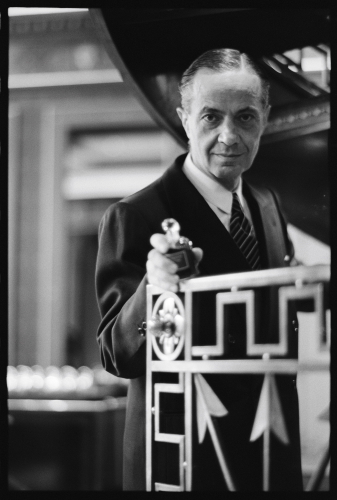
Serge Lutens via The Perfume Magazine
I’m a huge fan of Serge Lutens and his fragrances, even when I can’t wear them. To me, there is no other perfumer who seems so genuinely intellectual as a person, so philosophically theoretical and inquisitive, and so damn original across the broad range of his fragrances. Serge Lutens and his perfumes fascinate me on every level, and I constantly find myself intellectually engaged by what he’s trying to do, as well as often being emotionally touched by what he actually creates, even when I can’t wear them, find some fault with them, or am left undecided and completely confused as to what I actually think…. (Datura Noir, I’m looking straight at you for that last one!)
 Boxeuses is another Lutens perfume that fascinates me. It’s not one that I love, or that ultimately worked very well for me, but I deeply admire it. It evoked a sharply divergent set of impressions — from Rasputin fleeing a dacha in the woods to, structurally, a sandwich — but, as always with Serge Lutens, it made me think. I cannot tell you how rare that is for me when it comes to perfumery. Boxeuses was released in 2010 and is the creation of Lutens’ favorite cohort in olfactory adventures, Christopher Sheldrake. Its description — like all of Lutens’ descriptions — is a fun, intellectual source of amusement. Except for Parfums d’Empire, I think no-one does better stories for their perfumes than “Uncle Serge,” as he is affectionately known in the perfume community. His background tales are frequently a mix between some sort of romantic, whimsical Proustian or Zola-like saga, and Camus-influenced existential angst. They rarely, however, seem to actually encapsulate the feeling or scent of the perfume, in my opinion. And the brief synopsis of Boxeuses on the Lutens website is no exception:
Now’s the time to fight.
To get the idea, think of Russian leather tanned on birch bark.
Now add animalic notes, strong enough to suggest a black eye.
In other words, it’s time to see stars!

Source: TheWeek.co.uk
“Boxeuses” translates to women boxers in English, but I have to say that was the last thing that came to mind when I smelled the perfume. As for the notes, Serge Lutens almost never provides a list, so it’s a little bit of a guessing game as to what Boxeuses actually contains. Compiling the elements from Fragrantica, Surrender to Chance, and the Perfume Shrine, the list would seem to be:
Leather, licorice, birch tar, fruit, plum, violet, cedar, styrax, incense, spices, cade oil.
Boxeuses opens on my skin with a bouquet of notes that are so dark purple, they verge on black: plum molasses; violet cherry cola; black licorice; leathery, black fig compote; and sweet dried fruits topped by heaping dollops of prune over a richly resinous, smoky base. Birch tar is a huge part of that base with its tarry, smoky character. It’s a hard aroma to describe if you’ve never smelled it, especially as it’s quite different here from the way I’ve encountered it before. It’s not mentholated, not like eucalyptus, not like diesel, not like rubber, and not chilly — and, yet, it almost feels like all of it. It never seems like pure leather to me but, rather, like extremely gooey, black, resinous molasses, filled with a dark, pungent, almost sharp smoke that has a diesel-like undertone to it. The molasses smells like the thickest concentration of stewed prunes, plums and black figs. I have no idea if black figs are actually in Boxeuses, but something about that sticky foundation smells like the grainy, densely sweet, slightly spiced, slightly leathered, earthy aspects of thick, Black Mission fig jam.

Fig Jam. Source: Bettycupcakes.com (For recipe for homemade fig jam, click on photo. Link to website imbedded within.)
The real key to Boxeuses, however, comes from the birch tar and cade elements in conjunction with that fruit. As the Perfume Shrine explains in an article on ingredients often used in leather perfumes, birch tar has a very smoky, tarry, phenolic character and was frequently used by Russian or Finnish tanneries to treat leather. It’s a key part of leather perfumes like the legendary Chanel classic, Cuir de Russie. Cade oil comes from juniper trees and has the aroma of a smoky campfire. Those two notes combine with the fruit to create what I can only describe as a jammy-fruited-molasses tar with black smoke and, also, a hugely liqueured edge. It’s as if every dark fruit in the world had been cooked in and then soaked in a wood-infused casket of vodka, cognac and smoky tar, then left to seep and age for 75 years. Sadly, I think I’m still not doing justice to its particular and unusual nuance in Boxeuses.

Silver birch tree. Source: my own photograph.
Five minutes into the perfume’s development, the leather aspect starts to rise a little from the depths of that smoky, fruity, dark molasses base. It’s never a cold, raw, harsh leather; nothing about it feels black or steely. This is a fruit-soaked, jammy leather tinged with church incense and backed by dark woods. It’s beautiful and, oddly, conjured up Rasputin in my mind. Perhaps it’s the mental association of church frankincense with birch tar — an element so often used to treat the leather boots of Imperial Tsarist officers’ boots — and Cuir de Russie. Whatever the reason, the image which comes to mind is Rasputin, wandering around a birch forest in the snow outside a luxurious Russian dacha. He is followed by women trying to serve him sweet, stewed fruit or to cover him with a leather coat. His clothes reek of church incense and smoke, and he’s completely drunk on some dark fruit liqueur which makes him stumble and lose his way amidst the sea of trees. I grant you, it’s not what I’m suppose to imagine with Boxeuses but, despite all the fruit at the base of the perfume, Boxeuses has a very strong feel of the outdoors and winter, of snow and Russian forests, of campfire smoke and sharp incense.

Painting: Julie McInnes. Source: FineartAmerica.com
Twenty minutes in, the perfume shifts a little. Black licorice becomes more prominent, flickering tongues of salt over the campfire flames whose smokiness has increased even more. The dried fruits and the always subtle leather nuance have receded to the background, working their magic from afar and with indirect impact, and leaving the tarry birch woods, church incense and salty black licorice to duke it out at center court. At the forty minute mark, the three are still the most prominent notes, though I somehow smell a salty beeswax element as well.
Then, suddenly, exactly one hour in, Boxeuses suddenly becomes abstract: the notes all morph into one vague, generalized soft accord without a hugely distinctive, individualized character. There is still salty black licorice flickering but now, it’s in the distance along with much else. The perfume feels as though it’s muted and seen through a foggy veil where the overall impression is of very amorphous dark woods with smoke, licorice and some vaguely fruited-molasses elements. Part of the problem is Boxeuses’ sillage on my skin. It’s soft from the start and, on both occasions where I tested the perfume, it started to hover just barely above the skin between the 40 minute and 1 hour marks. It’s such a soft fragrance, it feels abstract. Even during the second test where I applied substantially more, Boxeuses became nondescript quite quickly and much sooner than I had expected. The notes feel so translucent, despite their underlying purple hue, that they lack any distinctiveness.
 And that never changed for the rest of Boxeuses’ limited duration on my skin. Two hours in, the perfume turns into abstract licorice woods. There is still a hint of birch in the background; it’s enough to infuse the licorice note with smoke and to make it take on a slightly burnt aspect. Nonetheless, it feels as though Boxeuses is starting to slowly die on my skin. It gives a few gasps during the third hour, almost like a second wind before death: the jammy, dark, pruney-fig molasses note reappears, joining the smoked licorice element and bringing amber along as a companion. Then, just barely after the fourth hour, Boxeuses gives its final hiccup. It is barely ambered, smoked woods — and nothing more. The exact duration of Boxeuses on my skin in the two tests was: 3 hours and 50 minutes with an average dose; and 4 hours and 30 minutes with a large dose.

Source: Royalty-Free-RF-Clipart
Boxeuses’ structure consistently calls to mind a very badly cut sandwich. The top and the bottom — the “bread,” if you will — consist of the plummy-stewed-liqueured-dark molasses. The middle of the sandwich is all black “meat”: black birch tar, black frankincense smoke, and black, salty licorice. The top piece of bread is thick; the bottom one is sliced so thin as to be flimsy and translucent. Separating the “bread” from the “meat” is some sort of layer that brings in elements of both parts. Perhaps we can call it a “mayonnaise” which mixes part of the dark fruited molasses with elements of smoke and birch. It’s the overlap area, if you will, which takes place immediately after the thick opening minutes of liqueured molasses and, also, at the very end when the molasses returns. It may not be the most on-point or perfect analogy, but it’s what comes to mind when I think of the perfume’s evolution.
As you may have gathered, I found Boxeuses to be fascinating, but something about it didn’t sweep me off my feet, even apart from the sillage and longevity issues. To me, Boxeuses was always more of an intriguing intellectual construct. Yet, given the notes, I really should have loved it. For one thing, unlike some very intellectual Lutens creations that I’ve reviewed (like Tubereuse Criminelle, for example), Boxeuses is imminently wearable. I’m not too sure of how versatile it is all year-round, particularly in light of the very cold weather, snowy, winter feel of it, but on the Lutens scale of versatility, this is somewhere in the middle. Not as practical or versatile as my beloved Chergui or the cozy Five O’ Clock au Gingembre, but also not as distinctive as the difficult Tubereuse Criminelle, the rich, patchouli-chocolate Borneo 1834, or the complicated Serge Noire. For me, it falls somewhere in that middle category with De Profundis and Cuir Mauresque. Yet, Boxeuses doesn’t move or interest me anywhere close to those last two perfumes which are huge Lutens favorites of mine. Boxeuses is nice and quite enjoyable, but, at the end of the day, it didn’t really rock my world. It never tugged at me while I was wearing it or make me think, “Wow.” It also didn’t have a huge, lingering effect afterwards where I’d continue to think of the scent days or weeks later.
I’m sorry, Uncle Serge. Please forgive me. I will always be a devout, loyal member of your fan club.
Details:
Cost & Availability: Boxeuses is an eau de parfum that is part of the Serge Lutens “European Exclusives” line, which means it is available only in the larger 75 ml Bell Jar size. It retails for $290 for a 75 ml/2.5 oz bottle. You can find Boxeuses on the Serge Lutens website (US and international). Elsewhere in the U.S., you can normally find even exclusive Bell Jar Lutens sold at the New York Barney’s store. Even the exclusive De Profundis was shown on the company’s website, along with a note stating: “This product is only available for purchase at the Madison Avenue Store located at 660 Madison Avenue. The phone number for the Serge Lutens Boutique is (212) 833-2425.” However, Boxeuses is not listed or shown. I’m sure it’s sold in store, however, so you may want to check. Outside the US: In Europe, the price is considerably cheaper at €125 from the French Lutens website or from their Paris boutique. For other countries, you can use the Store Locator on the Lutens website. Samples: You can order samples of Boxeuses from Surrender to Chance (where I bought mine) starting at $3.99 for a 1/2 ml vial.
Perfume Review – Amouage Opus VII: The Heart of Animal Darkness
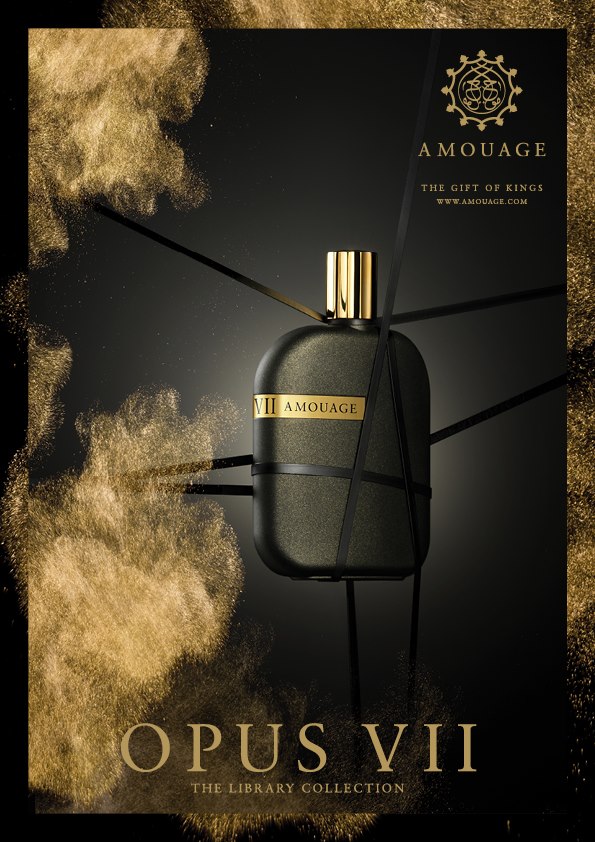 In 2010, the royal Omani perfume house, Amouage, launched a new line entitled The Library Collection which was meant to be a “poetic homage to the art of living” and inspired by the concept of memories as treasured books in a library. Just a month ago, in mid-April 2013, Amouage added a seventh “book” to its line, this one created by Alberto Morillas and Pierre Negrin. Opus VII is described as “a green, woody and leather fragrance evoking the juxtaposition of harmony with the intensity of recklessness.” It is a difficult, complex, assertive and very masculine scent that takes you to the heart of darkness in a smoky oud jungle populated by ferocious big cats.
According to the Amouage press release quoted by CaFleureBon:
Opus VII literally stands out from the previous six editions as it is the first to use a black flacon with gold criss cross lines; an allegory of the mind when thoughts are subjected and diverted. The use of galbumum and violet in Opus VII are integral to the composition and Christopher [Chong]’s vision.
 I don’t see violet listed as one of Opus VII’s notes which — according to both Amouage‘s website and Fragrantica — consist of:
top: Galbanum, Pink Pepper, Cardamom, Nutmeg, Fenugreek
heart: Agarwood Smoke, Patchouli, Ambrox [synthetic amber], Leather, Ambergris
base: Costus Root, Muscone [synthetic musk], Sandalwood, Olibanum [Frankincense], Cypriol [a woody note with earthy and spicy nuances]
Source: herbalveda.co.uk
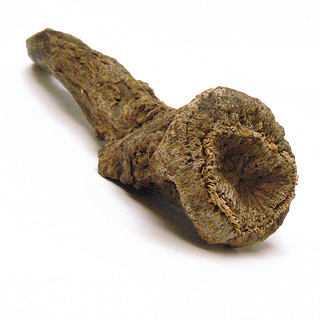
As always with Amouage, understanding what the perfume smells like requires understanding the more unusual ingredients that the house likes to use. In this case, one of the most important would be the Costus Root. In a long article on animalic notes, The Perfume Shrine describes costus root as “reminiscent of unwashed hair, in more intimate places than just head” and says that it is one of the elements for the trademarked perfumer’s base called “Animalis,” produced by Synarome. In a post on Animalis itself, The Perfume Shrine describes costus root as
a plant essence that has an uncanny resemblence to a mix of unwashed human hair, goat smell and dirty socks. […] It’s also part of the mysterious urinous & musky allure of Kouros by Yves Saint Laurent (which indeed features a healthy dose of costus under phenyl acetate paracresol).
Though the Perfume Shrine says that modern perfume restrictions have limited or “axed” the use of costus, it is a huge part of Opus VII on my skin.

Dried fenugreek leaves via Suhana.co.in
Another big element is Fenugreek, a plant whose dried leaves or seeds are often used in Middle Eastern or Indian cuisine. In fact, I have a large bottle of it in my pantry right now. Fenugreek has an extremely difficult scent to describe; if you’ve ever smelled it, you’ll know it right away, but otherwise, it’s a little complicated. Basically, it’s a very green aroma that is simultaneously sweet, herbaceous and extremely pungent. Though Wikipedia says that it’s called Methi in India and is a key component of some Indian dishes, to me it evokes Middle Eastern or Ethiopian food much more. It is a key ingredient in Persian Ghormeh Sabzi which Wikipedia says is considered to be one of Iran’s national dishes. Whatever its uses, fenugreek is one of those ingredients that, after you eat it, will ooze and seep out of your pores for days in a slightly sour, stale smell. As the Perfume Shrine explains,
An opaque, rather bitter smell with a nutty undertone, it traverses the urinary track to scent a person’s urine as well as their sweat and intimate juices. Its seeds’ odour is comparable to thick maple suryp. Fenugreek is featured in many fragrances which have rippled the waters of niche perfumery with pre-eminent examples Sables by Annick Goutal and Eau Noire by Christian Dior (composed by nose Francis Kurkdjian). Everytime I smell them I am reminded of the intense flavour that this spice gives them. [Bold font emphasis added.]
If all this talk of ingredients with sharp, bitter, animalic and/or urinous aromas is giving you pause, well, I’m sorry to say that both notes are key to understanding Opus VII. I could simply mention “fenugreek” and “costus root” all day long to you but, unless you know what that really entails, you won’t be prepared for the complicated, difficult scent that is Opus VII.

Source: all-hd-wallpapers.com
The perfume opens on my skin with an immediate burst of oud backed with something lemony that has a strong nuance of urine, along with the darkest of green notes and leather. Woods that are deeply smoky and dark sit atop pungently herbaceous sharp fenugreek with slightly intimate animalic musk, earthy, spicy elements, and sweetly bright, green patchouli. It is a vision of darkness, black and green, the innermost recesses of a forest where a golden jungle cat slithers, slinks and prowls in the shadows before releasing a guttural “rowwwwwwrrrr.” In the footsteps of that opening burst, there are other notes which quickly appear. There is brightly green galbanum that feels almost citric-like in its surprising freshness but which has a dark, liqueured undertone. Pink peppercorns and sharp smoke — black, acrid, and burning like a forest on fire — also join the dance.

Source: Facebook
Few of the notes besides the smoky oud have a chance of competing against the raw animalism of Opus VII’s opening minutes. If you’ve ever been to the wild cat enclosure of a zoo, you’ll know the smell. And, to detect it here, even in a less concentrated, milder form, is a complete shock to the system. It truly feels like a panther or cheetah’s ferocious growl: urinous, like animal droppings, but also musky with a faint tinge of dirty hair underneath. It’s lemon-tinged and sharply evokes YSL‘s vintage Kouros for me, albeit in a significantly softer, milder, tamer manner in Opus VII’s early stage. I lack the guts to be able to wear Kouros myself, but I absolutely adore it on a man and think it’s an incredibly sexy scent. However, that sharply animalic note — often described by some as resembling “urinal cakes” — makes vintage Kouros a deeply polarizing fragrance. I suspect the same will be true of Opus VII.
Despite the sudden shock, I found Opus VII’s opening to be completely mesmerizing, captivating and fascinating. Perhaps much like a scorpion’s victim would watch its slow, ominous walk forward. Opus VII is, on the one hand, exactly like a jungle on fire with its earthy, rooty, dark floor kicked up by panicked animals in full flight, leaving behind leathered, slightly urinous droppings in their wake. On the other hand, it is a deeply woody-leathery fragrance that feels quite smooth, with a savagely sensuous heart at its base and something that seems almost like a velvety floral. Opus VII is such a jungle scent in its opening stage: primal, elemental, ferocious, pungent, fetid, earthy, leathered and sharp — but, also, lushly green in the darkest way possible. Baudelaire would have fully approved of it and would have undoubtedly written a companion piece to Les Fleurs du Mal, entitled perhaps as La Forêt de Terreur. I approve, too, in some way that is almost partially terrified. I struggle with galbanum but, here, it’s not the brutal galbanum of Bandit or other famous leather scents. It’s not so green that it might as well be black; instead, it is smooth, spiced, warm and animalic. It’s a leathered, ambered jungle cat’s galbanum, and it actually makes me want to spray on some more.

Source: Tumblr
Thirty minutes in, Opus VII starts to shift a little. The smokiness that evoked a burning jungle recedes just a hair; the perfume turns slightly more sour and urinous; the pepper notes seem blacker and far less like pink peppercorns; the leather feels darker and muskier; and the subtle spices flicker with a little more fire in the background. Much more importantly, however, the earthy elements intensify. It’s as if the jungle’s humidity hit the blackest soil at the very base of an oud/agarwood tree, turning the earth almost rooty and musky.

Bearded iris via scenicreflections.com
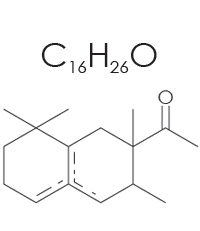
And, to my surprise, there is a definite impression of iris. A number of bloggers detected it, and they’re right. Though there is no iris or orris root listed in Opus VII, I’m guessing that some combination of the muscone, the earthy-woody cypriol, and the earthy elements of galbanum have created the distinct smell of iris. (Technically, “iris” as a note is impossible to create solely from the flower’s petals; it is replicated by taking rhizomes from the root, and/or often using other notes to lend to an overall impression of the flower’s scent.) I suspect that another thing that helps is ISO E Super.
ISO E Super. Source: Fragrantica
Yes, Opus VII starts with a flicker of my most dreaded, hated note on earth: ISO E Super. A flicker that starts to slowly increase in volume until, eventually, it completely ruins the entire fragrance for me. A perfumer once astutely noted that ISO E Super was my “kryptonite” and, sadly, it’s true. For those unfamiliar with the aroma-chemical, you can read my full description of its pros and cons here. In a nutshell, though, it is used most frequently for two reasons: 1) as a super-floralizer which is added to expand and magnify many floral notes, along with their longevity; and 2) to amplify woody notes and add a velvety touch to the base. It seems to be particularly used in fragrances that have vetiver, with Lalique‘s Encre Noire being just one of the many examples. It is also used in a large number of Montale Aoud fragrances, to amplify the wood note to that high-decibel shrieking volume. And it is the sole focus of Geza Schoen’s notorious Molecule 01 fragrance. ISO E Super always smells extremely peppery and, in large doses, has an undertone that is like that of rubbing alcohol, is medicinal, and/or antiseptic. Some people are completely anosmic to the synthetic, while others get searing, vicious headaches from it. It is a constant base in most Ormonde Jayne perfumes, so if you get a headache from those, blame the ISO E Super. I’m not afflicted in that manner, but I cannot stand the smell in large quantities and, my God, it is strong in Opus VII’s second stage.
At the end of the first hour, Opus VII shifts in hue, turning mossily green. Visually, it is no longer the black-green of the jungle’s shadow, seeming almost ebony-like in its darkness. Instead, the perfume now reflects slightly lighter green notes, sweeter, warmer, rounder and backed by amber. The patchouli blooms, feeling as bright as emerald moss, and it helps soften the sharp edges of the urinous leather and the aggressive oud smoke. At the same time, both the iris and the fenugreek note rise in prominence. Though I’m not one to usually rave about iris, here it’s truly lovely and feels like the lushest, most buttery, velvety suede. Creamy and delicate, it has a sturdy woody-rooty undertone that prevents it from feeling gauzy, ethereal and cold. It feels like taupe-brown suede, not grey-white, if that makes any sense. Opus VII starts to turn into warmer, ambered scent where the animalic notes are softened, less sharp, dirty or urinous, the smoke is less aggressive, and the whole thing is more velvety, mossy and earthy.

Source: Sodahead.com
Unfortunately, the start of the second hour marks an abrupt right turn in Opus VII’s development. From that fascinating start as olfactory ode to the heart of darkness in a smoky oud forest inhabited by the most powerful of leathery, ambered jungle cats alongside velvety iris and mossy green, the perfume suddenly becomes a fenugreek-oud scent — much like a dark forest through which shines the fluorescent light of ISO E Super. Sure, there are still elements of animalic musk, leather, iris, spices (cardamom, in particular) and amber, but the oud really goes into high gear here. It is always infused with the pungent, herbal fenugreek, the slightly urinous feline musk, and the sharply medicinal, astringent ISO E — and the combination just gets stronger with every minute. By the middle of the third hour, Opus VII is an oud-fenugreek-musk combination above gallons of medicinal, antiseptic ISO E Super. By the end of the fourth hour, it’s predominantly, painfully, and primarily pure ISO E Super and oud, backed by animalic, sour musk over light amber. Honestly, I preferred smelling like a panther just peed on me.
Opus VII’s drydown begins at the fifth hour. The perfume is primarily dark, peppered, woody notes headed by oud, followed thereafter by light, synthetic sandalwood (which has suddenly made its first appearance), the endless ISO E Super, a miniscule pinch of spices, and a lot of sour musk over vague, muted amber. In some odd way that I can’t explain, the whole thing feels generalized and somewhat abstract. Opus VII is also a much softer scent now in terms of sillage, becoming very close to the skin where it lingers on for another few hours. At the end, 8.5 hours in, all that really remains is a musky, spiced oud note, though tiny pockets of scent still pop up occasionally on random patches of arm for another few hours. For the most part, however, Opus VII lasted in full form about 8.5 hours on me. Its sillage was much more moderate than some of Amouage’s floral scents, never projecting in tidal waves, though the scent was still extremely powerful within its small cloud a few inches above my skin.
As you can tell, Opus VII was ultimately not for me but I do think many people will be fascinated by its dichotomy, especially men. I think the perfume will be disconcerting for others and, for women used to mainstream fragrances, it will scream “masculine” in a very negative way. Opus VII is a fragrance for people who like very aggressive leathers, ouds, sharp smoke and animalic notes — all in one — as well as those who don’t get raging headaches from ISO E Super.
I think one of the best reviews for Opus VII comes from Lucas at Chemist in a Bottle. In fact, it was Lucas who so kindly and thoughtfully sent me a small sample of the perfume as a surprise gift. In his review, entitled Black Ink, he wrote:
With the first day of sampling Amouage Opus VII I noticed that it is a perfume of two different natures. The “outer” stratum of the scent is a hard shell. The smell is dense and oily with cypriol oil. When I smell it I get a feeling like I could drown in this scent. It’s mysterious and dark suspension, a black ink that covers everything permanently, making it impossible to return to the previous state. In this kettle particles of warm and spicy cardamom float, blended with a resinous smell of galbanum.
In no time the dark tincture smell gets enriched by the aroma of sandalwood. It’s raw, dirty, not smooth but full of splinters that can hurt your hands when you want to touch it and feel the structure of the wood. Neither musk is soft here. In Opus VII musky tones are animalic, wild and untamed which is additionally pronounced by the earthy, almost rotten patchouli. Maybe it’s just my nose (not used to smelling scents like this one) but so far this Amouage is a beasty creature on me.
Once you survive through the “outer” stratum of Amouage Opus VII the different story begins. After the hard shell is broken, the softer core of the scent is revealed. To me it is still dark, but now it’s more gentle and chic like a black silk scarf. Amber creates warm and sensual aura around the wearer and olibanum adds the restrained mineral quality with a slightly salty touch. Of course oud had to find its place in the composition. Luckily it’s not very powerful. Accompannied by the leathery chords it creates this a little bit mischievous smell of tanner workshop. The smell of raw leather, pigments… it’s all in here.
In the rest of the review, which I recommend reading in full, he notes the presence of the iris note and how the final stage of Opus VII on his skin was spicy and dry. He concludes with a very apt warning: “Bear in mind – this is not an easy to wear perfume. In my opinion one has to be really self-confident and needs to have a strong personality to rock it.”
I agree very much with that last part as well as with his overall impressions of the perfume, though the details of our individual experiences with Opus VII differed. For one thing, I detected very little sandalwood on my skin until the very end. For another, Lucas has often noted that oud notes manifest themselves very softly on his skin. My skin, in contrast, amplifies certain base notes, I think, which may explain the vociferous roar of the oud. But we thoroughly unite on the issue of the raw leather and those prominent animalic notes which, as he put it so well, are “untamed” and completely “beasty” — in the full sense of that word. And, despite having perfume tastes at the opposite ends of the perfume spectrum, we both would run away from wearing Opus VII ourselves.

African lion spraying to mark his territory. Photo: Charles G. Summers, Jr. Source: WildImages on Flickr http://www.flickriver.com/photos/wild_images/2236584479/
Opus VII is a difficult, thorny scent for a variety of reasons, and it is not one which I would recommend to the vast majority of people. Though there are fascinating, intriguing and, at times, mesmerizing parts, at the end of the day, I think it’s a very masculine scent with extremely assertive edges that border on the abrasive. Some of the notes are wildly aggressive but, taken by themselves, they would be manageable. Even a jungle cat peeing on your arm can be handled, in small doses. But Amouage rarely does anything in moderation, and Opus VII is no exception. The combination of difficult, raw, beastly notes at such supersonic volume (and atop such vast lakes of ISO E Super) made much of Opus VII simply unbearable for me. If Opus VII had been a projection beast — which, thankfully, it is not — then it would have been a complete scrubber right off the bat. As it was, I tried it twice and the second time, I gave up after 6.5 hours. The second time round, the animalic notes were so prominent, I felt as if I’d been chained in a wild cat enclosure and been peed on by a vast legion of feral, growly animals who had been fed a steady diet of antiseptic oud. At $325 or €275 a bottle, Opus VII is a very expensive wildlife experience but, if you enjoy the woody heart of darkness, then give it a try.
DETAILS:
U.S. availability & Stores: Opus VII comes only in a 3.4 oz/100 ml eau de parfum that retails for $325. It is available from Parfums Raffy, the authorized US retailer for Amouage, who offers free domestic shipping and Amouage samples with each order. Parfums Raffy also sells a 2.5 ml sample of Opus VII for $6. Elsewhere, Opus VII is available at Luckyscent and MinNY.
Outside the US: In the UK, Opus VII is not yet available at Les Senteurs which normally carries the full Amouage line. I also don’t see it amongst the Amouage listings at Harrods. However, there is an Amouage boutique in London. In Paris, Opus VII is available via Jovoy for €275 with shipping available throughout the rest of Europe. First in Fragrance usually carries the Amouage line but doesn’t have Opus VII listed on its website for some reason. Of course, the perfume is also available on Amouage’s own website, along with a Library Sampler Set for €50 of the other 6 perfumes in the collection. The website also has a “Store Finder” for about 20 countries which should, hopefully, help you find Opus VI somewhere close to you.
Samples: Samples of Opus VII are available at Surrender to Chance starting at $3.99 for a 1/2 ml vial. The site also sells a Sampler Set for the other 6 of the Library line which starts at $19.99 for 1/2 ml vials.
Perfume Review: Habanita by Molinard (Eau de Toilette)

Source: Sensibility.com
By day, she was a delicate ingenué, tending to her charges in her job as a nanny in a Bohemian arrondissement of 1920s Paris. She would wear long, old-fashioned, frilly, white dresses up to her neck and dainty ankles, and she dusted her body in floral and raspberry-scented powder.

Source: Insfashion.com
By night, she haunted the smoky nightclubs of Montmartre and La Pigalle, luring men with the subtle tease of a dominatrix’s black leather whip that she eccentrically carried as she danced away the night in a flapper dress as white as silvered snow. She still smelled of raspberry powder, but now, she was also imbued with the smoke from the long cigarettes she held in a leather holder between her vermillion-red lips. Men did not fall for that pale face of baby innocence and floral sweetness, but for the contrast between her angelic facade and the biting sharpness that issued from her lips. She was a powerhouse of forcefulness and paradoxical contradictions that awed even the wild Zelda Fitzgerald. Her name was Habanita.
Habanita is perhaps the most famous, influential, historical perfume that is never sold in stores. It is a legend amongst perfumistas — and not only for its long history, or for how it is a tobacco perfume that is made without a single drop of actual tobacco. Habanita comes from the Grasse perfume house of Molinard, first established in 1849 and still run as an entirely family-owned business to this day. In 1921, Molinard released Habanita as perfumed sachets to enable those newly emancipated, modern women who smoked to do so with a perfumed cover to hide their habit. As the perfume blog, Now Smell This, succinctly explains, Habanita was originally introduced:
not as a personal fragrance but as a product to scent cigarettes. It was available in scented sachets to slide into a pack of cigarettes, or in liquid form: “A glass rod dipped in this fragrance and drawn along a lighted cigarette will perfume the smoke with a delicious, lasting aroma” (quoted in The Book of Perfume, page 76).

Habanita EDT bottle and box.
The perfume version soon followed in 1924, housed in a beautiful, black Lalique bottle decorated with cavorting nymphs. As the Molinard website proudly announces, it became known as “the most tenacious perfume in the world.” I’m unclear if that description applies to the pure parfum, solid parfum, the eau de parfum or to the eau de toilette, but I’m pretty sure you can describe almost all Habanita concentrations, now and in the past, as pretty damn tenacious! In the 1980s, Molinard reformulated Habanita and this is the version that I’m writing about, in eau de toilette concentration. Finally, in 2012, Molinard issued a new (and, again, reformulated) Eau de Parfum concentration as well.
2012 was also the year that I bought a big bottle of Habanita Eau de Toilette, blindly, off eBay, and due solely to the force of the blogosphere adoration for the scent. My post-lady handed me a small leaking package, commenting, “Boy! That’s strong!” And it was. There wasn’t a huge quantity that had seeped out, but that moderate amount, even partially dried, left a mindbogglingly enormous trail of scent in my wake as I made the walk back to my house from the postboxes. Later, I sprayed some on me and was almost blown out of the water by its strength. I enjoyed every bit of it, back then, overcome by its power, its novelty, and its unusual nature.
Unfortunately, a few more wears (and a very bad experience later in the fall with the scent on clothing) quickly led to a radical change in thought. The simple truth is that I don’t like Habanita very much and, if I’m really, truly honest with myself, I know deep down that I never did, and that my first initial appreciation stemmed purely out of wishful thinking. (Plus, a huge desire to justify a blind buy.) I wanted to like it; I knew I should like it, especially given the history (and my total faiblesse or weakness when it comes to anything historical), but mostly, I wanted to like it. So, I convinced myself that I did. Now that I’m a perfume blogger, I put great thought and analysis into each review, I rip things apart in a way I never did, don’t engage in risky blind buys, and I’m candid with myself from the start. If that post-box trip were to happen now, I would admit right away that Habanita is most definitely not for me, though I’d still respect and admire it for its history. And, dammit, I still want to like it! I almost feel like a traitor to history.
Habanita is classified on Fragrantica as an “Oriental” perfume, but I personally consider it more of a chypre-leather. The notes — as compiled from both Now Smell This and Fragrantica — seem to be:
bergamot, raspberry, peach, orange blossom, galbanum, oakmoss, jasmine, rose, ylang ylang, lilac, orris root, heliotrope, patchouli, amber, leather, musk, vetiver, cedar, sandalwood, benzoin and vanilla.
Habanita is a complicated scent on some levels and a simple one on others. If you were solely to smell the bottle, you’d detect makeup powder with florals, citrus and chypre notes. Even when on the skin, unless you really looked at the notes while smelling the perfume, you may initially conclude that you’re dealing with an avalanche of makeup powder alongside powerful (but completely amorphous, abstract) floral notes backed by the feel of scented tobacco paper and tinges of leather.

Source: Amazon.fr
The same thing happens when you put Habanita on the skin, though greater nuances are immediately noticeable, because it’s an incredibly elusive scent in terms of its layers. There are citrusy notes atop leather that has hints of something vaguely verging on animalic. The leather feels almost raw, at times, and there feels like whiffs of castoreum underneath it. The notes are sharp and, on some tests, can seem either medicinal or quite sour on the skin as well. I suspect it’s due to the galbanum which is never noticeable in an individual, distinct, separate way, but whose effects can be seen most indirectly in that leather. As a side note, galbanum’s sharpness was often used in leather fragrances — notably in Robert Piguet‘s Bandit — so I wouldn’t be surprised if that was the cause for the raw, sometimes sour nuance to the leather here.

Dried raspberries via Nuts.com
Habanita also contains a powerful whiff of something that is extremely hard to pinpoint if you don’t stare at the ingredient list, a note that is rarely used in high-end, niche, or classic perfumery: raspberry. Each and every time I put on Habanita, I struggle to place that one, odd, unusual, seemingly “off” element before I remember, “Oh, raspberry. Right.” I don’t know about you, but I actually can’t recall ever smelling raspberry in a significant way in perfumery. Making it all the more complicated for me is the fact that the raspberry in Habanita is not like the fresh, sweet, fruit of summer days. It feels simultaneously: desiccated, syrupy, sour, leathered, and highly powdered. Honestly, I’ve never smelled anything quite like it and, on my skin, it is always a heavy part of Habanita’s opening hours.
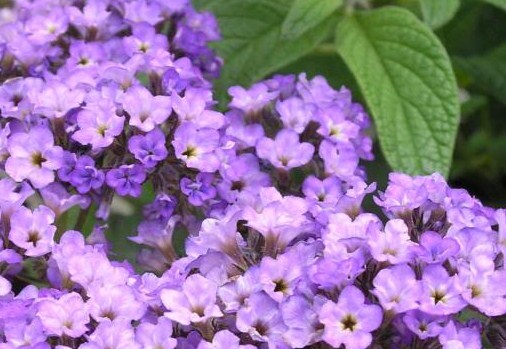
Heliotrope.
Nothing, however, can possibly detract from the powder note which is created by the iris, orris root, heliotrope and vanilla (perhaps, also benzoin) notes. It is not baby powder or talcum powder simply because this one is scented — and scented with a variety of things to boot. Thanks to the heliotrope, it has a subtext of almonds mixed with Play-Doh. The orris root — an ingredient long used in makeup and lipsticks as a fixative — gives it a makeup vibe, while the florals imbue it with rose, lilacs, and a whiff of jasmine. The vanilla adds its voice to the powder, too, perhaps solidifying some of the makeup associations.
There is something much more important underlying the powdered note, however, something that makes many people classify Habanita as a tobacco scent. The interplay of the powder elements with the other notes in Habanita create the overwhelming feel of powdered tobacco paper. Growing up in France, there were a number of cigarette boxes whose silver paper lining I recall being scented with a powdered note. I’ve never seen it in America, but I have seen similar sorts of boxes in India, the 1980s Soviet Union, Italy, and other parts of Europe. It’s a hard scent to describe if you’ve never encountered it because it doesn’t have the aroma of cigarette, nor stale ashtrays, but also not of paper or pure powder. It simply smells like talcum-powder tobacco paper.
I suspect the reason lies in the vetiver. It’s not like the sort of vetiver that most of us are used to; it doesn’t smell anything like the note in Chanel‘s Sycomore, for example, or Guerlain‘s Vetiver. It’s neither fresh and green, nor rooty, earthy, or woody. And, yet, when combined with the other elements, it creates “tobacco” in a powdered, papery form. Luca Turin categorizes Habanita as a “vetiver vanilla,” while CaFleureBon simply writes: “[a]lthough the perfume Molinard Habanita was originally produced to scent women’s cigarettes, it contained no tobacco and incorporated rose, vetiver, vanilla, and incense notes.” Whatever the exact alchemical reason for the note, “tobacco paper” is a profound part of Habanita’s character for much of the perfume’s development.
Habanita’s opening, as I’ve described it, can vary a little in its nuances. Sometimes, in the first minutes, the extremely sharp, almost pungently bracing, opening note of citrus-rose-leather softens a little, bringing out more of the powder. At other times, the note turns extremely sour on the skin, probably due to the arrival of copious amounts of raspberry which always turns into syrupy, raspberry leather dosed by talcum powder. Sometimes, the vanilla is much more immediately noticeable, while occasionally, the leather with its castoreum-like undertone doesn’t hang back quite as much. Every now and then, I get a fleeting flicker of lilacs in the florals tones, but generally, it is a rose note which rises to the surface.
Almost invariably, whatever the nuances, I get a headache. There are synthetics in the reformulated Habanita EDT, and it gives me that telltale burning sensation high up in the bridge of my nose. I’m not the only one who thinks the reformulated version is quite synthetic. The blogger, Brian, from “I Smell Therefore I” am wrote in a comment to his review of Habanita: “I think current Habanita is probably so synthetic that the pyramid is pure fantasy.” I fear that may be true. I do know that I’m not the only one who got a burning sensation from Habanita; I had a friend try it a while back, and they had a similar reaction.

Source: Allposters.com
Regardless, as Habanita opens up and develops, it turns into a scent that is primarily raspberry-vanillic powder with amorphous florals, Play-Doh undertones, and a whisper of raw, black leather in the background. It’s seriously extreme, a turbo-charged powder that feels like something from the vivid imagination of Willy Wonka.
Eventually, about five hours in, Habanita turns into something much more leathered in feel. It’s not like a cold, stony leather, exactly, but it’s definitely not like a richly buttered, oiled, soft, creamy leather. It feels like a rubbery, black leather jacket, imbued by a layer of sharp smoke. There is no incense listed on Habanita’s notes, but there certainly should be. At the same time, both the leather and the smoke are backed by the scented powder, fleeting flickers of rose, and a lingering sharpness that feels more dark green than ever before. Undoubtedly, it’s the galbanum which has risen to the surface alongside the leather. At times, wearing Habanita, I’ve also detected something that feels very much like the powerful black, smoky tea, Lapsang Souchong; only here, it’s imbued with some sharp, green, citrus elements. It’s all due to that endless black smokiness underlying Habanita. The whole thing evokes the image of a 1920s smoky club but, also, of that same 1920s flapper draped in a leather jacket atop a large Harley-Davidson, smoking as she flexes her whip. Whatever it is, it involves some sort of femme fatale domination and cigarettes. It’s… different.

Lara Stone, the Dutch model, photographed by Mert & Marcus for Interview Magazine.
In its final hours, Habanita turns into a fruited-powder scent with rubbery leather. It usually lasts about 8.5 to 9 hours on my perfume-consuming skin, almost all of that time pulsating away with high-intensity projection. On someone with normal skin, I wouldn’t be surprised if two good sprays lasted 16 hours or more. Four sprays, and you may be smelled from New York to California for more than a few days. If you think I’m exaggerating, check the longevity votes on Fragrantica where 49 people chose “very long-lasting,” 37 chose “long-lasting,” and 1 person chose “poor.” Similar numbers apply to the sillage: 46 for “enormous,” 43 for “heavy,” with 5 for “soft.”
As for fabric, I can tell you that Habanita will last on it forever. In my last wearing of Habanita — the time that put me off it more or less for good — I quickly sprayed some on my neck and on my sweater in a rush out the door. It was Fall and the weather was generally cool, so I can’t chalk it up to the heat for what happened next: a blast of incredibly sourness hit my skin, followed by that avalanche of scented powder. I put up with it, mostly because I didn’t have a choice, when I started to detect an odd smell wafting up from my sweater. It was like sour, powdered cigarette smoke. And it just kept getting stronger and more sour until I felt actually quite embarrassed. When I got home, I hurriedly took off the sweater and didn’t give it a second thought, certain that the perfume would eventually go away. Four months later, during an unexpected cold burst, I took out the sweater to wear it only to detect a massive amount of sour, stale, powdered cigarettes, and that odd, sour, raspberry note. The sweater went off to the dry cleaner, and Habanita was permanently banished to the darkest recesses of my armoire. Basta!
It is impossible to write about Habanita without bringing up the well-known perfume blogger, Denyse Beaulieu of Grain de Musc. Even before she wrote her recent book, The Perfume Lover, Ms. Beaulieu was well-known to adore Habanita. It is one of her favorites, along with Robert Piguet‘s legendary black leather and galbanum fragrance, Bandit. But it was Habanita which was her signature scent for years and years. I suspect my tastes range far from those of Ms. Beaulieu who seems to adore the dominatrix-like, black leather fragrances. I liked Bandit when I tried it, but I had to force myself to really, really give it a chance, and it is a very difficult fragrance. At the end of the day, it is a little too brutal for me, a little too harsh, probably due to the galbanum (a note I struggle with) as much as that ferocious black leather.

The new Habanita 2012 Eau de Parfum, Editions Privée.
Habanita is not Bandit — not by any stretch of the imagination, but it is an equally difficult perfume to wear, even if the reasons are different. I suspect that I would have a considerably better time of things with the vintage version, especially the vintage Eau de Parfum, as I’ve read that it’s lovely and apparently has quite a bit of sandalwood. But this review is for the current version of Habanita in eau de toilette, not the vintage Eau de Parfum or the new 2012 Eau de Parfum. If you’re interested in those concentrations, you can read some comparative assessments of the EDP from some readers of Grain de Musc. As a side note, the Eau de Toilette is no longer available or listed on the Molinard website, which leads some people and even the Perfume Posse to speculate that it has been discontinued and replaced by the IFRA-compliant 2012 Eau de Parfum version. According to one person on Fragrantica, Molinard confirmed it to her in an email. Despite that fact, however, the eau de toilette is still easily found and in plentiful quantities, especially on eBay.
I think the best assessment of the Three Faces of Habanita comes from the perfume blog, I Smell Therefore I Am. In it, Brian compares vintage Habanita (Version 1), the reformulated Eau de Toilette which is what I’m reviewing (Version 2), and the new Eau de Parfum released in 2012 (Version 3). A portion of his review for Vintage Habanita versus the current Habanita is as follows:
When I read on Fragrantica that a reader thought Habanita had, on first spritz, the “strongest blast of baby powder, EVER,” I felt pretty sure she was referring to Version 2. No mistake, Version 1 is powdered as well, but not to the same degree. I would argue there’s a lot more going on in Version 1, but the nose approaching Version 2 could easily mistake bombast for complexity. I like Version 2 a lot, and it smells very rich. It’s also incredibly powdered. I say that in a good way. Almost without fail, when someone talks about powder overload and Habanita I feel sure they’re referring to Version 2. Version 1 is thick, too, but you feel its layers. Version 2 is a sort of wall of scent; equal parts tobacco, vanilla, and oakmoss. Fragrantica lists raspberry, peach, orange flower, Lilac, Ylang-Ylang, rose, bergamot. I’d be lying if I told you I get anything remotely floral, and not getting any closer to the truth if I led you to believe this is because the fragrance is so “well-blended”. I believe that Version 2 is a much cruder facsimile of Version 1, and that many people take this crudeness to be the source of its infamous reputation. Again, I love this version. I happen to like crude and bombastic. But Version 2 resembles some of my favorite cheapo drugstore fragrances (Toujours Moi comes to mind) and relates to Version 1 the way they relate to their earlier formulations. Many people get root beer or cola from this version. I never really have.
I think his review is very interesting, and I agree on Habanita having a small similarity to the “cheapo drugstore fragrances.” But I don’t share his love for Habanita. In part, it’s because I dislike very powdery perfumes, but the powder isn’t, per se, my real problem. It is Habanita’s sharpness, the sourness that almost feels rancid at times, the sheer overbearing forcefulness of that powder, and the lingering cigarette effect which I find difficult to bear. A few people on Fragrantica have even written that the perfume has a morbid feel to it, with one talking about Habanita’s opening blast of dead florals evoked “a plague [death] mask.” Though I don’t agree, I can certainly understand it because, every time I start to think that, maybe, just maybe, I can handle the perfume, I quickly realise that I’ve really had enough. Habanita always starts out as an interesting novelty that, on some level, fascinates me with its uniqueness, its oddness, its almost niche-like complexity. But then it just becomes too damn much. The constant burning in my nose from the synthetics doesn’t help much, either. Undoubtedly, it would be a whole other matter if I tried vintage Habanita, let alone vintage Habanita Eau de Parfum with its slightly different notes and its sandalwood base. But I don’t have it, so I can only tell you about the current Eau de Toilette. And, in my opinion, it’s a stinker. It really is.
My favorite review for Habanita on Fragrantica amusingly sums up just a miniscule fraction of what I think about the scent. In it, “nikitajade” writes:
First initial spray I am hit full in the face with powder. Like an angry nanny has just slammed down the Johnsons&Johnsons again. ARGGGGHHHHH. Luckily, as it dries down the baby powder disappears and this smoky, leathery gorgeous fruit and spice appears. I’ll just say the nanny apparently moonlights as a dominatrix and leave it at that.
I’m significantly less appreciative of the fragrance than she is, but Habanita receives a LOT of love of Fragrantica, even from those who find it impossible to wear:
- As others have said, yes it is leathery-dusty-powdery with just a touch of vanilla. Yes, at first it is so sharp it numbs your nostrills. But I love Habanita. The same way I love a classic houndstooth Chanel deux pieces, but would never wear it. If there was a perfume museum, Habanita would be on a pedestal in the main gallery.
- What a masterpiece. I almost doomed it at the first sniff, for the sweet powder. But man, how i´m happy i didn´t. [¶] Just the history and idea of Habanita is stunning. […] It´s like an old daguerreotype of mysterious young lady who´s beauty persists for centuries. [¶] Habanita smells velvety smooth and incendiary. Maybe it’s the balance of its main attributes – woman (lipstick, powder, rose) + man (tobacco, leather, motor oil).
- Habanita is such a BIG TEASER, [¶] The most complicated smell I’ve ever come across. She introduced herself in sweet, fresh, delightful feminine manners…BUT it’s not too long before she stripped off of her light floral dress into the hidden dark & nasty clinging leather suit. She would captivate you, tortured you like a real dominatrix, and you just couldn’t help but yield to her eventually… After an hour, as the leather faded she might show some mercy and comforted you with the most beautiful ghost of heliotrope in rich smokey creamy powder. [..]
There are pages of similar reviews, with vast swathes of them using the word “femme fatale” and raving about how stunning Habanita is, about how she sends you back in time to the most elegant 1920s club filled with velvet and passion. Intermixed in those gushing accolades (most of which go on for far too many paragraphs for me to quote them) are a handful of solitary voices who talk about how sour the perfume was on their skin, how it smelled “rank and stank,” about the hot rubberiness of the leather, “burnt gasoline,” or about the impossibility of dealing with all that powder. More than a few said it made them think of an old lady locked in a room and chain-smoking, or the 1980s Love’s Baby Soft fragrance “covered with cigarettes.” One person — who says she loves leather fragrances — said it was absolutely the worst thing she’d smelled in years, akin to car cleaner and incredibly “dirty.” The dissenting voices are comparatively few and far between though, because, for the most part, Habanita is worshipped. We’re talking hardcore genuflection and obéissance here!

Vintage Habanita ad. Source: The Perfume Posse.
It’s even more loved on the blogosphere. I could link you to a gazillion reviews, but the most interesting one was this more balanced assessment from Anne-Marie at the Perfume Posse which sums up the feel of Habanita, along with its elusiveness:
What I love about Habanita is the elusiveness created by the powdery notes (orris and heliotrope). For me, powder suffuses the whole thing, but it shifts constantly. Suddenly I get a sharp bite of sticky fruit. The powder takes over again, but in the next whiff it clears and I get … oh yes, vanilla! … and so on through all the major effects: flowers, vetiver, woods, leather, and so on. For me there is no real top-middle-base structure in Habanita, just a series of fascinating and deeply alluring fragrant moments, all glimpsed through that whispy veil of powder. The contrast of sweet/soft with bitter/acrid (almost Bandit-like) notes has me utterly enthralled.
Many people get tobacco and smoke, but I don’t. I do get a smoke-like effect created by vetiver and leather. Or okay, perhaps that would be a leather-like effect created by smoke and vetiver? I can’t tell. But look, if Habanita was produced firstly as a fragrance to add to cigarettes, why would it smell of cigarettes itself? Put like that, it doesn’t make sense, does it? […]
Depending on your tastes and sensory experience, Habanita will seem absurdly old-fashioned or intriguingly niche-like and modern to you.
I think that last statement is very true, and I’ve heard it echoed a number of times by others. Habanita feels extremely old-fashioned while — simultaneously and oddly — seeming completely modern, and very much the sort of thing that a perfume house like Etat Libre d’Orange might put out. It isn’t really timeless so much as so odd, so off-kilter, and so old-fashioned that it could be a modern niche perfumer’s intentional, revolutionary riff on old perfumery. It’s a completely paradoxical fragrance.
I also find it to be an elusive one, not only in terms of assessing the notes and individual layers, but as a whole. Every now and then, something about it makes me lift up my head and go, “Hmm…. maybe.” But, each and every time, that thought is short-lived because, deep down, I really don’t like it. Not the deluge of powder, not the feel of cigarettes, not the synthetics that burn my nose, not the sour sharpness, not that odd raspberry note, not the black rubbery undertones…. nothing. But I keep feeling as though I must love it, that I should love it. It’s the only perfume I know that leaves me so utterly torn between expectations and wishful thinking, versus the simple reality deep-down. It’s one reason why I’ve taken this long to review Habanita. Everything about it is just so damn complicated.
The honest truth, though, is that I really can’t bear it. In six months from now, a year from now, or even three, I will probably still be bullying myself over this fragrance and still be hating every moment of it on my skin, while still feeling incredibly guilty for being an utter philistine. So be it. I am a Philistine. Modern Habanita is not for me. You can start stoning me in…. three, two, one….