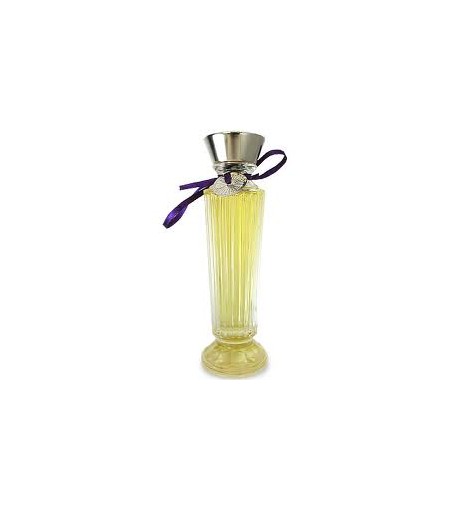
Perfume Review: Serge Lutens La Fille de Berlin

In time for Valentine’s Day, Serge Lutens is releasing the first of two new fragrances for 2013. It is La Fille de Berlin (“The Girl from Berlin”), a unisex rose perfume that tries to pay homage to a woman’s strength, resilience and beauty in the face of destruction.

Lutens is a very intellectual perfumer who seeks to render concrete the most abstract of theories and images. That is never more evident than in his press materials for La Fille de Berlin — such as his explanatory video which you can watch below and which has been translated in full on YouTube.

A shorter, barely less oblique explanation of the scent is available in the press release posted on Fragrantica where Mr. Lutens describes the perfume as follows:

A flower grown under our ruins, cut off from the world, appears before your eyes to all of us to open our eyes. I took courage in both hands in her flowing Rheingold hair. On the lips, I tasted blood. My girl from Berlin showed combative, more beautiful than ever–and so I broke my contempt and yet my shame, hiding under the guise of my pride. Through the power of criticism, of love and hate, God and the devil, death and life, I drew a furrow in which she disappeared. And while the maelstrom together beats on me, I pay homage to her beauty enraged.

A scene from "A Woman in Berlin" ("Anonyma: Eine Frau in Berlin".)    REUTERS/Constantin Film/Handout  Source: Reuters article 2008

A scene from “A Woman in Berlin” (“Anonyma: Eine Frau in Berlin”.) REUTERS/Constantin Film/Handout. Source: Reuters article 2008

If all this esoterica leaves you sighing, you’re not alone. Long story short, La Fille de Berlin is meant to pay homage to the strength of German women who survived the Soviet occupation after the war — though there seems to be something much darker, more ominous, and much more violent being referenced in both his video comments and in the press release references above to shame and blood. If you read the complete YouTube quote from Mr. Lutens, you will get a full sense of the incredible bleakness, anger, betrayal and misery which seems to be at the start of his dark, almost existentialist mythology for La Fille de Berlin. (One almost wonders if he’s talking about rape, in addition to some sort of actual or symbolic “murder.” No matter how much resilience may be his ultimate theme, the whole thing is very unsettling.)

Since none of these things are a happy way to sell perfume (especially on Valentine’s Day), Mr. Lutens tries to be slightly more positive in his quotes to The New York Times where he states, “Beauty is the moment in which you rise up […] It is the moment when you pick up your head, stride through your own ruins and climb up the mountain.” Okay, it’s still not particularly happy and cheerful, what with “your own ruins” — but, at least he tried.

La Fille de BerlinThere are no perfume notes for La Fille de Berlin. Lutens is a perfume house which often omits a large part of the ingredients in its perfume description but, here, it does so completely. The rumour mill says that La Fille is a rose and pepper scent, while Luckyscent feels some of the notes are “Rose, violet, pink and black pepper, musk” — but Lutens himself has stayed silent. On his website, the fragrance is only described with still further (and, by now, rather exasperating) lyricism:

She’s a rose with thorns, don’t mess with her. She’s a girl who goes to extremes.
When she can, she soothes; and when she wants … !
Her fragrance lifts you higher, she rocks and shocks. 

That’s all well and good, but I’m afraid I find nothing shocking or extreme about La Fille de Berlin. It’s a lovely rose scent which starts with peony-like roses before taking a fruity (and almost fruity-patchouli) turn, then becoming rather austere and, by the end, quite nondescript. I found it pretty average as a whole, and far preferred LutensSa Majesté La Rose for a rose scent — and any number of other Lutens fragrances in general. If truth be told, La Fille de Berlin was actually a bit of a disappointment. I’m not alone in feeling that way. One of the handful of reviews already out is from Cosmetopica (who also couldn’t make head nor tails out of Lutens’ lyricism). She, too, found the perfume far less distinctive and exciting than many of Lutens’ other creations.
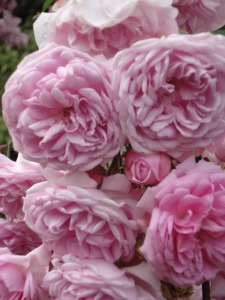
Peony roses at Warwick Castle, UK. Photo used by permission from CC at "Slightly Out of Sync."

Peony roses at Warwick Castle, UK. Photo used by permission from CC at “Slightly Out of Sync.”

La Fille de Berlin opens on me with a wet, dewy rose note that is faintly similar to the sweetness in a tea rose, but slightly richer and redder. That said, it’s not as rich as a hearty, beefy Bourbon or Damask rose, but something in-between. Perhaps, large peony roses? Soft violet notes flicker and dance at the edges. Sometimes, the scent seems soft and slightly powdered. At other times, heartier and deeper. The violet notes vaguely evoke YSL‘s Paris in its original formulation but Paris is a much warmer, headier, more intense, and spicier take on roses.

As some others have noted, there is a subtle green note which is present. It’s as if Christopher Sheldrake (Lutens’ favorite perfumer and traditional cohort in olfactory adventures) sought to bring in the scent of the green, leafy sepals which protect a rose bud. The green notes are hard to describe. They’re not like those at the start of Sa Majesté La Rose which is a much more lavish, baroque and dramatic scent after its green, slightly soapy start. In La Fille de Berlin, the green elements are fresher and slightly dewy, and underscored by what seems to be geranium leaf.

Source: ElementalLife.org

Source: ElementalLife.org

There is also an unexpectedly woody element, like that of a rose’s own stem, and elements of rich, wet soil. It’s an odd mix — greenness with earthy, loamy soil and the faintly woody aspect of a rose stem — and it makes me wonder if Christopher Sheldrake sought to disassemble every part of a rose before putting them back together again. He’s done that deconstruction trick for Lutens before; it was handled brilliantly with the tuberose flower in Tubereuse Criminelle.

Ten minutes in, La Fille de Berlin begins to take on a fruity aspect. At first, it’s the unexpected scent of cherries. Then, it’s just a general fruity smell under the veneer of sweetness and it strongly resembles some purple patchouli fragrances I smelled last year. Specifically, it calls to mind Marc JacobsLola and, to a much lesser extent, Chanel‘s Coco Noir. Both are scents with rose, a fruity patchouli element, notes of pear, pink peppercorn, and geranium, over a base of musk. As the Fragrantica notes demonstrate, Lola, in particular, is a primarily rose and peppercorn perfume with fruity-patchouli overtones. I own Lola and Coco Noir, so I sprayed on a little bit of each on my legs to see if I was just imagining things.
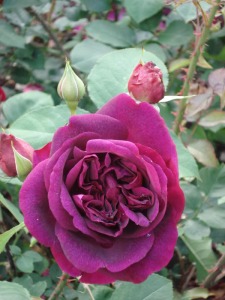
Purple rose at Warwick Castle, England. Photo provided with permission by CC from "Slightly Out of Sync" blog.

Purple rose at Warwick Castle, England. Photo provided with permission by CC from “Slightly Out of Sync” blog.

I was not imagining things. Though Lola opens with heavy fruit notes, it soon develops into something extremely similar to the jammy, peppercorn rose in La Fille de Berlin. Coco Noir is completely different in its opening, but it too has that jammy, purple, fruity patchouli element in its middle stages. (I reviewed it here, if you’re interested.) It should be noted that Christopher Sheldrake (who undoubtedly created La Fille de Berlin) was also responsible for Coco Noir, along with Chanel’s in-house perfumer, Jacques Polge. But it is really to Lola that La Fille de Berlin seems most similar at the start. The main differences is that the latter is slightly less fruity, much more subtle and fresh, and of infinitely better quality. There is nary a screeching synthetic in sight — which is much more than I can say for Mr. Jacobs’ creation.

Two hours in, La Fille de Berlin changes. The sillage drops even further, and the perfume takes on a cold, austere, almost metallic bent. It loses what warmth it had and becomes a linear progression that is predominantly rose with white musk and light sandalwood. It is far from exciting. Victoria from Bois de Jasmin had a far sexier time with the scent, experiencing amber, musk and faintly “naughty” bits:

A couple of hours later, my skin smells of amber and musk. La Fille de Berlin has an intriguing animalic note that would be untoward and raunchy if the rest of the composition were not so refined and polished. The reference here seems to be Serge Lutens’s own Muscs Koublaï Khan […] a rose wrapped into so much musk and civet that it becomes something else altogether. La Fille de Berlin, on the other hand, is much less musk and more rose, and it’s well-behaved enough to be worn to the office without raising anyone’s alarm. But when you press your wrist to your nose, you notice the naughty and smoldering bits. The impressive tenacity will ensure that you will be aware of La Fille de Berlin for the entire day.

I only wish I had her experience; it sounds infinitely more interesting! Having just tested extreme animalic musk and naughtiness in Parfum d’Empire’s Musc Tonkin, I’d be quite alert to the presence of any skanky notes or civet in La Fille de Berlin, no matter how minute and refined. But, alas, I simply don’t smell it here. No amber, either. There is some earthiness which was there from the start, though faint, but I attribute it to the undertones of what seemed more like patchouli than animalic elements. And, even so, on a scale of 1 to 10 (with 10 being extreme earthiness), I’d place the note at a 3.5 at the start and at a mere 1 towards the end. Instead, something else is much more evident. I swear, even in the dry-down, there is a fruity note! It is much, much more subtle than it was at the start, but it is still there. I find it excessively sweet, and I blame it on the pepper which has to be closer to the fruitier type of pink peppercorn berries than to anything black and biting.

As a whole, my experience with the final hours was much closer, again, to that of Cosmetopica. She owns and loves Muscs Koublai Khan, so she would have noticed any animalic similarities had she encountered them. Instead, she detected milky sandalwood in the dry-down. I agree; I found a definite creamy, soft, milky aspect to things, though to my nose it didn’t smell like strong or, even, genuine sandalwood. More like an ersatz cousin, if you will. For the most part, it was mild and quite overwhelmed by the white musk and by that endless fruity element.

La Fille de Berlin had average sillage and very good longevity. The perfume projected for the first twenty minutes before settling in to become much more discreet. It became close to the skin about three hours in, though it was still strongly noticeable if you brought your wrist to your nose. The overall duration of the scent was a little under nine hours on me. On Cosmetopica, it was eight; on Victoria from Bois de Jasmin, “the whole day.”

All in all, La Fille de Berlin is well-behaved, refined, unisex perfume that is perfectly pleasant — with all the implications that accompany that last adjective. As Cosmetopica’s review noted, one buys niche perfumes with their higher price tag for something that is slightly more distinctive and interesting. Serge Lutens has perfumes that run the gamut from being intellectually brilliant masterpieces that are not versatile scents for everyday use, to things that are simply lovely and constantly wearable, to scents that are occasionally just perfectly “nice.”

This is the latter. Though the bright pink colour of the liquid is absolutely gorgeous and though I wanted to love it, at the end of the day, I found La Fille de Berlin to be quite boring. And, for reasons I can’t quite pinpoint, it wasn’t a particularly happy scent in my mind either, unlike Sa Majesté La Rose. (That conclusion doesn’t even consider Mr. Lutens’ incredibly dark and depressing backstory for the perfume which, ideally, I shall forget about as soon as possible.) However, as with every review, perfume is a wholly subjective thing — so what may not be my cup of tea may be a ravishingly sophisticated, discreet rose scent for others. As always, it’s best to try it and see for yourself.


DETAILS:
Cost & Availability: La Fille de Berlin eau de parfum is available right now on the Serge Lutens website where it costs $120 for a 50 ml/1.7 oz bottle. In other currency units, I’ve read that it will cost €78. There does not seem to be a bell-jar for the scent on the website. It is also available right now for $120 on Luckyscent — which ships internationally. Luckyscent is not showing any samples for sale at this time. I will update this post when the perfume becomes available at other retailers, such as Barney’s or Harrods — both of which traditionally carry a handful of Lutens perfumes. La Fille de Berlin has just debuted, but is supposed to be fully launched in March 2013, so I suspect it may be a few weeks before it is available outside of the company’s website or in its Palais Royal headquarters in Paris. The perfume is part of Lutens’ “export” line of fragrances, so it definitely will be offered at other selected retail outlets. For other countries, once mid-March comes around, I suggest using the Lutens Store Indicator guide on its website to help you find a location that sells Fille de Berlin near you. Samples should also be available soon on decant sites, and I will update this post once I see them listed on places like Surrender to Chance.

Perfume Review: Parfum d’Empire Musc Tonkin (Extrait)

When Parfum d’Empire released a special, limited-edition perfume in late 2012, the blogosphere went into a frenzy. The niche perfume house is much respected for its high-quality fragrances that pay homage to different legendary empires in history, from that of Alexander the Great to Tsarist Russia. [12/8/2014 Note: this review applies only to the 2012 version of Musc Tonkin which was an extrait version. It does not apply to the new 2014 eau de parfum version which is reportedly quite different and very toned down.]

Source: CaFleureBon

Source: CaFleureBon

Musc Tonkin, however, had the added benefit of not only being very rare (only 1000 bottles were made), but also a complete mystery because no-one knows what was in it! Its creator, Marc-Antoine Corticchiato (who is also the founder of the perfume house), refused to release the list of notes beyond the one obvious mainstay of musk. Instead, he asked that people smell this incredibly concentrated extrait de parfum blindly and without preconceptions. Though the public has seemed a little ambivalent (to me) in its reaction to the scent, critics adored it. In fact, CaFleureBon ranked it as #1 on their list of the Top 25 Best Perfumes of 2012.

Siberian Musk DeerSource: the in-depth article on musk at Summagallicana.it

Siberian Musk Deer
Source: the in-depth article on musk at Summagallicana.it

One cannot begin to talk about Musc Tonkin without first explaining a little about musk. It is one of the oldest ingredients in perfumery, used for thousands of years for its supposed impact as an aphrodisiac. (According to Fragrantica, even some modern scientists “believe that the smell of musk closely resembles the smell of testosterone, which may act as a pheromone in humans.”) Beyond its sensuous underpinnings, however, it was also appreciated for its uses as a fixative in perfumery, enabling a scent to last longer and with greater depth. Thousands of years ago, musk came mainly from the perineal glands of a particular type of deer but, in recent times, animal cruelty concerns have prevented it from being used. In 1979, the use of deer musk was banned entirely.

As Fragrantica explains, nowadays,

[t]he term musk is often used to describe a wide range of musky substances, typically animalistic notes such as CivetCastoreum, and Hyrax, or various synthetic musks, known as white musks, which are created in chemical laboratories. […] In perfumery, the term “musk” doesn’t always apply to a concrete perfume component, but rather designates the overall impression of the fragrant composition. Natural aroma of musk is very complex and usually described with so many contradictory attributes. It’s description may range from sweet, creamy or powdery, to rich, leathery, spicy and even woodsy. Most typically, the musk note is described as an animalistic nuance, with a lively and oscillating, often contrasting nature.

In the case of Musc Tonkin, the word “musk” undoubtedly applies not only to the “overall impression” of the scent but also to its main note, replicated through the use of various substitutes. As CaFleureBon, the perfume blog, noted in its rave review of the perfume,

Marc-Antoine Corticchiato of Parfum D’Empire is one of the most uncompromising perfumers we currently have in the niche community and it is no surprise to me that he would take on the great challenge of making a musk fragrance without using proscribed ingredients. […] Of all the musks Tonkin musk was one of the most prized and highly sought after. Supposedly only able to be sourced from a Himalayan variety of musk deer the trip alone was daunting. M. Corticchiato wanted to create a facsimile of natural musk using the ingredients available to him and even more he wanted to create an image of the elusive Tonkin musk. This effort has succeeded…

It certainly has. The opening of Musc Tonkin is a pure blast of animalistic skank that is concentrated to such an extent that I actually recoiled at first. It is quite a painful ten minutes, but then the perfume settles into something much more manageable and, even, quite sexy.

If I were to join in the global guessing-game for Musc Tonkin’s notes, I would venture the following:

Top: Orange Blossom/Neroli, Gardenia, Ylang-Ylang, Peach, Cumin and, possibly, Coumarin and Bergamot. Middle: Jasmine Sambac, Damask Rose, Honey, Labdanum, and Patchouli. Base: Musk, Civet/Castoreum, Oakmoss, Tonka Beans, and, possibly, Benzoin.

Oakmoss or tree moss.

Oakmoss or tree moss.

The extrait is technically categorized on Fragrantica as a floral chypre, and there is no doubt that is correct. The perfume opens with a chypre’s usual notes of citrus and strongly pungent oakmoss with its characteristic dusty, dry, almost mineralized characteristics. But Musc Tonkin’s opening minutes go far, far beyond that usual chypre beginning.

Here, there is something that strongly evokes pure animal fat, skin, and hair. (Dare I say it, fur?) It’s a shockingly intense contrast to the accompanying notes that are both floral and fruity. The skin note verges on something like raw leather, and there is a faintly urinous undertone, too, along with that fatty note that conjures up rolls of white blubber in my mind. The citric notes feel like neroli — which my nose usually finds to be a slightly sharper, less sweet version of orange blossom — along with some other zesty citrus. It may be bergamot, though, here, it smells nothing like the Earl Grey note that is often associated with it. There also seems to be cumin, in addition to something that is earthy, extremely intimate, and smells greatly of unwashed panties. Honestly, I recoiled from the whole thing and felt a lot like the Coyote in the old Roadrunner cartoons just seconds before the dynamite exploded and the cliff dissolved from under him.

I wouldn’t be surprised if that animalic funk (which perfumistas often call “skank”) came from civet. It is a secretion from the anal glands of the civet cat. The funniest description I have ever read of any perfume ingredient came from Chandler Burr, the former New York Times perfume critic, who wrote about civet on his tour of the perfumery school of the Swiss company Givaudan, the world’s largest perfume maker. In an uproarious article entitled “Meow Mix,” he details regular people’s reactions to the ingredient and the descriptions given by Givaudan’s impish perfumer, Jean Guichard. I really don’t want to ruin the story, so, for our purposes, it suffices to say that civet can smell most definitely like unwashed underwear.

Ylang-ylang

Ylang-ylang

To my enormous relief, Musc Tonkin makes a sharp swerve soon after that slightly brutal few minutes. The floral notes take over, softening the animalistic tones which soon recede to the background. They never fade away completely — this is, after all, a pure musk fragrance — but they become the base for the perfume and not the solo aria. Instead, I smell very creamy, indolic flowers that I suspect are gardenia and ylang-ylang. The latter’s buttery notes are redolent of slightly banana-like custard, and they add a necessary softness to the pungency of the oakmoss and the intimacy of that funk. The leather note remains but it is no longer raw, pungent or rough as it was in those opening minutes. Softened by the florals, it is smoother and extremely subtle.

Soon thereafter, the perfume becomes sweeter. There are undertones that call to mind tonka bean and some faint woodiness that make me wonder if there is a sweet hay element from coumarin. But the greatest note is definitely from sweet peach, something which has been used in a number of fruity chypres from Guerlain‘s legendary Mitsouko to RochasFemme to provide a skin-like impression of intimacy. I’m strongly reminded of the latter, as well as Amouage‘s Jubilation 25 for Women which not only smelled very similar on me but which also led to an equally mixed reaction. The peach, cumin, chypre, skanky civet notes of deeply feminine intimacy in Jubilation 25 are strongly mirrored here. It’s quite erotic and seductive, and calls to mind the famous nudes from Delacroix or Rubens.

"Woman with a parrot" by Eugène Delacroix. Musée des Beaux-Arts, Lyons. Source: Lib-Art.com

“Woman with a parrot” by Eugène Delacroix. Musée des Beaux-Arts, Lyons. Source: Lib-Art.com

Marc-Antoine Corticchiato wasn’t far off in his description of Musc Tonkin on the company’s website:

A powerful, addictive, erotic aura… The scent of heated flesh, solar, feline, subtly leathery. This elixir reinvents in a novel, contemporary style, the most suave note in perfumery, worshipped for millennia: Tonkin musk.

More than a fragrance: an imprint… […]

Vibrant, facetted, surprising, at once nocturnal and solar, this aphrodisiac potion changes on each skin, the better to enhance it. A lick of salt for the taste of skin. A heady floral whiff to remind us that perfume links our bodies to the erotic spells of nature. A liquorous, mulled-fruit burn contrasting with a light, shimmering veil of powder…

"Venus at a mirror" - Rubens. Source: La Cornice.

“Venus at a mirror” – Rubens. Source: La Cornice.

A few hours in, as the middle notes start to take over, the perfume becomes even softer. The oakmoss has completely vanished, as have the fruity accords. Now, it smells like deep, dark, red rose with something that may well be Jasmine Sambac. The latter has a muskier, deeper, earthier element to it than regular jasmine. There are also hints of sweetness, as if from honey. The earthiness remains, though it is faint and tinged by more amber-like elements. It’s not resinous but hazy, as if soft amber has mixed with patchouli and musk to create a shimmering patina over the skin. It’s not a cozy, comfy scent, but a rather sensuous one. In its final hours, all that remain are traces of vanilla tonka and just plain soft musk.

All in all, Musc Tonkin had average projection on my skin and very good longevity. The sillage was very potent for the thirty minutes and strong-to-good for the first hour. Thereafter, the scent bubble became much less pronounced. The perfume became close to the skin about four hours in, but it didn’t fade away completely until ten hours had passed. I’ve read of much greater longevity — as would be expected from something that comes in the most concentrated form (extrait de parfum) —  on those with less voracious, perfume-consuming skin.

As a whole, Musc Tonkin has gotten great critical acclaim. (The exception being, perhaps, Now Smell This (“NST”) where the reviewer seemed definitely unenthused and was reminded of floral “chicken manure.”) Still, I have the impression that average perfume wearers are a lot more ambivalent about the scent than the critics at places like CaFleureBon. It’s hard to explain but, from the comments on Fragrantica and elsewhere, it’s as though people feel they are expected to adore and admire the scent — when, in reality, it’s far from a huge favorite. In fact, on Fragrantica, many seem to find it admirable but “challenging.”

I obtained my sample from an extremely generous friend and fellow perfume blogger, the very astute, talented Scented Hound. He couldn’t help himself and ordered a full bottle, unsniffed, only to find it was a “grungey flower” that brought to mind Miss Haversham from Great Expectations. I don’t get Miss Haversham flashbacks — probably because I associate her with extreme white, dust, powder, and shriveled old age — but Musc Tonkin is definitely a “grungey flower.” And it is a flower that is “filled with erotism, lust and sensuality,” to quote the review from Lucasai from Chemist in The Bottle. Others, however, seem to have had a very different experience from all three of us (and the NST reviewer): some posters on Basenotes talk about very powdery notes, a “clean” scent, strong impressions of shampoo and soap, and calone – a very aquatic-melon note. It’s almost as if we smelled a completely different perfume!

I think fans of fruity, skanky chypres like Femme or Jubilation 25 will absolutely adore Musc Tonkin. So, too, will those who like very musky, animalistic scents. Though the bottle is limited-edition and only a 1000 were made, it is still available on the company’s website. There has also been speculation that, if the scent is a run-away hit, it may actually end up in Parfum d’Empire’s permanent line. I can’t speak to that but, if you are a fan of naughty, skanky or chypre perfumes and/or are a perfume collector, you may want to snap up one of those bottles before they’re all gone. I have no doubt that they will appreciate in value by an enormous amount.

For everyone else, however, I would suggest getting a sample first. Musc Tonkin is a beautifully blended and very artistically clever ode to the musks of old — but it is also challenging and, at times, difficult, especially in those opening minutes. It is not something you can just throw on to go to the PTA or to a business meeting. But, then again, it’s not meant to be. It is, however, meant to be powerfully erotic. To the extent that it replicated warmly heated flesh and funky intimacy, I’d say it succeeded in that endeavor.

DETAILS:
Your best bet in obtaining Musc Tonkin is to order directly from Parfum d’Empire’s website where it is still available (as of this posting) and costs $150 or €120 for a 1.7 oz/50 ml bottle. Luckyscent is sold out of the scent and has been for a while. Surrender to Chance offers samples starting at $4.99 for a 1/2 ml vial.

Perfume Review – Trayee by Neela Vermeire Créations: A Vibrant Kaleidoscope

In Rig Veda Psych4u  blogspot http://psych4u.blogspot.com/2010/05/in-rig-veda.html

I lost my heart to India many years ago. At the end of 1990, I spent about a month touring that magnificent country with some dear friends. India captivated my mind, overwhelmed my senses, and held me hostage. She brought me feelings of serenity, joy, amazement, and peace — a sense of having come “home” which was quite strange for someone utterly new to the country and who had lived the life of a wandering nomad. India was, quite simply, the most intoxicating, fascinating place I’d ever seen in my long list of travels. I fell in love and have never stopped. Among the many places in that gloriously dazzling country that stand out in my mind is Matheran. It is a hill station on the Western Ghat mountain range and a few hours outside of Mumbai. Every part of Matheran — and my trip up it — is etched indelibly in my mind. After a long drive, we arrived at the base of a giant mountain.

Source: BrooklynMeetsBombay Blog

Matheran. Source: BrooklynMeetsBombay Blog

Source: TouristLink.com

Source: TouristLink.com

Before us lay a vast, curling, climbing road covered in bright, terracotta-red dust. An endless phalanx of dark, leafy trees on either side provided shade and a green canopy above our heads through which peeked a bright blue sky. The trees were gnarled and twisted, their enormous, beige roots visible and clawing at what little remained of the dusty earth surrounding them, a victim of the battering monsoons. Everywhere, small taupe monkeys scampered around, chattering and talking a mile a minute as they ran ahead of us or leaped up on the trees.

Source: Trip Advisor

Source: Trip Advisor

Source: VirtualTourist.Com

Source: VirtualTourist.Com

You can’t drive up Matheran as it is one of the few places in the world where cars are completely forbidden, so you take donkeys or horses. Gingerly, you place yourself on their bony bodies as you slowly ride that long, winding, red trail up, up and up.

Matheran. Photo: Reza Ahmed Flickr

Matheran. Photo: Reza Ahmed Flickr

Eventually, you get to the very top to behold a canyon that seems as vast as America’s Grand Canyon — only this one is a sea of green trees and golden earth that stretches out as far as the eye can see. My friend had a large summer place at the very top, overlooking the canyon, and the sight at dawn and dusk rendered me utterly speechless. Words simply cannot convey any of it. Not even for one as verbose as myself.

Matheran. Photographer: Peter Akkermans. Site: http://www.fotoakkermans.nl/

Matheran. Used with permission from the talented photographer: Peter Akkermans. Site: http://www.fotoakkermans.nl/

Matheran is what flashed before my eyes when I first smelled Trayee (pronounced as “Try-ee’), a brilliant, complex, rich perfume from the Parisienne Indie line, Neela Vermeire Créations, Parfums Paris (“NVC”). The niche perfume house was founded in 2011 by Neela Vermeire, a lawyer born in India and educated in the UK who now lives in Paris and is a self-taught nose of enormous talent. She collaborated with the famous perfumer, Bertrand Duchaufour, to launched three perfumes paying homage to different phases in India’s history and each has garnered enormous praise. (They sent perfumistas chattering like those monkeys on Matheran!) One of them, Bombay Bling, was chosen by the prestigious perfume website, CaFleureBon, as one of their top 25 fragrances for 2011. The greatest recognition, however, came for Trayee with what would be the equivalent of a perfume Oscar when the Fragrance Foundation recognized its creative excellence and nominated it for a Fifi award in the Indie category. Trayee

The vibrant kaleidoscope that is India is at the very heart of Trayee — and it is amply demonstrated by the perfume’s long list of notes:

Madagascar blue ginger, elemi, cinnamon, ganja accord, blackcurrant absolute, basil, Sambac jasmine absolute, Egyptian jasmine absolute, cardamom absolute, clove, saffron, Javanese vetiver, Haitian vetiver, incense, Mysore sandalwood oil, patchouli, myrrh, vanilla, cedar, amber notes, oudh palao from Laos, and oak moss.

The Three VedasThe complex notes are quite intentional because Trayee is a concrete evocation of India’s Vedic period (1500 BC to 500 BC), a time of great antiquity shrouded in mystery but known to be the source for what eventually became modern Hinduism. As Luckyscent (Trayee’s exclusive U.S. distributor) explains, the perfume’s name is:

an allusion to the sacred origin of the first three Vedas, the most ancient sacred texts in India. The notes are drawn from the ingredients used in religious rituals and Ayurvedic medicine during the Vedic era. Rich in incense, myrrh and oud, the fragrance is a poignant blend of smoke, spices and resins that harks back to the very origins of perfumery – a burnt offering to the gods and an aid to meditation.

Trayee opens with a rich, potent burst of saffron, cardamom and oud. The oud was, as is often the case with agarwood, entwined with strong notes of rose. It was never synthetic or screechy, but true to the faintly medicinal, camphorous, chilly aspects of real agarwood. The combination of beautiful sweet saffron with the faintly nutty, aromatic sweetness of the cardamom provide a perfect counterbalance. Following on the heels of those notes is incense whose peppery, smoky accords provide a bit of a bite to the richness of the other ingredients.

That opening was the only consistent element in the two times that I tried Trayee. It is a perfume that is so magnificently blended that different elements peek out at different times, undulating like perfumed waves of richness, woodiness and spice. There is so much depth to Trayee that trying to pick out consistent notes is a bit of a hard task. In an interview with Bois de Jasmin, Ms. Vermeire summed up in one sentence much of my experience: “Trayee’s notes appear and reappear, keeping the wearer guessing and creating a memorable olfactory experience.” It is absolutely true. Equally true is Ms. Vermeire’s comment that:

Trayee is one of the most evocative fragrances for me. It is a rich woody composition, with sandalwood, oud, vetiver and incense lending it many facets. On me, it changes all the time.

Udaipur Market. Photo: Amos Rojter or "Brother Amos." Source: Redbubble.com

Udaipur Market. Photo: Amos Rojter or “Brother Amos.” Source: Redbubble.com

The very first time I wore Trayee, the opening was followed by hints of cassis (which is how I’ve always known “black currant”), cloves, and ginger. There was smoke that stemmed from either the incense, the myrrh, elemi, or the cedar, along with some woody elements, black pepper and sweetness. As always with Trayee, it’s hard to know what scents stem from what ingredients but it always evokes the rich kaleidoscope of India.

Saffron. Source: FoodandFarsi.com

Saffron.
Source: FoodandFarsi.com

All the notes were subsumed under the veil of saffron which is one of my favorite spices. There is a lovely floral nuttiness to the saffron due to the cardamom, and the combination calls to mind the richness of L’Artisan Parfumeur‘s Safran Troublant with its evocation of Persian Sholeh Zard or Indian Kheer desserts. Trayee, however, is like Safran Troublant heightened to the max and with a thousand more elements added to the mix for a richer, more intense, more spiced and luxurious experience.

The second time I wore Trayee, the usual beginning was followed by hefty doses of creamy, rich sandalwood mixed with the earthiness of vetiver. The sandalwood is absolutely real Mysore sandalwood, a rare thing in perfumery today given its prohibitive cost and the Indian government’s protection of this over-sourced prized wood. The expert perfume critic, Luca Turin, has often bemoaned the use of a synthetic replacement in “sandalwood” perfumes or the reliance on the very different Australian sandalwood, and he’s right. Real sandalwood is usually too expensive for most perfumers, especially if used in any significant quantity. Here, there is a significant amount of absolutely genuine, lovely sandalwood in Trayee. I smelled copious amounts of it during the dry-down in my first go-round, and even more of it in the opening hour on my second attempt.

It is remarkable and supports everything Ms. Vermeire has said regarding her goal of using only the finest raw materials and expensive essences in her perfume. In The Perfume Magazine, Ms. Vermeire said: “Trayee has a high concentration of pure Mysore sandalwood oil, nearly 1% pure oud, and two different types of jasmine.” And elsewhere, in a comment quoted by Portia of Australian Perfume Junkies (in a glowing review of Trayee for the Perfume Posse), she elaborated that the perfume was made without regard to cost:

I did not give a budget cap so Bertrand Dachoufour never had a budget – Trayee is one of the most expensive perfumes he has created. We made sure there are lots of high quality natural ingredients…. Most niche companies want to spend 150 euros or so max per kg of essence. We went more than 7 times that so the essences are expensive (and hopefully exceptional).

It shows. It really, really shows. The richness of the scent, the use of the most concentrated “absolute” form for many of the ingredients, and the pure smoothness of the notes seep out from every moment that you wear the perfume.

The quality of the ingredients is matched only by their superb blending, the sure sign of an expert hand like the famous Bertrand Duchaufour. The development of the perfume in its later stages differed on both occasions I wore it. Sometimes, the dominant note was Elemi, a tree from the Philippines that is related to those from which we obtain frankincense and myrrh. (You can read more about elemi in my Glossary but, in a nutshell, it opens with a lemony note that thereafter turns into spicy, peppered pinewoods.) At other times, one notices the tobacco leaves which combine with the patchouli and earthy vetiver to create a vaguely chocolate-mocha impression. There are times when the perfume is predominantly sandalwood and vetiver, followed by cardamom, jasmine and sweet amber. On occasion, the spices take on a dusty, earthy quality, like that red road up Matheran mountain. It’s a perpetually shifting mystery that makes Trayee intoxicating, endlessly sniffable and always entrancing.

Source: Fractal ArtistFlickr: http://www.flickr.com/photos/8720628@N04/2257117100/

Source: Fractal Artist
Flickr (Click on photo for the link)

As a whole, however, the middle to end stages of Trayee are much sweeter than the dryer, spiced early stage. The perfume warms up in a way, evoking colours of soft burnished bronze and warm copper. The unctuous, creamy, luxurious sandalwood and deeply resinous, smoky amber rise like waves of molten gold and red, enveloping you in a scent that is deeply sensuous.

Trayee’s richness impacts its projection and sillage. This is heady, potent stuff! The perfume projected strongly for about 4.5 hours before becoming softer and less pronounced. It didn’t become close to the skin until around seven hours in — something I found to be utterly astonishing. Trayee also had remarkable longevity. On my skin which voraciously consumes perfumes and on which very little lasts for an extensive amount of time, there were very faint traces after 12.5 hours. I think that’s a new record, and one which left me utterly stunned. Granted, I did go a little crazy in the application (which is what tends to happen when I smell saffron) but, nevertheless, that ecstatic application has happened before and the perfumes never lasted anywhere remotely close to Trayee’s duration. On Fragrantica and Basenotes, however, I have read of shorter longevity with some saying Trayee lasted approximately eight hours. So, clearly, a lighter application will impact the perfume’s duration.

My one dilemma when it comes to Trayee is its cost. It is not cheap. It costs $260 for a small 1.8 oz/55 ml bottle. I was lucky to obtain my sample from a friend and fellow perfume blogger, The Scented Hound, who generously provided some from his own collection. He fell in love with Trayee, calling it “luscious, joyous, fragrant” — “like a magical day in the heart of India” — and eventually succumbed to a full bottle. I worry about the price (especially when I think of how beloved the other two perfumes in the India series are and how I’m bound to be tempted by Bombay Bling, in particular), but there is no doubt in my mind that I will try to obtain some Trayee — even if it’s only a decant. (You can read my Beginner’s Guide to Perfume to learn about perfume splits and groups that offer decants for sale.)

Summer palace on the lake Jaipur

Jaipur – Summer palace on the lake.

Despite Trayee’s cost, I honestly think you are getting what you pay for. There are many similarly priced perfumes out in the luxury market (albeit, usually for a larger sized bottle) but the quality of Trayee’s ingredients make it truly stand out. To me, it is the equal of perfumes from Ormonde Jayne and the uber-luxury perfume house, Amouage, and far surpasses those of several other prestigious houses.

Jodphur - Temple at Mandore. Source: Travel Pictures Gallery.com

Jodphur – Temple at Mandore. Source: Travel Pictures Gallery.com

At the end of the day, though, Trayee is more than just decadently sumptuous. It is elegant and evocative, mysterious and seductive, complex and quite mesmerizing. Wearing it, I was transported back to India. I was back on Matheran, but I was also in the palaces of Jaipur, the ancient temples of Jodphur, and the bustling markets of modern Udaipur. Trayee represents each part of the mysterious, complex, ancient beauty that is India. It is, very clearly, a work of love.

DETAILS:

Cost & Availability: In the U.S., Trayee is available exclusively at Luckyscent where it costs $260 for a 50 ml bottle. Luckyscent also sells a small 0.7 ml sample for $7. (And the site ships world-wide.) In addition, Trayee can also be purchased as part of a Discovery Set which includes, Bombay Bling and Mohur, Neela Vermeire’s other two India collection perfumes. The set is available exclusively on the company’s website and costs €21 for three small 2 ml vials, or €85/90 (depending on your location) for three larger 10 ml decants. Shipping is included in the price and, apparently, Ms. Vermeire writes a personal note for each order. (How lovely and rare is that?!) In Europe, Trayee costs €200 for the 55 ml bottle and is available at Jovoy Paris, the Swiss Osswald Parfumerie and Munich’s Sündhaft. You can find a few additional retailers from the Netherlands to Moscow which carry Trayee on the store’s Points of Sale page.

Perfume Review – Tom Ford Private Blend Oud Wood: An Approachable Oud

One might argue that Tom Ford ushered in the new dawn of oud fragrances — whether or not anyone wanted it — when he launched M7 for YSL fragrances in 2002. And, judging by the latter’s market bomb, no-one did want it. M7 was not just a trail-blazer and the first of its kind; it was also too original, unique, bold and, it seems, shocking for a world dominated by the freshness of (the revolting) Acqua di Gio. As I’ve discussed previously in my post on oud as the most popular, new trend in perfume, M7 was far ahead of its time.

Tom Ford Oud WoodWhen Tom Ford left YSL and began his own fashion line, it’s hardly surprising that he tried to remedy what may have been his first official failure. He returned to the oud well and launched Private Blend Oud Wood in 2007. Only, this time, he tried to make the oud (or agarwood) palatable, approachable and mild for the mainstream masses. (To read more about agarwood, you can turn to the Glossary, or to my post on the oud trend linked up above.)

And, he succeeded. Oud Wood is lovely and infinitely easy to wear, especially by the standards of many other agarwood fragrances in the market today. The reason is that — at the end of the day — Oud Wood is not a very oud fragrance at all. This is no nuclear Montale — a niche perfume house that has around 27 oud fragrances, all of which radiate post-apocalyptic intensity. And it’s not M7 either, a much sweeter, more potent, hard-core treatment of the subject. Though I’ve only tried the reformulated version of M7, I have to admit, I far preferred it to Tom Ford’s second foray into agarwood.

Oud Wood is a unisex perfume which Fragrantica categorizes as “Oriental Spicy.” On his website, Tom Ford describes it as follows:

Exotic Rose Wood and Cardamom, blended with exuberant Chinese Pepper, envelop the wearer in warmth. Eventually, the center exposes a smokey blend of rare Oud Wood, Sandalwood and Vetiver. Finally, the creamy scents of Tonka Bean, Vanilla and Amber are revealed.

The full set of notes according to Now Smell This (NST) are:

rosewood, cardamom, Chinese pepper, oud, sandalwood, vetiver, tonka bean, vanilla and amber.

Oud Wood opens softly. Extremely softly for a Tom Ford fragrance, if I might add. It may be the softest opening I’ve ever experienced for one of his perfumes — Private Blend or regular collection! The very first impression is of rose and sweet, nutty cardamom. It’s lovely. There is also Szechuan pepper, earthy vetiver, and hints of rich vanilla as if from a freshly cut Madagascar bean.

Following in their footsteps is the faintly medicinal tones of oud. There is no huge bite to the oud, and I don’t think it’s mutedness is due to the fact that it is covered by a veil of spice and sweetness. Even putting aside the unique nature of Montale’s fragrances, the oud here is different to others that I have smelled. For example, the By Kilian oud fragrances in the Arabian Nights collection range from cold, stony oud in Pure Oud to almost no oud at all in Amber Oud. Tom Ford’s Oud Wood may be closest to Rose Oud with its rose and soft agarwood, but there is still a difference that is hard to explain. It’s as if the oud has been hidden here such that it’s merely providing small cameo performances here or there. It’s not the star, but it’s also not one of the main supporting actors either.

Thirty minutes in, it remains a fragrance that is predominantly rose, cardamom and oud. The latter has become slightly more prominent now with a heavier element of camphor. Its chilly undertones provide a balance to the rose notes that are frequently present in oud fragrances. And the combination of oud with the nutty, aromatic, sweetness of cardamom is absolutely gorgeous. But, despite that, Oud Wood is still much less sweet, and much dryer, than the (reformulated) version of M7. And, frankly, I think I would have preferred a little more sweetness.

It’s around this time that there is an unexpected twist: I’m convinced I smell mocha! Something in the interplay of the nutty, sweet cardamom with the agarwood and the earthy rootiness of the vetiver has led to a strong impression of mocha ice cream. I’m an enormous fan of the latter, so I’m very happy (though somewhat perplexed). Yet, despite that surprise, Oud Wood isn’t a particularly complex or complicated fragrance. It doesn’t morph or fundamentally change in a huge way, but perhaps that’s why it’s such an easy fragrance to wear.

About two hours in, the vetiver starts to truly emerge and it remains prominent for the length of the perfume’s development. Oud Wood is now primarily a vetiver, cardamom and (vaguely) oud fragrance with the rose becoming increasingly fainter. At the three-hour mark, sandalwood makes its appearance, pushing the rose completely off the stage and blending with the vanilla, cardamom and the earthy vetiver in a truly lovely manner. At times, it seems as though Oud Wood is mainly a vanilla vetiver with hints of oud and spice. At other times, it’s mostly sandalwood with vetiver. The perfume fluctuates and undulates, showing just how well-blended it is.

"The Seine at Le Grande Jatte" by George Seurat.

“The Seine at Le Grande Jatte” by George Seurat.

Four hours in, the perfume is extremely close to the skin and predominantly sandalwood with vetiver. The latter is increasingly sweet, fresh and bright green, reminding me of the aromatic fragrancy of lemongrass more than anything earthy or dark. It’s lovely, especially when combined with the spiced creaminess of the sandalwood. There are faint traces of vanilla and tonka, and the oud occasionally pops up like a fleeting Jack in the Box, but those are all minor things. The dry-down is mostly just sandalwood and vetiver.

I’m truly taken aback by the moderate sillage and brevity of the perfume. The  projection is surprisingly mild and tame for a Tom Ford fragrance. Even more surprising, it has an unusually shortest duration: around 5.5 hours on my skin. I know I have peculiar skin, but I’m not alone in this one. From the review on NST to comments on Fragrantica, a large number of people have noted the average (or, for a Tom Ford, extremely below-average) projection, softness and mildness of the fragrance. On Fragrantica, there are repeated comments about how Oud Wood simply doesn’t last. (It’s enough to make one convinced that Tom Ford intentionally went to the exact opposite extreme of every single thing he did with M7.)

My greater difficulty, and one which has made this review a struggle to write, is that Oud Wood is hard to get extremely excited about. Please don’t mistake me, it’s an absolutely lovely fragrance and, if I had a full bottle, I would wear it. In fact, I would probably wear it frequently! It’s versatile, easy, uncomplicated, rich-smelling and that sandalwood dry-down is simply delicious. Oud Wood may even be my second favorite Tom Ford Private Blend fragrance. (I shall have to ponder that one.)

But it’s simply not remarkable. It’s hard to muster up enormous excitement for what is — by today’s standards in particular — a very average oud. I’m not criticizing it for that, especially as “average” was the express goal! Tom Ford already did “remarkable,” and fell on his tush. Personally, I’m still obsessed with smelling un-reformulated, original M7 but, since both it and the reformulated version have been discontinued, I’m out of luck for the moment. (It sometimes appears on eBay, so there is always hope.)

For those of you who have been unsuccessful with agarwood thus far but who really want to find an accessible oud to try, Tom Ford’s Oud Wood should be right up your alley. It’s really just a spiced, vanilla, vetiver, woody fragrance that simply happens to have some oud in it. It’s neither particularly sweet nor masculine. But it’s infinitely wearable, far from potent, very approachable, and utterly delicious at times. For those of you who have been previously traumatized by the bullying or “frat boy” aspects of some Tom Fords, you too may have better luck with this one. But if you’ve had greater exposure to the plethora of ouds on the market or are looking for a true agarwood fragrance, then this may be too tame for you.

DETAILS:
Cost & Availability: Private Blend Oud Wood is an eau de parfum, and is available on the Tom Ford website where it retails for: $205 for a 50 ml/1.7 oz bottle, $280 for a 100 ml/3.4 oz bottle or $495 for a 200 ml/8.45 oz bottle. In the US, you can also find it at fine department stores such as Nordstrom, Neiman MarcusSaks Fifth AvenueBergdorf Goodman, and others. In the UK, you can find it at Harrods where it sells for £195.00 for a 100 ml bottle or £300.00 for the super-large 250 ml bottle. (They are either sold out of the small 50 ml bottle or else, it’s not listed despite an initial reference to 50 ml on the main page for Oud Wood.) The smaller size is carried at Selfridges where it costs £135.00. Tom Ford Beauty doesn’t seem to be carried by retailers in France, but it is in many European nations from Denmark and Belgium to the Russian Federation. You can use the store locator on the website to find a retailer near you. In Australia, the Tom Ford line is supposedly carried at David Jones stores, but Oud Wood is not one of the 16 Tom Ford fragrances carried on the David Jones website. Elsewhere, Tom Ford fragrances are carried in numerous different countries; hopefully, you can find one near you using the store locator on the Tom Ford website.
Samples: You can find samples of Private Blend Oud Wood starting at $3 on Surrender to Chance, or on other decant/sample sites like The Perfumed Court. I think Surrender to Chance has the best shipping: $2.95 for any order, no matter the size, within the U.S. Unfortunately, international shipping has leapt up in price (from $5.95) due to the U.S. Postal Service’s recent (and large) price increases. It is now $12.95 for most orders going overseas. (It is a wee bit higher if your order is over $150.)