Perfume Review: Parfum d’Empire Azemour Les Orangers

Last night, I was transported to the Dust Bowl of the American plains during the Great Depression of the 1930s.

Dustbowl 1930s

The problem is, I wasn’t supposed to feel like Tom Joad in Steinbeck’s The Grapes of Wrath. I was supposed to be on horseback near orange groves and the moss-strewn craggy cliffs of Morocco’s coastline. I was supposed to be in Azemmour, one of the most ancient cities of the kingdom of Morocco, a Moslem and Jewish place of pilgrimage.

Silves Castle

Not Azemmour, but Silves castle in Portugal. The photo conveys what I thought I would feel and experience.

That is the goal of Azemour by Marc-Antoine Corticchiato, the founder and nose behind Parfum d’Empire. And it is a goal in which he seems to have succeeded for 99% of the people who have tried Azemour, a critical darling and much-loved perfume that has received endless praise in the blogosphere. I seem to be in the 1% of people for whom the perfume simply did not work.

Parfum d'Empire AzemourI’m truly saddened by that fact, as Azemour was one of the perfumes which I was most eager to try in the last few months and one which I expected to adore. For one thing, on paper, the description of Azemour is not only breath-taking, but filled with notes that should send me into a state of euphoria. Orange, clementine, tangerine, orange blossom, neroli, rose…. My God, it’s as if it were tailor-made for me! And the description even surpassed some of the notes.

In fact, I cannot remember the last time I was so transported by the sound of a perfume as I was when I read the following on the Parfum d’Empire website:

This fresh, timeless chypre plays on all the facets of the orange tree: the sparkling zest and sunny flesh of the fruit, the dark green of the leave, the honeyed sweetness of the flower, the force of the wood. But the word “amour” which nests in AZEMOUR also expresses the perfumer’s deep love for the land where he was born, and this fragrance is an evocation of the Moroccan landscape with its dunes, wild grass and orange groves… AZEMOUR, timeless elegance in the kingdom of Morocco…

The city of Azemmour, Morocco.

The city of Azemmour, Morocco.

A tribute to Azemmour, one of the most ancient cities of the kingdom of Morocco, a Moslem and Jewish place of pilgrimage; a tribute to his parents’ orange grove and to his long horseback rides on the lands that stretch along the Oum Er r’Bia wadi up to the ocean…

The golden light of the Moroccan Atlantic coast suffuses the top notes of AZEMOUR, a blend of sparking citruses dominated by the zest and flesh of orange, set in clementine, tangerine, grapefruit and citrus. Coriander, cumin, black pepper and pink pepper add their vibrancy to this burst of flavours; blackcurrant and galbanum set it in a dark green nest of leaves.

Then AZEMOUR speaks its heart with the freshness of neroli, intensified by geranium, fleshed out by suave, honeyed orange blossom absolute and delicately spicy old-fashioned rose.

Hay, moss and henna extracts conjure dry grass exhaling the day’s heat in the orange grove. Wood notes trace the undulating silhouettes of cypresses in the Atlantic wind. A tinge of saltiness evokes dunes swept with ocean spray…

Reading that lyrical imagery is almost enough to make one want to buy a plane ticket to Azemmour itself or, in the absence of that, just buy the perfume unsniffed! As for the notes which I mentioned earlier, the full and complete list (provided by Luckyscent) sounds simply marvelous:

orange, clementine, tangerine, grapefruit, coriander, cumin, black pepper, pink pepper, blackcurrant, galbanum, neroli, geranium, orange blossom, rose, hay, moss, henna and cypres[s].

Alas, on me, Azemour was not a trip to the orange grove by the sea. It was dry, dry, dry dust for a good portion of its opening, before settling into less dry green moss. My beloved orange notes were ghosts that taunted me, mocked me, laughed at me as they occasionally popped up for an instant before flitting away, teasing me with their presence in a constant vanishing act.The opening seconds of Azemour were a blast of bitter hay, strong henna powder, black pepper and moss with just the faintest hint of bitter orange. It smells of actual dust, and it evokes the barren, ravaged plains of America in the 1930s or the Sahara. Nor does it get better in those first ten minutes. In fact, as time passes, the dustiness just gets more bitter and green. The oakmoss is pungent and musty, evoking images of grey, mineralized lichen and dust. Usually, the scent of oakmoss in most fruity chypres (which is what Azemour is classified as on Fragrantica) is alleviated by the sweetness or freshness of citrus notes. Not here. Not on me. Instead, its pungent mustiness is accentuated by bitter hay and by the acrid greenness of galbanum. The overall impression is not helped by the dustiness of henna whose scent, here, occasionally, evokes ashtrays and leather.

As time passes, the oak moss becomes even more dominant but, still, no sweet mandarin, clementine, orange blossom, or zesty fruits. Instead, the dryness is joined by the faintly mentholated, tarry, pine notes of the galbanum and the dry woodiness of the cedar tree. There is the bite of black pepper, sea salt, and, fleetingly, that faint ashtray smell from the henna powder. Thirty minutes in, there is a light touch of cumin, coriander and some green geranium notes. It is at this point that the ghost of the orange notes becomes more evident but it is only momentary. It flits away like the very worst kind of tease.

My attempts at locating that ghostly note is not assisted by the fact that the sillage of Azemour drops substantially within the first hour. Quantity is not to blame, either, as I had put on a lot of the perfume in anticipation of loving the scent. (Plus, my vial partially broke on me at the time.) No, a solid, good dosage of the scent did nothing to help me locate the elusive orange. The perfume’s projection dropped so dramatically that — by the second hour — I was quite inhaling at my arm like a wild animal about to attack flesh. In all honesty, my discouragement and mood at this time were reaching an all-time low.

By the end of that second hour, Azemour was essentially just oakmoss, sea salt, an ambered leather accord, a hint of cumin and the occasional ghostly presence of orange. The oakmoss was, thankfully, much less pungent, musty and dusty than it was at first. To the extent that the leather felt “ambery,” I suppose you could say that was a subtle effect of the orange, blending with the leather for some resinous richness. And, in truth, the slightly animalic notes underlying the leather were quite nice. Or, perhaps, that’s just relief at smelling something other than dry dust for a while.

Nothing really changed for the remainder of the perfume’s development. For the last few hours, Azemour turned into a perfectly pleasant moss scent with ambered leather and a flicker of orange. There were traces of the perfume on my skin at the end of about five and half hours, I think, but I can’t be sure because, honestly, it was just so damn evanescent on my skin. I looked like a madwoman attacking my arm in hopes of smelling faint hints of something. And,yes, there were those hints. It just took monumental effort to find them! By the end, you can add intense frustration to the gamut of emotions that I experienced when testing this scent.

My experiences do not seem to mirror that of others who talk with gushing adoration of whole oranges, juicy pulp, citrus explosions over lovely mossy greens. My experiences don’t even seem to match in the longevity department, though that latter bit is not particularly surprising given my perfume-consuming skin. Others report that Azemour lasts on them for hours and hours, although many do say it’s an airy, light scent. But, as a whole, I seem to find few people who aren’t completely worshipful of the scent. There are a handful of slightly less enthused comments scattered here or there — and one person commented on Bois de Jasmin that she too smelled ashtray notes which Victoria also chalked up to the henna — but that’s about it.

I can’t even say it’s a gender thing. Yes, the vast majority of the worshipful reviews have come from men, but a large number of female bloggers have raved about Azemour, too. From Bois de Jasmin, to Grain de Musc, to Now Smell This — they’ve all loved the scent. Only Birgit at Olfactoria’s Travels noted that it could be a difficult scent to wear, but she too thoroughly enjoys wearing it from time to time. If the perfume smelled on me as it did on all of them, I might feel the same way. After all, I enjoy chypres and oakmoss, and I absolutely adore orange notes.

Unfortunately, what I experienced was simply too, too dry, dusty and masculine. I say that as someone who not only wears unisex perfumes, but who wears actual men’s colognes too at times. Azemour was simply not enjoyable in the way that it expressed itself on my skin. And I fear that the “for women” part of the title, as well as that stunning list of notes, may lead women who like more traditional, very feminine, “fruity” chypres into thinking this is the perfect scent for them. No, unless you like really DRY, dusty scents, this is not a perfume for you. As Birgit at Olfactoria’s Travels admits, this is “somber,” “severe and stern at times, hard and unyielding[.]” I think that’s very well stated. She thinks, however, that “in the end you realize that this inability to bend and give way is for your own good.”

I don’t quite agree with that. I think it depends on the person and their perfume experience. In my opinion, women who like more traditional, very feminine fruity chypres won’t bend and come to like this at all. Nor will those who prefer for more cozy, warm, or sweet scents. Or those who like more traditional, soft, feminine florals. Not one bit, and not even if they have the slightly more fruited experience that some others have done. In my opinion, this is a perfume for an adventuresome, very experienced perfumista who knows and likes niche scents, but who, most of all, can appreciate her pungent oakmoss on the masculine, dry, “severe” side.

Men, in contrast, will probably continue to worship at Azemour’s feet. And I have no doubt that it would smell wonderful on them.

DETAILS:

Azemour Les Orangers eau de parfum is available on Parfum d’Empire’s website where it costs $110 or €92 for a large 3.4 oz/100 ml bottle. You can also find it at Luckyscent which sells the smaller bottle in a 1.7 oz/50 ml size for $75, in addition to the large $110 bottle. Beautyhabitat sells the smaller size, The Perfume Shoppe sells the larger. For all other countries, you can find Azemour at a retailer near you using the Store Locator on Parfum d’Empire’s website. To test Azemour for yourself, Surrender to Chance sells samples starting at $3.49 for a 1 ml vial.
Perfume Review – Tom Ford Private Blend Lavender Palm

Perfume tastes never develop in a vacuum. Like ducklings, we are imprinted by the things around us, especially from an early age. Our childhood experiences, the perfume tastes of our family, the first scents we were exposed to and adored — these all help to shape our tastes as an adult. My early childhood experiences happened, at one point, to involve an excessive amount of lavender. Unlike other smells to which I was exposed at the time — such as orientals or powerhouse, indolic florals — I ended up having some hesitancy about the ingredient for much of the rest of my life.

As a perfume blogger, however, I try to keep an open mind and to be fair to all sorts of scents. But the reality is that perfume is a highly subjective thing, and some people are simply not the ideal, target audience for certain types of fragrances. Such is the case with me and Tom Ford‘s Private Blend Lavender Palm — a scent I can appreciate, but can’t relate to on a personal level. Some perfumes have changed my mind about ingredients that I previously struggled with, but Lavender Palm doesn’t. I find it quite schizophrenic and discordant at first, then far too simplistic and unbalanced. The very high cost for what later becomes a very simple fragrance further guarantees that I would absolutely never wear it. However, I think there are some who may find this to be a delightful twist on the more traditional lavender fragrances.

Source: Manface.co.uk

Source: Manface.co.uk

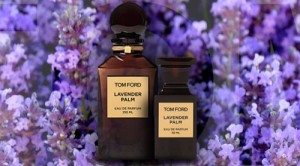
Lavender Palm is a unisex eau de parfum which Fragrantica puts in the category of “Aromatics.” The perfume was created for Tom Ford by Yann Vasnier and is described by Selfridges as:

Tom Ford’s creative take on the free–spirited ethos and chic elegance that defines California. It is a sensuous yet stylish remix of earthly lavender, bright citrus, moist palm leaf accord, clary sage, sensual woods and smooth tonka bean.

For some, Lavender Palm actually does seem to evoke California. One of my closest friends tried it months ago and wrote to me that, as he left Nordstrom’s, a waft of air brought out the perfume and strongly reminded him of home. He actually is from Southern California originally; and he had no clue about Tom Ford’s goal when he wrote to me. Others seem to have had the same impression, such as the reviewer at CaFleureBon who imagined Palm Springs and the big parties in the 1970s at the famous Kaufmann House. I’ve lived in California — both Northern and Southern — and I’m afraid I don’t see it.

According to Fragrantica, the notes in Lavender Palm are as follows:

two types of lavender, bergamot, lemon, clary sage, lime blossom, pink and white oleander, olibanum, green moss and vetiver.

Lavender Palm opens on my skin with an immediate burst of lavender and lemon, but there are vague hints of other things hiding underneath the surface. Less than a minute in, they start to rise to the surface. There are florals, but also, some very woody, earthy, musky, and herbal elements. The latter borders almost on the medicinal at times; it is sharply pungent and with a subtle whiff of something camphorous. At the same time, one can definitely smell a very root-y type of vetiver. It’s not fresh, bright or green, but dark brown and smoky.

Oleander flowers

Oleander Flowers.

There is also an extremely disconcerting talcum powder note that smells simultaneously of irises and of babies. It has to stem from the oleander plants which Fragrantica describes as having “talcum-like floral note, with hints of pollen sweetness.”  Here, the talc is a very disconcerting note when placed side-by-side with the earthy vetiver and the very pungent herbaceousness of both the lavender and the clary sage. When you add in the scent of the top of a baby’s head, it borders on the jarring and discordant for me. It’s almost as if the perfume is Dr. Jekyll and Mr. Hyde — two completely separate perfume personalities in one bottle.

Clary Sage. Source: TreeFrogFarm.com

Clary Sage. Source: TreeFrogFarm.com

Twenty minutes in, there is an odd creaminess that suddenly appears, along with an increasingly strong impression of medicinal camphor. I can’t pinpoint the cause, though I suspect it results from the clary sage (which is not the same sort of sage that you use in cooking). In my prior dealings with the plant, it smelled sweet, fresh, and with just a hint of lavender or peppermint. Fragrantica, however, describes the plant as having a “bracing herbaceous scent that smells like lavender with leathery and amber nuances, thus very popular from old times for perfumed products.”

Even if that’s the version which I’m smelling here, it doesn’t explain the more medicinal edge to the perfume. I can’t attribute it to either the Lavender Absolute or Lavandin (a lighter version of the scent) which CaFleureBon says were used in the perfume. And it doesn’t smell like the sort of pungency one finds in moss or oakmoss, either. It can’t come from the olibanum, because that’s just another word for frankincense. No, what I’m smelling are intensely mentholated, medicinal notes that almost resemble the camphorous aspects of pine trees or cypress wood.

But Lavender Palm isn’t finished yet. There is also something that is an oddly salty, almost aquatic note. It’s not wet, exactly, and it’s also not exactly like the beach, so it’s hard to explain but there is definitely an oddly aquatic element. I thought I was hallucinating, so I did a Google search for the “Lavender Palm and aquatic.” It turns out that I’m not the only one. One blogger, Full Time Ford, (and who seems to write about nothing but Tom Ford) wrote a whole review about how the perfume reminded him of the Adriatic Sea. But, on Basenotes, another poster (“rogalal“) was not so enchanted, writing:

That aquatic “seaweed” smell comes in and the lavender goes all metallic and artificial. At this point, it’s really only the leftover cumin that’s keeping Lavender Palm from smelling like hundreds of commonplace metallic aquatics. The base is a dark mix of piney tar smell and quinoline (that dark leather smell used most notably in Tuscan Leather), but the aquatic chemical smell sticks around, keeping the lavender very metallic and fake-smelling.

I don’t agree with a number of things in that review, not the least of which is the mention of cumin! (Really??!) I certainly don’t think the lavender ends up smelling metallic or fake. But I am glad to see that he also experienced the same aquatic smell and that he too noted a pine-tar smell.

So, to summarize, at the end of the first thirty minutes, I am simultaneously smelling: lavender, lemon, earthy vetiver roots, salty aquatic notes, something bordering on creamy, as well as mentholated and medicinal elements, iris, talcum powder, and the head of a newborn baby. I find that to be completely schizophrenic. Forget what I said about two perfumes personalities in one bottle. This is not bipolar; it’s Sally Field’s famous Sybil with multiple personality disorder.

To be fair, when I tried Lavender Palm a second time and put on much less, I had a different experience. As with many Tom Ford scents, the amount you use can impact what you smell — which is why I usually test each one at least twice. Using a lesser amount, I essentially smelled just lavender, lemon and vetiver — in one straight linear line. There were brief hints of more herbal elements like clary sage but, basically, it was just a big, simple, flat-line. I’m not sure if that’s much better….

In both tests, however, the perfume’s middle and final stages essentially turn into a simple triad of lavender, vetiver and lemon. No benzoin, no tonka, no vanilla, no soft mosses. Instead, the vetiver which often dominated over the lavender with hefty notes of earthiness and smokiness, and some occasional flickers of lemon. There really isn’t much more to say than that.

I like the idea of a lavender perfume that isn’t the usual soliflore or a predictable lavender vanilla scent. And I expected to love a lavender perfume that included vetiver, bergamot, and frankincense (which is one of my favorite notes). Unfortunately, this is just not a scent for me. I couldn’t wrap my head around that odd, schizophrenic opening in the first hour and then, subsequently, I found the fragrance both simplistic and imbalanced with the excessively top-heavy vetiver.

For those who are looking for a bright, fresh lavender, I don’t think this is the one for you, either. While the perfume is much lighter than many of the fragrances from the Private Blend line, it is light only on a relative basis. The earthiness and smokiness of the vetiver and the dark woods give it a far greater heft than what you may be used to in more conventional, sweet lavender fragrances. Those elements may also render it too masculine for some.

It may be perfect, however, for those who are looking for an unobtrusive but woody lavender perfume. From CaFleureBon to Basenotes to Fragrantica, the majority opinion is that the perfume is average to moderate in sillage and projection, especially by the standards of a Tom Ford fragrance. Unfortunately, it is also reported to have below-average duration. (I think that’s the first time I’ve seen a CaFleureBon reviewer say that!) On me, Lavender Palm had moderate-to-low sillage for the first hour, and then became close to the skin after two hours. All in all, on my perfume-consuming skin, it lasted about 6.5 hours — which is very low for a Tom Ford, especially from the super-concentrated Private Blend collection. On others, I’ve read reports ranging from “it does not last” to 6 hours to 10 hours. The huge Tom Ford fan blogger, Full Time Ford, claims he found faint traces on his skin over 24 hours later — but that sounds like a pretty unique case from all that I’ve read.

The real issue may be the cost. Tom Ford Private Blend perfumes are never exactly cheap. But, in my opinion, they normally have a lot more complexity and depth than Lavender Palm. One of the Fragrantica commentators who loved it and found it “simplistic… but done incredibly well” seemed to have drawn the line at the price:

What is though no laughing matter is the criminal price they charge for what is essentially a lemony lavender.

I think it more a vetiver-lavender, but I agree with his general point. Even more so when one considers that lavender is hardly the most expensive ingredient around. Lavender Absolute may be a slightly more costly version, but still, it’s lavender — and $205 for the very smallest bottle? (As a side note, in its limited-distribution run at just the Beverly Hills boutique, a 250 ml bottle was priced at $950. Yes, you read me correctly and no, that is not a typo. $950!!! The prices was adjusted downwards when the perfume was fully launched in January 2012.)

Nonetheless, as I always say, price is subjective, as is the whole issue of perfume itself. In fact, I think perfume is one of the most subjective things around, so if this is a scent that intrigues you, I hope you will give it a try at the very least.

But you may want to do it soon. Lavender Palm was released in limited distribution less than two years ago (in the fall of 2011) and just a year ago (in January 2012) on a world-wide basis. Yet, for reasons that I simply cannot understand, it is not listed anywhere on Tom Ford’s website! It’s not in the Private Blend section, the Women’s fragrance section, the men’s fragrances, or in any other part of the “Beauty” section. Believe me, I searched repeatedly!

I have read nothing to indicate that it has been discontinued, so I have no explanation for its omission unless, perhaps, Tom Ford is contemplating removing it from the line? The thing is, perfume houses rarely come out with an official announcement that they’re discontinuing something; it’s too much of a declaration of failure. Instead, they usually start by removing it from their website, and then wait for all their stock with retailers to be used up. Or vice-versa. I fear that may be what is happening here, though, if that is the case, then it must have be an extremely poor seller for Tom Ford to pull plug just a year after its global release. On the other hand, the recently discontinued Amber Absolute is still shown on the website, as are some of the musk line which I’ve read were discontinued, too. (You can find a list of discontinued Tom Ford fragrances at the Perfume Shrine but it is only updated as of Spring 2012.) So, who knows what is really going on? 

In the end, whatever my feelings about the scent itself, I give Tom Ford and Yann Vasnier enormous credit for imagining such an unusual twist on lavender. Salty, aquatic notes and floral, talcum powder, with earthy vetiver and heavy woods as well – it’s very creative and different. 5 points to Gryffindor!

DETAILS:
Cost & Availability: As noted above, this perfume is not listed anywhere on Tom Ford’s website. It is, however, available at numerous high-end department stores where its price is just like that of other Tom Ford fragrances: $205 for a 50 ml/1.7 oz bottle, or $495 for a 200 ml/8.45 oz bottle. In the US, you can also find it at fine retailers such as Neiman Marcus, NordstromSaks Fifth Avenue, and many others. In the UK, you can find it at Harrods where it sells for £135.00 or £195.00, depending on size. It is also sold at Selfridges. Elsewhere, Tom Ford fragrances are carried in numerous different countries; hopefully, you can find one near you using the store locator on the Tom Ford website.
Samples: If you are intrigued, but are also sane enough not to want to spend such a large amount without testing it out first, I suggest stopping by one of the stores listed above for a free sniff. However, you can also find samples starting at $3 on Surrender to Chance, or on other decant/sample sites like The Perfumed Court. I think Surrender to Chance has the best shipping: $2.95 for any order, no matter the size, within the U.S., and $12.95 for most orders going overseas. (It’s a wee bit higher if your order is over $150.) International shipping has leaped up in price (from $5.95) due to the U.S. Postal Service’s recently increased prices.

Perfume Review: Absolue Pour Le Soir by Maison Francis Kurkdjian

Sultan Mehmed HD Wallpapers siteThe sun was setting in the East. The heat of the city sent shimmering swirls of dust into the air, blending with the smell of spices and the sweat of its people under the rose-tinged sky. But dusk was also when the invaders came. The fierce, sweaty, hairy men stormed the ramparts of the palace, attacking and forcing their way past the Sultan’s guards.

Théodore Chassériau - "Moorish Woman Leaving the Bath in the Seraglio." Wikipedia

Théodore Chassériau – “Moorish Woman Leaving the Bath in the Seraglio.” Wikipedia

They ran down The Passage of Concubines before arriving at the Seraglio, the innermost sanctum of the palace and home to the Sultan’s harem. As they broke down the heavy door made from the finest sandalwood, the smell of their sweat and wet leather mixed with the swirls of incense that billowed from within. They entered the women’s quarters and beheld the naked beauties at their bath. It was an instant war between warm human flesh, the mysteries of women, sweet honeyed intimacy, and feral, musky masculinity.

The Favorite Consort haughtily stepped to the forefront, approached the leader of the invaders and placed one cool, honeyed hand firmly against his sweat-stained leather cuirass. “I will wash your feet with the nectar of the finest Persian roses, feed you molten honey and spiced treats in rooms of silk and incense, and perfume your leather with the finest sandalwood, if you leave the women unharmed.”

"Picking the Favorite" - by Giulio Rosati  - Source: The Athenaeum.Org

“Picking the Favorite” – by Giulio Rosati. Source: The Athenaeum.Org

"The Slave and the Lion" by Georges Rochegrosse.Source: Tumblr

“The Slave and the Lion” by Georges Rochegrosse.
Source: Tumblr

He stared at her, his swarthy face silent. Finally, he nodded but not before pulling her closer to demonstrate his dominion. Their bodies were a meld of musk, sweat, dust and spices, warm flesh, heady flowers, wet leather, creamy sandalwood, sour notes, smoky incense, and ambered honey.

That was the vision which immediately arose in my mind when I wore Absolue Pour Le Soir (“Absolue”) from the luxury niche perfume house of Maison Francis Kurkdjian, Paris (“MFK”).

Francis Kurkdjian.

Francis Kurkdjian.

Francis Kurkdjian began his career as something of a young prodigy in the perfume world and has become one of its most celebrated, admired creators. As Luckyscent succinctly explains,

In the era of perfumer-as-star, Francis Kurkdjian (pronounced “kurr-janh”) has been the first to break away and found a house bearing his name. But Maison Francis Kurkdjian is not just another niche brand: its stated ambition is to become a house with “a soul and history”, the Guerlain of the 21st century. And if anyone can pull it off, it may just be the charismatic boy wonder who had already composed a blockbuster— Jean-Paul Gaultier’s Le Male— at the age of 25, and has since authored a slew of highly acclaimed scents, both mainstream and niche, from the cult Christian Dior Eau Noire to the best-selling Narciso Rodriguez for Her.

Maison Francis Kurkdjian released Absolue Pour Le Soir in 2011 as a more MFK APLS bottleconcentrated, spicier, naughtier, more animalic eau de parfum version of its 2009 cashmere and rose Cologne Pour Le Soir. On its website, the company describes the mood of Absolue as follows:

When the night takes on its own life, the tempo changes. Take along, longuorous [sic] breath. Linger till dawn, keep your head in the stars. You’re suspended in time.

The most detailed set of perfume notes that I’ve found has been on Luckyscent which lists the following ingredients:

Infusion of benzoin from Siam [aka Siam Resin], cumin, ylang-ylang, Bulgarian and Iranian rose honey, incense absolute, Atlas cedarwood and sandalwood.

Source: etshoneysupliers.

Source: etshoneysupliers.

Absolue Pour Le Soir opens on my skin with a rich, dark, molten layer of honey and cumin. There are notes of deeply resinous amber which conjure up a colour image of red-gold in my mind’s eye. There is almost a leathery note like wet, sweat-infused rawhide with an underlying sour-sweet element which evokes a hotly lathered horse and saddle. (It definitely helped contribute to my image of an attack on the seraglio!) I think musk can often have a leather undertone (to my nose at least), so I’m chalking it up to that because there is no doubt that Absolue is a musk perfume. The whole thing is overlaid by that rich honey and resin which oozes over everything like a wave of hot lava.

The cumin becomes much more pronounced after the opening minutes and it soon shares equal footing with the honey. And, yet, it almost feels as though there are other spices too, like cloves, star anise and cinnamon. Flickering and dancing in the background are the rose notes, creamy sandalwood, incense, and almost woody, sweet smokiness from the Siam resin. The resinous notes here don’t feel like pure Siam resin, and I have to wonder if they left out mention of labdanum. That is another resin, but it has a more animalic, musky, masculine, dirty edge to it. (You can read about both types of resin and their differences in my Glossary.) Given that Absolue’s notes don’t actually include any mention of musk as an ingredient, I wouldn’t be surprised if labdanum were used to create some of the more animalic, naughty accords.

There is something about the way that those resins combine with the spices, the rich rose, smoke and sandalwood that repeatedly makes me think of the middle to end stages of my beloved (vintage) Opium. I recently purchased a bottle of the latter from the 1970s (do not ever buy current Opium!) — and the similarities are pronounced in my mind, especially once the sandalwood becomes more noticeable. That said, the two scents are very different. Absolue is much dustier and heavily dominated by musk and cumin — which is not the case with the more floral-dominant spices of Opium.

The cumin is really interesting in Absolue. Unlike some of my other experiences with the note, it never has a really sweat-like accord after that first minute or two. Yes, there is an earthy feel to the scent, but it doesn’t make me give worried sniffs under my arms as some perfumes — like Serge LutensSerge Noire or Amouage‘s Jubilation 25 –have done. Moreover, there is nothing skanky, funky or intimate about the note or how it interacts with the other ingredients. Unlike the very animalic Musc Tonkin by Parfume d’Empire, there are no unsettling impression of deeply feminine intimacy or of unwashed panties. Rather, the cumin in Absolue Pour Le Soir just feels like the pure spice, albeit one which my nose is somehow convinced is mixed with star anise and cloves. The dusty, dusky dryness they impart are a perfect balance to the sweetness of the dark honey and resins; they prevent the perfume from being gourmand in any way.

As time passes, Absolue becomes much more of a true oriental in the grand old style. Superbly blended, the perfume takes on a more complex character and different notes peek out at different times. Sometimes, the creamy, spiced sandalwood is more pronounce while, at other times, the smoke and incense accords come to the foreground. All of them are tinged with cumin for the first hour and, then, by the floral notes for the second (and subsequent) hours, particularly the rich roses and the creamy, very indolic notes of ylang-ylang.

"The Pasha's Concubine" by Ferencz Eisenhut.

“The Pasha’s Concubine” by Ferencz Eisenhut.

The indolic nature of the ylang-ylang may prove to be a problem for some people. Very indolic flowers — like jasmine, tuberose and ylang-ylang — can occasionally take on a very extreme character, evoking impressions of rotting fruit, plastic-y flowers or a litter box. That doesn’t usually happen to me and I’m on record as saying how much I adore some of the most indolic perfumes around, like Robert Piguet‘s Fracas. Here, however, there is a definite sour note on my skin which I suspect stems from the ylang-ylang. It arises after the first  hour and lasts for another solid hour before the perfume transforms again, with the rich rose nectar taking the lead along side the creamy sandalwood and musk.

Over time, Absolue Pour Le Soir changes again. At the fourth hour, it is an absolutely luscious, heady, rich, rose perfume, with incense and sandalwood. In its later stages and during the dry-down, it is predominantly amberous resin and honey with just a dash of musk and a hint of creamy sandalwood. Unlike some, like the Candy Perfume Boy, I never smelled the metholated aspects of cedarwood or any hint of immortelle. Nor did I smell raw beeswax, as a few have mentioned on Luckyscent, or primarily incense notes. But I suspect that the perfume will change slightly each time one wears it, highlighting different facets and some of the comments on Fragrantica bear out that impression. It is a sign of just how brilliantly it has been blended.

I’d read a lot about Absolue Pour Le Soir’s “dirtiness” before trying it out and I really expected a skank monster filled with unsettling intimacy. I tend to struggle with those notes, so the online comments left me with much trepidation. It’s one thing when someone on Luckyscent says simply, “Dirty bee – very naughty, dirty bee!” But when a highly respected perfume blogger like The Candy Perfume Boy writes that it initially triggered a “fight or flight” reflex and that he originally “chose flight“….. well, one starts to worry a little! Not even the fact that he eventually succumbed to buying a full bottle, rapturously calling it a “beautiful, filthy beast” really allayed my hesitancy. Then again, Absolue Pour Le Soir made The Scented Hound, a perfume blogger who generously gave me a sample of the scent, gush in a way that he rarely does. He wrote that the perfume made him feel “incredibly sexy.” In fact, after succumbing to a full bottle (which seems to be a common theme when it comes to this scent), he later wrote that it “makes me want to take myself on a date.”

I think both bloggers’ assessment of the perfume is absolutely correct. As The Candy Perfume Boy wrote so beautifully, “[i]t is a fragrance that has the power to shock due to its dichotomy of ugliness and beauty.” However, I think that the “shock” will depend significantly on how much exposure you’ve had to really musky perfumes. I reviewed Parfum d’Empire‘s famous (infamous?) Musc Tonkin just last week and I think that may have immunized me from things that others may find to be a filthy, dirty beast. With Absolue Pour Le Soir, there is none of the animalic funk (and faint terror, if truth be told) that I felt at the opening minutes of Musc Tonkin. That was a truly “dirty” monster of an opening — all animalic fat, skin and hair. This is not.

Instead, what I found was something that was definitely musky, yes, but not truly animalic or heavily skanky. It was lovely and approachable and, as time went by, damn seductive! I keep having the insane vision of a bottle of Andy Tauer’s dusty, dry, spicy L’Air du Desert Marocain having a three-way with a large pot of musk and a big vat of honey. Well, that overlooks the bottle of cumin and the big vase of the most lusciously meaty, beefy, dark roses to be found this side of Persia. But you get my point.

Those who love clean, fresh or light scents will not be a fan of Absolue Pour Le Soir. Those who despise cumin notes, musks or rich orientals, likewise. But for everyone else, especially those who love spice or some naughtiness in their scents, I strongly urge you to try a sample. Absolue Pour Le Soir is a very unisex, versatile, luxurious fragrance which would work on a man or a woman, at the office or on a date. It has strong sillage for the first hour, after which it becomes moderate for the next hour before becoming significantly closer to the skin at the third hour. You don’t need to violently inhale at your wrist to smell it, but no-one across the room is going to be bludgeoned on the head by it either. It’s extremely heady, but not overpowering. (Unless you drown yourself in it, in which case, it may be a whole other matter.) And Absolue has fantastic longevity. On my perfume-consuming skin, there were faint traces of it over ten and a half hours later!  On Fragrantica, the vast majority of voters put the perfume’s longevity in the highest category (“very long-lasting”).

Plus, by the standards of niche perfumes, it is almost quite affordable. (Well, as “affordable” as this sort of luxury niche perfume can be.) This incredibly high-quality perfume costs $185 for a 2.4 oz bottle – which is almost a third larger than the traditional “small” size of 1.7 oz. Other perfumes of this quality that I have tried have tended to start at $200 (again, for that smaller 1.7 oz quantity), with some going over $300. In my opinion, it is of infinitely better quality than a number of perfumes that I’ve tried from better known houses and that have been in the mid-$200 range. Moreover, it’s a lot more distinctive.

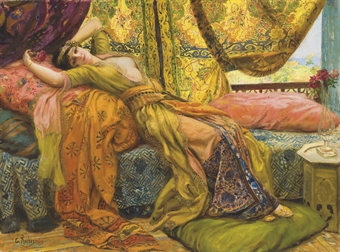
"Reclining Beauty" by Georges Antoine Rochegross. Source: Christie's.

“Reclining Beauty” by Georges Antoine Rochegross. Source: Christie’s.

At the end of the day, though, perfume is meant to be a voyage of the senses — both of mind, smell, and imagination. For me, Absolue Pour Le Soir transports me to the Sultan’s harem. It initially conjures up visions of sweaty, musky, leather-clad warriors who have leaped off their mighty steeds just moments before entering the feminine heart of the palace. Later, it makes me feel like the Sultan’s favorite consort — perfumed, indulged, sensuous — as she reclines over brightly-coloured pillows of raw silk, confident in her power and beauty. At the end, in its absolutely intoxicating dry-down phase of honey and amber, it makes me feel as languid as a cat stretching out in the sun.

Warrior or Consort Queen… it’s all just a few drops away.

DETAILS:
You can buy Absolue Pour Le Soir from the Maison Francis Kurkdjian website where the eau de parfum is available in two different sizes. The 2.4 oz/70 ml bottle costs €115, while the 6.8 fl oz costs €160. Prices are not given for US dollars. You can also order Absolue in a Discovery Kit of 4 samples (which you can also mix up with other scents from the line). “Each pouch contains 4 samples of 2 ml each. It’s up to you to choose.” The sample set costs €12. In America, Absolue Pour Le Soir retails for $185 for the 2.4 oz bottle and can be found at Neiman MarcusBergdorf Goodman, Bigelow, and Luckyscent. In the UK, you can find Absolue at Liberty, London where it retails for £115.00 for the 2.4 oz/ 70 ml bottle. For all other places, you can turn to the company’s website whose Points of Sale page which lists retailers around the world where you may find Absolue or other MFK perfumes, from Europe to Asia, Oceana and the Middle East. If you’d like to try a sample, you can find it at Surrender to Chance which sells vials starting at $3.99 for 1/2 a ml. Luckyscent also sells a sample at the link posted above.

Reviews en Bref: By Kilian Love (Don’t Be Shy) & Straight To Heaven (White Cristal)

As always, the Reviews en Bref are for perfumes that — for whatever reason — didn’t seem to warrant one of my lengthy, exhaustive reviews. In this case, it’s because I really don’t think I have the skin chemistry for the three By Kilian fragrances I tried from his L’Oeuvre Noire collection. In fact, I have not had such a miserable perfume experience in a while.

STRAIGHT TO HEAVEN (WHITE CRISTAL):

In 2007, Kilian Hennessey — the scion of the famous LVMH luxury conglomerate — came out with a perfume collection for his By Kilian perfume line. It was called L’Oeuvre Noire and contained a number of different scents, one of which is Straight to Heaven (with “White Cristal” being a subtitle). It was created by the perfumer, Sidonie Lancesseur, and Luckyscent gives its notes as follows:

Martinican rum absolute, dried fruits accord, Javanese nutmeg oil, hedione, cedarwood, Indonesian patchouli oil, ambergris, vanilla absolute, white musk.

I think “Straight to Heaven” might be more aptly named “Straight to the Doctor’s Office.”  This is a scent that replicates the pure rubbing alcohol, antiseptic, medicinal scent of a  doctor’s office or a hospital. It opens with a pure blast of an incredibly metallic, medicinal scent of the stuff used to clean your arm before you get a vaccination shot. Except, here, it is combined with fake powdered vanilla and sugar. Despite that, the medicinal note doesn’t have any of the sweetness that often comes with the medicinal note in agarwood. Here, it is really like pure grained alcohol and cold antiseptics. It’s like being in a hospital room after they’ve scrubbed everything down and disinfected the counters, before trying to cover up the smell by spraying some Glade Powdered Vanilla in the air.

After a little time, there are more chilly, mentholated aspects to the medicinal scent. There are also some soapy aspects that I attribute to the cheap-smelling musk. I don’t initially smell any of the rum that everyone talks about with this scent, but that does eventually arrive. About three hours later. Then, Straight to Heaven turns into an odd combination of Vick’s Vapor Rub and some oddly “off” boozy note. There is patchouli, too, but it is completely dominated by the cedar. Everything is dominated by that cedar. There is no escape from it and it turns everything medicinal. There is also an underlying synthetic, chemical tinge to everything. Straight to Heaven simply doesn’t smell particularly natural; the ingredients don’t smell rich, luxurious, or soft.

In utter olfactory exhaustion and misery, I went to bed, wishing I could scrub this off. When I woke up, there were still faint, flickering, minute traces of the fragrance on my skin. It was now mere vanilla powder, soft but with some sort of chemical twist, and musk. It was almost 14 hours after the time that I first put on the perfume!

A lot of people talk about the boozy “rum” nature of the perfume. I disagree. Strongly. This is not a scent that is predominantly rum in note — and certainly not a pleasant one at that. I love boozy rum scents, from Teo Cabanel‘s glorious Alahine, HermèsAmbre Narguilé, Guerlain‘s Spiriteuse Double Vanille or Tom Ford‘s Tobacco Vanille. Straight to Heaven is not like ANY of those. It is primarily a cedar perfume, though I would argue it is a medicinal, rubbing alcohol fragrance first and foremost. I’m not the only one who thinks so. On Makeupalley, where the perfume has a 3.3 rating out of 5, there are as many reviews noting the strength of that note as there are those who consider this a “rum” perfume. My favorite comment is that from “cerulfox” who writes:

My opinions on the By Kilian typically waver between indifference and derision, having tried all of the L’Oeuvre Noire collection and finding myself only liking three of the ten. Straight to Heaven is one of the dislikes. It starts off with a piercing cedar note that quickly disappears to be replaced with a strident booze note. I’m assuming that’s the rum, but on my skin it’s so overwhelmingly alcoholic I might as well have doused my skin in Everclear or straight grain alcohol. All of rum’s typical spice notes are muted and virtually non-existent compared to the screechy alcohol. This remains until Straight to Heaven evaporates into a puff of generic skin musk. Honestly this is more akin to Straight to AA rather than Straight to Heaven, the booze note is so strong.

On Fragrantica, more people find the “booze note” to be “rum” than hardcore alcohol disinfectant. The most amusing review comes from “gmstrack” who titles his comment with “Headline: Woody Oriental Drinks Rum in Hamster Cage” and then writes:

After reading several reviews, it seems like this fragrance is in a special purgatory: too conventional for some and too medicinal or dirty hippy for others. I definitely fall in with the too conventional camp, but at the same time, I find Strait to Heaven very comforting. Maybe childhood memories of playing in a cedar swamp have something to do with this. The patchouli could be dirtier, the cedar turned down just a tad and, oh yes, dump in something interesting (rum doesn’t count). Heh.  3/5

Well, he’s correct that it can be purgatory for some. Me, for example. I was incredibly relieved when it was all finally over. And, I was convinced that nothing could be worse. I was mistaken. Badly mistaken. You see, I hadn’t tried Love (Don’t Be Shy) yet….

LOVE (DON’T BE SHY):

Love (Don’t Be Shy) is another fragrance from Kilian’s 2007 L’Oeuvre Noire Love by Kilian By Kilian for women collection. It was created by Calice Becker and is categorized on Fragrantica as an “oriental.” If this is an oriental, then I’m the Queen of Sheba. It’s pure gourmand, in my opinion, if not a sugar bomb.

The most complete list of notes that I have seen for the perfume comes from Luckyscent which says that the perfume was inspired by a marshmallow:

Bergamot calabria oil, Tunisian neroli oil, pink pepper berries oil, coriander seeds oil, honeysuckle, orange flower absolute, orange water absolute, Egyptian jasmine absolute, Bulgarian rose concrete, Bulgarian rose oil, iris butter absolute, reconstituted civet oil, caramelized sugar, vanilla absolute, cist labdanum absolute, white musk.

Love opened on me with notes of neroli and caramelized sugar that were so strong, they just about blew my head off. Neroli always comes across to my nose as sharper and slightly more bitter and metallic than orange blossom, though they are both from the same flower and stem only from differences in production or distillation. Normally, orange blossom notes are one of my favorite ingredients in a perfume. Here, however, it is strident, screechy and damn unpleasant.

Following soon thereafter is honeysuckle, pink peppercorn, rich gooey violet notes, cloyingly synthetic, saccharine-sweet vanilla and musk. The orange and sugar notes dominate, however — by a mile. Or thousand. Though the inspiration is supposed to be marshmallow, I see more one of those bright orange taffy sweets that are pure sugar. There is absolutely nothing even remotely approaching an animalic, skanky civet note on my skin, no matter what the perfume notes may say.
As the perfume develops, it turns into a cloyingly sweet, powdered vanilla, with tooth-achingly sweet sugared roses, and sweet, candied violets. If you’re sensing a theme here, you’re not wrong. This is diabetes in a bottle. I have either developed ten cavities just from wearing it or 80 pounds. It is unbearable — not to mention synthetically cloying in the worst way possible. I am strongly reminded of those cheap $4 sweet perfumes for pre-teens, though I suppose the quality of this one is vaguely better. Except for that vanilla note. No, that one seems about as cheap as you can get.

Love eventually became less sweet — but that’s all relative. After a while, the orange notes receded and it became much more like a marshmallow with powder, sugar and more cloying vanilla. I have found I have much less patience with really unbearable scents these days and won’t torture myself for hours just for the sake of a review. So, I eventually scrubbed this one off. I simply could not bear another minute of it.

But, no, Love was not finished with me. Despite two washings of my arms with very hot water and much soap, there were faint traces of that cloying scent which remained for hours. And hours. I’ve read that synthetic, chemical ingredients are used, in part, because they increase the longevity of a scent and Love certainly proves that theory correct. The fact that Kilian perfumes cost $235, $145 or $135 (depending on the form in which you buy them) is a whole other issue. But I can tell you this, even if this were a $10,000 perfume given to me for free, I would not wear it. The mere thought of it makes me shiver.

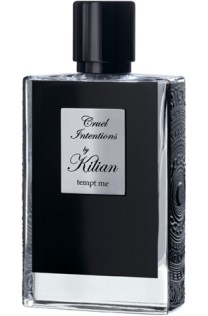
As a side note, I also tried By Kilian’s Cruel Intentions (Tempt Me), his woody oud Cruel Intentions By Kilian for women and menfragrance from the same 2007 collection. I’m not even going to bother writing about it. Something about the vanilla base in all these perfumes simply does not agree with me. I find Cruel Intentions to be equally unbearable, despite a list of notes that would normally appeal to me:

Top notes are african orange flower, bergamot, rose and violet; middle notes are guaiac wood, agarwood (oud) and papyrus; base notes are vetiver, musk, sandalwood, styrax, vanille and castoreum.

On me, that screeching, sharp, cloying and very synthetic vanilla simply overpowers everything. I suppose there are faint traces of vetiver and, eventually, some sandalwood — but they are hard to detect. I am simply bashed over the head by that same fake, powdered vanilla which made my stomach heave in Love (Don’t Be Shy). A number of people on Fragrantica say that Cruel Intentions is primarily a sandalwood fragrance. I love sandalwood, but there is no way I’m going to last long enough to find out. Plus, I have to say, I’m highly skeptical that anything will overcome this horrid, synthetic, vanilla powder (and white musk) that has been an overwhelming hallmark of two of the three L’Oeuvre Noire fragrances that I’ve tried thus far. As I said at the start, perfume hasn’t made me quite so miserable in a while. It’s hard to believe that these perfumes come from the same house which produced the oud Arabian Nights Collection — a line that is miles apart from this one.

Now, if you’ll excuse me, I have to scrub myself clean…..