Ancient history, the mysteries of the Middle East, Galahad atop his fiery steed in the Holy Lands, the Balm of the Sacred Mountain, luminous amber with sacred herbs, and mythical creatures who concoct elixirs in celebration of Dionysius — those are the inspirations behind a trio of fragrances from the French niche perfume house of Lubin. Created by Delphine Thierry and Thomas Fontaine, Galaad, Akkad and Korrigan are three Oriental fragrances released in 2012 for a perfume house whose history is far more fascinating that the perfumes themselves.
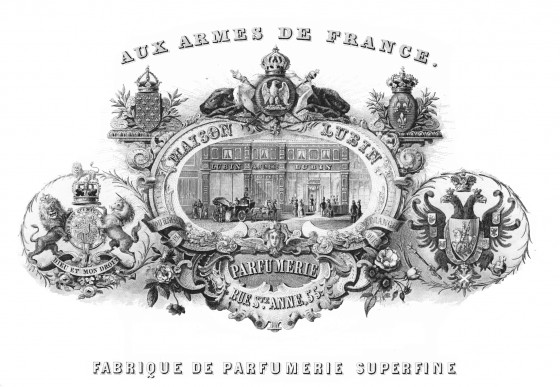
Lubin was founded in 1798 by Pierre François Lubin, soon after the French Revolution. He had apprenticed under the perfumer who served Marie-Antoinette but this was a new political climate. Lubin soon won favour with Napoleon’s Imperial court and his scents were beloved by both Empress Josephine and Napoleon’s influential sister, Pauline. The royal courts of Europe soon followed suit, from the King of England to the Tsar of Russia. Once Napoleon fell, the seemingly wily, pragmatic Lubin managed to curry favour with the new royal dynasty by dedicating his fragrances to the Bourbon queen, Marie-Amélie. A very ambitious man, Lubin seemed to need more worlds to conquer and, in 1830, became the first perfume-maker to conquer the New World with perfumes that reached the banks of the Mississippi. I have no idea if that last part of biographical past was embellished a little bit but, frankly, I didn’t care one whit. For a history geek like myself, it was all utterly fascinating.
Unfortunately, I far preferred the history to the new perfumes. Everything about the background stories for the fragrances has been done with finesse, poetry and beauty, but the perfumes themselves left me feeling cold. And I’m genuinely saddened by that. If you ever have time to spare, I urge you to check the Lubin website for their gorgeous graphics and story for each scent. They’re really incredibly well-done.
GALAAD:

Galaad from the Lubin website via MrNyStyleandTravel.com.
Galaad is classified on Fragrantica as an “oriental woody,” and is centered on leather and myrrh. The story behind Galaad involves the “Balm of the Sacred Mountain,” the Arthurian knight, and the most precious of the Holy Land’s ingredients:
Out of Egypt come caravans to fetch myrrh in my land of Galaad. My name is the same as that of the land that witnessed my birth, for I am Galaad, the knight of the Holy Mountain. It is rich with honey from our hives, tall cedars that shade it and resins brought to Pharaoh. With frankincense, cypress and dried grass from Atlantis, we refine the precious balm used by the lords of the East to perfume themselves.
 The press release shared by Luckyscent adds to the beauty of the story and describes its notes as follows:
A heart of myrrh is topped with spices that bring out refreshing head notes (cardamom), and sustained by aromatic base notes (rosemary, cypress). The base is cool leather with wood and tobacco (blond tobacco, Atlas cedar, agar oud).
Delphine Thierry, who created Galaad, invites us to a tranquil morning ride in the mountains of the Middle East, when the scents of myrrh bushes blend with cypress resins and the woody fragrance of cedars. The leather of saddle and gloves gently warm up in the first rays of sun, while the little Arab horse snorts amidst the morning dew that has settled on Judean balsam trees and on the vines climbing along the mountain slopes of Galaad.
Notes: Cardamom, cypress, rosemary, myrrh, honey, copahu balm, Agar oud, Atlas cedar, cipriol, blond Burley tobacco.
Beautiful! If only the perfume smelled that way….
Instead, on my skin, Galaad was the rankest of sweaty leather. It opened with cardamom and honeyed myrrh with a very animalic, dirty, nutty, sweaty leather feel. Copahu balm is said to be a very sweet, balsamic resin and, here, it shares some characteristics with labdanum. Only much, much skankier. The leathery undertones to the perfume compete with some very sweetened wood notes that have an oddly herbaceous element to them. At the same time, there is a hint of dry tobacco that almost evokes the pages of a very ancient manuscript. I ascribe that to the cipriol which is another name for papyrus grass.

Source: Equisearch.com
There is something odd about the smell that I really struggle to describe and cannot quite pinpoint. There is something not quite… right… about it all. The mix of honey and dirty ambered resin calls to mind a very sweaty saddle covered by sweetness; there are salty aspects; papery notes; dry, peppered woods; and something a bit rank. It’s not even the eventual smell of sweaty crotch that appeared after about an hour. It’s something that I can’t quite describe. And I didn’t like it very much at all. I tried Galaad twice to be sure and, the second time, it was even more rank on me with a skanky, fecund undertone that evoked unwashed private parts. It wasn’t huge and it was subtle, but it was most definitely there.
Lucas of Chemist in the Bottle was also not a fan of Galaad. He found “something sweaty” in it, along with a note of burnt plastic. He also detected oud in the perfume; I did not. But maybe I was just overwhelmed by the overall unpleasantness of the skanky, raunchy leather.
Thankfully, the sillage and duration of Galaad are not enormous. The perfume is quite thin, oddly enough, and didn’t have great projection on my skin after the first 20 minutes. It hovered a few inches above the skin for about an hour, became close around the 3 hour mark, and then died altogether after about 5.5 hours. I was quite relieved.
KORRIGAN:

Source: Miriadna.com desktop wallpapers.
Another absolutely beautiful story. This time for Korrigan, classified as an “oriental vanilla” and set in the verdantly lush, green isles of the United Kingdom. As the Lubin website explains:
A Korrigan is a small mythical creature that haunts the moors of Brittany, Ireland, Scotland and Wales, whisking us away to the folklore and legends of Celtic civilisation. [… They] know recipes for elixirs offered as libation at Beltane and Samhain, festivals to celebrate the change of seasons.
An occasion of course to evoke the strong beverages of the somewhat bleak moors. Whisky is one of them, in the form of a smooth, fragrant cream liqueur, accentuate by a counterpoint of oudh accord, which brings to mind dark caves where secrets lie hidden.
“Korrigan” is therefore a fragrance to accompany Dionysian rites. […] In the Armorican countryside the Korrigans frolic at night. They come to harvest juniper berries and wild beechnuts. Then, in dark caves, they distil barley into spellbinding spirits, spicing them with saffron, musking them with ambrette, scenting them with lavender. During the solstice festivals, they all drink their elixirs out of leather pouches, causing bodies and souls to capsize.
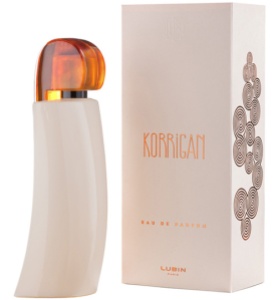 The specific goal of perfumer Thomas Fontaine was to create, in the words of the Lubin website, “Caramel Wood Liqueur.” Luckyscent provides the following notes for the perfume:
Juniper berry, saffron, cognac, Lavender, ambrette, whiskey, Cedar, oudh, leather, vetiver, musk.
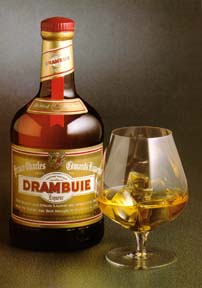
“Caramel Wood” pretty much nails the description of this disconcerting, cloying and quite perplexing fragrance. Korrigan opens on my skin as caramel-infused wood with a herbaceous undertone. It is like Drambuie’s herbal, whisky liqueur with a definite cloying sweetness that verges on the synthetic. I don’t detect saffron, vetiver, or anything close to the evergreen aspects of juniper. Just caramel woods.
 Something about it is truly bewildering and, again, I cannot find the words to describe exactly why. I’ve smelled numerous fragrances with a boozy undertone, woody undertones, gourmand vibes and more, but something about Korrigan’s combination of gourmand caramel with whisky, white woods, pepper, and herbalized, honeyed leather leaves me at a loss. The odd combinations and Korrigan’s cloying sweetness also leave me feeling distinctly queasy.
The wood notes are also a bit odd. I don’t smell oudh or agarwood the way some did on Luckyscent, so much as white, soft woods that are peppered and yet, incredibly sweetened at the same time. It’s a different kind of sweetness than that cloying caramel, however, but I cannot explain it. All of this is going on simultaneously with very honeyed leather that seemed soaked in Irish whisky and a very strange herbal element. I don’t think the latter is my old nemesis, lavender, though it may be how lavender transforms itself here in combination with the other notes and that caramel.
After hours of something caramel-like that I cannot properly describe, the perfume turns into a simple amber fragrance along with hints of musk, vanilla and soft leather. The perfume lasted just over 7.5 hours with generally soft to low sillage throughout.
I’m sorry I can’t explain its development better to you, but some discordant aspect of this perfume leaves me absolutely stumped. There are reviews on Fragrantica which may help you more, ranging from those who love its woody caramel creaminess and bought a full bottle, to those who found it extremely “weird,” a highly acquired taste, or a “sticky, sour wood and a sweat note… [A] disaster.” You can also turn to Lucas from Chemist in the Bottle who liked Korrigan the most out of the trio, finding it to be “like a milky vanilla toffee” with an “alcoholic vibe of warming cognac and whiskey” combined with subtle lavender and other notes. His experience sounds infinitely more appealing than the queasy mess that it was on me.
AKKAD:

Akkad photo from the Lubin website via MrNYStyleandTravel.com
Luminous amber. That was the goal for Akkad. According to the press release quoted by Beautyhabit:
 Delphine Thierry, who composed this creation, imagined an amber note that is both spicy and luminous. The opposite therefore of the dark, mystical ambers that bring to mind the smoke of frankincense in ancient temples.
Akkad amber opens with an aromatic citrus head note of mandarin and bergamot, enhanced by Clary sage. Clary sage, also known as “the sacred herb”, is renowned for its euphoric, harmonizing properties.
The heart unfolds in the rich, balmy, spicy notes of frankincense and styrax, evocative of the ancient east, cooled by elemi, a fresh, soothing herb, and intensified by cardamom.
The base with its two ambers of plant and animal origin centers on the woody richness of patchouli, sweetened with a sensual vanilla.
Notes:
Top: Mandarin and Bergamot from Italy, essence of Clary Sage.
Middle: Essence of Cardamom, Elemi, Frankincense, Styrax.
Base: Amber and Cistus-Labdanum, Vanilla and Patchouli.
Akkad was my favorite of the three fragrances and the reason for that was simple: it smelled like a very close, sheer relative of the wonderful Mitzah from Dior‘s Privée Couturier line. I loved Mitzah and its robust labdanum heart, intermixed with incense and other notes. Akkad is not as rich or complex at Mitzah, and it lacks the latter’s quiet undertone of roses and spices, but it is a definite kissing cousin.
Akkad opens on my skin with sugared orange that is slightly burnt, along with patchouli and leathery, nutty labdanum over a sheer hint of powder. Cardamom and frankincense soon follow to join the amber party. But, in less than a minute, Akkad turns into a predominantly labdanum, frankincense, and patchouli fragrance. There is the merest feel of abstract spices (cinnamon and ginger) with just the slightest suggestion of burnt orange, but it’s infinitesimal. There is a definitely dirty, hippie, ’70s feel to the smoky, leathered, animalic labdanum and patchouli combination, and it is the fundamental core of the perfume. Those who don’t like labdanum with its dirty, masculine, nutty — and, here, slightly animalic — undertones may want to stay away from Akkad. There really isn’t much more to say about the perfume. It’s labdanum, light smoke and patchouli for hours. At the very end, it turns into a very light amber with a sort of caramel, butterscotch undertone and with a hint of vanilla.
Despite the seemingly heavy notes, Akkad is surprisingly lightweight in texture and feel. It’s even lighter than Mitzah and the sillage is quite moderate. Akkad remains just a few inches above the skin for hours, before becoming finally becoming a skin scent around the sixth hour. Akkad had good longevity on my perfume-consuming skin, lasting just a little over 8.5 hours. I prefer Mitzah with its greater nuances, but Akkad may be a good substitute for those who want something even airier and simpler.
SUMMARY:
I had great hopes for Lubin’s trio of orientals but, alas, ultimately, none of them really blew me over. Akkad was the best of the lot, in my opinion, but given how much I hated the sweaty-crotch feel of Galaad’s leather and the cloying, peculiarly baffling mélange of Korrigan’s caramel, I realise it seems as though I’m damning it with faint praise. Akkad truly was nice, I swear. The problem is that Akkad (like its siblings) costs $180 for a 3.4 oz/100 ml bottle, when the Dior Mitzah that I prefer costs $155 for a 4.25 oz/125 ml bottle. (If you love labdanum, frankincense and patchouli, you really must try Mitzah!) Still, if you have the chance, you may want give the perfumes a sniff if you stumble across them. Who knows, you may find Korrigan’s gourmand take on woods and leather to be interesting. But Galaad… no, I really wouldn’t recommend it.
DETAILS:
You can find all three fragrances on the Lubin website. Each costs $180 for a 100 ml/3.4 oz eau de parfum bottle. The website also offers a list of retailers from Hong Kong to the United Arab Emirates. In the US, you can find the trio on Luckyscent, Aedes, and on BeautyHabit. MinNY also carries them and is currently discounting each fragrance by a $1.80, selling them for $178.20 instead of $180. I find that microscopic discount to be extremely peculiar. In Europe, Essenza Nobile carries all three fragrances with two of them being €145 and Korrigan being €139. The site also sells samples. In the UK, Harrods normally carries Lubin fragrances but the website does not list this trio. If you’d like to try samples of any or all the fragrances, Surrender to Chance offers all three in a sampler set of 1 ml vials for $14.99. That’s what I chose to do since, individually, each 1 ml would be $5.49.

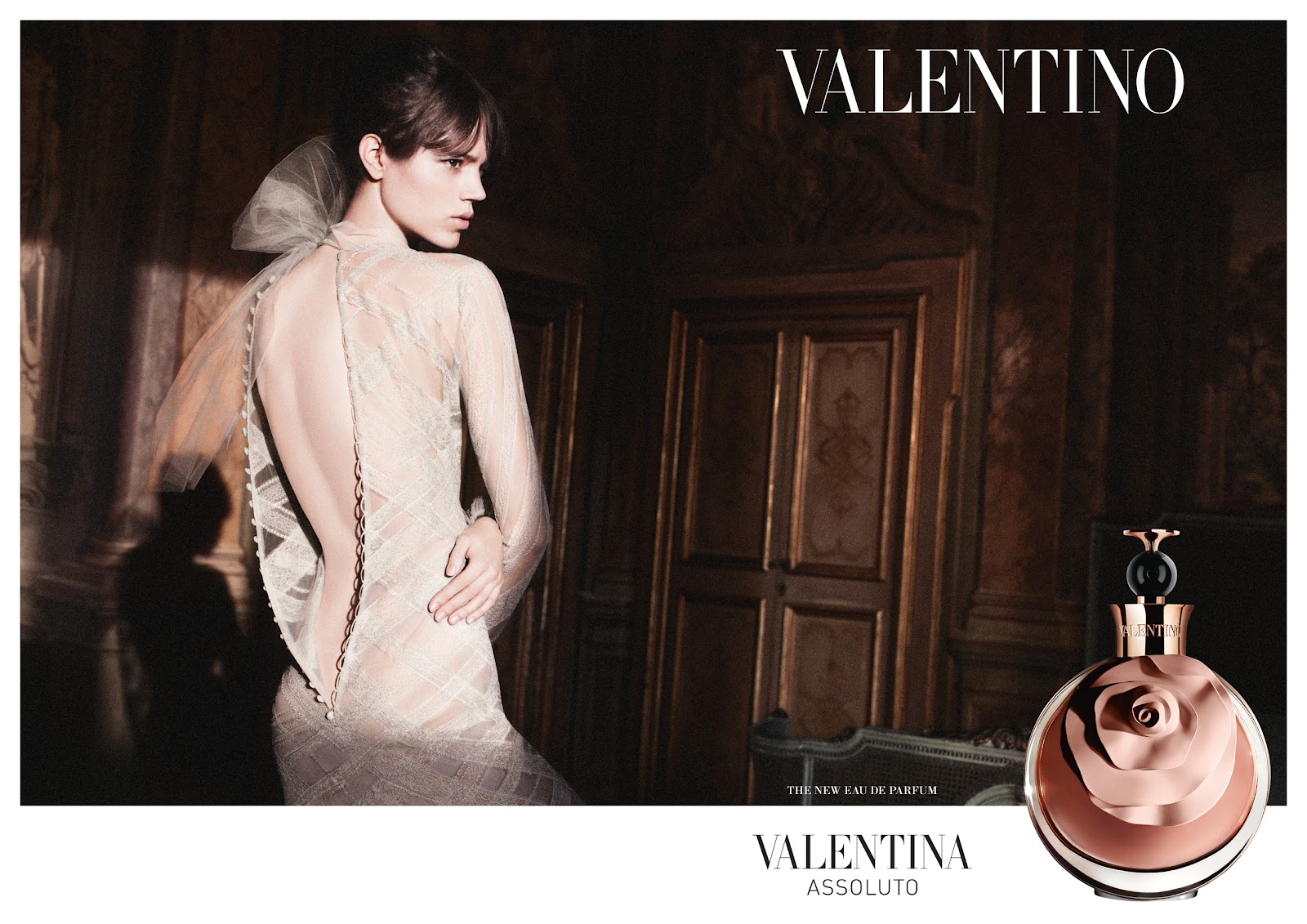

 Fragrantica classifies the perfume as a “Chypre Floral.” I think that is following the ad copy far too slavishly. Valentina Assoluto is a fruity floral scent, first and foremost, with a heavy emphasis on “fruity;” it is an oakmoss or chypre fragrance only by the very loosest possible definition.
 I haven’t the faintest idea how any of this is supposed to be “nocturnal.” I feel quite ready for a summer picnic with strawberry desserts in the bright, cheerful sun. I think those who love sugar bombs like Victor & Rolf‘s Flowerbomb will love this part of the perfume because it’s very exuberant and happy. Those who prefer more modulated, more well-balanced and less sugared florals will find this to be excessive.


