
Perfume Review – Arquiste Anima Dulcis: Conquistadors, Convents & Chocolate

It was a chilly day in Mexico City that November, long ago in 1695, and the kitchens of the Royal Convent of Jesus Maria were a beehive of activity. The haughty Mother Superior took the heavy key from the chain around her neck and unlocked the vault with the sisters’ most precious ingredients: bitter, dark chocolate, rich chilies, earthy spices, incense used in their religious ceremonies, and the heaviest of vanillas. The recipe for their famed “Anima Dulcis” was a secret one — even some of the nuns weren’t privy to its true magic. Were there flowers hidden under its dark depths? Was ancient incense responsible for its smoke, or was it darkened patchouli? The Mother Superior smiled to herself as she passed through the convent’s stone passageways and heard the younger sisters’ whispered questions. She, and she alone, would add the finishing touches.

Sao Roque Church, Lisbon, which is a little how I imagine the Royal Convent to appear. Photo: "ToonSarah" on VirtualTourist.com

The chapel of Sao Roque Church, Lisbon, which is a little how I imagine the wealthy Royal Convent in my mind. Photo: “ToonSarah” on VirtualTourist.com

Cornelis de Vos, Flemish Baroque painter, 1584-1651. Source: This Ambiguous Life Blogspot.

Cornelis de Vos, Flemish Baroque painter, 1584-1651. Source: This Ambiguous Life Blogspot.

The Royal Convent of Jesus Maria in Mexico City on a day in November 1695, is the explicit reference point for the “baroque gourmand” fragrance that is Anima Dulcis (loosely translated as “soul of sweetness”). It comes from the perfume house of Arquiste, founded by the Mexican architect and designer, Carlos Huber. Mr. Huber — who just won the Fashion Group International’s Rising Star award a few weeks ago — was inspired by the convent’s history and practices after he worked on renovating and converting the building in Mexico City.

Carlos Huber. Source: Etiket.com.

Carlos Huber. Source: Etiket.com.

As Mr. Huber explains on the Arquiste website, the Royal Convent of Jesus Maria had been founded in 1578 for the female descendants of the Spanish Conquistadors. (Or, at least, the very wealthiest and most aristocratic among them!) It was known for the nuns’ recipes which combined European and Asian ingredients with those particular to Mexico’s ancient history. Octavian, the highly respected perfume blogger of 1000 Fragrances, elaborates further in his beautiful review of the perfume:

The most carnal elements of the baroque cuisine were mixed in unexpected combinations, forgotten by the modern nose. Animalic jasmine, tuberose, petals of white flowers and all the temptations of the flesh were mixed with cocoa and hot spices to produce liqueurs and sweets. The nuns were discovering the fabulous scents of the new world, earlier than Europe. Vanilla, cocoa and tuberose, brought to Versailles, but still a great luxury before their massive use in the next century, made their debut in a Convent where the ancient Maya and Aztec flavors were tested and studied by Europeans. Anima dulcis, a modern interpretation of this magic encounter, tells the story of when the european sensibility started to use the “dark” ingredients of the New World – the discovery of cocoa, vanilla and chili pepper, reported by Cortez 150 years earlier. [Emphasis in the original.]

Using his research (and, I believe, the sisters’ actual recipes), Carlos Huber worked with twoAnima Dulcis perfumers, Yann Vasnier and Rodrigo Flores-Roux, to encapsulate the Convent’s creations. The result was Anima Dulcis which was released in 2011. It is classified on Fragrantica as an “oriental vanilla,” though I think “oriental chocolate” might be a more accurate summation. On its website, Arquiste says the notes include:

Cocoa Absolute, Mexican Vanilla, Cinnamon, Chili infusion.

Those official notes are just the tip of the iceberg. There is no way that the list is complete. I would venture a guess that the complete list might possibly look a little bit like this:

Cocoa Absolute, Mexican Vanilla, Cinnamon, Red Chili infusion, Jasmine Sambac (or some sort of florals), Seville Oranges, Cumin, Cardamom, Patchouli, Incense and, possibly, some sort of ambery resin.

Pre-Columbian chocolate with chilies. Source: CaFleureBon.

Chocolate with chilies and spices. Source: CaFleureBon.

Anima Dulcis opens on my skin with cinnamon-infused dark chocolate. It’s chewy, dusky, and spiced, but also, simultaneously, honeyed. Fiery red chilies counter the sweetness of the vanilla that just barely seems to breathe in the background. So does the earthiness of a dark patchouli — dirty and slightly smoky in the best way possible. The smoky notes seem to be further accentuated by some hint of light incense. It’s a lovely take on vanilla and chocolate, especially with the piquancy from the red chili pepper.

Mexican Hot Chocolate. Source: Zested.com. (Click on the photo for a link and a recipe.)

Mexican Hot Chocolate. Source: Zested.com. (Click on the photo to go to the website where you can find a tasty recipe.)

The chocolate note, however, is the real star. It’s unusual and nothing like the typical sort of chocolate notes which, to me, often feel more like powdery cocoa. At the same time, it’s also not like purely dark chocolate. Here, it’s more like the richest chocolate flourless cake covered with ganache made from bitter chocolate, covered by a dusting of smoky powder, cinnamon, cumin, cardamom, decorated with faint slivers of Madagascar vanilla pods, and then set on a plate of spicy, cinnamon red-hot candies. The richness almost has the feel of a British Christmas plum pudding, only tinged with incense.

It’s an incredibly cozy scent that is, at the same time, very sexy. There is a rich, meaty, chewy, dark aspect to it that can certainly be called “baroque” but, to be honest, aristocratic Mexican nuns descended from the Conquistadors are not really what comes to mind when I smell it.

Vermont West Hill House B&B.

Vermont West Hill House B&B.

Instead, I feel transported to a secluded wood cabin in Vermont on a very snowy, wintery night; there, by the light of a roaring fire which casts flickering shadows on the wall, a seduction scene full of deep long kisses and teasing nuzzles unfolds. Cups of spiced hot chocolate filled with dark liqueurs lie empty; the fire releases an occasional tendril of smoke; the light is glowing amber and red; and sensuality underlies the cozy warmth of the scene.

As time progresses, the baroque chocolate notes are joined by something that is definitely floral in nature. It’s lovely, adding a lightness and sweetness to the dry spices, but I can’t pinpoint the exact flower. Perhaps Jasmine sambac, with its earthier, muskier nature than regular jasmine? Octavian on 1000 Fragrances thinks it’s a green lily note and, while I can see some light greenness, I don’t think it’s the delicate lily flower. Either way, the perfume definitely has some sort of floral component. Carlos Huber may consider Anima Dulcis as a “baroque gourmand,” but, to my mind, it is much more of a spicy oriental perfume which just happens to have some gourmand elements. It’s also a very ambery perfume for something that is meant to smell like Mexican hot chocolate, and I wonder if there is some sort of resin in Anima Dulcis’ foundation. Whatever the specific notes, it’s a fascinating and addictive scent. I can’t stop sniffing my arm, and I just barely stifle the urge to put on more.

Nordic Christmas Oranges. Source: Trine Hahnemann & The Times of London.

Nordic Christmas Oranges. Source: Trine Hahnemann & The Times of London.

Two hours in, the perfume shifts and changes a little. It is now predominantly cinnamon orange with red chili peppers. There is a feeling of caramelized cooked fruit, where the caramel has burnt just a little. Or, maybe, it’s more like a sticky, toffee’d orange, salted and sweet, mixed with dark raisins stewed in rum and dark chocolate. It’s really hard to pinpoint; the perfume is superbly blended, leading all the notes to melt together in a decadently luscious, rich whole. The burnt note, unfortunately, lasts a wee bit too long for my liking, and seems to become just a tad bit more bitter and burnt with time. It’s not strong and over-powering — it’s not even the predominant note — but I think I would have liked just a little less of it or, perhaps, a little more sweetness to counter it.

After another hour, it fades, leaving Anima Dulcis as a lovely combination of bitter Seville oranges, dark patchouli, cinnamon, chili pepper and a soft dusting of sweet vanilla. Eventually, at the end of the fourth hour, the perfume turns into a soft amber with spices and just a flicker of orange, before finally ending up in its final stage as sweet vanilla and light white cocoa powder, with just a smidgen of dusty spice.

For all that these notes seem dark and heavy, the perfume itself actually is not. It’s neither narcotically heady nor cloyingly sweet. It’s not a light, clean, airy scent by any means — no laundry detergent freshness here —  but it’s surprisingly not heavy or opaque either. Octavian describes it as “light, woody, airy” and “delicate.” I think it’s a bit heavier than that; I wouldn’t want anyone to think this is a sheer, translucent scent or something like the minimalistic creations made by Jean-Claude Ellena. But, given the richness of some of its components, it is far from thick and never overbearing.

In fact, even the sillage is moderate. In the beginning, you can smell it on yourself but it’s far from overpowering. Someone across the room definitely won’t be gassed by it. After the first hour, the perfume becomes softer and, by the third hour, it was quite close to my skin. By the fourth hour, it took some determined sniffs, putting my nose right on the skin, to detect some of the nuances in the notes. As for longevity, it was moderate on my perfume-consuming skin. It faded away shortly before the sixth hour. On others, I’ve read lengths of time around varying between six and eight hours.

All in all, I really liked Anima Dulcis. A lot. The only thing stopping me from wanting a full bottle is the fact that, for my personal tastes, I would have preferred it if the scent were heavier, headier, and just a slightly bit sweeter. (Just a smidgeon!). I realise, however, that most people don’t share my preference for narcotically heady scents, so I think Anima Dulcis would be a real crowd-pleaser for many. It taps into the current trend for gourmand scents but, in my opinion, it really isn’t one. Those who are expecting a true dessert fragrance will be disappointed. This is not half as sweet as some of the niche Guerlains that are out there. Those, however, who share my feeling that a few of those Guerlains are a bit too gourmand should really look into Anima Dulcis. The same applies to anyone looking for a very high-quality, luxurious take on spicy Orientals without the heavy, boozy or opaque aspects that can sometimes accompany them. I should add that it is most definitely unisex!

Try Anima Dulcis, and see if a perfume twist on a recipe from the aristocratic descendants of the Conquistadors over three hundred years ago touches your sweet soul.

DETAILS:
Anima Dulcis costs US $165, CAD $200, £125.00 or €149. It comes only as an eau de parfum and is available only in a 55 ml/ 1.8 oz size. In the US, it is available on the Arquiste website, Barneys, and Aedes. In Canada, the Arquiste line is available at Holt Renfrew Bloor in Toronto (though I could not locate it on the overall Holt Renfrew website), or at Etiket in Montreal for CAD $200. Each store is the exclusive dealer for the Arquiste line in their city. In the UK, it is available for £125.00 at Liberty London. In France, you can find it at Jovoy Paris where it retails for €149. In Germany, it is sold at Aus Liebe Zum Duft. Elsewhere, you can use Arquiste’s “Stockists” page to find a retailer near you. Samples are available at Surrender to Chance where the price starts at $4.99 for a 1/2 ml vial. The site also sells all 7 perfumes from the Arquiste line in a sample pack for $33.99.

Reviews en Bref: By Kilian Love (Don’t Be Shy) & Straight To Heaven (White Cristal)

As always, the Reviews en Bref are for perfumes that — for whatever reason — didn’t seem to warrant one of my lengthy, exhaustive reviews. In this case, it’s because I really don’t think I have the skin chemistry for the three By Kilian fragrances I tried from his L’Oeuvre Noire collection. In fact, I have not had such a miserable perfume experience in a while.

STRAIGHT TO HEAVEN (WHITE CRISTAL):

In 2007, Kilian Hennessey — the scion of the famous LVMH luxury conglomerate — came out with a perfume collection for his By Kilian perfume line. It was called L’Oeuvre Noire and contained a number of different scents, one of which is Straight to Heaven (with “White Cristal” being a subtitle). It was created by the perfumer, Sidonie Lancesseur, and Luckyscent gives its notes as follows:

Martinican rum absolute, dried fruits accord, Javanese nutmeg oil, hedione, cedarwood, Indonesian patchouli oil, ambergris, vanilla absolute, white musk.

I think “Straight to Heaven” might be more aptly named “Straight to the Doctor’s Office.”  This is a scent that replicates the pure rubbing alcohol, antiseptic, medicinal scent of a  doctor’s office or a hospital. It opens with a pure blast of an incredibly metallic, medicinal scent of the stuff used to clean your arm before you get a vaccination shot. Except, here, it is combined with fake powdered vanilla and sugar. Despite that, the medicinal note doesn’t have any of the sweetness that often comes with the medicinal note in agarwood. Here, it is really like pure grained alcohol and cold antiseptics. It’s like being in a hospital room after they’ve scrubbed everything down and disinfected the counters, before trying to cover up the smell by spraying some Glade Powdered Vanilla in the air.

After a little time, there are more chilly, mentholated aspects to the medicinal scent. There are also some soapy aspects that I attribute to the cheap-smelling musk. I don’t initially smell any of the rum that everyone talks about with this scent, but that does eventually arrive. About three hours later. Then, Straight to Heaven turns into an odd combination of Vick’s Vapor Rub and some oddly “off” boozy note. There is patchouli, too, but it is completely dominated by the cedar. Everything is dominated by that cedar. There is no escape from it and it turns everything medicinal. There is also an underlying synthetic, chemical tinge to everything. Straight to Heaven simply doesn’t smell particularly natural; the ingredients don’t smell rich, luxurious, or soft.

In utter olfactory exhaustion and misery, I went to bed, wishing I could scrub this off. When I woke up, there were still faint, flickering, minute traces of the fragrance on my skin. It was now mere vanilla powder, soft but with some sort of chemical twist, and musk. It was almost 14 hours after the time that I first put on the perfume!

A lot of people talk about the boozy “rum” nature of the perfume. I disagree. Strongly. This is not a scent that is predominantly rum in note — and certainly not a pleasant one at that. I love boozy rum scents, from Teo Cabanel‘s glorious Alahine, HermèsAmbre Narguilé, Guerlain‘s Spiriteuse Double Vanille or Tom Ford‘s Tobacco Vanille. Straight to Heaven is not like ANY of those. It is primarily a cedar perfume, though I would argue it is a medicinal, rubbing alcohol fragrance first and foremost. I’m not the only one who thinks so. On Makeupalley, where the perfume has a 3.3 rating out of 5, there are as many reviews noting the strength of that note as there are those who consider this a “rum” perfume. My favorite comment is that from “cerulfox” who writes:

My opinions on the By Kilian typically waver between indifference and derision, having tried all of the L’Oeuvre Noire collection and finding myself only liking three of the ten. Straight to Heaven is one of the dislikes. It starts off with a piercing cedar note that quickly disappears to be replaced with a strident booze note. I’m assuming that’s the rum, but on my skin it’s so overwhelmingly alcoholic I might as well have doused my skin in Everclear or straight grain alcohol. All of rum’s typical spice notes are muted and virtually non-existent compared to the screechy alcohol. This remains until Straight to Heaven evaporates into a puff of generic skin musk. Honestly this is more akin to Straight to AA rather than Straight to Heaven, the booze note is so strong.

On Fragrantica, more people find the “booze note” to be “rum” than hardcore alcohol disinfectant. The most amusing review comes from “gmstrack” who titles his comment with “Headline: Woody Oriental Drinks Rum in Hamster Cage” and then writes:

After reading several reviews, it seems like this fragrance is in a special purgatory: too conventional for some and too medicinal or dirty hippy for others. I definitely fall in with the too conventional camp, but at the same time, I find Strait to Heaven very comforting. Maybe childhood memories of playing in a cedar swamp have something to do with this. The patchouli could be dirtier, the cedar turned down just a tad and, oh yes, dump in something interesting (rum doesn’t count). Heh.  3/5

Well, he’s correct that it can be purgatory for some. Me, for example. I was incredibly relieved when it was all finally over. And, I was convinced that nothing could be worse. I was mistaken. Badly mistaken. You see, I hadn’t tried Love (Don’t Be Shy) yet….

LOVE (DON’T BE SHY):

Love (Don’t Be Shy) is another fragrance from Kilian’s 2007 L’Oeuvre Noire Love by Kilian By Kilian for women collection. It was created by Calice Becker and is categorized on Fragrantica as an “oriental.” If this is an oriental, then I’m the Queen of Sheba. It’s pure gourmand, in my opinion, if not a sugar bomb.

The most complete list of notes that I have seen for the perfume comes from Luckyscent which says that the perfume was inspired by a marshmallow:

Bergamot calabria oil, Tunisian neroli oil, pink pepper berries oil, coriander seeds oil, honeysuckle, orange flower absolute, orange water absolute, Egyptian jasmine absolute, Bulgarian rose concrete, Bulgarian rose oil, iris butter absolute, reconstituted civet oil, caramelized sugar, vanilla absolute, cist labdanum absolute, white musk.

Love opened on me with notes of neroli and caramelized sugar that were so strong, they just about blew my head off. Neroli always comes across to my nose as sharper and slightly more bitter and metallic than orange blossom, though they are both from the same flower and stem only from differences in production or distillation. Normally, orange blossom notes are one of my favorite ingredients in a perfume. Here, however, it is strident, screechy and damn unpleasant.

Following soon thereafter is honeysuckle, pink peppercorn, rich gooey violet notes, cloyingly synthetic, saccharine-sweet vanilla and musk. The orange and sugar notes dominate, however — by a mile. Or thousand. Though the inspiration is supposed to be marshmallow, I see more one of those bright orange taffy sweets that are pure sugar. There is absolutely nothing even remotely approaching an animalic, skanky civet note on my skin, no matter what the perfume notes may say.
As the perfume develops, it turns into a cloyingly sweet, powdered vanilla, with tooth-achingly sweet sugared roses, and sweet, candied violets. If you’re sensing a theme here, you’re not wrong. This is diabetes in a bottle. I have either developed ten cavities just from wearing it or 80 pounds. It is unbearable — not to mention synthetically cloying in the worst way possible. I am strongly reminded of those cheap $4 sweet perfumes for pre-teens, though I suppose the quality of this one is vaguely better. Except for that vanilla note. No, that one seems about as cheap as you can get.

Love eventually became less sweet — but that’s all relative. After a while, the orange notes receded and it became much more like a marshmallow with powder, sugar and more cloying vanilla. I have found I have much less patience with really unbearable scents these days and won’t torture myself for hours just for the sake of a review. So, I eventually scrubbed this one off. I simply could not bear another minute of it.

But, no, Love was not finished with me. Despite two washings of my arms with very hot water and much soap, there were faint traces of that cloying scent which remained for hours. And hours. I’ve read that synthetic, chemical ingredients are used, in part, because they increase the longevity of a scent and Love certainly proves that theory correct. The fact that Kilian perfumes cost $235, $145 or $135 (depending on the form in which you buy them) is a whole other issue. But I can tell you this, even if this were a $10,000 perfume given to me for free, I would not wear it. The mere thought of it makes me shiver.

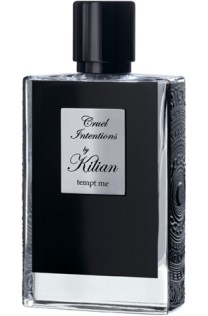
As a side note, I also tried By Kilian’s Cruel Intentions (Tempt Me), his woody oud Cruel Intentions By Kilian for women and menfragrance from the same 2007 collection. I’m not even going to bother writing about it. Something about the vanilla base in all these perfumes simply does not agree with me. I find Cruel Intentions to be equally unbearable, despite a list of notes that would normally appeal to me:

Top notes are african orange flower, bergamot, rose and violet; middle notes are guaiac wood, agarwood (oud) and papyrus; base notes are vetiver, musk, sandalwood, styrax, vanille and castoreum.

On me, that screeching, sharp, cloying and very synthetic vanilla simply overpowers everything. I suppose there are faint traces of vetiver and, eventually, some sandalwood — but they are hard to detect. I am simply bashed over the head by that same fake, powdered vanilla which made my stomach heave in Love (Don’t Be Shy). A number of people on Fragrantica say that Cruel Intentions is primarily a sandalwood fragrance. I love sandalwood, but there is no way I’m going to last long enough to find out. Plus, I have to say, I’m highly skeptical that anything will overcome this horrid, synthetic, vanilla powder (and white musk) that has been an overwhelming hallmark of two of the three L’Oeuvre Noire fragrances that I’ve tried thus far. As I said at the start, perfume hasn’t made me quite so miserable in a while. It’s hard to believe that these perfumes come from the same house which produced the oud Arabian Nights Collection — a line that is miles apart from this one.

Now, if you’ll excuse me, I have to scrub myself clean…..

Review: By Kilian & Montale Oud perfumes

I’ve tried a number of unisex Oud fragrances from such niche perfume lines as Montale and By Kilian. (The latter was founded by the grandson of the famous Hennessy dynasty whose high-end cognac company is now part of the LVMH luxury conglomerate.) Oud scents are not cheap and the niche houses who put them out can charge a pretty penny. I could afford to try so many only thanks to the incredibly useful website, Surrender to Chance, which sells sample vials or larger-sized “decants” of almost every cologne or fragrance imaginable – from department stores lines to the niche houses to the rare, discontinued and vintage. (I cannot recommend them enough and the shipping is a fantastic price for a fast turnaround: $2.95 for First Class Shipping on any order within the U.S., and starting at $5.95 for international shipping.)

From By Kilian (hereinafter referred to just as Kilian), I tried four unisex fragrances from his Arabian Nights Collection: Amber OudRose OudIncense Oud and Pure OudIncense Oud opened with a sharp lime note which quickly receded to the background as the smoky, incense-y wood notes appeared. I liked this scent, though I swing back and forth as to whether I prefer the Rose Oud which opens with that sharp lime note before adding a rose element to the smokiness and woodiness. Honestly, I’ve concluded that that bitter, acrid, sharp, almost burning lime element has to be some element of the Oud distillation because I get it in a number of different Oud scents on the market. Not all, but enough such that I sometimes wonder if I’m imagining its pervasiveness, particularly as “sharp, acrid lime” is not something usually associated with Oud. This is obviously where personal chemistry comes into play.

Regardless, both Incense and Rose Oud settle into a comfortable, smoky woodiness that is quite different.  Neither has much sillage or longevity on me, but as I have repeatedly mentioned, few things do. With both Kilians, they fade into softness as quickly as 15 minutes later! However, they do remain, albeit close to the skin, with the Incense lasting for about 2 hours and the Rose Oud lasting a bit closer to 3 hours.

Kilian’s Amber Oud was a different experience because I smelled no oud whatsoever! No acrid, sour lime here but, rather, a lovely, very sweet opening note of amber and brown sugar. Almost a caramel feel, you might say, mixed with some 1970s-style patchouli and vanilla. The wood accord is simply nonexistent. So much so that I wondered if I was completely insane and decided to check the website, Basenotes. Apparently, I’m sane. There is no oud, according to most of the commentators, even though the official notes include it, along with bayleaf, cedarwood, amber and vanilla. As one person noted, you could get  the same result from Prada’s Amber series. I will say this, however, it lasted longer on me than the Rose or Incense versions.

Pure Oud was a completely unique experience out of the four Arabian Night fragrances that I tried. Basenotes states that it is composed of: “Oud, Saffron, Copahu balm, Amber, Gaiac wood, Cypriol, Cistus labdanum, Myrrh, Animalic notes.” On me, it (thankfully) lacked the strong opening lime note but descended immediately into a pure, almost synthetic perhaps, explosion of woodiness. It was different, there is no doubt, and quite fascinating. I can honestly say I’ve never smelled anything like it, perhaps as it is a cold, stony, wintery wood scent with a leather undertone. It strongly reminds me of the inside of a new, very expensive luxury car with ample (real) walnut wood and leather that is like butter. Except here, the leather isn’t hugely prominant in the face of that cold, steely wood. There is definitely an outdoorsy feel to this that is quite mentally and psychologically evocative. Living in warm Houston, I was strongly reminded of living in New York at Christmas time, wrapped up in a thick woolen coat and walking a street decorated with Christmas lights and covered with snow as tall steel or stone structures loomed up above. There is a slightly stony element and a coldness (in a good way) to the scent, along with the outdoorsy elements and leather. It made me wonder if this was what “cold,” “winter” or “stone” smelled like to the antihero, Grenouille, in the famous book Perfume.

Alas, even half a sample vial of this (in one go!) started to mellow on me within 15 minutes. It did not, however, fade completely. Instead, something different emerged. I actually could smell some Saffron (I cook a lot) and definitely some Myrrh. From that very cold, almost stone-like opening of wood with leather, now emerged lovely Myrrh, Saffron and Oud. My nose is not distinguished enough to know what Gaiac Wood, Cyprior or Cistus Labdanum smell like exactly but, whatever this is and whatever they do, the overall result is lovely. All in all, Pure Oud lasted perhaps 2 hours on me. I can’t say that it is something I would reach for daily but for those occasions when I want to feel different, unique and strangely enough, powerful, I would reach for this.

In contrast, Lime Aoud from Montale made me want a “Silkwood Shower.” (“Silkwood” is a fantastic film with Meryl Streep which led to the popular term referencing the scalding shower intended to rid one of radioactive contamination.) In fact, I did take my own version of Silkwood shower. Alas, there was no remedying how revolting this smelled on me. Oh, the irony that the woman on whom most things fade is subjected to a perfume she loathes and cannot escape. (As one of my best friends put it, it’s a situation worthy of the Twilight Zone.) I should begin by stating that the niche perfume house, Montale, is well-known (and much adored) for its various Aoud scents. They have many, with Dark Aoud being one that people frequently rave about as the ultimate in pure, really dark, super intense Aoud scents. (God, if it’s stronger than the Lime Aoud, please kill me before a touch of it gets on me.)

I ordered Lime Aoud because of the many raves for it on Fragrantica. Its notes intrigued me and certainly sounded good at the time: Aoud, Rose, Iris, Amber, Patchouli, Sandalwood, and Saffron. (See, Basenotes.) Some comments mention the extremely harsh opening of lime and Aoud. (It was the first time that lime was officially supposed to be part of an Aoud fragrance that I’d tested and, yet, I sometimes smell that note when it’s not supposed to be. Baffling.) Other commentators talk about a medicinal, bitter and metallic scent. I agree with both of those impressions. I’m not sure I agree with those who say that Lime Aoud turns into amber, sandalwood and roses.

The first time I put on Lime Aoud, I put on a small amount as I could tell from the moment I opened the vial that it was intense. I was blasted back by the lime and medicinal nature of it for hours. Sharp, acrid, medicinal, camphorous even, mixed in — totally incongruously, if I might add — with competing floral scents in an utterly revolting mix that just got stronger and stronger. After about 5 hours of barely suppressing nausea, I finally caved and took a long, scalding shower. Even after that, I could still smell faint traces of the worst part of it. And my clothes and hair positively reeked of it. It was so horrendous, I threw my clothes into the washer.

A few days later, I wondered if I’d imagined it and thought that I should give it another go. After all, some scents develop and change. Maybe I hadn’t given it enough of a chance. No. I lasted even less this time. I simply could not bear it. It was like someone had sprayed a floral scent in the air of a morgue, combining with its antiseptic, harshly metallic, cold, steel, and then added about a gallon of bitter lime on top of all that. My God, I’m cringing at the sheer memory.

Montale’s Aoud Blossom was slightly more successful  on me. Probably because it seems to have very little Aoud in it! According a commentator on Basenotes, it contains: “bergamot, Sicilian mandarin, ylang ylang, violet, jasmine sambac, tuberose, rose, Mysore sandalwood, Arabian oud.”  Many seem to think there is little to no real Aoud in it. I disagree. I can definitely smell it in the opening minutes, faint though it may be. Someone says they can smell the tuberose in it. I love tuberose and I get none of that on me. What I can smell is a definite floriental. Floral from the very dominant rose component, and oriental from the more spicy notes. I’m not sure I can really detect the mandarin, violet or jasmin but I can definitely smell the bergamot, ylang ylang and the sandalwood. However, everything is essentially overwhelmed by a very loud rose note that remains consistently dominant.

While Kilian and Serge Lutens fragrances don’t last long on me (at all!), Montale ones have decent to moderate sillage, and great longevity. (Too great, alas, in the case of the Lime Aoud). Its longevity is quite surprising to me, given how niche fragrances usually die a quick death on my skin. Aoud Blossom lasted about 5 hours on me, all in all. I will be frank, however, this is not a scent I would ever reach for again. And I am fighting off the urge to take another shower. It’s simply too pungent and in-your-face. Now, I *adore* strong scents, floral orientals and anything with a POW! And almost nothing gives me a bad physical reaction. But this… I can feel it at the back of my throat, it’s so overpowering that I feel a bit dizzy and I feel the onset of a migraine. It’s a deeply unhappy experience and one which has made me conclude that I must stay very far away from the House of Montale.

That said, there are enough variations of Aoud on the market that — whether your preference is for a sweeter version, a more woody one, a floral rose variation or hard core medicinal iteration — you can be sure to find one that appeals to you. If you’re willing to pay the prices for the uniqueness! This is not Coty or even your mother’s Estée Lauder. As for me, I will continue my exploration of Oud – probably with Tom Ford’s Oud Wood next as a friend of mine reports nothing medicinal, metallic, acrid or sharp about it. If I do try it out, I will be sure to report back.