Review En Bref: Aftelier Perfumes Secret Garden Eau de Parfum

As always, my Reviews En Bref are for perfumes that — for whatever reason — didn’t seem to warrant one of my more lengthy, exhaustive, detailed reviews.

SecretGarden bookOne of the most beautiful children’s books is The Secret Garden (1910/1911) by Frances Hodgson Burnett. As a rather lonely, very isolated child whose main companions were books and animals, The Secret Garden gave me hours of comfort, joy and peace. In fact, I kept my copy of it throughout the years and am staring at it as we speak. So, as you might imagine, I was extremely excited to try its concrete, olfactory manifestation: Secret Garden by the highly respected, acclaimed perfumer, Mandy Aftel of Aftelier Perfumes.

Ms. Aftel is a perfumer who specializes in natural fragrances, seeking out only the finest in pure essences and oils. She hand-blends and bottles all the perfumes herself in small batches in her Berkeley studio. As she explains on her website:

My perfumes and products contain only the purest, most sublime botanical essences from around the world. I work with awe and passion for the alchemy that transforms these rare, gorgeous individual natural essences into a beautiful perfume. Indulge yourself in authentic luxury.

Secret Garden Eau de Parfum. Source: Fragrantica.

Secret Garden Eau de Parfum. Source: Fragrantica.

In 2011, Ms. Aftel released Secret Garden, a floral oriental fragrance that comes in Pure Parfum and Eau de Parfum concentrations. This review is only for the latter. According to the Aftelier website, the perfume’s notes include:

Top: bergamot, bois de rose, Geraniol, blood orange.
Heart: jasmine sambac, raspberry (compounded isolate), Turkish rose.
Base: civet, castoreum, vanilla, deertongue (plant), benzoin, aged patchouli.

A few words about the notes. First, I’ve read on a number of sites, including Fragrantica, that the perfume also includes Blue Lotus, which has a sweetly aquatic, watery, floral aroma. I don’t know if it is still included, since it is not listed on the Aftelier website. Second, “deertongue” is a plant and has nothing to do with any animal. There are no animal cruelty issues to be concerned about here! The plant is sometimes called the “Vanilla Plant,” and its scent is described by Ms. Aftel as a combination of “the sweet and powdery notes of tonka beans with the aromas of the countryside.” Third, Ms. Aftel clarified in a comment on Now Smell This that Bois de Rose is another name for rosewood. Lastly, as Fragrantica explains, Secret Garden “includes two historical animal essences: very old civet bought from a retired perfumer and castoreum tinctured from the beaver.” Since the civet was extremely old stock, there should be no concerns of animals being harmed to create Secret Garden, but those who seek completely vegan perfumes may want to ponder the civet issue.

Ms. Aftel describes the perfume as follows:

Like fitting a key in a lock, when you inhale Secret Garden, you enter a redolent and sensual wild garden, where the scent awakens a vitalizing force in the wearer.

Secret Garden opens into roses and wood, brightened with mixed citrus. The jasmine sambac heart of the perfume, with its spicy indolic kick, paired with the jammy raspberry, lends the illusion of spice where there is none — like the lure of a blind pathway in a garden. This intertwines with voluptuous Turkish rose absolute.

Secret Garden opens on my skin with animalic notes from the very start. There are subtle touches of geranium alongside a very heavy, rich, red rose, atop a foundation of raspberry with just the subtlest hint of citrus. But these are all extremely muted; the primary, overwhelming impression is of castoreum and civet, creating a dense musk tonality with strongly leathered, almost tarry, undertones. The castoreum is potent and, for once, the term “animalic” applies quite literally.
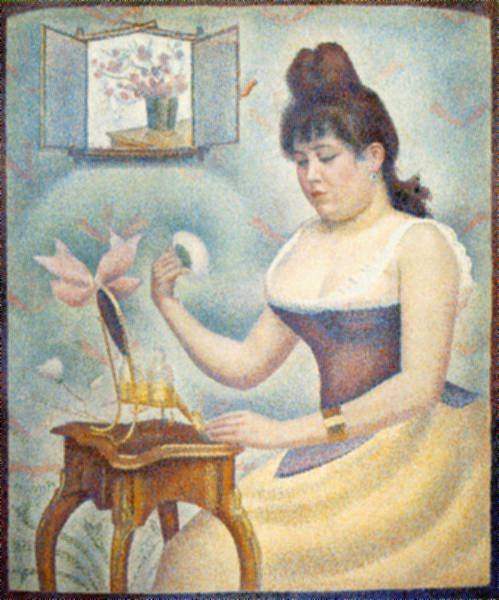
George Seurat: "Young Woman Powdering Herself."

George Seurat: “Young Woman Powdering Herself.”

There are also hints of vanillic powder that lurk in the background and that become stronger with every passing moment. As it increases in prominence, less than five minutes into the perfume’s development, it softens the potent, opaque, heavy richness of the animalic tones, rendering them lighter and softer. The powder accord strongly brings to mind those extremely old-fashioned, big, powder poofs that women in the late 19th century would use to dust their décolletage to erase any suggestion of a moist sheen. Here, the note is that exact same old-fashioned, vanilla-centered, makeup powder accord. It’s light and daintily sweet, but, as time passes, it becomes one of the primary, dominant notes on my skin, overshadowing much else except the castoreum.

Ten minutes in, the perfume shifts a tiny bit. The geranium recedes to the background, to be replaced by muted hints of rose and jasmine. They are not strong. In fact, the flowers are never wholly distinct on my skin at all, and are completely dominated by the other notes. By the twenty-minute mark, the floral bouquet feels almost amorphous and abstract, just an overall suggestion in the midst of what is predominantly fruity musk, raspberry and vanilla powder. Very soon thereafter, and for the remainder of the perfume’s development on my skin, Secret Garden is merely powdery, raspberry musk. That’s it.

I tried Secret Garden twice, and it was the exact same development on both occasions. Before the start of the second test, I wondered if perhaps my skin was too dry to bring out the lush, blooming garden that I had so anticipated, so I put on some unscented lotion, waited thirty minutes, and then re-tested the perfume. I applied a greater quantity; I even applied a smear to my inner thigh as well, in case something about my arms was wonky and was throwing off the scent. But, alas, nothing worked. Just like the first time, there were minimal florals at the start, followed by almost none after the first 20 minutes. Instead, the perfume was mainly raspberry castoreum musk and old-fashioned, scented makeup powder, lying close to the skin. And Secret Garden remained that way for approximately 5.5 hours and 6.5 hours, respectively, until the last traces finally faded away. (For an all-natural perfume with no synthetics, the longevity on my voracious, perfume-consuming skin was quite impressive.)
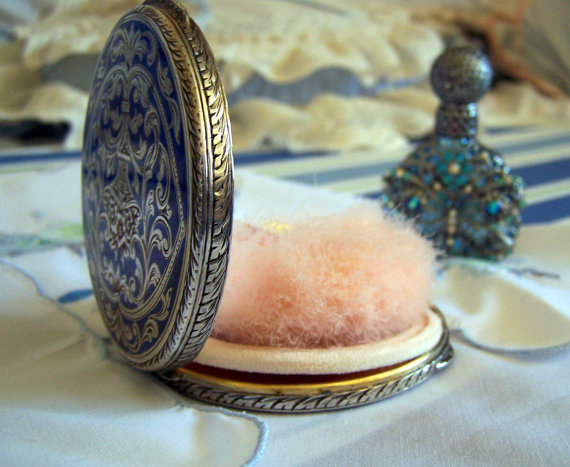
Vintage 1930s Powder Puff Compact. Source: Etsy Boutique "ItsAGoodThing" listing 72555631

Vintage 1930s Powder Puff Compact. Source: Etsy Boutique “ItsAGoodThing” listing 72555631 (Link to the Etsy store embedded within. Click on photo.)

Given my personal style and tastes, the way Secret Garden manifested itself on my skin wasn’t my cup of tea. Something about my skin chemistry completely refused to bring out the lush garden that I kept reading about in all the reviews. Whether one reads the assessments on Now Smell This, The Non-Blonde, The Perfume Shrine, Perfume-Smellin’ ThingsOlfactoria’s Travels, or Smelly Thoughts, they are all glowing; and the vast majority talk about the rich, spicy, powerful floral heart that prevents the perfume from being too jammy or too much of a fruit cocktail. Reading Freddie’s experiences in his Smelly Thoughts review, in particular, I felt as though I was crazy and smelling a different fragrance entirely. Naturally, the tricky issue of skin chemistry will often mean that a perfume manifests itself differently. But those are usually small differences in degree, here or there, not a totally polar opposite experience.

I would have felt like a complete anomaly in the vast ocean of positive raves about the lush, floral garden if I hadn’t come across a few isolated voices whose comments reflected — just in small part — my own experience. For example, on Surrender to Chance, one person wrote: “Sadly, on me it smelled unexciting — like Juicy Fruit gum, with a little nutmeg thrown in. Next.” If we’re going by this analogy, I would compare it more to a powdery sweet, raspberry bubble gum, but I can understand the impression. On Fragrantica, one of the two (both positive) comments says “Warning: it can smell ‘grandmother-y’ to certain people used to very conventional perfumes.” I like both conventional and extremely unconventional scents, and I’m hardly a perfume dilettante, but, yes, I think Secret Garden’s manifestation on my skin was “grandmother-ly.” Without any doubt at all. It’s the overwhelming powder. It’s not bad, and it’s almost sweetly pretty, but that extremely old-fashioned, simple character is not to everyone’s taste.

Again, the minor criticisms or caveats are few and far between. Judging by the blogosphere, 99% of people seem to have had a completely different experience than I did. All perfume experiences are subjective; I repeat that again and again in my reviews. My personal experience with Secret Garden may very well be a complete anomaly. But given the overwhelming nature of those many (many) positive reviews, I thought it was important to share a dissenting opinion, especially as we’re talking about a perfume whose cost can reach $170 for a small bottle. I very much hope that Secret Garden manifests itself on your skin as a lush, blooming floral garden with a secret heart of animalic gold, a perfume that incorporates India’s heady, opulent, orientalist flowers with the best of the English countryside. But, if it doesn’t, you’re not crazy and not completely alone.


DETAILS:
Cost & Availability: Secret Garden comes in different formulations and sizes. It is available directly from the Aftelier website as 2 ml of Pure Parfum for $50; 0.25 oz of Pure Parfum for $170; and 30 ml Eau de Parfum for $170. Samples are available for $6 for a 1/4 ml vial of both the EDP and the pure parfum. Aftelier’s shipping rates start under $5 in the U.S., and under $9 worldwide. I obtained my sample of the Eau de Parfum from Surrender to Chance where prices start at $3.99 for a 1/2 ml vial.

Perfume Review – Arquiste L’Etrog

L'Etrog presentation on the Arquiste website.

L’Etrog presentation on the Arquiste website.

October 1175. Calabria, Italy. South of Naples, northeast of Sicily. “During the First Crusade, Southern Italy fell to the Normans, which encouraged Calabrian Jews to engage in the agricultural trades. By the 12th century, the communities were thriving. Since then, the harvest of the Diamante Citron or Etrog has remained a regional tradition.” Etrog is even described in the Bible in connection to the Garden of Eden. “The fragrance is said to be the ‘Fragrance of Heaven’, and the Etrog itself is associated with righteousness, goodness and desirability.”

Carlos Huber.

Carlos Huber.

October 1175 in Calabria, history and the etrog fruit are the specific inspirations for L’Etrog by the American niche perfume house, Arquiste. Founded by the architect turned perfumer (and now, designer), Carlos Huber, Arquiste always attempts to bottle a specific moment in history. It’s something that I greatly admire, as history has always been one of my greatest passions in life. And, here, the mission is not only to capture the festival of L’Etrog in Norman-conquered Calabria, but also the very feel of life in the Mediterranean itself.

Arquiste elaborates further on the exact mental picture that the perfume is meant to evoke:

In Medieval Calabria, a family gathers to celebrate a good harvest. Within a cabin built of Palm leaves and other woody branches, an aromatic bounty is presented. The citrusy scent of the Etrog citron, a regional specialty, brightens the air while embracing Myrtle and lush Date Fruit envelope the sweet warmth of the Mediterranean night.

L'EtrogReleased in late 2011, L’Etrog is described as a “citrus chypre” and was created by Rodrigo Flores-Roux and Yann VasnierOn its website, Arquiste says:

The brisk character of Myrtle marries with leafy nuances, emulating the freshly opened fronds of palm trees. An unexpected mouthwatering accent follows, with Smyrna Date fruit and elegant Cedar wood from Lebanon.

Cedar, however, is not explicitly included in L’Etrog’s official notes on the Arquiste website which merely list:

Calabrese Cedrat [Citron], Myrtle, Date Fruit and Vetiver

Elsewhere, however, department store retailers like Barneys and blogs like CaFleureBon quote the press release description which states the perfume is: “a citrus chypre with citron, palm leaves, willow branches, myrtle and dates.” So, let’s just assume that “willow branches” and “palm leaves” are in there, along with cedar, too.

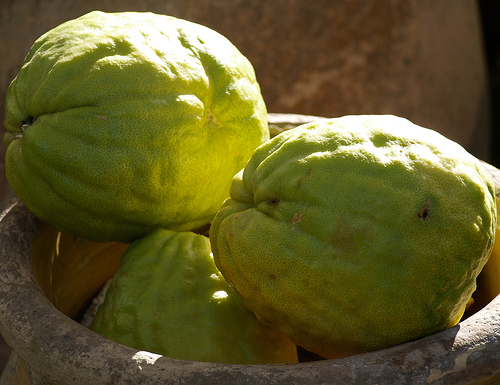
Diamante Citron or Etrog.

Diamante Citron or Etrog.

As for the fruit in question, internet research tells me that cedrat is a type of very large, fruity lemon with a thick rind and little acidity. It has many different names: cedrat seems to be one linguistic version of the term citron (which is the main French name) and seems to be the same as etrog which Wikipedia tells me is the Hebrew version. Whatever the linguistics, the fruit looks a bit like its close cousin, the pomelo, but doesn’t smell (or taste) like a grapefruit.

I’m a little OCD, so forgive my brief digression into history for a moment. First, Arquiste’s comment on the Normans would seem to imply that they were responsible for agriculture successes in the region, when I think that history would argue it was the Saracens or Moors. Starting in the late 9th Century, they invaded the area in southern Italy that includes Calabria and that later became part of the larger Kingdom of Sicily. It was the Moors who seriously impacted both the agriculture and the cuisine (not to mention the architecture); who brought over things like dates, oranges and lemons; and whose advancements in agricultural techniques led to the thriving cultivation of those citrus crops — techniques that, I would argue, were the sole reason for the bounty of the etrog on that day in October 1175 during the Jewish festival of Sukkot. It was not the bloody Normans! They were merely the subsequent conquerors. So, while Robert Guiscard admittedly encouraged the Calabrian Jews, it was the Moors who got the whole ball rolling to start with in what has been termed the Arab Agricultural Revolution. (Sorry for the tangent, but that esoteric point has been bothering me for hours and hours.)(And hours!)

Second, and returning to the perfume now, I don’t understand how L’Etrog is supposed to be even a neo-chypre, let alone an actual one. There is no oakmoss; there isn’t even the patchouli that is sometimes considered as an alternative foundational base. Is vetiver alone now enough? Not in my opinion.

Citron.

Citron.

I tested L’Etrog twice, using different quantities and resulting in a very different openings. The first time, my hand slipped and quite a large amount gushed out of the vial onto my arm. It was a vision of bright, sunny, yellow with sweet lemon that wasn’t zesty so much as slightly fruity and rich. There were also elements of light vetiver and myrtle. According to Fragrantica, myrtle oil is said to have a scent similar to eucalyptus but here, during the first test, there is a minty undertone instead. It creates a slightly chilled, very energizing effect that is lovely. At the same time, however, something about the overall combination leads to a definite impression of Theraflu or LemSip cold powder. As the seconds passed, the minty touches grow stronger, creating more of a fizzy, sparkling aspect than just mere fruity citron.

After 15 minutes, the perfume changes slightly. The fruity aspect of the citron grows stronger, but it doesn’t seem at all like dates, per se. In fact, there is nothing reminiscent of sweetly dark, dried fruits at all. At the same time, the vetiver also becomes more prominent, adding a quiet earthiness to the scent. What is more interesting, however, is the interplay between the vetiver and the myrtle.

Eucalyptus leavesOn one part of my arm, the peppermint note has transformed into eucalyptus, nullifying much of the sweet lemon but accentuating the vetiver. L’Etrog shows itself here as a spicy, mentholated eucalyptus with vetiver that is simultaneously earthy, rooty and touched by nuances of green citrus. On another part, however, it remains as peppermint, enabling the sweet, fruited lemon to show itself. Here, L’Etrog is a fruity lemon scent with a more generalized, abstract woody undertone. In both cases, however, the perfume is incredibly light, airy, and sheer. It’s much more akin to a cologne in feel and becomes a skin scent in as little as 20 minutes on my skin.

At the ninety minute mark during this first test, L’Etrog is a sheer lemon vetiver scent with the merest hint of woody, peppery elements and a bare drop of sweetness. Something in the undertone feels a little like ISO E Super, but it’s extremely light. The perfume remains this way for a number of hours until, around fifth hour, it turns into a thin veil of musky vetiver with a hint of lemony fruit. By the ninth hour, the last traces of L’Etrog are soapy musk with vetiver. Soon thereafter, it faded away entirely.

Joy Dishwashing liquidMy second test of L’Etrog involved a far lesser quantity and, as a result, led to a very different opening. This time, the perfume opened with spicy lemon (not a sweetly fruited one) intertwined completely with very woody vetiver. There was also quite a noticeable amount of soap from the start, and the myrtle showed no minty aspects at all. Instead, it was all eucalyptus. The whole lemon, vetiver, soap mix strongly called to mind lemon liquid dishwashing liquid. It wasn’t unpleasant, but the Joy similarities couldn’t be ignored.

Another big difference was the presence of ISO E Super. I don’t know why it was so much more evident at a lesser quantity of L’Etrog, as opposed to the greater dosage, but I’m absolutely convinced it’s there. L’Etrog had a slightly velvety wood undertone with that telltale, giveaway sign of peppery, rubbing alcohol. The ISO E Super is not enormously prominent, and it does fade away after an hour, but given the headaches that even small amounts can cause people who are sensitive to the note, I wanted to warn you.

By the second hour, during the second test, L’Etrog was primarily a vetiver scent with lemon nuances, a woody undertone, and the merest whisper of light musk. And it remained that way until the final drydown when it turned, again, more of a soapy, light musk. The perfume was so close to the skin, it was incredibly hard to smell at times. Clearly, this is a perfume that — like a cologne — will require a significant quantity if you want to detect its nuances. And, even then, you’re going to have to put your nose directly on your skin after the first hour. All in all, the perfume lasted a little under 7 hours with the lesser amount.

L’Etrog wasn’t my cup of tea. True, my personal style and tastes are very different, but I also found it disappointing as a whole. Ignoring completely the sillage issue, L’Etrog was a tame, boring, linear creation that really just played off lemon and vetiver. Perhaps if I’d smelled actual dates, I would have been more excited. But I doubt it. Lemon and vetiver are the primary strands of this perfume, with everything else being merely a tangential, occasional touch — from eucalyptus, to soap, to amorphous woody notes, to ISO E Super, to musk. They can’t take away from the main, most evident thrust of the perfume. Even the lemon itself wasn’t unique, the way the descriptions of Calabrese cedrat or etrog had led me to expect. In short, L’Etrog simply isn’t that interesting — not at $165 for a 55 ml/1.8 oz bottle. It actually verges on the banal and mundane. I far preferred Arquiste’s fabulous, wonderfully nuanced, sophisticated, rich Anima Dulcis.

On Fragrantica, the comments vary. There are those who find it “super wearable” but admit that they don’t have “the most trained of nose palates,” and then there are established commentators like the hardcore perfumista, “Sherapop,” who found L’Etrog to be a pleasant, somewhat quirky perfume that is “nice… but not compelling.” She reached that conclusion despite smelling not only the dates, but some candied sweetness and some caramel. (So, perhaps I didn’t miss out on anything after all?) Interestingly, she seems to have first smelled the perfume blind as part of Chandler Burr’s Untitled Series and thought that it was Histoires de Parfums 1873 (“Colette“). In a side by side test, before the reveal, she detected small differences, but not much. The similarity is something to keep in mind if you have tested or own Colette.

But Sherapop wasn’t the only one who gave a shrug of “meh” to L’Etrog. Another commentator, “Alfarom,” succinctly summed up the perfume as follows:

A citron hologram introduces a honestly crafted woody-citrus fragrance that’s refined, nice smelling and very wearable. The woody notes (incredibly not overdone) and some sweetness, provide some sustain to an otherwise extremely fleeting composition that while resulting definitely pleasant, it still doesn’t have the ability to stand out in todays overpopulated niche market…

Nice yet somewhat forgettable.

That said, for those who want a simple, light, sheer, summery, lemon vetiver cologne that is utterly inoffensive, you may want to try L’Etrog. It would be appropriate for even the most conservative office environment. No perfume Nazi would be bothered, simply because they wouldn’t be able to detect it; unless they had sensitivities to ISO E Super, in which case, you may be screwed….


DETAILS:
Cost & Availability: L’Etrog costs US $165, CAD $200, £125.00 or €149. It comes only as an eau de parfum and is available only in a 55 ml/ 1.85 oz size. In the US, it is available on the Arquiste website, Barneys, and Aedes. In Canada, the Arquiste line is available at Holt Renfrew Bloor in Toronto (though I could not locate it on the overall Holt Renfrew website), or at Etiket in Montreal for CAD $200. Each store is the exclusive dealer for the Arquiste line in their city. In the UK, it is available for £125.00 at Liberty London which also ships throughout Europe. In France, you can find it at Jovoy Paris where it retails for €149. Elsewhere, you can use Arquiste’s “Stockists” page to find a retailer near you. Samples are available at Surrender to Chance where the price starts at $4.99 for a 1/2 ml vial. The site also sells all 7 perfumes from the Arquiste line in a sample pack for $33.99.

Perfume Review: By Kilian Flower of Immortality

The daintiest of Chinese watercolours with sheer, minimalistic and translucent brush strokes. That is what comes to mind when I wear Flower of Immortality, the new fragrance from the luxury perfume house, By Kilian.

Chinese watercolour. Source: Xiami.com

Chinese watercolour. Source: Xiami.com

Flower of Immortality is an eau de parfum which will be released next week, in early April 2013, as the third in Kilian’s Asian Tales series of perfumes which first launched in 2012. It is a simple, uncomplicated, fruity-floral scent which is pretty but alarmingly evanescent — and not just for my skin.

Source: Tumblr.

Source: Tumblr.

Flower of Immortality celebrates white peaches, the flower of which represents immortality in ancient Chinese folklore. The perfume was inspired by “A Tale of the Fountain of the Peach Blossom Spring” where a fisherman follows the scent of peach blossoms and ends up in Utopia. Luckyscent has the full details on the scent which it describes as follows:

For Kilian, Flower of Immortality is, above all, an olfactory homage to the peach blossom and its very strong symbolism in China. This blossom, whose pink petals are unveiled only in the middle of the winter, is believed to have the power to bewitch the human soul and to make it immortal. It is the set of symbols and myths that surround the flower that Kilian wanted to recreate in this new fragrance.

peach blossomFlower of Immortality was composed as the memory of the utopian paradise, where the fragrance of peach blossoms brings a promise of hospitality and immortality. The smooth and juicy scent of White Peach, interweaved by the sweet and powdery notes of Carrot and Iris. A dazzling breeze of Blackcurrant Bud absolute refreshes while the exquisite Rose Crystal is softened by the Tonka Bean and the scent of Vanilla beans drying in the sun.

By Kilian FOI 50 ml Bottle.JPGThe perfume was created by Calice Becker and the full list of its notes, as compiled from both Fragrantica and LuckyScent, is as follows:

White peach, carrot seeds, blackcurrant bud, freesia, iris, rose, vanilla, tonka bean, and white musk.

Flower of Immortality opens on my skin with the very sweetest of white peaches. There is nothing heavy or ripe in the note which blossoms like an airy cloud on the skin. Seconds later, there is a fleeting touch of black currant (or cassis) with a touch of tart juiciness — but it doesn’t last very long. Soon, it is replaced by notes of fresh carrots and light roses on a white musk base. I happen to like the sweet touch that carrots can bring and think it adds a little depth to the very predominant fruity aspects of the perfume. There are also some very quiet, subtle floral hints from the freesia; like the black currant, that doesn’t last long, either. I don’t detect any iris at all in the perfume.

Source: TheCleverCarrot.com

Source: TheCleverCarrot.com

A few minutes in, Flower of Immortality turns predominantly into a white peach scent. It’s almost like a watery nectar in its airy, shimmery, gauzy feel. There is the muted hint of white musk and, like a ghost popping up every now and then, some extremely subtle touches of carrot. None of these notes change the simpleness of the basic scent: it feels as though I have the lightest veil of actual white peach juice on my skin, and not much else. It’s very pleasant for what it is, but this is a not a complex fragrance by any stretch of the imagination.

The perfume continues as a white peach and musk scent for another hour. And then it dies. Completely. One doesn’t aim for “immortality” in perfumes, but this is too bloody short! If I sniff my arm with intense determination to find it — somewhere, anywhere — I tell myself that I can detect some lingering traces in tiny, random patches for another twenty minutes. Honestly, I think it’s the mere power of suggestion.

The frightening thing is that I — with my perfume-consuming skin — was actually luckier than one poor woman (“raw umber“) on Fragrantica whose entire experience lasted just 20 minutes. Her frustration is quite telling:

Flower of Immortality opens with sugar-covered yellow & pink Haribo peach gummy candies in a cut crystal dish with zingy black currants and a powdery floral note. Mmhm… not bad at all.

[¶] … Only 15 minutes after application, I am holding my nose to my skin in disbelief. Did I spray perfume here once? I swear it smells like peaches, but it must be my imagination. Or maybe… It was a ghost!!!

Perhaps there is an intentional inverse relationship between the Immortal in the name, and the life-span of this scent? 20 minutes in, I’m smelling basenotes as if the perfume had been applied three days ago and this is all that remains. 

I want to put the paddles on this fragrance and shock it back to life. Alas, before I can reach for my cell phone charger, my flame thrower, or my sample vial for a refresher, ANYTHING that might in some way help… Flower of Immortality is already going… going… 

gone.

By Kilian fragrances are not cheap, though thankfully there are a few more affordable options in terms of travel-sizes and refill bottles. Flower of Immortality costs $235 (or €175) for 1.7 oz/50 ml in the traditional lock-box version, but $135 if you want to purchase the refill bottle instead. Either way, that’s expensive for a linear, uncomplicated peach scent which disappears after 20 minutes or, if you’re lucky, an hour. And this is an eau de parfum, so it’s not as if you can try to buy it in a more concentrated, lasting form!

Chinese Peach blossom paintings from FengSuej com

To be frank, I thought the Chinese watercolours I found while writing up my post were a lot prettier and more interesting than the perfume. Don’t get me wrong, Flower of Immortality is perfectly pleasant, even if it’s a little boring. If you like airy, sheer, minimalistic, peach nectars, you may truly enjoy the scent. But I would highly recommend testing it out on your skin before buying it blindly. For those who aren’t a fan of the peach note, you may want to stay away entirely.

DETAILS:
Cost & Availability: Flower of Immortality is an eau de parfum that costs $135, $145 or $235 (depending on the form in which you buy it). It is available on By Kilian’s international website where it costs €175 for a 1.7 oz/50 ml bottle. The site also has the more affordable options. In the U.S., Flower of Immortality is available for pre-order now on Luckyscent with the perfume to be shipped out on April 4, 2013. The site also offers samples for $4 for a 0.7 ounce vial. Samples are also available at Surrender to Chance and cost $3.99 for a 1/2 ml vial. I obtained my sample from Saks Fifth Avenue, thanks to the generosity of a sales assistant. Saks also carries the scent, though it won’t be available for purchase in the actual stores until April 4th. I was going to give you the link to the Saks website but, somehow, between the time that I got the sample and saw it online, and the time of writing this post, the perfume is no longer shown online. 

Perfume Review: I Love New York For All by Bond No. 9

Bond No. 9 is a New York perfume house founded in 2003 whose fragrances celebrate the city itself. As the company explains on its website,

The Bond No. 9 collection of women’s, men’s, and unisex eaux de parfum — has a dual mission: To restore artistry to perfumery, and to mark every New York neighborhood with a scent of its own. Each fragrance represents a specific downtown, midtown, or uptown locale or a city-wide sensibility.

ILNY_LOGO_BANNER_RED

Bond No. 9 has a variety of different collection lines, but the “I Love New York” (sometimes spelled elsewhere as “I Love NY”) line is intended to be a special post-9/11 homage to the whole state of New York. Released in September 2011, ten years after the horrors of that day, “I Love New York” began with three perfumes (For Him, For Her, and For All) and will soon expand to number many others fragrances. I think there may be nine in the line by now (For Marriage Equality, For Mothers, For Father’s, For Earth Day, etc.), but I’m not certain of the final total.

Sephora began to carry a few Bond No. 9 fragrances as of March 2013, so I thought this would be a good time to start exploring the line. There is enormous adoration for the big fan favorite, Chinatown, as well as for New Haarlem, but I thought I would start with the “I Love New York” collection since that is what Sephora carries. I chose “I Love New York For All” because it’s essentially a coffee scent and… well, I have a slight problem with caffeine over-consumption.

I_Love_NY_For_AllThe company describes I Love New York for All as:

velvety smooth yet sense-awakening—like a really good and fresh cup of java laden with cream. In fact, at the heart of this warmth-inducing gourmand’s delight is an infusion of coffee beans with soothing but slightly spicy cacao natural and tantalizing creamy chestnut. But those aren’t the first flavors you smell. At the outset, a gentle wake-up call: a citrus-floral-spice blend of bergamot, lily of the valley, and pepper. Top-notes usually aren’t as softspoken as these, but for sure your attention is riveted, and remains so as the coffee aroma begins percolating. The mellowness is sustained at the end with base notes of exotic, always-entrancing patchouli, animal leatherwood, hypnotic sandalwood, and, adding a rum-like kicker, vanilla.

The exact notes in the perfume (which I’ll sometimes refer to simply as, “For All“) are:

bergamot, muguet, lily of the valley, pepper, coffee beans, cacao, creamy chestnut, patchouli, vanilla, leatherwood and sandalwood.

Oddly enough, the carded manufacturer’s sample that I have also lists “full-bodied geranium,” which is not on the notes on either Bond No. 9’s website nor on Fragrantica. It is, however, most definitely part of the perfume and a big part of its opening.

I Love New York For All has a crazy, crazy start! Utterly schizophrenic and unusual — not in a good way, either. It begins all green, black and brown: heavy green geranium leaves; spicy, biting, sharp, pungent black pepper and acrid smoke; and brown woods. There is an occasional note of chestnuts, like marron glacé, which pops up somewhere in the mix, as well as vague hints of patchouli. And yes, there is a vague, fleeting impression of coffee, but it’s nothing like actual coffee. Not even remotely.

I had to look up “leatherwood” to see if it was responsible for the extremely unpleasant, medicinal note of smoke and woods. After doing some digging around, I still don’t know what it is. Wikipedia states, rather unhelpfully, that it might be one of several different kinds of plants or shrubs, possibly a tree. Whatever it is, I’m sure it’s something with a definite smoky, peppery wood aroma that, here, is similar to either cedar or cypress. Perhaps, even agarwood oud, as it’s got a heavily medicinal aspect to go along with the dark wood note.

And, yet, despite that very acrid, bitter, sharp note, there is an incredible sweetness to I Love New York For All. It’s sickly sweet, revoltingly cloying, synthetic and chemical — and it churns my stomach. The combination of it with the geranium — so green that you can almost smell the fuzz on the leaves — and with that acrid pepper and dry wood made me want to dry-heave at my desk.

The nauseating mélange softens after fifteen minutes, but only just barely. Chestnut, cardamom, vanilla and ersatz coffee impression become much more noticeable, with a definite chocolate edge to the whole green-brown mess. As time passes, the brown notes overtake the green and black ones, though the synthetic trumps all. I think it’s meant to be vanilla, and it does eventually turn into something less chemical, but for the first hour, it’s beyond painful. It’s hard to explain what that note is really and truly like, but it feels like medicine. Almost antiseptically sharp and unnatural.

I tried to find some explanation for it in reviews, someone who could tell me what the hell this painful cocktail of medicine was really all about. I didn’t have any luck. I found one review by The Scentrist who seems to have changed his mind about “ILNYFA,” now loves it, and says he is was wrong about the scent. His initial review merely states that he found it the most interesting of the original “I Love NY” trio and damns it with faint praise; his later review finds the scent much more “likable” and something he really enjoys. Obviously, his experience was very different from mine, but he does pinpoint the vanilla as being too sweet, writing:

it does a fairly masterful job of straddling the fine line between being overly feminine and butchy-masculine. Can I find fault with the vanilla? A bit, as it makes the concoction sweet, perhaps overly so in some respects. It could likely do without it, but it wouldn’t be quite the same and probably lack a broader appeal.

Having read that, I think it might be the vanilla note which is causing me so much misery, along with its manifestation in conjunction with some other, extremely discordant elements. Or, maybe, it’s the cedary woods having turned the vanilla? Whatever it is, the result is something too harshly synthetic and chemical, with medicinal undertones.

My experience was close to that of the commentator, “sebjar,” on Fragrantica who wrote:

geez all I get is medicine, bitter medicinal notes almost annoying like the medicine has gone bad kind of smell. Or almost like opening a wooden medicine cabinet where the medicine fragrance has taken over the wooden cabinet with just a hint of the wood like cedar or some other fragrant wood. Not recommended. […] I usually love cacao, chocolate notes but it’s just not working for me here. And I was really hoping it would because I’m a huge fan of gourmands but I wouldn’t call this a gourmand! Sorry!

Or to “bigjakeriz” who said:

Based on the notes I thought I would love this since I love sweet gourmand fragrances. But when I got to test this , what a shocker. Like a combination of all the notes but gone stale. Just a sickly sweet stale scent. Smells like chocolate when it turns bright and flakey with some medicine poured over it. I could not tolerate this at all.

In all fairness, however, the perfume has a number of rave reviews on Fragrantica.  A large number of people seem to have had a very, very different experience with the smell. Some called it a chocolate scent, others a coffee one. A few changed their minds completely on it, going from dislike over the peppery notes to a much greater appreciation. A handful compared it to “popcorn” (which I don’t agree with) or to cinnamon waffle cones. I did notice that the vanilla tamed after two hours and, yes, turned to something vaguely reminiscent of waffle cones, albeit very chemically artificial ones. 

I couldn’t tolerate I Love New York For All to see how it further developed. I lasted 2.5 hours before I waved the white flag and had to scrub it off. By the end of that period, the nausea was just too great. I don’t mind gourmand fragrances is done properly, but there is nothing rich, luxurious and natural about the Bond No. 9 take on things. It’s not like a Guerlain gourmand fragrance, for example. No, I Love New York For All takes sweet to a whole new and very sickly level with synthetic notes. Then, it tosses sweetness into a mix that involves acrid woods, over-done biting black pepper, cocoa and geranium (!) for a combination that is simply unbalanced in every possible way. I can’t even begin to imagine what it would be like if I actually smelled lily-of-the-valley, bergamot and muguet in that unholy mélange.

Unbearable. Simply unbearable.

DETAILS:
I Love NY For All is available on the Bond No. 9 website where it costs $105 for a 1.7 oz/50 ml bottle and $175 for a 3.5 oz/100 ml bottle. Bond also offers a limited-edition eau de parfum version of the scent with a charm necklace for $255 for 3.3 oz. There is free ground shipping within the US for all purchases, but international shipping seems crazily high at $150!! (Surely that must be a typo!) You can also find the perfume at Sephora which seems to offer accompanying products such as body lotions and a body wash. Nordstrom also carries it for the same prices, along with the limited-edition $255 eau de parfum version. Saks Fifth Avenue has it as well and seems to be the retailer with which Bond No. 9 works most closely. In Canada, you can find Bond No. 9 at The Bay where it costs CAD $120 for a small and CAD$200 for a large bottle. In the UK, Harrods seems to carry all of Bond No. 9’s “I Love NY” line except for I Love NY For All. In Russia, Bond No. 9 is carried at TSUM. In Dubai, the line is available at Paris Gallery.