Neela Vermeire Mohur Extrait de Parfum: A Queen To Rule Them All

Va-Va-Voom! Mohur has put on her ball gown and is ready for a gala! The new Mohur Extrait** de Parfum by Neela Vermeire Créations (“NVC”) takes the existing Eau de Parfum formulation up a notch in sophistication, richness, luxuriousness and creaminess. It is — quite simply — spectacular.  **[UPDATE 10/20/13 – This article was originally written when the perfume was called Mohur Esprit de Parfum, but the name has subsequently been changed to just Mohur Extrait de Parfum. I believe legal and trademark issues were the reason. Consequently, I’ve changed this post to reflect the new name.]
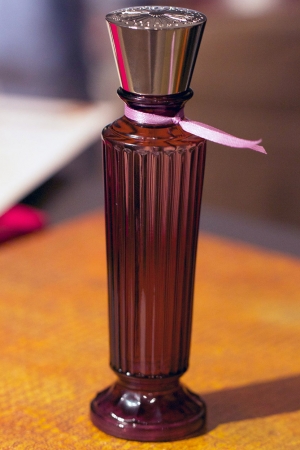
Mohur Esprit de Parfum. Source: Fragrantica.

Mohur Esprit de Parfum. Source: Fragrantica.

Mohur Extrait de Parfum (hereinafter “Mohur Extrait” or “Extrait”) is a new concentration of Mohur and the very first pure parfum offered by Neela Vermeire. It will be released in early Fall of 2013. [Update: it will now be released in Winter 2013 or in 2014.] The perfume was recently shown at the Milan Esxence show, and a European friend got me a small vial. I don’t know if the Extrait has had any slight alteration in notes, or if it is exactly the same perfume in a greater concentration, but something about it feels a little different.

I’ve always felt a little badly for Mohur Eau de Parfum. Trayee is the mysterious, seductive older sister; Bombay Bling, the happy, innocent, playful, joyous baby sister. Mohur is the quiet, reserved, elegant one. Like many middle sisters, Mohur EDP always seemed a little overlooked and forgotten in the company of her much more exuberant or forceful sisters. I myself loved Mohur, but I was just a little more bouleversée by Trayee. While something about Mohur EDP stayed in my mind, inching its way further and further into my heart with time, it could never quite compete with the force of nature that is Trayee. Until now. Until Mohur Extrait de Parfum.

It may be useful to briefly refresh your memory of Mohur’s notes, at least for the Eau de Parfum. The incredibly long list — twenty-three ingredients in all — includes:

Top: Cardamom absolute, Coriander seed oil, Ambrette seed, Carrot, Black Pepper, Elemi oil;

Middle: Turkish rose oil, Moroccan Rose Absolute, Rose Accords 11%, Jasmine accord, Orris, Aubepin Flower [hawthorn], Almond milk notes, Violet Flower, Leather vitessence:

Bottom: Sandalwood, Amber, White Woods, Patchouli, Oudh Palao from Laos, Benzoin Siam [resin], Vanilla, Tonka bean.

rose de reschtI tested Mohur Extrait de Parfum side by side with Mohur Eau de Parfum. One on each arm. Twice. The differences are merely of degree and are not substantial — but they are there. Mohur Extrait de Parfum opens with a considerably greater degree of sweetness. The roses are concentrated and heightened, tinged only subtly with the other notes, instead of sharing equal space with them. The flower is touched with carrots, followed then by violets, all atop a lightly ambered base with muted almond milk. There is a much stronger note up top of lightly powdered iris and a quiet hint of white woods. In contrast, Mohur Eau de Parfum has the rose note well mixed in with the other tonalities. The carrot accord is partnered side by side, but the rose never full dominates in quite the same way. There are also much more noticeable spices, pepper and elemi right at the front with the EDP. The violet note is considerably more subtle right at the start but, later, it deepens more and is a much more consistent vein throughout the Eau de Parfum in its subsequent development.

Mohur Eau de Parfum is also much sharper in its opening minutes. Now, I have never thought Mohur to have a sharp note whatsoever. Until I put on the Extrait de Parfum. Side by side, on both occasions, the EDP has a sharper, thinner aspect to the initial opening minutes. In contrast, Mohur Extrait was deeper, stronger, richer and with significantly increased sweetness. The Extrait also has, quite naturally, a greater sillage and power. We’re talking Fracas levels of potency if you apply a lot!

As time passed, other changes were perceptible, too. The Extrait seems more ambered and spicy. The woodsy notes and oud are stronger, though the latter is still not a significant part of Mohur for me. It is far too well-blended and sheer a note as a whole; it adds subtle depth to the fragrance — in both formulations — but I would never consider Mohur to be a real or hardcore oud fragrance by any means. With the Extrait de Parfum, I also detected subtle hints of the leathery undertone which has always been negligible for me in Mohur EDP. The latter seems more purely floral, much more violet infused and slightly milkier. It also feels as though there is less noticeable patchouli in the EDP, whereas it’s a plush, velvety, almost mossy companion to the sandalwood that begins to come out within the second hour of the Extrait.

Lastly, Mohur Extrait differs in terms of both sillage and longevity. I applied the same quantities of both fragrances from a dab vial. While the EDP became close to the skin about 4.5 hours in, the Extrait de Parfum became a skin scent after 8 hours. Mohur EDP lasted approximately 9.5 hours on me. The pure parfum concentration is, naturally, much stronger and lasted almost 13 hours on my perfume-consuming skin.

"Proserpina" by Dante Gabriel Rossetti.

“Proserpina” by Dante Gabriel Rossetti.

Again, the olfactory differences between the two versions seem, for the most part, to be very minor and just one of degree. But those differences somehow make Mohur Extrait de Parfum a much more sophisticated, more grown-up and regal version of the perfume in my mind. More importantly, they have taken away some of the wistfulness that seemed so much a part of Mohur EDP. Unlike her sisters, Mohur has never been a perfume that evoked India, one of my favorite places on earth. In my review of the EDP, I consistently compared Mohur to one of the slightly melancholy, pale beauties of Dante Gabriel Rossetti’s Pre-Raphaelite paintings, or to an ancient princess of long-ago, mourning a lost love. She was Iseult of Tristan et Iseult, Guinevere, or one of the countless maidens of legend whose beauty was tinged with loss. 

"Boreas" by John William Waterhouse.

“Boreas” by John William Waterhouse.

Mohur Extrait de Parfum is different. The melancholic heart seems lessened; the spicy sandalwood, oud and woodsy foundation seems stronger; the milky opening notes much milder; and the roses significantly sweeter and more concentrated. The violets which underscored the Eau de Parfum and which evoked, in my mind, faint parallels to Guerlain‘s 1906 masterpiece, Après L’Ondée are still very much a presence in Mohur Extrait. They are definitely more concentrated at the very top of the Extrait, particularly in the first thirty minutes. Yet, the note doesn’t create quite the same sort of haunting, brooding, and bittersweet thread throughout the long-term development and life of Mohur Extrait as it did in Mohur EDP.

The problem in attempting to ascertain minor differences is that Mohur is a brilliantly blended perfume in both formulations. Its prismatic nature means that the minor differences I smell today may not be the same ones I smell tomorrow, if I even smell them at all. When perfumes throw off different notes like reflective rays off a crystal chandelier hit by sunlight, the facets are sometimes mutable. But I definitely sense a difference in degree that goes beyond mere richness and depth.

The best way that I can explain the differences in feel, to me, between the two perfumes is through photos. The woman in the new Mohur Extrait starts off as:

Sarah Jessica Parker in Vogue, March 2010. Dress: Dior Haute Couture. Photo: Mario Testino. Source: Vogue.com

Sarah Jessica Parker in Vogue, March 2010. Dress: Dior Haute Couture. Photo: Mario Testino. Source: Vogue.com

She then turns into:

Dress: Rami Kadi Haute Couture Spring-Summer 2013. Source: FlipZone and Tweets.seraph.me

Dress: Rami Kadi Haute Couture Spring-Summer 2013. Source: FlipZone and Tweets.seraph.me

She is no longer quite the restrained, reserved, quietly elegant, haunting sister, living in the shadows of her more forceful sisters. Mohur is now full diva, a glamourous star in her own right, luxuriating in her femininity and richness, dripping with opulence. The wistful princess has now become a powerful queen. She may well rule them all. 

[ED. Note: You can find a review for the new, upcoming Neela Vermeire perfume, Ashoka, which will come out at the same time as Mohur Extrait here.]

DETAILS:
Cost & Availability: Mohur Extrait de Parfum is extrait de parfum concentration. I have no idea as to pricing or size, particularly as this is the first pure parfum released by Neela Vermeire Créations.

Review En Bref: Aftelier Perfumes Secret Garden Eau de Parfum

As always, my Reviews En Bref are for perfumes that — for whatever reason — didn’t seem to warrant one of my more lengthy, exhaustive, detailed reviews.

SecretGarden bookOne of the most beautiful children’s books is The Secret Garden (1910/1911) by Frances Hodgson Burnett. As a rather lonely, very isolated child whose main companions were books and animals, The Secret Garden gave me hours of comfort, joy and peace. In fact, I kept my copy of it throughout the years and am staring at it as we speak. So, as you might imagine, I was extremely excited to try its concrete, olfactory manifestation: Secret Garden by the highly respected, acclaimed perfumer, Mandy Aftel of Aftelier Perfumes.

Ms. Aftel is a perfumer who specializes in natural fragrances, seeking out only the finest in pure essences and oils. She hand-blends and bottles all the perfumes herself in small batches in her Berkeley studio. As she explains on her website:

My perfumes and products contain only the purest, most sublime botanical essences from around the world. I work with awe and passion for the alchemy that transforms these rare, gorgeous individual natural essences into a beautiful perfume. Indulge yourself in authentic luxury.

Secret Garden Eau de Parfum. Source: Fragrantica.

Secret Garden Eau de Parfum. Source: Fragrantica.

In 2011, Ms. Aftel released Secret Garden, a floral oriental fragrance that comes in Pure Parfum and Eau de Parfum concentrations. This review is only for the latter. According to the Aftelier website, the perfume’s notes include:

Top: bergamot, bois de rose, Geraniol, blood orange.
Heart: jasmine sambac, raspberry (compounded isolate), Turkish rose.
Base: civet, castoreum, vanilla, deertongue (plant), benzoin, aged patchouli.

A few words about the notes. First, I’ve read on a number of sites, including Fragrantica, that the perfume also includes Blue Lotus, which has a sweetly aquatic, watery, floral aroma. I don’t know if it is still included, since it is not listed on the Aftelier website. Second, “deertongue” is a plant and has nothing to do with any animal. There are no animal cruelty issues to be concerned about here! The plant is sometimes called the “Vanilla Plant,” and its scent is described by Ms. Aftel as a combination of “the sweet and powdery notes of tonka beans with the aromas of the countryside.” Third, Ms. Aftel clarified in a comment on Now Smell This that Bois de Rose is another name for rosewood. Lastly, as Fragrantica explains, Secret Garden “includes two historical animal essences: very old civet bought from a retired perfumer and castoreum tinctured from the beaver.” Since the civet was extremely old stock, there should be no concerns of animals being harmed to create Secret Garden, but those who seek completely vegan perfumes may want to ponder the civet issue.

Ms. Aftel describes the perfume as follows:

Like fitting a key in a lock, when you inhale Secret Garden, you enter a redolent and sensual wild garden, where the scent awakens a vitalizing force in the wearer.

Secret Garden opens into roses and wood, brightened with mixed citrus. The jasmine sambac heart of the perfume, with its spicy indolic kick, paired with the jammy raspberry, lends the illusion of spice where there is none — like the lure of a blind pathway in a garden. This intertwines with voluptuous Turkish rose absolute.

Secret Garden opens on my skin with animalic notes from the very start. There are subtle touches of geranium alongside a very heavy, rich, red rose, atop a foundation of raspberry with just the subtlest hint of citrus. But these are all extremely muted; the primary, overwhelming impression is of castoreum and civet, creating a dense musk tonality with strongly leathered, almost tarry, undertones. The castoreum is potent and, for once, the term “animalic” applies quite literally.

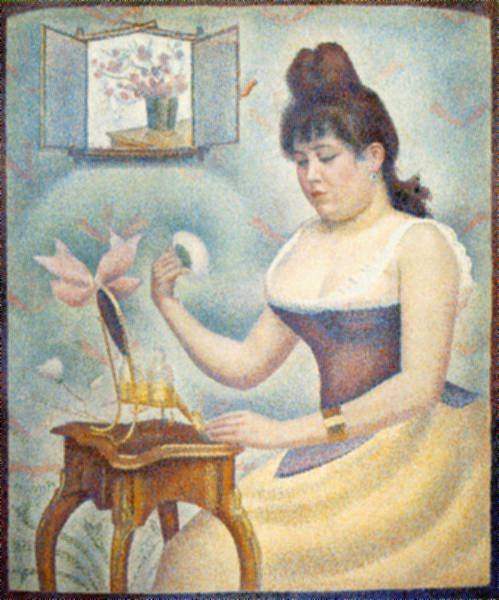
George Seurat: "Young Woman Powdering Herself."

George Seurat: “Young Woman Powdering Herself.”

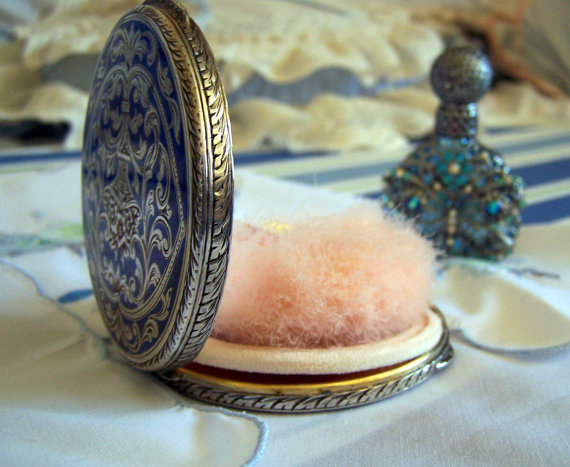
There are also hints of vanillic powder that lurk in the background and that become stronger with every passing moment. As it increases in prominence, less than five minutes into the perfume’s development, it softens the potent, opaque, heavy richness of the animalic tones, rendering them lighter and softer. The powder accord strongly brings to mind those extremely old-fashioned, big, powder poofs that women in the late 19th century would use to dust their décolletage to erase any suggestion of a moist sheen. Here, the note is that exact same old-fashioned, vanilla-centered, makeup powder accord. It’s light and daintily sweet, but, as time passes, it becomes one of the primary, dominant notes on my skin, overshadowing much else except the castoreum.

Ten minutes in, the perfume shifts a tiny bit. The geranium recedes to the background, to be replaced by muted hints of rose and jasmine. They are not strong. In fact, the flowers are never wholly distinct on my skin at all, and are completely dominated by the other notes. By the twenty-minute mark, the floral bouquet feels almost amorphous and abstract, just an overall suggestion in the midst of what is predominantly fruity musk, raspberry and vanilla powder. Very soon thereafter, and for the remainder of the perfume’s development on my skin, Secret Garden is merely powdery, raspberry musk. That’s it.

I tried Secret Garden twice, and it was the exact same development on both occasions. Before the start of the second test, I wondered if perhaps my skin was too dry to bring out the lush, blooming garden that I had so anticipated, so I put on some unscented lotion, waited thirty minutes, and then re-tested the perfume. I applied a greater quantity; I even applied a smear to my inner thigh as well, in case something about my arms was wonky and was throwing off the scent. But, alas, nothing worked. Just like the first time, there were minimal florals at the start, followed by almost none after the first 20 minutes. Instead, the perfume was mainly raspberry castoreum musk and old-fashioned, scented makeup powder, lying close to the skin. And Secret Garden remained that way for approximately 5.5 hours and 6.5 hours, respectively, until the last traces finally faded away. (For an all-natural perfume with no synthetics, the longevity on my voracious, perfume-consuming skin was quite impressive.)

Vintage 1930s Powder Puff Compact. Source: Etsy Boutique "ItsAGoodThing" listing 72555631

Vintage 1930s Powder Puff Compact. Source: Etsy Boutique “ItsAGoodThing” listing 72555631 (Link to the Etsy store embedded within. Click on photo.)

Given my personal style and tastes, the way Secret Garden manifested itself on my skin wasn’t my cup of tea. Something about my skin chemistry completely refused to bring out the lush garden that I kept reading about in all the reviews. Whether one reads the assessments on Now Smell This, The Non-Blonde, The Perfume Shrine, Perfume-Smellin’ ThingsOlfactoria’s Travels, or Smelly Thoughts, they are all glowing; and the vast majority talk about the rich, spicy, powerful floral heart that prevents the perfume from being too jammy or too much of a fruit cocktail. Reading Freddie’s experiences in his Smelly Thoughts review, in particular, I felt as though I was crazy and smelling a different fragrance entirely. Naturally, the tricky issue of skin chemistry will often mean that a perfume manifests itself differently. But those are usually small differences in degree, here or there, not a totally polar opposite experience.

I would have felt like a complete anomaly in the vast ocean of positive raves about the lush, floral garden if I hadn’t come across a few isolated voices whose comments reflected — just in small part — my own experience. For example, on Surrender to Chance, one person wrote: “Sadly, on me it smelled unexciting — like Juicy Fruit gum, with a little nutmeg thrown in. Next.” If we’re going by this analogy, I would compare it more to a powdery sweet, raspberry bubble gum, but I can understand the impression. On Fragrantica, one of the two (both positive) comments says “Warning: it can smell ‘grandmother-y’ to certain people used to very conventional perfumes.” I like both conventional and extremely unconventional scents, and I’m hardly a perfume dilettante, but, yes, I think Secret Garden’s manifestation on my skin was “grandmother-ly.” Without any doubt at all. It’s the overwhelming powder. It’s not bad, and it’s almost sweetly pretty, but that extremely old-fashioned, simple character is not to everyone’s taste.

Again, the minor criticisms or caveats are few and far between. Judging by the blogosphere, 99% of people seem to have had a completely different experience than I did. All perfume experiences are subjective; I repeat that again and again in my reviews. My personal experience with Secret Garden may very well be a complete anomaly. But given the overwhelming nature of those many (many) positive reviews, I thought it was important to share a dissenting opinion, especially as we’re talking about a perfume whose cost can reach $170 for a small bottle. I very much hope that Secret Garden manifests itself on your skin as a lush, blooming floral garden with a secret heart of animalic gold, a perfume that incorporates India’s heady, opulent, orientalist flowers with the best of the English countryside. But, if it doesn’t, you’re not crazy and not completely alone.


DETAILS:
Cost & Availability: Secret Garden comes in different formulations and sizes. It is available directly from the Aftelier website as 2 ml of Pure Parfum for $50; 0.25 oz of Pure Parfum for $170; and 30 ml Eau de Parfum for $170. Samples are available for $6 for a 1/4 ml vial of both the EDP and the pure parfum. Aftelier’s shipping rates start under $5 in the U.S., and under $9 worldwide. I obtained my sample of the Eau de Parfum from Surrender to Chance where prices start at $3.99 for a 1/2 ml vial.

Perfume Review – Arquiste L’Etrog

L'Etrog presentation on the Arquiste website.

L’Etrog presentation on the Arquiste website.

October 1175. Calabria, Italy. South of Naples, northeast of Sicily. “During the First Crusade, Southern Italy fell to the Normans, which encouraged Calabrian Jews to engage in the agricultural trades. By the 12th century, the communities were thriving. Since then, the harvest of the Diamante Citron or Etrog has remained a regional tradition.” Etrog is even described in the Bible in connection to the Garden of Eden. “The fragrance is said to be the ‘Fragrance of Heaven’, and the Etrog itself is associated with righteousness, goodness and desirability.”

Carlos Huber.

Carlos Huber.

October 1175 in Calabria, history and the etrog fruit are the specific inspirations for L’Etrog by the American niche perfume house, Arquiste. Founded by the architect turned perfumer (and now, designer), Carlos Huber, Arquiste always attempts to bottle a specific moment in history. It’s something that I greatly admire, as history has always been one of my greatest passions in life. And, here, the mission is not only to capture the festival of L’Etrog in Norman-conquered Calabria, but also the very feel of life in the Mediterranean itself.

Arquiste elaborates further on the exact mental picture that the perfume is meant to evoke:

In Medieval Calabria, a family gathers to celebrate a good harvest. Within a cabin built of Palm leaves and other woody branches, an aromatic bounty is presented. The citrusy scent of the Etrog citron, a regional specialty, brightens the air while embracing Myrtle and lush Date Fruit envelope the sweet warmth of the Mediterranean night.

L'EtrogReleased in late 2011, L’Etrog is described as a “citrus chypre” and was created by Rodrigo Flores-Roux and Yann VasnierOn its website, Arquiste says:

The brisk character of Myrtle marries with leafy nuances, emulating the freshly opened fronds of palm trees. An unexpected mouthwatering accent follows, with Smyrna Date fruit and elegant Cedar wood from Lebanon.

Cedar, however, is not explicitly included in L’Etrog’s official notes on the Arquiste website which merely list:

Calabrese Cedrat [Citron], Myrtle, Date Fruit and Vetiver

Elsewhere, however, department store retailers like Barneys and blogs like CaFleureBon quote the press release description which states the perfume is: “a citrus chypre with citron, palm leaves, willow branches, myrtle and dates.” So, let’s just assume that “willow branches” and “palm leaves” are in there, along with cedar, too.

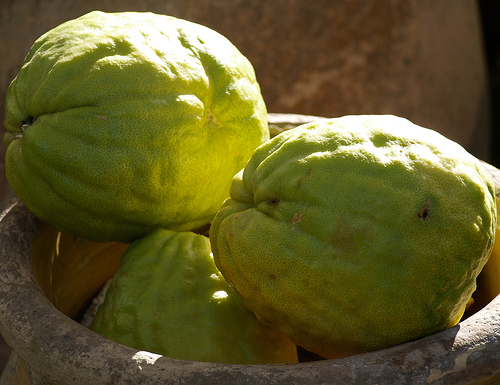
Diamante Citron or Etrog.

Diamante Citron or Etrog.

As for the fruit in question, internet research tells me that cedrat is a type of very large, fruity lemon with a thick rind and little acidity. It has many different names: cedrat seems to be one linguistic version of the term citron (which is the main French name) and seems to be the same as etrog which Wikipedia tells me is the Hebrew version. Whatever the linguistics, the fruit looks a bit like its close cousin, the pomelo, but doesn’t smell (or taste) like a grapefruit.

I’m a little OCD, so forgive my brief digression into history for a moment. First, Arquiste’s comment on the Normans would seem to imply that they were responsible for agriculture successes in the region, when I think that history would argue it was the Saracens or Moors. Starting in the late 9th Century, they invaded the area in southern Italy that includes Calabria and that later became part of the larger Kingdom of Sicily. It was the Moors who seriously impacted both the agriculture and the cuisine (not to mention the architecture); who brought over things like dates, oranges and lemons; and whose advancements in agricultural techniques led to the thriving cultivation of those citrus crops — techniques that, I would argue, were the sole reason for the bounty of the etrog on that day in October 1175 during the Jewish festival of Sukkot. It was not the bloody Normans! They were merely the subsequent conquerors. So, while Robert Guiscard admittedly encouraged the Calabrian Jews, it was the Moors who got the whole ball rolling to start with in what has been termed the Arab Agricultural Revolution. (Sorry for the tangent, but that esoteric point has been bothering me for hours and hours.)(And hours!)

Second, and returning to the perfume now, I don’t understand how L’Etrog is supposed to be even a neo-chypre, let alone an actual one. There is no oakmoss; there isn’t even the patchouli that is sometimes considered as an alternative foundational base. Is vetiver alone now enough? Not in my opinion.

Citron.

Citron.

I tested L’Etrog twice, using different quantities and resulting in a very different openings. The first time, my hand slipped and quite a large amount gushed out of the vial onto my arm. It was a vision of bright, sunny, yellow with sweet lemon that wasn’t zesty so much as slightly fruity and rich. There were also elements of light vetiver and myrtle. According to Fragrantica, myrtle oil is said to have a scent similar to eucalyptus but here, during the first test, there is a minty undertone instead. It creates a slightly chilled, very energizing effect that is lovely. At the same time, however, something about the overall combination leads to a definite impression of Theraflu or LemSip cold powder. As the seconds passed, the minty touches grow stronger, creating more of a fizzy, sparkling aspect than just mere fruity citron.

After 15 minutes, the perfume changes slightly. The fruity aspect of the citron grows stronger, but it doesn’t seem at all like dates, per se. In fact, there is nothing reminiscent of sweetly dark, dried fruits at all. At the same time, the vetiver also becomes more prominent, adding a quiet earthiness to the scent. What is more interesting, however, is the interplay between the vetiver and the myrtle.

Eucalyptus leavesOn one part of my arm, the peppermint note has transformed into eucalyptus, nullifying much of the sweet lemon but accentuating the vetiver. L’Etrog shows itself here as a spicy, mentholated eucalyptus with vetiver that is simultaneously earthy, rooty and touched by nuances of green citrus. On another part, however, it remains as peppermint, enabling the sweet, fruited lemon to show itself. Here, L’Etrog is a fruity lemon scent with a more generalized, abstract woody undertone. In both cases, however, the perfume is incredibly light, airy, and sheer. It’s much more akin to a cologne in feel and becomes a skin scent in as little as 20 minutes on my skin.

At the ninety minute mark during this first test, L’Etrog is a sheer lemon vetiver scent with the merest hint of woody, peppery elements and a bare drop of sweetness. Something in the undertone feels a little like ISO E Super, but it’s extremely light. The perfume remains this way for a number of hours until, around fifth hour, it turns into a thin veil of musky vetiver with a hint of lemony fruit. By the ninth hour, the last traces of L’Etrog are soapy musk with vetiver. Soon thereafter, it faded away entirely.

Joy Dishwashing liquidMy second test of L’Etrog involved a far lesser quantity and, as a result, led to a very different opening. This time, the perfume opened with spicy lemon (not a sweetly fruited one) intertwined completely with very woody vetiver. There was also quite a noticeable amount of soap from the start, and the myrtle showed no minty aspects at all. Instead, it was all eucalyptus. The whole lemon, vetiver, soap mix strongly called to mind lemon liquid dishwashing liquid. It wasn’t unpleasant, but the Joy similarities couldn’t be ignored.

Another big difference was the presence of ISO E Super. I don’t know why it was so much more evident at a lesser quantity of L’Etrog, as opposed to the greater dosage, but I’m absolutely convinced it’s there. L’Etrog had a slightly velvety wood undertone with that telltale, giveaway sign of peppery, rubbing alcohol. The ISO E Super is not enormously prominent, and it does fade away after an hour, but given the headaches that even small amounts can cause people who are sensitive to the note, I wanted to warn you.

By the second hour, during the second test, L’Etrog was primarily a vetiver scent with lemon nuances, a woody undertone, and the merest whisper of light musk. And it remained that way until the final drydown when it turned, again, more of a soapy, light musk. The perfume was so close to the skin, it was incredibly hard to smell at times. Clearly, this is a perfume that — like a cologne — will require a significant quantity if you want to detect its nuances. And, even then, you’re going to have to put your nose directly on your skin after the first hour. All in all, the perfume lasted a little under 7 hours with the lesser amount.

L’Etrog wasn’t my cup of tea. True, my personal style and tastes are very different, but I also found it disappointing as a whole. Ignoring completely the sillage issue, L’Etrog was a tame, boring, linear creation that really just played off lemon and vetiver. Perhaps if I’d smelled actual dates, I would have been more excited. But I doubt it. Lemon and vetiver are the primary strands of this perfume, with everything else being merely a tangential, occasional touch — from eucalyptus, to soap, to amorphous woody notes, to ISO E Super, to musk. They can’t take away from the main, most evident thrust of the perfume. Even the lemon itself wasn’t unique, the way the descriptions of Calabrese cedrat or etrog had led me to expect. In short, L’Etrog simply isn’t that interesting — not at $165 for a 55 ml/1.8 oz bottle. It actually verges on the banal and mundane. I far preferred Arquiste’s fabulous, wonderfully nuanced, sophisticated, rich Anima Dulcis.

On Fragrantica, the comments vary. There are those who find it “super wearable” but admit that they don’t have “the most trained of nose palates,” and then there are established commentators like the hardcore perfumista, “Sherapop,” who found L’Etrog to be a pleasant, somewhat quirky perfume that is “nice… but not compelling.” She reached that conclusion despite smelling not only the dates, but some candied sweetness and some caramel. (So, perhaps I didn’t miss out on anything after all?) Interestingly, she seems to have first smelled the perfume blind as part of Chandler Burr’s Untitled Series and thought that it was Histoires de Parfums 1873 (“Colette“). In a side by side test, before the reveal, she detected small differences, but not much. The similarity is something to keep in mind if you have tested or own Colette.

But Sherapop wasn’t the only one who gave a shrug of “meh” to L’Etrog. Another commentator, “Alfarom,” succinctly summed up the perfume as follows:

A citron hologram introduces a honestly crafted woody-citrus fragrance that’s refined, nice smelling and very wearable. The woody notes (incredibly not overdone) and some sweetness, provide some sustain to an otherwise extremely fleeting composition that while resulting definitely pleasant, it still doesn’t have the ability to stand out in todays overpopulated niche market…

Nice yet somewhat forgettable.

That said, for those who want a simple, light, sheer, summery, lemon vetiver cologne that is utterly inoffensive, you may want to try L’Etrog. It would be appropriate for even the most conservative office environment. No perfume Nazi would be bothered, simply because they wouldn’t be able to detect it; unless they had sensitivities to ISO E Super, in which case, you may be screwed….


DETAILS:
Cost & Availability: L’Etrog costs US $165, CAD $200, £125.00 or €149. It comes only as an eau de parfum and is available only in a 55 ml/ 1.85 oz size. In the US, it is available on the Arquiste website, Barneys, and Aedes. In Canada, the Arquiste line is available at Holt Renfrew Bloor in Toronto (though I could not locate it on the overall Holt Renfrew website), or at Etiket in Montreal for CAD $200. Each store is the exclusive dealer for the Arquiste line in their city. In the UK, it is available for £125.00 at Liberty London which also ships throughout Europe. In France, you can find it at Jovoy Paris where it retails for €149. Elsewhere, you can use Arquiste’s “Stockists” page to find a retailer near you. Samples are available at Surrender to Chance where the price starts at $4.99 for a 1/2 ml vial. The site also sells all 7 perfumes from the Arquiste line in a sample pack for $33.99.

Perfume Review: “The People v. Xerjoff Zafar” – Prosecution & Defense

The People v. Xerjoff Zafar– Case # 13-276891XZ

[The Bailiff]: “All rise! The Court is now in session, The Honorable Charles Highblossom presiding. On the docket, The People v. Xerjoff Zafar, Case # 13-276891XZ. The charge is olfactory assault and battery. State your name and business before the Court.”

[A small, goat-like, balding man rises]: “I am the District Attorney, Luke Sneering.”

[A tiny, dark woman wearing a custom-made Chanel suit rises]: “I am Loverly Limburger from the firm of Wealthy Lawyers, Screw Them, & Howe representing the Defendant, Sheikh Zafar of Xerjoff.”

Continue reading