
Perfume Review: Dries Van Noten Par Frederic Malle

Snickerdoodles! That, in a nutshell, is the essence of the new perfume, Dries Van Noten par Frederic Malle (often shortened to just “Dries Van Noten”), from the the luxury fragrance house Editions de Parfums Frederic Malle. It is one of the most respected haute-niche lines in the world and was founded in 2000 by Frederic Malle, a man who has luxury perfume in his blood. His grandfather founded Christian Dior Perfumes, and his mother later worked as an Art Director for the same perfume house. 

Dries Van Noten (left) with Frederic Malle (right).

Dries Van Noten (left) with Frederic Malle (right).

Recently, Mr. Malle decided to shift his focus from collaborating with perfumers to working with fashion designers. The first designer he chose for this new line would be Dries Van Noten whose eponymous fragrance was created by Bruno Jovanovic and released in early March 2013. According to Grain de Musc, the perfume is Malle’s own loose interpretation of Dries Van Noten’s aesthetic and not the designer’s own creation as rendered by Bruno Jovanovic. In other words, inspired by — not “made by” — Dries Van Noten. The Frederic Malle website supports that conclusion in its concise description of the scent:
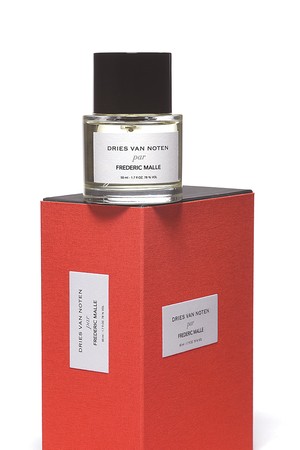
Small sized bottle of Dries Van Noten par Frederic Malle.

Small sized bottle of Dries Van Noten par Frederic Malle.

A perfume built around natural sandalwood, chosen for its softness and its character, and the fact that it is simultaneously exotic and evocative of the tradition of great classic perfumes. This very short formula made of very precious materials, generates a sober but distinct sensuality. It is, in my eyes, a fair parallel to Dries van Noten’s world.

Fragrantica categorizes Dries Van Noten Par Frederic Malle as a woody Oriental and lists its notes as follows:

sandalwood, guaiac wood, tonka bean, vanilla, saffron, jasmine, musk, bergamot, lemon, nutmeg, cloves, patchouli, woody notes and peru balsam.

Source: Fragrantica

Source: Fragrantica

There was a lot of fuss in the blogosphere about the perfume not only because it was a departure from Malle’s traditional focus but, also, because Dries van Noten involved the use of sustainable Mysore sandalwood. As the Perfume Shrine explained back in January,

it’s also an innovation on the formula front, as the new Malle perfume is touted to be inclusive of a new, natural Indian sandalwood from a sustainable source. Indian sandalwood, for those who didn’t know, had essentially been eradicated from perfumery in the last 20 years or so, due to concerns and regulations on the sustainability of the Mysore sandalwood. The news therefore is a leap of hope for the industry in general and sure to create a real peak of interest in the heart of every perfume fan out there.

Large-sized 3.4 oz bottle.

Large-sized 3.4 oz bottle.

All that is absolutely wonderful, particularly for those (like myself) who adore true Mysore sandalwood, but sandalwood isn’t at the heart of this perfume. No, it’s cookies. To be very specific, the American cookie (or “biscuit,” as the British term it) called “Snickerdoodles.” Americans will know immediately the precise smell which that name invokes but, for others, here is a brief summation from Wikipedia:

snickerdoodle is a type of cookie made with butter or oil, sugar, and flour rolled in cinnamon sugar. Eggs may also sometimes be used as an ingredient, with cream of tartar and baking soda added to leaven the dough. Snickerdoodles are characterized by a cracked surface and can be crisp or soft depending on preference.

Snickerdoodles are often referred to as “sugar cookies”. However, traditional sugar cookies are often rolled in white sugar whereas snickerdoodles are rolled in a mixture of white sugar and cinnamon.

SnickerdoodlesThe thick, yellow-brown, very buttery, very doughy, cinnamon-sugar cookie is exactly what Dries van Noten smells like — only with nutmeg replacing the cinnamon. The opening on my skin is as simple as that, though there is a definite subtext of flour that sometimes verges into the raw dough batter territory. There are creamy, milky notes, both of vanilla and something resembling almonds at times. The whole thing is wrapped up in a cloud of nutmeg, dancing around like the sugar spice fairy. It’s never bitter or pungent, but, instead, sweetened. The sandalwood is similarly sugared, and seems nothing like vintage or real Mysore sandalwood. There is a definite creamy fluffiness to the scent which is surprisingly light in feel. It’s almost as if the sometimes heavy, doughy sugar cookies have been turned into gauzy air.

About ten minutes in, woody notes start to appear — light, white, and quietly smoky. The notes add a dryness to the scent and ensure that the perfume is never cloying, excessively sweet, or cheap-smelling. As time passes, but especially at the thirty minute benchmark, the woods start to turn much smokier. The guaiac wood is starting to make itself noticed with its strong note of burning leaves or burning paper. I love the smell in its more unusual twist on traditional “smoke,” especially as it’s never acrid, sharp or bitter. I think it adds a much-needed dryness to the extremely sweet, fluffy cookie-aspect of the fragrance.

There is also the start of a faint muskiness from the jasmine. The latter is not perceptible as a floral note, in and of itself, at first. It’s far from indolic, heavy, or sour, so those who fear the note need not worry. But the jasmine gives rise to something very puzzling: one part of my arm starts to smell almost solely of sweet, slightly musky jasmine, while the rest of it smells of snickerdoodles, smoking paper, nutmeg and vanilla. It’s as though there is a No Man’s Land inlet of territory where the jasmine is evident, but nowhere else. And it remains that way for a good two hours. No blending, no merging, no jasmine elsewhere — ever. I find it the oddest thing!

For the next six hours, the majority of my arm (minus that one No Man’s Land) smells of Snickerdoodles to varying degrees, but with small subtexts of other notes. At first, the nutmeg is much more pronounced; then it becomes the guaiac and other wood tonalities; after a while, it’s the dough and flour which become the main subtext; and, then, vanilla and sandalwood. But the core essence of nutmeg sugarcookie never changes. At first, I find it delightful and cozy, and then, frankly, I become very  tired and bored of it.

Snickerdoodle dough. Source: FindingTimeForCooking.com

Snickerdoodle dough. Source: FindingTimeForCooking.com

By the time the creamy (but definitely sweetened) sandalwood rolls around, the linearity has driven me a little mad. Particularly as the final dry-down is still mostly flour, yeasty dough, sugar and vanilla. To be fair, I’m not really one for food scents to begin with and, despite the early dry, woody and spiced elements, the needle definitely veers into the “gourmand” category here. Fragrantica can classify this as a “woody oriental” as much as they want; to me, sugar cookies=foody desserts=gourmand fragrances. Period.

I find the fragrance to be a surprising scent to come out of Frederic Malle. This is a lot more what I imagined Jo Malone’s recent “Sugar and Spice” collection to be like. Well, if it were, you know, actual fragrance that was both good, of high-quality, and long-lasting. (Yes, yes, I know, “Meow.”) As a whole, I think Dries Van Noten is not as distinctive as many of Malle’s usual fragrances are, and I suspect that is why a few people seem to have a slight tone of disappointment underlying their generally positive reviews. Or perhaps that is merely my interpretation of the initial test reactions on a Basenotes thread, along with Grain de Musc’s assessment of the perfume.

In Denyse Beaulieu’s case, she had originally expected a scent that evoked a Flemish vegetal garden, but found instead a “speculoos” cookie (which is, I am assuming, a Belgian version of a Snickerdoodle):

When I learned he was partnering with Frédéric Malle I immediately though of Van Noten’s 60-acre garden near Antwerp and envisioned a vegetal, unconventionally floral scent.  [¶] I envisioned a landscape instead of a portrait. Frédéric Malle headed straight for a warm, well-ordered Flemish interior with a plate of cookies. Dries Van Noten is a very delicate woody gourmand, folding a cinnamon and clove-sprinkled, vanillic speculoos cookie accord into milky-smoky Mysore sandalwood[i]. To conjure the toasted, nutty, yeasty cookie dough, Malle remembered that sulfurol, more commonly used in food aromas, was also resorted to by Grasse perfumers to boost sandalwood (the material was featured in the odd, yeasty-milkyLe Feu d’Issey). Patchouli coeur (i.e. divested of its musty/camphor notes), methyl ionone and musk set the blend between woody and cosmetic accords. Jasmine absolute is listed, but not legible per se to my nose; the patchouli is fairly prominent.

I don’t smell any patchouli, but the rest is dead on. Victoria at Bois de Jasmin seems to have had a completely experience from both of us, however, with much more floral notes:

Dries Van Noten’s perfume is smooth like melted chocolate and rich like whipped cream, but you won’t smell of Belgian waffles topped with cherries, or anything edible for that matter. The fragrance uses Indian sandalwood*, and it smells simply decadent–rosy, creamy, warm and opulent. Add to this a lush jasmine note, and I’m in Rajasthan, rather than Antwerp, but this is a wonderful fantasy in itself.

The sweetness of vanilla and toasted almond is balanced out by the citrus and earthy violet notes. The hint of something savory is an accent that shouldn’t work but does. The first impression of Dries Van Noten when I spray it on my skin is a classical oriental a la Guerlain Shalimar, where citrus is used to cool down the rich woods and vanilla. But as I wear it longer, it becomes more floral and musky. The perfume reminds me more of the violet tinged woods of Serge Lutens Bois de Violette than of caramelized sandalwoods like Lutens’s Santal de Mysore or Guerlain Samsara.

Violets? Hm. Not on my end. No Shalimar-like citrus, either. 

Where I do agree with both ladies is the extremely minimal projection of the perfume. However, there seems to be a little bit of a twist where that is concerned. At first, Denyse of Grain de Musc “found its sillage surprisingly introverted despite several spritzes.” Later, she discovered that maybe it vanished only to her own nose! And she wasn’t alone in that. As she explains:

After discussing Dries Van Noten with other French bloggers and perfume lovers who’d tested it, it seems that while the wearer stops being able to perceive the fragrance after a while except in whiffs, other people smell it quite well.
We agreed we’d noticed this occurring with a few sandalwood and iris accords (there is no iris in DVN but there are ionones) like Cartier L’Heure Promise, Tom Ford Santal Blush and Diptyque Volutes. Other people can smell them just fine on us while we feel the fragrance has all but vanished.
Could there be some type of anosmia or “de-sensitization” at play?

Victoria of Bois de Jasmin also found it had “minimal” projection, while some people on a perfume group I frequent have simply said that the scent vanished entirely after an incredibly brief period of time. In short, it’s definitely something to take into consideration, given the cost of the perfume, and to test it for yourself! 

The early consensus from those who’ve tried it is that Dries Van Noten is an incredibly cozy and comforting scent. I think that is very true, if you like gourmand fragrances. But those who aren’t so keen on smelling like food may not be that enamoured. It is one reason why I’m not a huge fan. Another is that I find both its sweetness and its linearity to be, ultimately, a bit too much for my personal tastes — especially for the price. The perfume starts at $185 for a 1.7 oz/50 ml bottle, with the larger bottle retailing for $265. Even if you buy the set of 3 travel-sized minis, it’s still $125 to smell like a Snickerdoodle and yeasty, sugar dough.

Nonetheless, I have no doubt that this will be an enormously popular fragrance, particularly amongst those who enjoy dessert scents with an occasional dry, woody undertone. The gushing I’ve already seen on some sites seems to support that. Plus, the light sillage and good longevity (about 9.5 hours on my perfume-consuming skin) make it ideal for those who want something airy, lightweight and cozy. It’s also suitable for the office, though I personally would not wear it in a very conservative work environment. (Can one be taken seriously if one smells of Snickerdoodles?) 

To mangle the famous quote from the great Judi Dench, “if cookies be your perfume of love… spray on.” 

DETAILS:
Cost & Availability: As noted above, you can purchase Dries Van Noten in a variety of different forms and ways. On his website, Malle offers: 3 travel-sized sprays in a 10 ml size for $125; a 50 ml/1.7 oz bottle for $185; or a 100 ml/3.4 oz bottle for $265. You can also find the perfume at Barneys. In Canada, I’ve read that it is carried at Holt Renfrew, but Dries Van Noten is not listed amongs the few Malles shown on their website. In the UK, it is available at Liberty which sells the 50 ml size for £110.00 and the 100 ml bottle for £155.00. The three 10 ml travel-sized bottles are also available for £70.00. Elsewhere, you can use the Store Locator to find a location that carries the fragrance near you. If you want to test it out, I bought my sample at Surrender to Chance where prices start at $5.99 for a 1 ml vial.

Perfume Review – Tom Ford Private Blend Café Rose (The Jardin Noir Collection)

Subversive. Forbidden. IntoxicatingBewitching. Darkness that is so thrillingly beautiful it “could almost ruin you.”

That was Tom Ford’s goal for his 2012 Jardin Noir collection, a subset of his prestige “Private Blend” line of fragrances. His twist on traditionally innocent flowers encompassed roses, narcissus, hyacinths, and lilies with Café Rose, Jonquille de Nuit, Ombre de Hyacinth and Lys Fume. I have three of fragrances and have already reviewed Ombre de Hyacinth.

This review is focused solely on Café Rose, a scent that triggered a wide array of emotions, but which ultimately left me feeling cold. To be honest, it was quite overwhelming at times. By the end, I felt simply tired out and beaten over the head. I am admittedly not a huge worshipper of rose fragrances, but there is something almost bullying, cloying, and deeply exhausting about Café Rose.

We’re getting ahead of ourselves. According to Tom Ford’s full press release description for the Jardin Noir collection on Bergdorf Goodman’s site, his vision for the Jardin Noir collection is as follows:

Jardin Noir explores the forbidden sides of four of perfumery’s most treasured blooms: narcissus, hyancinth [sic], rose, and lily.

Convention is abandoned and unexpected ingredients converge with bewitching and intoxicating results. Iconic flowers fall open, dropping their innocent facades to reveal the subversive beauty and fierce elegance they normally keep hidden.

The specific description of Café Rose is quite beautiful:

Enticing. Exotic. Seductive. Cafe Rose descends into a hidden labyrinth, where roses’ fine breeding gives way to darker pleasures.

Café Rose was created by Antoine Liu and, according to Fragrantica, the notes are:

Top notes are saffron, black pepper and may rose; middle notes are turkish rose, bulgarian rose and coffee; base notes are incense, amber, sandalwood and patchouli.

Tom Ford fragrances are the oddest thing on my skin because how they smell can vary substantially with how much you put on. Café Rose is no exception. I tried it on three times, each with slightly varying results for the opening stage. On each occasion, I put on less of the perfume with the third time having the very smallest amount. That time, the perfume opened with a faintly soapy musk note that was sweet with an almost vanilla-like undertone to the roses. It was definitely a plethora of white musk, which I am not particularly keen on, I must say.

With that outcome being a slight exception, my overall first impression of Café Rose has always been fruited roses — with only the concentration or degree of the note varying. There is an explosively sweet impression of roses — blood-red and tea-rose pink — with jammy notes that definitely evoke fruit. There is a dark grape, almost like Welch’s, as well as something that smells surprisingly a little like canned peaches.

I suspect the patchouli is responsible for that very “purple patchouli” fruited note; those who dislike it may want to want to steer clear of Café Rose because there really is no escaping it. It’s there almost from start to finish. It also adds a very thick, almost gooey and unctuous feel to the roses which, at times, can feel spectacularly sweet. That sweetness almost verges on “tea rose” territory, and those of you who were around for the infamous ’80s Tea Rose fragrance from Perfumer’s Workshop may shudder in response.

Despite the headiness and painful sweetness of Café Rose, the perfume is never oppressively heavy. Ten minutes after applying it in even a concentrated dose (2 good sprays), it becomes a much lighter, sheerer scent. The sillage drops as well, though this is one very persistent perfume. I don’t detect any saffron in its own right but there is a vague sense of creamy sandalwood underneath all that jammy fruit.

Two hours in, Café Rose turns darker with the presence of black pepper and coffee. The black pepper adds a slightly fiery, peppery bite to the sweetness of the floral note, though at times it feels more like pink peppercorns in a combination that is all too familiar these days. The coffee note is far more interesting. If you’re expecting the aroma of Starbucks or roasted coffee beans, you will be disappointed. Here, it’s more like the wet, black coffee grounds that you empty out of your filter after you’ve brewed a cup. It adds a faintly bitter, nutty, earthy note to that heavily jammy, very fruited rose note.

The fiery pepper and the bitter coffee make a valiant (though not wholly successful) effort at diluting the jamminess of the roses. Thank God for small favours, because, by the two-hour benchmark, my nose was quite oppressed by just how sweet this perfume is. Plus, to be quite frank, there is almost an artificial, synthetic aspect to things where it doesn’t smell wholly natural but, rather, just…. painful. It’s hard to explain, but there is something in this perfume that — no matter how much or how little you put on — simply feels cloying. And, really, there seems to be no escape from it.

That overwhelmed feeling probably explains why I couldn’t detect a plethora of notes in Café Rose. Over the course of its development, the degree of the black pepper and black coffee grinds rose and waned in differing degrees, but the oppressive presence of that very purple patchouli note dulled everything else to a large degree. There was some creamy sandalwood and, I suppose, faint smoke from the incense, but did I mention purple patchouli?

It did fade away, eventually, leaving me gasping like a stranded seal on a beach. At that point, about seven hours later, all that remained was the rose note, accompanied simply by vanilla and powder. Then, in the eighth and final hour, there was merely some vague, amorphous sense of a powdery soapy musk.

Oddly, on the third test, when I wore very little of the fragrance, the painful purpleness was much less. Instead, now, there was just that soapy white musk accord which I cannot stand. It felt clean and fresh, I suppose. If that’s damning with faint praise, it’s because it’s meant to be. 

Café Rose does have its fans, many of whom seem to find it a purely rose and coffee fragrance. However, a good number of people on Fragrantica find it to be a substantially poorer cousin to Tom Ford‘s Noir de Noir. I agree with that assessment. I liked a good portion of Noir de Noir (which I reviewed here) and, though I didn’t like its powdered violet finish, I think it’s a much better, more complex treatment of roses.

On Fragrantica, a number of others keep talking about Café Rose having an oud note — which frankly leaves me utterly bewildered. If I didn’t have a manufacturer’s sample with the card and labeling on the vial, I’d wonder if I tried the wrong perfume. There is absolutely no agarwood in this cloying sweet, peppered aberration.

I’m sure there is more to say on Café Rose — more talk of sillage and longevity, or some positive reviews I could link to, as well as other negative ones. To be honest, I simply lack the energy for that. After living with this bloody thing for two days, and making every effort possible to be fair, I find myself just wanting to be rid of it. I’m tired of Café Rose — on every possible level. I want it gone from my life forever. In fact, since I cannot bear another moment thinking of, discussing, or even wearing this blasted thing, I’m ending this here and now.

DETAILS:
For some odd reason, none of the Jardin Noir fragrances are listed anywhere on Tom Ford’s website. They are, however, available at numerous high-end department stores where its price is just like that of other Tom Ford fragrances: $205 for a 50 ml/1.7 oz bottle, or $495 for a 200 ml/8.45 oz bottle. In UK pricing, they sell for £135.00 or £195.00, depending on size. In the US, you can find Café Rose at Nordstrom, Saks Fifth Avenue, Bergdorf Goodman, Neiman Marcus and many others. In the UK, you can find it at Harrods and Selfridges.
Samples: If you are intrigued, but are also sane enough not to want to spend such a large amount without testing it out first, I suggest stopping by one of the stores listed above for a free sniff. However, you can also find samples of Café Rose starting at $3 on Surrender to Chance, or on other decant/sample sites like The Perfumed Court. I think Surrender to Chance has the best shipping: $2.95 for any order, no matter the size, within the U.S., and $12.95 for most orders going overseas. (It’s a wee bit higher if your order is over $150.) International shipping has leaped up in price (from $5.95) due to the U.S. Postal Service’s recently increased prices.

Let’s Play Questions…. Vol. 2 – Perfume & Television

I’m a TV junkie. Yes, I admit it fully and without shame. Television is one of the few ways I can turn off the endless, whirling dervishes of my mind. As someone who is an insomniac partially because of that fevered mind, television is also a lovely companion at 3:48 a.m. when even the Hairy German is asleep. I watch all sorts of series, from acclaimed dramas to historical period pieces, serial-killer detective shows to every single thing ever released on HBO and, yes, even things of a less… er… reputable nature like reality shows. (Heidi Klum, we need to have a little chat about your new perfume on the recent episode of Project Runway.)

“Kalinda Sharma” on The Good Wife.

One of those (better) shows came to mind the other day when I was mulling over Robert Piguet‘s legendary butch leather perfume, Bandit, and how, in the end, I simply wasn’t tough enough for her. It suddenly hit me who would be the ideal woman for Bandit: Kalinda on The Good Wife. Tenacious, tough, edgy, often in black leather, with a seductive, mysterious, enigmatic side to that Mona Lisa smile. And, yes, sexually open in a way that Bandit’s famous creator, Germaine Cellier, would wholly approve of. After all, Cellier was allegedly not only a lesbian but, also, the woman who supposedly sniffed the panties of models coming off of from the runway in order to absorb the true essence of a woman. (If you’re interested, you can read the story of Bandit and Germaine Cellier in my review of the fragrance.)

So, I started wondering: what other fragrances would be the perfect fit for characters on shows that I watch? I began by going through various series that I adore with a passion (Game of Thrones, Breaking Bad, Homeland, Mad Men, Downton Abbey, Person of Interest), those I really like a lot (Boardwalk Empire, The Good Wife, The Americans), and even those old favorites from the past (The Wire, Frasier, All Creatures Great and Small, Upstairs/Downstairs, Inspectors Morse/Lewis, Foyle’s War, House of Cards, and every BBC show ever made — since I seem to have watched them all).

I concluded that starting with the television show was absolutely the wrong way to go about things! It was overwhelming to think of all the characters and what might suit them. It was much more logical to start with the perfume itself and then cast about for which character — across all possible shows — might fit with it. Even so, it’s still a bloody difficult task!

I’ve got a few vague mental images in my mind thus far, but I’m struggling. For Game of Thrones, obviously one of the “Night’s Watch” up North would wear Frederic Malle‘s Eau d’Hiver, but which one? I think Ned Stark, Sean Bean’s character, would wear something leathery and masculine, but I doubt it would be any of the sweetly spiced ones. And no refined leather like Cuir de Russie for such a warrior, either.

“Dany” on Game of Thrones.

I’m still pondering that one, as I am for the rest of the characters on the show. For example, Daenerys Targaryen could go one of two, very different ways: something extremely light and white to reflect the Targaryen clan’s platinum hair; or a spicy oriental to reflect her time in the desert, and her evolution from an innocent girl who would have once worn a soft floral. Nothing comes to mind on the first front. For the second, however, I could easily see her with some feminine, spicy floral leather fragrance like Serge LutensCuir Mauresque or Puredistance M. The latter, in particular, would fit the molten fires of that critical scene at the end in the first season. (I won’t say which to avoid spoiling it for those who haven’t seen the show.)

Daenerys is much easier than the Lannisters. I cannot imagine a perfume for a single one of the icy, power-hungry, incestuous, and/or mentally unhinged Lannister clan. Perhaps fantasy shows do not lend themselves well to more moderate, civilised scents? That said, the very extreme Secretions Magnifique from Etat Libre d’Orange might suit The Imp, but it seems a shame to saddle such a brilliant, rich, complex character (and the only decent Lannister!) with something so singular. On the other hand, Tyrion does seek to be intentionally provocative to those around him and, also, does seem a little obsessed by sex, so perhaps it fits after all.

“Roger Sterling” (left) and “Don Draper” (right) on Mad Men.

Unfortunately, I’m struggling with modern-era series just as much, albeit for very different reasons. I don’t know enough about true men’s colognes to think of scents for characters like Walter White on Breaking Bad. (What would a chemistry teacher turned meth drug overlord wear anyway???!) I can see Don Draper on Mad Men wearing Eau Sauvage (if only because of the name) and Roger Sterling with Givenchy’s Monsieur de Givenchy — but neither seems like a truly perfect, “Aha!”-type fit.

“Carrie Mathison” on Showtime’s Homeland.

As for the women, on most of the shows I watch, they wouldn’t be the sort for the rich, spicy Orientals or the flamboyantly diva-like florals that I know so well. Bi-polar CIA operatives on an obsessed hunt for a terrorist mole/Marine/Senator don’t typify something like my beloved, boozy Alahine, the happy Bombay Bling, or the ultra-feminine diva, Fracas. (Gaby on Desperate Housewives might be another matter entirely.) On second thought, perhaps the very schizophrenic, creamy Datura Noir from Serge Lutens might fit the very troubled, blonde Carrie Mathison? As for Nick Brody, somehow I see Andy Tauer‘s L’Air du Desert Marocain, but is his purported clean-cut, All-American image better suited for something American, fresh, and conservative? So many questions!

Equally perplexity is the issue of Reagan-era, KGB “Directorate S” operatives living as moles in the suburbs of D.C. Despite the era, I can’t see the characters of The Americans wearing anything as ’80s in its potency or forcefulness as a Tom Ford Private Blend fragrance — or even the actual ’80s powerhouse, Giorgio. But I can see them wearing His and Hers versions of Armani‘s Acqua di Gio. Perfectly innocuous, bland, mass-market, generic scents that completely blend in with their lack of character and, thus, never stand out.

“Betty Draper” on Mad Men.

“Megan” on Mad Men.

Speaking of restrained fragrances, I see Betty Draper on Mad Men wearing an extremely repressed, reserved, haughtily rich-smelling Chanel scent. My guess would be Chanel’s new (and extremely boring) 1932. In contrast, Megan would probably opt for something with a little edge and probably some hippie patchouli in it as well, though I have no idea yet what it would be. Serge LutensBorneo 1834? Or, perhaps, Chanel‘s Coco Noir with its more classic character but, at the same time, with that purple patchouli note? Neither seems to be the perfect fit, though I see the Lutens being more applicable than the Chanel.

My questions for you: Is there a fragrance that you see as the ideal “Aha!” match for a character on a show that you watch? If so, what perfume and why does it so perfectly epitomize that character? Obviously, you’re not limited to the shows I’ve mentioned; I’d love to know what you enjoy. Also, don’t feel compelled to restrict yourself to fragrances that existed at the time in which the characters live or lived. For example, just because Downton Abbey takes place in the very early part of the 20th century doesn’t mean that you’re limited to Guerlain, Coty, or Caron. Lastly, are there any characters whose ideal perfume stumps you? If so, perhaps someone else can help and jump in with the answer.

Perfume Review – Mohur by Neela Vermeire Créations: A Princess’ Wistful Rose

The princess stared out into the garden from her cold marble bench. The sun was setting, turning the sky into an artist’s canvas of pinks, yellows, and fiery oranges before the oncoming wave of violet and blue. In the horizon, the silver birch trees trembled in the night wind. Delicate and frail, their thin bodies added a touch of somber beauty to the tableau of colours filling the sky behind them.

Source: my own photograph, taken in Sweden, near the Arctic Circle.

Source: my own photograph. Location: Sweden, near the Arctic Circle.

The Northern light rendered everything crisp and silvered, casting the tall rose bushes surrounding the princess into stark relief. Every pink petal — and every red one, too — seemed brighter, more concentrated and filled with the force of life. Their intensity was a sharp contrast to the princess’ pallor. As she welcomed the coming night, her large, dark eyes were filled with longing and wistfulness, as she remembered her lost love. How many times had they sat in this very spot, watching the sky turned violet and blue?

Source: my own photograph, taken in Sweden, near the Arctic Circle.

Source: my own photograph. Location: Sweden, near the Arctic Circle.

As the sun bid its final adieu, the princess took out a violin and played in the violet, blue light. A single tear streamed down her milky, almond skin to drop on the irises at her feet. The tall rose bushes around her quivered, as if trembling with the force of her longing; the peppered trees swayed over the water, sending out her call to distant shores; and her sandalwood satin dress glowed amber in the night like a beacon.

Fjallnas Sweden

Source: My own photograph.

Princesses of old, legends tinged with beauty and loss, the coming of violet night, and wistful remembrances of times past…. that’s what I feel when I wear Mohur by the French perfume house, Neela Vermeire Creations, Paris (“NVS“). So many times in the past — often in reference to a Guerlain classic — I’ve heard talk of wistfulness in a scent, but I’ve never truly felt it until now. Mohur is a stunningly haunting perfume whose very quietness lends strength to scenes of longing and melancholy. Filled with restrained elegance and classic notes of violets, irises and roses, it never takes me to India but, rather, to the silvery light of northern Scandinavia. It is a fragrance for Isolde in Tristan and Isolde, for Guinevere, for the countless maidens of legend whose beauty was tinged with loss.

Mohur.

Mohur.

Mohur is technically not supposed to evoke any of that. It is a tribute to 500 years of India’s history from Moghul era of the Taj Mahal to the end of the British Raj period in 1918. It is particularly inspired by India’s most powerful Empress. As the Neela Vermeire website explains:

Known as Mehrunissa, the most powerful Empress of the Mughal dynasty, Noor Jahan was the favorite wife of Emperor Jehangir. She was the true power behind the throne while her husband lived, so much so that after his death her male relatives had her sequestered (in comfort!) for the rest of her life. In her confinement, she devoted herself to the art of perfumery as it had been passed down from her mother.

Mohur is a rose-based fragrance, a combination of opulent moghul rose perfumes and a distinguished spicy leather bouquet that can only be imagined during a high tea after a polo match. To capture this moment, Mohur has been created as a refined rose-oudh alliance that pays tribute to Noor Jahan’s power and talent.

As for the name of the perfume, Neela Vermeire Creations explains that “the word ‘mohur’ derives from Sanskrit and refers to the most valuable gold coin in India’s history, the last of which were minted in 1918.”

Mohur is the second in a trio of scents, all of which were made in collaboration with the legendary perfumer, Bertrand Duchaufour, and all of which were released in 2011 to great acclaim. Mohur’s stunning sibling, the award-nominated Trayee, is perhaps one of my favorite perfumes that I’ve smelled in years and years. And Bombay Bling is pure joy in a bottle — so incandescent, bubbling, bouncy, happy and ebullient that people repeatedly call it their “happy” scent or the perfume equivalent of an anti-depressant.

I actually hadn’t expected to like Mohur as much as I did. It’s considered to be the quiet sister to the other two, each of which were said to have more immediate impact — and I’m generally not one for the quiet, subdued, and restrained. Trayee is the mysterious, seductive older sister; Bombay Bling, the happy, innocent, playful, joyous baby sister. Mohur is the quiet, reserved, elegant one. To my surprise, however, it was immediate love upon first sniff. I never thought it could equal Trayee in my estimation, but it does. Oh, but it does!

Mohur has an enormously long list of notes. Unlike many perfumes nowadays with their six or, maybe, ten ingredients, Mohur has twenty-three! The fragrance has:

Top: Cardamom absolute, Coriander seed oil, Ambrette seed, Carrot, Black Pepper, Elemi oil;

Middle: Turkish rose oil, Moroccan Rose Absolute, Rose Accords 11%, Jasmine accord, Orris, Aubepin Flower [hawthorn], Almond milk notes, Violet Flower, Leather vitessence:

Bottom: Sandalwood, Amber, White Woods, Patchouli, Oudh Palao from Laos, Benzoin Siam [resin], Vanilla, Tonka bean.

In the opening seconds, Mohur begins with single note of great purity: roses. The most absolute, concentrated note and it quivers in the air, like the very first stroke of a bow on a violin. It’s as tens of thousands of rose petals — pink and ruby-red — have been distilled into a single drop. The purity and strength of that note is beautiful, but it’s never cloying or sickly sweet.

Immediately thereafter, other notes trip and dance on its footsteps: woody notes that seem soft and like the white woods of the description; spices; amber; almonds; and a base of creamy sandalwood. There is the merest hint of cardamom and, perhaps, some saffron too. The latter is never red, rich or reminiscent of Indian desserts. Rather, it just adds some underlying sweetness and depth to the fragrance. 

There is also something which truly surprised me. My notes read, “Oh my God, I actually do smell carrots!” Here, the carrot note is exactly like that in a really creamy, sweet, spiced carrot soup, the sort you’d mix with butternut squash or pumpkin to create a velvety sweetness and richness. And, somehow, it works magnificently with the roses — probably due to that amazingly creamy sandalwood which is such a significant note in all of Neela Vermeire’s creations.

VioletsAs time passes, the violet and almond notes become more distinctive, contrasting with the black pepper and the subtle hint of creamy vanilla. The violet notes…. words can’t describe its beauty or its melancholy. Yet, two hours in, the violets and almonds recede a little to make greater way for the peppery elemi woods which — in combination with the actual black pepper — turn the rose into something spicy and fiery. At the same time, the patchouli works in the background to make the rose very jammy and plummy as well. One can’t smell any actual patchouli, but its effect on the rose is distinctive. Parts of my arm smell like pure, sweet pink roses, while other parts smell like fruited, purple, jammy roses.

Roses may be the motor, but violets (and their accompanying purple sibling, irises) are the petrol which truly drive Mohur forward. They are the exquisite center of the fragrance, adding a classique and very European backbone to the spicy rose. It is these purple notes which add that longing and wistfulness to the scent, emotions which are so hard to explain in the context of perfume. When people talk about Guerlain‘s L’Heure Bleue‘s blue hour or the inherent sadness of certain perfumes, I’ve always been left a little at a loss. I’ve never found L’Heure Bleue to evoke melancholy, or any other perfume for that matter. Until now. 

"Proserpina" by Dante Gabriel Rossetti.

“Proserpina” by Dante Gabriel Rossetti.

Mohur definitely seems to be a call back to the most classique of French perfumery and, for a thirty minutes, I struggled with what it was. Finally, it hit me: Guerlain‘s 1906 masterpiece, Après L’Ondée. Like Mohur, it too is a fragrance whose notes are filled with violets, irises, almonds, sandalwood, amber, vanilla, oriental resins and, yes, some roses, too. Bois de Jasmin has a lovely, emotional review of Après L’Ondée’s “radiant and exquisitely graceful composition… [with its] suggestion of a brooding darkness hiding in its opulent layers,” and its “bittersweet beauty” with its “wispy and ethereal” velvety iris heart.

I feel as though all those words are the perfect description for Mohur. That said, there are substantial differences in the two scents. Mohur is predominantly a rose fragrance which is significantly woodier, as well as spicier. And, unlike many Guerlain perfumes, the powder note is subtle on my skin. But, despite those differences, there is a definite connection between the two fragrances in my mind. If Après L’Ondèe had an affair with a very tall, dark, woodsy, peppery Orientalist, their love child would definitely be Mohur. And she would be as blue as the blue hour of L’Heure Bleue, mourning a lost love like those fragile beauties who so stole my heart in Pre-Raphaelite art. In truth, Mohur’s representative woman probably would be one of Gabriel Dante Rossetti’s feminine, graceful beauties with their long necks, large eyes, quivering lips and haunted gaze.

"La Ghirlandata" by Dante Gabriel Rossetti, the leader of the Pre-Raphaelites.

“La Ghirlandata” by Dante Gabriel Rossetti, the leader of the Pre-Raphaelites.

As Mohur develops, it shifts away from the blue wistfulness of the violets and the dark, brooding heart of elemi and black pepper. Now, it turns softer, creamier, sweeter. The sandalwood is out in full force: creamy, heady, and as lush as custard. At the same time, the amber and benzoin resin turn things soft and hazy; the milky almonds return; and the vanilla becomes much more noticeable. There is also the merest suggestion of oud. It’s sheer, light, far from pungent, and never (thankfully) medicinal or antiseptic. For some on Fragrantica, however, the oud was a significant part of the perfume’s later hours; and a few smelled leather. I did not.

It’s an odd experience but, on both occasions, when I tested Mohur, different parts of my skin would reflect different scents — all at the same time. It’s not only the constantly shifting nature of the rose note — sometimes pure, sometimes peppery, sometimes spicy, sometimes jammy or fruited — but the perfume as a whole. It’s so incredibly well-blended that I suspect it will throw off different prisms at different times, like a light-reflecting crystal. All of Neela Vermeire’s creations are like that; they reflect different facets each time you wear them.

Despite Mohur’s prismatic nature, the final hours were — for the most part — the same during both tests. There was endless creamy sandalwood, vanilla, tonka bean, and dollops of jammy rose that would pop up, then flit away. Sometimes, there seemed to be more vanilla; at other times, there would be more almond. Sometimes, it was slightly more amber than sandalwood; at other times, the reverse.

All in all, Mohur lasted a little over 9.5 hours on me. For my perfume-consuming skin, that’s very good, though I have to note that it was much less than Trayee which lasted around 13 hours. (And, almost 14.5 on a recent day). But, then again, Mohur is a much softer fragrance. As noted on Fragrantica, its sillage is good-to-moderate for the first hour. If you apply two good sprays, the scent noticeable from a few feet away; if you put on a few dabs, the projection will obviously be significantly less. At no time, however, is Mohur ever bullying or bludgeoning in its presence; it’s not going to keel over your office mate. After that first hour, Mohur becomes much softer and hovers about five inches over your skin. It becomes fully close to the skin after about 4.5 hours, but it remains like a lovely silken caress for much longer.

I think Mohur is an extremely versatile fragrance. Its moderate sillage also makes it very suitable for the office, especially if you don’t apply it heavily. However, I must be frank, I don’t think the majority of men would be able to wear Mohur. Despite its woody underpinnings and the occasionally biting black pepper, the sheer quantities of roses — with one accord being at 11% concentration — makes this a very feminine fragrance.

"Boreas" by John William Waterhouse.

“Boreas” by John William Waterhouse.

It also has such a retro, classique, restrained elegance that I wonder if very young women might think it too mature a scent for them. Or, perhaps, one just has to have experienced a lot of life and heartache to respond to Mohur’s wistful, longing calls. To be frank, it actually bowled me over. And I found that to be an enormous surprise. Traditionally, I am not a huge fan of rose scents, and I certainly am not one who usually falls for restrained florals. Yet, Mohur stole my heart from the very first sniff. I find its blue-violet melancholy to be absolutely exquisite — and exquisitely haunting.

I fear that, like many middle sisters, Mohur will get lost in the much more exuberant or forceful company of its sisters. Those who expect the immediate POW that they get from Bombay Bling or the WOW glam of the FiFi-award nominated Trayee will undoubtedly be disappointed upon the first sniff of Mohur. I think Mohur is like one of those quietly elegant women whom you never notice amidst all the exuberant, fun, laughing girls, or the smoldering seductresses. But, if you gaze upon her face long enough, you suddenly wonder: how did I ever missed her beauty?

When you apply Mohur for the very first time, I think you need to close your eyes, imagine Beethoven’s Moonlight Sonata, and see that princess on her marble bench surrounded by roses amidst the incoming wave of violet night, as she thinks wistfully of the past and of her one true love. I think, maybe, just maybe, you’ll be haunted by her quiet beauty, too.

[UPDATE: Mohur will be released in a pure parfum concentration in Fall 2013. It will be called Mohur Extrait de Parfum, and it’s magnificent. You can read my early review for it here.]

DETAILS:

Full bottle, boxed, of Bombay Bling.

Full bottle, boxed, of Bombay Bling.

Cost & Availability: In the U.S., Mohur is an eau de parfum that is available exclusively at Luckyscent where it costs $250 for a 55 ml bottle. Samples are also offered at $7 for a 0.7 ml vial. (And the site ships world-wide.) Samples are also available from The Perfumed Court where they start at $7.99 for a 1/2 ml vial. A much better offer than both of those comes from Neela Vermeire Creations itself which offers Mohur as part of two different sets: A Taste of India set and the Discovery Set. Both sets are exclusive to the Neela Vermeire website and both include the award-nominated Trayee and the fan-favorite, Bombay Bling, Neela Vermeire’s fruity-floral perfume.The Taste of India set costs: €21 (or about $27) for three, much larger, 2 ml vials; the Discovery Set is $117 or €85/90 (depending on your location) for three, large 10 ml decants. Shipping is included in the price. In Europe, Mohur costs €200 for the 55 ml bottle and is available at Jovoy Paris, along with the Swiss Osswald Parfumerie. You can find a few additional retailers from the Netherlands to Moscow which carry Trayee on the store’s Points of Sale page.