When Parfum d’Empire released a special, limited-edition perfume in late 2012, the blogosphere went into a frenzy. The niche perfume house is much respected for its high-quality fragrances that pay homage to different legendary empires in history, from that of Alexander the Great to Tsarist Russia. [12/8/2014 Note: this review applies only to the 2012 version of Musc Tonkin which was an extrait version. It does not apply to the new 2014 eau de parfum version which is reportedly quite different and very toned down.]

Source: CaFleureBon
Musc Tonkin, however, had the added benefit of not only being very rare (only 1000 bottles were made), but also a complete mystery because no-one knows what was in it! Its creator, Marc-Antoine Corticchiato (who is also the founder of the perfume house), refused to release the list of notes beyond the one obvious mainstay of musk. Instead, he asked that people smell this incredibly concentrated extrait de parfum blindly and without preconceptions. Though the public has seemed a little ambivalent (to me) in its reaction to the scent, critics adored it. In fact, CaFleureBon ranked it as #1 on their list of the Top 25 Best Perfumes of 2012.

Siberian Musk Deer
Source: the in-depth article on musk at Summagallicana.it
One cannot begin to talk about Musc Tonkin without first explaining a little about musk. It is one of the oldest ingredients in perfumery, used for thousands of years for its supposed impact as an aphrodisiac. (According to Fragrantica, even some modern scientists “believe that the smell of musk closely resembles the smell of testosterone, which may act as a pheromone in humans.”) Beyond its sensuous underpinnings, however, it was also appreciated for its uses as a fixative in perfumery, enabling a scent to last longer and with greater depth. Thousands of years ago, musk came mainly from the perineal glands of a particular type of deer but, in recent times, animal cruelty concerns have prevented it from being used. In 1979, the use of deer musk was banned entirely.
As Fragrantica explains, nowadays,
[t]he term musk is often used to describe a wide range of musky substances, typically animalistic notes such as Civet, Castoreum, and Hyrax, or various synthetic musks, known as white musks, which are created in chemical laboratories. […] In perfumery, the term “musk” doesn’t always apply to a concrete perfume component, but rather designates the overall impression of the fragrant composition. Natural aroma of musk is very complex and usually described with so many contradictory attributes. It’s description may range from sweet, creamy or powdery, to rich, leathery, spicy and even woodsy. Most typically, the musk note is described as an animalistic nuance, with a lively and oscillating, often contrasting nature.
In the case of Musc Tonkin, the word “musk” undoubtedly applies not only to the “overall impression” of the scent but also to its main note, replicated through the use of various substitutes. As CaFleureBon, the perfume blog, noted in its rave review of the perfume,
Marc-Antoine Corticchiato of Parfum D’Empire is one of the most uncompromising perfumers we currently have in the niche community and it is no surprise to me that he would take on the great challenge of making a musk fragrance without using proscribed ingredients. […] Of all the musks Tonkin musk was one of the most prized and highly sought after. Supposedly only able to be sourced from a Himalayan variety of musk deer the trip alone was daunting. M. Corticchiato wanted to create a facsimile of natural musk using the ingredients available to him and even more he wanted to create an image of the elusive Tonkin musk. This effort has succeeded…
It certainly has. The opening of Musc Tonkin is a pure blast of animalistic skank that is concentrated to such an extent that I actually recoiled at first. It is quite a painful ten minutes, but then the perfume settles into something much more manageable and, even, quite sexy.
If I were to join in the global guessing-game for Musc Tonkin’s notes, I would venture the following:
Top: Orange Blossom/Neroli, Gardenia, Ylang-Ylang, Peach, Cumin and, possibly, Coumarin and Bergamot. Middle: Jasmine Sambac, Damask Rose, Honey, Labdanum, and Patchouli. Base: Musk, Civet/Castoreum, Oakmoss, Tonka Beans, and, possibly, Benzoin.

Oakmoss or tree moss.
The extrait is technically categorized on Fragrantica as a floral chypre, and there is no doubt that is correct. The perfume opens with a chypre’s usual notes of citrus and strongly pungent oakmoss with its characteristic dusty, dry, almost mineralized characteristics. But Musc Tonkin’s opening minutes go far, far beyond that usual chypre beginning.
Here, there is something that strongly evokes pure animal fat, skin, and hair. (Dare I say it, fur?) It’s a shockingly intense contrast to the accompanying notes that are both floral and fruity. The skin note verges on something like raw leather, and there is a faintly urinous undertone, too, along with that fatty note that conjures up rolls of white blubber in my mind. The citric notes feel like neroli — which my nose usually finds to be a slightly sharper, less sweet version of orange blossom — along with some other zesty citrus. It may be bergamot, though, here, it smells nothing like the Earl Grey note that is often associated with it. There also seems to be cumin, in addition to something that is earthy, extremely intimate, and smells greatly of unwashed panties. Honestly, I recoiled from the whole thing and felt a lot like the Coyote in the old Roadrunner cartoons just seconds before the dynamite exploded and the cliff dissolved from under him.
I wouldn’t be surprised if that animalic funk (which perfumistas often call “skank”) came from civet. It is a secretion from the anal glands of the civet cat. The funniest description I have ever read of any perfume ingredient came from Chandler Burr, the former New York Times perfume critic, who wrote about civet on his tour of the perfumery school of the Swiss company Givaudan, the world’s largest perfume maker. In an uproarious article entitled “Meow Mix,” he details regular people’s reactions to the ingredient and the descriptions given by Givaudan’s impish perfumer, Jean Guichard. I really don’t want to ruin the story, so, for our purposes, it suffices to say that civet can smell most definitely like unwashed underwear.

Ylang-ylang
To my enormous relief, Musc Tonkin makes a sharp swerve soon after that slightly brutal few minutes. The floral notes take over, softening the animalistic tones which soon recede to the background. They never fade away completely — this is, after all, a pure musk fragrance — but they become the base for the perfume and not the solo aria. Instead, I smell very creamy, indolic flowers that I suspect are gardenia and ylang-ylang. The latter’s buttery notes are redolent of slightly banana-like custard, and they add a necessary softness to the pungency of the oakmoss and the intimacy of that funk. The leather note remains but it is no longer raw, pungent or rough as it was in those opening minutes. Softened by the florals, it is smoother and extremely subtle.
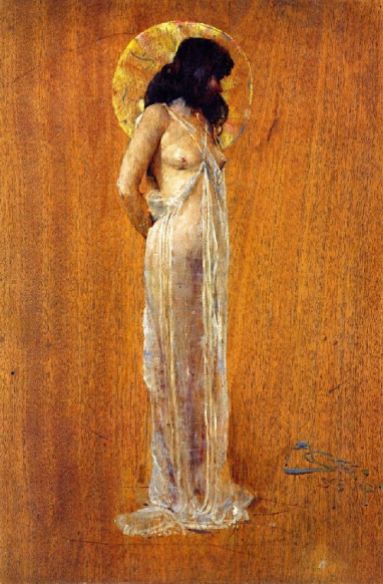
Soon thereafter, the perfume becomes sweeter. There are undertones that call to mind tonka bean and some faint woodiness that make me wonder if there is a sweet hay element from coumarin. But the greatest note is definitely from sweet peach, something which has been used in a number of fruity chypres from Guerlain‘s legendary Mitsouko to Rochas‘ Femme to provide a skin-like impression of intimacy. I’m strongly reminded of the latter, as well as Amouage‘s Jubilation 25 for Women which not only smelled very similar on me but which also led to an equally mixed reaction. The peach, cumin, chypre, skanky civet notes of deeply feminine intimacy in Jubilation 25 are strongly mirrored here. It’s quite erotic and seductive, and calls to mind the famous nudes from Delacroix or Rubens.

“Woman with a parrot” by Eugène Delacroix. Musée des Beaux-Arts, Lyons. Source: Lib-Art.com
Marc-Antoine Corticchiato wasn’t far off in his description of Musc Tonkin on the company’s website:
A powerful, addictive, erotic aura… The scent of heated flesh, solar, feline, subtly leathery. This elixir reinvents in a novel, contemporary style, the most suave note in perfumery, worshipped for millennia: Tonkin musk.
More than a fragrance: an imprint… […]
Vibrant, facetted, surprising, at once nocturnal and solar, this aphrodisiac potion changes on each skin, the better to enhance it. A lick of salt for the taste of skin. A heady floral whiff to remind us that perfume links our bodies to the erotic spells of nature. A liquorous, mulled-fruit burn contrasting with a light, shimmering veil of powder…
“Venus at a mirror” – Rubens. Source: La Cornice.

A few hours in, as the middle notes start to take over, the perfume becomes even softer. The oakmoss has completely vanished, as have the fruity accords. Now, it smells like deep, dark, red rose with something that may well be Jasmine Sambac. The latter has a muskier, deeper, earthier element to it than regular jasmine. There are also hints of sweetness, as if from honey. The earthiness remains, though it is faint and tinged by more amber-like elements. It’s not resinous but hazy, as if soft amber has mixed with patchouli and musk to create a shimmering patina over the skin. It’s not a cozy, comfy scent, but a rather sensuous one. In its final hours, all that remain are traces of vanilla tonka and just plain soft musk.
All in all, Musc Tonkin had average projection on my skin and very good longevity. The sillage was very potent for the thirty minutes and strong-to-good for the first hour. Thereafter, the scent bubble became much less pronounced. The perfume became close to the skin about four hours in, but it didn’t fade away completely until ten hours had passed. I’ve read of much greater longevity — as would be expected from something that comes in the most concentrated form (extrait de parfum) — on those with less voracious, perfume-consuming skin.
As a whole, Musc Tonkin has gotten great critical acclaim. (The exception being, perhaps, Now Smell This (“NST”) where the reviewer seemed definitely unenthused and was reminded of floral “chicken manure.”) Still, I have the impression that average perfume wearers are a lot more ambivalent about the scent than the critics at places like CaFleureBon. It’s hard to explain but, from the comments on Fragrantica and elsewhere, it’s as though people feel they are expected to adore and admire the scent — when, in reality, it’s far from a huge favorite. In fact, on Fragrantica, many seem to find it admirable but “challenging.”
I obtained my sample from an extremely generous friend and fellow perfume blogger, the very astute, talented Scented Hound. He couldn’t help himself and ordered a full bottle, unsniffed, only to find it was a “grungey flower” that brought to mind Miss Haversham from Great Expectations. I don’t get Miss Haversham flashbacks — probably because I associate her with extreme white, dust, powder, and shriveled old age — but Musc Tonkin is definitely a “grungey flower.” And it is a flower that is “filled with erotism, lust and sensuality,” to quote the review from Lucasai from Chemist in The Bottle. Others, however, seem to have had a very different experience from all three of us (and the NST reviewer): some posters on Basenotes talk about very powdery notes, a “clean” scent, strong impressions of shampoo and soap, and calone – a very aquatic-melon note. It’s almost as if we smelled a completely different perfume!
I think fans of fruity, skanky chypres like Femme or Jubilation 25 will absolutely adore Musc Tonkin. So, too, will those who like very musky, animalistic scents. Though the bottle is limited-edition and only a 1000 were made, it is still available on the company’s website. There has also been speculation that, if the scent is a run-away hit, it may actually end up in Parfum d’Empire’s permanent line. I can’t speak to that but, if you are a fan of naughty, skanky or chypre perfumes and/or are a perfume collector, you may want to snap up one of those bottles before they’re all gone. I have no doubt that they will appreciate in value by an enormous amount.
For everyone else, however, I would suggest getting a sample first. Musc Tonkin is a beautifully blended and very artistically clever ode to the musks of old — but it is also challenging and, at times, difficult, especially in those opening minutes. It is not something you can just throw on to go to the PTA or to a business meeting. But, then again, it’s not meant to be. It is, however, meant to be powerfully erotic. To the extent that it replicated warmly heated flesh and funky intimacy, I’d say it succeeded in that endeavor.
 tricks her new husband into saving her life by enchanting him with a different tale each night. The powerful Persian king had become bitter and enraged by the infidelity of his former wife, so each day he would marry a virgin, only to behead them the next morning before they could betray him. Eventually, the kingdom ran out of virgins and the Vizier (or Prime Minister) was at a loss to know how to placate his bloodthirsty, vengeful king. The Vizier’s daughter, Scheherazade, offered herself as a volunteer; she had a plan to tame the king and stop the bloodshed destroying the land.
 never finished it and stopped at the most exciting part right before dawn, the time of her impending execution. The king, determined to know how the story ended, was forced to delay her sentence. That next night, she finished the tale but began an even more exciting story. Once again, she stopped exactly midway shortly before dawn, and the curious king spared her life so that he might hear the conclusion. This continued for a thousand and one nights, as Scheherazade weaved her magic through stories of Aladdin and the Genie, Ali Baba, Sinbad and many more. By the end, the king had fallen in love with the clever Scheherazade and made her his queen.