Perfume Review: Amouage Interlude (Man)

Source: Stock image. footage.shutterstock.com

Source: Stock image. footage.shutterstock.com

Imagine a kaleidoscope where, every time you turn the knob, the plates shift and change. Sometimes, it’s just in the colours and their order: red, yellow, green and black, turning into yellow, green, black and red. Sometimes, the shapes themselves change, creating a whole new vision. And, sometimes, it’s both things, with the overlapping plates changing in both formation and colour.

Source: Vogue.ru

Source: Vogue.ru

That was my experience with Interlude for Men (hereinafter just “Interlude“) from the royal Omani perfume house of Amouage. It’s a triumph of technical mastery with notes put together like the bricks in an Egyptian pyramid, in a vision of intricate, olfactory complexity. Yet, Interlude is also an incredibly changing fragrance that will throw off different colours and shapes like a kaleidoscope. The broad strokes occasionally remain the same, but the details differ each time. 

I tried Interlude twice with two different results, and am currently at the end of a third day, with still further variations in the nuances. Interlude is a perfume that I could test for 30 days in a row and I suspect that I’d have about 10 different, subtle variations, at the very least, during that time. That’s the sign of a spectacularly well-crafted, well-blended fragrance with more intricacies than a Swiss watch, a fragrance that will reveal different facets each time like a perfectly cut diamond. And some of those facets are simply stunning. In fact, I’m not sure what has left a greater impact on me: Interlude’s complex intricacy, or the intriguing, forceful, and often beautiful scent of some of its stages. Yet, for all that, I experienced some rough patches which make me a little uncertain that this brilliant creation is ultimately for me. All of that means that this is going to be a very long review, I’m afraid. Interlude is simply too complex a scent to avoid it.

Interlude Man is an eau de parfum that was created by Pierre Negrin and released in 2012. Fragrantica classifies it as a woody Oriental, and says that Interlude was intended “to evoke an air of disorder while maintaining a sense of balance and tranquility through the inventive use of incense and myrrh.” The Amouage website elaborates on that point a little:

Interlude for Man is a spicy and woody fragrance inspired by chaos and disorder masquerading an interlude moment of harmony in its heart.

Top Notes: Bergamot, Oregano, Pimento Berry Oil.

Heart Notes: Amber, Frankincense, Cistus [Labdanum], Opoponax.

Base Notes: Leather, Agarwood Smoke, Patchouli, Sandalwood.
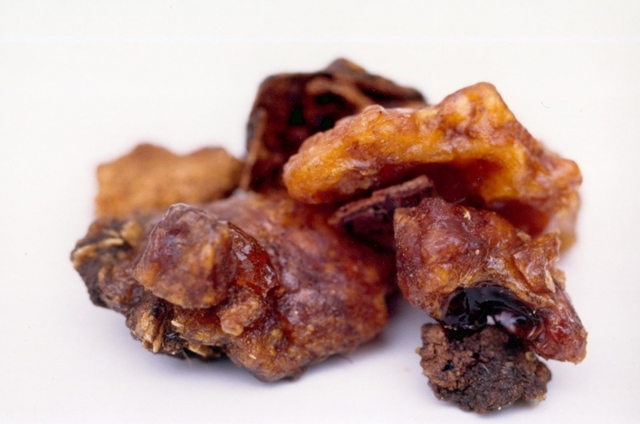
Opoponax. Source: Basenotes.

Opoponax. Source: Basenotes.

For once, the PR and marketing descriptions are quite accurate. Interlude does have a rather chaotic, difficult, intense, and disordered opening which soon gives way to plush, comforting, gorgeously rich harmony. Part of it stems from the oregano on the list, and part of it has to do with the opoponax. Opoponax is another name for Sweet Myrrh, a resin which has a very honeyed, balsamic, sweet aroma. In that way, it differs from regular myrrh which can be more churchy, cold, soapy, or medicinal. Opoponax runs like an aorta through the heart of Interlude, combining first with the oregano, incense, and pimento in the opening, before later melting into the sandalwood and amber. 

I tested Interlude in full twice, and, for the most part, the openings were largely the same in their broad strokes. There is always an initial blast of sweetness from the honeyed opoponax, mixed with incense smoke and green herbs atop subtle hints of leather and amber. That’s where the similarities end, however, because the notes, their order, their strength, and their feel varied quite a bit in each tests.

FIRST TEST:

In my first test, Interlude opened with honey, caramel, nutty amber, and sweet incense followed quickly by mentholated green notes, touches of camphor, leather, and chili pepper pimento. There is a huge blast of dried green herbs but — thanks to the strength of the pimento berries and the powerfully sweet, balsamic, honeyed opoponax — it feels almost as if the dried leaves have been transformed into something sticky, spicy, and caramelized. In fact, the honeyed nuances of the opoponax are so rich, it really does have the nutty feel of caramel. Underneath, there are subtle leather tones, and an intense, dirty, slightly goaty labdanum.

The overall bouquet is of a very medicinal, dried, green, herbal concoction covered with honeyed caramel, sweet resins, sweet smoke, and dark, warmed, animalic, slightly dirty leather. There is a somewhat dusty feel to the combination, too. The fragrance strongly evokes one of the old, dusty, Asian, herbal, homeopathic medicine shops that I visited in China, mixed perhaps with the dusty parts of an ancient Moroccan souk. The aroma is exactly what I thought Serge LutensAmbre Sultan would be like with its reportedly strong, medicinal, herbal opening. That wasn’t my experience with Ambre Sultan, but it is very much how Interlude starts for me in my first test. Medicinal, herbal amber with sweetness, incense, and a hint of ancient dustiness. The golden amber is stunningly beautiful, though extremely sweet, and it creates a visual kaleidoscope whose shifting colours center on gold, dappled with specks of dark green and fiery, peppery red.

Model of an old Shanghai medicine shop. Source: arekusu.de http://www.arekusu.de/?p=292

Model of an old, 19th-century, Shanghai medicine shop. Source: arekusu.de http://www.arekusu.de/?p=292

As time passes, the herbal pungency of the oregano feels less dry and medicinal. The camphorated notes vanished within minutes, but even the pungency has been tamed by the honeyed caramel richness. The subtle flickers of ancient dust are similarly overtaken, only now it’s by the warm, slightly animalic musk seeping out of the labdanum. Throughout it all, however, is the gorgeous incense whose smokiness infuses all the other elements and ties them together like glue. It’s sweet from the opoponax, but it’s also dark like frankincense. Fifteen minutes into Interlude’s development, the oud smoke joins the festivities. It never feels like pure, actual oud, but, rather, more like the dry, woody aroma that would ensue if agarwood were burnt. It’s very subtle at first, and limited to a mere flickering, woody shadow in the background, but it’s very pretty. Together, the oud smoke and incense help cut through some of the opoponax’s caramel richness, ensuring that Interlude is perfectly balanced and never so sweet that it verges on the cloying.

In that first test, I applied 4 really big sprays of Interlude but, to my surprise, the sillage wasn’t monstrous. It created the perfect small cloud around me, as golden as a halo. The richness of the caramel-honey was so intense, it feels as though one were swimming in liquid gold flecked with herbs. Again, I’m reminded of how this is what I thought Ambre Sultan would be like, except the latter was sheer, thin and mild on my skin instead. Another perfume comes to mind as well. The way Interlude softens to a dreamy, billowing, intensely rich, golden cloud makes me think of Xerjoff‘s Mamluk. It has some of the same rich sweetness as Interlude, though Mamluk is primarily a gourmand caramel-honey-lemon bouquet, and not a dry caramel-honey-oregano-smoke one. Still, the degree of both perfumes’ opulence and that honeyed caramel accord makes them feel like distant cousins in the same wealthy clan. 
Source: layoutsparks.com

Source: layoutsparks.com

Forty-five minutes in, Interlude starts to shift a little. The leather, dust, and medicinal undertones have largely faded to a muted whisper. Only the sweet musk and the subtle fieriness of the pimento spice remain as supporting players on Interlude’s stage. They stand quietly on the sidelines, watching as, under the spotlights, like a giant Valkyrie out of Wagner’s Ring opus, the darkly green, dried, herbal, smoky, caramel amber sings her heart out. She ends her song around the 90-minute mark, at which time Interlude changes course fully and drastically. The perfume has suddenly become extremely dry and woody. It’s as though the oud smoke and woody notes have pushed the singing, caramel-opoponax Valkyrie off center stage, and taken its place next to the dried, green, herbal and spice mix.
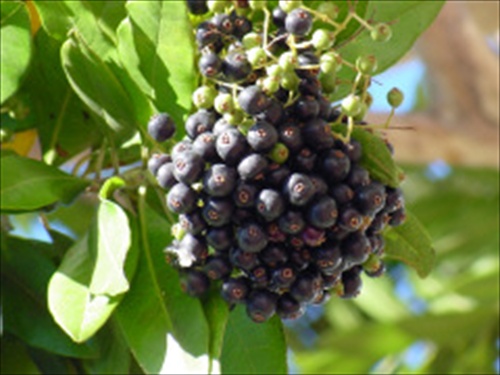
Pimento berries. Source: spiceryshop.com.ua

Pimento berries. Source: spiceryshop.com.ua

Something new has also appeared. There is an unexpected fruitness swirling around Interlude, as if the red pepper pimentos were truly in berry form. Actually, the note feels distinctly like raspberries! It’s quite perplexing. It probably means the patchouli is at play and of the slightly fruited variety; when mixed with the pimento berries, the patchouli must have sweetened them to a fruited, almost syrupy degree. On occasion, the raspberry note balances Interlude’s new smoky aridness and woody flavour, but generally, it feels discordant and out-of-place. It doesn’t help that the musty dust specks have returned, adding yet another strange layer to Interlude’s background notes.
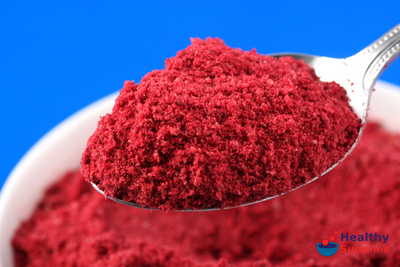
Source: healthysupplies.co.uk

Source: healthysupplies.co.uk

I’m not crazy about the overall combination, truth be told. And I become distinctly less enthused around the 3.75 hour mark when Interlude’s strange raspberry note takes on a somewhat powdered and vanillic feel. A sheer veil of oud lurks right behind it.The herbal notes are now distant figures in the horizon, something for which I’m quite thankful as it would simply be too odd of a combination. The honeyed caramel has similarly retreated. Now, Interlude is primarily a dry, woody, raspberry fragrance. It’s light in weight, gauzy and soft in feel, and hovers just an inch or so above the skin.

Interlude continues to change. By the middle of the fourth hour, the fragrance is primarily a powdered raspberry wood fragrance with oud and incense atop an abstract, vague sweetness. A new element starts to stir in the base: sandalwood. It doesn’t feel like Mysore sandalwood, but it’s extremely pretty with creamy richness that is delicately sweetened and warmed. It blooms with every passing minute until, at the start of the sixth hour, it really dominates the scent, turning Interlude into the harmonious, beautiful, comforting luxury that the PR ad copy talked about. The raspberries are still there to a small extent, but the sandalwood is at the heart of the drydown. It’s infinitely creamy, sweet, rich, and thick, with an almost nutty undertone. The latter may stem, in part, from the labdanum amber with its rich, sweet, honeyed nuances. The two new stars — the amber and the sandalwood — are both infused with oud smoke, creating a layered triptych of creamy woods, smoke, and sweetened amber.
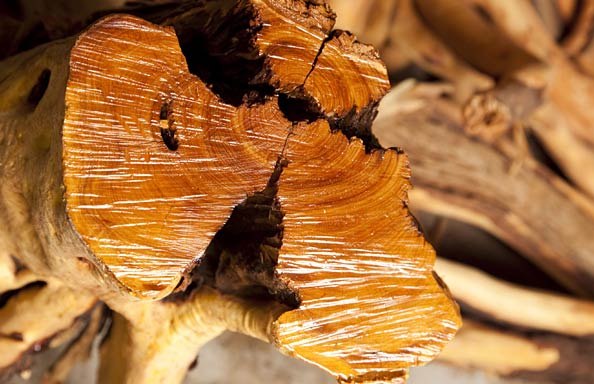
Sandalwood cross-section. Source: http://vk.com/wall172858112_51

Sandalwood cross-section. Source: http://vk.com/wall172858112_51

Interludes remains that way, in this first test, largely until its final moments. The oud smoke fluctuates in strength, sometimes seeming as though it’s about to take over, sometimes sharing the stage with the sandalwood and amber. The raspberry, alas, remains in place. At its very end, Interlude turns into an abstract, woody dryness mixed with a hint of fruity powder. All in all, with 4 large sprays, Interlude lasted a whopping, astronomical 14.75 hours on my voracious, perfume-consuming skin. The sillage was good, though it was less powerful in projection than what I had expected. Still, Interlude was a small, soft, billowing cloud around me for about 3 hours, then shrinking in size to hover just an inch above the skin for another few hours. It became a true skin scent around the end of the seventh hour. Excellent times, all in all, but I did apply a substantial amount.

SECOND AND THIRD TESTS:

Given the amount that I initially applied, and the characteristic complexity of Amouage’s fragrances, I decided to test Interlude a second time. This time I used half the amount, about 2 good sprays, and I was surprised to have a very different outcome. Now, Interlude was primarily a fruited, but dry, woody scent with a lot of incense smoke.
Photo: Nicole Resseguie-Snyder, "Cracked Moon," on Flickr. (Website link embedded within photo.)

Photo: Nicole Resseguie-Snyder, “Cracked Moon,” on Flickr. (Website link embedded within photo.)

In my second test, Interlude opened with honeyed herbs that had a harshly medicinal, camphorated edge mixed in with leather. The latter feels raw, uncured, rough, harsh, and very dirty. The oregano smells concentrated, and somewhat off-putting. It’s simultaneously like the dried variety, like a massive bunch of the fresh kind, and a third sort where both forms of oregano have been burnt to an acrid, smoky edge. Interlude evokes more than ever an old Chinese spice, herbalist medicine shop that is lightly covered by the dust of ages. This time, however, some of those herbs have been set on fire and mixed with sharp frankincense smoke. A sweet but animalic muskiness adds to the pugnacious mix which is joined, within a matter of mere minutes, by the raspberry note. It feels like both the concentrated, dried fruit, and the candied variety infused with sugar, but never like fresh raspberries. The honeyed myrrh is very subtle this time around, taking a back seat to the other notes, and adding just a hint of sweet caramel. Fifteen minutes in, the oud appears as well, feeling a little like agarwood as well as its smoke.

I’ll spare you the hour-by-hour fluctuations, but the bottom line this time around is that Interlude has an extremely different focus for its first 7 hours. The primary bouquet is of fruited, raspberry woods covered by a thick veil of sharp, black frankincense smoke with oud and some peppered spicy notes. The powerful oregano accord with its varied nuances remains for a good portion of the first two hours, until it eventually fades away. I don’t mind it, but I can’t stand it in conjunction with that fruited, raspberry note. Actually, to be precise, I can’t stand the raspberries. Not one bit, and especially not when they take on a vanillic, powdered characteristic.

Starting at the middle of the eighth hour, Interlude shifts into the gorgeous, glorious sandalwood stage that I loved so much the first time around. The infinitely creamy, slightly spiced woods are supplemented by cozy, comforting, rich amber, along with smoke and the merest hint of aged leather doused in a fine layer of caramel. It’s truly beautiful, and quite addictive to sniff. Flickers of dry oud smoke and, unfortunately, raspberries dance around the edges, but they are subtle. Nine and a half hours in, Interlude is all toasty, nutty, sweet, sandalwood with caramel and hints of smoke. By its very end, 12.5 hours from Interlude’s start with just 2 sprays, the perfume is nebulous, amorphous sweetness with a hint of some vague, lightly powdered fruitness mixed in.

I’m actually writing this review towards the end of my third test of the fragrance in as many days, and there is a third version of Interlude that has emerged. As you can tell, the layers in Interlude show themselves very differently upon each wearing. The overall brush strokes this time around are not wholly the same, though the fragrance begins with the same herbal notes as in all the other tests. The nature of the oregano falls somewhere between the opening of the first two times, but, unfortunately for me, the raspberry is as heavy from the start as it was during the second test.
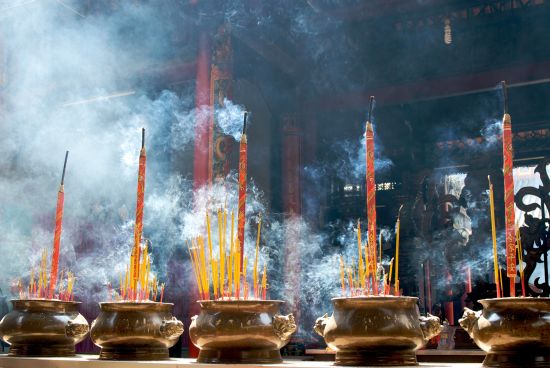
Source: 123rf.com photos.

Source: 123rf.com photos.

This third time, however, the frankincense has truly dominated everything else, even the oregano, and it is incredibly powerful. Its sharpness and strength call to mind one of the Chinese Buddhist temples that I saw in Beijing during a religious festival, where incense smoke billowed out from seemingly every nook and cranny. In the third test, the leather seems significantly more noticeable, too, right from the start, but the oud is much more insubstantial than it was the second time around. And, as a whole, this 3rd version of Interlude bears very little resemblance to the first version. At best, you could say it’s like a combination of Test 1 and Test 2 (particularly since the bloody raspberry is there again), except that comparison wouldn’t be wholly accurate given the intensity of the incense.

OVERALL:
Source: footage.shutterstock.com

Source: footage.shutterstock.com

In short, Interlude is a bit of a kaleidoscope where all the gears shift and change depending on wearing. Both the strength and the order of Interlude’s notes vary in the perfume’s first seven or eight hours, such that the primary focus seems different each time. On me, depending on test, Interlude was primarily a herbal-caramel amber scent, then a dry fruited-woody-oud one, and finally, an incense smoke one subtly backed by leather. All the remaining, additional elements or nuances varied each time in terms of strength and when they appeared. Yet, in each test, the final stage was always that gorgeous “harmony” period of sandalwood, amber and sweetness. And it’s truly beautiful.

A few other things about Interlude. I personally think this is a fragrance that smells better from afar sometimes than sniffed up close, at least during the first stage. Some people loved the overall scent that was wafting from me one night from a distance but, when I gave them my arm to sniff Interlude up close, they wrinkled their nose. I suspect it’s the pungency of the oregano, or perhaps it’s the combination of the oregano with the incense. Another thing to pay heed to is the strength of the fragrance. On Fragrantica, commentator after commentator talks about how Interlude is positively “nuclear” in its forcefulness, both in terms of sillage and longevity. On a few people, the fragrance can last up to 24 hours; one person said they could detect the aroma wafting just from the bottle alone on the other side of the room.

As a whole, Interlude Man seems to be one of men’s favorite Amouage scents and a cult hit. The majority of reviews on Basenotes and Fragrantica are overwhelmingly positive. On Basenotes, out of 23 reviews, 48% (or 11 commentators) give it the full 5 stars, with 9% giving it 4 stars. However, 26% give it 3, and 17% (or 4 people) give it 1 star. Interestingly, one of those raving 5-star reviews comes from a person who was wholly unimpressed by Interlude when he dabbed it on, but who fell head over heels for the fragrance when it was sprayed. It makes sense to me because I think this is a very complicated scent, and both the act of spraying and the quantity can impact Interlude’s character. The 4 Basenotes posters who hated the fragrance and rated it one star seemed to have sharply different reasons for doing so. For one, Interlude had too much of a “kitchen spice” accord, while another found it to be extremely cloying. A third found Interlude to be all amber mixed with a synthetic oud, and, thus, to be “seriously over-priced.” In contrast, the fourth found Interlude to be mainly sour fruit in aroma:

SOUR! Not a slight animalic or medicinal note but sour like ramming tamarind paste up my nostrils. This continued for hours without the slightest of evolution. Definitely not dry woods or incense or leather or even astringent bergamot. It was soggy wet rotten fruit for hours.

Over on Fragrantica, the reviews are even more positive in number than they are at Basenotes. The majority view is best summed up by the chap who described Interlude as a “fantastic, in-your-face spice/incense MONSTER that grabs you by the neck and throws your face into it’s scent full-throttle.” To my relief, one person detected the raspberry note, another thought it was strawberry, and a third picked up the Ambre Sultan resemblance, writing “Reminds me Ambre Sultan by Lutens, but with less spicy notes and more incense.” Perhaps my favorite assessment came from “kochy7058” who found Interlude to be an initially harsh scent that was redeemed by its drydown, but whose overall  “testosterone” forcefulness made it suited only for bosses in upper management. To be specific, “Gordon Gecko,” Michael Douglas’ ruthless corporate raider from the movie Wall Street. It’s hilarious, but it really does fit. Interlude is like a battleship and a boss, steamrolling its way through most things with the arrogant confidence of supreme dominance.

However, I think the negative reviews of Interlude can be quite instructive on how that forcefulness, mixed with Interlude’s harsh opening, can make the fragrance go terribly wrong on some people. To wit:

  • This reeks of an old, dusty attic with an odd “something smells sweet and sticky in the corner” odor. [¶] I have a sample of this and have to say that it’s absolutely horrid. [¶] This stuff is like napalm. It sticks to you and tortures you and no matter what you do, you can’t wash it off or scrape it off your body.
  • I like it, but it cause dizziness seriously! maybe it is the insence.
  • I’m not really liking this as the “kitchen spice accord” really overwhelms everthing else. And it smells like something that should be on a pizza or put into a curry. And its something I do not want to smell like.
  •  it is a different story when it is sprayed out of a bottle. It dried down to a very harsh, herbal mess mixed with body odor and I literally had to convince myself that it smelled “good.” [¶] The final straw was when I had a friend over to my place. He sniffed the air a couple times and gave a repulsed look. “Something smells like fucking ass.” I blamed it on my dog farting, and excused myself to the bathroom and scrubbed it off. I sold the bottle 3 days later.

Oh dear. “Napalm,” dusty attics, pizza toppings, and herbal body aroma. Clearly, how Interlude manifests itself on your skin will depend not only on chemistry, but also, on how your brain processes the chaotic, odd, harsh, sometimes discordant opening. The oregano, in particular, seems to be an insurmountable obstacle for some. My own varied experiences with the fragrance should underscore the obvious fact that Interlude is a fragrance that you need to test a number of times. Quantity, method of application (i.e., spraying versus dabbing), and the perfume’s innate complexity mean you can have slightly different results each time.

For me, personally, Interlude is a lovely scent, but I’m not driven wild with madness for two reasons. First, I hated that damn raspberry note. Second, I don’t trust which version I will get from one day to the next. I didn’t mind the oregano opening, and I enjoyed it when combined with the opoponax’s honeyed caramel, especially once the more bitter, medicinal nuances faded away about twenty minutes in. The second time around, it was very different, and wasn’t so appealing. Plus, the raspberry — especially when powdered and vanillic — was far from my personal cup of tea. I wasn’t too crazy about the rawness of the leather in the opening moments of one test, either. At all times, however, I absolutely adored the sandalwood stage at the end. 

Despite the difficult bits, whenever I would catch wafts of Interlude in the air a few hours in, I always thought it to be truly lovely. There was something mysterious about its intriguingly different complexities when smelt from afar, and something smolderingly intoxicating about the overall bouquet. I would absolutely wear Interlude if a bottle accidentally fell into my lap, though I would probably make sure that I sprayed on enough to get the honeyed caramel/Ambre Sultan version, and I would try not to smell it up close until at least a few hours had passed. It is a scent that I think is really spectacular on a technical level, but I’m not sure I like — or trust — Interlude enough to ever contemplate spending so much money buying it.

At the end of the day, perhaps the best way to describe Interlude is, indeed, that original Amouage PR copy about chaos and disorder as a prelude to beautiful harmony. The issue for you will be how well you manage with that first stage…. 
DETAILS:
Cost, Availability, & Sales: Interlude Man in an eau de parfum that comes in two sizes: a 50 ml/1.7 oz bottle that retails for $240 or €180, or a 3.4 oz/100 ml eau de parfum that costs $290 or €220. You can buy Interlude in both sizes directly from Amouage. However, Interlude Man in discounted online at a few sites. The small 1.7 oz size is on sale at Beauty Encounter for a discounted price of $210 instead of $240. There is free domestic shipping (with international shipping for a fee). You can find Interlude Man discounted in both sizes at OnlineShoppingX for $216.60 and $261.73, depending on size, with free global shipping. I don’t know how long these special discount prices will last. I should add that I’ve ordered from BeautyEncounter in the past with no problem, as have many of my friends, and they are a very reputable dealer. Universal Perfumes, which I think is a Middle Eastern perfume retailer, sells the large 100 ml bottle of Interlude Man on sale for $249.99 instead of $290.
In the U.S.: the authorized Amouage dealer is Parfums Raffy which sells Interlude Man for a sale price right now of $225 or $275, depending on size. There is free domestic shipping and free Amouage samples with order. Luckyscent carries both sizes of Interlude Man. The larger size of Interlude Man can also be purchased online at MinNYAedes, or Parfum1.
Outside the US: In Canada, The Perfume Shoppe offers the 100 ml size of Interlude Man, along with sample sets and more. There is free worldwide shipping, I think. The perfume is priced below retail at $275 for 100 ml, despite the fact the CAD prices are usually higher, so you may want to drop them an email to inquire. In the UK, Harrods carries Amouage, but I don’t see Interlude Man listed on their website. It is, however, available at Les Senteurs where it costs £145 or £175, depending on size, along with samples for purchase. There is also an Amouage boutique in London. In France, Interlude Man is available in the large size for €196 from Premiere Avenue, or from Jovoy in Paris for €215. In Germany, Interlude Man is available at First in Fragrance where it costs €185 or €255 (depending on size) with free shipping within the EU and shipping elsewhere for a fee. In Italy, with worldwide shipping, Interlude Man is carried at Essenza Nobile for €185 or €255, along with a sample for sale. In Australia, Interlude Man is available at Libertine for AUD$326 for the large size. For other countries, the Amouage website has a “Store Finder” which should, hopefully, help you find the perfume somewhere close to you.
Samples: You can buy samples of Interlude Man from Surrender to Chance where prices start at $3.99 for a 1/2 ml vial. The site also sells a Sampler Set for 7 Amouage men’s fragrances, including Interlude Man, which starts at $22.99 for 1/2 ml vials.

Perfume Review: Xerjoff Mamluk (Oud Stars Collection)

Mamluk. Source: Fragrantica.

Mamluk. Source: Fragrantica.

Xerjoff is an uber-luxury, Italian niche perfume house founded in 2004 by Sergio Momo. In 2012, Xerjoff (pronounced as “Zer-joff”) launched its Oud Stars Collection of fragrances which included Mamluk, a gourmand take on agarwood. Like the rest of its siblings, Mamluk was created by the perfume house’s founder, in conjunction with Sonia Espelta and Laura Santander

The notes in Mamluk according to Xerjoff and Luckyscent include:

Italian Bergamot, Honey, Caramel Accord, Jasmine Garndiflorum, Osmanthus, Laos Benzoin, Vanilla Madagascar, Indian Oud, Crystal Musks, and Amber.

Photo: Blentley via fr.fotopedia.com

Photo: Blentley via fr.fotopedia.com

Mamluk opens on my skin as the most unbelievably sweet bouquet of lemon and honey with a beautiful, but faint, floral tinge. Quickly, sour notes emerge, smelling rather urinous, though simultaneously infused with an incredible sugariness. Thankfully, both the sourness and the pee-like nuance are very short-lived, and fade away in a matter of minutes. In the meantime, subtle whiffs of a sharp, slightly astringent oud flicker on and off, while musk, amber, and a warm plushness stir in the base.

The famous Cora "Sun Drop" yellow diamond. Source: extravaganzi.com

The famous Cora “Sun Drop” yellow diamond. Source: people.com.cn

What’s interesting about Mamluk’s opening minutes is that, despite smelling the nuances of the individual notes, you’re subsumed by the overall effect which is far more over-reaching, all-encompassing and lovely. Yes, you can detect the lemon or the subtle florals, along with the other elements, but Mamluk envelops you in a blooming cloud that feels absolutely radiant. It’s like a giant, yellow diamond shining in the dark, throwing off rays of crystal clarity and sharpness. And, yet, there is incredible softness billowing out as well. It’s like a juxtaposition of angles but, also, of extremes that’s very hard to describe. Take, for example, that lemon and honey combination. It is so sweet, it almost hurts; so intense, it can verge on the sharp; and yet, there is a radiant softness that almost glitters.

Bergamot. Source: a1.ro

Bergamot. Source: a1.ro

Ten minutes into Mamluk’s development, the perfume turns even sweeter and warmer. The citrus is heady, conjuring images of the fruit lying ripe, thick, and heavy on the branch, and so sweetened by the sun that it verges on the over-blown. The subtle floral nuances are simultaneously airy, thick, gauzy, dainty, indolic, and slightly voluptuous. Again, it’s the story of contradictory extremes. In the background, the Indian oud now feels so sweetened that it almost verges on the caramelized. It’s a far cry from the medicinal, ripe cheese and fecal characteristics of the very aged, rare agarwood from Laos that dominates Mamluk’s very masculine sibling, Zafar. The overall effect of the different elements in Mamluk is an intoxicating, honeyed headiness that feels almost piercing in its sweetness and glitter.

Slowly, slowly, the sweetness starts to take some shape. Twenty minute in, the heavy honey cloud takes on a definite salty caramel undertone. There is a similar salty vibe to the musk and golden amber, leading me to believe that there may be actual ambergris — that really rare, difficult to find, incredibly expensive ingredient — in Mamluk, and not the generic sort of “amber” that is used in most perfumery. The floral notes aren’t as easy to distinguish. They feel amorphous, and never like distinct jasmine or osmanthus. In fact, I don’t smell any of osmanthus’ tea or apricot undertones, though I detect something that feels a lot like peach. Perhaps, it’s the effect of the rich honey and the lurking caramel that have made the osmanthus into something far richer than delicate apricot. Over time, the caramel becomes stronger and more powerful, infusing everything with its sugary tones. When combined with the honey, the sweetness completely overpowers and overshadows the subtle flickers of oud, which now retreats far, far to the background, never to be seen again until the drydown. At the 40-minute mark, even the flowers feel as though they’ve been drenched in caramel and, to be honest, it’s a bit cloying at this stage. Have I mentioned that Mamluk is a very sweet fragrance?

Source: Wallpaperscraft.com

Source: Wallpaperscraft.com

Mamluk never changes in its primary essence, only in its shape. From start to finish, it is predominantly a very sweet citrus-honey fragrance with other notes that circle around it like planets around a honeyed sun. For the first three hours, the florals are the main lady-in-waiting, though they always feel abstract and indistinct. Sometimes the floral-peach note seems a little more prominent, sometimes the caramel, but, at all times, the star of the show is the tangoed dance of honey and heavy, sun-sweetened lemon.

The only big change in this period is in Mamluk’s texture which becomes softer, warmer, smoother, lighter, and less thick. The edges have been rounded out, even blurred, so that the whole thing feels more billowy than ever. The perfume feels better balanced, particularly the sweetness which, at the start of the second hour, seems much less overwhelming. Mamluk is that oddest of combinations: a fragrance whose potent, indolic notes feel simultaneously thick and airy, strong and light, voluminous and heavy, sharp and blurry. It would almost feel like a vague cloud, except you can clearly detect those main notes — limited and monotonous as they may be.

It’s only around the fourth hour that the notes themselves start to shift their place in the rotation. Now, the oud starts to peek out from behind the sun. It’s as though it needed the power of the other notes to fade a little before it had the chance to be noticed. Taking its place in the background is the floral bouquet which becomes softer and less noticeable with every passing hour. Mamluk is now a honey-citrus perfume infused with sweetened agarwood and the barest suggestion of rich vanilla bean paste. In its final moments, Mamluk is nothing more than abstract sweetness with the vaguest suggestion of honey.

All in all, Mamluk lasted a little over 11.25 hours on my perfume-consuming skin. It’s an incredibly powerful perfume, even when its projection drops from its initial heady heights towards the end of the second hour. At that point, Mamluk only wafts 3 inches above the skin, though it is still extremely strong within that small cloud. It takes the fragrance about 7.5 hours to become a skin scent, though it doesn’t require voracious sniffing to detect it even then. For all that Mamluk sometimes feels like a billowing, radiant cloud in weight, the strength of the fragrance cannot be under-estimated. I merely dabbed, approximately 2.5 large-ish smears, and I cannot imagine the power of Mamluk if one actually sprayed it on, never mind if one sprayed on a lot. My God, they might smell you out at the space station!

I like Mamluk, though I think one could get a little bored of it and exhausted by the fierce onslaught of its richness. It’s linear, monotonous, far from complex, and, yet, it’s also pretty, lush, rich, heady, and languid. Mamluk is really a honey lover’s fragrance, and not something I’d ever recommend to those whose skin chemistry always turns the note sour, urinous, or animalic. I’m lucky and, with one single perfume exception, honey always blooms on my skin, so obviously this review reflects that aspect. As a whole, Mamluk feels quite unisex, though it may be too feminine for those men who like their agarwood on the very undiluted, masculine, edgy, raw side (like in Zafar). Mamluk is actually a perfect fragrance for those who normally struggle with oud, who like it highly tamed and sweetened, and who prefer it to be a minor, unobtrusive player instead of a main one. It’s definitely a fragrance for those who love very sweet or gourmand perfumes. For me personally, it’s a little too repetitive, one-dimensional, and boring, but I can definitely see its heady charms. Mamluk is frightfully expensive, however, and I personally think it’s actually far too expensive for its very simple nature. However, price is always a subjective issue, and Mamluk does feel opulently luxurious, so if you love honey and dislike strong oud, then you may want to give it a try.

DETAILS:
General Cost: Oud Stars Mamluk is an eau de parfum that is only available in a 50 ml/1.7 oz bottle that costs $315 or €240. In the U.S.: you can buy Mamluk from Luckyscent, though they seem to be back-ordered. There is also an Oud Stars Discovery set of 6 fragrances in 15 ml sizes for $250, but they are sold out of that too at the moment. Mamluk is also offered by Parfums Raffy for the same price of $315, and it is not sold out there. MinNY does not list Mamluk, though it does offer a sample for purchase. Outside the U.S.: You can order Mamluk directly from Xerjoff for €240, or you could opt for the sample set (which is currently sold out) for €195. In the UK, Xerjoff is carried at Roja Dove’s Haute Parfumerie in Harrods. In Paris, Mamluk is carried at Jovoy which sells it for €240, Germany’s First in Fragrance sells it for €247, and the Netherland’s Aafkes for €240. In Russia you can buy Mamluk at Orental for what seems to be 6,000 Ru, and also at Lenoma. The Oud Stars Discovery Set is offered by some perfume retailers, such as Aafkes and First in Fragrance. It’s priced at €195 for 6 different fragrances in 15 ml sizes. For all other locations from Sweden to the Middle East, you can turn to the List of Retailers on the Xerjoff site to find a Xerjoff vendor near you. Samples: you can buy Mamluk from Surrender to Chance where prices start at $6.99 for a 1/2 ml vial. Samples are also sold at MinNY.

Perfume Review – Serge Lutens Muscs Koublaï Khan: Animal Magnetism

Marlene Dietrich as Catherine the Great in "The Scarlet Empress."

Marlene Dietrich as Catherine the Great in “The Scarlet Empress.”

Catherine the Great on horseback, riding to meet a young Cossack officer at a secret rendezvous where the lovers will tangle under Siberian furs before a roaring fireplace. Henry VIII seducing Anne Boleyn on more piles of fur on a winter’s night at a hunting lodge. The Sun King, Louis XIV, and one of his mistresses at Versailles, a palace redolent with the smell of the human body covered by powdered roses. The memory of riding my horse on a warm day, and the subtle aroma of his lightly musked, heated, muscular neck, mixed with the smell of the leather harness and saddle.

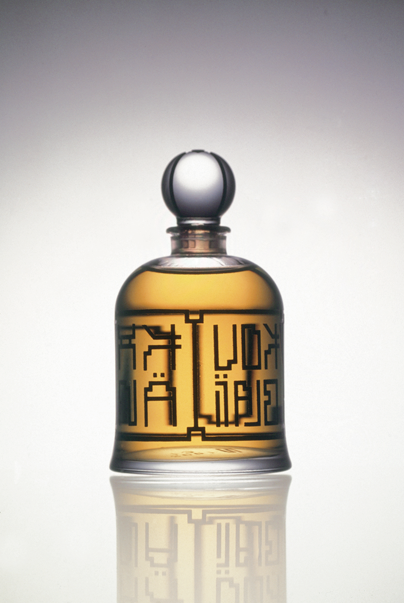
Special, limited-edition, rare bell jar bottle of Muscs Koublai Khan. Source: Serge Lutens Facebook page.

Special, limited-edition, rare bell jar bottle of Muscs Koublai Khan. Source: Serge Lutens Facebook page.

Those tangled thoughts and images are what cross my mind when I wear Muscs Koublaï Khan from Serge Lutens. Muscs Koublaï Khan (or “MKK” as it is often referred to for short) is a fragrance that always conjures up royalty in days long gone, along with fur and the memory of horses. It is an eau de parfum that I’d always wanted to try for very personal reasons. The tale in my family is that one side is a direct, linear descendant from the legendary Genghis Khan, leader of the Mongol hordes and the terror of both the Asiatic and the European plains. I’ve never bothered with genealogy and know nothing of its rules, so who knows how true it is, but I’ve always loved the story. So, a fragrance inspired by Genghis Khan’s grandson, Kublai Khan (or, as Serge Lutens writes it, Koublai Khan)? Clearly, it was something to try.

Regular bell jar of MKK, available for purchase today.

Regular bell jar of MKK, available for purchase today.

Then, I started reading about the famous Lutens creation — and I stopped in my tracks. Perhaps few fragrances come with such baggage. Horrified reactions abound on the internet, reaching such a crescendo of revulsion that any sane person would hesitate. From tales of crotch sweat, testicular sweat, camel feces, unwashed taxi drivers, and anal odor, to shuddering comments about how it would be socially unacceptable to go out in public reeking of Muscs Koublai Khan, the perfume has one of the most horrifying reputations around. I got a sample months ago but, every time I went to pick it up, I would think about “camel balls,” and I promptly put it back down again.

Imagine my disbelief, then, when I actually tried Muscs Koublai Khan and thought: “this is IT??? What’s all the fuss about?!” More to the point, I loved it. While I would never — ever — recommend MKK to someone just starting their perfume foray into niche brands or to anyone who isn’t a fan of animalic scents, I definitely think people who love musky Orientals and have some perfume experience should ignore the perfume’s reputation and give Muscs Koublai Khan a try.

The 50 ml/1.7 oz bottle of MKK available.

The 50 ml/1.7 oz bottle of MKK available.

Muscs Koublai Khan is an eau de parfum that was created with Lutens’ favorite perfumer, Christopher Sheldrake, and released in 1998. Though it was originally a Paris Bell Jar exclusive, American perfume buyers can easily find it in a regular 1.7 oz/50 ml bottle that is easily available and sometimes discounted online. In Europe, however, Muscs Koublai Khan is still limited to the Bell Jar format that is exclusive to Serge Lutens’ Paris headquarters, though I did find the smaller bottle available at one French online retailer.

Le Grand Serge” describes Muscs Koublai Khan on his website as follows: 

Valuable furs were spread for the Emperor of China to tread on, muddy boots and all.

Ultra-animalic musks and all kinds of tanned hides make a sensational debut in this fragrance. Pay no attention to their aggressiveness: once on the skin, they retract their claws in favor of padded paws.

Fragrantica classifies Muscs Koublai Khan as a “chypre,” which I think is odd, and says that the notes consist of:

civet, castoreum, cistus labdanum, ambergris, Morrocan rose, cumin, ambrette seed (musk mallow), costus root and patchouli.

Source: imgfave.com. Artist or creator unknown.

Source: imgfave.com. Artist or creator unknown.

Muscs Koublaï Khan opens as sweet amber, mixed with a slightly urinous, very musky edge. It feels just like warm, heated skin that is faintly dappled by a light sweat. The whole thing is sweet, sour, musky, just a little bit fetid, and a tiny bit dirty, all at the same time. But it truly doesn’t smell like stale body odor. A citric rose note, laden with rich, almost syrupy honey, peeps up from the musky amber base. There is just the faintest hint of a floral, rosy, vanillic powder sprinkled on top. Lovely flickers of sweetness come from the patchouli, and it mixes with the mildest, most minute touch of cumin. The whole bouquet sits atop the gorgeously plush, velvety warmth of the castoreum and the sweet nuttiness of the labdanum amber. It’s all sexy as hell, and significantly tamer than I had expected.

Source: narutoforums.com

Source: narutoforums.com

The ambered base is beautiful. It’s gloriously rich from the ambergris which, like the labdanum, is enriched by the warm plushness of the velvety castoreum, as well as by the naturally sweet muskiness of the ambrette seeds. That said, the ambergris doesn’t smell very concentrated or profound. It lacks the salty, wet, sweet, slightly sweaty muskiness of anything more than just a few drops of ambergris. At times, I wonder if it’s the real thing at all.

Perhaps the best — and, certainly, the most fascinating — part is the slightly urinous note from the civet. I realise that sounds odd and strange, and maybe you just have to be a really obsessed perfumista, but there is some appeal to that sour aroma. Just as really rich, really buttery food needs a dash of acidity to create a balance, so too does really rich perfumery. Here, the civet adds a really well-modulated edge that initially isn’t really like urine, but more like a sweet, little sour, almost vinegary, feline muskiness. To my surprise, it’s not rendered skanky or raunchy by the costus root which can sometimes take on a sharply feral aspect. (I likened its effects in Amouage’s Opus VII to “panther pee.”)  Here, there is just the slightest musky dirtiness, perhaps akin to the smell of “dirty hair” that costus sometimes evokes, but it’s far from strong and certainly not over-powering. Still, I imagine that those who hate animalic notes in even the smallest dose will probably keel over from Muscs Koublai Khan’s combination of civet and costus.

"Red Orange Rose Yellow Abstract" by LTPhotographs, Etsy Store. (Link to website embedded within, click on photo.)

“Red Orange Rose Yellow Abstract” by LTPhotographs, Etsy Store. (Link to website embedded within, click on photo.)

Ten minutes into its development, Muscs Koublai Khan radiates an unusual bouquet of richly sweet, lightly vanillic, almost citrusy, powdered rose mixed with the scent of a warm, musky body. The combination of the civet with the powdered rose and the amber keeps triggering thoughts of Bal à Versailles, the legendary scent whose vintage form sought to replicate the scent of aristocrats at Versailles who used strong floral powders to mask their lack of hygiene. It’s often said that courtiers at Louis XIV’s Versailles palace would relieve themselves in corners without the slightest hesitation, and that is another aroma that Bal à Versailles sought to recreate in its nuances. I wish I had a vintage sample to compare to Muscs Koublai Khan, but my memory tells me that Bal à Versailles was a much more extreme, raunchy, dirty, skanky proposition. Muscs Koublai Khan is much better balanced, and far, far less dirty. Furthermore, the urinous note from the civet and costus root is too mild and too sweetened to evoke the same aroma. And, just to be clear, nothing in Muscs Koublai Khan reminded me of a urinal.

Source: Zavvi.com

Source: Zavvi.com

Twenty minutes in, Muscs Koublai Khan becomes muskier in a more rounded way, taking on a velvety, smooth, deep quality that is as luxurious as it is sensuous. It really feels like the scent of warmed bodies under a cozy, thick, fur blanket. For all the talk about sweat or urinous edges, the thing that Muscs Koublai Khan truly evokes is the scent of skin itself. Not stale, sweaty skin, but skin that is heated and just barely sweaty from perhaps a romp under the sheets. Yes, the perfume has some animalistic tendencies, but nothing about it evokes testicular “ball sweat,” anal secretions, or fecal notes. Just heated bodies intertwined in intimacy.

By the same token, nothing about the cumin note makes me think of unwashed, stale body odor. In fact, the cumin is almost imperceptible on my skin which normally amplifies the note. It’s not even a millimeter like the rancid, wholly intimate, extremely dirty note of unwashed genitalia that it triggered in Vero Profumo‘s Rubj eau de parfum. Nor is it like the stale armpit sweat of Frederic Malle‘s Bigarade Concentrée. Granted, the cumin here is not the pure, dusty spice of something like Parfum d’Empire‘s Ambre Russe, but its muted, emasculated nature and the way it flickers just once in a blue moon in the background is hardly what I was expecting.

Photo: Lydia Roberts, 2011. Source: Tumblr http://www.tumblr.com/tagged/lydia-roberts

Photo: Lydia Roberts, 2011. Source: Tumblr http://www.tumblr.com/tagged/lydia-roberts

Muscs Koublai Khan remains relatively unchanged in its core essence for a large portion of its development. It is a beautifully sweetened rose scent flecked by vanilla powder and a citric, slightly urinous civet note, all atop a gorgeously plush, velvety, rich amber base that radiates the warmth of heated, musky skin. The notes fluctuate in prominence, intensity and strength, but Muscs Koublai Khan on my skin is primarily a musky amber fragrance with rose and vanilla. The civet note waxes and wanes, reaching its highest peak around the middle of the second hour where it definitely feels a little sharper than it did originally. Then, it becomes tamer, softer, and richer, perhaps thanks to the castoreum which casts out its warm tendrils to enrich everything it touches. There is also a subtle leathery undertone to Muscs Koublai Khan which becomes more noticeable at the end of the first hour and which feels a little raw at times. It, too, becomes gentler, sweeter, and warmer after a while, thanks to the amber’s plush embrace.

"Theequus" - photo by David Sinclair, via Crossed Wires Tumblr. (Website link embedded within photo.)

“Theequus” – photo by David Sinclair, via Crossed Wires Tumblr. (Website link embedded within photo.)

For all that the sophisticated elegance of Muscs Koublai Khan evokes historical figures covered by rich furs, it also calls to mind a more personal memory for me. Something about the overall combination of notes reminds me of riding. If you’ve ever been a horseman, you’ll know the aroma, especially after a gallop in the warm sun. The musky smell of a horse’s warm body, just lightly veiled by sweat, that is sweet but, yet, just a little sour as well. The soft heat of his muscular neck, combined with the faintest whiff of leather from the saddle and harness, all bundled up with a golden muskiness. That aroma is a subtle undertone of Muscs Koublai Khan for a brief time around the 90-minute mark and in an extremely mild form, even though the fragrance bouquet is primarily radiating the sweetest rose, its light touch of vanillic powder, and a plush, ambered base.

The overall combination is far too civilized and sophisticated to evoke the pillaging, raping, filthy brutality of the Mongol hordes. For me, one needs to go down a little later in history to a later Slavic legend, Catherine the Great, whose sensual appetites were almost matched by her passion for the hunt and for refined luxury. Muscs Koublai Khan would have very much suited the Great Catherine from its floral, vanillic rose that is powdered like her face, to the languid, feline heat of warmed bodies intertwined under blankets of the richest Russian furs.

Model, Bregje Heinen, photographed by Jean-François Campos for Flair November 2010.

Model, Bregje Heinen, photographed by Jean-François Campos for Flair November 2010.

Perhaps the most surprising change with Muscs Koublai Khan is how the volume quickly decreases to a purring hum. Less than forty minutes into its development, Muscs Koublai Khan seems to get a little blurry around the edges and the sillage drops quite a lot, though its smell is still extremely potent up close, thanks to the civet. At the end of the second hour, the perfume is so airy and lightweight that it feels far weaker than a hardcore oriental eau de parfum. In fact, Muscs Koublai Khan is far sheerer than I had expected. It lacks the opaque, baroque heaviness of Maison Francis Kurkdjian‘s ravishing Absolue Pour Le Soir, another animalic, musky, amber oriental fragrance but one which is, ultimately, night and day apart from Muscs Koublai Khan. Absolue Pour Le Soir is actually much dirtier than Muscs Koublai Khan, not to mention heavily spiced, more floral, and infused with almost as much beautiful sandalwood as it is with musk and amber. Muscs Koublai Khan is tamer, more linear, more muted, and much less complex, though it is beautiful in a very different way and perhaps more refined than the Absolue with its more hardcore, slightly beastly edge.

Muscs Koublai Khan soon starts to take on quite an abstract aura. At the start of the third hour, the fragrance is a soft, nebulous blur of amber, vanilla and quietly animalic musk. The flecks of a citric, civet-infused, and lightly powdered rose start to recede, slowly become less and less noticeable. By the start of the third hour, the rose is largely gone, leaving behind only an ambered, powdered, vanilla musk with a hint of civet. And there Muscs Koublai Khan remains for hours and hours, turning more and more abstract and amorphous. It soon loses the civet, becoming just an musky, powdery, sweet amber fragrance. Though Muscs Koublai Khan’s sillage hovered just above the skin for the second and third hours, its projection drops even more. (That said, I dabbed it on, and, apparently, it’s a very different issue if you spray Muscs Koublai Khan.) Around the sixth hour, the ambery perfume becomes a complete skin scent. By its very end, almost exactly 12.5 hours from its opening, Muscs Koublai Khan is just a hint of a sweetened, musky powder, and nothing more.

I think Muscs Koublai Khan — and the extreme reactions to it — need to be placed in context. For one thing, the average perfume user nowadays is used to a very different sort of musk in perfumery. Clean, white musks abound, and the extent of something ostensibly “dirty” is probably Narcisco Rodriguez‘s musk For Her. Muscs Koublai Khan is a whole different kettle of fish. Perfumes with civet (and even castoreum) are no longer common in perfumery, so people aren’t so exposed to what musk used to be all about when perfumes like Bal à Versailles and its cohorts celebrated the skank provided by civet, castoreum and real Tonkin deer musk. For animal cruelty and ethical reasons, many of those ingredients are no longer used and their scent has to be replicated through vegetal musks like ambrette seeds. I’m glad for that, but it does mean that exposure to a dirty sort of musk — even through vegetal recreation — can trigger a repulsed response in those who expect musk to have the modern, common characteristics of white, laundry-clean freshness.

Muscs Koublai Khan is not a perfume that I would recommend to everyone. Those who are brand new to perfumery may find the civet and musk accords repulsive. Those who are experienced perfumistas, but who feel that even the smallest drop of something animalic in their perfumes renders it unbearably “dirty,” will undoubtedly feel the same way. But those who adore true Orientals and who can appreciate some animalic nuances should absolutely try it. Don’t let Muscs Koublai Khan’s dangerous reputation keep you away. I think you will be like a lot of bloggers who have tried Muscs Koublai Khan and wondered: what is all the Sturm und Drang about?

Take, for example, the review at Pere de Pierre where the blogger clearly was prepared to be blown away by Muscs Koublai Khan’s terrible reputation:

Of all the “bad boy” fragrances, the outlaws, the ones whose whispered descriptions contain the words “unwashed” and “crotch”, often in succession, and sometimes with “of a Mongolian horseman after three days of burning, raping and pillaging” appended, it may be that none has a more salacious reputation than Muscs Koublaï Khän.

Thus, it was with great anticipation that I first pulled the stopper on a sample. Civet and castoreum? Bring it!

The first sniff of the vial seemed promising; yes, there was civet in there.

On application, though, it seemed much like Kiehl’s Musk Oil, a similarity that has been noted by many a reviewer before. A simple floral musk, nothing terrible or even animalic about it.

Fortunately, it did not take long before MKK began to develop, something that Kiehl’s does not ever seem to do, on me anyway.

MKK shuffled its accords and painted scenes with them. However, they were not dramatic, sharply pitched scenes of lust and conquest; they were more like dreamy landscapes with dark clouds scudding through a sky above shifting fields of roses and poppies. Sensual, yes, but more of a lazy Sunday afternoon lovers’ feast than a frenzied, climactic battle. […][¶]

In subsequent wearings, only once did the civet ever really raise its head, and it was glorious; I wouldn’t mind if it did it more often. But mostly, this is a sultry, sometimes even sweet, and floral musk.

Kiehl’s Musk is not the only fragrance to which Musc Koublai Khan has been compared. The other one is Frederic Malle‘s Musc Ravageur. I haven’t tried it yet, but the general consensus seems to be that there are differences. The blogger, The Candy Perfume Boy, did a comparison of the two fragrances, and his section on the Serge Lutens begins with: “I just can’t see what all of the fuss is about.” He found Musc Koublai Khan to be disappointing in its tameness, and not particularly filthy. As a gourmand lover, he far preferred Malle’s Musc Ravageur with its “edible” characteristics. On Fragrantica, one reviewer writes about the Lutens: “it’s similar to Musc Ravageur, but Koublai Khan is rounder and deeper (and more discreet) while MR is more playful and contemporary.”

Speaking of Fragrantica, one commentator clearly shares my experience with horses, writing in a review that I’ve reformatted only for the sake of trying to keep things shorter:

I fell in love with it. [¶] Maybe it will be easier for those of you who are familiar with horses to comprehend what I will try to describe.

First wave, it smelled like a horse with saddle and all that has been running a mile on a sunny summer day. Since I love horses and their smell, well, it didn’t bother me at all. Au contraire. [¶] It was musc and a bit sweet and also a bit “sweaty”. [¶] Then the dry down became very soft and almost powdery, almost buttery. In the middle of the composition I also smelled like hay and kind of what it would smell like when you walk in a wild field in summer.

So for me, that perfum is very comforting. [¶] The funny part is that my husband thinks the same as me when it come to the smell of this perfume. He says that it also smell “very clean”!? [¶] My best friend (women) love the first “snif” then she looked at me with a strange look on her face and she says that she also smell like “pee”?????!!!. And at last my best friend (man) told me it smells like baby powder!!

I think Musc Koublai Khan is all those things: sweetly horse-y (but in a really subtle, muted way), summery, almost clean in the sense that it evokes a person’s skin scent more than body odour, but with slightly urinous nuances, and sufficient powder that a handful of people may think it resembles baby powder towards the end.

The Non-Blonde, however, didn’t smell anything horsey about the fragrance at all. Her review talks about how clean it actually smells, but also cautions about over-application:

If you google Muscs Kublai Khan and dig enough, you would find colorful reviews, mentions of horses, genitalia and horses’ genitalia. Which is where I make the “whatcha talking ’bout?” face.

I cannot argue with the fact MKK smells “raw”, which probably translates to “animalic” for some. I’ve heard rumors of cumin, but I don’t get any at all. Quite the opposite, actually, if we agree that a cumin note in perfume represents the dirty and the sweaty. What I’m getting is actually clean, sweet and warm. The dirty part is not the scent itself, but the warm skin feel it evokes and all the things one might associate with a skin in this state. In his review for Perfume Smellin’ Things, my scent twin Tom called it “clean bodies in compromising positions”, and that’s exactly right.

[…] On my skin it’s a thing of beauty and has nothing to do with the great unwashed. It’s also incredibly strong and persistent, even after the big show of the ultra sweet top notes fades away.

It’s so strong, actually, that anything more than a couple of dabs can get extremely distracting. Over apply and you will keep smelling MKK, thinking about MKK, feeling MKK. It will occupy your thoughts in a NSFW way, so be careful. Another word of warning: Muscs Kublai Khan is meant to be dabbed and not sprayed. I’m saying this as someone who prefers to spray just about anything and regularly decants parfum extracts into mini atomizers. I did the same with MKK and it’s just wrong. You don’t want to cover a lot of skin with this, and spraying releases way too much. 

You may think all this gushing and raving is bias from bloggers who are Lutens groupies, but that would not be true. Take the blogger, Pour Monsieur, who says he flat-out hates Lutens fragrances, and finds “them overly complex, pretentious and unwearable.” Yet, he writes that “Muscs Koublai Khan is the one huge exception, and is truly a special scent.  It is the best musk fragrance in the world, hands down.” [Emphasis added.] In his review, he explains why:

This is more “body smell” rather than “body odor”.  It reminds me of the smell of sweat on clean, warm, tanned skin.

It’s a complex scent, but not the ego trip of the other Lutens fragrances I’ve tried.  The sense of perfect balance and complexity in Muscs Koublai Khan is amazing, and makes it so comforting to wear.  It smells like there are several different types of musk used in MKK – light, heavy, white, dark, etc..  They’re all unified by soft floral and herbal notes, which add depth to the scent and prevent it from smelling like someone’s asshole. […][¶]

Muscs Koublai Khan is not only the most wearable Serge Lutens perfume I’ve ever smelled.  It’s perhaps the most wearable scent I’ve ever worn, period.  This is a fragrance, more than any other I’ve tried, that absolutely must be worn on skin, and that’s because it smells like skin.  When you wear this, it becomes a part of you, smelling like it’s part of your body.  It’s both extremely masculine and extremely feminine, depending on who’s wearing it, and it melds itself to its wearer.  I can’t imagine Muscs Koublai Khan smelling unsuitable on anybody.  So it’s both daring and suitable for anyone.  Think about what an incredible acheivement that is for a perfumer.

I don’t agree that Muscs Koublai Khan is the most wearable Lutens, but I think many of his other points are true.

I’ve spent all this time covering other people’s assessments of Muscs Koublai Khan’s tameness for a reason. The horror stories don’t always apply, and it’s not just me with my heavy bias towards Orientals and my love for Serge Lutens. Even those who can’t stand Lutens fragrances think this one is special. And I’m definitely not alone in finding all the Sturm und Drang about MKK’s supposed terrors to be very different from the reality on one’s skin. But I cannot repeat enough, this is not a perfume to try if you’re looking for something totally clean and without the slightest bit of animalic edge. Laundry-fresh it is not! And if you’ve never encountered civet or are new to niche perfumery, then you may be in for a shock. In fact, I suspect you’ll think it smells of poo.

However, for those who adore Orientals and have some perfume experience, I beg you not to believe all the stories about Muscs Koublai Khan, and to give it a test sniff. Uncle Serge is completely right when he says: “Pay no attention to [the musks’] aggressiveness: once on the skin, they retract their claws in favor of padded paws.” It’s very true, and that’s why I’d wear Muscs Koublai Khan in a heartbeat if I had a bottle. The perfume has enormous sexiness (the Non-Blonde is right in saying it triggers NSFW thoughts or images), and a sort of fascinating, raw animal magnetism that is simultaneously very refined as well. Muscs Koublai Khan is also totally unisex, and has great longevity. Lastly, for U.S. buyers, it is easily available — and often at a discount, in fact — so there are no accessibility barriers.

So, try it and, when you do, I doubt that you’ll think of the ravaging, filthy Mongol hordes. But your thoughts may not be totally clean, either….


DETAILS:
General Cost & Discounted Sales Prices: Muscs Koublaï Khan is an eau de parfum that comes in two sizes: a 1.7 oz/50 ml size and a larger 2.5 oz/75 ml bell jar version. The retail price for the 1.7 oz size is $140, or €99, with the 75 ml bell jar going for $300 or €140. However, Muscs Koublaï Khan is currently on sale at FragranceX where the 1.7 oz/50 ml bottle is priced at $113.99. The price is also reduced at Parfum1 which sells the 1.7 oz bottle for $126 with a 10%-off coupon for new customers. I don’t know how long these specials will last.
Serge Lutens: you can find Muscs Koublaï Khan in both sizes on the U.S. and International Lutens website (with non-english language options also available). 
U.S. sellers: Muscs Koublaï Khan is available in the 50 ml size for $140 at Luckyscent, Barney’s (which also sells the expensive bell jar version), and Aedes.
Outside the U.S.: In Canada, you can find Muscs Koublaï Khan at The Perfume Shoppe for what is US $140, since it is primarily an American business with a Vancouver branch. They also offer some interesting sample or travel options for Lutens perfumes. For Europe and Australia, it gets harder. The perfume seems to be deemed “Limited Edition” for many European vendors, in the sense that MKK was originally a Paris exclusive and limited for sale elsewhere in Europe. So, it has not been easy for me to find online vendors. In the UK, I can’t find Muscs Koublaï Khan listed at Harrods, Harvey Nichols, Liberty or Les Senteurs — shops which normally carry most Lutens fragrances. However, in France, Premiere Avenue sells it for €96 and I believe they ship world-wide, or at least through the Euro zone. 
Samples: You can test out Muscs Koublaï Khan by ordering a sample from Surrender to Chance where prices start at $3.99 for a 1/2 ml vial. There is also a Lutens Sample Set for $18.99 where the vials are also 1/2 ml each, but you get your choice of 5 Lutens Non-Export fragrances (ie, those that are Paris exclusives).

Perfume Review- Serge Lutens Ambre Sultan

Serge Lutens tells you up front to expect something different:

This fragrance is not an Oriental, but an Arab and a Lutens. That being the case, don’t expect it to fit in. [Emphasis added.]

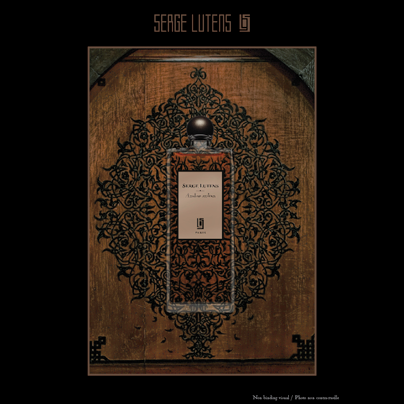
Source: Serge Lutens Facebook page.

Source: Serge Lutens Facebook page.

He’s right. For a large number of people, Ambre Sultan is not a typical amber, and some get a small shock upon first sniffing it. They expect something soft, cozy, sweetly vanillic, and gentle, but end up with a very herbal, almost medicinal, fragrance in the beginning.

I had a different experience, however, and it was a far cry from the “Chinese medicine” or “herbal spice shop” amber that I had expected. Yes, it was there to a minuscule, muted degree, but it lasted less than ten minutes and it was hardly a predominant aspect of the fragrance. Instead, on my skin, Ambre Sultan was primarily a labdanum and beeswax fragrance. It’s very nice, but it’s not the amber of my heart, and I don’t share in the view that it is the best, richest amber fragrance around. 

Serge Lutens Ambre Sultan regular photo

Ambre Sultan, 50 ml bottle.

Ambre Sultan is an eau de parfum that was created with Lutens’ favorite perfumer, Christopher Sheldrake, and that was originally released in 1993 before becoming available worldwide in 2000. The remainder of Serge Lutens’ description quoted up at the top is really key in understanding the perfume, in my opinion: 

The point of departure was a scented wax, found in a souk and long forgotten in a wooden box. The amber only became sultanesque after I reworked the composition using cistus, an herb that sticks to the fingers like tar, then added an overtone that nobody had ever dreamed of: vanilla. Why? Because vanilla is sticky, too, and it clung to my memory.

As usual, Uncle Serge provides no notes for the perfume, but Fragrantica says that they consist of:

coriander, bay leaf, oregano, angelica, resins, myrrh, amber, myrtle, sandalwood, patchouli, benzoin and vanilla.

Labdanum compiled into a chunk. Source: Fragrantica

Labdanum compiled into a chunk. Source: Fragrantica

Fragrantica leaves out the most important part: the cistus or labdanum discussed by Serge Lutens. It’s not accurate enough, in my opinion, to just mention “amber” because, to me, labdanum is a whole other creature. The three main resins generally used in oriental fragrances to create the amber smell are: labdanum, ambergris, and benzoins. (Tolu Balsam is another, but it’s not so common.)

Labdanum has a very specific, intense aroma that is nothing like the general, more commercial, easy “amber” mélanges found in many scents. It’s much more masculine with a nutty, toffee, darkly syrupy, sticky, honeyed, sometimes leathery aroma that is almost dirty in nature. It can also be very animalistic on occasion, and frequently musky; in many cases, it can feel almost raw, at least relative to the generic ambers used in some perfumes. Dark brown, verging on black in colour, labdanum is the heart of some of the most-beloved, oriental amber perfumes, from Dior‘s Mitzah and Amouage‘s Opus VI, to Puredistance‘s M and Tom Ford‘s Amber Absolute.

Source: Colourbox.com

Source: Colourbox.com

The very particular, very unique aroma of labdanum is the opening, middle, and end of Ambre Sultan on my skin. The perfume opens with a very boozy, resinous blast of labdanum with all its nutty, dirty, toffee’d, slightly honeyed, sticky, vaguely leathered undertones. It is accompanied by a subset of the honey note which usually emanates from labdanum and which, here, is all about the beeswax. The overall impression is that cognac, rum, toffee, something almost verging on nutty chocolate, and the beeswax from a large hives of bees all got together for a boozy orgy, resulting in the lovechild that is Ambre Sultan. I absolutely love it.

Source: indiamart.com

Source: indiamart.com

All too quickly, however, the perfume loses some of its sticky, resinous sweetness, thanks to the subtle infusion of dried, green herbs. They’re led by bay leaf in particular, and the aroma is initially as strong as one of those over-sized, chef jars that contains hundreds of the dried ingredient. There is the faintest touch of oregano that follows in its trail, but it’s brief and quickly flitters away. Far, far below, in the base, there is a subtle, very muted, tarry note that almost verges on the camphoraceous, but which never quite gets to the eucalyptus point on my skin. Like the oregano, it too quickly disappears. Much more prominent, however, is the subtle smokiness in Ambre Sultan that dances all around the edges. It doesn’t feel like true incense but, rather, like the smell of burning leaves in autumn.

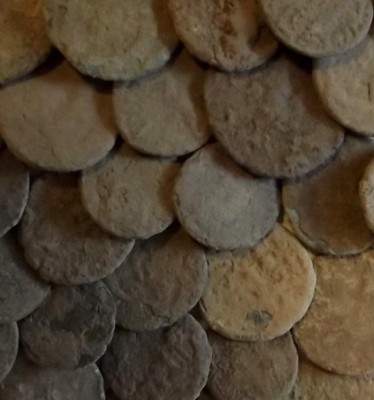
Ancient coins. Source: eBay.

Ancient coins. Source: eBay.

Accompanying it in the background is an unusual musty, earthy, dustiness. It’s a strange note because it really evokes the feel of some ancient artifact or parchment that had been left at the bottom of an old spice drawer for seventy years. It’s as much earthy as it is dusty and, when combined with the strong beeswax vein running through Ambre Sultan, it really and truly evokes what Serge Lutens intended: “a scented wax, found in a souk and long forgotten in a wooden box.”

The quiet dryness of all these notes, along with the extremely muted veil of herbs, helps to ensure that Ambre Sultan’s sticky, resinous character never verges into the cloyingly sweet or the unctuous. Yet, I’m truly surprised by how minor, light and hidden that green veil is on my skin. I don’t get a blast of myrtle with its medicinal, eucalyptus aroma; there is no angelica with its common celery nuances; the bay leaf disappeared in about 5 minutes; and the oregano was never more than a momentary flicker.

Source: honey-center.gr

Source: honey-center.gr

Instead, Ambre Sultan quickly devolves into a very simple, completely linear, and, ultimately, if I dare say it, somewhat boring combination of labdanum and beeswax. Yes, there are subtle nuances of smokiness and minor muskiness. Yes, there eventually is some vanilla that is faintly powdered and which arises at the very, very end. But, on my skin, Ambre Sultan is just nutty, slightly toffee’d, vaguely honeyed labdanum with its sidekick, the beeswax. It’s like the Lone Ranger and Tonto. They ride side by side for hours on end, with the slightly honeyed beeswax temporarily pulling slightly ahead around the end of the third hour, but it’s mainly just the two of them for most of the journey. No sandalwood, no patchouli, no herbs — nothing.

Source: background-pictures.feedio.net -

Source: background-pictures.feedio.net –

The only change in Ambre Sultan is in degree and sillage. Less than one hour into its development, the perfume softens, becoming milder, warmer, and tamer. At the 90-minute mark, Ambre Sultan starts to become blurry at the edges; it feels more like a vaguely nebulous, gauzy bouquet of labdanum and beeswax. It hovers just barely atop the skin, but the sillage decreases even further. Thirty minutes later, at the two-hour mark, Ambre Sultan turns into a complete skin scent. It is becoming increasingly hard to delineate beyond the two main notes that have now blurred together as one. Eventually, however, around the end of the sixth hour, the vanilla and benzoin start to slowly stir in the base, joining the main players in a very muted, hazy form. It’s a lovely, cozy drydown bouquet of sweet, barely resinous, generally amorphous, nutty amber with vanilla, lightly flecked by beeswax. In Ambre Sultan’s final moments, the perfume is nothing more than a faint trace of vanilla with a subtle nuance of powderiness. All in all, it lasted just 7.5 hours.

I liked Ambre Sultan, but I know my lack of exuberance is showing. So, I think it’s really important to put my reactions into a context here. I love massively resinous, spicy amber perfumes, and I’ve tried a lot of them. I think that, perhaps, I had heard a little too much about Ambre Sultan, and that my expectations were a little too high. I also think that my reaction would be very different had I smelled Ambre Sultan at the start of my journey to cover seemingly every amber or amber oriental perfume around. Had I done so, I would probably have been more blown away. As it is, I fear Ambre Sultan is getting the shaft by being compared to other fragrances I’ve tried that are considerably more intense, be it Tom Ford‘s Amber Absolute, or the stunningly rich, dense, concentrated Profumum line of Ambra Aurea and Fiore d’Ambra. By my personal, admittedly peculiar, and distorted standards of richness, I find Ambre Sultan to be light, airy, and safe. I realise that a lot of people consider it to be one of the richest, spiciest ambers around. But then, they also say that about Parfum d’Empire‘s Ambre Russe, too — and I thought that one was so sheer and anorexic that it might as well be an eau de toilette. So, clearly, I have a very different measuring stick than most.

Yet, despite my admittedly uncommon views on what constitutes richness versus lightness, I’m not completely alone in finding Ambre Sultan to be tamer than anticipated. Olfactoria’s Travels had the same reaction, and her review encapsulates many of my feelings about the perfume:

Usually, light or subtle are not adjectives one would immediately associate with a Lutens creation. And not that Ambre Sultan is either of these traits, but it is way less than what I was expecting in volume.

I thought an amber fragrance from our dear Serge would blast me clean out of my boots, to put it mildly. What I got was a purring kitten, sleeping in my lap, spreading its warmth, not a roaring tiger that is out to have me for dinner.

Ambre Sultan is a gorgeous perfume, an amber to love, an amber to cherish, an amber perfect in its execution, but it does not pack a punch like Annick Goutal Ambre Fetiche, Armani Privé Ambre Orient, Parfums d’Empire Ambre Russe or Tom Ford’s Amber Absolute, it is a lot subtler and lower in volume.

I would not make that much of a fuss, were it not a Serge Lutens perfume. You just come to expect certain things and when they are not met, there is a kind of disappointment, that is not necessarily rational or justified. But it is there nonetheless. […][¶]

Things would be different had I come from the other side. Never having smelled an amber scent like the ones mentioned above, would probably have resulted in a different view.

Despite that initial disappointment, Olfactoria (or Birgit) grew to love the scent, finding it “erotic” and “deeply sexy.”

I part ways with her there. I find Ambre Sultan to be cozy and safe, verging a little on the uninteresting, given the way that it manifested itself on my skin. It’s surprisingly boring and linear for a Lutens, too. But perhaps my heart is simply too taken by Profumum’s Ambra Aurea with its gloriously different focus on pure ambergris — in the most enormous, expensive quantities imaginable — resulting in a smoky, sultry, endlessly smooth, insanely concentrated fragrance that I couldn’t get out of my head. (I cannot wait for my 30 ml decant to arrive!)

Still, if you’re new to amber, please don’t let me stop you from trying Ambre Sultan. It’s a great amber fragrance that is surely bound to be very satisfyingly rich for you. As the perfume critic, Tania Sanchez, writes in her four-star review in Perfumes: the A-Z Guide, Ambre Sultan essentially pioneered the way for all the amber fragrances which later ensued. It started the trend when it was originally released in 1993, and has been hotly copied ever since. As she says, “[w]hat distinguishes Ambre Sultan in this now-crowded arena is a high dose of fantastic dried-herb smells, which give it, in the top, a dusty, salty, outdoor air, before the more familiar vanillic-balsam plot takes over.”

My only word of caution — and it is a strong one, indeed — pertains to those distinguishing herbs. My skin amplifies base notes, so I didn’t get a lot of the herbal blast at the top, but you should expect it unless your skin is like mine. Some people really cannot stand the bay leaf, while others struggle with the oregano, or find the overall combination to evoke medicinal images. For example, on one Basenotes thread, some of the negative reviews consist of the following:

  • I was very excited to try this fragrance…. applied some on my wrist and took a sniff!!! oh oh! I don’t like this one that much… this smells like the Chinese medicine that my mom used to give me as a kid when I have an upset stomach… this smells like coriander with some Chinese herbal medicine.
  • I like the ambre basenotes but not the kitchen spices in the opening.
  • Yeah I feel the same way. It smells like awkward mint. Like eating a weird foreign dish full of spices and then chewing gum. Bleh
  • I actually hate this fragrance, it turned me off to amber for a while..the herbal was more than I could stand and after a few hours I actually felt sick. About the most unpleasant experience I’ve had with a fragrance.

Those comments are in the minority, however, as many, many people adore Ambre Sultan. There are extremely positive reviews in that same thread, as there are on Fragrantica where some gush in all-caps about their love for Ambre Sultan, or write:

  • If I can only have one perfume, this will be it. The opening is quite strong but then as it dies down, a warm comforting amber cocoons your surrounding.
  • Normally I have no desire to sit in the smoke direction by a campfire. But this fire has the most amazing smoke. The wood on the fire is pure sandalwood. An amazing hot, smoky, spicy perfume. Makes me quite warm. Check me in as part of the harem of Ambre Sultan’s Palace.
  • If I close my eyes I envision myself in an exotic bazaar, the air filled with heavy incense, spices, and herbs and after thoughts of men’s colognes. Ambre Sultan, fit for a king, worn by a woman.

There are many more in that same vein. As I said, Ambre Sultan is one of the most popular amber fragrances around. But, if herbs are not your cup of tea, then you can always try to hunt down Tom Ford’s now discontinued Amber Absolute or his new Sahara Noir (which I found to be incredibly similar to Amber Absolute on my skin, only with oud.) Or, if you want the glory that is true ambergris (as opposed to labdanum or just regular, plain “amber”), then try Profumum’s Ambra Aurea, and be prepared to have your socks knocked off. No herbs, no spices, no complications — and it leaves all the others in the dust, in my admittedly biased opinion.

Still, if you want a different take on ambers, give Uncle Serge’s pioneering vision a chance. You may enjoy his soft, fragrant, herbal trip to a Moroccan souk.


DETAILS:
Serge Lutens Ambre Sultan bell jarGeneral Cost & Sales Prices: Ambre Sultan is an eau de parfum that usually comes in a 1.7 oz/50 ml size, though a larger 2.5 oz/75 ml bell jar version is also available from some limited vendors, and Serge Lutens also has a refill option of 2 x 30 ml sprays. The retail price for the usual, common 1.7 oz size is $120, €82 or £69.00, with the bell jar going for $280 or €125. However, Ambre Sultan is currently on sale as the “Deal of the Week” at FragranceNet where the 1.7 oz/50 ml bottle is priced at $81.19, with an additional 15% OFF with the coupon code RESFT5 and free domestic shipping. Oddly enough, Fragrancenet sells the same perfume through Sears for $68.75 with $6.25 shipping. Ambre Sultan is also on sale at FragranceX for $96.22, and 99Perfume for $100.99. I don’t know how long these specials will last.
Serge Lutens: you can find Ambre Sultan in both sizes on the U.S. and French Lutens website, with other language options also available. There is also the extra option not seen elsewhere of Travel Refills where 2 x 30 ml sprays of Ambre Sultan are sold for a total of $135 or €90. 
U.S. sellers: Ambre Sultan is available in the 50 ml size for $120 at Luckyscent, Barney’s (which also sells the expensive bell jar version), Aedes, Parfum 1, and Penny Lane.
Outside the U.S.: In Canada, you can find Ambre Sultan at The Perfume Shoppe for what may be CAD$110, but I’m never sure about their currency since it is primarily an American business. They also offer some interesting sample or travel options for Lutens perfumes. In the UK, you can find Ambre Sultan at Harrods or Liberty where it costs £69.00 for a 1.7 oz/50 ml bottle. You can also find it at Les Senteurs (or perhaps just at their Elizabeth Street shop) where that same bottle costs more at £79.00. The site sells samples of Ambre Sultan for £3.50. In France, Premiere Avenue sells it for €79 and I believe they ship world-wide, or at least through the Euro zone. In Italy, you can find Ambre Sultan at Essenza Nobile for €78. In Australia, it is sold out on the Grays website where the 1.7 oz/50 ml bottle retails for AUD $109.50, but you can find it at CosmeticsNow for AUD$126.95. For other countries, you can use the Store Locator on the Lutens website.
Samples: You can test out Ambre Sultan by ordering a sample from Surrender to Chance where prices start at $3.99 for a 1/2 ml vial. There is also a Four Lutens Sample Set for $18.99 where the vials are larger at 1 ml each, and you get your choice of 4 Lutens Export fragrances (ie, not those that are Paris exclusives).