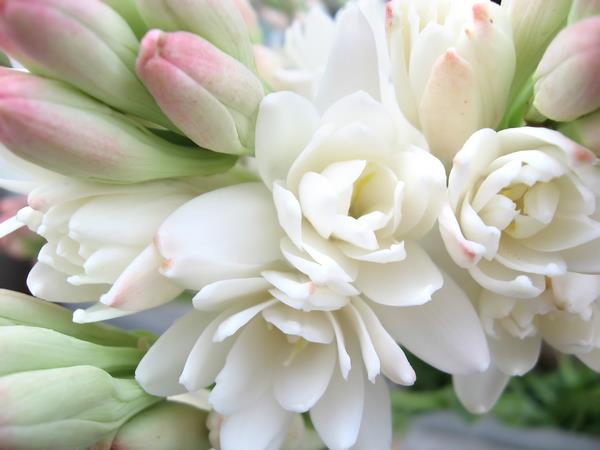
Perfume Review: Infusion d’Iris L’Eau d’Iris by Prada (Limited Edition)

Man cannot live solely on oriental perfumes, though clearly I do my best to try. Still, I recently decided to test Infusion d’Iris L’Eau d’Iris, the new flanker fragrance from Prada. The extremely wordy “Infusion d’Iris L’Eau d’Iris” (which I shall call just simply, “L’Eau d’Iris“) is a limited-edition eau de toilette which was released in March 2013 and which seems to be exclusive to a particular retailer in each country. For example, in the U.S., it is Macy’s department store; in Canada, it seems to be Holt Renfrew.
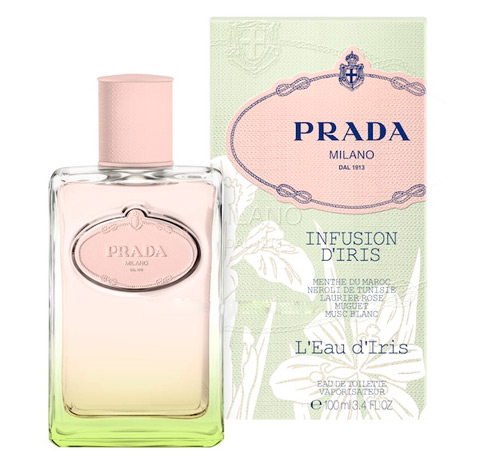
Prada Infusion d'Iris L'Eau d'IrisL’Eau d’Iris is a light-weight summer fragrance that follows on the heels of Prada’s original, 2007 hit, Infusion d’Iris. There have been a few other flankers since then, and you can read about the various versions from the men’s fragrance to the Eau Absolue (with photos of the differences in packaging or bottles) at The Perfume Shrine. Like all its siblings, L’Eau d’Iris was created by the perfumer, Daniela Roche Andrier (of Givaudan) and, according to Fragrantica, was “inspired by spring flowers and the fusing of iris and laurel in the gardens of Tuscany.” Its notes include:

Top notes: Moroccan mint, Tunisian neroli.

Heart: pink laurel bay, iris, rose, lily of the valley, orange blossom.

Base: white musk, woody notes, vanilla.

I have absolutely no idea what “pink laurel bay” smells like, and it wasn’t easy to research amidst all the references to regular bay leaves, but “laurel bay” appears to have an almond-like, powdery aroma. And, in truth, that is a large part of this very fresh, clean fragrance.

Source: Wallpaperban.com

Source: Wallpaperban.com

L’Eau d’Iris opens on my skin with a citrus note that has a faintly soapy edge, followed by white musk and hints of powdery iris. A muted touch of rose lurks around the edges, but, like everything else to do with L’Eau d’Iris, it is soft and light. Less than five minutes into the perfume’s development, the iris takes over, the citrus element fades away, and an almond note rises to the surface. It is a little powdery and smells very much like heliotrope, a note often mixed with iris to create a lightly powdered, floral aroma. As many of you know, the smell of an iris can’t be extracted from the petals, so the scent is often recreated through distillation of its root, as well as through the addition of other elements. For those of you who are unfamiliar with what “iris” smells like, the note has often been compared to boiled carrots, lipstick, or powdery violets. Sometimes, the smell is slightly rooty, if there is a lot of orris root used in the fragrance, but generally it’s a rather cool, floral note. Here, in L’Eau d’Iris, the aroma is powdery, floral, and a little like that of sweet, boiled carrots.
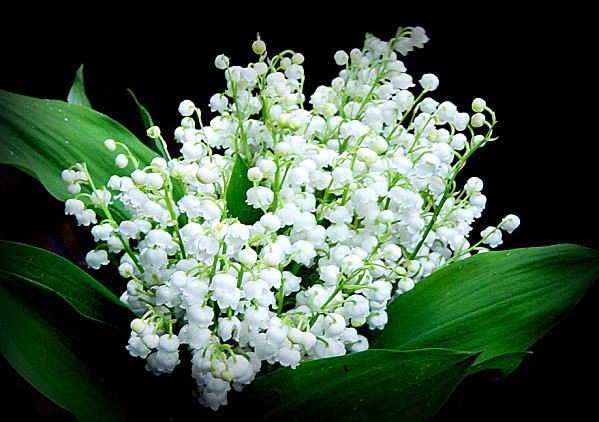
Lily of the Valley, or Muguet.

Lily of the Valley, or Muguet.

Thirty minutes into the perfume’s development, L’Eau d’Iris shifts a little. For one thing, it becomes a complete skin scent that is much harder to detect. For another, the light, green, lily of the valley note and the whisper of rose that lurked at the perfume’s edges become even more muted. Taking their place is vanilla and almonds. The vanilla note starts off being light, thin and subtle, but it soon grows stronger and combines with the laurel leaf’s almond essence to create L’Eau d’Iris’ second most dominant accord.

Other elements start to become noticeable. From the start, there was a light alcohol element lurking at the edges of the fragrance. Midway during the second hour, it grows into something chemical and synthetic that really bothered me and gave me a slight headache. I can’t pinpoint if it stems from the white musk (which is always a synthetic ingredient), or from something else. In addition, the powder takes on a sour nuance that I found unpleasant. The second hour also saw the emergence of an amorphous, vague “woody” undertone that was very beige and slightly synthetic. It makes the iris note feel a little more rooty and dry, less purely floral; it also helps to cut through the vanilla and almond.

Source: 123rf.com

Source: 123rf.com

As a whole, L’Eau d’Iris was primarily a simple fragrance of powdered iris, vanilla, and clean musk. There are tiny flickers of muguet (or lily of the valley) that lurk in the background, but they are always very subtle. Equally subtle is the light soapiness underlying the scent; it’s almost more of an indirect thing that simply adds to the overall impression of a fresh, clean scent. In its final moments, L’Eau d’Iris was a sheer, abstract, lightly powdered, floral, iris fragrance with a subtle carrot-like nuance, soapy musk, and the merest suggestion of woodiness. At no time did I smell mint, orange blossom, or neroli. On occasion, the fragrance did evoke the scent of makeup powder. All in all, L’Eau d’Iris lasted just short of 5.5 hours on my skin, with moderate sillage at first that quickly dropped even further to become a virtual veil on the skin. At times, it was extremely hard to detect in its sheerness and lightness. I realise that L’Eau d’Iris is meant to be a light “eau” version of an eau de toilette, but I’m not the only one who thought the scent was extremely weak.

Take, for example, the review from Makeup Stash which is the only in-depth assessment that I could find for L’Eau d’Iris. The blogger described the scent as “fleeting,” and seemed singularly unimpressed with the perfume as a whole. (I share her feelings.) The review reads, in part, as follows:

The pink laurel carries an almond hint, while the iris is clearly powdery-floral. […][¶] Pleasantly powdery with a high floral note, I could barely discern the mint of Morocco (meant to illuminate the composition) whose faint whiff edges the scent. When I first learnt of this fragrance, I was intrigued and pleased by the unusual inclusion of the mint. I’d expected its presence to be more apparently – intrusive, even – so the barely-there nature was a bit of a disappointment. Still, it’s nice to have this lively sprinkle.

Unfortunately, the scent disappears very quickly. In this aspect, it surely lives up to its ephemeral inspiration. While it is an agreeable scent and very likely a crowd-pleaser, it is more fleeting than I’d expected it to be. The brand depicts it as being ‘transient yet unforgettable’ but the latter part is hard to live up to, if the fragrance doesn’t last long enough for me to grasp its essence. In my many days of using it, it’s still hovering on the periphery of memorable. Perhaps a scent memory moment will hit me one day and it’ll finally be of recollective substance.

I didn’t smell mint at all, but I completely agree on the gist of her review: L’Eau d’Iris has a pleasant, transient and wholly forgettable nature.

On Fragrantica, in contrast, there is quite a bit of love for L’Eau d’Iris. And, in fact, a lot of people detected the mint note, with one commentator writing: “This is too boring. It’s fresh, sweet and minty. The most dominant notes are iris and mint.” There seems to be a split on another issue, namely the soapiness. One person called L’Eau d’Iris “the soapiest perfume I have ever smelled,” though she loved it. Another said it was not as soapy or dry as the original, Infusion d’Iris, but more floral and green. One couldn’t stand the sour baby powder note that she detected, while another loved all the powder. But no-one talked about orange blossoms or neroli. I have to say, I have a loathing of extremely soapy fragrances, but I thought the note was quite manageable in L’Eau d’Iris. I struggled much more with the synthetic white musk.

All in all, I think that L’Eau d’Iris is a perfume that will appeal to those who like light, fresh, clean, soft, powdery, soapy florals of an extremely unobtrusive nature. It is the furthest thing from my personal cup of tea, but then I’m not one for iris scents in general, let alone something like this. However, if I were to put myself in the shoes of someone who likes these sorts of fragrances, I would probably write a review like that of the Fragrantica commentator, “Vintage_Scent“:

This is my new Spring in a bottle! It is soft pastels and delicate pink petals all riding on a fluffy, powdery cloud! The iris is just as beautiful as ever, but it is definately a light-as-a-feather soft pastel iris. […] The mint is light, but it is always there, all the way through the drydown, which is simply sublime. The drydown is probably my favorite part. It is so soft and angelic, like angels’s wings. […]  I must say that midway through this perfume has to be the soapiest perfume I have ever smelled…then the lovliest iris blooms at the end in the most romantic way. Beautiful.

I can completely see how someone who adores fresh, clean, soft florals might view the fragrance that way. At the same time, I have to caution those who may not be a fan of powdery fragrances, especially as the note turned a little sour on someone other than myself. And if you’re looking for a perfume with sillage, forget about it!

I’m trying to be fair to L’Eau d’Iris, but I really don’t think it’s particularly special or noteworthy. However, if you love Prada’s hugely popular original, Infusion d’Iris, or if you love powdery, clean scents in general, then it is probably worth a sniff.
 

DETAILS:
Cost & Availability: Infusion d’Iris L’Eau d’Iris is a Limited Edition Eau de Toilette. It is only available in 3.4 oz/100 ml. In the U.S.: the fragrance is exclusive to Macy’s where it retails for $77. Macy’s has free domestic shipping on orders over $50. Nowhere else will sell this particular, limited-edition flanker — not Nordstrom, not Sephora, not Neiman Marcus. Also, I don’t know for how long this perfume will be available, or whether it will be common to all Macy’s brick-and-mortar stores. Outside the U.S.: In Canada, I’ve read that the perfume is available at Holt Renfrew. For other countries, I honestly have no clue where L’Eau d’Iris may be sold. It seems to be exclusive to one retailer in each country. Oddly, I don’t see it listed even on Prada’s own website. It has to be available in Prada boutiques, however, so you may want to check the Store Locator guide on the company’s website or to call one of their stores near you. Samples: The Perfumed Court sells samples starting at $3 for a 1 ml vial.

Perfume Review – By Kilian Musk Oud: Cardamom Rose

Kilian Hennessy. Source: Metro.co.uk http://metro.co.uk/2012/11/27/kilian-hennessy-the-perfume-industry-is-too-obsessed-with-packaging-549545/

Kilian Hennessy. Source: Metro.co.uk
http://metro.co.uk/2012/11/27/kilian-hennessy-the-perfume-industry-is-too-obsessed-with-packaging-549545/

Consider me surprised. I actually like Musk Oud, a fragrance from the luxury house, By Kilian. I don’t think it’s a fantastic, complex, original, nuanced — let alone impressive — fragrance, but it actually smells really good. And that is truly a first for anything that I’ve tried thus far from Kilian Hennessey, the grandson of the founder of LVMH. Of course, since it is a By Kilian fragrance, my feelings come with all sorts of huge qualifiers regarding sillage, longevity and an even more ridiculous price than usual, but you could have bowled me over with the feather when I kept sniffing my arm appreciatively.

The newly released Musk Oud is the fifth (and last) in Kilian’s Arabian Night Collection of oud perfumes which first launched in 2009. Unlike all the rest of its siblings, Musk Oud was created by the legendary perfumer, Alberto Morillas, who was recently awarded the very first FiFi Lifetime Achievement Award from the U.S. branch of the Fragrance Foundation. He’s a fantastic perfumer and co-created my favorite oud fragrance thus far: the spectacular (and sadly discontinued) forerunner of the whole oud trend, YSL‘s M7. The Kilian website describes Morillas’ latest project as follows:

An animalic perfume with a sensual feminity

Musk Oud is a perfume built on the contrast between a liquorish Rose and an animalic Oud accord of great sensuality. In the opening, the Lemon and Mandarin bring a ray of light warmed by Cardamom and Coriander. The heart is an explosion of Roses made syrupy and intoxicating thanks to the Rum extract CO2. A trace of Frankincense and Indonesian Patchouli bring a smokey facet to the composition saturated with dry woods.

Source: Luckyscent

Source: Luckyscent

Musk Oud’s full list of its notes, as compiled from LuckyScent, is as follows:

Lemon, mandarin, cardamom, coriander, cypress, Bulgarian Rose, geranium, davana, Rum extract, frankincense, Oud accord, Musk accord, patchouli.

Musk Oud is the furthest thing from complicated and, on my skin, it is also the furthest thing from either an animalic musk fragrance or a true oud one. It opens on my skin with a rich, beefy, dark red rose that drips thick, jammy juices and which is lightly infused with lemon and a touch of orange. The whole thing is covered with a heavy layer of gorgeous cardamom, and sits upon a quiet, woody base of cypress tinged with patchouli.

Crimson Rose by Karen Betts. Source: redbubble.com

Crimson Rose by Karen Betts. Source: redbubble.com

Seconds later, like a crocodile’s tail moving in muddy water, there are tiny ripples of animalic musk. To my slight unease, it smells very much like dirty, unwashed hair. However, the note is not only incredibly subtle, it essentially vanishes for most of the perfume’s development. It subsequently pops up only two more times, gives a brief bow for a few minutes, and then disappears completely. I was actually surprised by how evanescent it was since one blogger (who admittedly loathes anything animalic) was completely traumatized by the note in Musk Oud. Since my skin actually amplifies both animalic and base notes, I’d fully prepared myself to be overcome by every possible filthy, dirty, raunchy, unwashed, fetid aroma imaginable. Never happened. Not once. And if it should happen to anyone, it should happen to me with my wonky skin that amplifies animalics. Instead, there were only the most minuscule of stirrings in the brown waters of Musk Oud’s base. Perhaps a more accurate analogy would be to compare it to a mosquito in water instead of a crocodile’s tail.

Cardamom. Source: kitchenheadquarters.org

Cardamom. Source: kitchenheadquarters.org

The primary, overwhelming impression of Musk Oud in the first hour is of a cardamom-rose fragrance with other notes just dancing in the sidelines. The richness of the rose is accentuated by a darkly liqueured note, while the cardamom… oh, what cardamom! It’s sweet, nutty, a little dusky, and very spicy. So much so that it almost feels as though it’s accompanied by a fiery red saffron. Undoubtedly, that is just my mind interjecting things, since saffron is often the third twin to the rose-cardamom combination, but Musk Oud does feel as though there is saffron in there, too. As for the dry base, the cedar is lightly sweetened by patchouli and entwined by subtle tendrils of black smoke. There is absolutely no oud at first, and it takes ten minutes for the note to show its face. It’s slightly medicinal but, like all the other elements in the base at this stage, it is extremely muted and serves only to add indirect depth and body to the overall fragrance.

Things start to go down hill a little near the end of the first hour. It took all of 40 minutes for Musk Oud to become a complete skin scent on me. I tried the perfume twice — which wasn’t hard to do, given the usual, below-average longevity that I experience with all Kilian fragrances — and the second time, I applied double the quantity. This time, Musk Oud took one whole, whopping hour to become so glued to my skin that I had to inhale at my arm like a rabid animal to detect its nuances.

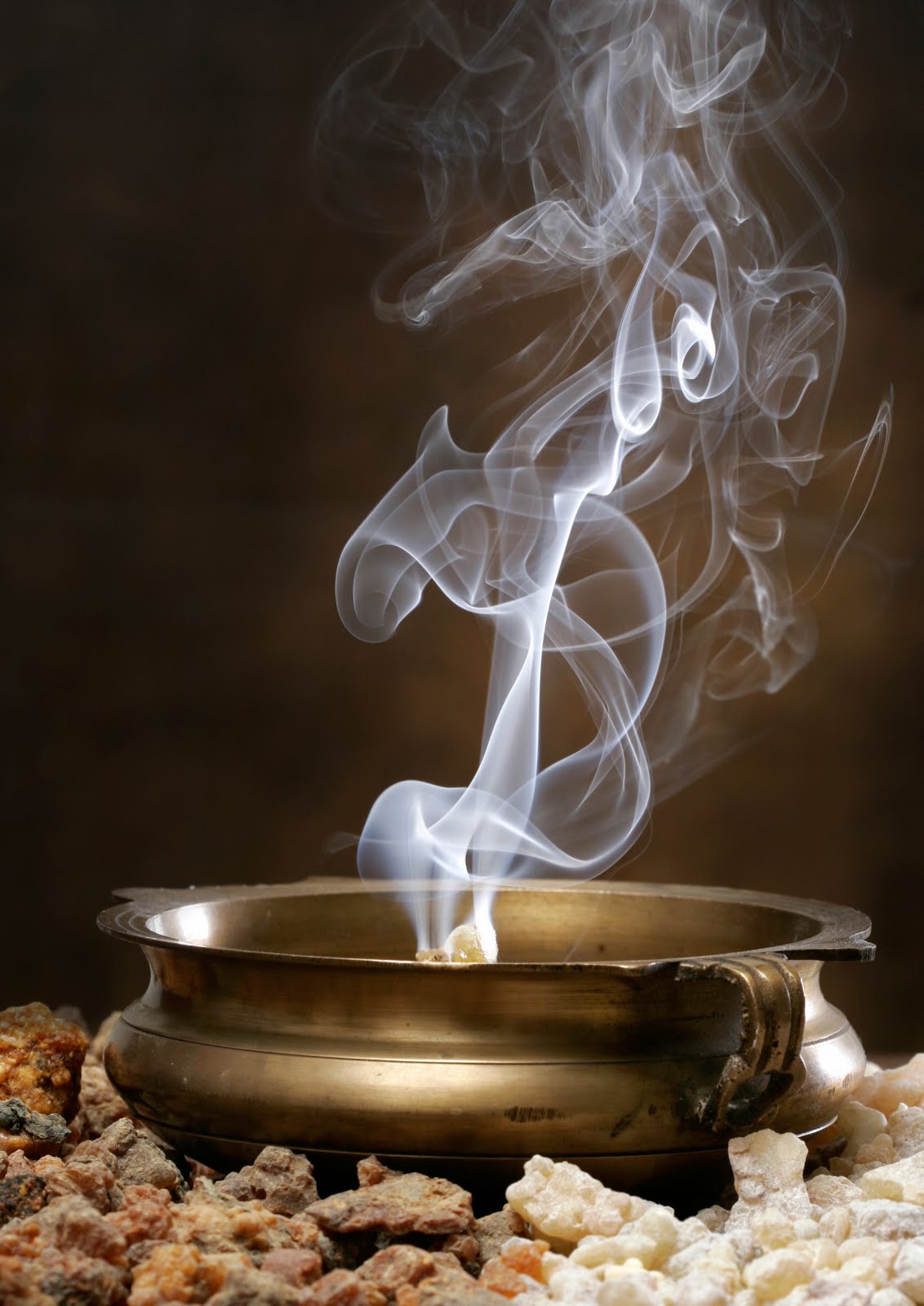
Frankincense Smoke  via iStock photos

Frankincense smoke via iStock photos

And, in truth, those nuances were few and far between — in both tests. Just over an hour into the perfume’s development, the base notes come to the foreground as frankincense and oud emerge as the dominant duo. However, neither note is very rich or deep. There is still a heavy sprinkling of cardamom, but the rose note has receded somewhat to the background. Occasionally, it will pop up and become more noticeable, then vanish, then come back to take over the whole scent for about five minutes, then retreat…. and so on. The animalic musk makes a brief appearance around the 90 minute mark, but quickly decides to throw in the towel completely. So, those simple, repeated notes with their varying fluctuations are really the sum total of Musk Oud. The citrus notes had departed long ago; ditto for the cedar; and there was never any geranium or davana to begin with. As for the rum and patchouli, both are essentially undetectable in any distinctive, individual way, except in helping to create that liqueured base to the rose.

After a brief period of time as an oud fragrance with tablespoon of cardamom, a teaspoon of rose, and a pinch of smoke, Musk Oud turns into a simple, more abstract, woody fragrance. There are subtle flecks of oud and cardamom with just a light whisper of jammy rose, but the whole thing feels quite muted and is extremely hard to detect given the nonexistent sillage. Then, Musk Oud dies entirely, having lasted no more than 3.5 hours with my usual dose and 4.25 hours with my larger one. Neither number is very impressive.

I had been curious to what extent Alberto Morillas’ co-creation of the fabulous M7 might have influenced the smell of another spicy agarwood fragrance. The answer is none at all. With the exception of the citrus, cardamom and oud, the two fragrances have no familial olfactory resemblance at all. To my surprise, it is a wholly unexpected perfume house which comes to mind: Guerlain. Kilian’s Musk Oud really evokes early parts of Guerlain‘s Rose Nacrée du Désert from Les Déserts d’Orient Collection. The first hour of Rose Nacrée has the exact same sort of rich, darkly liqueured, jammy, beefy rose infused with cardamom that dominates Musk Oud. Of course, the two perfumes eventually part ways, with the Guerlain turning into an overly syrupy, sugared, almost gourmand fragrance, while the Kilian turns into frankincense and oud. I’m sure there are even more cardamom-rose fragrances out there that resemble Musk Oud (especially from Montale) because, the truth of the matter is, it’s not a very inventive fragrance. It smells great for what it is, but it treads some well-worn ground.

Going by my experiences, the name “Musk Oud” feels like a misnomer. For one thing, on my skin, there was almost no musk in it. For another, the quantity of agarwood was hardly enough to render the scent a true oud one. It reminded me Kilian‘s Amber Oud which, to my nose and on my skin, had virtually no oud in it at all. Musk Oud has more of the note, but it’s all relative. In fact, given how the fragrance is such a skin scent, what little oud there is may be even harder to detect.

There aren’t a lot of in-depth blog reviews out there for Musk Oud. The fragrance is so new that I couldn’t even find a Fragrantica entry for it. However, out of the two comments on Luckyscent, both focused on the musk issue. One poster loved the scent, writing that Musk Oud was “[j]ust the right balance between the oud and the musk, neither too animalic nor too clean.” The other tried hard to be polite and mask his disdain:

Not impressed. I love rich, deep musk scents. My favorite perfume is Musc Ravageur. So when you name something Oud Musk, well I’m expecting something rich and dark and almost dirty. There is nothing unique about this. It’s not a clean musk mind you, it does have the dirtiness but its done in an oddly sheer way. I will say however, that that is probably perfect for some people. A polite, dirty musk. I guess there is a place for it.

Both commentators thought that the perfume had outstanding longevity and wrote that it “lasted all day.” I think that may be the first time I’ve ever seen that said about any Kilian fragrance, but, hey, I’m happy there are exceptions.

How you feel about Musk Oud will depend solely on two things: how you feel about animalic notes, and how your skin deals with them. The second review on Luckyscent is significant because it underscores that point. If you’re someone who loves a scent like Frederic Malle‘s Musc Ravageur (or, even more extreme, Parfum d’Empire‘s Musc Tonkin), then Musk Oud will be disappointing child’s play. If you’re someone like me whose feelings about musk can depend on its treatment, you may greatly enjoy Musk Oud, especially if your skin chemistry decides to play nicely with the note. But if you’re someone who can’t stand any animalic notes whatsoever, then Musk Oud may be a nightmare regardless of chemistry.

That was the case with Lucas of Chemist in a Bottle whose traumatized account of the fragrance reads, in part, as follows:

The opening act of By Kilian Musk Oud is a tidal wave of musk on my skin. I smell raw, animalic if not a fecal kind of musk. It has that dense, powerful structure that will be definitely too much for those who are not infatuated and obsessive by this raw perfume material. I definitely don’t belong to that group! Couple of minutes later I start to smell trouble. Double trouble because here appears the oud. In the whole oud fragrances trend I am quite lucky that oud notes don’t manifest themselves too bold on my skin. However Musk Oud doesn’t classify as one of those. As I write this my arm is almost dripping with oud. No joke! [¶]

[Later] I was attacked by a hard to describe smell that to me, in the closest comparison, was a mix of unwashed, sweaty clothes and sticky, greasy hair. So gross and so off-putting.

As you can see, a wholly different experience from either myself or the two chaps on Luckyscent. The odd thing is that my skin normally amplifies both musks and agarwood to the point where it can overwhelm a perfume, while Lucas — in testing the exact same fragrance — can find them to be completely minute and tolerable. So, I’m not quite sure what happened here to flip the situation so much on its head but, for me, Musk Oud was neither a musk fragrance nor an oud one. (It certainly was nothing like my experience with Opus VII, the animalic, musky oud fragrance from Amouage!) Where my experience does parallel (a little) that of Lucas is in terms of sillage and longevity. Musk Oud lasted 6 hours on him, and he found the sillage to be very low.

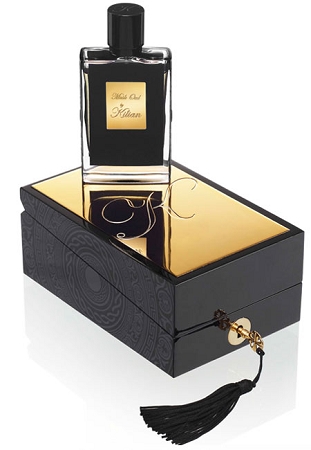
Musk Oud, 50 ml bottle. Source: Aedes.

Musk Oud, 50 ml bottle. Source: Aedes.

I very much enjoyed the cardamon-rose aspects of the fragrance, but I would never buy Musk Oud. I think it’s ridiculously over-priced for what it is, and simply isn’t special enough. Kilian’s prices are high to begin with, but the Arabian Nights Collection takes it to ridiculous levels given the generally uncomplicated, bare bones, and sometimes mundane nature of the scents. (Yes, Amber Oud, I’m looking at you.) Normally, Kilian charges $235 for a small 50 ml/1,7 oz bottle of one of his fragrances, like the recent Flower of Immortality. However, Musk Oud — like all the oud scents in the Arabian Nights Collection — retails for $395 (or €295), with the “cheap” alternative options starting at $185 for a refill bottle. Until Mr. Hennessey corners the world supply of either jammy roses, cardamom, musk or oud, I see nothing in this simple, relatively linear, fleeting, and sometimes impossible to detect fragrance that is worth $400 (more, with tax) for a tiny bottle, or even $185. There are half a dozen fragrances from Montale alone that are based on oud, rose, cardamom, frankincense and/or musk; they cost $110 for the same size bottle, have projection, and last forrrrrrrrrrrrrrrever!

That said, I do think Musk Oud is pretty enough to be worth a sniff or a small decant. However, given the sillage, longevity, cost, uncomplicated and non-oud nature of the fragrance, it may not be worth more than that.

DETAILS:
Cost & Availability: Musk Oud is an eau de parfum that costs $395, $235 or $185 (depending on the form in which you buy it). The lovely lock-box version is 1.7 oz/50 ml of fragrance and costs $395; the refill bottle is $185; and the travel option is $235. In the U.S.: Musk Oud is available at Bergdorf Goodman (in all 3 options), Saks Fifth Avenue (2 options) and Aedes (just the $395 lock box). All 3 options are available at Luckyscent, along with samples for $5 for a 0.7 ounce vial. Outside the U.S.Musk Oud is available on By Kilian’s international website where it costs €295 (with VAT included) for a 1.7 oz/50 ml bottle. The site also has the more affordable options. In London, you can find Musk Oud at Harvey Nichols which carries the 50 ml/1.7 oz size lock box version for £265.00 or the 50 travel refill for £110.00. Harvey Nichols stores around the world, from Dubai to Hong Kong, also carry the Kilian line. In Paris, the Kilian line is carried at Printemps. As for other locations, By Kilian’s Facebook page lists the following retailers and/or locations: “HARVEY NICHOLS (UK, Honk Kong, UAE, Saudi Arabia, Koweit, Turkey), Le BON MARCHE (France), TSUM (Russia), ARTICOLI (Russia) and HOLT RENFREW (Canada).” Samples: Samples are available from Surrender to Chance where prices start at $4.99 for a 1/2 ml vial. 

Perfume Review – Le Labo Ylang 49

Le Labo Ylang 49Ylang 49 is one of three new scents released last month, in May 2013, by Le Labo. Two of them — Lys 41 and Ylang 49 — will join the permanent collection and won’t be exclusive to any one city. As always with Le Labo, the perfume name (and the number that corresponds to its purported number of ingredients) does not give the full picture. Ylang 49 is a ylang-ylang fragrance, but it is also a chypre — and one with a heavy amount of very fruited patchouli.

I will be honest and confess that it bored me. It bored me to tears and, even worse, felt like an utterly exhausting slog that I just wanted to end. To my surprise, my favorite out of the two new Labo fragrances was the delicately ethereal lily fragrance, Lys 41, while Ylang 49 was barely tolerable. I’m in a distinct minority on that point, however, as Ylang 49 has received endless raves with one highly experienced blogger, the fabulous Non-Blonde, declaring that it may be her favorite out of all Le Labo’s floral scents!

Ylang 49 was created by Frank Voelkl and described on Le Labo’s website as follows:

Ylang 49 is a chypre floral, where Pua Noa Noa (gardenia from Tahiti) completes the floral voluptuousness of ylang ylang… Patchouli, oakmoss, vetiver, sandawood [sic] and benjoin follow to tip the blend into darker sensual undertones…

Ylang 49 is a walk in the woods, a lush floral bouquet in your hand, listening to G. Gould’s well-tempered clavier and realizing that a floral composition can go beyond flowers, in the same way a fugue in D minor is way beyond the D…

Out of the perfume’s 49 notes, the only ones we know about are:

ylang ylang, Tahitian gardenia [or pua noa noa], patchouli, oakmoss, vetiver, sandalwood, benzoin.

Ylang-ylang. Source: wallpaper.free-photograph.net

Ylang-ylang. Source: wallpaper.free-photograph.net

Ylang 49 opens on my skin with a definitely old-school, classic chypre profile: citrus notes (probably from one of the hidden, secret ingredients) infused with patchouli and oakmoss. The oakmoss is interesting because it has that dry, slightly mineralized greyness of the real thing, while simultaneously feeling a little fresh, green, bright and rich like the more patchouli-infused modern sort. Seconds later, hints of ylang-ylang and the coconut-y characteristics of Tahitian gardenia start to emerge. They’re subtle at this point, especially the gardenia, and add just an amorphous “floral” touch to the chypre opening.

"Purple Velvet Gold Flakes" by *Will3style at Deviantart.com. http://will3style.deviantart.com/art/Purple-Velvet-Gold-Flakes-258099755

“Purple Velvet Gold Flakes” by *Will3style at Deviantart.com. http://will3style.deviantart.com/art/Purple-Velvet-Gold-Flakes-258099755

As the minutes pass, the floral tones in Ylang 49 take more shape and become more distinct. The ylang-ylang takes the lead, but the gardenia dances around the edges. The flower has brief flickers of coconut, but it’s also a lot more gardenia-like than I had expected from the Tahitian variety. I keep getting images of a thick pile of dark green and purple velvet, perhaps because the patchouli is so prominent. It’s very hearty and veers dangerously close, in my opinion, to the purple patchouli that I dread so much. It infuses the ylang-ylang in particular, turning it into something so jammy, velvety and rich that it almost feels like a beefy, meaty, red damask rose. The normally white ylang-ylang flower has taken on the same sort of darkly liqueured undercurrent — to the point that Ylang 49 strongly calls to mind how Amouage‘s Lyric Woman manifested itself on my skin. (Unlike most people’s experiences with Lyric Woman, on me, it was predominantly a very beefy, liqueured, ylang-ylang fragrance.)

Source: damask-wallpaper.com

Source: damask-wallpaper.com

Ylang 49 doesn’t morph substantially in the hours that ensue, shifting only in degree as to which note undulates to the top of the heap. Namely, the patchouli which turns stronger, heavier, richer and more painfully fruited. Ylang 49 is essentially just a plush, heavily fruited, ylang-ylang perfume atop a strong patchouli base that is lightly flecked with oakmoss. Occasionally, the fragrance will throw off flickers of coconut or gardenia like a warm ray of light, but its fundamental essence unchanged. The most noticeable thing after a few hours is a softening of the patchouli element, but it’s just an incremental drop and a question of degree. Still, it serves to make the ylang-ylang feel slightly more custardy, buttery and floral in nature, and a little less fruited. It’s all relative…

At the start of the third hour, the flower’s creamy undertone is matched by an equally creamy, beige wood note that subtly adds even further depth to the ylang-ylang. The wood accord is undoubtedly from the sandalwood which feels like a synthetic, Australian, or generic cousin to the rare, spicy, rich Mysore wood that is now almost extinct. Here, the sandalwood is bland and rather nondescript, but I suppose it serves its uses in adding that extremely subtle, amorphous, beige, creamy “woodiness” to the base. At the start of the fifth hour, Ylang 49 turns into a creamy floral fragrance that is somewhat ylang-ylang in nature but also, increasingly abstract. The overall bouquet is infused with the endless (and still fruity) patchouli and hints of oakmoss atop a base of dry, generic sandalwood. The floral part is pretty, but I truly can’t stand the patchouli at this point. I’m also not enthused by the sandalwood which smells faintly sour, a little burnt, and a little too arid to my nose.

As time progresses, Ylang 49 turns more nebulous and vague; Now Smell This accurately describes it as a “hard-to-pin-down presence,” though they notice it after the third hour. It happens to me much later, but particularly around the eighth hour when Ylang 49 becomes a wholly abstract patchouli “floral” with musky overtones and some of that bland, slightly unpleasant, totally unimpressive “sandalwood.” In its final hours, Ylang 49 ends up as an amorphous, dry, slightly bitter woodiness.

All in all, the perfume lasted 13.25 hours on my skin with the patchouli wearing me out for almost the entire length of time. (So much patchouli, and always of the blasted fruited kind!) Ylang 49 had great projection for the first hour, but it dropped soon thereafter. The fragrance started to inch closer to the skin midway during the fourth hour, though it was still very potent if you brought your arm right up to your nose. It became a true skin scent on me around the eighth hour. As a side note about longevity, I obviously have wonky skin because Ylang 49 is said by many to have astounding longevity, with some saying it lasts all-day and overnight. They said the same about Lys 41 which never lasted more than 6 hours on me — and that was with a large dose. Still, for me, Ylang 49’s duration is phenomenally high at 13.25 hours, so I have no doubt it probably could 24 hours on normal skin. (I’m remain unconvinced about the Lys 41, though.)

I suspect that my overall prose about Ylang 49 reeks of flatness and a general lack of bouncing enthusiasm. I can’t help it. I’m trying very hard to be fair, but I’m truly so bored, I can barely write. Much has been made of how the perfume harkens back to a lost, golden, magical time when chypres were really chypres, when classique perfumery had depth, luxurious richness and elegance. Take CaFleureBon whose admiring description of the perfume ends with the words: “Ylang 49 feels like something found at an estate sale in an unlabeled crystal flacon.” Or take the rapturous review from The Non-Blonde which reads, in part, as follows:

Ylang 49 may be my favorite out of all the Le Labo flower perfumes. It has  a lot of warmth and a substantial base that surround the tropical flowers and make them more abstract and mysterious. The yellow blossoms are rich and enticing, but they’re also restrained and wonderfully elegant: this is what they mean by calling Ylang 49 a “modern chypre”. I was ready to protest and request that the label “chypre” be retired as were the true perfumes in this category, but you won’t find me kvetching this time. Ylang 49 is as chypery as it is modern. It moves from floral to a recognizable oakmoss-patchouli base; there’s  a hint of chypre soapiness, a  touch of roasted tea, and instead of the  animalic base of yore you get the familiar Le Labo sandalwood enriched with benzoin.

Perhaps CaFleureBon and The Non-Blonde are right. I grant you that Ylang 49 is a very heavy, rich perfume that — if you’re feeling really charitable — is a little like the chypres of yore. (Or it would be, if the old chypres were based primarily on patchouli.) Still, that doesn’t mean Ylang 49 is a great chypre and, in all honesty, I don’t think it is.

For me, ultimately, Ylang 49 lacks the layers, range, or complexity of a good chypre — of any era — because, on my skin, it was primarily a mundane mix of 3 main notes: fruited patchouli, predominantly abstract white florals, and slightly dry oakmoss. You can’t create a stunning symphony with three notes drummed continuously on the same boring cadence. What made the classic chypres so great wasn’t simply the now-regulated oakmoss; it was a hell of a lot more than that.

I can give you a list of places to start if you’re looking for truly good, complex chypres that have ylang-ylang. Check out any of the following fragrances on Fragrantica before heading to eBay to find them in vintage (and only in vintage) form: Ungaro‘s stunning, spectacular Diva by Jacques Polge (now of Chanel); Dominique Ropion‘s famous Ysatis for Givenchy; and either Paloma Picasso‘s Paloma Picasso or her Mon Parfum. They may not be centered solely around ylang-ylang, but that’s because they are not 3-note perfumes (with endless, painful patchouli). As for wholly modern fragrances that are easily available today, Amouage has some stunningly sophisticated chypres. (On my skin, Lyric Woman manifested itself more like a chypre than an oriental, and it was primarily ylang-ylang in nature, though it is generally seen as a spicy rose fragrance. And I think one could argue that Amouage’s ylang-ylang fragrance, Jubilation 25, has some definite chypre attributes as well.) In terms of other houses, Tom Ford‘s Arabian Wood is a gorgeous chypre that has ylang-ylang, along with other florals and significantly better sandalwood.

Interestingly, Now Smell Thisreview of Le Labo’s Ylang 49 specifically warns that some perfumistas will be underwhelmed by the fragrance which it concedes is not “especially challenging[.]” (That’s an understatement.) NST writes:

Although Ylang 49 isn’t an especially challenging perfume, a brand new perfumista might not take to it right away. It’s not overtly pretty or sexy or delicious. It’s not about flash and décolletage. If you’re moved to order a sample of Ylang 49 and on smelling it think, “It’s all right but nothing to get excited about,” I urge you to put the sample away somewhere cool and dark and come back in another year. Keep smelling, keep paying attention. You may never love Ylang 49 — or you might! — but I bet you’ll at least respect it.

I would argue that it has nothing to do with perfume experience or the lack thereof. Perhaps, Ylang 49 actually is much ado about nothing. But if this is what we’re now stuck with in the current IFRA/EU world of oakmoss restrictions and the slow death of the chypre genre, then I suppose Ylang 49 is nice. It’s certainly a scent that would appeal to both men and women, is versatile, and ….. Oh God, it’s too boring to continue. Try Ylang 49, I guess.


DETAILS:
Cost & Availability: Le Labo Ylang 49 is an eau de parfum (though it is really extrait or pure parfum concentration) and comes in a few sizes, the most common of which are: 1.7 oz/50 ml for $145; and 3.4 oz/100 ml for $220. (There is also a 15 ml mini and a giant 500 ml bottle available from the company’s website.) Le Labo Website Options: Ylang 49 is available directly from Le Labo which says that it personally makes and customize the bottle for each customer: “all Le Labo products are personalized with labels that bear the client’s name.” The company has a variety of different country options for the website, from North America to UK to France to International. On its North American website,Ylang 49 comes in Eau de Parfum and perfume oil, with the usual accompany products like body lotion, shower gel, massage oil, etc., to come later in the fall. The prices are the same as listed above: 1.7 oz/50 ml for $145; and 3.4 oz/100 ml for $220. They also offer a tiny 15 ml bottle for $58. I’m assuming they ship to Canada, too, given the website name. On the UK website, Ylang 49 eau de parfum costs £95 for the small size and  £138 for the larger 100 ml bottle. Other sizes are also available, including a small 15 ml/0.5 fl. oz bottle for £40. On the International Labo website and the French website, Ylang 49 costs €110 and €170 for the 1.7 and 3.4 oz bottles, respectively. Le Labo also offers perfumes in a Travel Refill Kit of 3 x 10 ml bottles (of your choice, and which you can mix or match) for $120. Ylang 49 is one of the options listed. Lastly, Le Labo also has a Sample Program: “Our sampling program comes in two forms – a Discovery Set of 3 x 5 ml  (0.17 fl.oz.) glass rods with spray and cap and a personalized label with your name on it, ideal for hard core testing of 3 different scents before making up your mind, and a standard (yet beautiful) sample of 1.5 ml (0.05 fl.oz.), available for all scents and ideal for more cost conscious clients who fall in love at first whiff.” I think the individual samples cost $6. As for their shipping prices, I’m afraid I can’t find any pricing information. Le Labo World Boutiques: Le Labo has store locations from New York to London and Tokyo, as well as retailers in a ton of countries from Australia to Italy to Korea. You can find a full list of its locations and vendors hereIn the U.S.: Ylang 49 is currently available from Barneys and LuckyscentOutside the US: In Canada, Le Labo is carried by Toronto’s 6 by Gee Beauty, but not on their online website for direct purchase. Call to order by phone. In the UK, Le Labo is carried at Harrods’s Designer Department on the First Floor, and at Liberty but Ylang 49 is not yet listed on their website. Again, the UK prices for Le Labo, are £95 or £138, depending on size. In the Netherlands, you can find Le Labo products and Ylang 49 in specific at Skins Cosmetics which sells the Eau de Parfum for €111.85 or €172.90, depending on size. In Australia, Le Labo is carried at Mecca Cosmetica, but I don’t see Ylang 49 listed yet on the website. In general, Le Labo prices in Australia range from AUD$198 to AUD$308, depending on size. Samples: I obtained my sample from Surrender to Chance which sells the Eau de Parfum starting at $4.25 for 1 ml vials.

Perfume Review – Le Labo Lys 41: Dancing Floral Princesses

Source: www.chcrossstitch.com

Source: www.chcrossstitch.com

Once upon a time, in a land far, far away, there were three princesses who tiptoed out in secret every night to dance until dawn. Lily was the eldest and dominant sister. She wore a white dress but her green and red hair reflected her spicy nature. Then came the young twins, Tuberose and Jasmine: Tuberose was tall, elegant, also dressed in white, but had mint and black hair to reflect her slightly smoky, mentholated, chilly scent; Jasmine was short, round and sweet, bedecked in floaty, gauzy, white and yellow velvet.

Source: Tumblr

Source: Tumblr

Every night, they were secretly escorted to the shores of a magical tropical island by a boatman called Vanilla. He was a husky, swarthy brute of a man who smelled faintly of the buttery coconut that he’d picked up in his travels to Tahiti. He could be domineering, speaking as loudly as the sisters, but he could also be extremely soft. It all depended on his mood, as he watched the sisters dance the night away. They looked like petals floating in the wind, leaping with airy and light footsteps until they were a blur of white. Though they started on a powerful, strong note, they soon tired and their steps softened until they faded away in muted exhaustion. Sometimes, they danced for 4 hours, sometimes for 6. It all depended on how much of the magic potion they had drunk — but they were always a force of femininity, representing both delicacy and full-blown diva power. The boatman had a name for them: Lys 41.

Source: Basenotes.

Source: Basenotes.

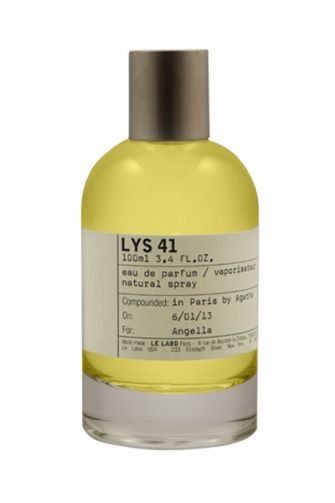
Lys 41 is one of three new scents released last month, in May 2013, by Le Labo. Two of them — Lys 41 and Ylang 49 — will join the permanent collection and won’t be exclusive to any one city. If you’re new to Le Labo, it is a niche perfume house who hand blends your perfume for you at the time of purchase and who uses numbers in the name of their scents to reference the amount of ingredients in that perfume. So, the eau de parfum, Lys 41, purportedly has 41 notes. As with all their fragrances, the name may not actually correlate to what the perfume smells like. Now Smell This explains more:

In each case, the number in the fragrance name refers to the number of notes that make up the scent’s composition, and the name is taken from the ingredient in the highest concentration; to take one example, Jasmin 17 has 17 ingredients, with jasmine being in the highest concentration. The names are thus not necessarily related to what the fragrance is meant to smell like.

Lys 41 was created by Daphne Bugey and, out of the 41 notes, the only ones we know about are:

Lily, jasmine, tuberose absolute, tiare, warm woody notes, vanilla madagascar and musks.

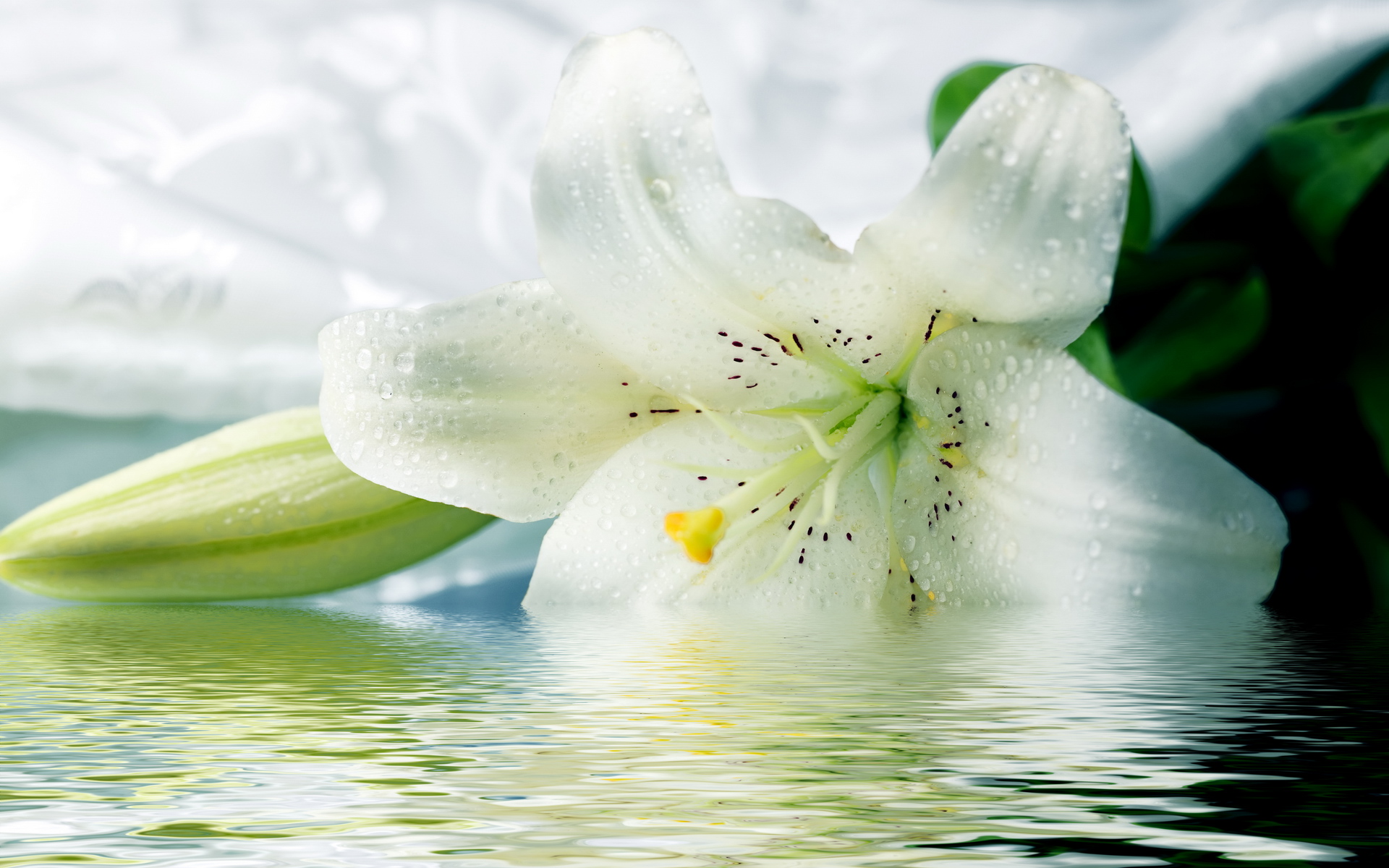
Source: Kootation

Source: Jwallpapers.com

Lys 41 opens on my skin as a stunningly beautiful, completely diva-like, big white floral that is surprisingly delicate and a touch green as well. Like the oldest princess in charge in my version of the Grimm fairytale, it’s all about the lily as the dominant note in those opening minutes. She’s fresh, airy, slightly green, very diaphanous and endlessly white. She is trailed by her two white sisters, but the shock comes when the boatman — Vanilla — muscles his way past them to dance with Lily.

Source: Kootation.com

Tiare. Source: Kootation.com

He’s a big, brash, bold, hearty fellow who appears almost butch in comparison to his dainty companions. I have to admit, I am very finicky about my vanilla; I like it in a benzoin form or as a light, subtle touch, but almost never as true vanilla-vanilla. And I certainly don’t like it to be so buttery that it takes on an almost coconut-like tropical hue. Which is what our burly boatman does in this story, thanks to the indirect effect of the tiaré flower. As Fragrantica explains, tiaré is a type of Tahitian gardenia with a tropical aroma that “often reminds us of suntan lotion in perfumes due to its frequent use in such products; monoi essence is made by macerating tiara in coconut oil.” For me, the beauty of Lys 41 lies in its white-green notes, not in its more tropical, buttery, coconut undertones. And, yet, the boatman called Vanilla is an odd one. At times, he is so subtle and soft, he’s absolutely perfect. The whiff of tiaré’s coconut vanishes, and Lys 41 becomes a perfect dance of just the three sisters with him providing only a delicate support in the background. Frankly, I wish he (and the bloody tiaré he’s infused with) would stay there and stop joining the others, but he doesn’t. Back and forth, the vanilla note in Lys 41 changes character.

Tuberose. Source: Fragrantica.de

Tuberose. Source: Fragrantica.de

Lily may be the head princess, but the other florals certainly dance alongside her. Ten minutes into Lys 41’s development, Jasmine starts to be a little less shy. Her appearance, in conjunction with her twin, Tuberose, inevitably brings to mind Gardenia as a lost sister in this dance. True gardenia, and not the Tahitian version called Tiaré. Yet, the whiff or visual of gardenia is just a subtle mental flicker. The more interesting thing is the tuberose which starts to take on a subtle camphorous note. In concentrated or absolute form, as it is here, tuberose can have mentholated aspects as it did in Serge Lutens‘ famous Tubereuse Criminelle. Lys 41, however, has none of the gasoline, rubbery, almost black, tarry, asphalt qualities of the Lutens fragrance. Instead, the note feels more chilly and, increasingly, a little bit smoky.

The combination of notes is a marvel of white, a blur as softly airy, diaphanous and delicate as a prima ballerina’s white skirts. In fact, it is really hard not to think of a row of dancing ballerinas when you wear Lys 41. Yes, on some levels, it is a powerhouse white floral and, yet, it isn’t indolic, over-ripe, over-blown and languidly extreme. The green and spicy nuances to the lily prevent the indoles from feeling over the top. Lys 41 is like Fracas in its white intensity, but it’s a surprisingly airy perfume. The best description of it comes from Luckyscent who writes:

While this is definitely not light in the sense of being understated, it is light in the sense of being airy and buoyant. It is an expansive airiness – a large billowy cloud of something weightless: rows and rows of ballerinas spinning in tutus, hundreds of white butterflies being released into the air, an impossibly long chiffon veil floating in the wind.

Absolutely brilliant and right on the nose! (And, see, they thought of ballerinas, too! I’m telling you, this perfume evokes the entire ballet corps of Swan Lake leaping in the air!)

Isabel Munoz dancing. Photo: Le Ballet Nacional de Cuba

Isabel Munoz dancing. Photo: Le Ballet Nacional de Cuba

Lys 41 remains essentially unchanged for the first two hours. There was, on my first test, a growing note of pepperiness underlying the notes that didn’t feel like ISO E Super (which Le Labo apparently loves to use) because it wasn’t antiseptic or medicinal. Instead, it was just simple “pepperiness.” Yet, I got such a raging migraine, I felt as though someone had taken a cleaver to my head. Oddly enough, during my second test, I actually applied a greater quantity of Lys 41 and… no headache. There also was no pepper nuance that time, but simply the chilly, almost peppermint-y smokiness from the tuberose absolute. I have no explanation. 

Regardless, Lys 41’s gorgeous floral bouquet remains unchanged until the start of the third hour when the perfume turns into abstract. Lys 41 is now a skin scent and none of the three dancing sisters is distinguishable in an individual capacity. Rather, they are a blur of soft, delicate white. There is also the perfect touch of vanilla: sheer and evoking the subtle sweetness of a vanilla mousse. The tiaré-coconut and mentholated notes have vanished, and taking their place is a subtle muskiness with a hint of creamy, beige woods. In its final moments, Lys 41 is nothing more than a delicately abstract, nebulous, floral muskiness with a tinge of light soapiness.

I was a little surprised by Lys 41’s longevity. For one thing, Lys 41 is concentrated at 25% perfume oil such that it is really a pure parfum or extrait de parfum in strength. For another, I had read on CaFleureBon that the perfume had “overnight longevity.” Yet, in my first test, Lys 41 lasted a mere 4.5 hours. I was so astonished, I tried it again, applying double the amount of the perfume. This time, the longevity clocked in at 6.5 hours. At least 3.5 hours of that time was spent as a complete skin scent. In my first test, out of the 4.5 hours, 2.5 of them were right on the skin. So, in my opinion, the perfume’s overall sillage is moderate to low, as is the longevity. Yet, in the first 30 minutes, Lys 41 definitely creates a lovely, small cloud around one, wafting about 3 inches above the skin.

One of the best reviews for Lys 41 comes from CaFleureBon, which is the only site I’ve seen thus far to discuss the very subtle, mentholated, smoky note that I detected:

So often with the name of a Le Labo fragrance it is sort of a feint as the note in the name is not the focal point. That is not the case with Lys 41 which perhaps should be written LYS 41 to be completely accurate. The lily is a big old white floral diva in Lys 41 like she knows it’s her name on the label. Perfumer Daphne Bugey creates a ginormous white flower fragrance which at 25% perfume oil concentration is at extrait strength. Often when something is at this concentration it sort of smokes and smolders on the skin. Lys 41 shakes her moneymaker right in front of your nose. The great green floral quality of lily draws you in and quickly it is surrounded with indolic jasmine, tuberose absolute, and tiare. The lily is the lead singer while jasmine adds a bit of low harmony, and tiare the high notes. The tuberose in the form of the absolute adds that camphoraceous quality the best tuberose has in high concentration and that is alto to lily’s contralto. The base is a foundation of woods, vanilla, and musk which you won’t notice for hours after you have this on. The white flowers are in charge and they won’t get off the stage without a fight. I haven’t enjoyed a busty powerhouse white floral like Lys 41 in a long time but this is going to be a summer staple for me.

The Non-Blonde has a very amusing review in which she recounts several people’s experiences with the fragrance, from herself to her friend, husband and brother-in-law. It may be useful for the various comparisons based on skin chemistry and, also, for how men feel about the scent:

It was an unexpected love since I’m not a lily person.  I don’t wear Un Lys (Lutens) or Lys Méditerranée (Malle)… but something about Lys 41, the new fragrance from Le Labo, seems to work incredibly well and to gain the approval of friends and husbands, though not everyone liked it on themselves, and my sweet brother-in-law was not amused.

If you ask me, it’s the tuberose. While Lys 41 is chock-full of white flowers, my skin amplifies tuberose and the warm facets of the musky dry-down. The husband found it very sensual and nicely sweetened. On me, that is. His own skin took the jasmine note and shot it to high heaven. However, not even five minutes after spraying the sharp green screech was gone and the orchidy vanilla and fuzzy musk took over. I definitely want to keep smelling Lys 41 on him, and the husband himself doesn’t object, though he says it’s not really his kind of thing. […][¶]

In any case, Le Labo’s newest white floral is lovely. There’s something in the base of both Lys 41 and Ylang 49 that seems to embrace my skin and wrap it in a mohair-like warmth. I love the light twist into vanilla territory in the dry-down which lasts for long hours and projects nicely. I doubt that Lys 41 is office friendly, but I’ll say it’s an incredible date scent.

Obviously, my experience was extremely different in terms of sillage and longevity, not to mention the chilly, slightly smoky nuance I got from the tuberose. Where I think her review is uniquely useful, however, is in the issue of how men may feel about Lys 41. I think a “manly man” like her brother-in-law who prefers more traditional or masculine fragrances would not feel comfortable wearing Lys 41. And if he hate lilies, then forget about it completely! In fact, people of either gender who scream in terror at the thought of any of the flowers in question (you know who you are, you tuberose and jasmine-phobes) should obviously stay far, far away.

I really liked Lys 41 for a variety of reasons. First, I prefer my florals to be super dramatic powerhouse divas; second, I adore lily scents; and third, I am particularly fond of white florals when they have a green, spicy undertone to them. Given my personal experiences with Lys 41’s sillage and longevity (not to mention that headache the first time around), I’m not sure I’d look for a decant, but something about the scent fascinates me and is hard to forget. It’s the sheer delicacy of it all, with the strong mental image of Swan Lake’s entire ballet corps leaping gracefully into the air with skirts like waving petals. It’s the twist on the Brothers’ Grimm tale of the 12 Dancing Princesses. And, lastly, it’s the stunning beauty of the lily note in the first hour.

Source: nipoem.blogspot.com

Source: nipoem.blogspot.com

I think Lys 41 will fit very specific tastes. Those who prefer darkness, woodiness or spice with their florals will be disappointed. Same with those who prefer something less linear and limited in focus. I also think the average man won’t find it to be his cup of tea; Lys 41 definitely skews quite feminine. Yet, for the target audience, I think Lys 41 will be a big hit and extremely popular.


DETAILS:
Cost & Availability: Le Labo Lys 41 is an eau de parfum (though it is really extrait or pure parfum concentration) and comes in a few sizes, the most common of which are: 1.7 oz/50 ml for $145; and 3.4 oz/100 ml for $220. (There is also a 15 ml mini and a giant 500 ml bottle available from the company’s website.) Le Labo Website Options: Lys 41 is available directly from Le Labo which says that it will personally make up the bottle for each customer: “all Le Labo products are personalized with labels that bear the client’s name.” The company has a variety of different country options for the website, from North America to UK to France to International. On its North American website, Lys 41 comes in Eau de Parfum and perfume oil, with the usual accompany products like body lotion, shower gel, massage oil, etc., to come later in the fall. The prices are the same as listed above: 1.7 oz/50 ml for $145; and 3.4 oz/100 ml for $220. They also offer a tiny 15 ml bottle for $58. I’m assuming they ship to Canada, too, given the website name. On the UK website, Lys 41 eau de parfum costs £95 for the small size and  £138 for the larger 100 ml bottle. Other sizes are also available, including a small 15 ml/0.5 fl. oz bottle for £40. On the International Labo website and the French website, Lys 41 costs €110 and €170 for the 1.7 and 3.4 oz bottles, respectively. Le Labo also offers perfumes in a Travel Refill Kit of 3 x 10 ml bottles (of your choice, and which you can mix or match) for $120. Lys 41 is one of the options listed. Lastly, Le Labo also has a Sample Program: “Our sampling program comes in two forms – a Discovery Set of 3 x 5 ml  (0.17 fl.oz.) glass rods with spray and cap and a personalized label with your name on it, ideal for hard core testing of 3 different scents before making up your mind, and a standard (yet beautiful) sample of 1.5 ml (0.05 fl.oz.), available for all scents and ideal for more cost conscious clients who fall in love at first whiff.” I think the individual samples cost $6. As for their shipping prices, I’m afraid I can’t find any pricing information. Le Labo World Boutiques: Le Labo has store locations from New York to London and Tokyo, as well as retailers in a ton of countries from Australia to Italy to Korea. You can find a full list of its locations and vendors hereIn the U.S., Le Labo is traditionally carried by Barneys but I don’t see Lys 41 listed yet on its website. The perfume is currently available from LuckyscentOutside the US: In Canada, Le Labo is carried by Toronto’s 6 by Gee Beauty, but not on their online website for direct purchase. Call to order by phone. In the UK, Le Labo is carried at Harrods’s Designer Department on the First Floor, and at Liberty but Lys 41 is not yet listed on their website. Again, the UK prices for Le Labo, are £95 or £138, depending on size. In the Netherlands, you can find Le Labo products and Lys 41 in specific at Skins Cosmetics which sells the Eau de Parfum for €111.85 or €172.90, depending on size. In Australia, Le Labo is carried at Mecca Cosmetica but I don’t see Lys 41 listed yet on the website. In general, Le Labo prices in Australia range from AUD$198 to AUD$308, depending on size. Samples: I obtained my sample from Surrender to Chance which sells the Eau de Parfum starting at $4.25 for 1 ml vials.