Arabian Oud Kalemat: Rivers of Gold & Affordable Luxury

You have to buy this! I don’t usually start my reviews with that blunt, bottom line, but stylistic rules be damned. Kalemat from the company Arabian Oud is a gorgeous amber in a rich, heady, potent, incredibly long-lasting brew that is both affordable and utterly addictive. From its start as a molten river of caramelized amber creme brulée, Kalemat turns into a heady cloud that encompasses every nuance and range on the amber spectrum: a floral amber, a slightly fruity one, a woody one, a herbal one, a musky one, a sweetly honeyed one, and a lightly pipe tobacco and oud one. It’s beautiful, I bought it for myself, and the mere scent of it on my skin led a family member to purchase a bottle moments later! There are a few practical draw-backs to the Arabian Oud system, and you basically have to order blindly, but we’ll get to those issues at the very end of this review. The thing you need to know is that Kalemat is absolutely gorgeous, and if you love opulent amber Orientals, you really should consider it.

Source: rockgem-at-deviantart http://stock7000.deviantart.com/art/Stock-Texture-Molten-Lava-165584521

Source: rockgem-at-deviantart http://stock7000.deviantart.com/art/Stock-Texture-Molten-Lava-165584521

Having started with the end of the story first, let’s go back to the beginning. Kalemat (sometimes written as Kalamet and a few other linguistic variations) is an eau de parfum from the Saudi perfume house of Arabian Oud. I’d heard a lot about the fragrance from such perfume sites as Basenotes where it is a small cult favorite, so I couldn’t resist popping into Arabian Oud‘s Paris Champs-Elysées store upon my recent trip. I’ll talk more about that store and their bewildering array of options at the end, but all you need to know now is that Kalemat was actually the third or fourth on my list of favorites. I think that tells you something about the other three, as well as the quality of this perfume house as a whole.

One downside to the brand is that it is an organisational nightmare in terms of all practical considerations as an uninformed shopper or curious, prospective perfumista. There really is no other way to put it but the phrase “hot mess” — and even that doesn’t give you the full picture. Take the issue of perfume notes, for example. It’s not exactly easy to find out what is in each of the perfumes, as the accounts vary depending on site and source. In fact, the main Arabian Oud site has no description for Kalemat at all. Luckily, I stumbled upon the UK version thanks to the company’s (totally unused) Twitter account. It’s slightly easier to navigate and substantially more informative.
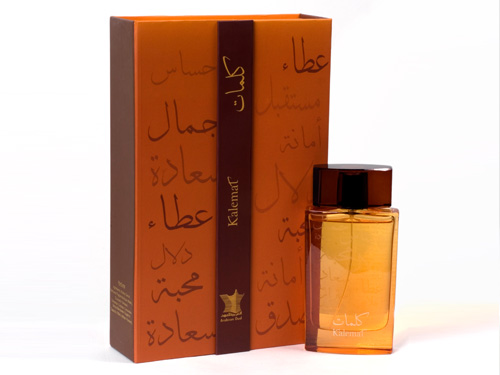
Kalemat with its box that opens like a book.

Kalemat with its box that opens like a book.

According to the London Arabian Oud website, the notes in Kalemat include:

Bilberry, anise, rosemary, Kashmir wood, musk, sweet amber, honey leaves.

Fragrantica gives a slightly different list:

Top notes are blueberry and anise; middle notes are rosemary, cashmere wood and floral notes; base notes are musk, amber and honey.

Kalemat opens on my skin with an enormous burst of richness and opulence. Two small squirts from my sample vial led to a heady, billowing cloud of amber infused with a fruity berry note. I’m not generally one for fruity fragrances — and Kalemat isn’t one at its core — but the berry element works wonderfully. If I didn’t know it was “blueberry” or “bilberry” (whatever that is), I would never have guessed it. To me, it smells more like a tangy, tart, juicy touch of black currant, mixed with a hint of blackberry. It’s never cloying or syrupy, though it initially feels as dense as the rest of the perfume.

Source: fr.123rf.com

Source: fr.123rf.com

Kalemat’s opening symphony is deepened almost instantly by a touch of honey and musk, resulting in an aroma of a creme caramel whose top has been lightly singed with a cooking torch to create a delicate shell of darkened, caramelized sugar. There is a touch of some fresh, aromatic green herbs, but it’s just a light touch that is soon overtaken by a rich Ta’if-like, ruby rose. Ta’if roses are a type of Damask rose but with 30 petals, and, according to Fragrantica, have an aroma that is significantly richer and deeper than most Damascena varieties. It is very common to Arab perfumery, and to attars in specific. Within a few minutes, the rose note has turned Kalemat into the loveliest, attar-like, opaque, boozy, floral amber with just the lightest hint of honey. Its richness feels like a running river of molten lava and gold. In fact, my skin actually has a light gleam and sheen from the concentrated oils that make up the fragrance. This is serious stuff.

Ta'if rose: perfumemaster.org

Ta’if rose: perfumemaster.org

Yet, for all of Kalemat’s richness, I really don’t think it’s ultimately a heavy perfume in terms of its weight. The potent, heady, concentrated, and very narcotic cloud that billows out around one is not unctuous, gooey, or dense in mass. As an analogy, I would say that Kalemat feels less chewy or opaque than some Profumum Roma fragrances, but significantly more powerful in sillage, especially in the first two hours. At the same time, Kalemat is substantially heavier in weight to the LM Parfums line and, once again, stronger in initial projection. In short, it is very typical and representative of traditional Middle Eastern perfumes, and yet airier in feel than something like Amouage‘s concentrated attars.

Dried tobacco leaves. Source: colourbox.com

Dried tobacco leaves. Source: colourbox.com

There is a subtle undertone to Kalemat that repeatedly reminds me of Serge Lutens‘ much adored, cult favorite, Chergui, only concentrated by a thousand. Something in Kalemat feels very much like sweet pipe tobacco, even if it’s just a subtle vein running below the perfume’s surface. Tobacco is not listed in Kalemat’s notes, but the reference to “honey leaves” (honey has leaves?) makes me wonder. Chergui’s aroma is, in part, of sweetened tobacco leaves set out to dry in the sun. Perhaps that is what Arabian oud means by its term? All I know for certain is that I was walking around Paris one evening, wafting Kalemat, and repeatedly wondering why the fragrance felt so familiar when I suddenly realised: concentrated Chergui! There is much more to Kalemat — and I was reminded of many other fragrances as well, as you will soon see — but I wouldn’t be shocked if there was a bit of some tobacco in Kalemat as well.

Kalemat isn’t a twisting, morphing creature with many stages, but it’s not completely linear either. The fragrance does subtly change, but over time and without fanfare. It is such a superbly blended fragrance that it slides almost seamlessly from one stage to another, rippling as smooth as water. In its very first opening hour, Kalemat is an opulently rich, custardy smooth, silky amber that is perfectly blended with fluid swirls of ruby Tai’if rose, dry woodiness, musk, honey, and hints of tobacco, herbs, and berries. There is almost a gourmand feel to the richness of the sweet brew, but it is not an actual gourmand fragrance as a whole. Perhaps a more helpful description would be to say that Kalemat’s opening phase comes close to straddling the Oriental and Gourmand genres, but never fully tips over into the latter.

The sweet, opulently over-the-top richness of Kalemat’s first stage explains why some people think the fragrance bears a resemblance to Tom Ford‘s Tobacco Vanille. Judging by what appeared on my skin, I think the two fragrances are different. On me, Tobacco Vanille has a plum pudding feel that is heavily accented with tobacco, and an almost potpourri-like blend of spices. Kalemat lacks those elements, along with the vanilla heart underlying the Tom Ford fragrance. To me, Kalemat seems much closer to Serge Lutens’ Chergui, only without the latter’s touch of powder and, as stated, a substantially more concentrated feel. It’s also much sweeter, deeper, and creamier than the Lutens.

To me, in the opening stage, Kalemat bears a closer resemblance to another famous amber fragrance — HermèsAmbre Narguilé — than to the more heavily spiced Tobacco Vanille. If you took certain aspects of Ambre Narguilé, changed the type of fruit to a blueberry, combined it with Chergui, and reduced the overall mix down to a thicker, more dense, almost vicous-like attar, then you’d have Kalemat. I think fans of Guerlain‘s much loved Spiritueuse Double Vanille would adore Kalemat, as it shares some similarities in terms of richness, but with honeyed amber and woodiness as the focus instead of ambered vanilla.

Source: fr.123rf.com

Source: fr.123rf.com

Slowly, slowly, almost before you realise it, Kalemat turns softer, woodier and bit darker in visual hue. At the start of the third hour, the fragrance is gentler, more rounded, and a bit blurry around the edges. There is something like the most restrained touch of oud flickering just below the surface, along with a gentle, slightly fresh, green herbaceousness. Kalemat has lost more than half of its rose floral undertone, and is less sweet, less honeyed. Now, it slowly begins its second phase where it is primarily a woody amber infused with a whiff of oud, tobacco, musk, and herbs. Only the lightest fruity and floral elements remain, but they’re minor, light, and blended seamlessly into the larger whole.

Near the end of the third hour, Kalemat also feels softer in weight and projection, though that is only relative to the powerhouse opening of the first hour. Now, it hovers 2-3 inches above the skin, and is noticeable when you bring your arm near to your nose. It doesn’t announce its presence with quite as much fanfare in the space around you. Honestly, I find Kalemat to be so addictive that this lowered sillage phase always leaves me wanting to spray on more. More, more, more, until I have surrounded myself with a nuclear mushroom cloud. Luckily for me, Kalemat comes in a 100 ml/3.4 oz bottle because I have plans to lock myself in my house on the night that it arrives, insulate all windows and doors, and apply at least 10 sprays. The Mars Rover may be able to smell me in outer space, but I don’t care.

"Abstract streams of gold." Photo: Jason Tockey. Site: jstimages.wordpress.com

“Abstract streams of gold.” Photo: Jason Tockey. Site: jstimages.wordpress.com

Kalemat’s sillage continues to drop, though the perfume gives absolutely no signs of dying anytime soon. Around the 4.5 hour mark, Kalemat hovers just an inch above the skin as a woody, sweet amber. It’s as golden as a cloud, but still much richer than that comparison would imply. Oddly, I’m somewhat reminded of a honeyed, unpowdered, more opulent version of Ambre 114 from Histoires de Parfums. Kalemat has the same sort of golden aura that made Ambre 114 conjure up James Bond’s Goldfinger for me.

Yet, for all that visual similarity, Kalemat is now primarily a woody sort of amber. The oud element waxes and wanes in how noticeable it is at the very top layer of the fragrance, but it is always there. Around the 5.5 hour mark, Kalemat is an amber with slightly musky oud, vaguely herbal dryness, an occasional flicker of rose, and a lingering whisper of tobacco. At the 7.5 hour point, Kalemat turns into a complete skin scent. The notes are almost wholly abstract: amber, a blur of sweetened wood that is barely decipherable as something oud-y, and other indistinct, dry elements. In its very final moments, Kalemat is nothing more than lightly sweetened dryness.

Kalemat’s longevity is fantastic. With two tiny squirts from the atomizer, Kalemat lasted just a fraction over 12 hours on my perfume-consuming skin, though the sillage was moderate to low for about 7.5 of them. In the past, when I’ve worn Kalemat, I’ve applied a far greater amount, and both the longevity and projection were even higher. On one occasion, I applied 5 sprays (from an atomizer that yields much less than a normal bottle would, due to a small hole), and Kalemat lasted over 16 hours on me. As regular readers to the blog know, my skin is absolutely voracious when it comes to perfume and I struggle constantly to find things that will last. If Kalemat gives me these sorts of hours, I think normal people would get astounding results.

Source: wallsave.com

Source: wallsave.com

I think Kalemat is something that people should try for a number of reasons. First, it is a completely versatile, extremely easy to wear, very cozy, comforting fragrance. It is far too powerful to wear to a really conservative, perfume-phobic office environment, but it works almost everywhere else. Second, I think Kalemat would work wonderfully on both a man and a woman. While men seem to be the ones who talk about it the most on sites like Basenotes, it was a female family member who took one whiff of Kalemat on me, and purchased it ten minutes later. If you’re a woman who likes Tobacco Vanille, Chergui, or Guerlain’s Spiritueuse Double Vanille (and there are vast numbers of you who do), then you can absolutely wear Kalemat.  

Third, Kalemat has the quality and richness of some incredibly expensive, very high-end perfumes. Kalemat is not comparable just to the prestige lines of such brands as Hermès, Guerlain, or Tom Ford, but also to such luxury perfume houses as AmouageIn fact, I’ve heard that some people think that Kalemat is very similar to Amouage’s Interlude Man, due to I think its second stage as a woody, slightly oud-y fragrance. I’m not sure I’m really qualified to speak to that, because, on my skin, Interlude Man was such a shape-shifter that it manifested itself differently on each of the 3 occasions that I tested it. It is such a complex chameleon that I could probably wear it 10 times, and experience 10 different versions.

However, judging by the three types I encountered, I think Amouage’s Interlude is different. Its herbal start can be enormously dominant, and sometimes aggressively pungent. Kalemat is hardly a herbal fragrance during any of its stages, and has only a little green touch in the background. With Interlude, its sharp greenness is then followed by a significant incense, smoky period, before ending in a stunning sandalwood drydown. Kalemat is substantially less complex. In addition, whatever smokiness it has is extremely subtle and seems merely to be the effect of other notes, instead of actual frankincense, let alone a lot of it!
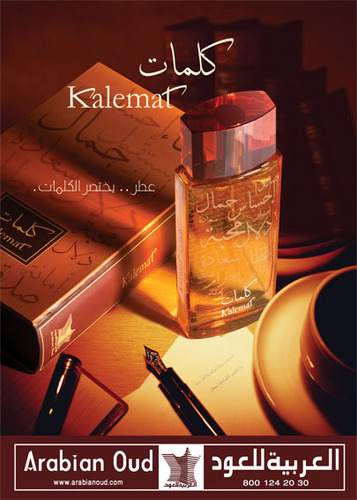
Source: paradiseperfumesandgems.co.uk

Source: paradiseperfumesandgems.co.uk

There are other differences, too. Kalemat is more floral and fruited at the start; the oud is extremely mild; it has no sandalwood; but it does include some honey. I would say that all the individual elements are toned down more, and that the overall effect is substantially smoother. The elements also blend into each other more seamlessly. Yet, it does share the luxurious feel and richness of an Amouage fragrance. When you consider that you can buy 100 ml of Kalemat on Amazon at a discounted price of $59.99 (without shipping), versus the $290 retail price of Interlude Man, I honestly don’t know how you can beat this amount of richness, depth, body, and addictive opulence for the price.

The only drawback I can see to Kalemat is that the company simply does not make it easy for consumers new to the brand. I’m going to spend a bit of time on this issue because I think it’s important to understand what your retail options are, some of the practical difficulties in learning more about the line, and the reason why Arabian Oud may be a brand you’ve rarely heard discussed. I truly think that Western perfumistas are missing out in not trying some of the company’s amazing fragrances, and that easier, more straightforward access would make them a name on everyone’s lips. As it is, however, it’s an extremely frustrating situation.

In addition to Arabian Oud’s aforementioned disorganisational chaos on its website, there is no place where you can test it or sniff the perfumes outside of London, Paris, or Arabian Oud’s several hundred stores in the Middle East. The decant/sample site, Surrender to Chance, does not carry Arabian Oud. The Perfume Court offers a few of its fragrances, but not Kalemat. And Arabian Oud does not sell samples on its website.

In fact, trying to navigate Arabian Oud’s websites consistently makes me want to throw something at the monitor. The main Saudi version is in English, but it’s a hodge-podge of categories, it doesn’t list perfume notes in a particular perfume entry, and the similarity between some perfume names is confusing. The fact that “Mukallet” seems to be the term for an attar or perfume oil that is stuck on half the perfumes doesn’t help.

The real problem, however, is sheer, overwhelming quantity of selection. According to Fragrantica’s page for Arabian Oud, Kalemat is one of 160 fragrances (!!!!!) offered by the house. The fact that that long Fragrantica listing does not include three of my favorite Arabian Oud fragrances should tell you just how many fragrances we’re talking about. Fragrantica also says that the 160 perfumes were “all launched in 2012” — something which is not only highly unlikely, but also inaccurate. The 2012 mistake (along with Fragrantica’s description of the company as a “new” one) is undoubtedly yet another victim of Arabian Oud’s utterly disorganized state of affairs. While the Saudi site provides no details, the London version says the company’s history actually goes back to 1982 when it was founded by Sheikh Abdul-Aziz Al Jasser who opened his first store in the old Alzal souk of Riyadh, Saudi Arabia.

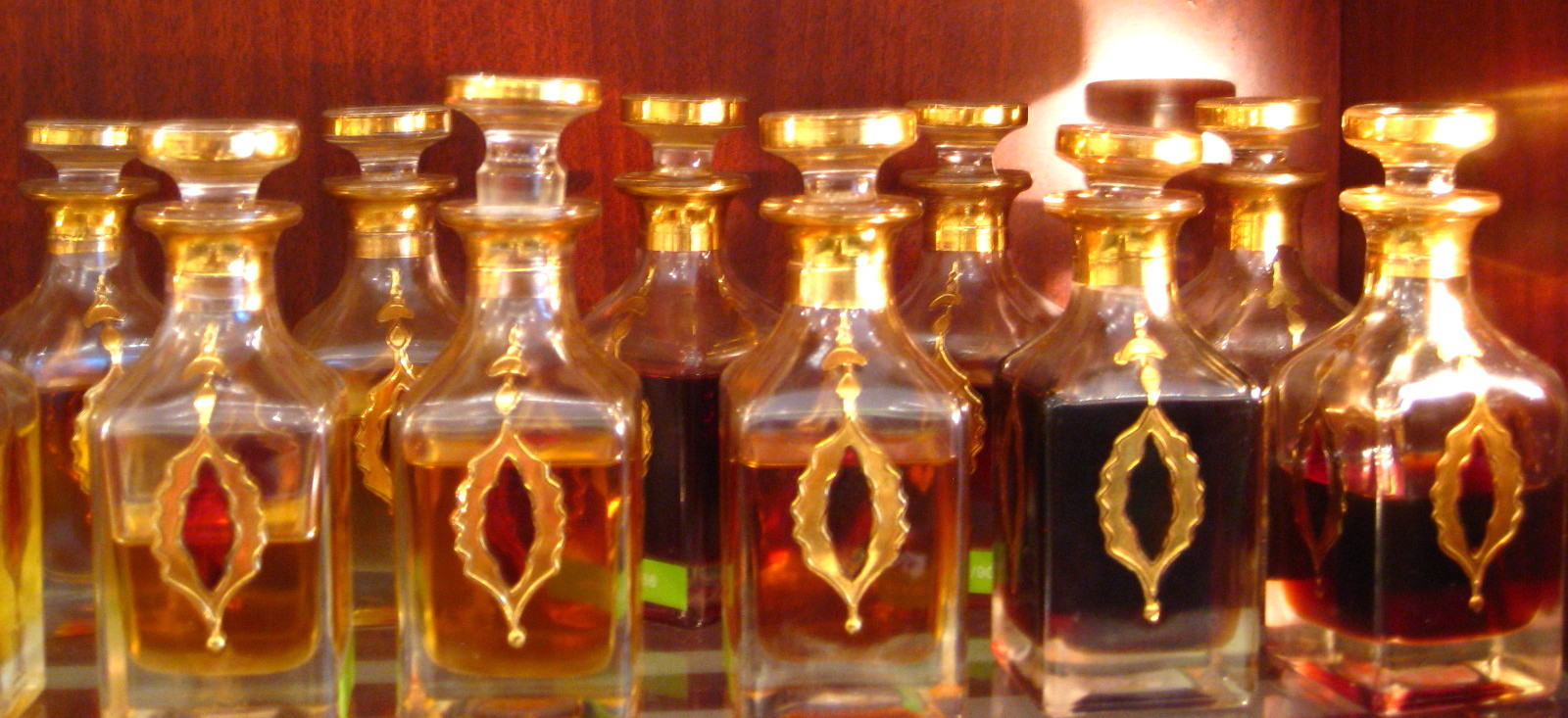
If you’re lucky enough to be in London or Paris, with easy access to one of the Arabian Oud stores, and want to just pop in for a sniff, you’re likely to be overwhelmed just as much as if you merely checked out the company’s website. When you go in, you’re confronted by shelves of elaborately ornate, fancy, decorated, Middle Eastern bottles which rarely seem to have an actual name on them. To give you an idea, I’ll share with you some photos I took in the store, though I need to repeat my frequent caveat that they won’t be great. As I’ve said elsewhere, my camera seems to have chosen this holiday to decide that it absolutely hates perfumery, so 6 out of every 10 perfume shots were wholly unusable. In the case of Arabian Oud, only two are decent (and a third is blurry), but a least it will give you an idea of things. Photos of just one small portion of the Paris store:
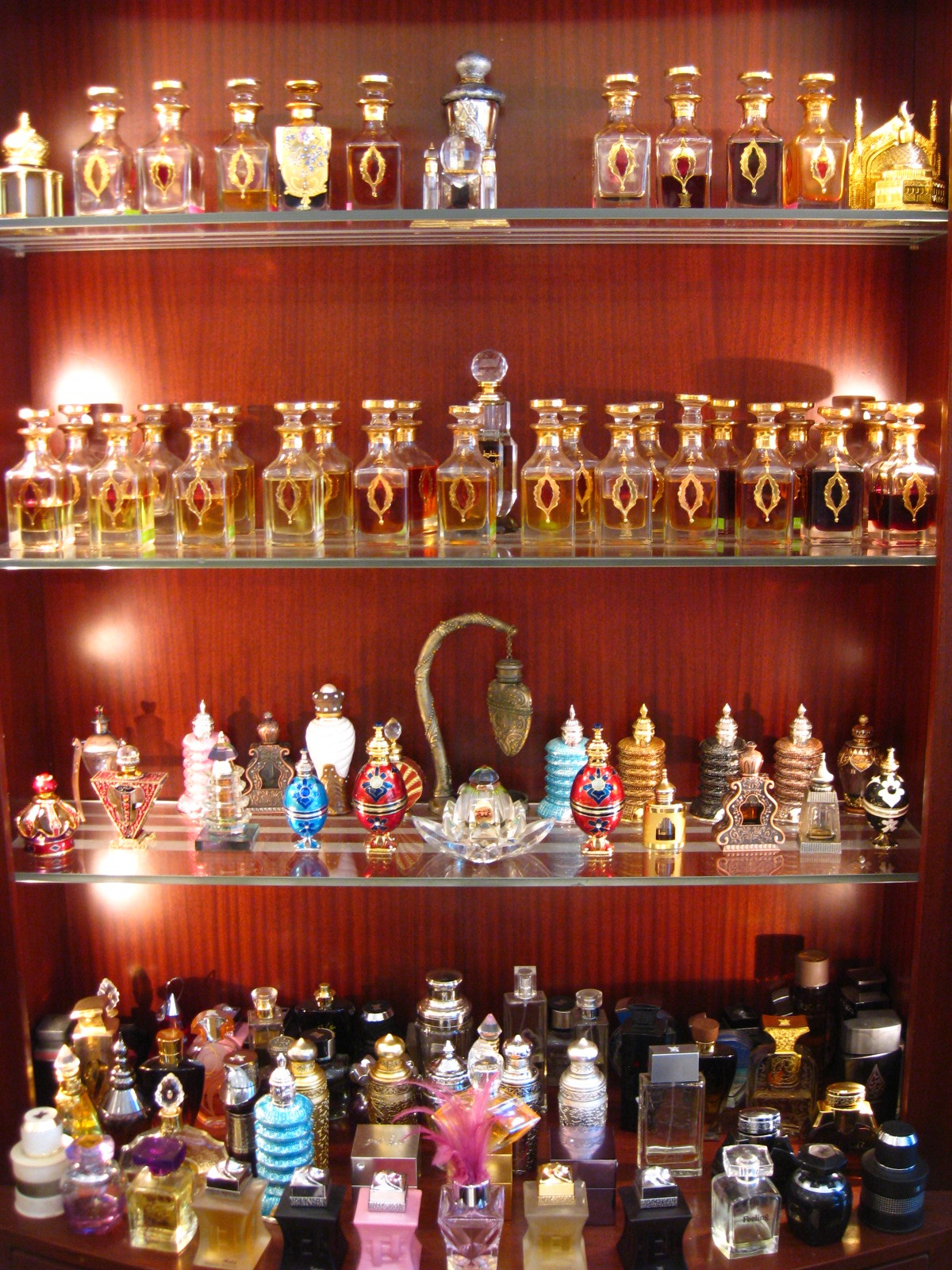

Arabian Oud2 Arabian Oud

So sorry it's blurry!

So sorry it’s blurry!

It is a testament to the quality of Arabian Oud’s products that Kalemat was actually not my favorite of the things that I tried. One of them, a perfume attar called Taj Mahal blew me out of the water. It is one of the most spectacular florientals I’ve tried in years, surpassing any and all Amouages (including Fate Woman) in its lush, deep, opulent beauty. Based on my memory of it, it was an orange blossom, jasmine, rose, sandalwood oriental oil that almost glowed in its rich sheen on my skin, and which cost (at its lowest, most affordable price) about €60 or $80 for a few drops. (Something like 4 ml. Its price on Zahras, the American-based website for Middle Eastern perfumes, is inflated to a ridiculous $371 for a tiny 6 ml bottle!) If I’d encountered Taj Mahal at the start of my trip, and had time to test it out properly on my skin, I would have bought that small vial without a qualm. As it was, I went to Arabian Oud on the last day of my holiday, after having purchased many other fragrances, and while wearing too many scents for a proper test, so the situation didn’t quite work out. The high price also made a mere sample impossible to obtain. 

It is a true sign of Arabian Oud’s disorganized chaos that Taj Mahal is not even listed on the company’s own websites. (Neither is another one of my other favorites, Dinon or Dinan, whose name the salesman wrote down for me in a scrawl to ensure that I had the correct spelling!) Happily, interested parties can always call the Paris store directly to order it, and one day, I shall have my Taj Mahal. The third one on my list of favorites was Ghroob, a concentrated perfume attar which is listed on the original Arabian Oud site without any notes, but which isn’t listed on the London version no matter what sort of spelling variation I tried. (Are you getting an idea yet of just how complicated it is to try to order a perfume from these people without pre-existing, advance knowledge?!) [UPDATE: In the comments below, you can read more about Ghroob, its floral-oriental-sandalwood notes, and its supposed resemblance to Amouage‘s $350 Homage attar. I have reviewed Ghroob here, and don’t see an similarity to Homage. Arabian Oud has discounted it on Amazon at around $44, and offers a lower price of shipping if you purchase more than one item. Also, as a side note, if you are relying on the Zahras site that I linked up above for information, please be careful. The notes that they list are not always accurate or the same as what Arabian Oud lists for their fragrances.]

Thankfully for my fourth favorite, and the subject of this review, Kalamet is easily available not only on all the Arabian Oud company websites, but also on Amazon (U.S.). Arabian Oud is the actual vendor and seems to have discounted the listed retail price of $99.99 by 40%, selling the 100 ml bottle of eau de parfum (really more like pure parfum extrait, if you ask me!) for an incredibly low price of $59.99. There is a shipping cost of $16.48 for a total of $76.47, but I paid no tax, and the final price is still substantially lower per ml for any analogous pure parfum extrait of that quality. You’re essentially paying about .76 cents per ml, when Amouage’s stunning Tribute attar is available from decanting sites for $14.99 for a 1/4 ml! Granted, the two fragrances have substantial differences in notes, smell, ingredients and concentration, but still!

Helping matters further, Arabian Oud’s Amazon shipping (from Saudi Arabia?) seems to be both fast and extremely professional. The company’s Amazon rating is 4.8 stars out of 5 with 48 votes, and consistently positive praise from buyers. A friend of mine purchased Kalemat blindly on the basis of my passing raves about it, and he was extremely pleased with the speed of the delivery, the packaging of his bottle, and Arabian Oud’s polite service. Another reader of this blog, “Laird Angus,” bought Kalemat blindly and his gushing review on Amazon talks about both the perfume’s original packaging, and the beauty of its smell. It’s an extremely accurate assessment and the best one I’ve seen on the scent, so I’d like to quote a large part of it.

Calling Kalemat a “reference amber,” he writes:

In ancient times, books were rare and precious objects. The learned elite treasured them. Scholars and holy men spent countless hours transcribing and illustrating them. Calligraphy held a place at the high table of the arts.

Kalemat, which means “words” in Arabic, pays tribute to this lost era in its exquisite packaging. It arrives in a beautiful oversized box designed to look like an antique arabic book. When opened, the box reveals a smaller, ribbon-bound tome which contains the bottle of perfume itself. And so even before the first spray, you know that this an oriental perfume in its full glory–dramatic, confident, mysterious, exotic, precious beyond compare.

Inside Kalemat's "book." Photo via eBay.

Inside Kalemat’s “book.” Photo via eBay.

The juice itself does not disappoint. Kalemat opens with a lush jammy berry accord, balanced perfectly by incense and a hint of dry woods. The berry note is apparently bilberry, which was new to me. It is sweet and perhaps slightly tart. Wonderful. Novel. 

After 20 minutes or so, the berry notes recede, leaving behind a sumptuous base of incense, woods, and lightly jammy rose. This is the heart of Kalemat, and it is apparently inspired by the Middle Eastern hospitality traditions around bakhoor, a household incense of dried wood and rose. It reminded me somewhat of Jubilation XXV by Amouage, but Kalemat is somehow deeper and rounder. There are no jagged edges here. Although it is not listed in the ingredients or the notes, I am convinced that there is a trace of high quality synthetic oud in this as well. It is used here not as an individual note, but as a fixative and an amplifier of the other notes. Perfect!

Over the next 8-10 hours, the rose fades out, then the incense, leaving only the driest cedar-like scent, like the inside of an ancient chest found in an old Cairo apartment.

Kalemat is everything I had hoped it would be. I’ve been searching for an authentic and wearable Arabian scent. It is no easy thing! I’ve sampled virtually every offering from Amouage, a number of rare attars, low cost oils from al Rehab, and various western “interpretations” of middle eastern fragrances. None has come close to Kalemat. It is a deeply relaxing scent, perfect for stressful days at the office. It speaks something of eternal truths, of timeless values, of the cycle of life-death-rebirth that renders all of our transient worldly concerns puny by comparison.  [Emphasis to the names added by me.]

I would hardly go so far as to say Kalemat speaks to eternal truths, but, yes, it is an absolutely gorgeous amber that is opulent, heady, full-bodied, and deeply comforting. That is why I will go to so far as to say that you should definitely consider a blind buy of Kalemat if (but only if) you’re a huge fan of any of the perfumes that I’ve mentioned in this review. If you love wispy, gauzy, sheer, light, fresh, clean scents, Kalemat is not for you. This is a fragrance for a die-hard lover of amber, oriental or oriental-gourmand fragrances, and I don’t think you will be disappointed.

You should consider a blind buy even more if some of those other fragrances I’ve mentioned have been out of your reach due to their high cost. I can’t recall if I have ever recommended that people buy a perfume blindly and untested, but Kalemat’s price is low enough that I’m breaking my usual rule. If you absolutely hate it or if your skin chemistry inexplicably makes things go wonky, I don’t think you’d have much difficulty in selling your bottle on eBay, where Kalemat is usually listed for almost double the Amazon price and rarely offered by US sellers.

If you’re located outside of the United States, I don’t know if you can purchase Kalemat at the discounted Amazon price and have Arabian Oud simply ship it to you elsewhere. I couldn’t find Kalemat on the Canadian, German or Brazilian Amazon sites, so I suspect that price is limited to U.S. buyers. Even without Amazon, though, it’s still not hugely expensive to buy Kalemat as it retails for $99, and you have several other vendor options. You can find the fragrance on the Arabian Oud site for 300 SAR which seems to come to a little over €58 at the current currency conversion rates, and I believe they ship internationally. On the UK Arabian Oud site, the perfume is offered for £52, discounted from £87. The site’s flash options don’t seem to let me use a direct, saved link to Kalemat’s specific page, but you can find it easily with a word search. (You may want to immediately mute the volume on the site as it plays annoyingly repetitive music incredibly loudly.)

For all other countries, you may can use the Universal Perfumes retailer in Kuwait that I introduced to you months ago, and which is very reliable. It sells Kalemat for $99, with a flat-rate, international shipping price of $6.99 for the first item. I’ve heard it takes about two weeks for its packages to come from Kuwait to the States, so I assume it will be around the same for other destinations. Lastly, you can always try eBay which has a number of British and Middle Eastern sellers who offer the fragrance.

At the end of the day, Kalemat is not a revolutionary, complicated, complex scent, but it is such an utterly addictive, luxurious, rich, comforting, soothing one, that I find it utterly irresistible. If you hear a bellow of joy on or around November 8th, you will know that my perfume package has arrived, that irrational amounts of spraying will follow, and that a golden mushroom cloud of amber will explode shortly thereafter from this part of the Western hemisphere. I cannot wait.

[UPDATE 3/23/2015 — I’ve just reviewed Kalemat Amber concentrated oil, and it’s even better. Simply outstanding! Kalemat Floral is equally lovely. There are also Wood, Musk, and Oud versions of Kalemat. Right now, Arabian Oud London is willing to help readers of the blog to buy the Kalemat oils (in any version) and to ship them world-wide. The details of the special deal are in my review for Kalemat Amber. The company no longer sells on Amazon, but some third-party vendors do have Kalemat eau de parfum. However, the oils are not available there from anyone. Kalemat Wood or Kalemat Musk are sometimes sold on eBay. However, the best of the lot from the ones I’ve tried are Kalemat Amber and Kalemat Floral.]

By Kilian Playing With The Devil (In The Garden of Good and Evil)

The Devil slinks into the Garden of Good and Evil, cloaked in red, emitting fire, and adding a painful bite to everything he touches. He curls his way around the cedar tree that smells mostly of green freshness with a tinge of damp earthy sweetness, entwines himself around branches carrying lychees and cassis, and breathes a hot red mist of chili all over it. Then, he vanishes in a puff of crimson smoke, leaving fruits that are sweet with a slightly poisoned, synthetic touch. But his crimson present barely lasts, and the evil drains quickly from the Garden of Eden, returning it back to a state of fruited sweetness. It’s an increasingly abstract “goodness,” a fresh blur of fruits that soon takes on a creamy tone with vanilla, before turning into powdered and a little bit sour in their staleness. That’s what happens when you are Playing with the Devil.

Michelangelo,  “The Temptation and Expulsion of Adam & Eve.”

Michelangelo, “The Temptation and Expulsion of Adam & Eve.”

The impact of the Devil in the Garden of Good and Evil has been turned from a whimsical allegory into concrete perfume form by Kilian Hennessey. This month marks the release of Playing With The Devil, an eau de parfum created by Calice Becker. The scent is the fourth edition in Kilian’s In The Garden of Good and Evil collection that was first launched in 20012 and which is centered around a common theme. According to the original press release for the collection (quoted by Now Smell This) and Playing with the Devil‘s description on Luckyscent, “it is the myth of original sin” where “the world of perfume enters into the garden of Eden and shows us another side of the story” with a “tribute to forbidden fruits.”

Source: Fragrantica.

Source: Fragrantica.

LuckyScent gives the following notes for Playing with the Devil:

Blood orange, black currant, white peach, lychee, pepper, pimento [chili pepper], cedar, sandalwood, patchouli, Rose, Jasmine, tonka, benzoin, vanilla.

Playing with the Devil opens on my skin a burst of lychee and tart, juicy, zesty, slightly sour blackcurrant. (I’m used to calling it “cassis,” so that’s what I’ll go with from here on out.) There is an unexpected touch of damp earth underlying the scent, which symbolically melts into the very green, leafy images I get from the fruits. On their trail is a fiery chili pepper (pimento) that feels as visually red as the most brutally piercing Scotch Bonnet or Ghost Chili on the market. It’s a very funky, odd, fascinating note because its bite feels a little like the capsaicin that you’d experience if you nibbled on a pimento pepper. Yet, the second time I tested Playing with the Devil, it was largely overwhelmed by a very fresh, clean scent that sometimes borders a little on the soapy, powdery aroma that you’d get from a deodorant. I actually own a deodorant that has some similarities, so it made me grimace a little, I must confess.

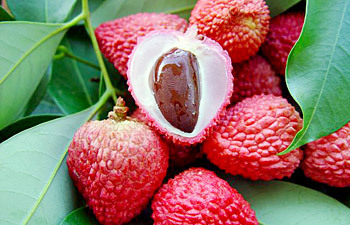
Lychee. Source: fanpop.com

Lychee. Source: fanpop.com

In its opening stage, Playing with the Devil is primarily a lychee and cassis fragrance with that fiery chili pepper bite lurking underneath. Minutes into the fragrance’s development, the peach makes its quiet, very muted debut, feeling white, delicate, pastel and almost liquidy like a thin nectar. It’s followed by a slightly smoky, dry, woody note that initially doesn’t feel like cedar but which soon takes on that tree’s aroma. It smells of bright greenness, mixed with pencil shavings and a light touch of smokiness. The blood orange isn’t a very noticeable note at all on my skin. At best, there is something that feels like the suggestion of its tart, citric nature, but it’s only a vague, fleeting impression. Increasingly, however, Playing with the Devil is dominated by the cassis with its tart, sometimes sour freshness leavened a little by the lychee’s watery sweetness.

Source: splendidtable.org

Source: splendidtable.org

The note that fascinates me the most is the pimento, a type of chili pepper. I’m rather obsessed with how it appears here, though not always for positive reasons. You see, I tend to have an allergic reaction to the chili peppers where my lips swell up in response to the capsaicin that is so much a part of them. Here, with Playing with the Devil, I feel a slight burning in my throat, a sensation I’ve gotten from some chili peppers on occasion, but also, from some synthetics on a much more common, frequent basis. I find it difficult to believe that Calice Becker used an essential oil derived from chili pepper distillation in Playing with the Devil, so I’m venturing a guess that the pimento note here is largely an aromachemical. Well, congratulations on mirroring the sort of physical reaction that I get from the real thing.

Source: free-hdwallpapers.com

Source: free-hdwallpapers.com

On the other hand, a more sincere, genuine congratulations are in order for such a brilliant piece of symbolism. The intellectual conceit or theory here is damn clever, and I absolutely love the thought of the fiery, red-hot pepper representing Satan in the Garden of Eden, thereby turning it smoky and evil. Intellectually, I was impressed with every bit of it. Perfume wise, I find it an extremely interesting, wholly original counterpoint to the lychee and cassis.

Personally, however, it’s a whole other matter, because I’m not swooning over any of it. Playing with the Devil is pretty on some levels, and I like the effect of the cedar in adding an increasingly dry counter-point to the fruits, but none of it really wows me. I also enjoy the liquidy sweetness of lychee, but that alone is not enough to make the overall fragrance something that really knocks me to my feet. Moreover, the clean, fresh, slightly soapy, faintly powdered aspects of the beginning are most definitely not me. It’s a pretty opening, but perhaps you have to really adore fruity fragrances to really love it, and I’m afraid I’m not one of those people.

At the end of the first hour, Playing with the Devil starts to shift. At first, it’s just the slow stirrings of vanilla in the base, adding a different sort of sweetness to the zesty, tart, slightly green, fresh top notes. At the same time, the fiery, red kick of the chili pepper recedes to the background. There is the vaguest hint of something floral wafting about, but it’s so muted, it’s virtually impossible to really identify. The dry woodiness in the base starts to increase, as does the hint of powderiness. Playing with the Devil’s sillage drops, the notes start to overlap each other, and the fragrance starts to feel a little abstract. These issues were especially noticeable the second time I tested the fragrance, when I put on substantially less of Playing with the Devil. With two small smears, instead of about 4 large ones, the fragrance turned vague and abstract far sooner, became a skin scent more quickly, and the nuances in notes were significantly harder to detect. The capsaicin chili pepper element was also substantially less noticeable, though the burning sensation in my throat remained in a faint way.

In both tests, however, Playing with the Devil became a total blur of fruity notes quite quickly. The first time around, with the large dose, it took about 1.25 hours for the fragrance to turn into a generalized, somewhat abstract haze of tart, sweet fruits atop vague woodiness with vanilla. The most you can really single out from the lot is cassis. Underneath, in the base, there is the start of something synthetic lurking about that isn’t clear or distinguishable, along with a touch of fruited patchouli. The peach, and lychee have largely faded away, replaced by hints of blood orange. The chili pepper has disappeared entirely. The whole thing is a soft bouquet of fresh fruits with patchouli, cedar and vanilla that hovers just barely above the skin in an airy, gauzy blur.

Playing with the Devil continues its subtle changes. By the end of the second hour, the soft, leafy, green feel of the fragrance is joined by a shadow of a dewy, pale, watery pink rose, but it’s an extremely muted note. As a whole, the scent is a soft, cozy, fruity vanilla with an increasingly synthetic patchouli note that burns my nose when smelled up close. Playing with the Devil loses its dryness as the patchouli overwhelms the cedar, and the fragrance takes on even greater sweetness. For some strange reason, I have the subtle impression and feel of green tea, only in a creamy ice-cream version. It comes and goes, however, during the third hour, then dies completely as Playing with the Devil becomes increasingly fresh and clean.

Source: popularscreensavers.com

Source: popularscreensavers.com

Starting at the fourth hour, the Garden of Eden is a place where all traces of the Devil have been wiped away. The Luckyscent description of Playing with the Devil talks about how naughtiness wins out in the fight between good and evil, but not on my skin. The fragrance is now a completely nebulous haze of clean, fresh sweetness with fruity vanilla and some powder. The latter soon takes over completely. By the 4.5 hour mark, Playing with the Devil is abstract floral-fruity powder with a slight tinge of vanilla underneath. At the 6 hour mark, the powder takes on a slightly sour, stale characteristic, and the fragrance remains that way until its very end. All in all, Playing with the Devil lasted 9.75 hours with a very large dose (4 very big smears) and just over 7.5 hours with a small one (2 small smears). The sillage throughout was moderate to soft.

Playing with the Devil is far too new for there to be extensive reviews out there. On Fragrantica, only two people seem to have tested the perfume, writing:

  • smells exactly like “Enchanted Forest” but the blackcurrant note isnt as loud. if you want loud blackcurrant buy Enchanted Forest. if you want a more softer blackcurrant note buy this.
  • Fresh, peachy, fruity, bright and feminine. If you like fruity (but not sticky sweet) fragrances, you must try Playing with the devil.
    I can detect all the fruits, the peach, cassis, blood orange and lychee. The rose is present but is subtle not overpowering
    This is how fruity fragrances should be done. Thumbs up!

My experience with The Vagabond Prince‘s The Enchanted Forest was quite different because I had quite a lot of pine develop on my skin, but I do agree with some of the commentator’s assessment: this is a much softer cassis note. I wasn’t a particular fan of The Enchanted Forest, and I’m not of Playing with the Devil, either, and the reasons are somewhat encapsulated in the second Fragrantica review: it’s a fresh, feminine fruit cocktail. Playing with the Devil is also powdery, somewhat synthetic, quickly abstract, and rather boring. If that fiery pimento had really lasted, maybe my reaction would be different, but I highly doubt it.

I think you have to really love cassis, and “fresh, clean” scents to appreciate Playing with the Devil. You also have to be one of those people for whom blackcurrant doesn’t turn urinous or into “cat pee” on their skin. You’d be surprised how many people have that problem with the note, so I’d definitely counsel testing Playing with the Devil before you buy it. It’s not a cheap fragrance  — and, in my opinion, Playing with the Devil is rather over-priced for what it is — but at least there is a more affordable refill option at $145 if you really love fruit cocktails. I don’t, so I shall play with the Devil elsewhere.

DETAILS:
Cost & Availability: Playing with the Devil is an eau de parfum that costs $245 for a 50 ml bottle or $145 for a 50 ml refill bottle. The fragrance is not currently listed on the Kilian website, so I don’t know its Euro retail price. In the U.S.: Kilian fragrances are usually available at a variety of fine department stores, but Playing with the Devil seems to be too new to be listed on the websites of either Bergdorf Goodman, or Saks Fifth Avenue. However, you can order it at Aedes or Luckyscent, though both vendors seem to be back-ordered at the time of this post. Outside the U.S.: Playing with the Devil is not yet listed on By Kilian’s international website. In London, Harvey Nichols always carries the Kilian line, but they don’t have Playing with the Devil listed on their website yet. Elsewhere, you can find the Kilian line at Harvey Nichols stores around the world, from Dubai to Hong Kong. In Paris, the Kilian line is carried at Printemps. As for other locations, By Kilian’s Facebook page lists the following retailers and/or locations: “HARVEY NICHOLS (UK, Honk Kong, UAE, Saudi Arabia, Koweit, Turkey), Le BON MARCHE (France), TSUM (Russia), ARTICOLI (Russia) and HOLT RENFREW (Canada).” Samples: you can find Playing with the Devil at Surrender to Chance where prices start at $3.99 for a 1/2 ml vial.

Armani Privé Oud Royal & Cuir Noir (2013) (Mille et Une Nuits)

Armani is re-releasing some of its limited-issue Privé line, and I obtained samples of three of the fragrances from La Collection des Mille et Une Nuits. This review is for Oud Royal and Cuir Noir, neither of which is complicated enough or compelling enough to warrant an individual review. In fact, I’m starting to wonder if Armani could ever make a fragrance that would move me. His style is simply too bloodlessly refined for my tastes. Plus, for the cost, I keep thinking that one could do better. That is especially true for one of the Privé fragrances which seems to have been reworked into something completely different and rather terrible.

THE RE-LAUNCH:

Refinery29 has the details on which Armani Privé fragrances are being returned to the market:

The brand has been releasing its ultra-exclusive Privé scents in limited-editions since 2004, usually debuting just one at a time in small batches. Once they sold out, they were gone for good. Well, someone over there was feeling generous, because this summer sees the launch of four brand-new scents and the re-issue of all 10 of the previously launched scents. […]

The four “new” scents — Oud Royal, Cuir Noir, Ambre Orient, and Rose d’Arabie — were originally launched overseas back in 2011, but never made it to the U.S. They are part of the La Collection des Mille et une Nuits that was inspired by the classic Arabian tale, One Thousand and One Nights. They showcase notes of oud, leather, amber, and rose, respectively.

There is no word on whether these 2013 fragrances have been re-worked and re-formulated, but I think at least one of those fragrances must have been, as you will soon see.

OUD ROYAL:

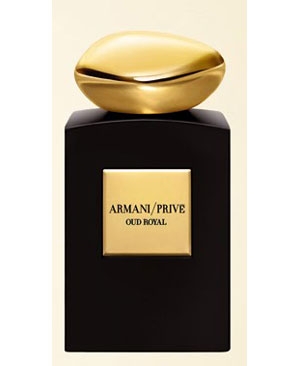
Armani Oud RoyalAccording to Fragrantica, Oud Royal was created by Alberto Morillas, while Bois de Jasmin says it is Symrise perfumer Evelyne Boulanger. Some people give the original release date as 2010, others say 2011. Regardless of whoever made Royal Oud or when, the fragrance is certainly described with opulence. In the original press release description of the fragrance, as quoted by Now Smell This, Oud Royal and its notes are described as follows:

“When Giorgio Armani turned his attention to oud, he decided to work it the way he would a heavy brocade lined with gold and silver, leaving its weight, its noble intensity and majestic sedateness. Respectful of its personality, Giorgio Armani set about highlighting each facet of character in its composition: depth is amplified by an amber harmony, the reddish glow is fanned with spices, the dark earth reflections are smoked with a veil of myrrh and incense.” Additional notes include black earth note, animalic notes.

The current description of the fragrance on Armani’s website is largely the same, though much less detailed and focusing more on the mystical nature of oud wood. Thus far, that much is the same. Armani, however, doesn’t list any notes for the fragrance. So, if we take the Now Smell This press release report, and combine it with the notes listed on Fragrantica, the list of ingredients in Oud Royal would be:

Oud from Laos, saffron, amber, rose, sandalwood, myrrh, incense, black earth and animalic notes.

Oud Royal opens on my skin with a very leathery facade, so much so that I actually had to double-check my sample to make sure I hadn’t accidentally put on Cuir Noir. The fragrance is dry, earthy, very dusty, only slightly sweetened by saffron, and reminds me strongly of Dior‘s Leather Oud. There is a subtle undertone of smokiness, but it’s extremely muted. After about five minutes, the saffron becomes a little more noticeable, taking on an almost meaty quality, but, like almost everything else in the fragrance, it’s restrained, refined, and very polite. The rose also makes an appearance at this time, but it’s bloodless, and remains a muted, virtually hidden presence in the perfume’s life.

It takes a mere 30 minutes for Oud Royal to turn into a highly refined, elegant, very pleasant blur. It hovers discretely above the skin as a pleasant haze of soft leather and oud, with saffron and a touch of incense. The rose is barely perceptible, the saffron loses its meaty touch, and the fragrance eventually turns slightly sweeter at the end of 90-minutes. A pretty little pop of sandalwood appears around the end of the fifth hour, but it is very subtle and is largely overpowered by the oud. Those are all minor changes, however, and the core essence remains the same: an extremely pleasant, almost pretty, soft, gauzy leather-oud fragrance that sticks close to the skin. All in all, Oud Royal lasted just short of 7.75 hours on my skin, with weak sillage throughout.

Our Royal is exquisitely blended, very refined, and highly conservative in every way imaginable. I can see its high quality, and even its prettiness, but something ultimately leaves me unmoved. On some levels, it seems like the perfect oud fragrance for those who: 1) dislike true agarwood scents; 2) are looking for a refined fragrance that is highly unobtrusive, in addition to being somewhat blandly safe; and 3) have a lot of money to spend on a prestige name in luxury goods. I think all three factors must apply for Oud Royal to really be worth your while.

The general reaction to Oud Royal is mixed. Bois de Jasmin seems to have been singularly unimpressed, giving the fragrance a 3-star (“adequate”) rating and finding its price (even back in 2010) to be too high for the scent in question:

the fragrances from this collection are in fact quite opulent, well-crafted, made with high-quality materials. Yet, as I am trying to get over the sticker shock of £170 per bottle (according to Harrod’s pricing,) I have to ask myself whether this price is warranted. I really enjoy the decadent sensuality that Oud Royal conveys as well as its prêt-a-porter interpretation of the leather-oud notes that sometimes are quite difficult to wear (such as by Kilian Pure Oud, beautiful though it is.) Yet, it does not strike me as particularly new or original. Or perhaps, something of this Arabian Tale was lost in translation.

On Basenotes, there are mixed reviews in one thread, while a Basenotes poll about the best oud fragrances for men that gives 11 different options has Oud Royal coming in seventh place with 4% of the votes. Are those voting numbers representative or comprehensive? No, and I’m not claiming that they are. Nonetheless, the poll shows that Oud Royal — while being perfectly pleasant and beautifully refined — isn’t necessarily a fragrance that sweeps people away. At the end of the day, the bottom line is that there really isn’t much to say about Oud Royal, and I think it has been intentionally made that way.

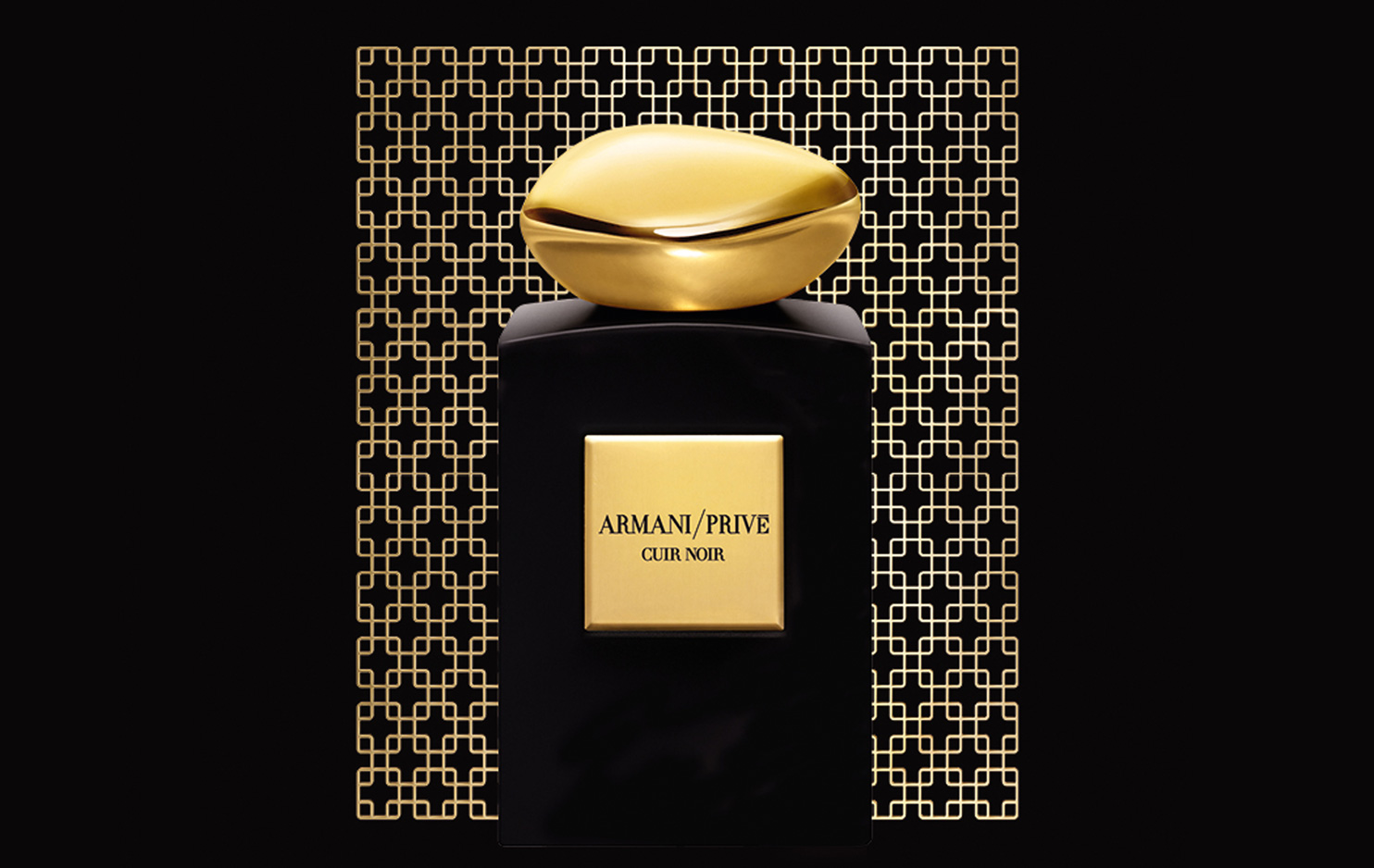
CUIR NOIR:

Source: Aishti.com

Source: Aishti.com

I find Cuir Noir to be singularly misnamed, and rather irritating to describe. The fragrance sample I obtained from Neiman Marcus would be more aptly called Saffron Rose, because a leather fragrance it is not. You wouldn’t know that from the Fragrantica description, however, which seems to quote the original Armani press release from 2011:

Cuir Noir was inspired by the art of Arabian tanners. “Leather is an art. From Cordoba, Spain to the borders of the Atlas Mountains. With a wine patina, it takes the name of “cordovan”. Tattooed with gold, it is called “maroquin”.” The perfume composition consists of Australian Sandalwood, Rose essence, Coriander, Nutmeg (in the top); Leather, Smoky Guaiac and Oud (in the heart); Tahitian Vanilla absolute and Benzoin balm (in the base).

I read that description, started testing the fragrance, then immediately stopped in my tracks. Leather? Sandalwood? Nutmeg? Not on my skin, it wasn’t. I double-checked the name printed on the manufacturer’s vial, I re-read Fragrantica, and then I went online to see what some reviews might say, because what was appearing on my skin was gooey, rose syrup with walloping, hefty amounts of saffron, and nary a whiff of leather in sight! I read with confusion Bois de Jasmin‘s bored, negative review of the scent and paid close heed to the statement: “Cuir Noir was created by perfumer Nathalie Lorson and includes notes of Bulgarian rose, nutmeg, coriander, guaiac wood, leather, oud, Australian sandalwood, ambergris accord, benzoin.”

I’ve concluded that Armani must have changed his mind about Cuir Noir, and that it must now be a very different thing from what it was back when it was originally released for the Middle Eastern market. You see, in his current description for the scent on his website, Armani barely bothers to talk about leather at all. Instead, the purportedly black leather fragrance is actually a tribute to saffron, and with rather a different focus from what Fragrantica originally quoted back in 2011:

Cuir Noir showcases the raw material Saffron, a spice with leather accents. The roundness and sensuality of its notes bring suppleness and warmth, reflecting the enveloping sensuality of skin-on-skin contact.  Derived from the crimson stigmas of Crocus sativus, saffron is the world’s most expensive apice [sic]. Its ochre colour symbolises inner happiness, which is why saffron-hued clothing is often mentioned in ancient mythology, tragedies and poetry. In perfumery, saffron lends a full, leathery and sensual note to fragrance compositions.  With Cuir Noir, Giorgio Armani journeys into the heart of an Arabian night. He revisits  the saffron accord to create a captivating Oriental. Golden and voluptuous, saffron infuses a profoundly sensual experience  that recalls the redolence of tanned hides with the wild scent of tallow and  e [sic] smouldering, tarry aroma of black birch.

Well, I don’t smell any tarry black birch at all, but the description does explain why my skin is reeking almost solely of saffron mixed with a syrupy, gooey, jammy rose. It’s revolting, cloyingly sweet, and backed by a sort of chewy darkness that feels like purple patchouli. Cuir Noir is also wholly unoriginal in bent, a retread of very tired old ground walked by so many other fragrances. In fact, the scent reminds me strongly of Tom Ford‘s Café Rose which was the same sort of jammy rose, saffron bomb on my skin.

From beginning to linear end, the same two notes dominate Armani’s Cuir Noir. For the first five minutes, there were flickers of something smoky (though it never felt like guaiac wood), but leather? Bah! BAH, I tell you! My notes are littered with comments about saccharine sweetness, and the complete absence of any mythical tanners from Cordoba. Even the oud is pretty much of a lost cause; it disappears within thirty minutes. Oddly, around the 10 minute mark, there was a momentary pop of a powdered lipstick tonality with a slightly violet aspect, but it vanished within minutes.

Cuir Noir becomes soft and sheer very fast. It takes less than 30 minutes for the moderate sillage to begin its sharp decline and drop; by the 90-minutes mark, the fragrance is a complete skin scent. Yet, Cuir Noir is oddly potent when sniffed up close, and I had almost a burning sensation when I sniffed the saffron, patchouli, rose combination during the second hour. It makes me wonder just how synthetic the fragrance is, and how much fruit-chouli is lurking underneath.

Cuir Noir doesn’t drastically change from its main, boring, sickly-sweet combination until the very end, so I should be thankful that it died so soon. In its final drydown, a rich, faintly custardy vanilla note shows up, along with some abstract, generic smoky woodiness that might be guaiac or ersatz, fake, Australian “sandalwood,” but both notes are as muted and sweetened as everything else in the fragrance. All in all, the fragrance lasted exactly 4.75 hours, ending as a whimper of vanilla sweetness. I know my skin eats fragrances quickly, but come on! For a $275 eau de parfum that is ostensibly made from the richest and best ingredients, that seems rather pathetic. As for the mythical tanners from Cordoba, all I can do is mutter about misleading names, and analogize to that old 1980s commercial for Wendy’s: “Where’s the beef?!”

As you can tell, I’m hugely unimpressed by Cuir Noir, especially in light of its $275 price tag. I never tested the original version released in the Middle East, but I find it hard to believe that the 2011 fragrance whose descriptions and reviews I read is the same one I tested now. The difference between the press release quoted by Fragrantica and what is now on the Armani website seems too vast. I even contemplated the possibility that Fragrantica was incorrect in its description of the scent’s leather, seeming press release quotes notwithstanding. So, I checked the Cuir Noir entry on Osmoz. Nope, Fragrantica wasn’t mistaken. Osmoz usually relies on press release descriptions, too, and its entry for Cuir Noir reads:

The Italian designer was inspired by the refined, ancient art of making leather. He wanted to “recreate the fascinating atmosphere of tanneries, which blend the pungent odor of tallow with the burnt and tarry aromas of black birch.’

Osmoz does reference that “This oriental-leather scent opens with spicy notes of coriander and nutmeg, with a sort of saffron effect.” However, that mere “effect” still differs from the way saffron is highlighted front and center in Armani’s description which, again, states flat-out “Cuir Noir showcases the raw material Saffron.” That seems to be a far cry from Armani’s prior focal point in 2011.

My conclusion about a difference in versions is further underscored by reading the reviews on Fragrantica where very little matches with either Armani’s current description or the manufacturer’s fragrance sample that I obtained from Neiman Marcus. References to leather (subtle as it was even then and lasting a mere 30 minutes) are joined by comments about the vanilla custard drydown, and quite a bit of talk of the amber. One person writes of a sort of industrial machine scent in the fragrance:

My father used melted stannary and resin to glue together small metal parts of broken machines. I used to love to see how the metal melts and the resin melts and evaporates into a wonderful perfume. The melted resin is what this perfume reminds me of.

There is not a single word about saffron. Not one. Not even indirectly. And there is nothing about how Cuir Noir is equally dominated by the rose note, either. The only things that seem to be exactly the same are the vanilla custard drydown, and the fact that the old version barely lasted on people either. There are complaints about its short longevity, with one person saying that it didn’t last above 4 hours.

Bois de Jasmin also seems to be describing a different scent. Her review is brief, so brief as to feel like she just wants to get the whole thing over with. Giving it 3 stars for “adequate,” her entire description of the way Cuir Noir actually smells is limited to four sentences:

Cuir Noir starts out as a big sweet amber and leather in the style of Tom Ford Amber Absolute or Annick Goutal Ambre Fétiche. There is a distinctive rose note that lingers from top to drydown. The medicinal, smoky oud is such a rich accent that it makes the leather play a second fiddle. Fans of oriental blends will enjoy Cuir Noir, but if you are looking for a smoky rich leather, it will not satisfy the craving.

Well, I certainly agree with her last statement, but I am more convinced than ever that the 2013 version of Cuir Noir is a wholly different fragrance. My skin might be even more insane than I had previously thought, but that doesn’t change the fact that saffron is the focus of Cuir Noir’s entry on the Armani website. No, this has to be a new version, it simply has to be.

ALL IN ALL:

I was unimpressed with both fragrances given their high price, but if one looks at Oud Royal in a complete vacuum, it isn’t a bad fragrance by any means. It’s actually quite pretty! Oud Royal has the trademark Armani signature stamped all over it: luxury ingredients incorporated seamlessly into a well-blended blur that is hyper-refined and proper to the point of being too elegant and bloodless. It’s just like Armani’s clothes: superbly crafted and reflecting a refinement that is minimalistic, aloof, and understated. Unlike his Privé line of clothing, however, Oud Royal lacks the style to make it really stand out. It’s also linear, uncomplicated, and so refined as to feel rather dull on occasion.

When I tested Nuances, Armani’s limited-edition, ridiculously priced ($500+) iris haute Couture line fragrance earlier this year, I thought part of my discomfort stemmed from the fact that I wasn’t an iris lover. Now, however, I think that the Armani signature simply doesn’t move me. I truly think that, if Armani could sanitize the slightly dirty, earthy qualities of oud to render it as suffocatingly prim as he did to the iris in Nuances, then he absolutely would. Oud Royal lacks the claustrophobic qualities of Nuances, a fragrance so elegant that its refinement gasps for life, but that’s not saying much. After all, there’s only so much one can do to suck all character out of oud combined with leather. That said, I still find Oud Royal to be largely unremarkable, in my opinion, and I much prefer the more nuanced, richer, longer-lasting Dior version (Leather Oud) with its significantly more palatable price tag.

As for Cuir Noir, I’m not sure the 2011 version was much to write home about, but the 2013 absolutely is not! In short, the less said about Cuir Noir, the better. Bah!

DETAILS:
Cost & Availability: Both Oud Royal and Cuir Noir are eau de parfums that come in a 100 ml/3.4 oz bottle and which cost $275, or £190. The Euro price in 2012 was €205, but I don’t know if it has been increased for the re-launch. Armani: You can purchase Oud Royal or Cuir Noir directly from the US Armani website, where the fragrances are listed under the Mille et Un Nuit section. However, I couldn’t see either perfume listed on the Armani International Privé section, and I’ve somehow never been able to select a Privé fragrance to put into a shopping cart on that particular site. Maybe you can figure out how it works. Finally, the UK Armani site does not carry Oud Royal, but does list Cuir Noir. In the U.S.: All four of the new Armani re-releases are sold exclusively at Neiman Marcus, which is where I obtained my samples. Outside the U.S.: In the UK, Harvey Nichols carries Oud Royal and Cuir Noir. The Heathrow Duty-Free boutique carries Oud Royal, but not Cuir Noir. In France, the fragrances are listed on the French Armani site, but no prices are given, and it doesn’t seem as though you can actually purchase fragrances directly from the website. In South Africa, I found Armani Privé at a store called Luminance. For all other locations, you can rely on the Index of different geographical Armani websites, or use their store locator within the site applicable to your area. Samples: I’m afraid you have to rely on an Armani store near you for Oud Royal, or the sales counter of one of the handful of boutiques that carries the Privé line. However, Surrender to Chance does offer samples of Cuir Noir starting at $4.99 for a 1/2 ml vial. Given the newness of the relaunched fragrances, I’m assuming they carry the original 2011 fragrance and not what I am testing now.

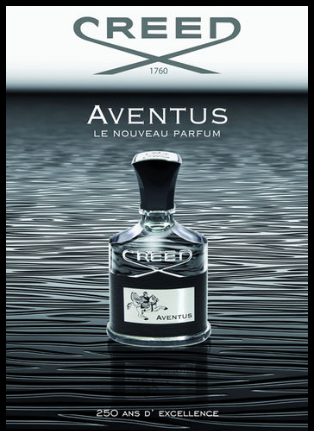
Creed Aventus Cologne

Source: Basenotes

Source: Basenotes

I fear I may have to go into perfume Witness Protection after this one. The power of Creed, and the worship of its fragrance, Aventus, in particular, is such that anything short of blind, unswerving, unqualified adoration seems to upset a few of its fans. Well, let’s get this over with then: I like Aventus and think it’s a perfectly pleasant — even occasionally pretty — fragrance that I would enjoy wearing. I also think it’s an over-hyped, simple, thin, linear scent that carries with it some frustrating issues, and which isn’t worth the high price.

There, I said it: I think Aventus is over-hyped. In fact, I firmly believe that, if Aventus were ever sniffed blindly in an unmarked, plain flacon located in Macy’s or some mall, some of its admirers may not be quite so uncritical. In my eyes, the hype and the reputation (“panty-dropper”) are as much a part of Aventus as its famous pineapple note. Furthermore, to be honest, I find the blind, cultish worship of some of its younger acolytes, and their aggressive response to those who don’t share their unqualified adoration, to be extremely off-putting. With that said, I shall henceforth walk and sleep with a Kevlar vest….

Creed is a fragrance house with a long and storied history, dating back to 1760. According to the biographical blurb quoted by Bergdorf Goodman, the house is unusual in a few different ways:

Olivier Creed with son, Erwin. Source: Vanity Fair.

Olivier Creed with son, Erwin. Source: Vanity Fair.

Founded in 1760 and passed from father to son, Creed is the world’s only privately held luxury fragrance dynasty. Based in Paris, the company today is led by Olivier Creed, a sixth-generation master perfumer.  […] Using the infusion technique (which has been abandoned by the modern industry), Creed weighs, mixes, macerates, and filters everything by hand. They also use the highest percentage of natural components in the prestigious French perfume industry..

For Aventus, Creed says it was inspired by “the dramatic life of a great, historic emperor, who waged war, peace and romance on terms he set, riding to power on horseback.” The fragrance seems to have been created primarily by Erwin Creed, the young, seventh-generation Creed perfumer, with input from his father, Olivier. The website states:

Royal but not imposing, CREED Aventus is made with ingredients hand selected worldwide by Erwin CREED, seventh generation of CREED and its future chief. Essences he chose were shipped to CREED’s French workshop, where father and son created Aventus using hand production methods that date to the founding of CREED in 1760.

According to Luckyscent, the fragrance is an eau de parfum, and its notes include:

black currant, bergamot, apple, pineapple, rose, birch, jasmine, patchouli, musk, oak moss, ambergris and vanilla.

Source: abstract.desktopnexus.com

Source: abstract.desktopnexus.com

Aventus opens on my skin with a burst of zesty, crisp, fresh bergamot, followed by the sweetness of pineapple and a hint of tart, green black currant. There is a quiet earthiness lurking about that feels like vetiver, but it is only a momentary impression. The primary bouquet is an incredibly pretty, airy, bright blend of bergamot’s crisp freshness infused with the succulent, pulpy, juiciness of pineapple. The fragrance feels very sheer and thin, though, so I added another huge smear (which almost emptied the rest of my vial) to the two large ones from my dab vial, for a total of 3 extremely large smears all up my forearm.

Dried oakmoss or tree moss.

Dried oakmoss or tree moss.

In just a few minutes, hints of oakmoss start to flitter about. It’s not fresh, springy, bright green moss, but rather something that feels like the real oakmoss absolute with its slightly mineralized, faintly salty, grey, musty characteristics. It smells a lot like tree bark and grey lichen. Quickly, it turns the citric, fruity freshness of Aventus into something drier and more layered. It almost feels akin to an aromatic fougère, minus its usual lavender underpinnings.

It also continues to feel very thin. I’ve read of men applying 10-12 big sprays of Aventus in one go and, at the time, I merely thought them to be extremely exuberant. Now, however, I understand it better. While aerosolisation definitely adds to a fragrance’s potency and longevity, Aventus seems like a scent that may well benefit from 10-12 sprays to give it some body and depth. I realise that I’m at a disadvantage in dabbing it, but I did put on quite a bit. Frankly, I’m keep struggling to believe that Aventus is ostensibly an eau de parfum, not a cologne (despite its name) or an eau de toilette.

Silver birch tree. My own photo. Fjällnäs, Sweden.

Silver birch tree. My own photo. Fjällnäs, Sweden.

Ten minutes in, Aventus is an extremely well-blended, elegant, refined blur of crisp, cologne-like citrus with dry, fusty, slightly mineralized oakmoss and hints of pineapple. There is a subtle woodiness in the base that reveals itself five minutes later as birch. It smells just like a smoky tree-bark with the faintest, tiniest nuance of ashiness. Birch can often have a tarry, phenolic character that makes it a common feature in leather fragrances, but not here. The note really calls to mind the delicate, silvery tree I saw in Sweden instead of anything dark, thick, and viscously tarry. Its advent turns the fragrance into a very mossy, woody scent with a subtle nuance of smokiness mixed with the crispness of citrus. The latter is quite muted now on my skin, and there are only subtle flickers of pineapple that occasionally pop up to add some countering sweetness. I wish there were more of the pineapple because it’s truly a beautiful touch and it adds an extremely interesting, original contrast to the woody-mossy accord. As a side note, the apple accord never appeared once on my skin, and the early hint of black-currant has faded away almost entirely.

Aventus remains largely unchanged for the next few hours. It’s a well-blended, airy, light swirl of birch and oakmoss, trailed by a crisp citrus note, pineapple, and a tinge of ashiness. To my happiness, the pineapple makes a more significant reappearance during the second hour for about thirty minutes before it sinks back into the overall bouquet. At the 2.5 hour point, the sillage drops and Aventus hovers about 2 inches above the skin. The notes no longer feel discrete, have started to overlap, and have lost all distinctive shape. Aventus, as a whole, feels wholly insubstantial in body, and is simply a nebulous haze of three primary notes: birch, oakmoss, and pineapple.

"Yellow jag" by Nancy Simmons Smith. http://simmonssmith.com/gallery/abstracts/

“Yellow jag” by Nancy Simmons Smith. http://simmonssmith.com/gallery/abstracts/

Despite the linearity of its core essence, there are a few, extremely subtle, changes in Aventus’ development. For a brief moment, at the start of the third hour, vanilla peeks its head around the curtain, but it’s pretty much a muted wallflower. For the most part, it serves only to have an indirect effect on the overall fragrance, adding some sweetness to the drier, woodier elements. It never screams “vanilla,” in any substantial, concrete way at all. But then, nothing about this fragrance feels substantial. At the end of the third hour, the jasmine makes a quiet appearance but, like the vanilla, it’s a mere suggestion more than a distinct, significant part of the fragrance. Around the same time, Aventus turns into a complete skin scent, calling to mind a balloon that has deflated.

Source: es.123rf.com

Source: es.123rf.com

From the 3.75 hour mark onwards, Aventus is a hazy, sheer, thin whisper of something vaguely mossy, woody, ashy, and fruity with a minuscule hint of sweet jasmine. I had to really inhale forcefully at my arm, with my nose right on the skin, to detect even that. Without such strenuous effort, I found it completely impossible to delineate any of the notes. Aventus remained a muted, flat blur until its very end when it was the merest suggestion of something vaguely fruity. All in all, it lasted just short of 5.5 hours on my skin, with extremely weak sillage after the first hour. I couldn’t detect any amber, musk, rose, or patchouli at any point in the fragrance’s development.

As a whole, my reactions are mixed: I thought Aventus was an extremely pretty scent at the beginning with an overall refined bent; I loved the evanescent pineapple bits; I wished the fragrance had more body, depth, and nuance; and I can see how it might be a wonderful scent for spring or in the hot, humid months of summer. I also thought Aventus to be extremely simple, linear, and faintly dull. Moreover, the longevity was a huge disappointment, and I really struggle with believing that Aventus is an eau de parfum and not a thin, weak cologne.

I’m not alone in terms of Aventus’ limited longevity on my skin. For a large number of people on Fragrantica, Aventus lasts between three and six hours. The precise breakdown of votes in the longevity department is as follows:

  • 29 for “poor” (30 min-1 hr)
  • 23 for “weak” (1-2 hrs)
  • 106 for “moderate” (3-6 hrs)
  • 228 for “long lasting” (7-12 hrs)
  • 80 for “very long lasting” (12+ hrs)

Clearly, this is a fragrance that requires spraying, not dabbing, and a hell of a lot of spraying at that, but do I want something that requires 5-10 applications (of any kind) to be detectable and to really last? More to the point, is it financially feasible? A tiny 1 oz/30 ml bottle of Aventus costs $165, and that won’t last very long if I need to use a large number of sprays each time for the scent to have some traction on my skin. Still, Aventus is available in a large 4 oz/120 ml bottle from one online retailer for $188 which is a much more practical, affordable price for such a light, airy, summer-perfect scent. But then another issue arises: can one trust that bottle? Not only are there apparently tons of fakes on the market, especially on eBay, but, apparently, the scent of Aventus can vary from batch to batch.

The issue of batch numbers and variations is something that comes up frequently when talking about Creed fragrances, and Aventus, in specific. My sample came from Surrender to Chance and was purchased a while ago, so I’m not sure which batch it came from. Surrender to Chance says that it buys most of its bottles directly from Creed, or, if not, then from Neiman Marcus or Bergdorf Goodman. I don’t know what to make of the batch issue or the way people pour over the numbers, with some being able to spout off the differences at the top of their head. The whole thing seems to be an incredible pain in the tush if true. How does one deal with such uncertainty? Plus, there seems to be the implication that one won’t even get an authentic Creed bottle if one buys it from anywhere else but the store itself or a few high-end stores. So that discounted bottle I mentioned earlier might as well not exist and, even if it’s authentic, who know what it will smell like? 

Making matters more complicated still are some commentators who argue that there is no such thing as batch variations. Take, for example, these two very interesting arguments from different Fragrantica commentators:

  • I don’t buy into batch variations I’ve smelled Z01 all the way up to the 2013 batches and its all the same.
  •  Forget about batch variations because that’s just a way for the fanboys to discredit your opinion.
Aventus batch numbers, via Basenotes.

An example of Aventus batch numbers, via the Basenotes thread.

If there really is no difference between batches, then why is there a 36-page discussion on Basenotes devoted solely to the different lots and how they smell? There seem to be too many firmly convinced people for the variations to be mere figments of their imagination. Either way, buying a Creed fragrance, but Aventus in particular, seems to entail a lot of work. As one person in that Basenotes thread joked, “[i]t’s almost like buying a car….” I can only shudder.

For me, the more interesting thing is the comment by the second Fragrantica poster quoted above regarding fanboys discrediting other people’s opinions. It supports something that has always really bothered me: I’ve seen some nasty behavior when it comes to Creed. Not by everyone, mind you, and not across the board, but enough to be truly noticeable as a small trend. In one group I occasionally read, a member was attacked as not knowing her stuff or being a real perfumista because she was underwhelmed by Creed as a brand. Elsewhere, I’ve seen chest-thumping braggadocio from some Creed fans about how Aventus is a total “panty-dropper” (a phrase that I find utterly revolting), or comments to the effect of “real men wear Aventus,” as if anyone who dislikes the fragrance isn’t a real man. The fans who display either type of cocky, superior, disparaging, or obsessive behavior tend to be on the younger side, but age is no excuse. As many of my usual readers know, I adore Serge Lutens fragrances, but I don’t like all of them, I had problems with a number of them, and have even given a few the ultimate, negative criticism: “boring.” Moreover, I’ve never attacked someone who dislikes a Serge Lutens fragrance that I love.

So, why does Aventus inspire such blind worship in some quarters? I think the hype has taken on a life all of its own, and has created a snowballing effect quite similar to that of Nasomatto‘s Black Afgano. Like Aventus, Black Afgano carries a certain sort of macho reputation that a few of its younger fanboys seem to use as a reflection of their own toughness or masculinity. It’s as if they think the fragrance’s reputation — “panty-dropper” in the case of Aventus, and super-macho edginess with the lure of the forbidden in the case of Black Afgano — will rub off on them, give them a sort of street cred, or enhance their own masculinity. Yet, one can question or dislike Black Afgano without some of its fans turning on you with pitchforks. Creed, however, seems to be in a class all its own.

In the case of Aventus, some have stated that the fragrance appeals to a younger crowd than Creed’s older, more traditional offerings, so perhaps age and immaturity have something to do with it, too. One blogger, The Scentrist, found Aventus to be very much Erwin Creed’s fragrance, more than his father’s, and that it “skewed toward a younger audience.” Either way, the hype is bad enough, without adding in the related, chest-thumping aggressiveness and defensiveness of what a friend of mine calls “a few bad apples.” Yet, there are enough of those bad apples to completely put him off trying any more Creed fragrances. I completely understand. I’ve had a sample of Aventus and Green Irish Tweed for over nine months, and it’s been hard to get motivated to go near either one.

On some levels, I know it’s not fair. As noted up above, Aventus is a really pretty scent at times, and I think its fresh, light, airy crispness would make it a nice choice in hot weather. In fact, I would probably wear Aventus if a bottle ever fell into my lap, especially if it were a bottle large enough for me to practically bathe in the scent as is clearly necessary for my skin. Nonetheless, to consider Aventus the Be-All, End-All, the Holy Grail, and the best fragrance ever made? I think that goes too far. To attack other perfumistas for not bowing at the altar of Aventus goes even farther still. In fact, I really have wonder if some of the fanboys would adore Aventus quite so unilaterally and unconditionally if they ever smelled it in an unmarked, unlabeled, plain bottle in the corner of Macy’s and priced at $50? I suspect a blind test would be quite revealing.

At the end of the day, however, fragrance is a wholly subjective issue. While I would normally link to a variety of different blog reviews or countering experiences to give you some sort of sense of what people think about Aventus, I won’t in this case. The fragrance is too well-known, there is too much of a polarity between those who worship it and those who think it’s over-hyped, and there is the added complication of possible batch variations. The bottom line is that you either love it, or you don’t. If you’re one of those people who thinks Aventus is the best thing to exist in every possible solar system, I’m very happy you’ve found something you love so much. We should all have fragrances like that! My opinion is different: I think it’s an extremely pleasant, elegant, refined fragrance that is also linear, simple, mundane, ultimately unexciting, and not worth the cost. Now, if you’ll excuse me, I need to put on my bulletproof vest, and go into hiding….


DETAILS:
Cost & Availability: Aventus is available in a variety of different sizes. It comes in: 1 oz/30 ml ($165);  2.5 oz/ 75 ml ($275); 4 oz/120 ml ($330); 8.4 oz/250 ml ($445); and 17 oz/500 ml ($675). Discount Retailers: You can purchase Aventus at a substantial discount in the 4 oz size directly from Amazon (US) which sells the 4 oz bottle for $188.30, instead of $320, or in the 2.5 oz size for $179.95 from a third-party vendor. You can find Aventus at a slightly less discounted price from FragranceNet which sells the bottle for $214.36 with a coupon. In the U.S.: You can buy Aventus directly from Creed (US) which offers free shipping and samples with any purchase. Aventus is also offered in 4 sizes from Bergdorf GoodmanNeiman Marcus, and Luckyscent, starting with the 1 oz bottle. Outside the U.S.: In Canada, Creed is carried at a number of different stores. You can find one near you using the Creed Store Locator. In the UK, you can purchase all Creed products directly from the company at its London boutique. Aventus is also available from Creed’s UK online website, or from Harrods. Other UK and Irish stockists are listed on the Creed UK Stockists website. Prices start at £95 for the smallest size. In France, Aventus is carried at Creed’s Paris boutique on the Champs-Elysée. For all other countries, I had difficulty finding stockists on either the US or UK Creed websites. Plus, both sites offer very limited shipping, geographically. The American site only ships to the US, its territories, and Canada; the UK one only to UK locations. I couldn’t find an International Creed version, or any way of finding official vendors in other countries. So, I suppose you can try FragranceNet which ships worldwide, and has a number of different country-specific sites. Just go to the link, click at the tiny flag icon at the very top right-hand side of the page, and choose your country. Samples: Aventus is available from Surrender to Chance starting at $3 for a 1/2 ml vial. They say that they obtain their bottles directly from the Madison Avenue Creed boutique, or from either Neiman Marcus or Bergdorf Goodman.